
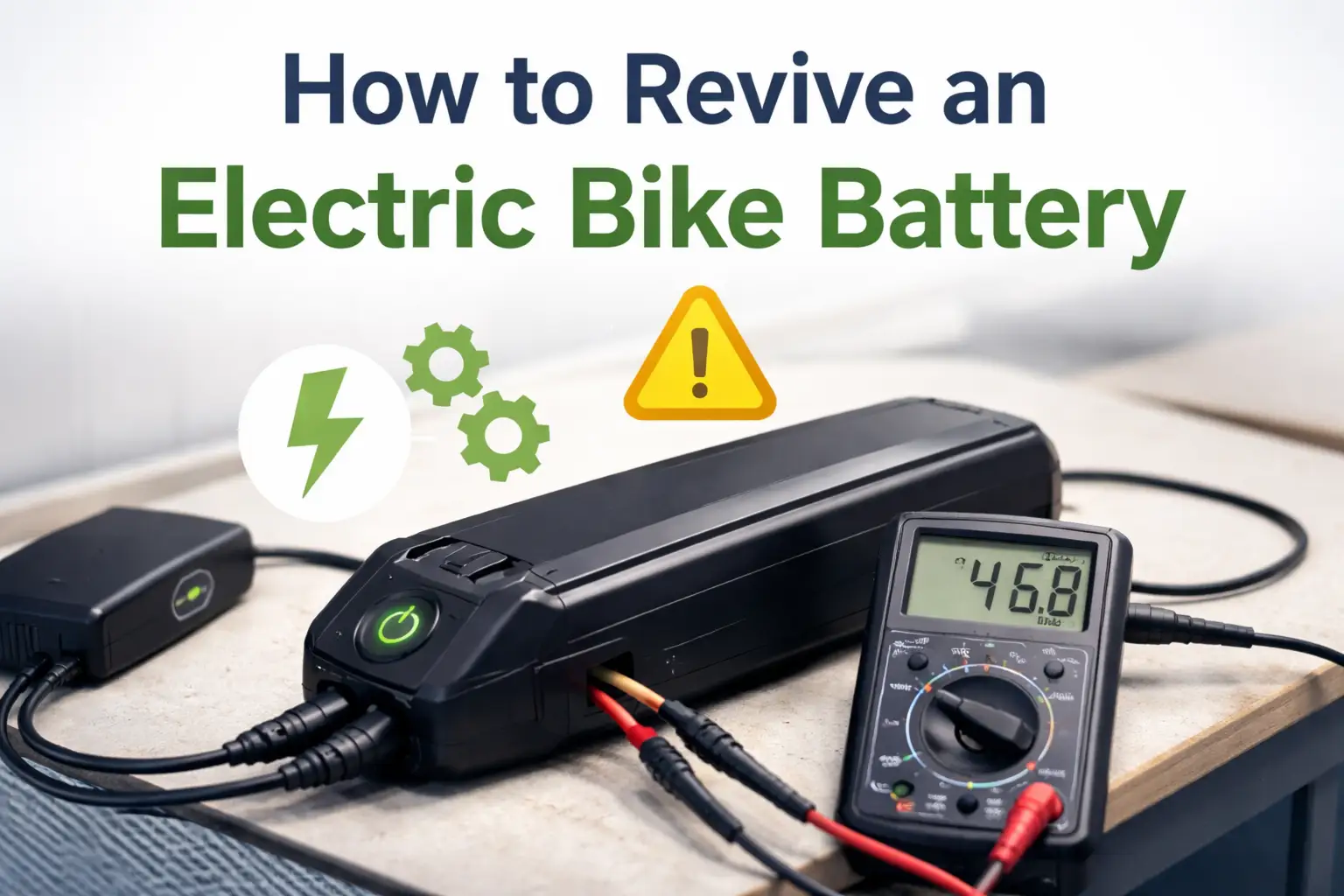
How to Revive an Electric Bike Battery Safely (Step-by-Step Guide)
Last Updated on March 5, 2026 by Kristina
Electric bike batteries are one of the most expensive components on an e-bike. When a battery suddenly stops working, many riders assume it is permanently dead.
In reality, some batteries that appear dead are experiencing issues like deep discharge protection, charger failure, loose connections, or battery management system shutdowns.
Before replacing your battery, there are several safe troubleshooting steps you can try.
This guide explains:
- how to revive an electric bike battery safely
- why e-bike batteries stop charging
- how to diagnose common battery problems
- when replacing the battery is the safest option
Who This Guide Is For (and Who It’s Not)
This guide is for:
- Riders whose e-bike battery suddenly stopped charging
- Batteries stored for months without use
- Riders seeing flashing battery lights or no power
- Anyone troubleshooting a battery before replacing it
This guide is NOT for:
- Batteries that are swollen or physically damaged
- Batteries with a burning smell or melted casing
- Batteries involved in crashes or water damage
If a battery shows visible damage or swelling, it should never be revived.
Safety guidance from the U.S. Consumer Product Safety Commission warns that damaged lithium-ion batteries can pose serious fire risks.
Quick Answer: Can You Revive a Dead Electric Bike Battery?
Sometimes.
An e-bike battery may appear dead because of:
- deep discharge protection
- battery management system (BMS) shutdown
- charger failure
- loose electrical contacts
- long storage without charging
If the lithium cells are still healthy, the battery may recover through safe troubleshooting steps.
However, lithium-ion battery cells cannot be restored once they degrade or fail.
What Actually Causes Most E-Bike Battery Failures?
Real-world troubleshooting cases typically fall into these categories:
| Cause | Estimated Frequency |
|---|---|
| Charger failure | ~30% |
| BMS shutdown | ~25% |
| Loose connections | ~15% |
| Battery cell degradation | ~30% |
This means many batteries that appear dead are actually recoverable.
Why E-Bike Batteries Stop Working
Understanding the cause is the first step toward fixing the issue.
Deep Discharge Protection
Most modern e-bike batteries contain a Battery Management System (BMS).
The BMS shuts down the battery if voltage drops too low to protect lithium cells from permanent damage.
If a battery sits unused for months or becomes completely drained, the BMS may temporarily prevent charging.
Learn more in:
👉 Understanding E-Bike Battery Capacity and Voltage
Lithium battery protection systems are widely used across electric vehicles and consumer electronics, as explained by the U.S. Department of Energy.
Charger Failure
Sometimes the battery is not the problem.
Signs of a faulty charger include:
- charger light never changes color
- charger stays green while plugged in
- charger becomes unusually hot
- battery level never increases
Testing with another compatible charger is often the easiest diagnostic step.
Loose Battery Connections
Loose contacts can interrupt power between the battery and the bike.
Check:
- battery mount contacts
- charging port
- wiring near the battery cradle
- battery alignment in the frame
Even minor misalignment can prevent charging.
Battery Management System Lockout
The BMS may disable charging if it detects safety conditions such as:
- over-current protection
- short circuits
- temperature extremes
- cell imbalance
When this occurs, the battery may appear completely dead even though the cells are still functional.
Extreme Temperatures
Lithium batteries are sensitive to temperature.
Cold temperatures can temporarily reduce performance or prevent charging.
Below roughly 32°F (0°C):
- battery voltage may appear lower
- charging slows significantly
- the BMS may block charging
Battery performance usually returns once the battery warms to room temperature.
Research from the National Renewable Energy Laboratory highlights temperature as one of the biggest factors affecting lithium battery lifespan.
In some cases, a battery may stop charging due to a simple electrical issue like a blown fuse or faulty charger. The video below shows an example of diagnosing and fixing a common e-bike battery charging problem.
How to Check E-Bike Battery Voltage
A multimeter can help determine whether your battery still has usable voltage.
Steps:
- Remove the battery from the bike
- Set your multimeter to DC voltage
- Touch probes to the battery terminals
- Compare the reading to typical voltage ranges
Typical E-Bike Battery Voltage Ranges
| Battery Type | Full Charge | Low Battery | BMS Shutdown Range |
|---|---|---|---|
| 36V battery | ~42V | ~33V | ~28–30V |
| 48V battery | ~54.6V | ~41V | ~36–38V |
| 52V battery | ~58.8V | ~44V | ~39–41V |
If voltage is above the shutdown range, the battery may still be recoverable.
Voltage behavior in lithium batteries is documented by research from Battery University.
Step-by-Step: How to Revive an Electric Bike Battery
Follow these troubleshooting steps before assuming the battery needs replacement.
Step 1: Check the Charger
Plug the charger into the wall first.
Look for:
- green standby light
- red charging light when connected
- stable indicator lights
If the charger shows no power, the charger may be defective.
Step 2: Inspect Battery Contacts
Remove the battery and inspect the contact pins.
Clean contacts using:
- microfiber cloth
- electrical contact cleaner
Avoid water or abrasive materials.
Step 3: Attempt a Slow Charge Reset
Sometimes the BMS requires time to reactivate.
- Plug the charger into the battery
- Leave connected for 6–12 hours
- Monitor indicator lights
Even if the battery initially appears dead, slow charging may allow the BMS to reactivate.
Step 4: Try Another Charger
Testing with another compatible charger can quickly reveal whether the charger or battery is the problem.
Step 5: Reset the System
Some e-bikes allow system resets through the display.
Typical reset methods include:
- holding the power button for 10 seconds
- resetting through the display menu
- disconnecting and reconnecting the battery
More reset troubleshooting is explained here:
👉 How to Reset an Electric Bike
Quick Troubleshooting Flow
If your battery stops working, try this order:
1️⃣ Check charger light
2️⃣ Inspect battery contacts
3️⃣ Leave battery charging overnight
4️⃣ Test another charger
5️⃣ Reset the system
6️⃣ Check battery voltage
7️⃣ Replace battery if voltage is extremely low
Battery Diagnostic Tool
Not sure whether your battery can be revived?
Use our diagnostic tool to evaluate battery condition.
👉 Try the E-Bike Battery Revival Checker
The tool analyzes battery age, voltage, storage conditions, and visible damage to estimate whether recovery is likely.
How to Recover a Battery After Long Storage
If your battery sat unused for several months:
- Bring the battery indoors
- Allow it to warm to room temperature
- Connect the charger
- Leave charging for 8–12 hours
Slow charging may reactivate the battery.
Most manufacturers recommend charging stored batteries every 1–2 months.
Lithium Battery Safety Warning
Never attempt to revive a battery showing these danger signs:
- swelling
- burning smell
- hissing sounds
- leaking fluid
- melted casing
The U.S. Fire Administration warns lithium battery fires are extremely difficult to extinguish once started.
If a battery shows these symptoms, discontinue use immediately.
Warning About Cheap Replacement Batteries
If you need to replace your battery, avoid extremely cheap aftermarket packs.
Low-quality batteries may:
- lack proper battery management systems
- use recycled or low-grade lithium cells
- have poor thermal protection
Safety agencies including the U.S. Consumer Product Safety Commission recommend batteries that meet recognized safety certifications such as UL 2849.
Common E-Bike Battery Error Codes
Some e-bike displays show battery-related error codes.
| Error | Meaning | Possible Fix |
|---|---|---|
| Error 21 | Battery communication issue | Check wiring |
| Error 24 | Motor signal error | Inspect connectors |
| Error 30 | Display communication error | Reset system |
Error codes vary by manufacturer.
Always check your bike’s manual for model-specific codes.
E-Bike Battery Troubleshooting: Symptoms and Fixes
| Symptom | Possible Cause | What to Try |
|---|---|---|
| Battery will not charge | Faulty charger | Test another charger |
| Charger stays green | BMS shutdown | Try slow charging overnight |
| Battery turns on but bike won’t run | Loose contacts | Inspect battery mount |
| Battery dies quickly | Aging cells | Consider replacement |
| Battery shuts off while riding | BMS protection triggered | Check wiring |
| Battery shows full but loses power | Cell imbalance | Charge fully and rebalance |
For deeper troubleshooting:
👉 E-Bike Battery Cuts Out While Riding
👉 E-Bike Throttle Not Working
👉 5 Common Pedal Assist Problems and Fixes
👉 7 Reasons Your Electric Bike Won’t Turn On and Quick Fixes
Cost of Replacing an E-Bike Battery
Replacement batteries typically cost:
| Battery Type | Typical Cost |
|---|---|
| 36V battery | $300 – $600 |
| 48V battery | $400 – $900 |
| High-capacity battery | $700 – $1200 |
Because batteries are expensive, troubleshooting first can save hundreds of dollars.
E-Bike Battery Maintenance Checklist
To extend battery lifespan:
✔ Charge between 20–80 percent
✔ Avoid draining completely
✔ Store batteries indoors
✔ Avoid extreme heat or freezing temperatures
✔ Charge monthly during long storage
✔ Inspect battery contacts regularly
These simple habits can extend battery life significantly.
The Most Important Thing Riders Should Understand About E-Bike Batteries
Lithium batteries rarely fail instantly.
Most failures happen gradually due to:
- repeated deep discharge
- excessive heat exposure
- long storage without charging
- aging lithium cells
Proper maintenance is one of the best ways to extend battery lifespan.
FAQs
Sometimes. If the BMS shut the battery down due to deep discharge, slow charging may reactivate it.
Most lithium-ion e-bike batteries last 3–5 years or 500–1000 charge cycles.
The BMS may have disconnected the battery due to a safety trigger. Resetting the system may help.
No. Jump-starting lithium batteries is dangerous and can damage the battery pack.
Some batteries stop charging early to protect lithium cells. It may also indicate aging cells.
Final Thoughts
A dead e-bike battery does not always mean the battery is permanently ruined.
Many issues are caused by chargers, connection problems, or safety shutdown systems, which can often be fixed.
If troubleshooting does not restore charging, replacing the battery is usually the safest option.
If you have experienced a battery issue before, share your experience in the comments. Your insight may help another rider diagnose their e-bike problem.
External Sources
The following organizations publish research and safety guidance related to lithium-ion batteries used in electric bikes and other devices:
U.S. Consumer Product Safety Commission – lithium battery safety and consumer protection guidance
U.S. Department of Energy – research on lithium-ion battery systems and energy storage
U.S. Fire Administration – fire safety guidance related to lithium battery incidents

Kristina is not just an enthusiast but a true authority on electric bikes. Nestled in the coastal beauty of Virginia, Kristina has found the perfect backdrop for her passion for electric biking. As a dedicated wife and homeschooling mom, her life revolves around family, faith, and the thrill of adventure.
Originally hailing from Ohio, Kristina's journey with electric bikes began as a curiosity and quickly evolved into a deep expertise. Her blog is a testament to her love for electric biking, combining her fascination for eco-friendly transportation with her coastal lifestyle.
When she's not cruising the beach on her electric bike, you'll find Kristina indulging in her other loves: long walks along the shore, getting lost in a good book, and cherishing moments with her loved ones. With a heart as big as her love for animals, especially cats, Kristina brings a unique perspective to the electric bike world, grounded in her strong faith in God and her dedication to a sustainable lifestyle.
Through her blog, Kristina shares her extensive knowledge of electric bikes, offering valuable insights, tips, and recommendations to fellow enthusiasts. Whether you're a seasoned rider or a newcomer to the electric bike scene, Kristina's blog is your go-to source for all things electric biking, fueled by her passion, expertise, and the scenic beauty of coastal Virginia.
