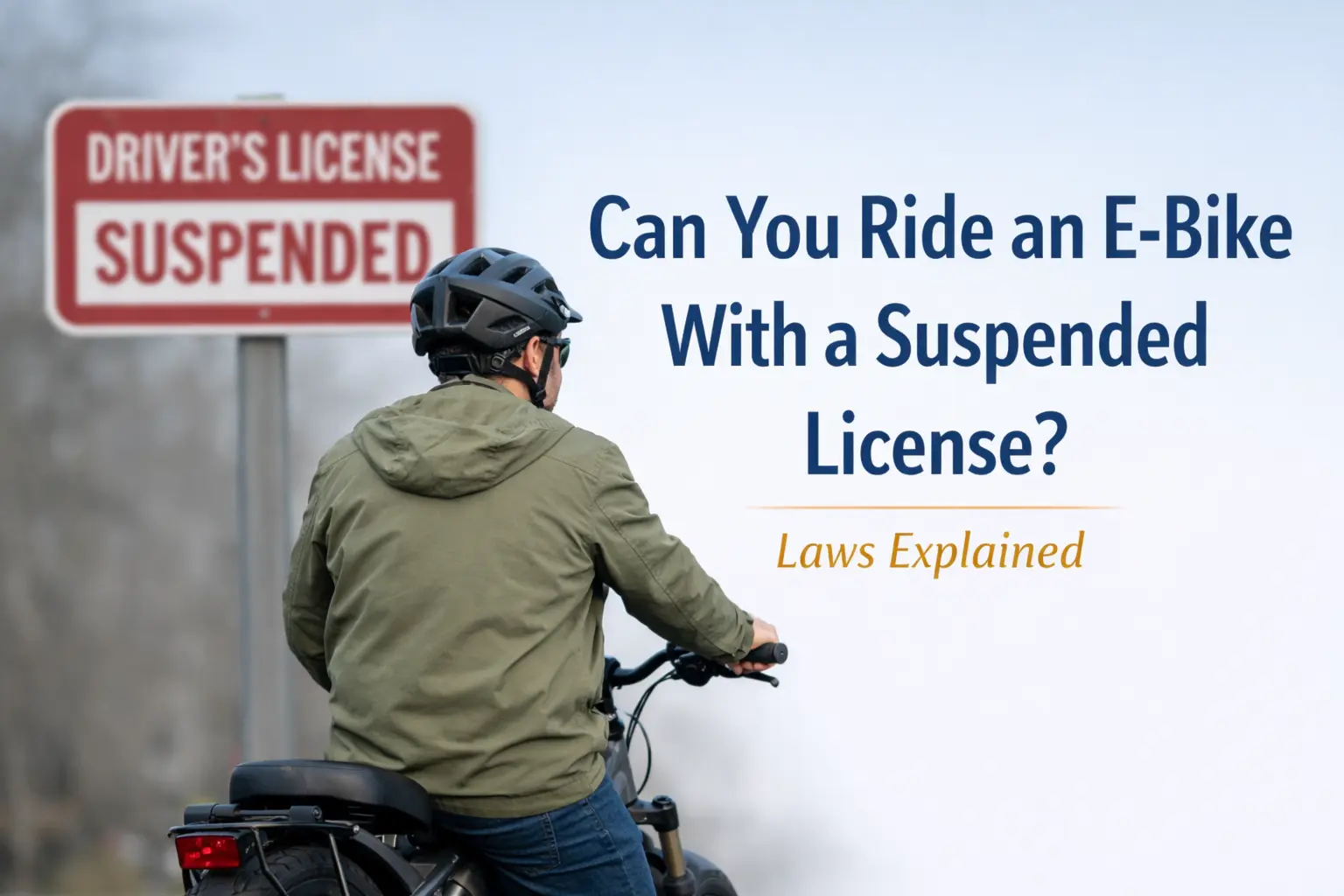
Can You Ride an Electric Bike If Your License Is Suspended? Laws Explained
Last Updated on September 21, 2026 by Kristina
If your driver’s license is suspended or revoked, an electric bike is not automatically a legal workaround. Whether you can ride one depends on the law where you ride, how that state classifies your bike, whether a license is required for that vehicle, and the exact terms of your suspension, revocation, court order, or probation conditions.
Some states expressly exempt qualifying e-bikes from driver-license requirements. Others do not. New Jersey is an important 2026 exception because its current rules require licensing and registration for covered e-bike riders, and NJMVC says a person cannot apply for or receive a motorized-bicycle license while driving privileges are suspended or revoked.
For the broader licensing rules, see my guide to whether you need a license for an electric bike and the State-by-State E-Bike Law Guide.
Quick Answer: Can You Ride an E-Bike With a Suspended License?
Sometimes, but there is no nationwide yes-or-no rule. A suspended or revoked driver’s license does not by itself tell you whether a particular e-bike is legal to operate.
| Question to check | Why it matters |
|---|---|
| Does your state require a license for this e-bike? | If no driver’s or special e-bike license is required, the license suspension may not automatically prohibit the bike. Other restrictions can still apply. |
| Does the bike legally qualify as an e-bike? | A faster, modified, or differently configured vehicle may be regulated as a moped, motorized bicycle, motorcycle, or another motor vehicle. |
| What does the suspension or court order actually prohibit? | A court, probation condition, or other order may be broader than the ordinary driver’s-license requirement. |
| Are there state or local e-bike restrictions? | Age, helmet, road, path, sidewalk, speed, registration, and other rules can still apply. |
⚖️ Law Research Note
I reviewed current state statutes, agency guidance, and available local rules when this guide was updated. E-bike laws can change, and cities, parks, trails, campuses, and property managers may impose additional restrictions. Confirm current requirements before riding.
A License Suspension and an E-Bike License Requirement Are Different Questions
The first question is whether the state requires a driver’s license or another credential to operate your particular bike. The second is whether your suspension, revocation, court order, or probation condition separately prohibits you from operating that vehicle.
That distinction matters. A state may exempt qualifying e-bikes from ordinary driver-license requirements, but a separate court order can still impose broader restrictions. On the other hand, a state such as New Jersey may require a credential for an e-bike or for a faster electric bicycle that falls into its motorized-bicycle category.
Federal E-Bike Law Does Not Decide Whether a Suspended Driver May Ride
Federal law is often misunderstood in this area. Under 15 U.S.C. § 2085, a low-speed electric bicycle is defined for federal consumer-product purposes as a two- or three-wheeled vehicle with fully operable pedals, a motor of less than 750 watts, and a motor-only maximum speed of less than 20 mph under the statute’s specified test conditions.
That federal consumer-product definition does not create a nationwide Class 1, Class 2, and Class 3 traffic-law system, and it does not decide whether someone with a suspended or revoked driver’s license may operate an e-bike on public roads. State and local law control those operating questions.
New Jersey: A Suspended License Can Be a Major Barrier
New Jersey is an important exception to the idea that an e-bike is always available to someone who cannot legally drive a car. Under current NJMVC guidance, covered e-bike operators generally must be at least 15 and have the required e-bike or motorized-bicycle credential or a valid driver’s license, depending on the vehicle and rider.
NJMVC also states that a person may not apply for or receive a motorized-bicycle license while that person’s driving privileges are suspended or revoked. That means someone with suspended or revoked driving privileges should not assume a faster electric bicycle is a legal substitute for a car in New Jersey.
New Jersey also requires registration for covered e-bikes, and its insurance rules differ between low-speed electric bicycles and motorized bicycles. Read my New Jersey e-bike law guide before riding there.
Florida: Qualifying E-Bikes Are Exempt From Driver-License Requirements
Florida law expressly exempts a qualifying electric bicycle and its operator from laws governing driver’s licenses, motor-vehicle licenses, registration, titles, and financial responsibility. Florida therefore provides an example where the state e-bike law itself does not require a driver’s license for a qualifying e-bike.
That does not override a separate court order, probation condition, or other restriction that specifically applies to you. Florida also allows local governments to adopt certain minimum-age requirements and require riders to carry government-issued photo identification.
Washington: No Driver’s License Is Required for a Qualifying E-Bike
Washington law expressly states that a driver’s license is not required to operate an electric-assisted bicycle. Washington also has class-specific rules, including a minimum operating age for Class 3 electric-assisted bicycles.
As in Florida, the e-bike exemption does not automatically answer what a particular suspension order, criminal sentence, or probation condition allows. Riders should check both the e-bike statute and the documents governing their individual restriction.
Your E-Bike’s Legal Classification Matters
A product does not become a legal e-bike simply because the seller calls it one. States use their own definitions involving assisted speed, motor power, pedals, throttle operation, class labels, and other features.
If you are unsure how your bike fits into the common class system, see my guide to Class 1, Class 2, and Class 3 e-bikes. For faster bikes, also read whether Class 3-style e-bikes require a license.
What If the Bike Is Too Fast, Too Powerful, or Modified?
If a bike falls outside the electric-bicycle definition in the state where you ride, it may be regulated as a moped, motorized bicycle, motor-driven cycle, motorcycle, or another vehicle category. Those categories can carry their own licensing, registration, insurance, equipment, and road-access requirements.
Common issues include removing or bypassing speed restrictions, changing controllers or motors, riding a vehicle without operable pedals when pedals are required, or operating a bike whose assisted speed exceeds the state’s e-bike limits. The legal result depends on the state’s actual definition, not on one national wattage rule.
If your vehicle sits near the line between an e-bike and another motorized vehicle, see my e-bike vs. moped vs. scooter legal guide.
What About DUI, Probation, or Court-Ordered Restrictions?
Do not assume the ordinary e-bike statute answers this question. A DUI-related order, probation condition, sentencing order, or other restriction may use language that is broader than the normal driver’s-license law.
Read the actual order carefully. Terms such as “motor vehicle,” “motorized vehicle,” or broader language may have definitions that depend on the controlling statute or the order itself. If the restriction is unclear, obtain advice from the court, supervising agency, or a qualified attorney who can review the specific order.
Local Riding Rules Still Apply
Even when a qualifying e-bike does not require a driver’s license, that does not mean it can be ridden everywhere. Cities, parks, trails, campuses, and property managers may regulate speed, sidewalks, bike paths, parking, charging, helmet use, and access by e-bike class.
For one of the most common local-rule questions, see my guide to whether e-bikes are allowed on sidewalks.
How to Check Before Riding With a Suspended or Revoked License
- Read the documents governing your suspension or revocation. Check exactly what conduct and vehicle types are prohibited.
- Confirm your state’s e-bike definition. Check assisted speed, motor limits, pedals, throttle rules, and class requirements.
- Check whether your state requires a license or special permit for that bike. Do not assume every e-bike is exempt.
- Check registration and insurance separately. They are different legal requirements from a driver’s license.
- Check age, helmet, and equipment rules. These can apply even when no driver’s license is required.
- Check local access rules. A legal e-bike may still be restricted on sidewalks, trails, boardwalks, campuses, or certain paths.
- Get individual legal guidance when the order is unclear. A general e-bike guide cannot interpret a specific criminal, probation, or court order for you.
Frequently Asked Questions
Possibly. The answer depends on whether your state requires a license for that e-bike, whether the bike legally qualifies as an e-bike, and whether your revocation or another court order separately prohibits the vehicle.
It can. A DUI-related suspension, court order, probation condition, or other restriction may be broader than the ordinary driver’s-license law. Check the exact wording that applies to you.
No. The class label alone does not answer the question nationwide. State definitions differ, and an individual suspension or court order can impose additional restrictions.
Current NJMVC guidance says a person may not apply for or receive a motorized-bicycle license while driving privileges are suspended or revoked. Check the current New Jersey rules for the specific bike you plan to ride.
Florida law exempts a qualifying electric bicycle and its operator from driver and motor-vehicle licensing requirements. Separate court orders and local e-bike rules can still matter.
Yes. Local rules may affect sidewalks, trails, speed, age, identification, helmets, parking, or other operating conditions even when state law does not require a driver’s license.
My Take
The safest approach is not to treat an e-bike as an automatic loophole around a suspended or revoked driver’s license. Start with the law where you ride, confirm that the vehicle really qualifies as an e-bike there, and then read the exact documents governing your suspension or revocation.
New Jersey’s 2026 changes are a good example of why old blanket advice no longer works. In a state that requires a credential for the vehicle you want to ride, a suspended license can matter very differently than it does in a state that expressly exempts qualifying e-bikes from driver-license requirements.
Legal Disclaimer
This guide is for general informational purposes and is not legal advice. License suspensions, revocations, court orders, probation conditions, state laws, and local rules can differ. Confirm current requirements with the responsible agency, court, or a qualified attorney before relying on an e-bike as transportation during a suspension or revocation.
Related E-Bike Legal Guides
- State-by-State E-Bike Law Guide
- Do You Need a License for an Electric Bike?
- Do Class 3 E-Bikes Require a License?
- New Jersey E-Bike Laws
- E-Bikes vs. Mopeds vs. Scooters
Helpful Gear for Riding
These items help you stay safe and follow the rules:
Official Sources
- 15 U.S.C. § 2085 – Low-speed electric bicycles
- New Jersey Motor Vehicle Commission – E-Bikes
- Florida Statutes § 316.20655 – Electric bicycle regulations
- Washington RCW 46.20.500 – Electric-assisted bicycle driver’s-license rule

Kristina is not just an enthusiast but a true authority on electric bikes. Nestled in the coastal beauty of Virginia, Kristina has found the perfect backdrop for her passion for electric biking. As a dedicated wife and homeschooling mom, her life revolves around family, faith, and the thrill of adventure.
Originally hailing from Ohio, Kristina's journey with electric bikes began as a curiosity and quickly evolved into a deep expertise. Her blog is a testament to her love for electric biking, combining her fascination for eco-friendly transportation with her coastal lifestyle.
When she's not cruising the beach on her electric bike, you'll find Kristina indulging in her other loves: long walks along the shore, getting lost in a good book, and cherishing moments with her loved ones. With a heart as big as her love for animals, especially cats, Kristina brings a unique perspective to the electric bike world, grounded in her strong faith in God and her dedication to a sustainable lifestyle.
Through her blog, Kristina shares her extensive knowledge of electric bikes, offering valuable insights, tips, and recommendations to fellow enthusiasts. Whether you're a seasoned rider or a newcomer to the electric bike scene, Kristina's blog is your go-to source for all things electric biking, fueled by her passion, expertise, and the scenic beauty of coastal Virginia.