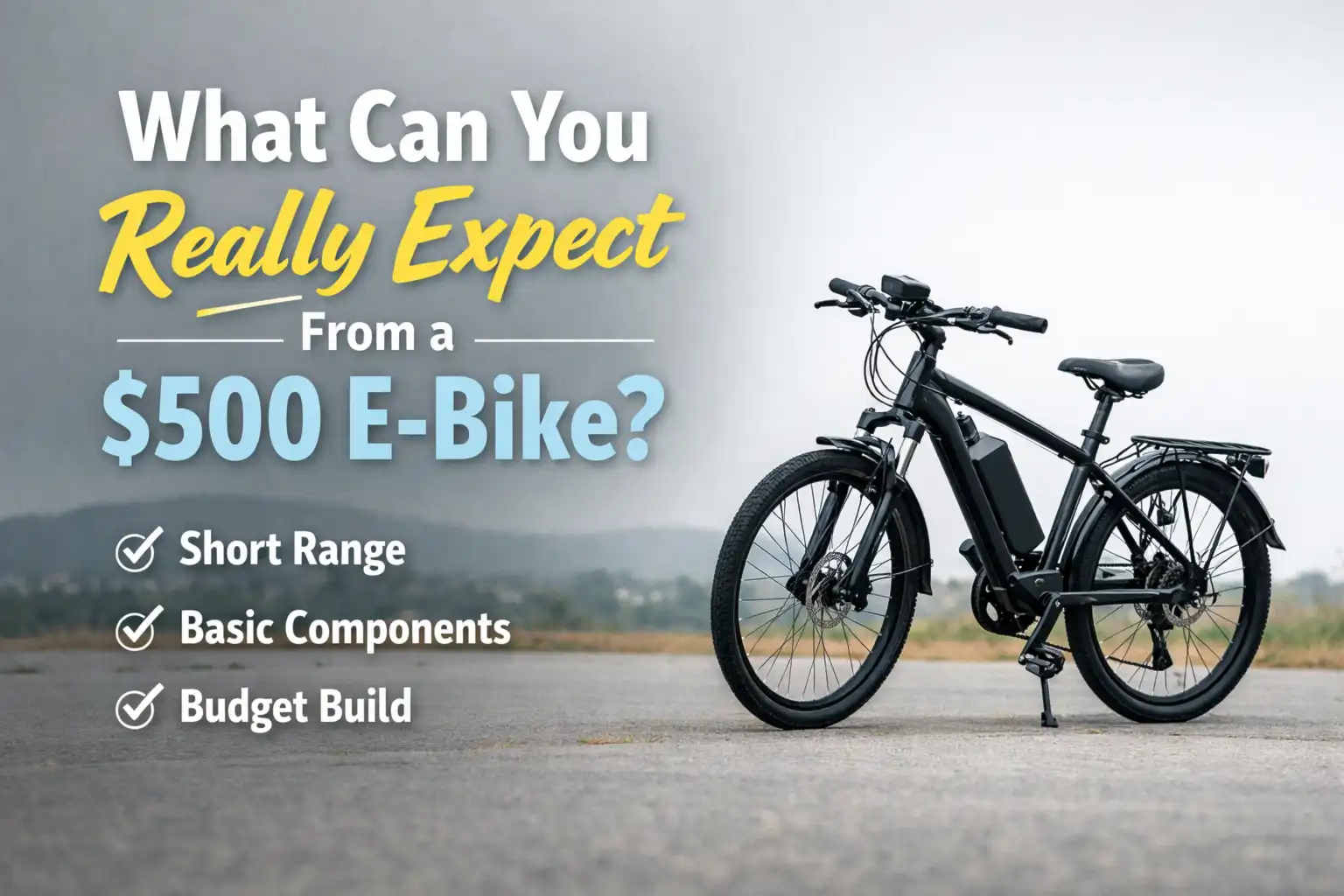
What Can You Really Expect From a $500 E-Bike? (And What You Won’t Get)
Last Updated on April 16, 2026 by Kristina
Most $500 electric bikes look great on paper.
They often promise:
- 500W motors
- 20+ mph speeds
- “Up to 40–60 miles” of range
But in real-world riding, what you actually get can be very different.
If you’re considering a cheap e-bike under $500, this guide breaks down exactly what’s realistic, what’s not, and whether it’s worth it.
If you’re still figuring out what type of e-bike actually fits your needs, start here first:
👉 E-Bike Buying Guide (How to Choose the Right Bike for You)
Who This Guide Is For (and Who It’s Not)
This guide is for:
- First-time e-bike buyers considering a $500 budget
- Riders trying to understand what cheap e-bikes actually deliver
- Anyone comparing low-cost vs mid-range electric bikes
This guide is NOT for:
- Riders planning daily commuting
- Buyers expecting long-term durability
- Riders needing strong hill performance or extended range
What a $500 E-Bike Actually Gets You (Real-World Breakdown)
At this price point, most e-bikes are built to hit a low cost target, not long-term performance or durability.
That shows up quickly in both how they’re built and how they ride.
What to Expect Overall
- Real-world range will be lower than advertised
- Components are entry-level across the board
- Performance drops under hills or heavier loads
- You may need upgrades sooner than expected
- Best suited for light, occasional use
What You Typically Get
- Basic hub motor (typically 250W–500W nominal)
- Smaller battery (often ~280–400Wh)
- Mechanical disc brakes
- Cadence-based pedal assist (on/off feel)
- Simple frame and components
What You Don’t Get
- Consistent real-world range
- Strong hill-climbing performance
- High-quality braking systems
- Long-term durability
- Smooth, refined ride feel
🔥 Current Budget E-Bike Deals Worth Checking
Looking for the best value right now? These budget-friendly e-bike deals change often and can save you hundreds.
- Mokwheel – Free accessories or bonus battery promotions
👉 View current Mokwheel deals - Lectric – Discounts on popular folding and commuter models
👉 See Lectric deals and bundles - Aventon – Seasonal sales and free accessory offers
👉 Check current Aventon promotions - Ride1Up – Limited-time savings on commuter e-bikes
👉 View Ride1Up deals - Velotric – Discounts on bikes and accessories
👉 See Velotric deals
Real-World Comparison: $500 vs Mid-Range vs Premium
| Feature | ~$500 E-Bike | $1,000–$1,800 | $2,000+ |
|---|---|---|---|
| Motor Feel | Basic / abrupt | Smooth | Highly refined |
| Range (real-world) | 10–25 miles | 25–60 miles | 40–80+ miles |
| Brakes | Mechanical | Hydraulic common | Premium systems |
| Ride Comfort | Basic | Improved | High-end |
| Reliability | Low–moderate | Good | High |
If you’re comparing options, start here:
👉 Best Budget Electric Bikes for Real-World Value
Battery Reality: The Biggest Limitation
Battery quality is where most cheap e-bikes cut corners.
While listings may claim high range, those numbers are usually based on:
- ideal conditions
- low rider weight
- minimal assist levels
In real-world use, most riders see:
10–25 miles per charge on smaller batteries (roughly 280–400Wh), depending on terrain, assist level, and rider weight.
Battery safety is also a growing concern. The U.S. Consumer Product Safety Commission has issued safety guidance around lithium-ion battery risks, particularly when products lack proper protections or are used with incompatible chargers.
Industry certifications like UL 2849 (e-bike electrical systems) and UL 2271 (battery packs), developed by UL Solutions, are designed to reduce these risks. Many ultra-cheap e-bikes do not carry these certifications.
👉 Related: E-Bike Range Explained: Real-World vs Advertised Range
Safety and Build Quality Concerns
At this price point, manufacturers often reduce costs in:
- Wiring and connectors
- Battery management systems (BMS)
- Brake components
- Frame weld consistency
This can increase the likelihood of:
- inconsistent performance
- shorter component lifespan
- safety concerns over time
For broader context, PeopleForBikes and other industry groups emphasize the importance of proper equipment standards and safe riding practices as e-bike use expands.
Braking Performance: A Major Trade-Off
Most $500 electric bikes use basic mechanical disc brakes.
In real riding, this often results in:
- longer stopping distances
- reduced confidence at higher speeds
- faster brake wear
This is especially noticeable for:
- heavier riders
- downhill riding
- stop-and-go commuting
👉 See: Why Your E-Bike Brakes Feel Weak (And How to Fix Them)
👉 See: Best E-Bike Brake Upgrade Kits (Hydraulic vs Mechanical)
Motor Performance: Why Specs Don’t Tell the Whole Story
Many cheap e-bikes advertise:
- 500W motors
- 20 mph top speeds
Those numbers can be accurate under ideal conditions, but real-world performance depends on:
- controller output
- battery voltage and current
- rider weight
- terrain
On hills or under load, most budget e-bikes:
- lose speed quickly
- require more pedal effort
- drain battery faster
👉 Related: Torque vs Wattage: What Actually Matters on an E-Bike
Real-World Scenarios
Casual Rider (Flat Terrain)
- Works well for short rides
- Lower expectations match performance
Daily Commuter
- Range limitations become a problem
- Reliability becomes more important
👉 See: Best Commuter E-Bikes for Daily Use
Hills or Heavier Riders
- Noticeable power limitations
- Faster battery drain
- Increased braking demands
Common Mistakes When Buying a $500 E-Bike
At this price point, small mistakes can lead to a disappointing experience. Here are the most common ones to avoid:
Choosing Based Only on Motor Wattage
Many listings highlight “500W” or “750W” motors, but wattage alone doesn’t determine performance.
Controller quality, battery output, and torque matter just as much. A poorly tuned 500W system can feel weaker than a well-designed lower-powered bike.
Trusting Advertised Range Claims
Range estimates are often based on ideal conditions like:
- low rider weight
- flat terrain
- minimal assist
In real-world riding, most $500 e-bikes deliver significantly less range than advertised.
Ignoring Battery Quality and Certifications
The battery is the most important (and most expensive) component.
Low-quality batteries can:
- degrade faster
- deliver inconsistent power
- pose safety risks if poorly built
Look for UL certifications (UL 2849 / UL 2271) when possible.
Expecting Mid-Range Performance
A $500 e-bike is not designed to perform like a $1,000+ model.
Common gaps include:
- weaker hill performance
- less consistent power delivery
- lower braking performance
Setting the right expectations upfront helps avoid frustration later.
Not Planning for Maintenance or Upgrades
Many riders don’t factor in:
- brake upgrades
- tire replacements
- general maintenance
Even basic upgrades can significantly improve performance, especially braking and comfort.
Cheap E-Bikes: Known Brands vs Unknown Brands
At this price point, who makes the bike matters just as much as the specs.
Two bikes can look identical online but perform very differently in real use.
Known Budget Brands
These are brands that specialize in entry-level e-bikes and have established support systems.
What you typically get:
- More consistent quality control
- Better customer support and warranty handling
- Easier access to replacement parts
- Larger user base (more reviews and troubleshooting help)
This reduces risk, especially if something goes wrong.
Unknown or Generic Brands
These are often sold through marketplaces with limited brand presence.
Risks can include:
- Inconsistent build quality
- Lower-quality battery or electronics
- Limited or unresponsive customer support
- Difficulty finding replacement parts
- Short product lifecycle (models disappear quickly)
This doesn’t mean every unknown brand is bad — but the risk is higher.
How to Reduce Risk When Buying Cheap
If you’re considering a lower-cost e-bike:
- Look for real user reviews (not just product page reviews)
- Check if replacement parts are available
- Avoid deals that seem unusually cheap for the specs
- Prioritize brands with at least some track record
Should You Upgrade a $500 E-Bike or Replace It?
Upgrade if:
- The frame is solid
- You only need better brakes or tires
Replace if:
- Battery performance is declining
- Motor struggles under normal use
- Multiple components are wearing out
Upgrades can improve usability, but they don’t always solve long-term limitations.
Cheap vs Mid-Range E-Bikes: Long-Term Cost
While a $500 e-bike has a lower upfront cost:
- Components wear faster
- Battery lifespan is often shorter
- More frequent repairs or upgrades
Mid-range e-bikes typically:
- last longer
- perform more consistently
- offer better long-term value
👉 Full breakdown: How Much Does It Cost to Own an E-Bike?
Is a $500 E-Bike Enough for You?
If you want to test e-biking before spending more → ✔ Good starting point
If you ride occasionally on flat terrain → ✔ It can work
If you plan to commute daily → ❌ You’ll likely outgrow it quickly
If you ride hills or carry weight → ❌ Performance will feel limited
When a $500 E-Bike Makes Sense
For many riders, stepping up in price makes a noticeable difference in daily use.
- Daily commuting
More reliable components and better range make a big difference over time - Riding hills or carrying weight
Stronger motors and better torque handling improve performance - Needing longer, more consistent range
Larger batteries reduce range anxiety and charging frequency - Prioritizing safety and braking performance
Hydraulic brakes and better components improve control and stopping power - Wanting a smoother, more natural ride feel
Higher-quality systems deliver more consistent power and comfort
Even moving into the $800–$1,200 range often results in significantly better performance, reliability, and long-term value.
When It’s Worth Spending More
For many riders, stepping up in price makes a noticeable difference in daily use.
- Daily commuting
More reliable components and better range make a big difference over time - Riding hills or carrying weight
Stronger motors and better torque handling improve performance - Needing longer, more consistent range
Larger batteries reduce range anxiety and charging frequency - Prioritizing safety and braking performance
Hydraulic brakes and better components improve control and stopping power - Wanting a smoother, more natural ride feel
Higher-quality systems deliver more consistent power and comfort
Even moving into the $800–$1,200 range often results in significantly better performance, reliability, and long-term value.
A Smarter Alternative to Buying a $500 E-Bike
Instead of going straight for the cheapest option, consider:
- Waiting for seasonal sales or promotions
- Looking at $800–$1,200 models on discount
- Choosing a reputable budget brand over unknown listings
Another option some riders consider is building their own e-bike, which can give you better components for the price if you’re comfortable with basic tools and setup.
👉 See: How to Build Your Own E-Bike From Scratch (Step-by-Step Guide)
However, this route takes more time, planning, and setup compared to buying a ready-to-ride bike.
In many cases, spending slightly more upfront results in:
- better performance
- longer lifespan
- fewer upgrades needed
👉 Start here: Best Budget Electric Bikes (Real Picks That Hold Up)
How to Get the Most Value at This Price
If you’re staying near the $500 range, a few smart choices can make a big difference.
- Prioritize battery capacity over speed claims
Range and consistency matter more than top speed in real-world riding - Look for safety certifications when available
UL-certified systems (when present) reduce risk and improve reliability - Choose brands with real support
Easier troubleshooting, parts availability, and warranty help - Plan for upgrades (especially brakes)
Small upgrades can significantly improve safety and ride quality
👉 See Current E-Bike Deals That Are Actually Worth Buying
What to Expect After 6–12 Months of Use
- Battery capacity may start to decline
- Brakes may need adjustment or replacement
- Tires may wear faster on lower-cost components
- Performance may feel less consistent over time
This doesn’t mean the bike is unusable, but it does highlight why cheaper models are best for lighter use.
Not Sure If $500 Is Enough? Here’s What to Do Next
If you’re still deciding, here’s the best next step based on your situation:
- Want something that will actually hold up long-term?
Start here: Best Budget Electric Bikes (Real Picks That Last) - Still figuring out what type of e-bike you need?
Read this first: E-Bike Buying Guide - Concerned about range and battery performance?
See: E-Bike Range Explained (What “Up to 60 Miles” Really Means)
Final Thoughts: Is a $500 E-Bike Worth It?
A $500 e-bike can work — but only in the right situation.
It’s best viewed as:
an entry-level option, not a long-term solution
If your expectations match what these bikes actually deliver, you can still get value.
But if you plan to ride regularly or depend on it, stepping up in price usually leads to a much better experience.

Kristina is not just an enthusiast but a true authority on electric bikes. Nestled in the coastal beauty of Virginia, Kristina has found the perfect backdrop for her passion for electric biking. As a dedicated wife and homeschooling mom, her life revolves around family, faith, and the thrill of adventure.
Originally hailing from Ohio, Kristina's journey with electric bikes began as a curiosity and quickly evolved into a deep expertise. Her blog is a testament to her love for electric biking, combining her fascination for eco-friendly transportation with her coastal lifestyle.
When she's not cruising the beach on her electric bike, you'll find Kristina indulging in her other loves: long walks along the shore, getting lost in a good book, and cherishing moments with her loved ones. With a heart as big as her love for animals, especially cats, Kristina brings a unique perspective to the electric bike world, grounded in her strong faith in God and her dedication to a sustainable lifestyle.
Through her blog, Kristina shares her extensive knowledge of electric bikes, offering valuable insights, tips, and recommendations to fellow enthusiasts. Whether you're a seasoned rider or a newcomer to the electric bike scene, Kristina's blog is your go-to source for all things electric biking, fueled by her passion, expertise, and the scenic beauty of coastal Virginia.