
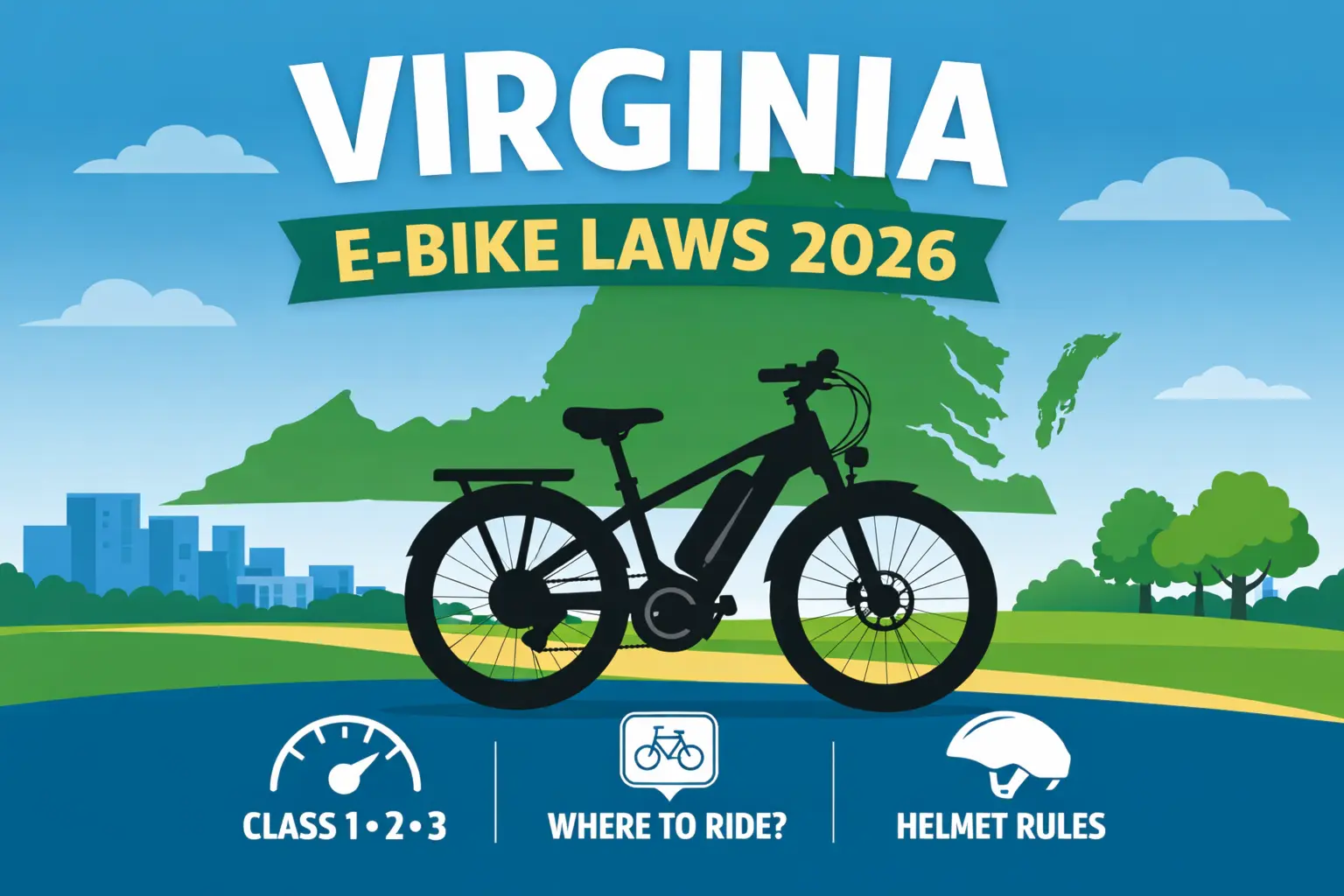
Virginia E-Bike Laws (2026): Classes, Speed Limits, and Where You Can Ride
Electric bikes are becoming increasingly popular across Virginia for commuting, recreation, and everyday transportation. Riders are using e-bikes on city streets in Richmond, along waterfront paths in Norfolk, and on long rail trails throughout the state.
But many riders still ask the same questions:
- Are electric bikes legal in Virginia?
- Do you need a license to ride an e-bike in Virginia?
- Can you ride an e-bike on sidewalks or bike paths?
- Are there speed limits or helmet rules?
The good news is that Virginia has clear electric bike laws that follow the three-class e-bike system used in many U.S. states.
However, local governments, trail systems, and park authorities can set their own rules, which can sometimes cause confusion.
This guide explains Virginia e-bike laws, classes, speed limits, trail rules, and city regulations so you can ride legally and safely.
If you want to compare e-bike laws across the country, see:
👉 State-by-State E-Bike Laws Guide
Who This Virginia E-Bike Law Guide Is For
This guide is for:
- Virginia residents considering buying an electric bike
- commuters riding in cities like Richmond, Norfolk, Arlington, or Virginia Beach
- recreational riders using bike paths and rail trails
- visitors bringing an e-bike into Virginia
This guide is NOT for:
- electric motorcycles
- mopeds or gas-powered bikes
- modified high-speed electric bikes exceeding legal limits
If you’re new to electric bikes and want to understand how they work before choosing one, start here:
Are E-Bikes Legal in Virginia?
Yes. Electric bikes are legal in Virginia.
Virginia recognizes three classes of e-bikes, and most are treated similarly to traditional bicycles.
In general:
- no driver’s license required
- no vehicle registration required
- no license plates
- no insurance requirement
However, riders must follow standard bicycle traffic laws, and local governments may restrict where certain classes of e-bikes are allowed.
🎥 Watch: Virginia Bicycle Law Changes Explained
Because electric bikes are legally classified as bicycles in Virginia, many of the same traffic rules apply. This short news segment explains recent bicycle law updates in Virginia and how they affect riders on roads and bike lanes.
How Virginia Law Defines an Electric Bike
Virginia law defines an electric bicycle as:
A bicycle equipped with fully operable pedals and an electric motor of 750 watts or less that provides assistance when pedaling or using a throttle.
To qualify as a legal e-bike, the bicycle must fit into one of the three official electric bike classes.
For official wording and legal references see:
- Virginia General Assembly
- Virginia Department of Transportation
Virginia’s Three E-Bike Classes
Virginia follows the widely used Class 1, Class 2, and Class 3 electric bike classification system.
| Class | Description | Maximum Assisted Speed |
|---|---|---|
| Class 1 | Pedal assist only | 20 mph |
| Class 2 | Pedal assist + throttle | 20 mph |
| Class 3 | Pedal assist only | 28 mph |
Key points for Virginia riders:
- Class 1 and Class 2 e-bikes are usually allowed anywhere bicycles are permitted
- Class 3 e-bikes may be restricted on some trails or shared-use paths
Virginia also sets additional rules for Class 3 bikes:
- riders must be at least 14 years old
- riders must wear a helmet
Many commuters and casual riders choose Class 1 or Class 2 e-bikes.
If you’re unsure which class is right for you, see:
👉 Understanding E-Bike Classes
Do You Need a License to Ride an E-Bike in Virginia?
No. You do not need a driver’s license to ride an electric bike in Virginia.
Because e-bikes are classified as bicycles, riders do not need:
- a driver’s license
- vehicle registration
- license plates
- insurance
However, if an e-bike is modified to exceed the legal motor power or speed limits, it may be classified as a motor vehicle instead of an electric bicycle.
👉 Learn more: Do You Need a License to Ride an E-Bike?
Are E-Bikes Allowed on Sidewalks in Virginia?
Virginia generally allows bicycles to ride on sidewalks unless a local city restricts it.
Since electric bikes are treated as bicycles under Virginia law, the same rule usually applies to e-bikes.
However, some cities limit sidewalk riding in busy pedestrian areas such as downtown districts or tourist zones.
For a detailed breakdown across all states, see:
👉 Are E-Bikes Allowed on Sidewalks? State-by-State Guide
Where You Can Ride an E-Bike in Virginia
In most cases, electric bikes can be ridden anywhere traditional bicycles are allowed.
This generally includes:
- public roads
- bike lanes
- shared-use paths
- neighborhood streets
However, local governments and trail managers may still restrict certain e-bike classes, especially higher-speed Class 3 bikes.
Always check posted signs when entering:
- parks
- multi-use trails
- boardwalks
- pedestrian zones
E-Bike Rules in Major Virginia Cities
While Virginia has statewide electric bike laws, cities and counties can regulate how e-bikes are used locally, particularly in busy pedestrian areas.
Virginia Beach
Virginia Beach has increased enforcement against high-speed e-bikes along the Oceanfront and boardwalk areas, where pedestrian traffic is heavy.
Local officials have focused on safety and preventing modified high-speed electric bikes from operating in crowded areas.
👉 Read more: Virginia Beach Cracks Down on High-Speed E-Bikes
Richmond
Richmond allows electric bikes wherever traditional bicycles are permitted, including:
- bike lanes
- public streets
- shared-use paths
The Virginia Capital Trail connecting Richmond to Williamsburg is one of the most popular cycling routes in the state.
Arlington
Arlington County has an extensive network of bike lanes and greenways.
Electric bikes are commonly used on:
- commuter corridors
- multi-use trails
- regional bike routes
Some park trails may restrict Class 3 e-bikes due to speed concerns.
Alexandria
Alexandria generally allows electric bikes wherever bicycles are permitted.
However, riders should use caution in:
- historic Old Town areas
- waterfront pedestrian zones
- narrow shared paths
Norfolk
Norfolk has expanded bike infrastructure and shared-use paths throughout the city.
Electric bikes are commonly used for commuting between downtown, waterfront areas, and nearby neighborhoods.
Charlottesville
Charlottesville allows electric bikes under Virginia’s statewide classification system.
However, some parks and natural trails may restrict certain e-bike types.
Virginia E-Bike Rules by City
| City | Sidewalk Riding | Trail Access | Notes |
|---|---|---|---|
| Virginia Beach | Restricted in tourist zones | Allowed on many paths | Boardwalk enforcement |
| Richmond | Generally allowed | Capital Trail popular | Growing bike network |
| Arlington | Limited in some areas | Extensive trail system | Some Class 3 restrictions |
| Alexandria | Allowed but discouraged downtown | Allowed on bike routes | Historic pedestrian zones |
| Norfolk | Generally allowed | Many waterfront routes | Expanding infrastructure |
| Charlottesville | Allowed with caution | Depends on park rules | Popular recreation area |
E-Bike Trail Access in Virginia
Virginia has an expanding network of bike trails and rail trails where electric bikes are commonly used.
However, trail managers may set their own electric bike policies.
| Trail | E-Bike Policy | Notes |
|---|---|---|
| Virginia Capital Trail | Generally allowed | Popular 50-mile cycling route |
| Washington & Old Dominion Trail | Allowed in many sections | Heavy pedestrian traffic |
| New River Trail State Park | Limited in some areas | Managed by state parks |
| Mount Vernon Trail | Restrictions possible | Busy near Washington DC |
Always check posted trail signage for current e-bike rules.
Are E-Bikes Allowed on School or College Campuses in Virginia?
Virginia state law does not prohibit electric bikes on school campuses.
However, individual schools and universities may set their own bicycle or micromobility policies.
Typical campus rules include:
- riding only on designated bike paths
- parking bikes in racks
- restricting riding on crowded walkways
Electric bikes are increasingly used by students at large campuses such as:
- University of Virginia
- Virginia Tech
- Old Dominion University
- Virginia Commonwealth University
- George Mason University
Students should check campus transportation policies before riding an e-bike.
Enforcement Trends in Virginia
As electric bike use grows, some Virginia cities have increased enforcement in areas with heavy pedestrian traffic.
Common enforcement concerns include:
- high-speed e-bikes on pedestrian paths
- modified electric bikes exceeding legal limits
- unsafe riding on crowded boardwalks
Virginia Beach has been one of the most visible examples of increased enforcement.
Common E-Bike Law Mistakes Riders Make in Virginia
Even though Virginia’s electric bike laws are relatively straightforward, riders sometimes misunderstand how the rules apply.
Common mistakes include:
Riding a modified high-speed e-bike
If an e-bike exceeds 750 watts or the legal class speed limits, it may no longer qualify as an electric bicycle.
Riding too fast on shared paths
Multi-use trails are shared with pedestrians, runners, and families.
Slowing down helps prevent trail restrictions.
Assuming all trails allow e-bikes
Trail managers can restrict certain e-bike classes if safety concerns arise.
Real-World Virginia E-Bike Law Scenarios
Understanding how Virginia electric bike laws apply in everyday situations can help riders avoid confusion.
Scenario: Riding an e-bike in a Richmond bike lane
Legal. Electric bikes are allowed wherever bicycles are permitted.
Scenario: Riding a throttle e-bike in a Norfolk neighborhood
Legal if the bike fits the Class 2 definition.
Scenario: Riding an e-bike on the Virginia Beach boardwalk
Rules may vary depending on local regulations.
Virginia E-Bike Law Summary
| Rule | Virginia Law |
|---|---|
| License required | No |
| Registration required | No |
| Insurance required | No |
| Motor limit | 750 watts |
| Class system | Yes (Class 1-3) |
| Throttle allowed | Yes (Class 2) |
| Sidewalk riding | Depends on local rules |
Nearby State Law Guides
Traveling outside Virginia? Laws change quickly.Check other states:
California e-bike laws
Pennsylvania e-bike laws
Washington e-bike laws
Ohio e-bike laws
👉 Compare all states in the state-by-state e-bike law guide
FAQs
Yes. Electric bikes are legal on public roads where bicycles are allowed.
No. Virginia does not require a driver’s license to ride an e-bike.
Yes, as long as they meet the Class 2 definition and do not exceed 20 mph.
Class 1 and Class 2 e-bikes assist up to 20 mph, while Class 3 e-bikes assist up to 28 mph.

Kristina is not just an enthusiast but a true authority on electric bikes. Nestled in the coastal beauty of Virginia, Kristina has found the perfect backdrop for her passion for electric biking. As a dedicated wife and homeschooling mom, her life revolves around family, faith, and the thrill of adventure.
Originally hailing from Ohio, Kristina's journey with electric bikes began as a curiosity and quickly evolved into a deep expertise. Her blog is a testament to her love for electric biking, combining her fascination for eco-friendly transportation with her coastal lifestyle.
When she's not cruising the beach on her electric bike, you'll find Kristina indulging in her other loves: long walks along the shore, getting lost in a good book, and cherishing moments with her loved ones. With a heart as big as her love for animals, especially cats, Kristina brings a unique perspective to the electric bike world, grounded in her strong faith in God and her dedication to a sustainable lifestyle.
Through her blog, Kristina shares her extensive knowledge of electric bikes, offering valuable insights, tips, and recommendations to fellow enthusiasts. Whether you're a seasoned rider or a newcomer to the electric bike scene, Kristina's blog is your go-to source for all things electric biking, fueled by her passion, expertise, and the scenic beauty of coastal Virginia.




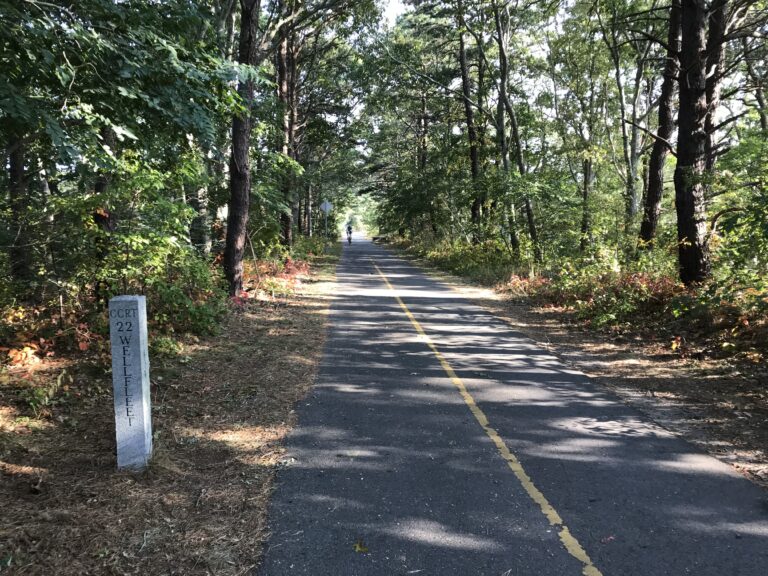
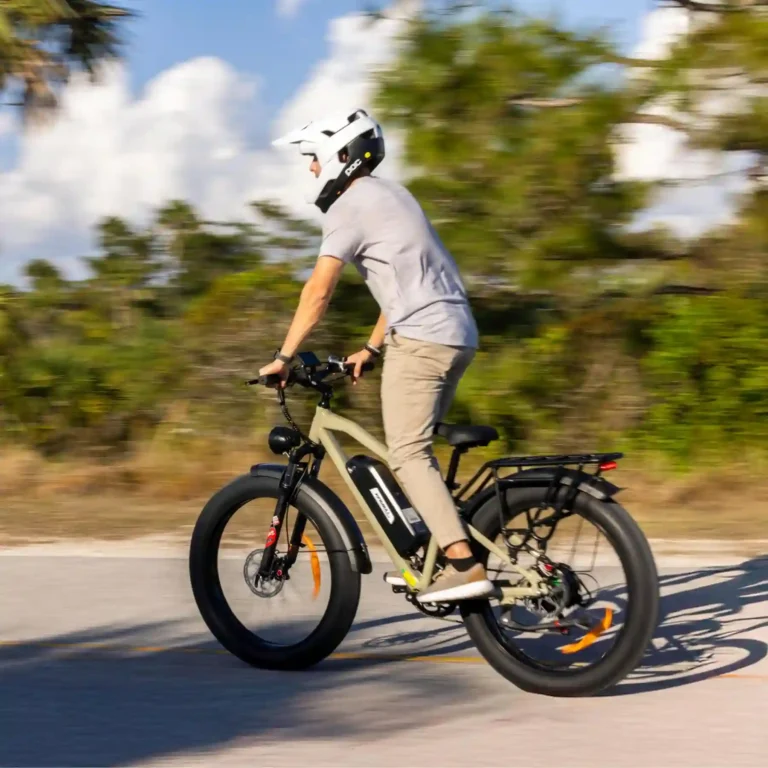
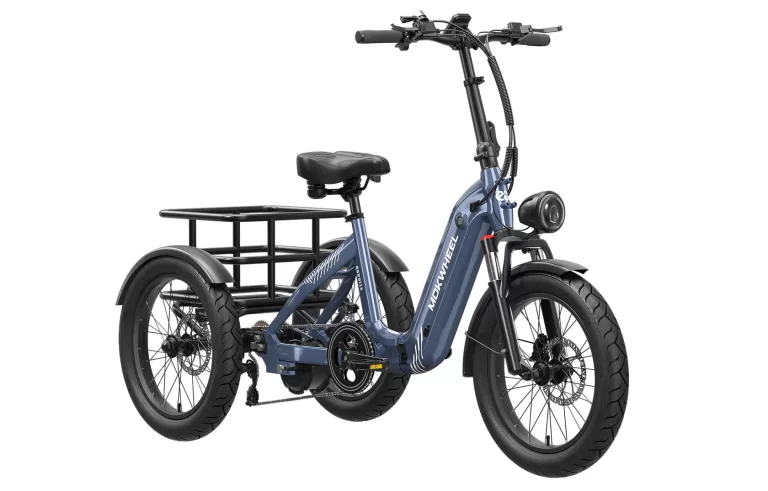
Can children under the age of 5 ride as passengers on an E-bike and without helmets in the state of Virginia?
In Virginia, there are two key rules to understand. Virginia law requires that children 14 years old and under must wear a helmet when riding on a bicycle or being carried as a passenger. Since e-bikes are generally treated the same as bicycles under state law, this applies to e-bike passengers too, so a child under 5 cannot legally ride without a helmet. Virginia law does allow passengers, but the bike must be designed to carry a passenger, the child must be in a properly secured seat, and the setup must allow the rider to maintain full control of the bike. For very young children, this typically means using a mounted child seat with a harness and footrests or a properly designed cargo e-bike setup with seating and restraints. There is no specific minimum age listed in Virginia law for riding as a passenger on a bicycle or e-bike. So in simple terms, a child under 5 can ride as a passenger, but they must wear a helmet and be in a secure, purpose-built seat.