How to Build Your Own Ebike From Scratch
Last Updated on October 15, 2026 by Kristina
Building your own electric bike sounds straightforward: add a motor and battery to a bicycle, then ride away. The reality is that the fit of the parts matters just as much as the parts themselves. A motor wheel with the wrong axle, a battery that will not fit the frame, or a display that cannot talk to its controller can stop a project before the first ride.
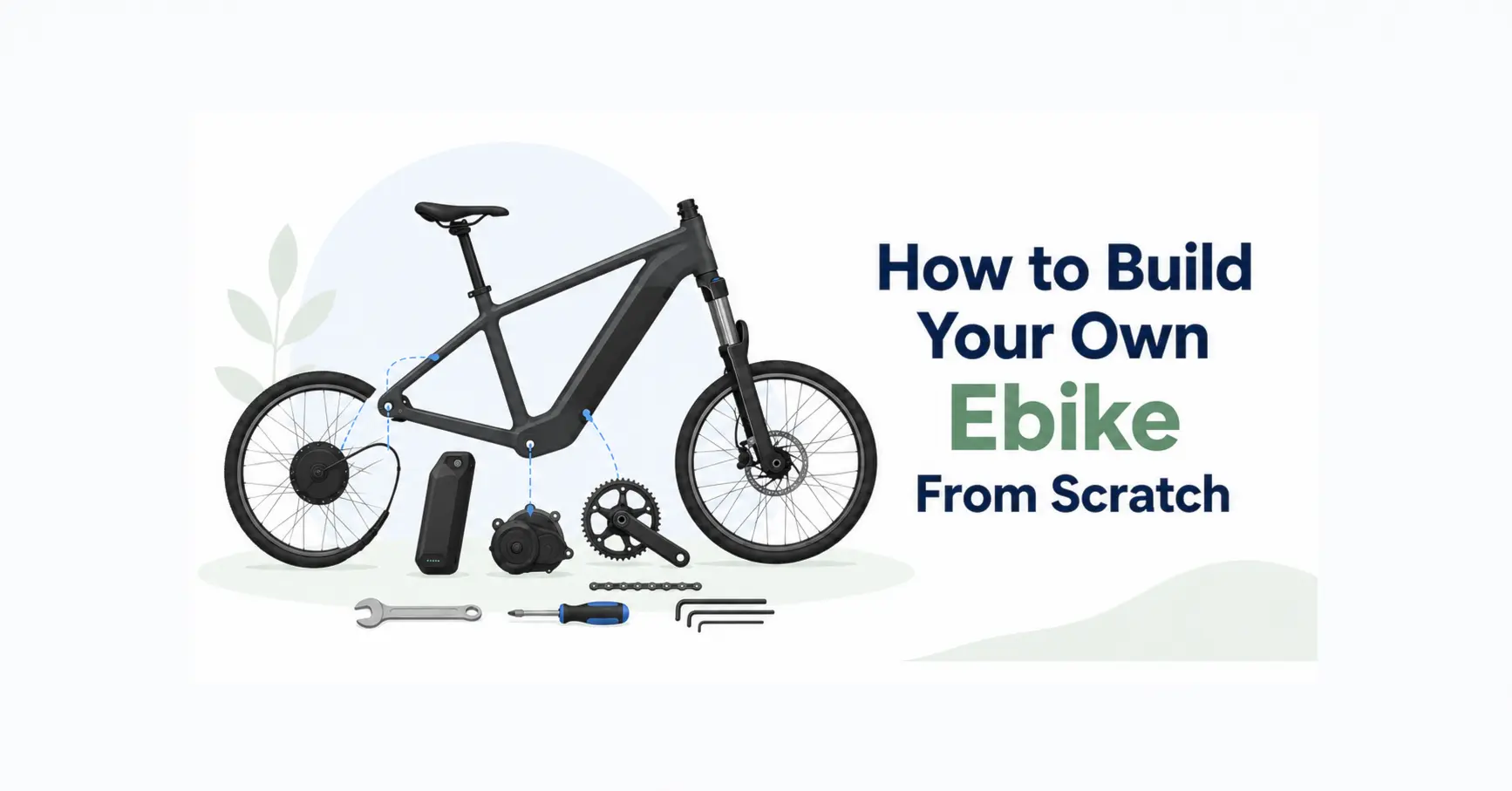
There are two ways to approach it. You can convert a complete bicycle with a compatible motor kit, or you can build the whole bike from a bare frame and select every mechanical and electrical component. This guide walks through both, with a practical example of the easier conversion route.
The sample build below is an illustrative planning example, not a bike I have personally assembled or tested. Your frame and kit manuals—not a generic online tutorial—must determine the exact hardware, installation sequence, and torque settings.
Safety first: An e-bike combines bicycle mechanics with a high-energy lithium-ion battery. Never modify or rebuild a battery pack, bypass its protections, improvise high-current wiring, or power up an installation with damaged connectors. If you are uncertain about dropout strength, motor retention, battery mounting, or braking, have a qualified bicycle mechanic or e-bike technician inspect the build before riding.
First, decide what you actually want to build
If this is your first attempt, I would start with a bicycle that already fits you and works well. You’ll still learn how the motor, controls, and battery go together, but you won’t also be learning to assemble a headset, lace wheels, size a chain, and set up brakes from nothing.
| Your starting point | What’s involved | Best suited to |
|---|---|---|
| Donor-bike conversion | Inspect an existing bike; fit a compatible hub or mid-drive kit, battery and controls; retest the brakes and handling. | A first DIY project, provided the donor bike and kit are compatible. |
| Bare-frame build | Build a complete working bicycle first, including fork, wheels, cockpit, brakes and drivetrain; then integrate the electrical system. | Experienced home mechanics who know bicycle standards and can get professional help when needed. |
Neither route is automatically cheaper than buying a complete e-bike. If your main goal is reliable transportation rather than the building process, compare the total project cost with a ready-made bike before spending anything. My DIY-versus-prebuilt cost comparison goes into that decision.
Example project: a practical rear-hub conversion
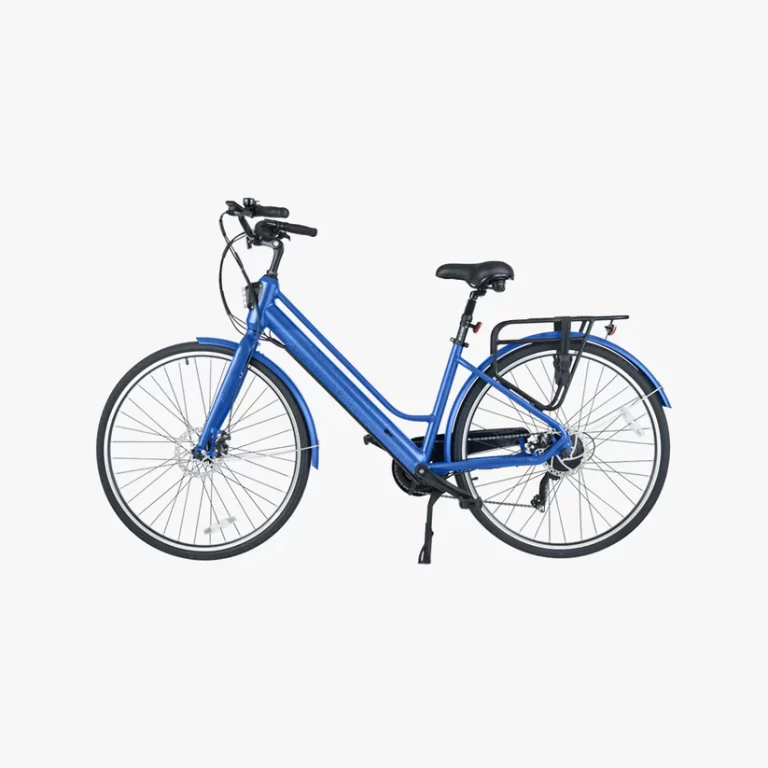
Imagine you already own a comfortable 700c hybrid bike with a sound steel or aluminum frame, working disc brakes, and a rear wheel held in conventional dropouts. You want assistance for commuting on mostly paved roads—not a high-speed off-road machine. A complete, manufacturer-matched rear-hub kit could be one option to investigate.
Here’s the important part: you do not buy a random “700c conversion kit” and assume it will fit. Before ordering, you would verify the rear dropout spacing and axle interface, brake rotor mount and alignment, cassette or freewheel system, tire clearance, frame condition, approved torque-arm setup, and battery mounting space. The kit supplier must confirm compatibility with the exact bicycle.
| Example planning item | What you’d verify before buying |
|---|---|
| Bicycle | Correct rider fit; undamaged frame and dropouts; sound headset, wheels and brakes. |
| Motor wheel | 700c rim size plus the correct axle, dropout spacing, brake mount, and cassette/freewheel interface. |
| Motor retention | Manufacturer-approved anti-rotation hardware or torque-arm arrangement suitable for the frame and axle. |
| Electronics | Motor, controller, display, sensors and wiring harness sold or documented as a compatible set. |
| Battery and charger | Battery approved for that system; matching voltage and discharge limits; correctly specified charger and secure frame mount. |
| Final setup | Legal assisted-speed configuration, properly adjusted brakes, reliable cutoffs if fitted, and professional inspection where needed. |
These are checks, not a claim that one specific 700c kit will work with every hybrid. If the supplier cannot answer those fit questions, choose a better-documented kit.
Step 1: Inspect the bicycle or frame before buying anything
A motor makes a bicycle heavier and can put new loads into its frame, fork, wheels and brakes. It does not fix a bike that already feels unstable, fits poorly, or needs repairs. Start with the mechanical condition.
- Frame and fork: Look for cracks, dents, bends, corrosion, damaged dropouts and loose suspension pivots. Get questionable areas assessed professionally; do not try to “reinforce” a damaged frame yourself.
- Fit: Make sure you can reach the brakes, steer comfortably and stop with control. A battery or motor should not interfere with pedaling or getting on and off.
- Brakes: Check pad wear, lever travel, cable or hose condition, rotor condition and stopping power. Don’t assume a brake upgrade can be solved simply by fitting a larger rotor—the frame, fork and caliper must permit it.
- Wheels: Check rims, spoke tension, hubs, tire condition and load ratings. A worn-out donor bike is usually a poor foundation.
- Mounting space: Hold a cardboard template of the proposed battery case inside the frame triangle. Check bottle bosses, suspension travel, crank clearance and whether the battery can slide in and out of its rail.
I would be especially cautious with a front-hub conversion on a carbon fork or an unverified suspension fork. Do not assume a fork can safely handle motor axle loads just because the axle seems to fit.
Step 2: Measure the parts that most often cause trouble
This is the least exciting part of a DIY build and one of the most valuable. Record the measurements and take close-up photos of the bike before contacting the kit supplier.
| Measurement or standard | Why it matters |
|---|---|
| Wheel diameter, rim and tire clearance | The replacement motor wheel must match the bicycle’s wheel and brake arrangement. |
| Rear or front dropout spacing and axle style | A bolt-on hub-motor axle does not automatically work in a thru-axle frame. Do not spread or file dropouts to force a fit. |
| Brake mount and rotor interface | Rotor size, mounting system and caliper alignment must work together. |
| Cassette versus threaded freewheel | A rear-hub wheel may accept one but not the other; that affects gears and shifting. |
| Bottom-bracket shell width and type | Crucial for a mid-drive motor: common BSA threaded shells and press-fit shells are different systems. |
| Battery case and rail dimensions | The battery must fit, remain secure and be removable without hitting the frame or components. |
For mid-drives, “68/73 mm BSA compatible” is often listed in kit specifications, but don’t assume that means the motor will clear every frame with those shell dimensions. Chainstay shape, cable guides, chainline and crank clearance still matter. Park Tool’s bottom-bracket standards guide is a useful reference for identifying what you have.
Step 3: Choose a motor type you can actually install
Rear-hub motor
For a conventional commuting conversion, this is often where I’d begin looking. The motor replaces the rear wheel while leaving the crank area largely unchanged. The difficult bits are matching the cassette or freewheel, brakes, dropout interface, wheel fit, and axle-retention hardware. A complete kit is easier to source than mixing several brands of controller and display.
Front-hub motor
A front-hub kit leaves the rear drivetrain alone, but it applies motor torque to the fork. Steering feel and traction may change. Unless both the fork and motor-kit manufacturer approve the exact mounting arrangement—including axle retention—I would not choose it. A carbon fork is not something to experiment with.
Mid-drive motor
A mid-drive fits at the bottom bracket and sends motor power through the chain and gears. It can work well for hills and heavy loads because the rider can select suitable gears. The tradeoff is a more demanding installation: crank and bottom-bracket removal, motor-housing clearance, chainline, shifting behavior and drivetrain wear all need attention.
If you’re torn between the options, see my hub-drive versus mid-drive explanation. Choose the motor for the terrain and bike—not the biggest wattage number in a listing.
Step 4: Buy a matched electrical system, not a pile of mystery parts
The motor, controller, battery, display, sensors and charger need to be electrically compatible. Plug shape alone tells you almost nothing about safe compatibility. Two displays from the same brand can use different communication protocols or firmware.
- Nominal voltage: The controller and battery must be designed to work together. A controller marked for 36V only cannot simply be paired with a 48V pack.
- Current: The controller’s current draw must stay within the battery’s documented discharge capability and the motor system’s limits. Increasing current may overheat parts or trip protection circuits.
- Connectors and communication: Confirm the motor connector, sensor and brake-cutoff connectors, display protocol, pinouts and supported controller versions with the supplier. Never guess polarity.
- Battery capacity: Multiply nominal volts by amp-hours for approximate energy. A 48V 15Ah pack is about 720Wh. That is not a promise of any particular riding range.
- Charger: Use the charger supplied or specifically approved for your exact battery by its manufacturer. Do not use a “universal” charger just because the plug fits.
For range planning, my guide to battery capacity and amp-hours explains why hills, wind, speed, rider weight and assist level can change what you get from the same battery.
A word about battery safety and certification
I would not cut corners on the battery. Look for a traceable manufacturer, clear documentation, replacement support and verifiable third-party safety testing. UL 2849 covers the e-bike electrical system as a system, while UL 2271 addresses batteries for light electric vehicles. Using a battery that claims UL testing does not automatically make a custom combination of components UL 2849 certified. See the UL 2849 standard’s scope and the CPSC’s e-bike safety guidance.
Do not buy packs assembled from salvaged cells, open a lithium-ion pack, replace its battery-management system yourself, or charge it unattended or while asleep. Stop using or charging a pack that is damaged, swelling, leaking, giving off unusual heat or odor, smoking, or sparking. If a battery is smoking or burning, get away, warn others and call emergency services; do not try to carry it outside.
Step 5: Gather the tools and small parts before assembly
You don’t need a professional workshop for every conversion, but the correct tools matter. Forcing a tight part or guessing at bolt tightness can damage expensive components or create a dangerous failure.
- Bicycle repair stand, metric hex and Torx tools, tire levers, tire pump and a measuring caliper.
- A torque wrench that covers the fastener ranges listed in your frame, brake, crank and motor manuals.
- Crank puller and the correct bottom-bracket tool if you’re fitting a mid-drive; appropriate cassette, freewheel and rotor tools if your hub conversion requires them.
- Approved motor axle retention hardware and torque arms where specified; battery rail or bracket designed to support the pack on your frame.
- Cable ties or protective sleeves for routing wires—not for holding up the battery—and a way to keep all small spacers and washers organized.
If you still need workshop basics, examples include a bicycle torque wrench, repair stand, or hub-motor torque-arm options. These are shopping links, not a substitute for checking compatibility with the exact bike and motor.
Step 6: Build or service the bicycle before installing the motor
For a conversion, repair the donor bike first: replace damaged tires or worn brake pads, correct any loose bearings, true the wheels if needed, and confirm it rolls, steers, shifts and stops normally. You want a baseline before you add electrical parts.
For a bare-frame project, this step is much bigger. The frame has to become a complete, safe pedal bicycle before you begin motor testing. Follow the frame and component manufacturers’ assembly manuals. In general, the work includes:
- Install the correct fork, headset, stem and handlebar, then check smooth steering and headset adjustment.
- Fit compatible wheels and tires, confirm axle retention and check frame and fork clearances.
- Install and adjust the brakes, using only approved rotor sizes and mounts.
- Fit the bottom bracket, crankset, chainring, cassette or freewheel, chain, derailleurs and shifters; confirm chainline and dependable shifting.
- Fit the saddle, seatpost, pedals and remaining controls. Perform a complete mechanical inspection before adding power.
A bare frame may arrive needing headset, bottom-bracket or other preparation that should be handled by a bicycle shop. If you don’t already know these jobs, paying a mechanic for the foundation is safer than learning on an electrically assisted test ride.
Step 7: Install the motor—take your time with axle retention
If you’re using a rear-hub motor kit
- With the battery removed, take off the donor rear wheel using the bike manufacturer’s instructions. Transfer the compatible tire and tube, rotor, and cassette or freewheel only if the interfaces match; otherwise use correctly specified replacements.
- Test-fit the motor wheel without forcing the axle, prying the frame apart or filing the dropouts. Check rotor alignment, gear clearance and cable exit direction.
- Install every manufacturer-specified washer, spacer, anti-rotation plate, torque arm and axle fastener in its documented position. Wrong washer order can be as serious as a loose nut.
- Tighten all retention fasteners to the values given for the exact kit and frame. Spin the wheel by hand and confirm that the tire, chain, rotor and motor cable clear adjacent parts.
A hub motor tries to rotate its axle in the opposite direction from the driven wheel. That can damage dropouts even when the wheel initially looks secure. Torque-arm requirements are about the complete axle, dropout and motor arrangement—not just whether the motor is called “high power.” Grin Technologies’ torque-arm guide explains the forces and the different retention approaches.
If you’re using a mid-drive kit
- Confirm the bottom-bracket standard and exact motor compatibility before removing any parts.
- Remove the existing crankset and bottom bracket with the appropriate tools and manufacturer’s procedure.
- Check motor housing, chainstay, chainring, crank and cable clearances with a careful dry fit. Don’t grind the motor, frame or carbon parts to make space.
- Install the specified mounts, spacers and lockrings in the kit’s required order. Set the chainline and make sure the cranks rotate freely and shifting remains reliable.
- Follow the maker’s torque and reinspection schedule. If the chainline or mounting does not work, stop rather than improvising.
Step 8: Mount the battery and controls
The battery should be secure, protected from impact and mounted where its weight will not make the bike difficult to handle. A location inside the main frame triangle often works well, but only if the frame and approved mounting system support the battery’s size and weight. Bottle-cage bosses alone are not proof that a heavy battery rail is adequately supported.
- Use the battery manufacturer’s mounting rail or an approved alternative for that model and frame. Check that the pack locks fully into place and cannot rattle.
- Turn the bars from stop to stop, rotate the cranks and move the suspension through its travel, checking for interference.
- Mount the controller in its recommended position with adequate cooling. Don’t wrap a heat-producing controller in insulation.
- Position the display, assist control and throttle (if the kit includes one) where they do not interfere with braking or steering. Confirm the throttle springs back freely.
- Route cables away from spokes, chain, crank, tires, rotors, sharp edges and pinch points. Leave enough slack for steering and suspension, but not loose loops that can snag.
- Fit compatible pedal-assist and brake-cutoff sensors as directed. Keep the battery removed while connecting the low-voltage components and securing the wiring harness.
Use only the kit manufacturer’s wiring diagram and specified connections. Do not splice high-current battery leads or solder connectors simply because two components use different plugs. Have a competent technician resolve mismatches instead.
Step 9: Check everything before connecting the battery
This is where a five-minute inspection can prevent a much bigger problem. The drive wheel should be clear of objects, the bike should be stable, and nobody should be touching the drivetrain when power is applied.
- Confirm the battery’s model, system voltage, connector and polarity against the documented kit—not assumptions.
- Inspect cables and connectors for bent pins, loose housings, crushed insulation, exposed conductors or incorrect routing.
- Check axle retention, specified torque arms, motor mounting, crank fasteners, battery mount and wheel installation against their manuals.
- Make sure both brakes work mechanically and no rotating part rubs on a wire or mounting bracket.
- Check the throttle rests at zero, assist starts at the lowest setting, and any installed brake-cutoff sensors are connected correctly.
If a connector looks burnt, damaged or unclear, do not connect the battery. Incorrect high-current connections can cause sparks, component damage and fire.
Step 10: Make the first powered test controlled and brief
If the manufacturer permits a stand test, secure the bicycle in a suitable stand with the driven wheel off the ground and nobody near the spinning tire, chain or spokes. Fit the correct battery, power on at the lowest assist setting and follow the kit’s startup procedure. Check the display, speed reading and basic motor response using only brief low-speed activation.
If fitted, check whether the brake cutoffs stop assistance promptly. Power off immediately if the wheel behaves unexpectedly, a cable moves toward the tire, the motor makes severe grinding noises or you notice unusual heat or odor. Do not perform a full-throttle free-spin test or put hands near moving components.
For the first ride, use a quiet, open area away from traffic. Start without assistance, check the brakes, then try the lowest motor setting. Test predictable engagement and disengagement, low-speed turning and stopping before gradually extending the ride. Follow the brake maker’s bedding-in procedure if new pads or rotors were installed.
After a short ride, turn the bike off and inspect the hubs, axle retention, torque arms, motor mounts, wheel spokes, brakes, chainline, battery rail and wiring again. Recheck at the intervals in the manuals, especially during the first several rides.
Print-or-save first-ride checklist
| Area | Pass only if… |
|---|---|
| Frame and fork | No damage; correct clearances; steering smooth without looseness. |
| Motor and wheel | Correct fit and retention; approved torque arms or equivalent; no axle movement; wheel spins freely. |
| Brakes | Firm, reliable stops; no rubbing or leaks; cutoffs behave correctly if fitted. |
| Battery | Approved, undamaged pack; mounted securely; correct charger identified. |
| Wiring | No exposed conductors, loose connectors or contact with moving parts at full steering/suspension travel. |
| Controls | Throttle returns freely; low assist and sensors behave predictably. |
| Tires and drivetrain | Proper inflation, tire clearance, chainline, shifting and spoke condition. |
| Riding setup | Helmet, lights and required equipment; legal motor and speed configuration for the intended area. |
How much should you budget?
The kit price isn’t your project total. Whether you’re converting a bike or building from a bare frame, add up the bicycle or frame, motor system, verified battery and charger, mounting hardware, brakes and tires, drivetrain parts, wheel work, specialty tools, shipping, and a professional inspection. Also think about where you’ll get a replacement battery, motor cable or controller in two years.
A conversion may save money if you already have a well-maintained bicycle. A bare-frame build can easily cost more than a comparable factory e-bike, especially if you need professional wheel building or several rounds of replacement parts. Get a written parts list and a total before buying the first item.
Mistakes that can derail a DIY e-bike build
- Ordering the motor before measuring: “Fits most bikes” doesn’t tell you whether your dropout, brake, cassette and axle interfaces match.
- Using a no-name battery and unrelated charger: this is a safety decision, not just a bargain-hunting decision.
- Ignoring axle torque: a hub-motor wheel can damage dropouts if its retention system is wrong or loose.
- Mounting the battery with cable ties: ties may help organize wires; they are not primary structural support for a heavy pack.
- Forcing the fit: filing dropouts, grinding frames or improvising washer stacks can turn a compatibility problem into a failure risk.
- Testing at full power: find brake, alignment and control problems while the bike is stationary or moving very slowly.
- Assuming the finished bike is street-legal: the motor, throttle and assisted speed must satisfy the rules that apply where you ride.
Is a DIY e-bike legal to ride?
In the United States, federal consumer-product law defines a “low-speed electric bicycle” using operable pedals, a motor of less than 750 watts, and a motor-only top speed under 20 mph under specified test conditions. That federal product definition is not a blanket permission to ride any build on every road, path or trail. States and local authorities have their own classes, speed rules, age restrictions and access rules.
Check my explanation of e-bike classes and the state-by-state e-bike laws guide before deciding on power or throttle settings. If your finished build falls outside the rules for e-bikes in your area, it may be classified as another type of vehicle.
A few questions worth answering before you start
Can a beginner build an e-bike from scratch?
A beginner with basic bicycle repair skills may be able to handle a well-documented conversion on a compatible bike. A full bare-frame build demands more experience: you’re responsible for assembling the entire bicycle as well as the motor system. Having a local shop inspect the mechanical build is worthwhile.
Do I need a torque arm for a rear-hub kit?
Possibly, and for many conventional hub-motor axle designs it is essential. Follow the exact kit manufacturer’s guidance for axle rotation, dropout material and shape, power level, hardware and whether one or more torque arms are needed. Never assume wattage alone answers the question.
Can I mix a different battery or display into a kit?
Only if the relevant manufacturers confirm compatibility with the exact system. The correct voltage is necessary but not sufficient: current limits, communication protocols, connectors, polarity and firmware matter too. Use only the charger approved for the battery.
What if the finished bike doesn’t power on?
Stop and refer to the kit’s troubleshooting manual. With power disconnected, check the correct battery seating, documented startup sequence, labeled connectors and brake-cutoff status. Don’t randomly swap batteries or controllers to see what works. My power-connection troubleshooting guide covers common checks.
My recommendation
If you’re building primarily because you want to learn, a sound donor bike and a matched, well-documented kit offer a manageable starting point. It’s still real mechanical work—and it can be rewarding to understand exactly how your bike fits together.
I wouldn’t start with a carbon frame, a mystery battery or an assortment of bargain electrical parts. And if I needed the bike for everyday transportation right away, I’d compare the cost and support of a ready-made e-bike before committing to a DIY project. The best build is one that fits the rider, stops reliably, charges safely and remains serviceable after the excitement of the first ride wears off.
If you’ve already started a project, feel free to share the bike model, kit, and the part that’s giving you trouble in the comments. Those details are much more useful for troubleshooting than just the motor’s advertised wattage.
Disclosure: As an Amazon Associate, I earn from qualifying purchases. If you buy through qualifying links on this page, I may earn a commission at no additional cost to you.
Sources and further reading
- U.S. Consumer Product Safety Commission — Micromobility and battery safety
- Grin Technologies — Hub-motor axle torque and torque arms
- Park Tool — Bottom-bracket standards and terminology
- UL 2849 — Scope of the standard for e-bike electrical systems
- 15 U.S.C. § 2085 — Federal low-speed electric-bicycle definition

Kristina is not just an enthusiast but a true authority on electric bikes. Nestled in the coastal beauty of Virginia, Kristina has found the perfect backdrop for her passion for electric biking. As a dedicated wife and homeschooling mom, her life revolves around family, faith, and the thrill of adventure.
Originally hailing from Ohio, Kristina's journey with electric bikes began as a curiosity and quickly evolved into a deep expertise. Her blog is a testament to her love for electric biking, combining her fascination for eco-friendly transportation with her coastal lifestyle.
When she's not cruising the beach on her electric bike, you'll find Kristina indulging in her other loves: long walks along the shore, getting lost in a good book, and cherishing moments with her loved ones. With a heart as big as her love for animals, especially cats, Kristina brings a unique perspective to the electric bike world, grounded in her strong faith in God and her dedication to a sustainable lifestyle.
Through her blog, Kristina shares her extensive knowledge of electric bikes, offering valuable insights, tips, and recommendations to fellow enthusiasts. Whether you're a seasoned rider or a newcomer to the electric bike scene, Kristina's blog is your go-to source for all things electric biking, fueled by her passion, expertise, and the scenic beauty of coastal Virginia.