Alabama Electric Bike Laws: Complete Guide to Riding Legally in Alabama (2026)
Last Updated on June 19, 2026 by Kristina
Whether you’re commuting through Birmingham, exploring Huntsville’s growing network of greenways, cruising along the Gulf Coast near Orange Beach, or enjoying a weekend ride through rural Alabama, understanding the state’s electric bike laws can help you ride safely and confidently.
The good news is that Alabama is considered an e-bike-friendly state. It officially recognizes the three-class electric bicycle system used throughout much of the United States, making it easier for riders to understand the rules and for manufacturers to build bikes that comply with state law.
For most riders, that means you can enjoy many of the same roads, bike lanes, and shared-use facilities as traditional bicycles without needing a driver’s license, vehicle registration, or insurance.
However, there are still important rules you should know before heading out. Class 3 e-bikes have additional requirements, local governments can regulate certain bicycle paths, and parks, universities, and trail systems may have their own policies.
In this guide, I’ll break down Alabama’s e-bike laws in plain English, explain what they mean for everyday riders, and highlight some local considerations that can help you avoid surprises on your next ride.
📚 New to Electric Bikes? Start Here
If you’re new to electric bikes, these guides will help you get the most out of this article:
- Start Here – A beginner-friendly overview of everything you need to know before buying or riding an e-bike.
- E-Bike Buying Guide – Learn how to choose the right electric bike for your riding style and budget.
- State-by-State E-Bike Laws – Compare Alabama’s laws with every other state.
- Can Electric Bikes Go on Trails? – Understand where e-bikes are typically allowed and what restrictions to watch for.
Alabama E-Bike Laws at a Glance
Yes. Electric bikes are legal in Alabama.
If your e-bike meets Alabama’s legal definition of a Class 1, Class 2, or Class 3 electric bicycle:
- You do not need a driver’s license.
- You do not need to register your e-bike.
- You do not need a title or license plate.
- You do not need liability insurance.
- E-bikes generally have the same rights and responsibilities as traditional bicycles.
- Riders must follow normal traffic laws.
- Additional rules apply to Class 3 electric bicycles, including helmet, age, and equipment requirements.
Although Alabama has statewide e-bike laws, individual cities, parks, universities, and trail managers may establish additional rules for certain locations. I’ll cover those later in this guide.
Alabama E-Bike Laws at a Glance
| Topic | Alabama Law |
|---|---|
| Are e-bikes legal? | ✔ Yes |
| Three-class system | ✔ Yes |
| Maximum motor power | 750 watts |
| Driver’s license required | ❌ No |
| Registration required | ❌ No |
| License plate required | ❌ No |
| Insurance required | ❌ No |
| Class 3 minimum age | 16 |
| Class 3 helmet required | ✔ Yes |
| Class 3 speedometer required | ✔ Yes |
| Local trail restrictions allowed | ✔ Yes |
Why You Can Trust Electric Bike Explorer
I don’t simply summarize information from other websites. Every state law guide I publish is researched using official state statutes whenever possible, along with government transportation resources, state park policies, and local regulations that may affect where you can legally ride.
I also review rules for major cities, universities, and popular trail systems because local regulations can differ from statewide law.
My goal is to explain Alabama’s e-bike laws in plain English so you can spend less time reading legal language and more time enjoying your ride. Whenever laws change, I update this guide to keep it as accurate and helpful as possible.
What Qualifies as an Electric Bike in Alabama?
Not every motorized bicycle is considered an electric bicycle under Alabama law.
To qualify as an electric bicycle, your bike must meet the state’s legal definition.
In general, a qualifying e-bike must:
- Have fully operable pedals.
- Use an electric motor rated at 750 watts (1 horsepower) or less.
- Fit within one of Alabama’s three recognized e-bike classes.
If a bike exceeds these limits, it may no longer be considered an electric bicycle under Alabama law. Instead, it could fall under different motor vehicle regulations that apply to mopeds, scooters, or motorcycles.
That’s one reason it’s important to understand your bike’s specifications before modifying it or purchasing aftermarket performance upgrades.
Alabama’s Three-Class E-Bike System
Like many states, Alabama follows the nationally recognized three-class system.
These classifications are used by manufacturers, retailers, law enforcement, and land managers to determine which rules apply to a particular electric bicycle.
If you’ve shopped for brands like Aventon, Lectric, Velotric, Ride1Up, Specialized, Trek, Rad Power Bikes, or Cannondale, you’ve probably already noticed these class labels.
Let’s look at each one.
Class 1 E-Bikes
A Class 1 electric bicycle provides motor assistance only while you’re pedaling.
Key features include:
- Pedal assist only
- No throttle
- Motor assistance up to 20 mph
- Maximum motor power of 750 watts
Because they closely resemble traditional bicycles, Class 1 e-bikes are often the most widely accepted on shared-use paths and recreational trails where bicycles are allowed.
They’re an excellent choice for:
- Recreational riding
- Rail trails
- Greenways
- Neighborhood rides
- Fitness
- Daily commuting
Class 2 E-Bikes
Class 2 e-bikes include both pedal assist and a throttle.
Features include:
- Pedal assist
- Throttle operation
- Motor assistance up to 20 mph
- Maximum motor power of 750 watts
Many riders appreciate having a throttle for starting from a stop, climbing hills, or giving their legs a break during longer rides.
Class 2 bikes remain one of the most popular options for recreational riders and commuters alike.
Class 3 E-Bikes
Class 3 electric bicycles are designed primarily for faster commuting and road riding.
Unlike Class 2 bikes, a Class 3 e-bike provides assistance only while the rider is pedaling.
Features include:
- Pedal assist only
- No throttle as part of the statutory Class 3 definition
- Motor assistance up to 28 mph
- Maximum motor power of 750 watts
- Required speedometer
Because of their higher assisted speed, Alabama places additional requirements on Class 3 e-bikes.
To legally operate a Class 3 e-bike in Alabama:
- The operator must be at least 16 years old.
- Both the operator and any passenger must wear a properly fitted bicycle helmet.
- The bike must be equipped with a speedometer.
If you commute in larger cities like Birmingham, Huntsville, Mobile, or Montgomery, a Class 3 e-bike can make it easier to keep pace with traffic while still enjoying the convenience and efficiency of riding a bicycle.
Which E-Bike Class Is Right for You?
If you’re new to electric bikes, choosing the right class can feel confusing.
Here’s a simple way to think about it:
| If you primarily… | Consider |
|---|---|
| Ride recreational trails and greenways | Class 1 |
| Want a throttle for convenience | Class 2 |
| Commute longer distances or ride on roads with faster traffic | Class 3 |
No matter which class you choose, make sure your bike remains within Alabama’s legal definition if you want it to continue being treated as an electric bicycle.
Do You Need a Driver’s License, Registration, or Insurance?
One of the biggest advantages of owning an electric bicycle in Alabama is that qualifying e-bikes are not treated like motorcycles or mopeds.
If your bike meets Alabama’s legal definition of a Class 1, 2, or 3 electric bicycle, you generally do not need:
- A driver’s license
- A motorcycle endorsement
- Vehicle registration
- A title
- A license plate
- Liability insurance
For many riders, this makes electric bicycles an affordable and convenient transportation option, especially for commuting, running errands, or simply enjoying recreational rides.
A Word About Modified E-Bikes
One mistake I occasionally see is riders assuming they can remove speed limiters or install a larger motor without affecting the bike’s legal status.
Be careful.
If you modify your e-bike so it no longer meets Alabama’s legal definition—for example, by exceeding the 750-watt motor limit or operating outside the recognized class system—it may no longer qualify as an electric bicycle under state law.
Depending on the modification, different vehicle laws could apply.
Before making performance upgrades, it’s worth understanding how those changes could affect where you can legally ride.
Helmet Requirements
One of the most common questions I hear is, “Do I have to wear a helmet when riding an e-bike in Alabama?”
The answer depends on the class of e-bike you’re riding.
Class 1 and Class 2 E-Bikes
Alabama’s electric bicycle law does not specifically require operators or passengers on Class 1 or Class 2 e-bikes to wear a helmet.
That said, wearing a properly fitted bicycle helmet is one of the easiest ways to reduce the risk of serious head injuries. Electric bikes are generally heavier and capable of higher average speeds than traditional bicycles, making a helmet a smart investment regardless of what the law requires.
Class 3 E-Bikes
Class 3 e-bikes have additional safety requirements.
Under Alabama law:
- The operator must wear a properly fitted bicycle helmet.
- Any passenger must also wear a properly fitted bicycle helmet.
These requirements apply because Class 3 e-bikes provide pedal assistance up to 28 mph, allowing riders to travel at higher speeds than Class 1 and Class 2 models.
My Tip: Even if you’re riding a Class 1 or Class 2 e-bike, I strongly recommend wearing a helmet every time you ride. It only takes one unexpected obstacle, distracted driver, or loose gravel to cause a crash.
Age Requirements
For most riders, Alabama’s age requirements are straightforward.
Class 1
Alabama’s electric bicycle law does not establish a minimum operator age for Class 1 e-bikes.
Class 2
Likewise, there is no minimum operator age specifically established for Class 2 e-bikes under the electric bicycle statute.
Parents should always consider a child’s maturity, riding ability, and the environment before allowing them to operate any electric bicycle.
Class 3
Class 3 e-bikes have stricter rules.
To legally operate a Class 3 e-bike in Alabama:
- The rider must be at least 16 years old.
- Riders younger than 16 may ride as passengers only if the bicycle is specifically designed to carry passengers.
If you’re purchasing an e-bike for a younger rider, Class 1 or Class 2 models are generally the better choice.
Where Can You Ride an E-Bike in Alabama?
One of the biggest advantages of Alabama’s e-bike laws is that qualifying electric bicycles generally have the same rights and responsibilities as traditional bicycles.
That means you’ll usually be able to ride in many of the same places where bicycles are allowed.
However, there are important exceptions. State parks, local governments, universities, and trail managers may establish additional rules for specific locations.
Let’s look at the most common places you’ll ride.
Riding on Public Roads
Yes.
Electric bicycles may generally be ridden on public roads where traditional bicycles are permitted.
Whether you’re commuting through Birmingham, riding neighborhood streets in Huntsville, exploring Mobile, or enjoying scenic rural highways, your e-bike is generally treated as a bicycle under Alabama law.
Like any cyclist, you must obey:
- Traffic signals
- Stop signs
- Lane markings
- Right-of-way rules
- Other applicable traffic laws
Ride as predictably as possible and make yourself visible to motorists by using lights and reflective gear, especially around dawn, dusk, or in poor weather.
Bike Lanes
Yes.
Electric bicycles are generally allowed to use bike lanes wherever traditional bicycles are permitted.
Many Alabama communities continue expanding their cycling infrastructure, including:
- Birmingham
- Huntsville
- Mobile
- Montgomery
- Auburn
- Tuscaloosa
When using bike lanes:
- Watch for vehicles turning across the lane.
- Signal before changing direction.
- Leave plenty of space when passing other cyclists.
- Be especially cautious near intersections and driveways.
Multi-Use Paths and Greenways
In many cases, yes.
Alabama law generally gives electric bicycles the same rights as traditional bicycles.
However, state law also allows local governments to prohibit or restrict e-bike use on certain bicycle paths or multi-use trails after following the procedures established in the statute.
Because of this, one trail may welcome all classes of e-bikes while another nearby trail may prohibit or restrict certain classes.
Some of Alabama’s most popular paved riding destinations include:
- Hugh S. Branyon Backcountry Trail (Gulf Shores and Orange Beach)
- Rotary Trail (Birmingham)
- Red Rock Trail System (Birmingham area)
- Aldridge Creek Greenway (Huntsville)
- Indian Creek Greenway (Huntsville)
- Three Mile Creek Greenway (Mobile)
- Tuscaloosa Riverwalk
Whenever you arrive at a trailhead, take a moment to read the posted signs before beginning your ride.
Can You Ride on Sidewalks?
This is one of the areas that causes the most confusion.
In Alabama, bicycles are generally treated as vehicles, and vehicles are generally not permitted to operate on sidewalks except in limited circumstances.
In addition, many cities have their own ordinances that further regulate sidewalk riding, particularly in busy downtown or business districts.
As a general rule, you should plan to ride:
- On the roadway,
- In a designated bike lane, or
- On a shared-use path where bicycles are permitted,
rather than on the sidewalk.
If you’re riding in places with heavy pedestrian traffic—such as downtown Birmingham, Mobile’s waterfront, or near university campuses—you’ll often find that using the street or a designated bicycle facility is both safer and more appropriate.
Can Local Governments Make Their Own Rules?
Yes.
Although Alabama has statewide electric bicycle laws, local governments have the authority to regulate e-bike use on certain bicycle facilities.
This means you may encounter additional restrictions in:
- City parks
- Municipal greenways
- Recreation trails
- Local shared-use paths
These rules may differ from one community to another, so always pay attention to posted signs.
In Part 2 of this guide, we’ll look at several Alabama cities—including Birmingham, Huntsville, Mobile, Montgomery, Tuscaloosa, Auburn, Gulf Shores, and Orange Beach—to highlight local riding considerations.
Riding at Night
If you plan to ride after sunset or before sunrise, your e-bike must meet Alabama’s bicycle equipment requirements.
For safe nighttime riding, your bike should have:
- A white front light visible from at least 500 feet.
- A red rear reflector that is visible from the distances required by law.
- Working brakes capable of stopping the bicycle safely.
Even if you’re riding in a well-lit area, I recommend adding a flashing rear light and reflective clothing to make yourself more visible to motorists.
Bringing Your E-Bike to Alabama
Planning a vacation or bringing your e-bike from another state?
If your bike meets Alabama’s definition of a Class 1, Class 2, or Class 3 electric bicycle, you’ll generally be able to ride it anywhere bicycles are allowed.
Just remember that:
- Local trail rules may differ.
- State parks may have additional restrictions for certain trails.
- Universities often have their own transportation policies.
- City ordinances may regulate sidewalk riding or shared-use paths.
Checking local regulations before riding somewhere new can help you avoid unexpected restrictions.
Know Before You Ride
Before every ride in Alabama, keep these tips in mind:
- Ride with the flow of traffic.
- Obey all traffic signals and stop signs.
- Yield to pedestrians on shared-use paths.
- Use front and rear lights when riding after dark.
- Wear a helmet every ride—even when it isn’t legally required.
- Watch for local trail and park regulations.
- Don’t assume every trail allows every class of e-bike.
- Be courteous to pedestrians, runners, and other cyclists.
Popular Places to Ride an E-Bike in Alabama
One thing I always recommend is finding places that not only allow e-bikes but also provide a safe and enjoyable riding experience.
Whether you’re looking for a scenic coastal ride, a family-friendly greenway, or a challenging mountain route, Alabama offers plenty of excellent options.
| Location | Type | Highlights |
|---|---|---|
| Hugh S. Branyon Backcountry Trail | Paved multi-use trail | Over 28 miles of trails connecting Gulf Shores and Orange Beach through Gulf State Park |
| Chief Ladiga Trail | Rail trail | Alabama’s longest paved rail trail, connecting to Georgia’s Silver Comet Trail |
| Oak Mountain State Park | State park | Road cycling, mountain biking, and scenic park roads |
| Monte Sano State Park | State park | Mountain scenery with challenging climbs |
| Rotary Trail | Urban greenway | Popular downtown Birmingham connector |
| Aldridge Creek Greenway | Greenway | Family-friendly paved trail in Huntsville |
| Indian Creek Greenway | Greenway | Scenic paved path through Huntsville |
| Three Mile Creek Greenway | Greenway | Popular Mobile-area ride |
| Tuscaloosa Riverwalk | Riverfront path | Easy recreational riding along the Black Warrior River |
Always check posted signs before riding, as individual trails or parks may establish additional rules regarding electric bicycles.
Alabama State Parks
Alabama’s State Parks are among the best places in the state to enjoy an electric bike.
In general, e-bikes are permitted on roads that are open to public vehicle traffic and in many locations where traditional bicycles are allowed. However, individual parks may establish rules for specific trails or recreation areas.
Some of the most popular parks for cycling include:
Gulf State Park
One of Alabama’s premier cycling destinations, Gulf State Park features the Hugh S. Branyon Backcountry Trail, a paved trail network that winds through coastal forests, freshwater lakes, and marshes.
The trail system is popular with:
- Recreational riders
- Families
- Bird watchers
- Visitors exploring the Gulf Coast
Because the trails are shared with walkers and runners, ride at a courteous speed and yield to pedestrians.
Oak Mountain State Park
Located just south of Birmingham, Oak Mountain State Park offers opportunities for:
- Road cycling
- Mountain biking
- Scenic recreational rides
Some natural-surface mountain bike trails may have separate regulations from paved roads, so always check trailhead signage before riding.
Monte Sano State Park
Near Huntsville, Monte Sano State Park offers beautiful mountain scenery and paved roads with significant elevation changes.
It’s especially popular with experienced cyclists looking for a more challenging ride.
Cheaha State Park
As Alabama’s highest point, Cheaha State Park provides spectacular views and winding mountain roads that many road cyclists enjoy.
Expect steep climbs and changing weather conditions.
Lake Guntersville State Park
Lake Guntersville State Park features scenic roads overlooking the lake and is another excellent destination for recreational riding.
National Park Service Lands
Federal lands operate under different regulations than Alabama State Parks.
Several National Park Service sites permit e-bikes where traditional bicycles are allowed, while others limit riding to roads or designated bicycle routes.
Examples include:
- Little River Canyon National Preserve
- Horseshoe Bend National Military Park
- Russell Cave National Monument
- Freedom Riders National Monument
Always review the specific park’s current regulations before your visit, as federal policies can vary by location.
Wildlife Management Areas and Hunting
Many Alabama hunters use electric bikes to quietly access hunting locations.
However, Wildlife Management Areas (WMAs) often have additional regulations regarding motorized vehicles.
Examples include:
- Barbour WMA
- Black Warrior WMA
- Skyline WMA
- Freedom Hills WMA
- Sam R. Murphy WMA
Access rules may vary depending on:
- Seasonal closures
- Road designations
- Wildlife management activities
- Whether motorized vehicles are permitted in a particular area
If you plan to use an e-bike while hunting, always review the regulations for the specific WMA before your trip.
Related Reading: Best E-Bikes for Hunting
Riding Near Alabama Beaches
Many visitors ask whether they can ride an e-bike on Alabama’s beaches.
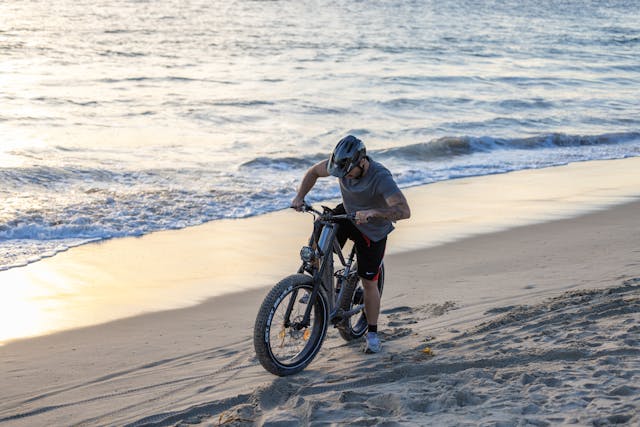
Generally, riding directly on the sand is either prohibited, impractical, or discouraged. Instead, most riders use nearby paved paths and roadways.
The best coastal riding is found on:
- Hugh S. Branyon Backcountry Trail
- Gulf State Park roads
- Shared-use paths around Gulf Shores
- Orange Beach cycling routes
Watch for heavy pedestrian traffic, especially during spring and summer.
City-Specific Riding Information
Although Alabama has statewide e-bike laws, cities may establish additional regulations for local parks, greenways, sidewalks, and shared-use facilities.
Birmingham
Birmingham has become one of Alabama’s most bicycle-friendly cities.
Popular riding areas include:
- Rotary Trail
- Red Rock Trail System
- Railroad Park
- Jones Valley Trail
Downtown Birmingham experiences heavy pedestrian traffic, so ride cautiously near parks, business districts, and shared-use paths.
Huntsville
Huntsville continues expanding its cycling infrastructure.
Popular locations include:
- Aldridge Creek Greenway
- Indian Creek Greenway
- Bradford Creek Greenway
- John Hunt Park
These greenways are excellent for recreational rides and family outings.
Mobile
Mobile offers several enjoyable riding locations, including:
- Three Mile Creek Greenway
- Mobile Bay waterfront
- Downtown Mobile
Expect increased pedestrian activity near waterfront attractions and public parks.
Montgomery
Montgomery continues improving bicycle access through bike lanes and shared-use facilities.
Popular riding locations include:
- Riverfront area
- Alabama Riverwalk
- Downtown bicycle routes
Use caution when riding near government buildings and busy intersections.
Tuscaloosa
Tuscaloosa offers a mix of recreational and commuter riding.
Popular locations include:
- Tuscaloosa Riverwalk
- Sokol Park
- Downtown bike lanes
Areas around the University of Alabama often experience heavy pedestrian traffic during the school year.
Auburn
Auburn is one of Alabama’s most bicycle-friendly college towns.
Popular riding destinations include:
- Auburn University campus
- Chewacla State Park
- City greenways
- Downtown Auburn
Always be alert for students walking between classes.
Gulf Shores
Gulf Shores attracts thousands of cyclists each year.
The city’s biggest attraction for e-bike riders is the Hugh S. Branyon Backcountry Trail, which offers one of the finest paved trail systems in the Southeast.
Remember:
- Yield to pedestrians.
- Follow posted trail speed limits.
- Stay off protected dunes and beach areas.
Orange Beach
Orange Beach connects directly with Gulf State Park’s trail system, making it another excellent destination for recreational riding.
Busy tourist seasons bring increased traffic, so ride defensively and remain alert around beach access points.
Riding on College and University Campuses
Many Alabama colleges have transportation policies that supplement state law.
The University of Alabama
The University of Alabama permits bicycles and e-bikes on campus but expects riders to follow university transportation rules.
Riders should:
- Yield to pedestrians.
- Use designated bicycle parking.
- Follow campus traffic signs.
- Respect restricted pedestrian areas.
The university also operates a shared micromobility program that includes designated parking and riding zones.
Auburn University
Auburn University permits bicycles and e-bikes but regulates their operation through campus transportation policies.
Riders should:
- Park only in approved locations.
- Avoid blocking sidewalks and building entrances.
- Yield to pedestrians at all times.
University of Alabama at Birmingham (UAB)
Because UAB serves both students and one of Alabama’s largest medical campuses, riders should expect busy sidewalks and pedestrian crossings.
Follow campus traffic signs and use bicycle parking where provided.
University of South Alabama
The University of South Alabama encourages cycling while requiring riders to operate responsibly around campus buildings and pedestrian areas.
Troy University
Troy University allows bicycles on campus while expecting riders to comply with university transportation policies and posted regulations.
Visiting Alabama with Your E-Bike
If you’re traveling to Alabama from another state, you’ll generally be able to ride your Class 1, Class 2, or Class 3 e-bike if it meets Alabama’s legal definition.
Before your trip:
- Review local trail rules.
- Check state park regulations.
- Follow university transportation policies if visiting a campus.
- Watch for local signs regarding shared-use paths.
A few minutes of planning can help you avoid unexpected restrictions and make your ride more enjoyable.
Equipment Requirements
In addition to Alabama’s electric bicycle laws, e-bike riders must also follow the state’s general bicycle equipment requirements.
If you’re riding after dark, your e-bike must be equipped with:
- A white front light visible from at least 500 feet.
- A red rear reflector visible from 100 to 600 feet when illuminated by a vehicle’s headlights.
- You may also use a red rear light in addition to the required reflector.
Every bicycle—including electric bicycles—must also have working brakes capable of making the braked wheels skid on dry, level, clean pavement. These requirements apply whether you’re riding a traditional bicycle or an e-bike.
My Tip
Even if you don’t plan to ride after dark, I recommend installing a bright front light and a flashing rear light. They make you much more visible during cloudy weather, heavy traffic, and early morning or evening rides.
Can You Modify Your E-Bike?
Many riders ask if they can remove the speed limiter, install a larger motor, or otherwise increase their e-bike’s performance.
The answer is: be careful.
Alabama law only recognizes electric bicycles that meet the statutory definitions for Class 1, Class 2, or Class 3 e-bikes.
If you modify your bike so that it no longer fits one of those definitions—for example by:
- Installing a motor larger than 750 watts
- Increasing the assisted speed beyond the legal class limits
- Making changes that remove it from the three-class system
it may no longer qualify as an electric bicycle under Alabama law.
Depending on the modification, your bike could instead be treated as another type of motor vehicle with different legal requirements.
If your goal is to ride legally on public roads, bike lanes, and shared-use paths, it’s generally best to keep your e-bike within Alabama’s legal specifications.
Riding Safely on Alabama Roads
Electric bicycles have the same basic rights and responsibilities as traditional bicycles.
That means riders should:
- Obey traffic signals and stop signs.
- Ride in the same direction as traffic.
- Ride as close to the right side of the roadway as practicable, except when preparing for a turn, avoiding hazards, or when it is unsafe to do so.
- Ride no more than two abreast unless riding on a path designated for bicycles.
- Use an adjacent usable bicycle path when one is provided alongside the roadway.
Motorists are also required to give bicyclists a safe passing distance of at least three feet when overtaking them.
Common Mistakes to Avoid
Even experienced riders occasionally overlook these rules.
Here are a few common mistakes that can lead to problems:
Riding a Class 3 E-Bike Without a Helmet
Class 3 operators and passengers must wear a properly fitted helmet.
Assuming Every Trail Allows Every E-Bike
Many trails welcome e-bikes, but some local governments restrict certain classes on specific bicycle or multi-use paths.
Always check posted signs.
Riding on Sidewalks
Because Alabama generally treats bicycles as vehicles, riding on sidewalks is generally prohibited unless a specific local rule or designated facility allows it.
Modifying Your E-Bike
Removing speed limiters or installing oversized motors may change your bike’s legal classification.
Forgetting Lights
Night riding without the required lighting is one of the easiest violations to avoid.
Penalties for Violating Alabama E-Bike Laws
Unlike some states, Alabama does not have a separate schedule of fines that applies only to electric bicycles.
Instead, e-bike riders are generally subject to the same traffic laws that apply to bicyclists.
Depending on the situation, violations may include:
- Traffic citations
- Local ordinance violations
- Restrictions from parks or trail managers
- Other penalties that apply under Alabama traffic law
Parents or guardians may also be responsible for certain violations committed by minors under Alabama’s bicycle laws.
Alabama E-Bike Law Summary
| Question | Answer |
|---|---|
| Are e-bikes legal? | ✔ Yes |
| Three-class system? | ✔ Yes |
| Driver’s license required? | ❌ No |
| Registration required? | ❌ No |
| Insurance required? | ❌ No |
| Maximum motor power | 750 watts |
| Class 3 minimum age | 16 |
| Class 3 helmet required | ✔ Yes |
| Speedometer required on Class 3 | ✔ Yes |
| Allowed on roads | ✔ Yes |
| Allowed in bike lanes | ✔ Yes |
| Allowed on most shared-use paths | Generally yes, unless locally restricted |
| Local governments may restrict trail access | ✔ Yes |
FAQs
Yes. Alabama recognizes Class 1, Class 2, and Class 3 electric bicycles that meet the state’s legal definition.
No. Qualifying electric bicycles do not require a driver’s license, registration, title, or insurance.
Usually yes, but local governments may restrict certain bicycle or multi-use paths, and natural-surface non-motorized trails may have additional restrictions.
Generally, no. Alabama treats bicycles as vehicles, and vehicles are generally prohibited from operating on sidewalks unless specifically authorized by law or local ordinance.
Many hunters do, but Wildlife Management Areas and public lands may have additional restrictions. Always review the regulations for the specific property before riding.
Yes. Tire size does not determine legality. A fat tire e-bike is legal if it meets Alabama’s definition of a Class 1, Class 2, or Class 3 electric bicycle.
Yes, if your e-bike is designed and equipped to carry a passenger. Carrying extra passengers on a bike that is only designed for one rider is not permitted under Alabama’s bicycle laws.
Alabama law does not prohibit properly designed bicycle child trailers. Use a trailer that is compatible with your e-bike, follow the manufacturer’s weight limits, and ride cautiously, especially on busy roads and shared-use paths.
My Take
One thing I like about Alabama’s electric bicycle laws is that they’re relatively easy to understand. The state follows the familiar three-class system used by many other states, so most riders won’t need to worry about licensing, registration, or insurance as long as their e-bike stays within the legal definition.
Where I see riders get tripped up is assuming that state law is the only rule that matters. Local governments, universities, state parks, and trail managers can all have their own policies for specific locations.
Whenever I’m riding somewhere new, I always take a minute to check the posted signs. It’s a simple habit that can save a lot of frustration.
Final Thoughts
For most riders, Alabama is a welcoming state for electric bicycles.
Whether you’re commuting to work, exploring one of the state’s beautiful greenways, or taking a weekend ride through Gulf State Park or along the Chief Ladiga Trail, you’ll generally enjoy the same rights and responsibilities as someone riding a traditional bicycle.
Just remember that the statewide rules are only part of the picture. Local trail managers, cities, universities, and parks may have additional regulations, so it’s always worth checking before you ride.
By understanding the law, respecting pedestrians, and riding courteously, you’ll help ensure that Alabama continues to be a great place to enjoy electric bicycles.
Continue Reading
If you found this guide helpful, you may also enjoy:
- State-by-State E-Bike Laws
- Can Electric Bikes Go on Trails?
- E-Bike Buying Guide
- Start Here
- Best Electric Bikes
- Best E-Bikes for Hunting
External Resources
For the most current information, refer to these official resources:
- Alabama Legislature – Code of Alabama (Electric Bicycles)
- Alabama Department of Transportation
- Alabama Department of Conservation and Natural Resources
- Alabama State Parks
- Drive Safe Alabama

Kristina is not just an enthusiast but a true authority on electric bikes. Nestled in the coastal beauty of Virginia, Kristina has found the perfect backdrop for her passion for electric biking. As a dedicated wife and homeschooling mom, her life revolves around family, faith, and the thrill of adventure.
Originally hailing from Ohio, Kristina's journey with electric bikes began as a curiosity and quickly evolved into a deep expertise. Her blog is a testament to her love for electric biking, combining her fascination for eco-friendly transportation with her coastal lifestyle.
When she's not cruising the beach on her electric bike, you'll find Kristina indulging in her other loves: long walks along the shore, getting lost in a good book, and cherishing moments with her loved ones. With a heart as big as her love for animals, especially cats, Kristina brings a unique perspective to the electric bike world, grounded in her strong faith in God and her dedication to a sustainable lifestyle.
Through her blog, Kristina shares her extensive knowledge of electric bikes, offering valuable insights, tips, and recommendations to fellow enthusiasts. Whether you're a seasoned rider or a newcomer to the electric bike scene, Kristina's blog is your go-to source for all things electric biking, fueled by her passion, expertise, and the scenic beauty of coastal Virginia.