E-Bike Motor Guide: Hub vs Mid-Drive, Power, Torque & How to Choose
An e-bike motor is only one part of the system that determines how an electric bike feels. Battery voltage and capacity, controller current, sensors, gearing, wheel size, total load, terrain, and software tuning can all change acceleration, climbing ability, range, and ride feel – even when two bikes advertise the same motor wattage.
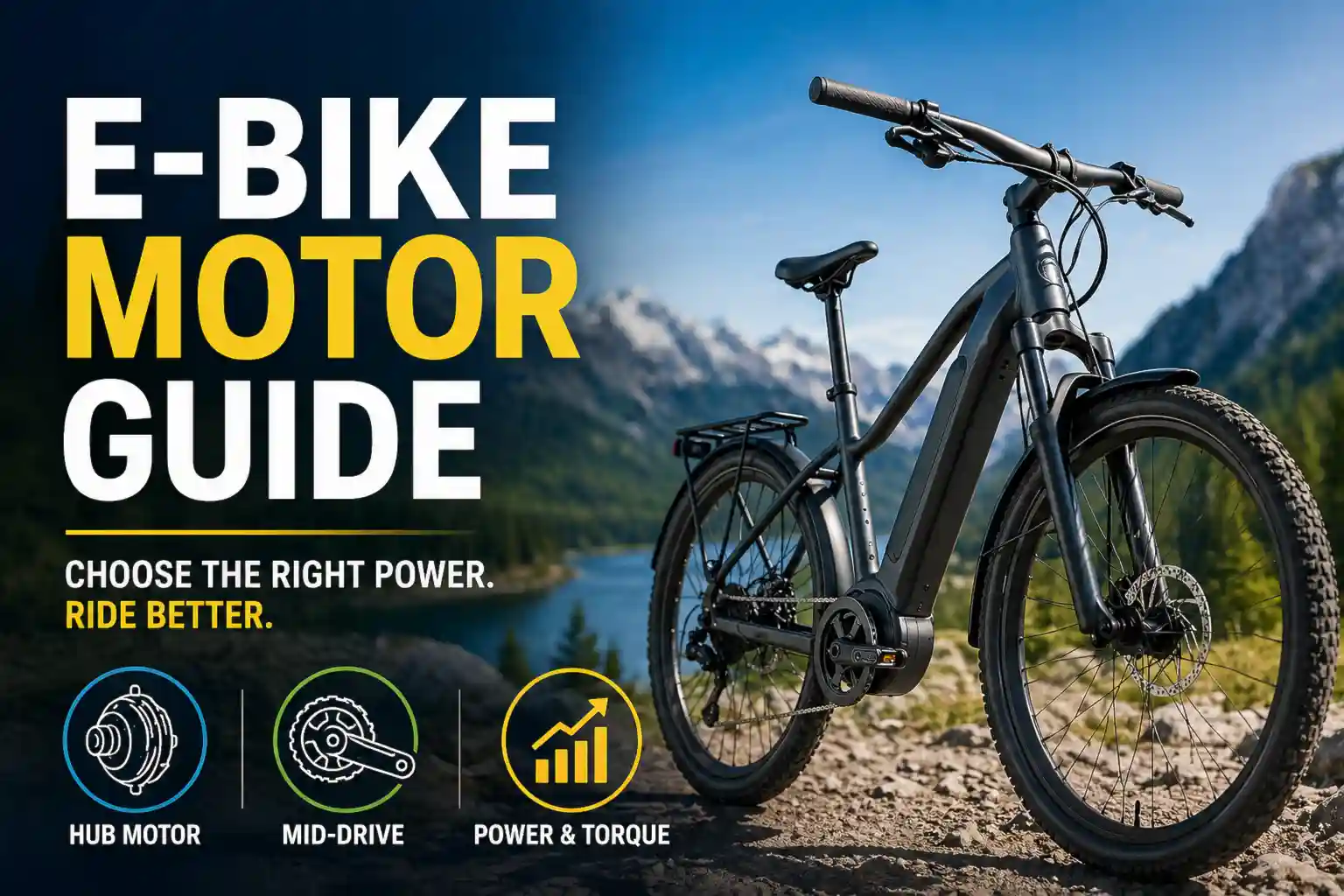
This e-bike motor guide explains the main motor types, watts and peak power, torque, cadence and torque sensors, hill performance, efficiency, lifespan, and the practical tradeoffs that matter when choosing a bike.
Want a quick starting point? Use the E-Bike Motor Selector Tool to compare hub and mid-drive options for your terrain, load, budget, and preferred ride feel. If you are still choosing your first bike, the complete E-Bike Buying Guide explains how the motor fits into the bigger buying decision.
In this guide you will learn:
- how the battery, controller, sensors, display, and motor work together
- the differences between front hub, rear hub, geared hub, direct-drive hub, and mid-drive motors
- what nominal watts, peak watts, voltage, amperage, and torque actually tell you
- why wattage alone does not determine speed, hills, acceleration, range, or ride quality
- how to match a motor system to commuting, hills, cargo, off-road riding, folding bikes, and heavier loads
- how to recognize motor warning signs and when professional diagnosis is the safer choice
Who This Guide Is For (and Who It’s Not)
This guide is for riders comparing motor types, trying to understand advertised power numbers, choosing an e-bike for hills or cargo, or troubleshooting a motor system that no longer feels right.
It is not an internal motor-rebuild manual or a guide to bypassing speed, current, thermal, or safety limits. Brand-specific electrical repairs should follow the manufacturer’s service information, and serious wiring or overheating problems are better handled by a qualified technician.
How We Evaluate E-Bike Motors
This guide is designed to help riders understand how e-bike motors perform in real-world riding conditions—not just on paper.
The information in this guide is based on:
• manufacturer motor specifications (watts, torque, assist systems)
• real-world rider experiences across commuting, hills, and cargo use
• comparisons between hub and mid-drive motor performance
• testing data and performance insights from major e-bike brands
• common issues and feedback reported by everyday riders
Our goal is to explain how e-bike motors actually feel and perform in daily use so readers can choose the right setup, avoid overpaying for unnecessary power, and ride with more confidence.
Explore E-Bike Motor Topics
E-bike motors are one of the biggest factors in how a bike feels, performs, and handles different terrain.
The guides below break down motor types, power, torque, ride feel, maintenance, and troubleshooting so you can quickly find the information you need.
Motor Basics

Learn how e-bike motors work, including hub vs mid-drive and how power is delivered.
Power & Torque

See how watts and torque affect performance and hill climbing.
Ride Feel & Performance

Learn why some e-bikes feel smoother or more powerful – even with similar specs.
Motor Tools

Estimate how much motor power you need for your riding style and terrain.
Motor Lifespan

Learn how long e-bike motors last and what affects their lifespan over time.
Motor Troubleshooting

Diagnose issues like power loss, cut-outs, and inconsistent performance.
Choosing a Motor
Compare motor types and find the best option for your terrain, riding style, and needs.
Motor Mistakes
Avoid common mistakes like choosing too much power or misunderstanding motor specs.
Riding Conditions
Find the best motor setup for hills, commuting, cargo, and different riding conditions.
How an E-Bike Motor Works
An e-bike motor converts electrical energy from the battery into mechanical assistance at the wheel or crank. The motor does not decide everything by itself. The controller determines how much electrical current is sent to the motor, while sensors tell the controller what the rider and bike are doing.
The basic chain is simple: the battery supplies energy, the controller meters power, the sensors detect rider or bike input, and the motor turns that command into assistance. The display or control pad lets you select an assist level and may also show speed, battery status, error codes, and system settings.
That is why two bikes with motors labeled 500W can behave very differently. Battery voltage, controller current limits, torque output, software tuning, sensor response, gearing, wheel size, and thermal protection can all change what you actually feel. The guide to why e-bikes with the same watt rating can feel different goes deeper into those differences.
If you want to understand the motor itself in more detail, the brushless vs brushed e-bike motor guide explains why modern e-bikes overwhelmingly use brushless designs.
Main E-Bike Motor Types
The first big choice is motor location. Hub motors drive a wheel directly. Mid-drive motors apply power through the bicycle drivetrain at the crank. Within the hub-motor category, geared and direct-drive designs behave differently.
Front Hub Motors
A front hub motor places the drive unit in the front wheel. It can keep the rear drivetrain simple and is common on some conversions, trikes, and utility setups. The tradeoff is that motor weight and drive force are concentrated at the steering wheel, so traction can be more limited on loose or steep surfaces and steering can feel heavier.
Rear Hub Motors
Rear hub motors are extremely common because they are relatively simple, work well with throttles on systems designed for them, and keep motor power separate from the chain and cassette. They often cost less than premium mid-drives. The rear wheel can be heavier and more involved to remove for tire or tube service.
Geared Hub Motors
A geared hub motor uses internal reduction gears so the motor can spin efficiently while the wheel turns more slowly. These motors can provide strong low-speed torque for their size and are often lighter than large direct-drive hubs. Internal gears and one-way clutches add wear parts, and most conventional freewheeling geared hubs cannot provide regenerative braking.
Direct-Drive Hub Motors
A direct-drive hub has no internal reduction gears between the motor shell and wheel. It can be mechanically simple, quiet, and durable, but it is usually heavier than a geared hub. Some direct-drive systems support regenerative braking, but direct-drive does not automatically mean regenerative braking. The controller and complete electrical system must support it, and the energy recovered on an e-bike is usually modest rather than a substitute for charging.
Mid-Drive Motors
A mid-drive motor sits near the crank and sends motor power through the bicycle’s chain or belt and gearing. Using the bike’s gears can help the motor stay in a useful operating range on long or steep climbs, which is one reason mid-drives are common on mountain bikes, cargo bikes, and premium commuters.
The tradeoff is that motor torque also loads the drivetrain. Chains, cassettes, chainrings, and shift components may wear faster, especially with hard shifts under power. Throttle availability also varies by motor system. A mid-drive is not automatically better for every rider.
| Motor type | Main strengths | Main tradeoffs |
|---|---|---|
| Front hub | Simple rear drivetrain, useful for some conversions and trikes | Front-wheel traction and heavier steering can be concerns |
| Rear hub | Affordable, common, simple drivetrain loading, throttle-friendly on many systems | Heavier rear wheel and more involved wheel removal |
| Geared hub | Compact, good low-speed torque for its size, usually freewheels easily | Internal gears/clutch can wear; most conventional designs do not regen |
| Direct-drive hub | Quiet, mechanically simple, can support regen in compatible systems | Usually heavier; regen is system-dependent |
| Mid-drive | Uses bike gearing, strong climbing potential, centered weight | Higher cost, more drivetrain wear, throttle support varies |
For a deeper side-by-side explanation, see the hub-drive vs mid-drive motor guide, the geared vs direct-drive hub motor guide, and the guide to hub vs mid-drive maintenance.
Watts, Peak Power, Continuous Power, Voltage, and Amps
Nominal or continuous wattage is intended to describe a level of power the system is designed to sustain under defined conditions. Peak wattage is a higher short-duration figure. Brands do not always measure, label, or advertise peak power the same way, so peak numbers are not automatically comparable.
Bosch provides a useful example: its Performance Line CX specifications list both a 250W rated continuous output and a much higher maximum power figure. That does not mean the motor continuously produces its maximum number. It shows why you need to know what kind of watt figure you are comparing.
A useful electrical relationship is watts ≈ volts × amps. A 48V system supplied with 20A is receiving roughly 960W of electrical input at that moment. That is an input estimate, not a guarantee of 960W of mechanical power at the wheel. Electrical and mechanical losses, controller behavior, motor speed, temperature, and efficiency all matter.
Voltage affects the electrical system’s operating level, while controller amperage limits how much current can be delivered. This is why controller programming and battery capability can make two similarly rated motors feel very different. Use the 250W vs 500W vs 750W motor guide for common rating comparisons, or the Motor Power Calculator for a scenario-based estimate.
A Note About Legal Power Limits
The U.S. federal low-speed electric bicycle definition used for consumer-product regulation includes fully operable pedals, a motor of less than 750W, and a motor-only speed condition below 20 mph under specified test conditions. That federal product definition is not a universal rule for where or how you may ride. State, city, trail, park, and land-manager rules can use different class, speed, equipment, and access requirements. Check the e-bike laws by state before choosing extra power that may affect where the bike can legally be used.
E-Bike Motor Torque and Hill Climbing
Torque is rotational force and is usually listed in newton-meters (Nm). More available torque can help a bike start strongly, accelerate under load, and maintain assistance at lower speeds. It is especially noticeable when climbing, carrying cargo, or restarting on an incline.
But the advertised torque number is not a hill-climbing guarantee. Climbing performance also depends on rider and cargo weight, hill grade and length, wheel size, motor type, controller programming, battery voltage and state of charge, gearing, cadence, traction, and motor temperature. A motor that performs well on a short climb can still heat up on a long climb if it is operating inefficiently.
Mid-drives often have an advantage on steep or sustained climbs because the rider can select a lower gear and let the motor spin faster. A strong hub motor can still be an excellent choice on moderate hills when it is correctly matched to the bike and load.
The torque vs wattage guide and e-bike motor torque guide explain the numbers in more detail.
Cadence Sensors vs Torque Sensors
A cadence sensor detects that the cranks are turning. On many systems, once pedaling is detected the controller delivers a programmed level of assistance. A torque sensor measures how hard you are pressing on the pedals and can adjust assistance in proportion to your effort.
| Factor | Cadence sensor | Torque sensor |
|---|---|---|
| What it detects | Pedal/crank rotation | Pedal force, usually combined with other system data |
| Ride feel | Can feel more on/off depending on tuning | Usually feels more proportional to rider effort |
| Starting behavior | May have a short rotation delay unless a throttle or other start strategy is used | Can react as pedal force rises, depending on tuning |
| Low-speed control | Varies widely by programming | Often easier to modulate precisely |
| Cost | Common on lower-cost bikes | Often used on higher-priced systems |
| Efficiency | Depends heavily on assist settings and rider behavior | Can encourage more proportional assistance, but is not automatically more efficient in every ride |
| Who may prefer it | Riders who want easy, consistent assistance with light pedaling | Riders who want a natural bicycle-like response and fine control |
Neither sensor is automatically best. A commuter on flat roads may prefer the simplicity of a well-tuned cadence system. A mountain-bike or fitness rider may value the natural modulation of a torque sensor. A rider with limited leg strength may prefer a cadence system, a throttle-equipped system where legal, or a very sensitive torque system depending on mobility and starting needs.
See the full cadence vs torque sensor comparison and the guide to how motor placement affects balance and handling.
Choosing an E-Bike Motor by Use
There is no single wattage that fits every rider. Start with the job the bike must do, then compare the complete system, legal class, battery, brakes, frame, tires, payload rating, and service support.
| Riding situation | Motor characteristics to prioritize | Watch for |
|---|---|---|
| Flat recreational riding | Smooth assistance, moderate power, quiet operation | Do not pay for power you will not use |
| Daily commuting | Predictable assist, efficient cruising, reliable support and parts | Range, weather exposure, serviceability, legal class |
| Moderate hills | Useful low-speed torque and sensible controller tuning | Total load and climb length matter as much as the watt label |
| Long or steep hills | Strong sustained climbing, good thermal management, suitable gearing | Heat buildup, battery sag, brake demands |
| Heavier riders | Torque, battery capability, sturdy wheels, adequate brakes, verified payload | Never exceed the bike’s stated payload limit |
| Cargo and child carrying | Low-speed control, strong torque, stable chassis, large battery, strong brakes | Combined rider, passenger, cargo, and accessory load |
| Hunting and off-road use | Traction, low-speed control, climbing ability, durable components | Trail-access and land-manager rules |
| Mountain biking | Responsive torque sensing, centered weight, useful gearing | Trail rules, drivetrain wear, heat on long climbs |
| Folding e-bikes | Compact packaging, manageable weight, moderate assist | Wheel size, heat, carrying weight, hinge/frame limits |
| Natural bicycle-like feel | Progressive torque sensing and smooth controller tuning | A high watt number does not guarantee refined assistance |
If hills are your main concern, see the e-bikes for hills guide. For compact storage and travel, compare the folding e-bike guide. Riders specifically interested in crank-drive systems can also review the crank-drive motor systems guide and the mid-drive e-bike guide.
Choosing a Motor for a Heavier Rider
For a heavier rider, the right answer is not simply “buy a bigger motor.” Total load, hill steepness, gearing, battery capability, controller settings, brakes, tires, wheels, frame rating, and the manufacturer’s payload limit all need to work together.
An oversized motor does not make it safe to exceed a bike’s stated payload capacity. If you are close to the limit, use the E-Bike Payload Calculator and the guide to e-bikes for heavier riders to evaluate the complete bike rather than the motor alone.
Motor Efficiency and Range
A larger motor does not automatically give you more range, and it does not automatically give you less range. What matters is how much energy the complete bike uses during your ride and how much usable energy the battery stores.
Speed, assist level, hill grade, tire pressure, wind, temperature, rider input, total weight, stop-and-go riding, battery watt-hours, motor operating speed, and controller behavior all affect consumption. A motor can be efficient in one operating range and inefficient in another. For example, repeatedly asking a hub motor for high torque at very low wheel speed on a steep climb can create substantial heat.
For trip planning, use the E-Bike Range Calculator. The E-Bike Battery Guide explains battery capacity and how it interacts with motor demand.
Interactive Motor Selector Tool
Not sure which motor setup fits your riding style? Use this quick tool to get a general recommendation based on terrain, riding needs, budget, and performance preferences.
Find Your Ideal E-Bike Motor Setup
Answer a few quick questions to see which motor type may fit your riding style best.
Note: This tool gives a general recommendation. Terrain, rider weight, local laws, battery size, and bike design can all affect real-world performance.
Results are for general guidance only. Real-world performance can vary based on rider weight, terrain, battery size, gearing, tire pressure, local laws, and specific bike design. Always compare full bike specs before buying.
Motor Lifespan, Care, and Warning Signs
There is no universal mileage figure for e-bike motor life. A well-designed motor can provide years of service, but lifespan depends on load, heat, water exposure, bearing and gear wear, drivetrain condition, installation quality, maintenance, and whether replacement parts remain available.
Basic owner care usually means keeping connectors secure and dry, maintaining tire pressure, keeping the drivetrain clean and lubricated, shifting a mid-drive sensibly, and avoiding repeated overheating. The guide to maintenance mistakes that can damage an e-bike motor covers common preventable problems.
Warning signs worth investigating include:
- new grinding, clicking, scraping, or crunching noises
- intermittent power or repeated cutouts
- excessive or unusual heat
- sudden loss of assistance
- persistent error codes
- damaged or pinched motor cables
- rough bearings or unusual vibration
A rider can safely start with a visual inspection for loose connectors, damaged cables, wheel interference, obvious drivetrain drag, and a battery that is not fully seated. Stop riding if there is severe heat, smoke, sparks, a burning or chemical odor, damaged high-current wiring, or a wheel/motor problem that could affect control. Internal motor or high-current electrical diagnosis is safer in the hands of a qualified shop or manufacturer.
For more detail, see how long e-bike motors last and the guide to e-bike motor grinding and unusual noise.
When a Motor Cuts Out or Feels Weak
A bike that loses assistance does not automatically have a failed motor. Brake cutoff sensors, battery voltage sag, loose connectors, controller faults, display settings, speed sensors, throttles, overheating, and drivetrain drag can all create symptoms that feel like a motor problem.
Start with the general E-Bike Troubleshooting and Maintenance Guide. If the symptoms point toward the controller, use the E-Bike Controller Diagnostic Tool. For a display warning, use the E-Bike Error Code Finder. If the bike is simply slow or weak, the Slow E-Bike Diagnostic Tool can help narrow down common causes.
For specific symptoms, see the guides to a motor that will not engage, an e-bike that shuts off while riding, and overheating e-bike motors.
Common E-Bike Motor Selection Mistakes
- Shopping by peak wattage alone. Peak figures can be measured and marketed differently, and they tell you little about sustained performance by themselves.
- Ignoring torque and controller programming. Low-speed response and climbing depend heavily on how the complete system delivers power.
- Ignoring battery capacity and output. A motor cannot deliver useful assistance if the battery cannot support the required current or does not have enough energy for the trip.
- Assuming every mid-drive is automatically better. Hub motors can be simpler, cheaper, and perfectly suited to many commuters and recreational riders.
- Choosing more power than local rules permit. Motor rating, class, throttle behavior, and riding location can affect legality and access.
- Overlooking replacement parts and service support. A technically impressive motor is less attractive if batteries, controllers, displays, sensors, or service are difficult to obtain.
- Ignoring drivetrain wear on mid-drives. Motor torque passes through the chain or belt and gearing.
- Confusing motor power with payload capacity. A stronger motor cannot make an overloaded frame, wheel, rack, tire, or brake system safe.
- Assuming a high-powered motor guarantees long range. Range depends on energy use and battery capacity, not the motor label alone.
The guide to why bigger motors do not always mean better e-bikes covers these tradeoffs in more detail. If you are considering changing an existing bike, also read the e-bike motor upgrade considerations before assuming a larger motor is a plug-and-play improvement.
Frequently Asked Questions
How many watts should an e-bike motor have?
There is no single correct wattage. Terrain, total load, speed expectations, motor type, controller limits, gearing, local rules, and how much you pedal all matter. Compare nominal and peak figures carefully instead of choosing the largest advertised number.
Is a 500W motor enough for hills?
It can be, especially on moderate hills with an appropriately geared mid-drive or a well-matched hub system. A long, steep climb with a heavy load can require very different performance than a short neighborhood hill, so the 500W label alone is not enough to answer the question.
Is a 750W motor better than a 500W motor?
Not automatically. The 750W system may offer more available power, but the better bike depends on torque, controller tuning, battery capability, motor type, gearing, heat management, ride feel, weight, reliability, and legal use.
Is torque more important than watts?
They describe different things. Torque helps explain rotational force and low-speed response, while watts describe power. Hill climbing and acceleration depend on both, along with motor speed, gearing, controller current, total load, and temperature.
Are mid-drive motors better than hub motors?
Mid-drives are often excellent for steep hills, cargo, and riders who want centered weight and a natural pedal response. Hub motors can be simpler, less expensive, easier on the bicycle drivetrain, and very effective for commuting and recreational riding. The best choice depends on the job.
How long does an e-bike motor last?
There is no reliable universal mileage figure. Motor quality, bearings, gears, heat, water exposure, load, drivetrain care, installation, and parts support all influence service life.
Can an e-bike motor overheat?
Yes. Long steep climbs, high load, low motor speed, hot weather, aggressive current settings, or poor cooling can raise temperatures. Some systems reduce power to protect themselves. Repeated or extreme overheating deserves investigation rather than simply pushing through it.
Why does an e-bike motor cut out while climbing?
Possible causes include battery voltage sag, a controller current or temperature limit, motor thermal protection, a loose connection, brake cutoff input, or a failing component. Repeated cutouts under load are a reason to diagnose the electrical system rather than assuming the motor itself has failed.
Can I replace an e-bike motor with a more powerful one?
Sometimes, but compatibility involves the controller, battery, wiring, display, sensors, frame or dropout strength, wheel, brakes, firmware, and legal classification. A motor swap should not exceed the capability of the rest of the bike.
Does a larger motor reduce range?
Not by itself. Range depends on how much energy the system uses. A larger motor ridden gently can use less energy than the same motor ridden hard, while a smaller motor can consume energy quickly when pushed inefficiently on a steep climb. Battery watt-hours, speed, hills, wind, temperature, assist level, and rider effort are usually more useful to consider together.
My Take
I would not choose an e-bike by the biggest motor number on the sales page. Start with the terrain, total load, legal class, and ride feel you actually need. Then look at nominal and peak power, torque, controller behavior, battery size, sensor type, gearing, brakes, service support, and the complete bike.
For many everyday riders, a well-designed hub-motor bike is simple, practical, and more than capable. A good mid-drive becomes especially attractive when long climbs, cargo, mountain-bike use, or a natural pedal response matter more than low purchase price and drivetrain simplicity.
If two bikes look similar on paper, pay attention to how the entire electrical and mechanical system is put together. That usually tells you more than peak wattage alone.
Sources
- U.S. Consumer Product Safety Commission – bicycle and low-speed electric bicycle requirements
- Bosch eBike Systems – Performance Line CX specifications and sensor information
- Grin Technologies – hub motor options and technical differences
- Grin Technologies – regenerative braking technical overview
Not sure where to go next?
Some riders are brand new. Others are fixing a problem or thinking about a new bike. Choose what fits you.
Learn & Get Comfortable
Understand how e-bikes work and what to expect when riding.
Improve Your Current Ride
If your bike isn’t performing how you want, learn what affects speed, range, and power.
Compare Better Bikes
Looking for something that fits your riding style? Start here.
- Best Electric Bikes for Beginners
- Recommended Commuter Ebikes
- Most Comfortable City E-Bikes
- Best Fat Tire Ebikes
- Top Folding Ebikes
- Best Step Through Ebikes
- Top Cargo Electric Bikes
- Best Lightweight Ebikes
- Best Long Range Ebikes
- Top Moped Style E-Bikes
- E-bike Reviews
🛒 Ready to Buy?
Top picks and current availability from trusted brands.
👉 Still deciding?
Take our E-Bike Recommendation Quiz to get matched with the right riding style in under two minute