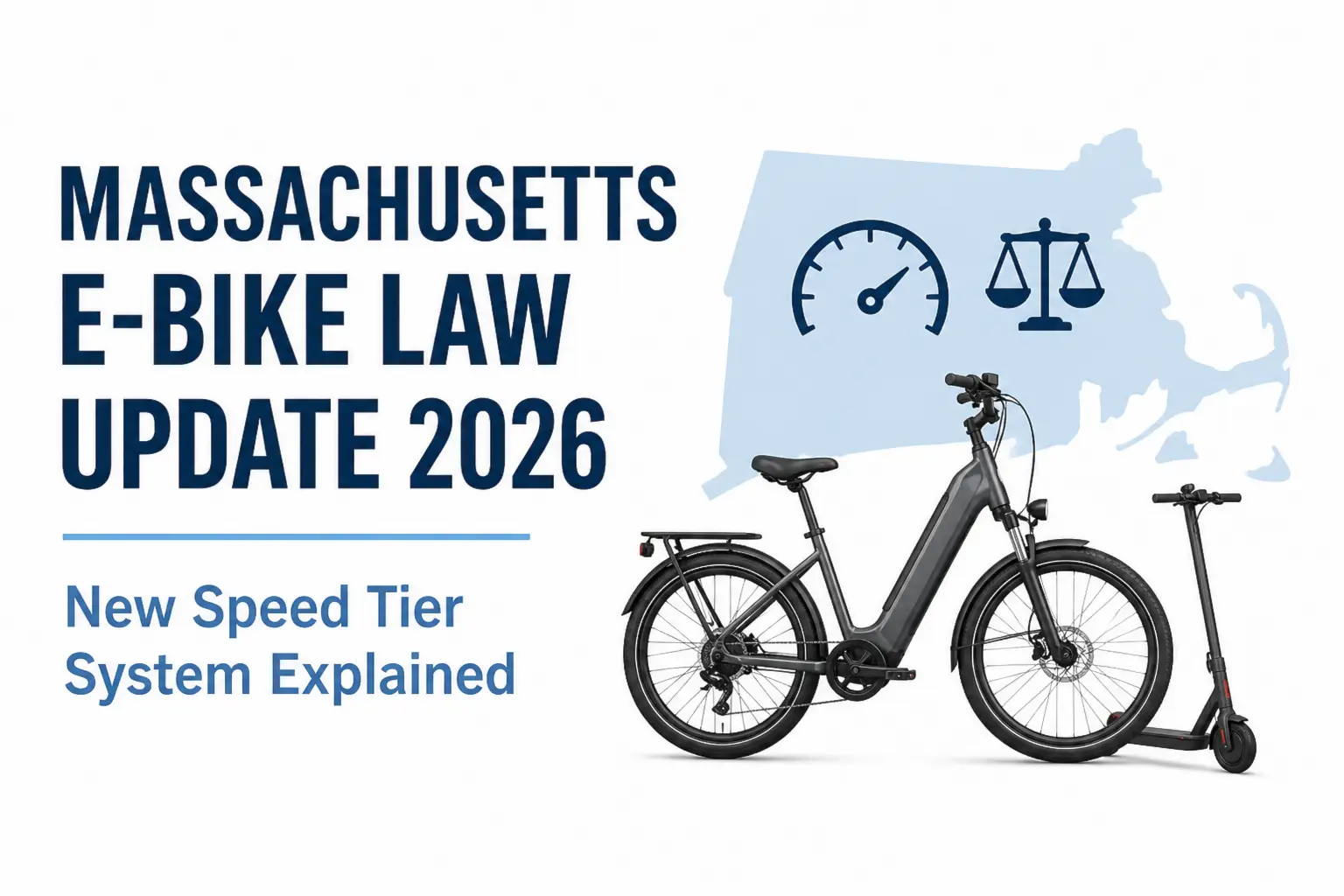
Massachusetts Proposes New E-Bike & Scooter Laws With Speed-Based Tiers
Last Updated on May 5, 2026 by Kristina
Massachusetts is moving toward what could become one of the most important e-bike law changes in the U.S.
Governor Maura Healey has introduced a new bill that would completely reshape how e-bikes, scooters, and other micromobility devices are classified and regulated – and it’s built around one key idea: speed matters more than labels.
If passed, this could become a first-in-the-nation framework for regulating e-bikes and similar vehicles.
Why Massachusetts Is Changing E-Bike Laws
E-bikes and scooters are everywhere now – but the laws haven’t kept up.
Right now, Massachusetts lumps very different vehicles together, from pedal-assist e-bikes to faster mopeds. That’s created confusion for riders, law enforcement, and cities trying to manage safety.
State officials say they’re seeing:
- More crashes and close calls
- Complaints about reckless riding
- Conflicts between riders and pedestrians
The new bill aims to fix that by creating clear, enforceable rules based on how fast a device can go.
How This Compares to Current Massachusetts E-Bike Law
Right now, Massachusetts does not clearly follow the standard 3-class e-bike system used in most states. Instead, many e-bikes fall into older “motorized bicycle” or moped-style definitions, which can create confusion around:
- Where you can legally ride
- Whether registration is required
- How speed limits are enforced
👉 If you want a full breakdown of current rules, see my
Massachusetts e-bike law guide →
👉 You can also compare how Massachusetts stacks up to other states here:
State-by-state e-bike laws →
🎬 What’s Actually Changing? (Quick Video Breakdown)
There’s a lot of confusion right now around whether e-bikes are being treated more like bicycles or mopeds.
This short clip explains why some lawmakers and communities are starting to blur that line – especially as speeds increase.
👇 Watch this quick breakdown:
The New Speed Tier System (Explained Simply)
Instead of classifying vehicles by type (like “e-bike” or “moped”), the proposal groups them into four speed tiers:
Tier 0 (0–20 mph)
- Includes most Class 1 and Class 2 e-bikes
- Treated like traditional bicycles
- Allowed in bike lanes and shared-use paths
- Helmet required for riders under 16
This is the category most everyday e-bike riders fall into.
Tier 1 (20–30 mph)
- Includes Class 3 e-bikes and mopeds
- Still allowed in bike lanes (with restrictions)
- Not allowed on sidewalks
- Riders must be 16+
- Helmet rules expand
Tier 2 (30–40 mph)
- Faster mopeds and limited-use motorcycles
- Banned from bike lanes and shared paths
- Treated more like motor vehicles
Tier 3 (40+ mph)
- Motorcycles and high-speed vehicles
- Fully excluded from bike infrastructure
💡 The key idea:
The faster the vehicle, the stricter the rules.
Real-World Examples (What Tier You Might Fall Into)
To make this easier to understand:
- A typical commuter e-bike (like Aventon, Lectric, or Velotric) → Tier 0
- A faster Class 3 commuter (28 mph pedal assist) → Tier 1
- A high-powered dual-motor or modified e-bike → could fall into Tier 1 or Tier 2
This matters because your top speed – not just your label – determines where you can ride.
Other Key Rules in the Proposed Bill
Beyond speed tiers, the legislation introduces:
- Minimum age requirements (16+ for higher-speed devices)
- Helmet requirements (especially for younger riders and faster tiers)
- Equipment rules (lights, reflectors, brakes)
- Potential registration, licensing, and insurance for faster vehicles
- More authority for the state to adapt rules as new tech emerges
What Makes This Law Different
Most states regulate e-bikes using a 3-class system (Class 1, 2, 3).
Massachusetts is going a different direction:
- Speed-based instead of category-based
- Designed to be future-proof as new devices hit the market
- Covers everything from e-bikes to scooters to emerging micromobility tech
This could influence how other states update their laws in the future.
What Happens Next
The bill still needs to pass through the Massachusetts legislature.
If approved:
- It would establish a statewide framework
- Additional rules (like registration or insurance) could come later
- A working group may refine details through 2027
What This Means for E-Bike Riders
If you ride a typical e-bike (Class 1 or 2):
Not much changes – you’ll still be treated like a bicycle.
But if you ride faster bikes or modified e-bikes:
Expect:
- More restrictions
- Possible registration or insurance
- Limits on where you can ride
Will This Change Where You Can Ride on Sidewalks?
One of the biggest practical impacts of this proposal is how it affects sidewalk riding.
Under the proposed system:
- Tier 0 (0–20 mph) devices may still be allowed in many areas depending on local rules
- Tier 1 (20–30 mph) devices are generally restricted from sidewalks
- Faster tiers are fully excluded from pedestrian areas
This follows a broader trend across the U.S.:
Slower e-bikes are treated like bicycles
Faster e-bikes are treated more like motor vehicles
If you’re unsure about sidewalk rules where you live, I break it down here:
👉 Are e-bikes allowed on sidewalks? (All 50 states) →
Important: Modified or High-Speed E-Bikes Could Be Affected Most
One major takeaway from this proposal:
Modified e-bikes may be regulated based on actual speed, not original classification.
That means:
- Unlocking speed limits
- Adding dual motors
- Increasing controller output
…could move your bike into a higher regulatory tier, even if it started as a standard e-bike.
This is something more states are starting to pay attention to.
My Take
Honestly, this is one of the smartest directions I’ve seen from a state so far.
For a long time, e-bike laws have been trying to fit everything into neat categories – but the reality is:
A 20 mph commuter e-bike and a 35+ mph “e-moto” are completely different machines.
This bill finally acknowledges that.
What I Like
- It protects normal riders (Tier 0 stays simple)
- It targets actual problem areas – speed and unsafe riding
- It future-proofs laws as new devices come out
What I’m Watching Closely
- Whether stricter rules creep into lower-speed bikes later
- How aggressively cities start restricting Tier 1 devices
- If registration requirements expand beyond higher-speed tiers
The Bigger Picture
This feels like the start of a shift nationwide.
States are realizing:
“E-bike” isn’t one thing anymore.
And laws are starting to catch up.
Stay Updated on E-Bike Laws
E-bike laws are changing quickly across the U.S.
👉 Start here:
Complete state-by-state e-bike laws guide →
Bottom Line
Massachusetts is proposing a major change:
E-bike rules based on speed, not labels
If it passes, it could:
- Improve safety
- Reduce confusion
- Set the standard for future e-bike laws across the U.S.
For more news on electric bikes click here

Kristina is not just an enthusiast but a true authority on electric bikes. Nestled in the coastal beauty of Virginia, Kristina has found the perfect backdrop for her passion for electric biking. As a dedicated wife and homeschooling mom, her life revolves around family, faith, and the thrill of adventure.
Originally hailing from Ohio, Kristina's journey with electric bikes began as a curiosity and quickly evolved into a deep expertise. Her blog is a testament to her love for electric biking, combining her fascination for eco-friendly transportation with her coastal lifestyle.
When she's not cruising the beach on her electric bike, you'll find Kristina indulging in her other loves: long walks along the shore, getting lost in a good book, and cherishing moments with her loved ones. With a heart as big as her love for animals, especially cats, Kristina brings a unique perspective to the electric bike world, grounded in her strong faith in God and her dedication to a sustainable lifestyle.
Through her blog, Kristina shares her extensive knowledge of electric bikes, offering valuable insights, tips, and recommendations to fellow enthusiasts. Whether you're a seasoned rider or a newcomer to the electric bike scene, Kristina's blog is your go-to source for all things electric biking, fueled by her passion, expertise, and the scenic beauty of coastal Virginia.