Maryland E-Bike Laws (2026 Guide): What’s Legal, Where You Can Ride, and Local Rules Explained
Last Updated on April 20, 2026 by Kristina
If you’re riding an e-bike in Maryland, the basic laws are simple – but where you can actually ride depends on city rules, trail systems, and who manages the land.
That’s where most riders get confused.
This guide breaks everything down clearly so you can ride safely and legally.
👉 Start here: E-Bike Buying Guide
👉 Understand your bike: E-Bike Classes Explained
👉 Sidewalk rules by state
⚠️ Maryland E-Bike Laws Are NOT One System
This is the most important thing to understand:
Maryland uses a layered rule system:
- State law → defines what an e-bike is
- City/local law → controls sidewalks + riding behavior
- Trail authority → controls where you can ride on trails
📌 That’s why rules can change just by crossing into a different city or trail system.
What Counts as an E-Bike in Maryland
Under Maryland Transportation Code §11-117.1, an electric bike must:
- Have operable pedals
- Have 2 or 3 wheels
- Have a motor 750 watts or less
- Follow Class 1, 2, or 3 system
✔ If it meets these rules:
➡ It is treated as a bicycle (not a motor vehicle)
Maryland E-Bike Classes (Quick Breakdown)
| Class | Max Speed | Throttle | Best Use |
|---|---|---|---|
| Class 1 | 20 mph | No | Trails + general riding |
| Class 2 | 20 mph | Yes | Comfort + casual riding |
| Class 3 | 28 mph | No | Road commuting |
📌 Important:
Class 3 e-bikes are the most restricted in real-world riding.
Where You Can Ride in Maryland
Roads & Streets
All classes are allowed where bicycles are allowed.
Bike Lanes
- Fully allowed
- Same rights as bicycles
Sidewalks (Key Rule Most Riders Miss)
Maryland generally allows bicycle use on sidewalks unless a local jurisdiction restricts it.
That means:
- Allowed in some areas
- Restricted or banned in others
Always verify locally
⚠️ Multi-Use Paths (Especially for Class 3)
- Class 1 → usually allowed
- Class 2 → sometimes restricted
- Class 3 → often restricted unless explicitly allowed
If you plan to ride paths regularly:
Class 1 is the safest choice
Maryland City E-Bike Rules
Baltimore (Strictest Enforcement)
- Sidewalk riding generally prohibited
- Exception limited cases at very low speed ( (~6 mph)
- Must ride roads or bike lanes
High enforcement area
Annapolis
- E-bikes treated as bicycles
- Restrictions in downtown and waterfront areas
- Strong pedestrian enforcement
Montgomery County (Most Rider-Friendly)
- Extensive bike infrastructure
- Sidewalk riding often allowed (varies locally)
- Trails widely usable
Best for commuting + path riding
Prince George’s County
- Strong trail network
- Focus on:
- Designated routes
- Speed control
Howard County
- Mixed rules
- Depends on trail type and park authority
Smaller Towns (Often Overlooked)
Some towns have stricter rules than major cities:
- Easton → sidewalk restrictions
- Other towns → local bans possible
Always check local ordinances
Maryland City Comparison
| Area | Sidewalks | Trails | Class 3 | Enforcement |
|---|---|---|---|---|
| Baltimore | Restricted | Limited | Restricted | High |
| Annapolis | Restricted zones | Limited | Restricted | Medium-High |
| Montgomery County | Mixed | Strong | Limited | Low |
| Prince George’s | Mixed | Strong | Limited | Medium |
| Howard County | Mixed | Mixed | Limited | Medium |
Maryland E-Bike Trail & Class Checker
Not sure whether a Class 1, 2, or 3 e-bike makes the most sense for how and where you ride in Maryland? Use this quick tool for a practical estimate, then double-check local signs and trail rules before heading out.
Maryland trail access is not one-size-fits-all. State park trails, county trail systems, and federal trails can all follow different e-bike rules.
Maryland E-Bike Trail & Class Checker
Use this tool for a quick Maryland-specific estimate of which e-bike class usually fits your riding style, and where you may need to double-check trail or local rules before riding.
Maryland E-Bike Trail Map (Overview)
Maryland trail access is not one-size-fits-all. Some trails are managed by Maryland DNR, some by county park systems, and others by the National Park Service. That means e-bike rules can change depending on the trail, the class of your bike, and the current posted signage.
This custom map highlights major Maryland trail systems riders often ask about, including rail trails, paved county paths, and major long-distance routes.
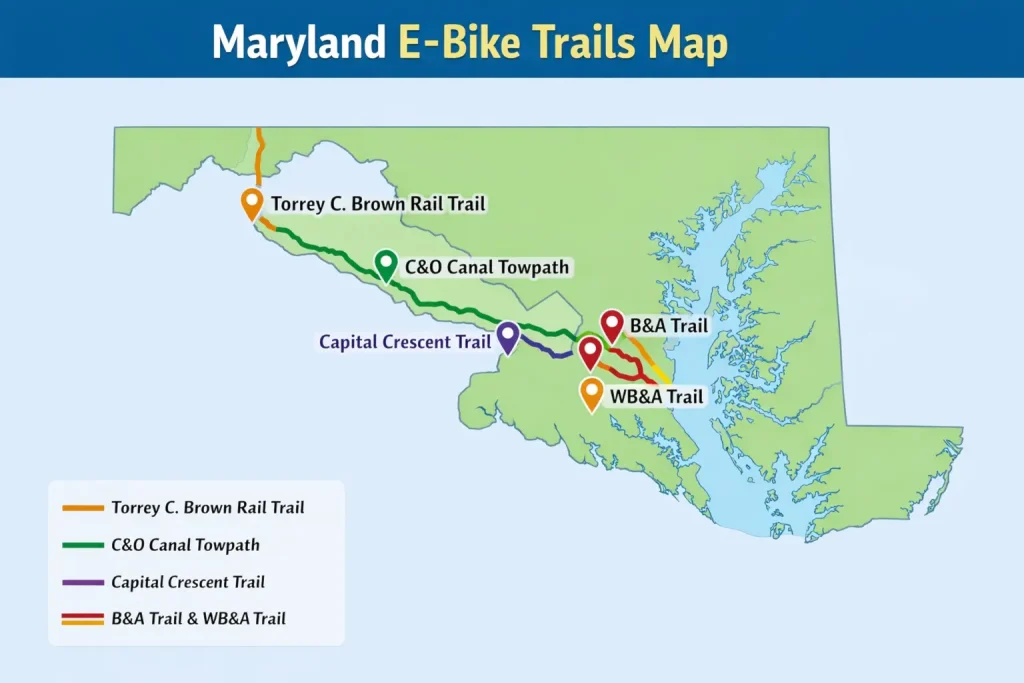
This is a custom visual overview of major Maryland trail corridors, not a navigation map. Always check official trail pages and posted signs before riding.
Maryland Trail Access
⚠️ No Single Statewide Trail Rule
Trail access depends on who manages the trail:
- Maryland DNR (state parks)
- County parks
- National Park Service
Maryland State Park Trails (DNR)
- Most trails → e-bikes not allowed unless designated
- Known allowed:
- ✔ Torrey C. Brown Rail Trail → Class 1
- ✔ Western Maryland Rail Trail → Class 1
These are the clearest legal trail options.
C&O Canal Towpath (National Park Service)
- E-bikes allowed where bicycles are allowed
- Must:
- Pedal (no throttle-only riding)
- Follow ~15 mph speed limit
Best fit: Class 1
Capital Crescent Trail
- Mixed control (NPS + local)
- Federal sections → stricter
- Local sections → vary
Best fit: Class 1
Anne Arundel County Trails (B&A + WB&A)
- E-bikes allowed on paved trails
- Must:
- Follow speed limits
- Yield to pedestrians
Best fit: Class 1 or 2
Prince George’s County Trails
- Allowed on designated paved trails only
- Trail-specific rules apply
Best fit: Class 1 or 2
Maryland Trail Selector Tool
Want a quicker way to check whether your e-bike class is a good fit for a specific Maryland trail? Use this trail selector tool to compare major trail systems and see where Class 1, Class 2, and Class 3 e-bikes are most likely to fit.
Maryland Trail Selector Tool
Choose a Maryland trail and your e-bike class for a quick, practical guide to what is usually allowed, what restrictions may apply, and what to double-check before you ride.
What E-Bike Class Should You Choose?
Best overall → Class 1
- Works almost everywhere
- Least restrictions
Best for comfort → Class 2
- Throttle included
- Some limits on trails
Best for commuting → Class 3
- Fastest option
- Best for road use
Common Maryland E-Bike Mistakes (and How to Avoid Them)
Assuming all trails allow e-bikes
Not true. Many Maryland trails have specific rules depending on who manages them.
✔ Always check:
- Trail signage
- Park or trail website
Riding a Class 3 e-bike on shared-use paths
Class 3 e-bikes are often restricted on multi-use trails and paths.
✔ Best use:
- Roads
- Bike lanes
- Commuting routes
Ignoring local city rules
State law sets the baseline, but cities can override key rules, especially for sidewalks and enforcement.
✔ Example:
- Baltimore is much stricter than surrounding areas
Using throttle where it may not be allowed
Some trails and paths restrict:
- Throttle use (Class 2)
- Or motor-only operation
✔ When in doubt:
- Use pedal assist instead of throttle
⚠️ Modifying an E-Bike in Maryland (What You Need to Know)
If you modify your e-bike, it may no longer be considered a legal electric bicycle under Maryland law.
This includes changes like:
- Increasing motor power beyond 750 watts
- Removing or bypassing the speed limiter
- Modifying the bike to exceed:
- 20 mph (Class 1 & 2)
- 28 mph (Class 3)
What happens if you modify your e-bike?
If your bike no longer meets Maryland’s e-bike definition:
➡ It may be legally classified as a motor vehicle or moped
That can mean:
- You may need registration
- You may need insurance
- You may need a license
- You may NOT be allowed on bike paths or trails
Where this becomes a real problem
Modified e-bikes are often:
- Not allowed on multi-use trails
- Not allowed in bike lanes in some situations
- Treated differently in accidents or enforcement
Even if enforcement seems low, liability risk is much higher.
Real-world advice
If you plan to ride:
- On trails → stick with Class 1
- In cities → avoid modifying speed limits
- For commuting → use a legal Class 3 instead of modifying
⚠️ Possible Future Law Changes
Maryland is actively reviewing and expanding e-bike access rules.
Potential changes may include:
- Expanded trail access
- Additional regulations
Not fully implemented yet – but important to watch
Maryland E-Bike Law Summary
| Rule | Maryland |
|---|---|
| Max Power | 750W |
| Max Speed | 20–28 mph |
| License | No |
| Registration | No |
| Insurance | No |
| Helmet | Under 16 |
| Class 3 Age | 16+ |
Nearby State Law Guides
Traveling outside Maryland? Laws change quickly. Check other states:
California e-bike laws
Pennsylvania e-bike laws
Ohio e-bike laws
Virginia e-bike laws
Indiana e-bike laws
👉 Compare all states in the state-by-state e-bike law guide
Common Questions About Riding an E-Bike in Maryland
Yes. E-bikes are legal in Maryland as long as they meet the state definition, which includes having operable pedals, a motor of 750 watts or less, and fitting into Class 1, Class 2, or Class 3 categories.
When these conditions are met, e-bikes are treated as bicycles, not motor vehicles.
No. Maryland does not require a driver’s license to operate a standard e-bike.
As long as your e-bike meets the legal definition, you can ride it without a license.
No. E-bikes do not need to be registered in Maryland.
However, if your bike is modified beyond the legal limits, it may no longer qualify as an e-bike and could require registration under different vehicle laws.
No. Insurance is not required for standard e-bikes in Maryland.
That said, some riders choose to carry insurance for added protection, especially when commuting in busy areas.
It depends on the city.
Maryland generally allows bicycles and e-bikes on sidewalks unless a local jurisdiction restricts it. Cities like Baltimore have stricter rules, especially in high-traffic areas.
👉 For a full breakdown by state and city, see:
Are E-Bikes Allowed on Sidewalks? State-by-State Guide
E-bikes are generally allowed anywhere bicycles are allowed, including:
Roads and streets
Bike lanes
Some multi-use paths
Certain trails (depending on the managing authority)
However, local laws and trail rules can restrict access in specific areas.
Yes. E-bikes are allowed in bike lanes in Maryland and have the same rights as traditional bicycles.
This includes all three classes, although local conditions and traffic laws still apply
Some are, but not all.
Class 1 e-bikes are the most widely allowed
Class 2 e-bikes may be restricted in some areas
Class 3 e-bikes are often not allowed on multi-use trails
Trail access depends on the managing agency, such as Maryland DNR, county parks, or the National Park Service.
Sometimes.
Class 2 e-bikes, which include a throttle, are allowed on some paved trails but may be restricted in areas where throttle use is not permitted.
Always check trail-specific rules before riding.
Often no.
Class 3 e-bikes are frequently restricted on multi-use paths and trails because of their higher speeds.
They are best suited for roads and bike lanes.
Yes, but with restrictions.
E-bikes are allowed where bicycles are permitted, but riders must:
Use pedal assist (not throttle-only operation)
Follow speed limits (typically around 15 mph)
Class 1 e-bikes are the best fit for this trail.
Yes, e-bikes are allowed in Baltimore, but there are stricter local rules compared to many other areas in Maryland.
Sidewalk riding is generally restricted, especially in downtown and high-traffic areas
Riders are expected to use bike lanes or roads
Enforcement is higher than in most other cities in the state
Best practice:
Stick to bike lanes and streets, and avoid sidewalks unless clearly permitted.
Yes, but expect stricter enforcement in certain areas.
E-bikes follow the same rules as bicycles
Sidewalk riding is often restricted in downtown and waterfront areas
Riders must follow all traffic laws
Best practice:
Ride on roads or bike lanes, especially in tourist-heavy zones.
Yes, on many paved and designated trails.
Prince George’s County has a strong trail system, including routes like the WB&A Trail and Anacostia Tributary Trail system.
Class 1 e-bikes are the safest choice
Class 2 e-bikes are often allowed
Class 3 e-bikes may be restricted on shared-use paths
Trail-specific rules still apply, so check posted signs before riding.
My Take on Maryland E-Bike Laws (What Actually Matters)
If you take everything in this guide and boil it down to what matters most in real-world riding, here’s how I would approach it.
Best choice for most riders: Class 1
If you want the least hassle and the most flexibility, Class 1 is the safest option.
- Works on the most trails and multi-use paths
- Rarely restricted compared to other classes
- Ideal for casual riders, fitness riding, and mixed-use paths
If you’re unsure what to buy, Class 1 is the most “future-proof” option in Maryland.
Best commuter setup: Class 3 (roads and bike lanes)
If your main goal is commuting, especially longer distances, Class 3 makes sense.
- Faster speeds (up to 28 mph)
- Better for keeping up with traffic
- Ideal for road riding and bike lane commuting
But:
- Often restricted on trails and shared-use paths
- Not ideal if you plan to ride in parks or mixed-use areas
Think of Class 3 as a road-focused e-bike, not a trail bike.
Best balance option: Class 2 (comfort + throttle)
If you want a more relaxed riding experience:
- Throttle helps with hills and stop-and-go riding
- Good for casual riding and shorter trips
⚠ Trade-off:
- Some trails restrict throttle use
- Slightly more limited than Class 1 in certain areas
Biggest advice for riding in Maryland
Maryland isn’t difficult – but it does require awareness.
Before every ride, especially in a new area, check:
- Local city rules (especially sidewalks)
- Trail signage and posted restrictions
- Park or trail authority guidelines
This matters because:
- Rules can change between cities
- Trails are managed by different agencies
- What’s allowed in one place may not be allowed a few miles away
Simple rule to remember
If you want the least restrictions:
Choose Class 1
If you want speed for commuting:
Choose Class 3 (and stay on roads)
If you want comfort and flexibility:
Choose Class 2 (but expect some limits)
Final thought
The biggest mistake riders make in Maryland isn’t choosing the wrong bike –
it’s assuming the rules are the same everywhere.
They’re not.
Ride with awareness, follow posted rules, and you’ll avoid almost every issue.
External Sources
- Maryland Transportation Code §11-117.1
- Maryland DNR Trail Policy
- National Park Service (C&O Canal)
- Anne Arundel County Parks
- Prince George’s County Parks
- PeopleForBikes

Kristina is not just an enthusiast but a true authority on electric bikes. Nestled in the coastal beauty of Virginia, Kristina has found the perfect backdrop for her passion for electric biking. As a dedicated wife and homeschooling mom, her life revolves around family, faith, and the thrill of adventure.
Originally hailing from Ohio, Kristina's journey with electric bikes began as a curiosity and quickly evolved into a deep expertise. Her blog is a testament to her love for electric biking, combining her fascination for eco-friendly transportation with her coastal lifestyle.
When she's not cruising the beach on her electric bike, you'll find Kristina indulging in her other loves: long walks along the shore, getting lost in a good book, and cherishing moments with her loved ones. With a heart as big as her love for animals, especially cats, Kristina brings a unique perspective to the electric bike world, grounded in her strong faith in God and her dedication to a sustainable lifestyle.
Through her blog, Kristina shares her extensive knowledge of electric bikes, offering valuable insights, tips, and recommendations to fellow enthusiasts. Whether you're a seasoned rider or a newcomer to the electric bike scene, Kristina's blog is your go-to source for all things electric biking, fueled by her passion, expertise, and the scenic beauty of coastal Virginia.