E-Bikes vs Mopeds vs Scooters: The US Laws That Can Get You Fined Fast
Last Updated on May 20, 2026 by Kristina
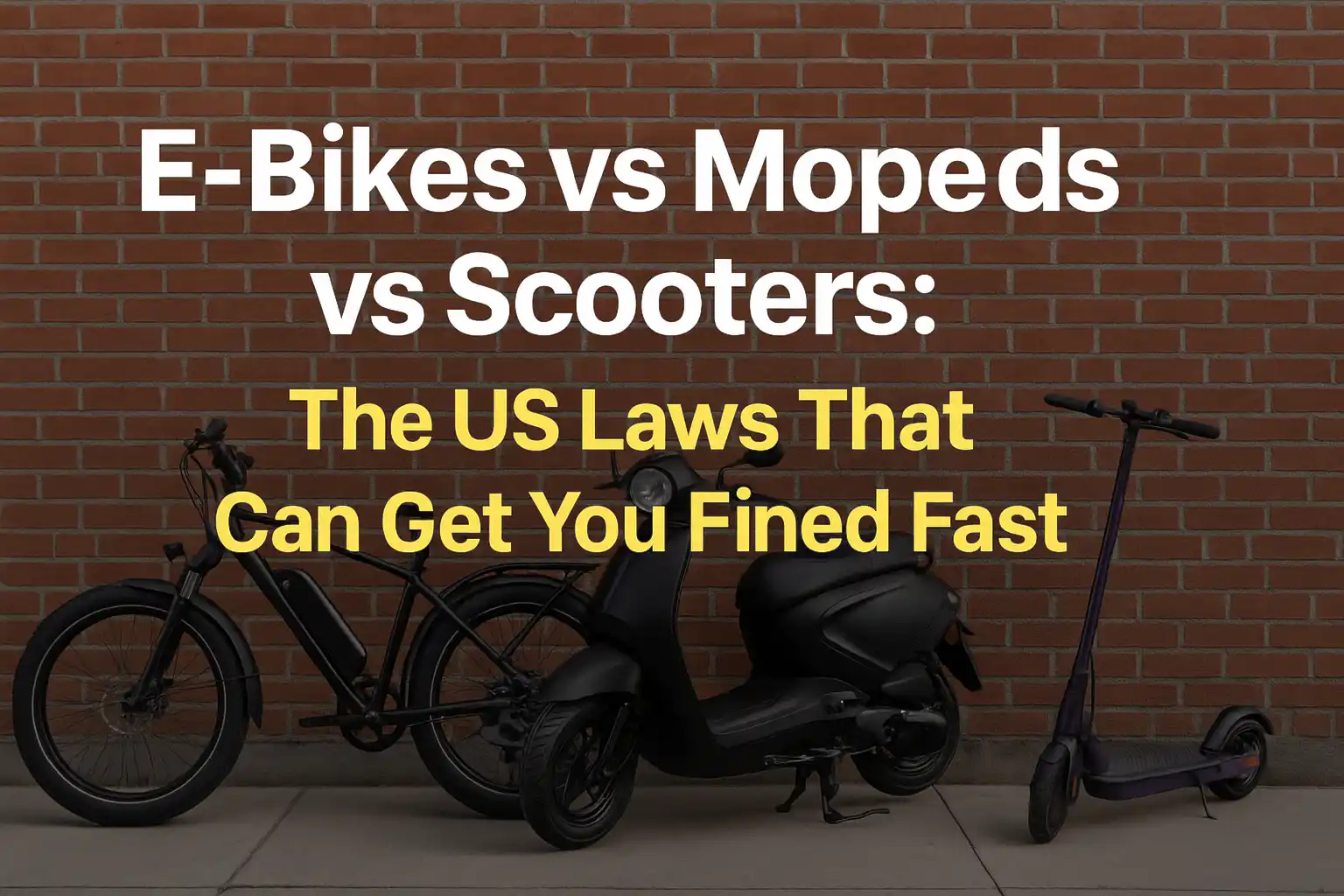
Electric transport is everywhere now – e‑bikes, mopeds, rental scooters, personal scooters. But US laws do not treat them the same. And the legal category you fall into decides whether you may ride in a bike lane, whether you need a licence, and whether police can stop or even impound your vehicle.
Reality check: Most people who get ticketed did not “break the law on purpose.” They just assumed their e‑bike was “still a bicycle” – or that a scooter was “treated like a Lime rental.” That assumption is what gets you fined.
Why Legal Classification Matters Before You Ride or Buy
Three things depend directly on classification:
- Where you can ride (bike lane, road, sidewalk, trail)
- What documents you need (licence, plates, insurance)
- What penalties apply (warnings, fines, seizure/impound)
The category is determined by behaviour and speed, not by what the seller called it.
Reality check: If it looks and rides like a tiny motorcycle, US cities usually treat it like a motor vehicle — no matter what the Amazon listing said.
📖 Read Next
What Makes an E-Bike Road-Legal? (2025 U.S. State Guide)
Florida’s Collier County Bans Class 2 and 3 E-Bikes From Sidewalks
NYC Council Moves to Ban Sale of Fast Class 3 E-Bikes in New Legislation
California’s New E-Bike Law: Throttles No Longer Welcome on Class 1 and 3 Bikes
Understanding Electric Bike Classes: A Comprehensive Guide
What is a Throttle on an E-Bike? A Beginner’s Guide
Federal vs State vs City — Who Decides the Rules?
In the US, the rule stack is layered:
- Federal law — defines what counts as a “low‑speed electric bicycle” for manufacturing/safety
- State law — sets categories (Class 1/2/3 e‑bike laws, moped licence rules, registration)
- City/Local rules — decide lane/sidewalk access, speed caps, enforcement intensity
You must follow all three.
Reality check: Even if your e‑bike is “federally defined as a bicycle,” a city can still ban it from a specific path or lane.
👉 Wondering where sidewalk riding is allowed nationwide? See the Sidewalk Rules by State Guide.
At‑a‑Glance: Summary Table of Legal Classes
| Type | Top Legal Speed Limits* | Bike Lane Access? | Licence / Plate / Insurance? |
|---|---|---|---|
| Class 1 / Class 2 e‑Bike | ≈20 mph (pedal assist / throttle) | ✅ Usually yes | ❌ Usually not |
| Class 3 e‑Bike | ≈28 mph (pedal assist only) | ⚠️ Varies widely | ❌ Usually not |
| Moped / Fast “E‑Bike” >28 mph | 30 mph+ (throttle or assist) | ❌ Usually no | ✅ Yes — licence/plate/insurance |
| Electric Scooter (city rules) | ≈15–20 mph | ✅ Often yes (not sidewalks) | ❌ Usually not unless high‑speed |
* These are approximate / typical U.S. thresholds — always check your local state and city rules.
US Legal Definition of an E‑Bike (Not Just Any Bike With a Motor)
Most US states now follow the 3‑Class system:
- Class 1 — Pedal assist only, motor cuts at ~20 mph
- Class 2 — Throttle allowed, motor cuts at ~20 mph
- Class 3 — Pedal assist, motor cuts at ~28 mph, often banned from multi‑use trails
Key point: If your vehicle assists above the class limit or has been modified to bypass a limiter, it usually ceases to be an “e‑bike” legally and slides into moped/motorcycle rules.
Reality check: If you buy a “52 V 35–40 mph e‑bike” from a direct‑to‑consumer brand, it is not legally an e‑bike in most US states — it is a moped or motorcycle for enforcement purposes.
US Legal Definition of a Moped
A moped is legally a motor vehicle (even if tiny):
- Has a throttle
- Typically exceeds 20–30+ mph
- Needs licence + registration + insurance in many states
- Must ride in traffic lanes, not bike lanes
Reality check: Having pedals does not make something “a bicycle” in US law once speed exceeds the limit.
US Legal Definition of an Electric Scooter (Kick Scooter / Sit‑Down Scooter)
Electric scooter rules are city‑dependent:
- Often no licence for low‑speed scooters
- Speed caps ~15–20 mph
- Often allowed in bike lanes, not sidewalks
- Sidewalk bans strictly enforced in some cities (LA, SF)
- Shared vs personal scooters are treated differently
Reality check: A 15‑mph shared Lime scooter and a 40‑mph stand‑up “performance scooter” are not the same in the eyes of US law.
Thinking about a moped-style electric bike?
If you’ve decided pedals aren’t for you, the next step is choosing something that’s actually safe, supported, and realistic for how you plan to ride.
👉 See our best moped-style e-bikes for 2026, including real-world pros and cons, range expectations, and what to watch out for before buying.
How US Cities Enforce E-Bike, Moped, and Scooter Laws Differently
New York City (NYC):
- Class 1 & 2 e‑bikes are allowed in bike lanes.
- Mopeds must be registered.
- NYPD conducts seizures of unregistered mopeds used in bike lanes.
Los Angeles (LA):
- Scooters are banned on sidewalks.
- Speed‑limited on certain pathways.
Chicago:
- E‑bikes allowed in bike lanes.
- Scooters have operating zones + speed/time limits.
San Francisco / Seattle:
- Scooter sidewalk bans enforced.
- Class 3 e‑bikes may be restricted on shared paths.
Reality check: The city where you actually ride can make a legal Class 3 feel illegal in practice — not because Class 3 is banned, but because that city bans Class 3 on that path.
Here’s a city-by-city snapshot of how the same vehicle is treated differently depending on where you ride it:
| City | E-Bikes (Class 1/2/3) | Mopeds | Electric Scooters |
|---|---|---|---|
| NYC | Class 1 & 2 allowed in bike lanes; Class 3 allowed in traffic bike lanes but restricted on some paths | Must be plated; unregistered mopeds often seized | Rental scooters limited zones; sidewalk riding banned |
| Los Angeles | E-bikes in bike lanes; Class 3 restricted on some trails | Must use vehicle lanes; no bike lanes | Scooters banned on sidewalks; speed caps on paths |
| Chicago | E-bikes allowed in most bike lanes; Class 3 may be restricted on trails | Treated as motor vehicles; Reg+plates+licence | Scooter pilots regulate zones + hours |
| San Francisco | Class 1/2 widely allowed; Class 3 restricted on shared paths | Not allowed in bike lanes | Scooters banned on sidewalks, monitored downtown |
| Seattle | Similar to SF; Class 3 harder on shared paths | Motor vehicles only | Scooters lane-allowed but enforced for sidewalk riding |
Reality check: What is “fully legal” in one city can get you stopped, ticketed, or seized in another — without crossing a state line.
The Single Biggest Enforcement Trigger in US Cities
Riding something that behaves like a moped — inside a bike lane.
If your vehicle:
- Has a throttle
- Exceeds ~20‑28 mph
- Looks or accelerates like a motor vehicle
…then officers assume “moped with no plates in bike lane” — a ticket or seizure risk.
Reality check: Police do not run a technical classification test roadside — they judge by speed + lane + behavior.
Mistakes That Get People Fined (Across US Cities)
- Riding a non‑registered moped in a bike lane
- Riding >20‑28 mph inside a bike lane on what you think is an “e‑bike”
- Riding scooters on sidewalks where banned (LA / SF / NYC)
- Believing “because I pedaled, it counts as a bicycle”
- Believing “because I bought it on Amazon, it must be legal”
- Believing “I see others doing it so it must be fine”
Reality check: Seeing 100 people break a rule does not prove the rule doesn’t exist — it only proves enforcement hasn’t reached them yet.
Short Decision Tree — What Am I Legally Riding?
- Does it assist above ~20‑28 mph? → If yes, it may not be an e‑bike.
- Does it move with a throttle and no pedaling? → That leans toward moped classification.
- Could you ride it in traffic at 30+ mph with cars? → Then most cities will require motor‑vehicle rules.
- Would you feel afraid to share a lane with cars on it? → If yes, it’s probably not legally allowed where you’re riding it.
Reality check: Legality is not what you intend — it is how the machine performs.
Still unsure which category your ride falls under? This chart compares the legal differences at a glance:
| Factor | Street-Legal E-Bike (Class 1/2/3) | Moped / Fast “E-Bike” >28 mph | Electric Scooter (city rules) |
|---|---|---|---|
| Motor behavior | Pedal-assist; Class 2 throttle ≤20 mph | Throttle, exceeds e-bike speed caps | Mostly throttle; capped in shared fleets |
| Top assist / speed | 20 mph (Class 1/2), 28 mph (Class 3) | 30–45+ mph | 15–20 mph typical |
| Licence needed | Usually no | Usually yes | Usually no if low speed |
| Registration / plates | No | Usually yes | No (unless high-speed scooter) |
| Insurance | Rarely | Often required | Rarely |
| Bike lanes | Class-dependent, often yes | No | Often yes (sidewalk bans common) |
| Sidewalks | Depends on city | No | Often banned in major cities |
Reality check: US law doesn’t care what the product page called it — it cares how it behaves and where you ride it.
Before‑You‑Ride Checklist (US‑Focused)
- Know the Class (1/2/3) or moped status
- Check bike lane vs road rules for your city
- If moped/motorcycle speed — expect licence + plate + insurance
- If scooter — confirm sidewalk rules and speed caps
- Assume shared paths have extra restrictions
- When in doubt, ride in road lanes, not bike lanes
Reality check: In US cities, choosing the “wrong lane” is the fastest way to get stopped — not the machine itself.
FAQ
In many states yes, but many cities ban Class 3 on multi‑use paths and trails
No licence is required for Class 1 or Class 2 in most US states
Yes, in most states.
Often no — sidewalk bans are common in major cities
Yes — especially in NYC for unregistered mopeds used in bike lanes
No. At that speed it is treated as a motor vehicle under most US laws.
Legal‑Friendly E‑Bikes
Note: Always check motor speed, throttle limits, and local bike lane rules.
- Lectric XP4 – A folding commuter e‑bike starting around $999, with strong upgrades and value. Ships with Class 1/2 mode (throttle + pedal assist up to ~20 mph) although higher‑speed versions exist.
Buy from Lectric
✳️ Read our full review of the Lectric XP4 to understand its strengths and what to watch for. - Ride1Up Roadster V3 – Sleek city commuter with torque sensor, no throttle, and ~24 mph pedal assist — suitable for many Class 3 paths.
Buy from Ride1Up
✳️ See our Ride1UP Roadster V3 review for real‑world riding insights. - Heybike Ranger 3.0 Pro – Full‑suspension, fat‑tire foldable e‑bike. Ships in Class 2 mode (~20 mph throttle + pedal assist) but can be unlocked to ~28 mph — check local laws & keep it limited for best legality.
Buy from Heybike
✳️ Check our review of the Ranger 3.0 Pro for how it performs and how to keep it compliant. - Mokwheel Obsidian – High‑performance fat‑tire e‑bike (~1000 W motor, top speeds > typical bike‑lane limits). If you consider this model: ensure it’s limited or be prepared for moped/vehicle rules.
Buy from Mokwheel
✳️ Read our Mokwheel Obsidian review to understand trade‑offs between power and legality. - Aventon Aventure 3 – Rugged fat‑tire e‑bike built for exploration; ships in ~20 mph mode but capable of 28 mph when unlocked.
Buy from Aventon
✳️ Read our review of the Aventon Aventure 3 to see how it handles and what unlock settings mean legally.
Disclaimer: Specs, settings, and local laws vary. Always verify the exact version you’re buying, confirm speed/throttle limits, and check your state/city regulations before riding.
Seizure Risk / Enforcement Trigger Sidebar
Seizure risk is highest when:
- A vehicle behaves like a moped/motorcycle (speed >20‑28 mph)
- It is not registered/insured/licensed
- It is being ridden in a bike lane or sidewalk
Reality check: You are rarely seized for “owning the wrong thing” — you are seized for riding it in the wrong place without the required documents. Most first-time buyers regret buying “the fastest thing” — not because of power, but because of where it becomes illegal to ride it.
Final Takeaway
If it behaves like a bicycle, the law treats it like one.
If it behaves like a motor vehicle, the law treats it like one.
Legal status is not about branding — it is about speed, throttle, and lane.
Useful Resources
Helpful? Bookmark or share this post with friends before they get ticketed.

Kristina is not just an enthusiast but a true authority on electric bikes. Nestled in the coastal beauty of Virginia, Kristina has found the perfect backdrop for her passion for electric biking. As a dedicated wife and homeschooling mom, her life revolves around family, faith, and the thrill of adventure.
Originally hailing from Ohio, Kristina's journey with electric bikes began as a curiosity and quickly evolved into a deep expertise. Her blog is a testament to her love for electric biking, combining her fascination for eco-friendly transportation with her coastal lifestyle.
When she's not cruising the beach on her electric bike, you'll find Kristina indulging in her other loves: long walks along the shore, getting lost in a good book, and cherishing moments with her loved ones. With a heart as big as her love for animals, especially cats, Kristina brings a unique perspective to the electric bike world, grounded in her strong faith in God and her dedication to a sustainable lifestyle.
Through her blog, Kristina shares her extensive knowledge of electric bikes, offering valuable insights, tips, and recommendations to fellow enthusiasts. Whether you're a seasoned rider or a newcomer to the electric bike scene, Kristina's blog is your go-to source for all things electric biking, fueled by her passion, expertise, and the scenic beauty of coastal Virginia.