
Puckipuppy Poodle Review: Big Battery and Strong Brakes for the Price
Last Updated on August 24, 2026 by Kristina
📚 Research-Based Review – Built from independent sources, specs, and user reports
Introduction
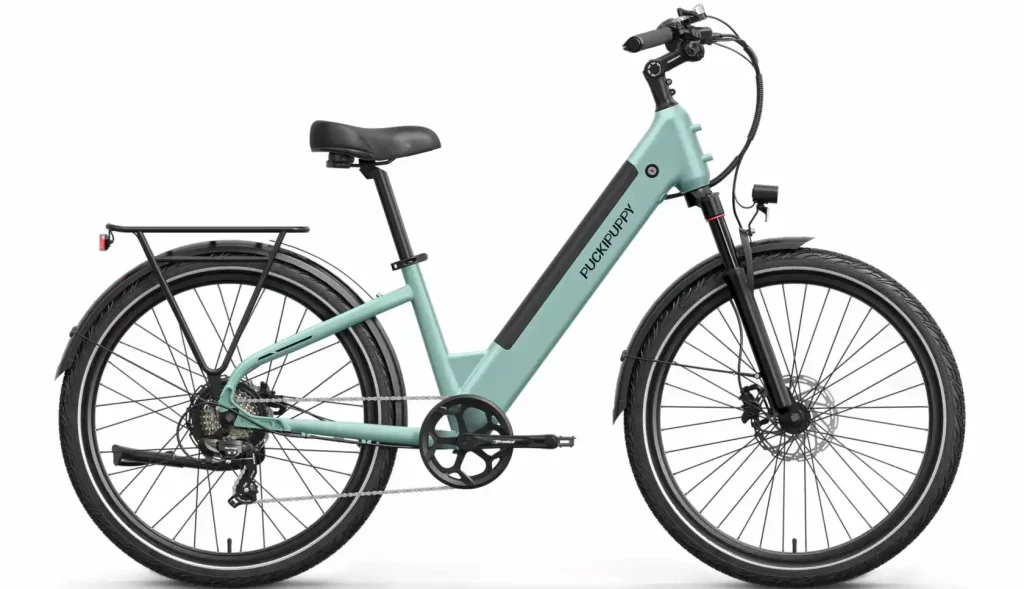
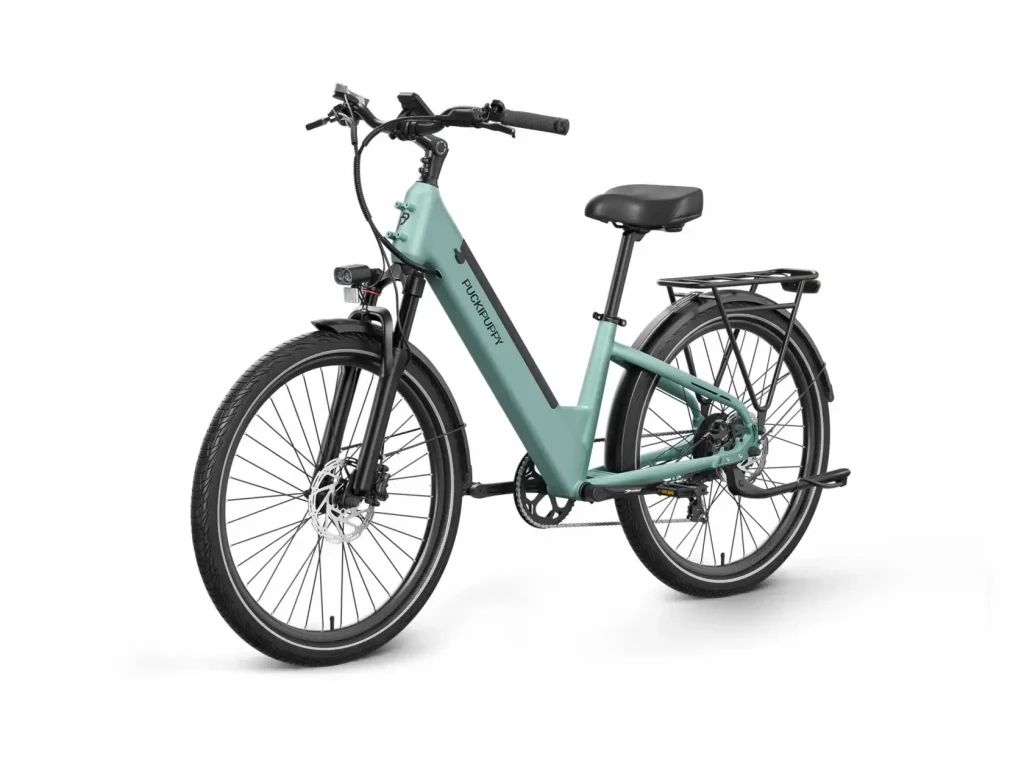
The Puckipuppy Poodle is a full-size step-through commuter e-bike built around a 750W rear-hub motor, 48V 15Ah removable battery, hydraulic disc brakes, 27.5 x 2.4 in. tires, front suspension, and a relatively low step-through frame.
What catches my attention is how much useful hardware Puckipuppy puts into an e-bike that has been promoted below $1,000. The Poodle has a nominal 720Wh of battery capacity, hydraulic brakes with 180mm rotors, an adjustable cockpit, a color display, a 350 lb manufacturer-listed maximum load capacity, and pedal assistance that can reach 28 mph.
The tradeoffs are also important. The Poodle uses a cadence sensor rather than a torque sensor, its 7-speed drivetrain has a fairly narrow reported gearing range, it lacks the connected technology found on some newer commuters, and Puckipuppy currently says UL 2849 certification for the complete Poodle electrical system is still in progress.
If you are still figuring out which features matter, my complete e-bike buying guide explains motor power, batteries, sensors, brakes, fit, and other buying considerations. You can also compare the Poodle with models in my commuter e-bike guide or browse more Electric Bike Explorer reviews.
Quick Verdict
Overall Rating: 7.9 out of 10 – Good with Tradeoffs
Best for: Budget-conscious commuters, recreational riders, beginners, returning cyclists, and riders who want a comfortable step-through frame with a substantial battery.
Strongest reason to buy: The combination of a 720Wh battery, hydraulic brakes, accessible frame, and useful commuter equipment is strong when the Poodle is selling near its lower promotional price.
Biggest tradeoff: The cadence-sensor pedal assist and basic 7-speed drivetrain are less refined than the torque-sensor systems and wider gearing available on some competitors.
Review type: Research-Based Review
Evidence confidence: Moderate
Price checked: August 22, 2026
🔎 Why You Can Trust This Review
I researched this review using Puckipuppy’s current product specifications, comparison information, warranty and return policies, certification statements, replacement-parts listings, independent performance testing, and available rider information.
I separate manufacturer claims from independent test results and disclose conflicting or unverified specifications rather than choosing the number that looks best. Affiliate relationships do not influence my rating or conclusion. You can read more about how I research and score electric bikes.
Who the Puckipuppy Poodle Is Good For – and Who Should Skip It
Who It Is Good For
I think the Poodle makes the most sense for someone who wants a traditional full-size commuter or recreational e-bike rather than a folding bike, fat-tire bike, cargo bike, or lightweight fitness-oriented model.
- Daily commuters: The large battery, hydraulic brakes, full-size wheels, front suspension, and upright geometry are useful for normal everyday transportation.
- Beginners: The step-through frame and adjustable riding position make the bike approachable, although new riders should become familiar with how its cadence sensor engages.
- Returning cyclists: The low frame can make mounting and stopping easier than a traditional high-step frame.
- Recreational riders: The Poodle should suit neighborhood rides, paved paths, errands, and casual weekend riding.
- Riders who want substantial battery capacity: The listed 48V 15Ah battery works out to approximately 720Wh.
- Riders who prioritize hydraulic brakes: Puckipuppy lists hydraulic discs, and both its comparison page and independent testing identify 180mm rotors front and rear.
- Riders needing a higher load rating: Puckipuppy lists a 350 lb maximum load capacity.
Who Should Skip It
I would probably choose something else if you:
- Want the proportional, bicycle-like response of a good torque sensor.
- Regularly ride long or very steep hills.
- Want a wider-range drivetrain with lower climbing gears.
- Want Bluetooth, GPS, app-based tuning, navigation, or sophisticated anti-theft technology.
- Specifically require completed UL 2849 certification for the entire e-bike system.
- Frequently need to carry your bike upstairs.
- Are at the very top of the claimed rider-height range and require full pedaling extension.
- Prefer buying and servicing your bike through a large established local dealer network.
Puckipuppy Poodle Specifications
| Specification | Puckipuppy Poodle |
|---|---|
| Bike type | Commuter / recreational e-bike |
| Current price checked | Puckipuppy’s product page displayed $899.99 on August 22, 2026, while its comparison page displayed $1,099.99. Confirm the final checkout price. |
| Availability | Official product page listed the Poodle in stock and shipping within 2 working days when checked |
| Frame style | Step-through |
| Frame material | 6061 aluminum alloy |
| Colors | Sage Green, White, Slate Blue, Dusty Purple |
| Claimed rider height | 5 ft. 3 in. to 6 ft. 4 in. |
| Bike weight | 63.1 lb claimed; independent testing measured approximately 64 lb |
| Maximum load capacity | 350 lb claimed. Puckipuppy does not state a separate rider-only weight limit on the current specification page. |
| Standover height | 19.4 in. |
| Reach | 19.69 in. |
| Head tube length | 6.89 in. |
| Wheelbase | 44.69 in. |
| Handlebar height | 46.46 in. |
| Minimum saddle height | 29.13 in. |
| Maximum saddle height | 38.19 in. |
| Motor | 750W rear-hub motor |
| Peak motor output | 960W claimed |
| Official torque rating | Not published by Puckipuppy |
| Throttle | Thumb throttle |
| Throttle speed | Up to 20 mph |
| Pedal-assist speed | Up to 28 mph where configured and legally permitted |
| Manufacturer class designation | Class 2/3 |
| Pedal-assist sensor | 48V cadence sensor |
| Pedal-assist levels | 5 |
| Battery | 48V 15Ah removable lithium-ion battery |
| Nominal battery capacity | Approximately 720Wh |
| Manufacturer-claimed range | 45 to 75 miles |
| Independent range information | Electric Bike Review listed estimated ranges of approximately 25 to 30 miles at maximum assist and 55 to 60 miles in lower assist; these were estimates rather than a completed standardized range test |
| Charger | 48V 2A charger |
| Reported charge time | Approximately 7 hours according to independent testing |
| Battery water-resistance claim | IPX7 |
| Whole-bike water-resistance claim | IPX6 |
| Battery certification | Manufacturer states SGS certification to UL 2271 |
| Complete e-bike certification | Puckipuppy states UL 2849 certification is currently in progress for the Poodle |
| Display | Center-mounted color LCD |
| Smartphone app | No companion app identified |
| Drivetrain | Shimano 7-speed |
| Rear gearing | 14-28T reported by Electric Bike Review |
| Crankset | 170mm forged alloy |
| Chain | Corrosion-resistant chain |
| Brakes | Hydraulic disc brakes |
| Brake rotors | 180mm front and rear |
| Front suspension | 80mm adjustable suspension fork |
| Rear suspension | None |
| Tires | 27.5 x 2.4 in. |
| Rims | Aluminum alloy |
| Spokes | 13-gauge front and rear |
| Handlebar | Customized aluminum alloy with adjustable riding position |
| Saddle | Leather cushion saddle listed by manufacturer |
| Headlight | 200-lux integrated LED with adjustable angle according to Puckipuppy’s comparison page |
| Warranty | 3 years on frame/structure; 2 years on several structural and electronic components including the motor and battery; 1 year on various other components |
| Return window | 15 days from delivery, subject to return conditions and fees |
| Financing | Affirm and Klarna displayed on the current product page; terms depend on eligibility and checkout offer |
Puckipuppy Poodle Rating Breakdown
| Category | Score |
|---|---|
| Ride quality and handling | 7.6 / 10 |
| Motor and performance | 7.4 / 10 |
| Battery and range | 8.4 / 10 |
| Fit and accessibility | 8.0 / 10 |
| Brakes and safety | 8.2 / 10 |
| Features and practicality | 8.2 / 10 |
| Build and serviceability | 7.1 / 10 |
| Support and warranty | 7.4 / 10 |
| Value | 8.5 / 10 |
| Overall | 7.9 / 10 – Good with Tradeoffs |
✅ Pros
- Large 720Wh nominal battery capacity for the price
- Hydraulic disc brakes with 180mm rotors
- Accessible step-through frame
- 750W nominal motor with 960W claimed peak output
- 350 lb manufacturer-listed maximum load capacity
- Adjustable cockpit helps riders fine-tune their position
- 27.5 x 2.4 in. tires balance comfort and pavement efficiency
- 20 mph thumb throttle
- Pedal assistance up to 28 mph where permitted
- Color LCD display
- UL 2271 battery certification claimed through SGS
- Front suspension for rough pavement and easy paths
- Compatible replacement batteries are listed by Puckipuppy
- Strong value when purchased near the lower promotional price
❌ Cons
- Cadence sensor is less natural than a good torque sensor
- Independent testing found noticeable pedal-assist engagement delay and slight motor overrun
- Narrow reported 14-28T gearing limits climbing and higher-speed pedaling
- No companion smartphone app identified
- No built-in GPS or advanced connected security system identified
- Battery indicator uses bars rather than an exact percentage
- Display was reported to be harder to see in bright sunlight
- Complete UL 2849 certification remains in progress according to Puckipuppy
- 63.1 lb is still substantial if you need to lift the bike
- Tall riders near the 6 ft. 4 in. stated maximum may not achieve ideal leg extension
- Customer-initiated returns can involve substantial fees
- The current base-bike accessory package is much smaller than the large bundle supplied with some earlier review bikes
Key Features That Matter in Everyday Use
The Poodle does not stand out because of one exotic feature. Its appeal comes from putting several practical pieces together at a relatively low price.
The 720Wh nominal battery is larger than I expect on many sub-$1,000 commuters. Hydraulic brakes are another meaningful advantage because braking quality matters much more to me than flashy motor marketing, particularly on a bike that can provide assistance up to 28 mph.
The adjustable cockpit, step-through frame, front suspension, 27.5 in. wheels, color display, and thumb throttle also fit the needs of an everyday commuter or recreational rider.
Where the budget nature becomes more obvious is the cadence sensor, basic drivetrain, simple suspension fork, and limited connected technology.
Motor and Power
The Poodle uses a 750W rear-hub motor, and Puckipuppy claims up to 960W of peak output. The manufacturer does not currently publish an official torque rating for this motor, so I would not assign it a torque figure based only on how it felt in third-party testing.
The thumb throttle provides motor power up to 20 mph, while pedal assistance can reach up to 28 mph where that speed and configuration are legally permitted. Puckipuppy therefore markets the bike as Class 2/3 capable.
For normal commuting, neighborhood riding, and recreational use, the motor appears to provide adequate everyday power. I would not, however, judge its performance only by the 750W label. Controller tuning, gearing, rider weight, terrain, wheel size, and the pedal-assist system all affect how strong an e-bike actually feels.
The Poodle’s bigger performance limitation is its cadence sensor. It provides assistance based mainly on whether the pedals are turning rather than how much force the rider is putting into them. That makes the power delivery less natural than what I would expect from a well-tuned torque-sensor commuter.
Cadence-Sensor Behavior
Independent testing found a noticeable delay between beginning to pedal and the motor engaging. The tester also reported a brief amount of continued motor assistance after pedaling stopped.
That behavior is fairly common on lower-cost cadence-sensor e-bikes, but it is something I would want a new rider to understand before riding in traffic or making tight low-speed turns.
I would spend some time practicing starts, stops, U-turns, parking-lot maneuvering, and dismounting until the assist response feels predictable. Keeping a hand near the brake lever during slow-speed riding is also a good habit.
Hill Climbing and Acceleration
The Poodle can handle ordinary urban grades, but I would not consider steep-hill performance one of its biggest strengths.
In independent testing, the Poodle completed a 0.34-mile climb with 185 ft. of elevation gain and a 10.1% average grade in 1 minute 57 seconds with rider pedaling. That proves it can get up a substantial hill, but the result was not especially quick compared with stronger commuter e-bikes.
Throttle acceleration from 0 to 20 mph took roughly 10 to 11 seconds. Pedal-assist acceleration to 20 mph took approximately 9 to 10 seconds under the reported test conditions.
Reaching the full 28 mph also required meaningful rider effort rather than the motor effortlessly pulling the bike to maximum assisted speed.
I think that performance is adequate for flat and rolling commuter routes. If I lived somewhere with repeated steep climbs, I would prioritize stronger hill-test results and a wider drivetrain with lower climbing gears.
Ride Quality and Comfort
The Poodle is designed around a comfortable, relatively upright riding position rather than an aggressive or sporty posture. I think that fits its purpose well for errands, commuting, neighborhood rides, and recreational paths.
The adjustable cockpit is one of the more useful comfort features. Being able to change the handlebar position gives riders more control over reach and posture instead of forcing everyone into one fixed setup.
The 80mm front suspension fork is basic, but it should help take the edge off potholes, cracked pavement, expansion joints, and rougher paths. Independent testing found it appropriate for city riding and easy trails rather than serious off-road use.
The 27.5 x 2.4 in. tires also make sense for this bike. They provide more cushioning and stability than narrow commuter tires without creating the extra bulk and rolling resistance of oversized fat tires.
I would keep the Poodle within that intended role. It looks best suited to pavement, bike paths, neighborhood streets, and occasional light mixed-surface riding rather than technical trails.
Rider Fit, Height, and Weight Capacity
Puckipuppy lists the Poodle for riders from 5 ft. 3 in. to 6 ft. 4 in. The listed saddle-height range is 29.13 to 38.19 in., and the standover height is 19.4 in.
I would treat the manufacturer’s height range as a useful starting point rather than a guarantee of perfect fit. Independent testing found the bike comfortable for a rider around 5 ft. 11 in., but the available measurements suggest that riders near the very top of the stated range may have difficulty getting ideal leg extension.
Puckipuppy lists a 350 lb maximum load capacity. I would not describe that as a confirmed 350 lb rider-only weight limit because the company does not currently separate rider weight from cargo weight in that specification.
The bike itself is listed at 63.1 lb. That is not unusually heavy for a full-size commuter with a 720Wh battery, but it is still enough weight to matter if you need to carry the bike upstairs or lift it onto a rack regularly.
If fit is a major concern, my e-bike size calculator can help you compare your measurements with common e-bike dimensions.
Frame Style and Colors
The Poodle is currently offered as a step-through e-bike. I did not find a separate high-step or step-over Poodle sold under the same model name.
The low frame is one of the features I think will appeal most to commuters, returning cyclists, and riders who simply prefer not to swing a leg over a high top tube every time they get on or off the bike.
Puckipuppy’s current product information shows four color choices:
- Sage Green
- White
- Slate Blue
- Dusty Purple
Color availability can change with inventory, so I would confirm the option you want before ordering.
Display, Controls, and Tech
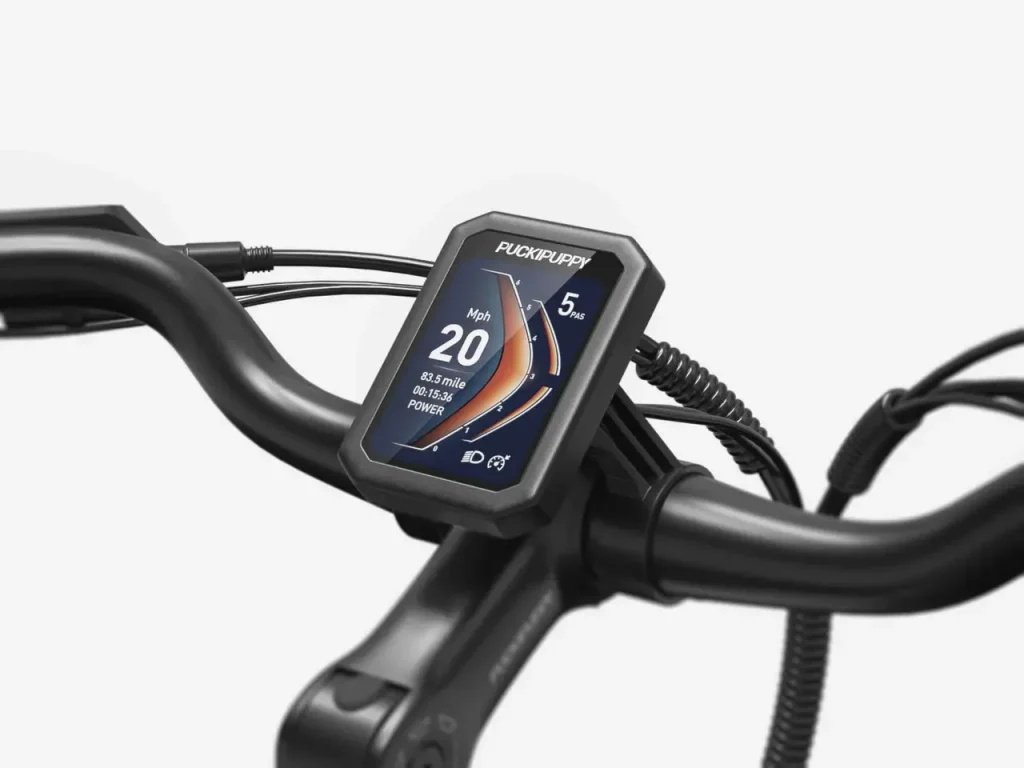
The Poodle uses a center-mounted color LCD that displays the main information I expect on a commuter e-bike, including speed, distance, pedal-assist level, and remaining battery information.
Independent testing found settings for screen brightness, miles or kilometers, trip reset, wheel diameter, speed limit, assist configuration, and different riding modes.
The bike normally uses 5 pedal-assist levels, although the display reportedly allows riders to switch to a simpler 3-level setup.
The biggest display weakness is the battery indicator. It uses segmented bars rather than showing an exact percentage. I prefer a percentage readout because it gives me a much better sense of how much charge remains on a longer ride.
The display was also reported to be somewhat difficult to read in strong sunlight. Adjusting the screen angle can help with glare, but I would still prefer a brighter panel.
No Companion App
I did not find a Poodle-specific companion app offering Bluetooth tuning, GPS tracking, navigation, geofencing, ride syncing, or over-the-air updates.
That makes the Poodle relatively simple from a technology standpoint compared with newer premium commuters.
I do not necessarily see that as a major negative for every rider. Some people would rather turn the bike on and ride without creating another account, pairing a phone, or relying on software that may change over time.
Battery, Charging, and Range
The Poodle uses a removable 48V 15Ah battery, which works out to approximately 720Wh of nominal capacity. That is one of the specifications I like most about the bike, especially when it is selling near its lower promotional price.
Puckipuppy claims a range of 45 to 75 miles per charge. I would treat the upper end of that range as a best-case manufacturer estimate rather than something every rider should expect.
Real-world range changes substantially with assist level, throttle use, rider and cargo weight, hills, speed, wind, temperature, tire pressure, stop-and-go riding, and road surface.
The most detailed independent review available when I researched the Poodle had not yet completed a standardized full-range test. Preliminary estimates suggested roughly 25 to 30 miles in high-assist riding and around 55 to 60 miles in lower-assist conditions.
Because those were estimates rather than completed standardized results, I would not present them as definitive real-world range figures.
Puckipuppy lists a 48V 2A charger. Independent testing reported a full charging time of roughly 7 hours.
Replacement Battery Availability
Puckipuppy currently lists a 15Ah replacement battery that includes Poodle compatibility. It was priced at $499.99 when I checked.
Availability was inconsistent, however, and one current listing showed the battery out of stock. I would verify replacement-battery inventory before assuming a new pack can be ordered immediately.
I still consider the existence of a model-specific replacement battery listing a positive ownership factor because every lithium-ion battery will gradually lose capacity over time.
Brakes and Safety
The Poodle’s hydraulic disc brakes are one of the strongest parts of its specification package.
Puckipuppy lists 180mm rotors front and rear. In independent testing, the hydraulic brake system remained consistent through repeated stops from approximately 20 to 25 mph on a descent, with no noticeable brake fade reported.
I consider that especially important on a bike capable of higher assisted speeds. A powerful motor matters much less to me if the braking system is not well matched to the bike’s speed and weight.
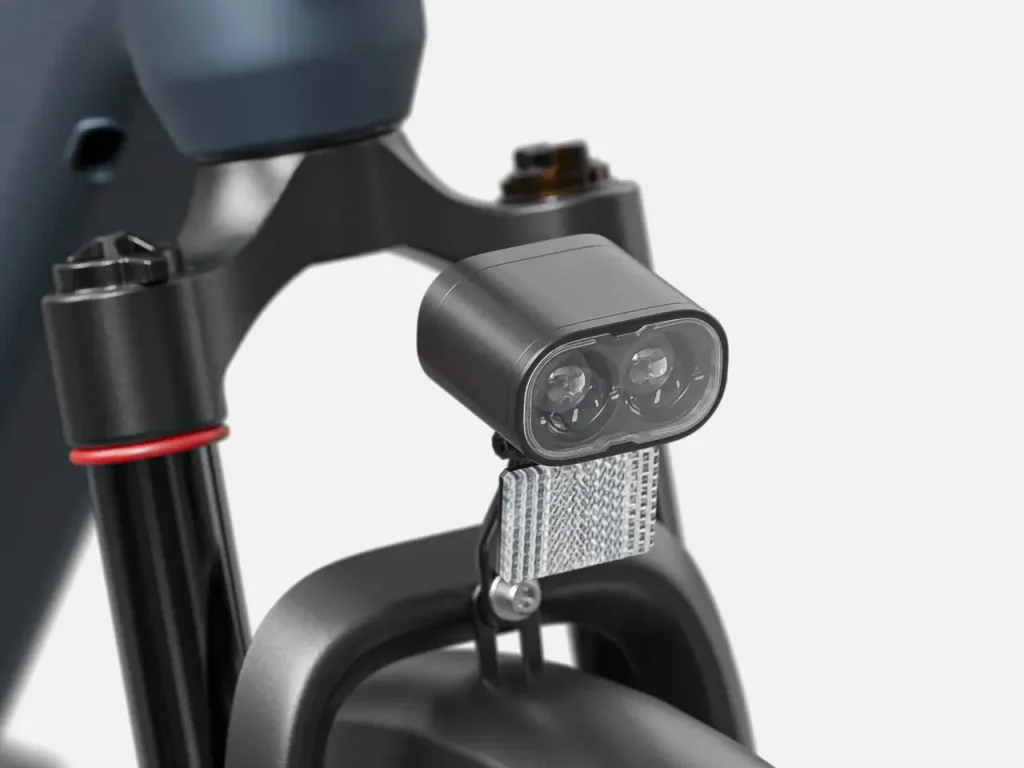
Puckipuppy’s current comparison information also lists a 200-lux integrated LED headlight with adjustable angle.
UL Certification
The certification language needs to be kept precise.
Puckipuppy states that the Poodle’s battery is certified by SGS to UL 2271. That certification applies to the battery system.
The company currently lists UL 2849 certification for the complete Poodle e-bike electrical system as still in progress. I would therefore not describe the Poodle itself as UL 2849 certified at this time.
If complete system certification is one of your buying requirements, compare the Poodle with models in my UL-certified e-bike guide and verify Puckipuppy’s latest status before purchasing.
Drivetrain and Gearing
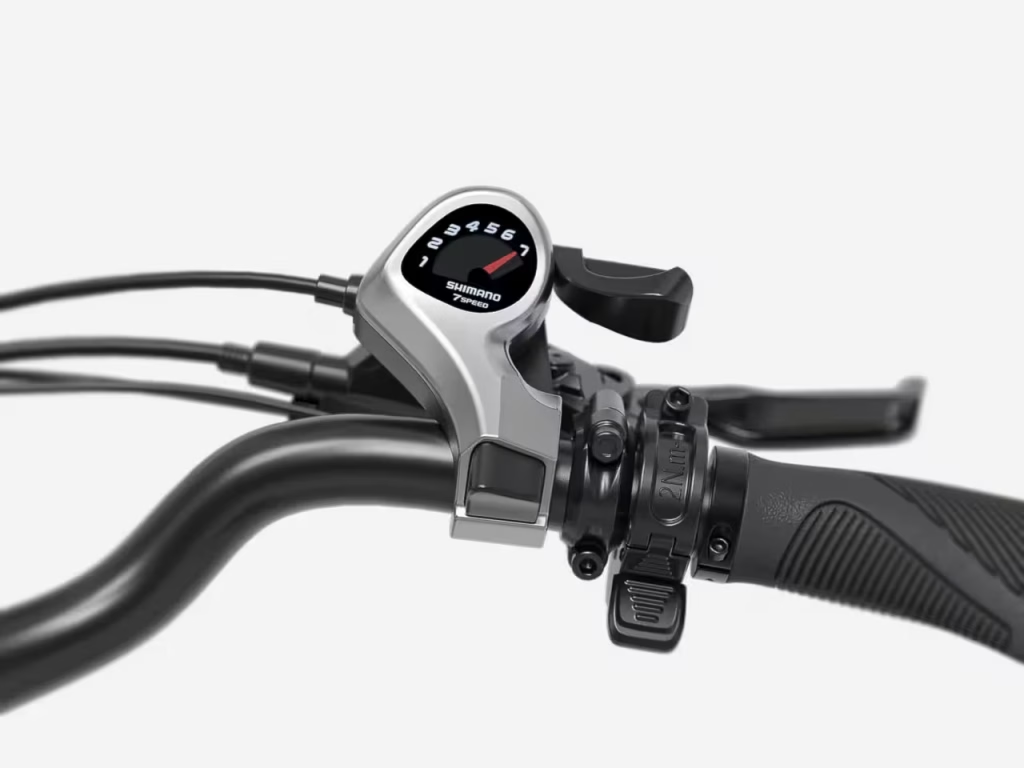
The Poodle uses a Shimano 7-speed drivetrain. I like the familiarity of standard Shimano mechanical components because most bicycle shops understand how to adjust and service them.
The limitation is the reported 14-28T rear gearing range. That is fairly narrow for a Class 3-capable commuter.
Independent testing found that the gearing could feel limiting at both ends. A lower climbing gear would have helped on steep grades, while higher assisted speeds could lead to ghost pedaling, where the rider’s legs are spinning quickly without contributing much additional power.
For flat and moderately rolling commuter routes, that may not matter very much. For riders dealing with steep hills or who want to pedal comfortably near 28 mph, I would prefer a wider gearing range.
Suspension, Tires, and Handling
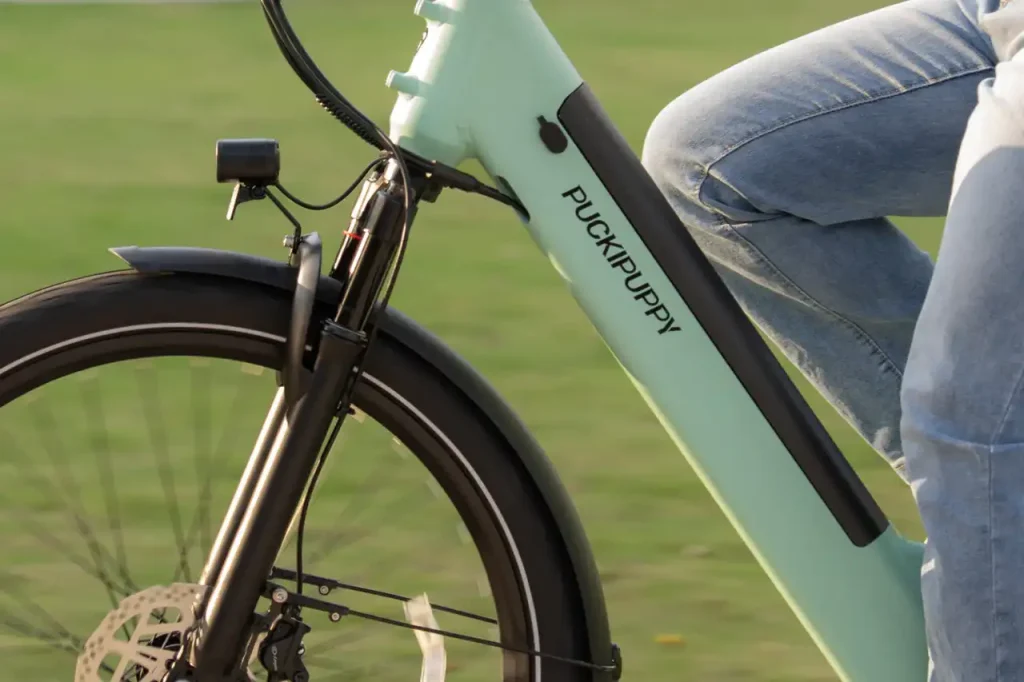
The Poodle uses an adjustable 80mm front suspension fork and no rear suspension.
This is basic commuter suspension rather than mountain-bike hardware, but it should help soften potholes, broken pavement, expansion joints, and light gravel.
The 27.5 x 2.4 in. tires provide a useful balance between stability, grip, cushioning, and pavement efficiency.
I prefer this setup for everyday commuting over oversized fat tires unless the rider actually needs sand, snow, or soft-terrain capability.
Included Accessories and Optional Equipment
The accessories included with the Poodle are worth checking carefully because promotional packages have changed over time.
One independently tested Poodle was supplied with a much larger accessory package that included items such as fenders, a rear rack, helmet, mirror, phone mount, lock, bike cover, glasses, and a rear rack bag. I would not assume that package represents what every buyer receives with the current base bike.
Puckipuppy’s current Poodle information says the e-bike itself comes with a wrench and bicycle pump. The product page also shows a separate promotional Premium Package and other individual accessories that may be offered as add-ons or limited-time promotions.
That distinction matters when I compare the Poodle’s value with competing e-bikes. I would not give the bike extra credit for accessories unless those items are actually included at the price available when you order.
Before buying, I recommend checking the product page and shopping cart to confirm exactly what comes with the Poodle, which accessories cost extra, and whether any promotional bundle is automatically included or must be added separately.
Essential E-Bike Gear (Quick Picks)
Before you choose your e-bike, these are the accessories most riders end up needing for safety and everyday use:
Reported Testing
The most detailed independent performance testing I found for the Puckipuppy Poodle came from Electric Bike Review. I used those results as one part of this research-based review rather than treating the manufacturer’s specification sheet as the whole story.
Hill test: The Poodle completed a 0.34-mile climb with 185 ft. of elevation gain and a 10.1% average grade in 1 minute 57 seconds with rider pedaling.
Throttle acceleration: Approximately 10 to 11 seconds from 0 to 20 mph.
Pedal-assist acceleration: Approximately 9 to 10 seconds from 0 to 20 mph under the reported test conditions.
Braking: Six to seven repeated stops from approximately 20 to 25 mph reportedly produced consistent braking performance without noticeable fade.
Pedal-assist response: The tester reported about half a pedal revolution of delay before motor engagement and a small amount of continued assistance after pedaling stopped.
Hill gearing: The 7-speed drivetrain and reported 14-28T range felt limiting on steeper climbs.
Higher-speed pedaling: The tester encountered some ghost pedaling near the upper end of the bike’s assisted-speed range.
Range: A standardized range test had not been completed when the review was published. The reported figures were preliminary estimates rather than final measured range results.
Assembly observations: The test bike had a few spokes that needed attention during setup. I would treat that as an observation from one sample rather than evidence that every Poodle will arrive with the same issue.
I find this kind of independent testing useful because it helps show how the motor, brakes, gearing, display, and pedal-assist system behave in actual riding. I still weigh those results alongside Puckipuppy’s official specifications, warranty information, certification statements, and other available evidence.
🎥 Want to see the Puckipuppy Poodle in action? This video gives you a closer look at the bike, its features, and how it performs on the road.
What Riders Are Saying
I do not think there is enough clearly independent, long-term, Poodle-specific owner information available yet to make strong claims about reliability patterns.
Puckipuppy’s Poodle page displays a 4.7 rating alongside a Trustpilot reference and hundreds of reviews, but I would not treat that as a clean Poodle-only owner score without clearer model-specific attribution.
For that reason, I give more weight to detailed independent testing, official specifications, warranty information, and clearly attributable rider experiences than to a general rating number.
I would like to see more long-term Poodle owner reports covering battery degradation, motor reliability, display problems, brake maintenance, replacement-parts turnaround, and customer-service experiences before raising my evidence confidence above Moderate.
Unboxing and Assembly
The Poodle requires some final setup after delivery, and Puckipuppy recommends having the bike inspected and tested by a certified bicycle technician before riding.
I think that is sensible advice for any partially assembled direct-to-consumer e-bike capable of reaching 28 mph with pedal assistance.
One independently tested Poodle needed attention to several spokes during setup. I would not assume every bike will have that problem, but it reinforces why I recommend checking the wheels carefully before the first ride.
I would inspect wheel security, spoke tension, brake alignment, handlebar and stem hardware, pedals, tire pressure, derailleur adjustment, battery mounting, and all visible electrical connections.
If you are not comfortable performing those checks yourself, having a local bicycle or e-bike technician inspect the bike is worth considering.
I would also keep the original box and packing materials until you are certain you are keeping the Poodle. Puckipuppy’s return policy makes the original packaging financially important if the bike needs to go back.
Customer Service, Warranty, Returns, and Financing
Customer Service
Puckipuppy’s current warranty page advertises lifetime technical support and says the company typically handles warranty problems by replacing parts rather than repairing the entire bicycle.
That direct-to-consumer approach can work well if you are comfortable performing some repairs or have a local shop willing to install replacement components.
I would check with your preferred bicycle or e-bike shop before ordering if you expect to rely heavily on local service.
Warranty
Puckipuppy’s detailed warranty provides different coverage periods for different components rather than one blanket warranty period.
The frame/structure is listed with 3 years of coverage. Several structural components receive 2 years. The motor, controller, wiring harness, and battery are also listed with 2-year coverage, while items such as the suspension fork, brakes, derailleur, shifter, tires, lights, sensor, and charger have shorter listed terms.
The warranty applies to the original purchaser and is not transferable.
Puckipuppy also says customers should contact the company for authorization before warranty repairs because unauthorized work may affect its ability to evaluate a claim.
Returns
The current return request window is 15 days from delivery.
For unused and unopened e-bikes, Puckipuppy’s policy says buyers are responsible for a $300 round-trip shipping charge and a 5% merchant-processing fee.
For used or opened bikes, the policy additionally lists a 20% warehouse handling fee. An e-bike must have no more than 20 miles on the odometer and meet the company’s condition requirements.
The policy also says a $500 repackaging and handling fee can apply if the original packaging is missing.
Those fees are substantial, so I would read the entire return policy before ordering rather than assuming a 15-day return window means a free trial.
Financing
The current Poodle page displays pay-over-time options through Affirm and Klarna and advertises 0% interest. Actual eligibility, payment schedules, and financing terms depend on the offer presented at checkout.
Like Electric Bike Explorer?
Add Electric Bike Explorer as a Preferred Source on Google to make it easier to see more of our e-bike news, guides, reviews, and troubleshooting content in Google Search.
Price and Value
Puckipuppy’s own current pages do not display one consistent Poodle price.
When I checked on August 22, 2026, the main product page showed $899.99, reduced from $1,199.99. Puckipuppy’s current comparison page showed $1,099.99.
I would therefore confirm the final cart price rather than relying on an article, advertisement, or search snippet.
At approximately $900, I think the value proposition is strong. A nominal 720Wh battery, hydraulic brakes, 180mm rotors, front suspension, full-size wheels, step-through frame, throttle, color display, and 350 lb claimed maximum load capacity make a competitive hardware package.
At approximately $1,100 to $1,200, I become more demanding because strong torque-sensor commuters begin to enter the comparison.
Battery replacement cost also matters. Puckipuppy currently lists a compatible 15Ah replacement battery at $499.99, although availability was inconsistent when I checked.
Should You Buy the Puckipuppy Poodle?
I think the Puckipuppy Poodle is most compelling when you can buy it near its lower promotional price.
The strongest reasons to buy it are the large 720Wh nominal battery, hydraulic brakes with 180mm rotors, step-through accessibility, adjustable cockpit, full-size wheels, useful 750W motor, 350 lb claimed maximum load capacity, and straightforward commuter design.
The most important drawbacks are the cadence-sensor ride feel, narrow reported gearing, lack of connected technology, substantial return fees, and the fact that Puckipuppy still lists UL 2849 certification for the complete Poodle as in progress.
You should buy this bike if you want an affordable step-through commuter for pavement, errands, recreational paths, neighborhood riding, and normal city transportation, and you care more about battery capacity and hydraulic brakes than sophisticated technology.
You should skip this bike if you regularly tackle steep hills, want very natural torque-sensor assistance, need advanced smart features, frequently lift your bike, or specifically require a completed UL 2849-certified e-bike system.
Final Electric Bike Explorer score: 7.9 out of 10 – Good with Tradeoffs.
Alternative 1: Lectric XPress2 Cruiser
I would choose the Lectric XPress2 instead if smoother pedal-assist response and stronger drivetrain specifications matter more to you.
The XPress2 uses Lectric’s XPerience Switch system, which lets the rider choose between torque-sensor and cadence-sensor pedal response. Lectric currently lists a 750W rear-hub motor with 1,310W peak output and 85Nm of torque, a 48V 14Ah 672Wh battery, Shimano Altus 8-speed drivetrain, hydraulic brakes, an 80mm SR Suntour fork, a 3.5 in. color TFT display with USB-C, and UL 2849 and UL 2271 certification.
The tradeoff is price. The XPress2 is currently $1,399. The comfort-oriented Cruiser step-through version was listed as a preorder shipping the week of September 28, 2026 when I checked, while the high-step Commuter version was listed in stock.
I would choose the XPress2 if natural pedal response, more refined gearing, electrical-system certification, and overall ride refinement justify the additional cost.
Read my full review of the Lectric Xpress 2
Alternative 2: Velotric Discover 3
If you have a much larger budget and want a more technologically advanced comfort commuter, I would look at the Velotric Discover 3.
Velotric currently prices the Discover 3 at $1,999. It uses a 750W rear-hub motor rated at 75Nm with 1,100W peak output, a 730Wh battery, SensorSwap torque/cadence sensing, an 8-speed 11-40T drivetrain, hydraulic brakes, an 80mm air suspension fork, suspension seatpost, and a high-brightness 3.5 in. color display.
The technology package is substantially more advanced than the Poodle’s. Velotric lists Bluetooth, NFC unlocking, app-based ride tuning and over-the-air updates, Apple Find My, Google’s Find Hub, USB-C charging, integrated turn signals, and UL 2849 and UL 2271 certification.
I would choose the Discover 3 instead if comfort, fit options, smart technology, torque-sensor capability, wider gearing, safety certifications, and a more premium commuter experience matter more than keeping the price near $1,000.
Read my full review of the Velotric Discover 3
For a broader comparison, see my commuter e-bike guide.
Before you buy: Confirm the Poodle’s checkout price, color availability, rider fit, maximum-load requirements, included accessories, replacement-battery inventory, warranty terms, return fees, and current UL 2849 status. Also check the rules where you plan to ride because a bike capable of 28 mph assistance may be subject to different access requirements. My guide to Class 1, Class 2, and Class 3 e-bikes explains the basic distinctions, and the state-by-state e-bike law guide can help you start checking local requirements.
Disclosure: As an Amazon Associate, I earn from qualifying purchases. This comes at no extra cost to you and helps support the content on this site.
📚 Read Me Next
- Compare this bike to others → Best Commuter E-Bikes
- Not sure about budget? → Budget E-Bike Guide
- Want to learn first? → E-Bike Buying Guide
- See more ebike reviews → E-Bike Reviews
External Sources
- Puckipuppy – Poodle official product page
- Puckipuppy – Current e-bike comparison specifications
- Puckipuppy – Warranty policy
- Puckipuppy – Return policy
- Puckipuppy – Replacement battery listings
- Electric Bike Review – Puckipuppy Poodle independent testing
- Lectric – XPress2 official specifications and availability
- Velotric – Discover 3 official specifications

Kristina is not just an enthusiast but a true authority on electric bikes. Nestled in the coastal beauty of Virginia, Kristina has found the perfect backdrop for her passion for electric biking. As a dedicated wife and homeschooling mom, her life revolves around family, faith, and the thrill of adventure.
Originally hailing from Ohio, Kristina's journey with electric bikes began as a curiosity and quickly evolved into a deep expertise. Her blog is a testament to her love for electric biking, combining her fascination for eco-friendly transportation with her coastal lifestyle.
When she's not cruising the beach on her electric bike, you'll find Kristina indulging in her other loves: long walks along the shore, getting lost in a good book, and cherishing moments with her loved ones. With a heart as big as her love for animals, especially cats, Kristina brings a unique perspective to the electric bike world, grounded in her strong faith in God and her dedication to a sustainable lifestyle.
Through her blog, Kristina shares her extensive knowledge of electric bikes, offering valuable insights, tips, and recommendations to fellow enthusiasts. Whether you're a seasoned rider or a newcomer to the electric bike scene, Kristina's blog is your go-to source for all things electric biking, fueled by her passion, expertise, and the scenic beauty of coastal Virginia.