
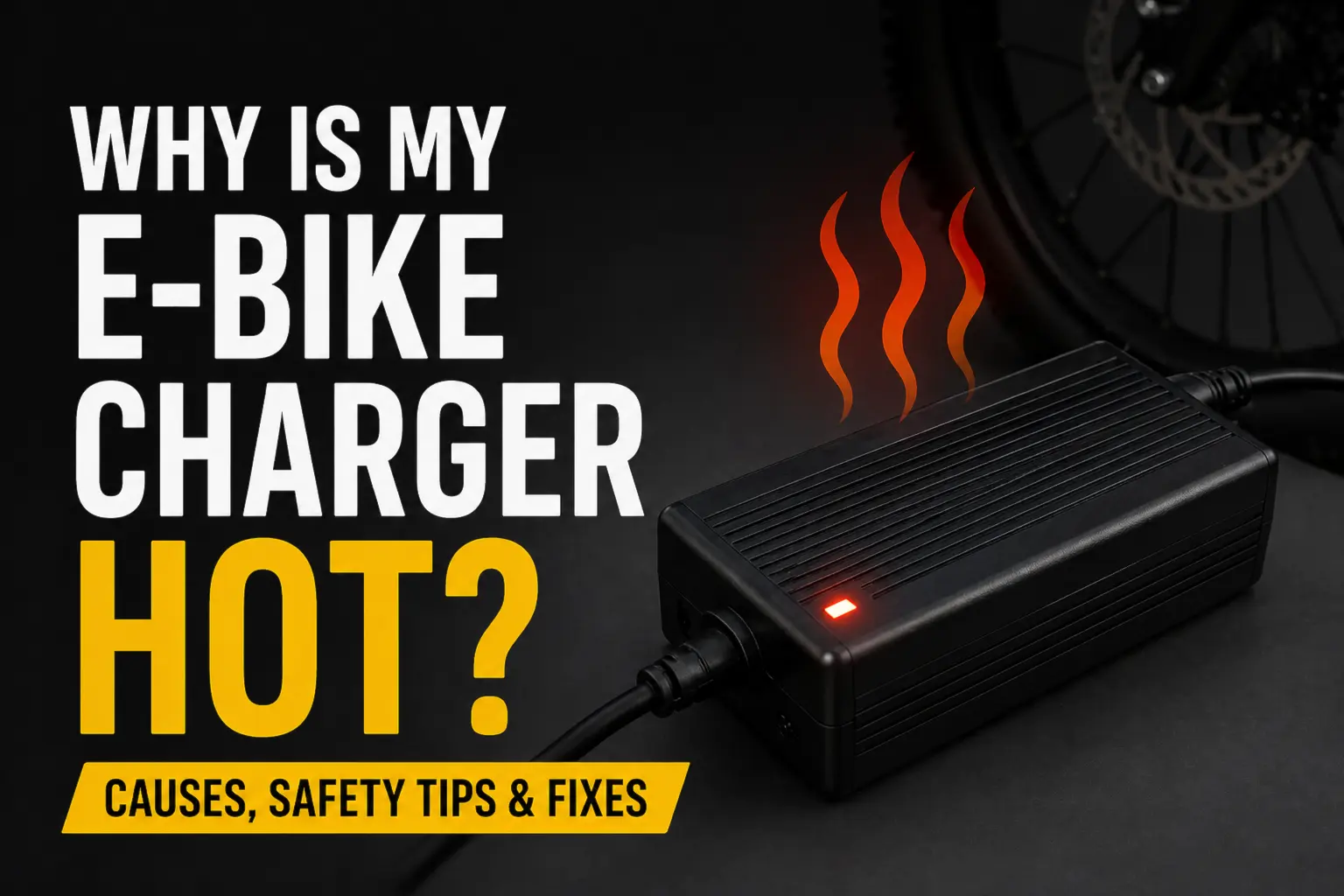
Why Is My E-Bike Charger Hot? Causes, Safety Tips, and When to Replace It
Last Updated on June 1, 2026 by Kristina
If your e-bike charger feels hot while charging, you are not alone. Many riders search for answers when their electric bike charger gets hot, feels warmer than usual, or seems too hot to touch.
The good news: some charger heat is normal.
The warning: extreme heat, burning smells, melted plastic, buzzing noises, repeated overheating, or hot plugs/outlets are not normal and should be taken seriously.
This guide explains why an e-bike charger gets hot, how to tell normal heat from dangerous heat, what causes overheating, and when it may be time to replace the charger.
If you are learning about battery care, also visit our E-Bike Battery Guide, Charging Time Calculator, Battery Health Checker Tool, and Troubleshooting Hub.
Is My E-Bike Charger Too Hot? Quick Answer for Riders
If your charger is warm or moderately hot while charging, that is often normal.
If it is:
- Painfully hot to touch
- Much hotter than usual
- Smells burnt
- Melting
- Buzzing loudly
- Heating the plug or outlet
- Staying extremely hot after charging ends
…stop using it until inspected or replaced.
📖 Read Next
How to Choose the Best eBike Battery for Your Commute (With Top Picks)
Understanding E-Bike Battery Capacity: Amp Hours (Ah) Explained
5 Signs It’s Time to Replace Your E-Bike Battery
The Ultimate Guide to Electric Bike Chargers: Types, Features, and Recommendations
Why Your E-Bike Battery Loses Charge Overnight — and How to Fix It
How Long Do E-Bike Batteries Last?
E-Bike Battery Charging Mistakes
E-Bike Battery Health Checker
How to Tell if Charger Heat Is Normal
Use this quick real-world guide:
- Warm like a coffee mug: Usually normal
- Hot but still touchable: Often okay, monitor it
- Painful or uncomfortable quickly: Warning sign
- Burning smell / melting / smoke: Unplug immediately
Charger temperatures vary widely based on design, output power, room temperature, and airflow.
Is It Normal for an E-Bike Charger to Get Hot?
Yes. Most e-bike chargers create heat while converting household AC power into DC power for your battery.
That conversion naturally creates warmth, especially:
- During the first charging stage
- When charging a low battery
- With higher-voltage systems (48V / 52V / 60V)
- In hot rooms or garages
- With faster chargers
- With less efficient low-quality chargers
A charger that warms during use and cools later is often behaving normally.
What Do Charger Lights Mean?
Many riders worry when charger lights change colors.
| Light Status | Often Means |
|---|---|
| Red | Charging |
| Green | Full charge / standby |
| Red then green quickly | Battery near full or connection issue |
| Flashing red | Fault on some chargers |
| No light | No power, failed charger, or outlet issue |
Important: light meanings vary by brand.
If unsure, check your charger label or bike manual.
How Long Should a Charger Stay Warm?
Typical patterns:
- Warm during first 30 to 90 minutes = common
- Cooling near full charge = common
- Very hot for hours after full = warning sign
- Unusually hot while connected only to wall power = possible inefficiency or fault
Common Reasons Your E-Bike Charger Is Hot
1. Normal Charging Heat
Some warmth is expected.
Larger batteries and faster chargers often run warmer.
2. Poor Ventilation
A charger on carpet, bedding, or under gear can trap heat.
Better surfaces:
- Tile
- Concrete
- Hardwood
- Desk
- Shelf with airflow
Never cover a charger.
3. Hot Room or Garage Temperature
Warm rooms increase charger temperature.
Charging inside a closed summer garage can make chargers much hotter.
4. Low Battery During Early Charge Stage
Chargers often operate at higher current during the early constant-current charging phase when charging a lower battery.
That can increase charger heat early in the session.
Learn more in our How Long Do E-Bike Batteries Last guide.
5. Aging or Failing Charger
Older chargers may run hotter due to worn internal components.
Signs include:
- Hotter than before
- Buzzing
- Flickering LED
- Burning smell
- Loose connector
- Cracked case
6. Wrong Charger Being Used
Using the wrong charger can be dangerous.
Always match:
- Voltage
- Connector style
- Polarity
- Output amps
- Manufacturer guidance
7. Fast Charger vs Slow Charger
Many riders ask why one charger runs hotter than another.
Example:
- Lower-output charger = often cooler
- Higher-output charger = often warmer
Design quality, cooling, and efficiency also matter.
Where Is the Heat Coming From?
This can help identify the real issue.
Charger Brick Warm
Often normal.
Cable Warm
Possible resistance or damaged wire.
Plug Tip Hot
Loose or poor connection.
Wall Plug Hot
Outlet concern.
Battery Charge Port Hot
Battery or connector issue.
Is It the Charger or the Wall Outlet?
Sometimes the outlet is the problem.
Signs outlet may be the issue:
- Plug blades are hot
- Outlet plate feels warm
- Plug is loose
- Small sparks while plugging in
- Charger works fine elsewhere
If outlet heat exists, stop use and consult a qualified electrician.
Can an Extension Cord Cause Charger Heat?
Yes.
Especially if using:
- Thin cheap cords
- Very long cords
- Coiled cords left wound up
- Shared cords with tools/heaters
Use a short heavy-duty extension cord only if truly necessary.
Direct wall outlet use is usually better.
Can Humidity Cause Charger Problems?
Yes, over time.
Humidity can contribute to:
- Corrosion
- Condensation
- Poor electrical contact
- Increased resistance heat
- Reduced charger lifespan
If a charger gets wet, allow it to dry fully before use.
Why Is My Lectric / Aventon / Rad / Velotric Charger Hot?
Some e-bike chargers naturally run warmer than others depending on:
- Output wattage
- Charge speed
- Battery voltage
- Charger efficiency
- Cooling design
- Room temperature
- Airflow during charging
A charger that feels warm during use is often normal. A charger that becomes painfully hot, smells burnt, or suddenly runs much hotter than before is not.
Always use the original charger supplied with your bike or a manufacturer-approved replacement whenever possible.
Lectric eBikes
Many Lectric bikes use 48V battery systems, and Lectric publicly sells standard chargers plus a faster 5A charger for some compatible models. Faster chargers often run warmer than slower chargers because they move more power.
If your Lectric charger gets hot:
- Mild warmth can be normal
- Fast chargers may run warmer
- Keep charger uncovered with airflow
- Verify model compatibility before upgrading chargers
Aventon
Aventon uses multiple battery systems across its lineup. That means charger plugs and charging specs may differ between models.
If your Aventon charger gets hot:
- Warm during charging can be normal
- Always match the charger to your exact bike model
- Avoid generic replacements unless specs fully match
- Inspect cord ends and plug fit regularly
Rad Power Bikes
Rad Power Bikes has sold many bikes over several generations, including older models still widely used today. Older chargers may run hotter over time due to age, dust, or worn internal components.
If your Rad charger gets hot:
- Compare current heat to how it behaved when newer
- Check for cable wear or cracked housing
- Replace aging chargers showing new symptoms
- Confirm charger compatibility by model/year
Velotric
Velotric bikes often use modern higher-capacity battery systems. Like many chargers, some warmth during charging may be normal.
If your Velotric charger gets hot:
- Charge in a ventilated indoor area
- Keep charger off carpet or bedding
- Use only approved replacement chargers
- Stop use if charger behavior changes suddenly
Important Reminder for Any Brand
Brand name does not override safety signs.
If any charger:
- Smells burnt
- Melts
- Buzzes loudly
- Heats the wall plug
- Becomes painfully hot
- Changes behavior suddenly
…stop using it until inspected or replaced.
How Hot Is Too Hot for an E-Bike Charger?
| Charger Condition | Usually Normal? | Action |
|---|---|---|
| Warm while charging | Yes | Monitor |
| Hot in warm room | Often | Improve airflow |
| Painfully hot | No | Stop use |
| Burning smell | No | Unplug |
| Outlet hot | No | Inspect outlet |
Summer vs Winter Charging Tips
Summer
- Keep charger out of sunlight
- Avoid hot garages
- Charge indoors if possible
- Give charger airflow
Winter
- Let battery warm to room temp first
- Avoid charging frozen batteries unless manufacturer approved
- Keep charger dry and indoors
Many lithium batteries should not be charged below freezing unless specifically designed for it.
⚡ Watch: Smart E-Bike Charging Safety Tips
If your charger gets hot, these simple charging and storage habits can help reduce risk and extend battery life.
How Long Do E-Bike Chargers Last?
Typical lifespan:
- 2 to 5+ years
Depends on:
- Build quality
- Heat exposure
- Moisture
- Drops
- Daily use habits
Where Should I Store My Charger?
Best places:
- Dry shelf indoors
- Cool room
- Dust-free area
Avoid:
- Damp garage floor
- Car trunk in summer
- Direct sunlight
- Freezing shed
30-Second Charger Safety Check
✅ No cracks
✅ Cord intact
✅ Plug fits snugly
✅ No smell
✅ Light behaves normally
✅ Only mild warmth
Signs Your Charger May Be Unsafe
Stop using it if you notice:
- Burning smell
- Melted plug
- Cracked housing
- Buzzing or popping
- Flashing abnormal lights
- Much hotter than normal
- Frayed cable
- Outlet discoloration
The U.S. Consumer Product Safety Commission publishes product recalls and safety alerts.
Charger Problem or Battery Problem?
Replace Charger First If:
- Charger smells hot
- LED acts strange
- Charger gets hot without battery connected
- Another charger works better
Battery May Be the Issue If:
- Battery overheats while charging
- Range has dropped sharply
- Battery will not accept charge
- Charge port gets hot
- Battery is swollen, leaking, cracked, or damaged
If a battery appears swollen, leaking, smoking, or physically damaged, stop charging immediately and move it to a safer area away from flammable materials.
Read our Battery Health Checker Tool and Battery Capacity Guide.
Need a Replacement Charger?
Before buying, verify:
- Voltage
- Connector style
- Output amps
- Brand compatibility
You may also like:
- Best Replacement E-Bike Chargers (coming soon)
- How to Test an E-Bike Charger With a Multimeter (coming soon)
- Can You Upgrade to a Faster E-Bike Charger? (coming soon)
- E-Bike Charger Compatibility Guide (coming soon)
Real-World Example: Hot Garage Charging
Many riders store e-bikes in garages, sheds, or utility rooms. In summer, those spaces can become much hotter than the outdoor temperature.
Charging an e-bike battery in a hot enclosed garage may cause the charger to run warmer than it would indoors with airflow.
If possible:
Use a hard nonflammable surface
Charge in a cooler dry space
Keep charger uncovered
Avoid direct sunlight
How We Evaluate E-Bike Safety Topics
We prioritize:
- Manufacturer guidance
- Public recalls
- Electrical safety basics
- Lithium battery best practices
- Common rider issues
We focus on practical help, not fear.
FAQs
Yes, many e-bike chargers become warm or moderately hot during normal charging. Chargers convert household AC power into DC power for the battery, and that process creates heat. Mild warmth is common. If the charger becomes painfully hot, smells burnt, or gets much hotter than usual, stop using it and inspect it.
There is no single universal temperature because chargers vary by brand and output. A practical rule is this: warm is often normal, but if it is uncomfortable to touch quickly, smells hot, melts plastic, or heats the wall plug, that is a warning sign.
Many chargers run warmer during the early charging stage because they are delivering higher current while the battery is lower. As the battery fills, chargers often reduce output and may cool down.
A charger may turn green quickly if:
The battery is already nearly full
The battery connection is loose
The charger is not properly seated
The battery management system has stopped charging
There is a charger or battery fault
Try reconnecting carefully. If it keeps happening with a low battery, further troubleshooting may be needed.
The safest practice is to charge while you are awake and able to check on it occasionally, then unplug after charging is complete. Many modern chargers have automatic shutoff or taper charging, but unplugging after full charge is still a smart habit.
Yes. A failing or poor-quality charger can cause improper voltage, inconsistent charging, excess heat, reduced battery lifespan, or charging failure. Using the correct charger matters for both performance and safety.
No. Matching plug shape alone is not enough. The charger must also match:
Battery voltage
Correct output specifications
Polarity
Connector wiring
Brand/model requirements
Using the wrong charger can damage the battery or create safety risks.
That often points to the charger generating normal operating heat or developing its own issue. Chargers usually run warmer than batteries during charging. If the battery remains normal and charging works properly, mild charger warmth may be expected.
Mild battery warmth can happen during charging. However, excessive battery heat, swelling, strange odors, leaking, or unusual behavior are warning signs. Stop charging immediately if those occur.
Yes. Thin, long, damaged, or coiled extension cords can create voltage drop and extra heat. If an extension cord must be used, choose a short, heavy-duty cord and avoid leaving it coiled.
Some chargers include internal cooling fans. Light fan noise can be normal. Grinding sounds, loud rattling, or sudden new noises may indicate wear or failure.
A warm or hot outlet may indicate a loose connection, worn receptacle, overloaded circuit, or electrical issue. Stop using that outlet and have it checked by a qualified electrician.
Many chargers last 2 to 5+ years, depending on build quality, charging frequency, heat exposure, storage conditions, and handling. Chargers that are dropped, overheated, or stored in damp areas may fail sooner.
If the charger is overheating, acting erratically, or showing LED issues, replacing the charger is often the first and lower-cost troubleshooting step. If the battery has poor range, swelling, won’t accept charge, or gets unusually hot, the battery may be the bigger issue.
Check for Charger Recalls
If your charger is overheating, check:
- U.S. Consumer Product Safety Commission
- Your bike manufacturer support page
- Retailer notices
Final Thoughts
If your e-bike charger is hot, it may be normal, but it should never be ignored.
Mild warmth is common. Extreme heat, odors, hot outlets, or repeated overheating are not.
When in doubt, replace the charger. It is usually far cheaper than replacing a battery or dealing with property damage.
For more ownership help, explore our Maintenance & Troubleshooting Hub, E-Bike Buying Guide, and Tools Hub.
Helpful External Resources
- U.S. Consumer Product Safety Commission recalls and battery alerts
- PeopleForBikes e-bike education resources
- Your battery manufacturer manual
- Qualified electrician for outlet heat concerns

Kristina is not just an enthusiast but a true authority on electric bikes. Nestled in the coastal beauty of Virginia, Kristina has found the perfect backdrop for her passion for electric biking. As a dedicated wife and homeschooling mom, her life revolves around family, faith, and the thrill of adventure.
Originally hailing from Ohio, Kristina's journey with electric bikes began as a curiosity and quickly evolved into a deep expertise. Her blog is a testament to her love for electric biking, combining her fascination for eco-friendly transportation with her coastal lifestyle.
When she's not cruising the beach on her electric bike, you'll find Kristina indulging in her other loves: long walks along the shore, getting lost in a good book, and cherishing moments with her loved ones. With a heart as big as her love for animals, especially cats, Kristina brings a unique perspective to the electric bike world, grounded in her strong faith in God and her dedication to a sustainable lifestyle.
Through her blog, Kristina shares her extensive knowledge of electric bikes, offering valuable insights, tips, and recommendations to fellow enthusiasts. Whether you're a seasoned rider or a newcomer to the electric bike scene, Kristina's blog is your go-to source for all things electric biking, fueled by her passion, expertise, and the scenic beauty of coastal Virginia.