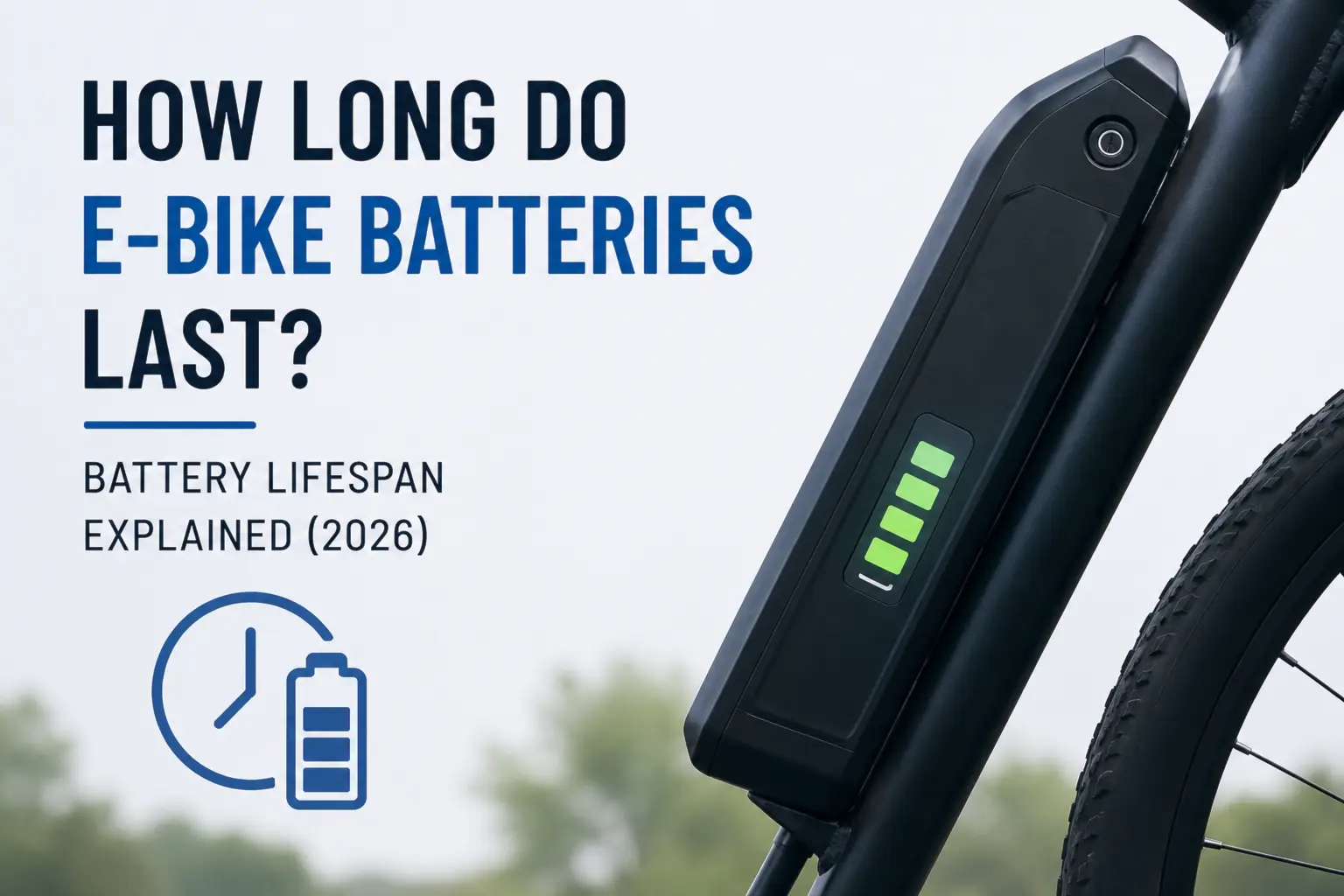
How Long Do E-Bike Batteries Last? Years, Cycles and Cost
Last Updated on September 20, 2026 by Kristina
Last updated: September 2026
If you are wondering how long an e-bike battery lasts, the most accurate answer is that there is no single number that applies to every battery. Battery life depends on the pack design, cell chemistry, charging habits, storage conditions, temperature, how deeply the battery is discharged, and how much energy you use on each ride.
Some current manufacturers publish useful benchmarks. Shimano, for example, says several of its e-bike batteries retain more than 60% of their original maximum capacity after 1,000 full charges. That is a manufacturer-specific example, not a universal rule for every e-bike battery.
For a broader overview of battery capacity, charging, range, safety, and replacement, start with my complete E-Bike Battery Guide. If you are already noticing reduced range or strange battery behavior, the E-Bike Battery Health & Lifespan Checker can help you organize the symptoms before you assume the battery needs replacing.
🔎 How This Guide Was Researched
I checked current manufacturer guidance from Bosch, Shimano, Specialized, and Lectric, along with battery-safety guidance from the U.S. Consumer Product Safety Commission and UL Solutions. Cycle-life figures and storage recommendations are identified as manufacturer-specific where appropriate because there is no universal e-bike battery lifespan specification.
How Long Do E-Bike Batteries Last? Quick Answer
| Question | Practical answer |
|---|---|
| Is there one normal lifespan in years? | No. Calendar age and usage both matter, and manufacturers use different battery designs and limits. |
| Is 500-1,000 charge cycles universal? | No. Some systems publish cycle benchmarks, but the exact rating belongs to the specific battery system. |
| Example of a published cycle benchmark | Shimano lists more than 60% remaining maximum capacity after 1,000 full charges for several current e-bike batteries. |
| Does the battery suddenly fail at the cycle rating? | Usually not. Capacity normally declines gradually, so the practical end of life depends on how much range and performance you still need. |
| Can storage habits matter? | Yes. Heat, long periods at a very high or very low state of charge, and storage outside manufacturer guidance can accelerate aging. |
What “Battery Lifespan” Actually Means
An e-bike battery does not normally reach a specific birthday or charge-cycle number and then stop working. Lithium-ion batteries gradually lose usable capacity as they age and as energy moves through the cells.
That means two different ideas matter:
- Cycle aging: capacity loss associated with charging and discharging the battery over time.
- Calendar aging: capacity loss that happens as the battery gets older even when it is not being ridden regularly.
A lightly used battery can still age while sitting in storage. A heavily used commuter battery can accumulate charge cycles much faster. This is why a fixed statement such as “every e-bike battery lasts 3 to 5 years” is too broad to be treated as a rule.
What Does a Charge Cycle Mean?
A full charge cycle is better understood as cumulative battery use equivalent to using the full battery capacity, not simply the number of times you plug in the charger.
For example, if you use about half the battery one day, recharge it, then use about half again later, those two partial uses add up to roughly one full-equivalent cycle. Partial charging is normal for lithium-ion batteries, and Bosch specifically says its batteries can be charged at any state of charge without harming the pack.
Real Manufacturer Battery-Life Examples
The best way to judge expected battery life is to look at the documentation for the exact system you own. These current examples show why one universal number is misleading.
| Manufacturer guidance | What it says | What it means |
|---|---|---|
| Shimano | Several current batteries are specified to retain more than 60% of original maximum capacity after 1,000 full charges. | The battery is expected to lose capacity gradually, not abruptly stop at 1,000 charges. |
| Bosch | Bosch emphasizes charging cycles, storage, temperature, and using the original charger rather than publishing one universal years-of-life promise. | Care and operating conditions materially affect useful life. |
| Specialized | Some current Turbo Levo models offer Eco charging and a charge-to-80% mode, which Specialized says can help extend battery life for daily riding and long-term storage. | This is a model-specific example of a battery-care feature, not a universal Specialized setting. |
These examples are not interchangeable. Always follow the manual for your own bike and battery because charging limits, storage state of charge, temperature limits, and service procedures can differ.
What Can Shorten E-Bike Battery Life?
Heat
Heat is one of the most important conditions to control. Avoid leaving an e-bike battery in a hot vehicle, direct summer sun, or another location that stays unusually hot for long periods. Follow the battery manufacturer’s charging-temperature limits, especially after a hot ride.
For a deeper look at temperature, see how heat affects an e-bike battery.
Leaving the battery completely depleted
You do not need to wait for an e-bike battery to reach 0% before charging it. Bosch says its batteries can be charged at any state of charge, and Shimano says a completely depleted battery should be charged as soon as possible rather than left empty.
Long storage at an unsuitable state of charge
Storage recommendations vary. Bosch recommends 30% to 60% charge for long storage, while a current Shimano manual recommends about 70%. That difference is exactly why I would not publish one “perfect storage percentage” for every e-bike battery.
For seasonal storage, use the winter battery storage guide as a planning checklist, then confirm the exact charge level and temperature range in your own manual.
Heavy energy use
Hills, high assist, heavy cargo, high speeds, strong headwinds, and frequent acceleration can increase energy use. Those conditions do not automatically mean a healthy battery is being damaged, but they can increase how much energy you use and how often you recharge. Bosch notes that battery service life is influenced by the type and duration of use.
Incompatible chargers or replacement batteries
This is a safety issue as well as an ownership issue. CPSC advises using the charger supplied with the product or one specifically recommended by the manufacturer, and warns against so-called universal micromobility chargers that may physically fit while still being electrically incompatible.
Safety First
Stop using or charging the battery if you notice swelling or another change in shape, smoke, leaking, unusual heat, a strong chemical or burning odor, discoloration, or serious physical damage. Do not open, modify, or rebuild a lithium-ion battery pack yourself.
CPSC advises riders to be present while charging micromobility products and not to charge while sleeping or while away from home. Use only an approved compatible replacement battery and charger, and follow the manufacturer’s instructions for handling a damaged or recalled battery.
E-Bike Battery Storage: Follow the Battery, Not a Generic Rule
| System | Current published storage guidance |
|---|---|
| Bosch | 30% to 60% charge for long storage, stored dry and at room temperature. |
| Shimano | About 70% charge for extended non-use, with a check/recharge about every six months so the battery does not fully discharge. |
Shimano’s current documentation also lists charging between 32°F and 104°F (0°C to 40°C) for several e-bike battery systems. That should not be assumed to be the charging range for every other brand.
The practical rule is simple: check the manual for your exact battery, avoid extreme heat, keep the pack dry, and do not leave it fully depleted for long storage.
Signs Your E-Bike Battery May Be Aging
Normal battery aging usually shows up as a gradual loss of usable range rather than a sudden failure. Signs worth investigating include:
- Noticeably less range under similar riding conditions
- More frequent charging than the bike needed when the battery was newer
- Repeated cutouts under ordinary load
- Large or erratic battery-percentage swings
- Difficulty holding charge while stored
- Charging behavior that has changed substantially
Those symptoms can also come from a charger, connection, display, temperature condition, BMS protection event, or another electrical issue. If the battery will not charge, use the e-bike charging troubleshooting guide before buying a replacement.
If the display percentage jumps around, the battery-percentage fluctuation guide explains voltage sag and other causes that can look like battery failure.
When Should You Replace an E-Bike Battery?
Replacement becomes a practical question when the battery no longer gives you enough usable range, repeatedly shuts down under normal use, will not charge normally after basic troubleshooting, or no longer has manufacturer support for safe service.
The end of useful life is partly personal. A commuter who needs 25 dependable miles every day may replace a battery sooner than a recreational rider who only needs 8 or 10 miles at a time.
Physical danger signs are different from normal aging. Swelling or another change in shape, smoke, leaking, unusual odor, excessive heat, discoloration, or serious damage are reasons to stop using the battery, not reasons to keep riding until the range gets worse.
How Much Does an E-Bike Battery Cost to Replace?
Replacement cost varies too much for one universal price-per-watt-hour table to be reliable. Brand, capacity, enclosure, electronics, compatibility, certification, availability, and dealer labor can all matter.
Two current manufacturer examples show the range:
| Current replacement example | Capacity | Price checked September 2026 |
|---|---|---|
| Lectric XP4 750 Long-Range Spare Battery | 48V 17.5Ah (840Wh) | $575 regular price, with a $489 sale price shown when checked |
| Specialized U2 Battery | 710Wh | $1,199.99 |
Prices and promotions change, so always confirm the current price for the exact compatible battery before buying. The E-Bike Battery Replacement Cost Calculator can help with planning, but manufacturer pricing and compatibility should be the final check.
How to Help an E-Bike Battery Last Longer
- Use the charger supplied with the bike or a replacement specifically approved for the battery system.
- Follow the manufacturer’s charging-temperature limits.
- Avoid storing the battery in a hot car, direct sun, or another high-heat location.
- Do not make a habit of leaving the battery fully depleted.
- For long storage, follow the manufacturer’s specified state of charge instead of relying on one generic percentage.
- Reduce unnecessary energy use by keeping tires properly inflated and using lower assist when conditions allow.
- Inspect the battery case, mount, connector, and charger for damage and stop using components that show safety warning signs.
Check Battery Symptoms Before You Replace It
I removed the old in-article “battery health score” approach because age and symptoms alone cannot measure real remaining capacity with diagnostic precision. Instead, use the dedicated E-Bike Battery Health & Lifespan Checker as a decision aid, and treat its result as a starting point rather than a lab test.
For broader electrical problems, the E-Bike Troubleshooting Guide helps separate battery, charger, wiring, display, controller, and motor symptoms.
E-Bike Battery Lifespan FAQs
There is no single number that applies to every e-bike battery. Useful life depends on battery design, age, charge cycles, temperature, storage, depth of discharge, and riding conditions. Check the manufacturer documentation for your exact battery system.
Some do have published benchmarks around that level, but it is not universal. Shimano states that several current e-bike batteries retain more than 60% of original maximum capacity after 1,000 full charges.
CPSC advises consumers to be present while charging micromobility products and not to charge while sleeping or while away from home. Follow the battery manufacturer’s charging instructions and unplug the charger when charging is complete.
There is no universal storage percentage. Bosch recommends 30% to 60% for long storage, while current Shimano guidance recommends about 70%. Follow the manual for your specific battery.
Replacement may make sense when usable range has fallen enough to interfere with normal riding, the battery repeatedly cuts out under ordinary load, or it no longer charges or holds charge normally after basic troubleshooting. Physical danger signs such as swelling or another change in shape, smoke, leaking, unusual odor, excessive heat, discoloration, or serious damage require immediate stop-use rather than continued testing.
Prices vary widely by brand, capacity, enclosure, electronics, certification, and compatibility. Current official examples range from several hundred dollars for some Lectric replacement packs to more than $1,000 for a Specialized 710Wh battery. Always check the exact compatible pack for your bike.
My Take
I would not judge an e-bike battery by age alone. A five-year-old battery that still gives you dependable range and charges normally may still be useful, while a much newer battery with severe capacity loss, repeated cutouts, or abnormal charging behavior deserves attention.
The most useful approach is to compare your battery with its own history: how far it used to take you, how it behaves under similar loads, whether charging has changed, and whether the manufacturer can still supply a safe compatible replacement. That gives you a better answer than relying on a generic “3 to 5 years” rule.
Not sure where to go next?
Some riders are brand new. Others are fixing a problem or thinking about a new bike. Choose what fits you.
Learn & Get Comfortable
Understand how e-bikes work and what to expect when riding.
Improve Your Current Ride
If your bike isn’t performing how you want, learn what affects speed, range, and power.
Compare Better Bikes
Looking for something that fits your riding style? Start here.
- Best Electric Bikes for Beginners
- Recommended Commuter Ebikes
- Most Comfortable City E-Bikes
- Best Fat Tire Ebikes
- Top Folding Ebikes
- Best Step Through Ebikes
- Top Cargo Electric Bikes
- Best Lightweight Ebikes
- Best Long Range Ebikes
- Top Moped Style E-Bikes
- E-bike Reviews
🛒 Ready to Buy?
Top picks and current availability from trusted brands.
👉 Still deciding?
Take our E-Bike Recommendation Quiz to get matched with the right riding style in under two minute
External Sources
- Shimano BT-E8035-L battery specifications
- Shimano e-bike battery user manual and storage guidance
- Bosch eBike Systems winter battery storage guidance
- Bosch eBike Systems battery care and charging guidance
- U.S. Consumer Product Safety Commission micromobility battery safety guidance
- CPSC warning about incompatible universal micromobility chargers
- UL Solutions overview of UL 2849 e-bike electrical-system certification
- NFPA e-bike and e-scooter battery safety tips
- Specialized Turbo Levo battery-care and charging features
- Lectric XP4 750 replacement battery
- Specialized U2 710Wh replacement battery

Kristina is not just an enthusiast but a true authority on electric bikes. Nestled in the coastal beauty of Virginia, Kristina has found the perfect backdrop for her passion for electric biking. As a dedicated wife and homeschooling mom, her life revolves around family, faith, and the thrill of adventure.
Originally hailing from Ohio, Kristina's journey with electric bikes began as a curiosity and quickly evolved into a deep expertise. Her blog is a testament to her love for electric biking, combining her fascination for eco-friendly transportation with her coastal lifestyle.
When she's not cruising the beach on her electric bike, you'll find Kristina indulging in her other loves: long walks along the shore, getting lost in a good book, and cherishing moments with her loved ones. With a heart as big as her love for animals, especially cats, Kristina brings a unique perspective to the electric bike world, grounded in her strong faith in God and her dedication to a sustainable lifestyle.
Through her blog, Kristina shares her extensive knowledge of electric bikes, offering valuable insights, tips, and recommendations to fellow enthusiasts. Whether you're a seasoned rider or a newcomer to the electric bike scene, Kristina's blog is your go-to source for all things electric biking, fueled by her passion, expertise, and the scenic beauty of coastal Virginia.