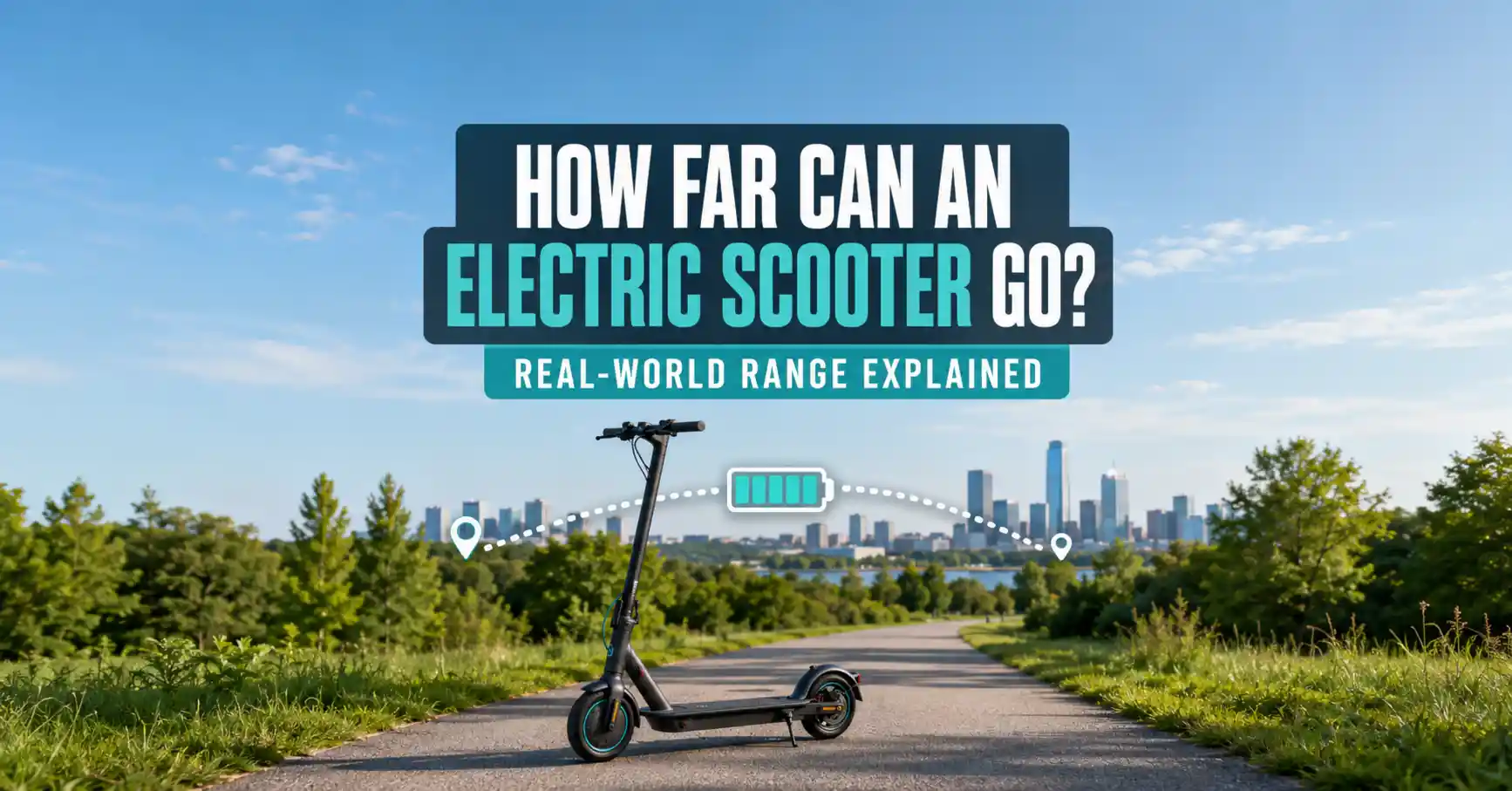
How Far Can an Electric Scooter Go? Real-World Range Explained
Last Updated on September 14, 2026 by Kristina
How far can an electric scooter go on one charge? For many adult stand-up electric scooters, a reasonable broad real-world expectation is roughly 10 to 40 miles per charge. Compact models can travel less, while scooters with very large batteries can go farther. The important catch is that a manufacturer’s advertised maximum range is usually measured under controlled or favorable conditions, so it should not be treated as guaranteed commuting distance.
Actual electric scooter range depends on battery capacity, speed, riding mode, rider and cargo weight, hills, wind, temperature, tire pressure and tire type, road surface, stop-and-go riding, battery condition, scooter weight, and motor configuration. If you are comparing distance with performance, see how fast electric scooters go. Before planning a route, also check the Electric Scooter Laws by State guide, because where and how you can ride varies by location.
Key Takeaways
- Advertised range is not guaranteed range. Manufacturers often measure range under specific speed, load, temperature, tire-pressure, and road conditions.
- Battery watt-hours matter. More stored energy generally gives a scooter more range potential, but efficiency and riding conditions still matter.
- Speed costs range. Riding faster, accelerating harder, climbing hills, and using high-performance modes usually increase energy use.
- Your route matters. Wind, hills, traffic, rough pavement, tire pressure, rider weight, and temperature can materially change the distance you get.
- Plan with reserve. For an important round trip, do not plan around the manufacturer’s absolute maximum or your scooter’s best-ever ride.
Why You Can Trust Electric Bike Explorer
This is a research-based informational guide, not a product review. I check specifications and advertised claims against manufacturer documentation, use reputable independent range testing to put those claims into context, and handle battery and charging safety information cautiously.
Affiliate relationships do not determine the conclusions in this guide. You can read more about Electric Bike Explorer’s research, review, and editorial process.
Electric Scooter Range at a Glance
The table below is a planning guide, not a guarantee. Scooter designs vary widely, and battery size alone cannot predict exact mileage. The battery bands and range figures are intentionally broad so they are useful without pretending every scooter in a category performs the same way.
| Scooter Type | General Battery Size | Commonly Advertised Range | Cautious Real-World Planning Range |
|---|---|---|---|
| Compact / short-trip scooter | About 200-350 Wh | Often about 10-25 miles | Roughly 7-18 miles |
| Everyday commuter scooter | About 350-600 Wh | Often about 20-40 miles | Roughly 12-30 miles |
| Long-range commuter / larger single-motor scooter | About 600-1,000 Wh | Often about 30-60 miles | Roughly 20-45 miles |
| High-performance / large-battery scooter | About 1,000 Wh and up | Often 40 miles and beyond | Highly dependent on speed, motors, terrain, and riding style |
Important: These are general planning estimates, not universal performance percentages. A well-matched scooter on flat roads at moderate speed may outperform the cautious band, while cold weather, heavy loads, hills, wind, aggressive acceleration, low tire pressure, or battery aging can push actual range lower.
Advertised Range vs. Real-World Range
The biggest mistake when comparing electric scooters is treating an “up to” number as normal everyday mileage. Advertised range can be useful, but only if you understand the conditions behind it.
A good example is Segway’s MAX G3 documentation. Segway’s current MAX G3 manual lists several different maximum-range figures depending on speed mode. It lists up to 50 miles at 10 mph, up to 40 miles at 15 mph, up to 34 miles at 20 mph, and up to 25 miles at 28 mph under specified test conditions. Those numbers illustrate an important point: even on the same scooter, higher speed can substantially reduce the manufacturer’s own measured maximum.
Independent testing also shows why a single advertised-to-real-world percentage is risky. In its June 11, 2026 range comparison, RiderGuide measured 12 scooters using its own real-world test protocol and reported results ranging from about 53% to 90% of the manufacturers’ claimed range figures. That spread is too wide to justify saying every scooter gets a fixed percentage of its advertised number.
Use an advertised range as one comparison point, not as a promise. When the manufacturer publishes the test speed, rider weight, temperature, tire pressure, route, and riding mode, those details are often more useful than the headline number itself.
How Battery Watt-Hours Affect Electric Scooter Range
Battery capacity is one of the biggest pieces of the range puzzle. The most useful unit for comparing stored energy is usually watt-hours (Wh).
Volts × Amp-Hours = Watt-Hours
The basic relationship is:
Volts × amp-hours = watt-hours
For example, the Segway MAX G3 manual lists a nominal battery voltage of 46.8 V and nominal capacity of 12.75 Ah. The calculation is:
46.8 V × 12.75 Ah = 596.7 Wh
Rounded, that is about 597 Wh, which matches the battery energy listed in the manual.
Watt-hours tell you how much energy the battery stores, but they do not tell you exactly how many miles the scooter will travel. Two scooters with similarly sized batteries can have different range because their motors, controllers, tires, weight, aerodynamics, riding modes, speed limits, and efficiency differ.
You may also see riders estimate efficiency in watt-hours per mile. That can be useful for tracking your own scooter over repeated rides, but there is no one universal Wh-per-mile number that accurately predicts every scooter and every route.
How Speed and Riding Mode Affect Range
Speed is one of the clearest reasons real-world range can fall below a maximum claim. As speed rises, aerodynamic drag becomes increasingly important, and the motor must supply more power to maintain that speed. Hard acceleration also draws more power than smoothly building speed.
Eco, standard, sport, and similar modes can change acceleration, top speed, torque delivery, or all three. An Eco mode that limits speed and softens acceleration may extend range. A Sport mode that allows stronger acceleration and higher speeds can shorten it.
Do not assume every manufacturer defines these modes the same way. If range is important, look for mode-specific figures in the official manual or support documentation rather than relying on the mode name alone.
What Changes Electric Scooter Range in the Real World?
Rider Weight and Carried Cargo
A heavier total load requires more energy to accelerate and more work to climb hills. Rider weight, a backpack, locks, groceries, and other cargo all contribute to the mass the scooter has to move.
This does not mean a heavier rider should expect one fixed percentage of lost range. Route, speed, motor efficiency, and terrain all interact with load.
Hills and Terrain
Climbing uses more energy than cruising on flat ground because the motor is working against gravity. Long or steep hills can have a much larger impact than a route with gentle rolling terrain.
Regenerative braking may return some energy on certain scooters, but it should not be treated as a way to recover everything spent climbing. Its behavior and effectiveness vary by model.
Wind
A strong headwind increases aerodynamic resistance and can make a flat ride behave more like a harder route. A tailwind may help in the opposite direction, which is one reason an out-and-back trip can consume energy unevenly.
Cold and Very Hot Temperatures
Lithium-ion batteries do not perform identically at every temperature. Cold conditions can temporarily reduce available performance and usable capacity, while excessive heat can accelerate battery stress and degradation.
Follow the scooter manufacturer’s stated charging, operating, and storage temperature limits. Do not assume a battery that can be ridden at a certain temperature can also be safely charged at that same temperature.
Tire Pressure and Tire Type
Underinflated pneumatic tires increase rolling resistance and can reduce efficiency. They may also increase the chance of tire damage. Check pressure when the tires are cold and use the manufacturer’s specified range.
Solid tires avoid pressure loss, but their rolling characteristics, ride comfort, and efficiency can differ from pneumatic tires. Tire construction is one of several reasons two scooters with similar batteries can return different mileage.
Road Surface
Smooth pavement generally demands less energy than loose gravel, broken pavement, soft surfaces, or rough off-road terrain. Surface changes also affect how often you slow down and accelerate again.
Stops, Starts, and Traffic
Repeated acceleration from a stop consumes more energy than steady cruising at a moderate pace. Urban traffic, intersections, and crowded paths can therefore reduce range compared with a continuous ride.
Scooter Weight, Motor Setup, Lights, and Accessories
A heavier scooter has more mass to accelerate, although weight alone does not determine efficiency. Large motors, dual motors, high-current controllers, wide tires, and performance-oriented tuning can all change energy consumption.
Lights, displays, and electronic accessories use some battery energy too. On most scooters, propulsion is the dominant load, so ordinary factory lighting is usually not the main reason range falls dramatically. Still, every electrical load contributes something, and high-power aftermarket accessories can matter more.
Why Dual-Motor and High-Performance Scooters Can Use Energy Faster
Dual-motor scooters can deliver much stronger acceleration and hill-climbing ability, but that performance can also make it easier to consume battery energy quickly. The issue is not simply that a scooter has two motors. It is how much power the motors are being asked to deliver.
If a dual-motor scooter is ridden aggressively in its highest performance mode, both motors and the controller system may draw substantial power during acceleration and high-speed riding. Some models let the rider use a lower-power or single-motor mode, but the actual behavior varies by scooter.
Large high-performance scooters sometimes offset their greater energy consumption with much larger batteries. That is why you should compare battery energy, riding mode, test speed, and reported range together rather than assuming every dual-motor scooter has poor range.
What Happens When an Electric Scooter Battery Gets Low?
Many scooters do not feel exactly the same at 10% battery as they do near a full charge. Depending on the battery-management system, controller programming, voltage under load, and riding mode, a scooter may limit acceleration, reduce top speed, show a low-battery warning, or eventually shut down to protect the battery from excessive discharge.
Do not assume every model follows the same sequence. A steep hill or hard acceleration can also cause voltage to sag temporarily, especially when the battery is already low.
The practical lesson is simple: do not plan an important trip around using the final displayed percentage of battery. A reserve helps account for hills, detours, weather, battery aging, and the possibility that performance will taper before the display reaches zero.
How Battery Aging Reduces Usable Range
Lithium-ion batteries gradually lose usable capacity as they age and accumulate charge cycles. Storage habits, heat exposure, charging behavior, depth of discharge, cell quality, and time all influence that process.
Segway’s MAX G3 documentation notes that battery power can deteriorate with age and mileage, which may reduce range compared with a new battery. That is normal battery aging, but a sudden or severe drop in range can also indicate a tire problem, brake drag, charger issue, battery fault, or another condition worth investigating.
A used scooter therefore should not be judged only by its original advertised range. Ask about battery age, storage history, current charging behavior, replacement availability, and whether the battery still delivers predictable performance.
Safe, Practical Ways to Improve Electric Scooter Range
- Use a moderate speed. Holding back from the scooter’s maximum speed is one of the most useful ways to reduce energy demand.
- Accelerate smoothly. Repeated full-power launches waste more energy than gradual acceleration.
- Use Eco or a lower-power mode when appropriate. Check the manual to understand what the mode actually changes.
- Keep pneumatic tires correctly inflated. Follow the scooter manufacturer’s pressure recommendation.
- Reduce unnecessary cargo. Do not overload the scooter or exceed its stated payload limit.
- Plan flatter, smoother routes when practical. A slightly longer flat route can sometimes use less energy than a shorter route with steep climbs.
- Maintain the scooter. Dragging brakes, damaged bearings, tire problems, and other mechanical issues can hurt efficiency and safety.
- Start important trips with an appropriate charge. Do not assume you can always recover missing range by finding an outlet later.
- Store and charge the battery as the manufacturer directs. Temperature and storage habits affect long-term battery health.
Battery Safety First
Use only the manufacturer-approved charger or a charger the manufacturer explicitly identifies as compatible. CPSC warns against using incompatible “universal” chargers with micromobility products.
Never open, rebuild, bypass, puncture, rewire, or modify a lithium-ion battery to try to increase range. Stop charging or using a battery that is swollen, damaged, unusually hot, smoking, leaking, sparking, or producing a burning or chemical odor. Move away from the device and seek emergency help when appropriate.
Avoid intentionally running the battery completely empty as a regular practice. Follow the manufacturer’s charging, temperature, storage, water-exposure, and inspection instructions, and have serious battery, charging, wiring, or electrical problems inspected by the manufacturer or a qualified technician.
For broader riding precautions, see the Electric Bike Explorer scooter safety guide.
How to Plan a Round Trip Without Assuming Maximum Range
The safest planning method is to work from evidence that resembles your riding, then keep a reserve rather than using every available mile on paper.
Start with this order:
- Find the scooter’s battery capacity and official range claim.
- Read the conditions behind the claim, especially speed and rider load.
- Look for reputable independent testing of the exact model.
- Compare those test conditions with your own rider weight, speed, hills, traffic, temperature, and road surface.
- Plan the full round trip plus likely detours.
- Keep a sensible reserve instead of planning to arrive at 0%.
Worked Example: A 12-Mile Planned Trip
Assumptions: A rider is considering a 5-mile commute each way, so the basic round trip is 10 miles. They want an additional 2 miles available for a grocery stop or route change, making the planned distance 12 miles.
Suppose the exact scooter they are considering is the Segway E2 Pro. Segway advertises a maximum range figure for the model, but RiderGuide’s independent comparison reported 16.0 miles in its test conditions. For this example, the rider uses the independent 16-mile result as a more conservative evidence point instead of planning around the manufacturer’s maximum.
The arithmetic is straightforward:
5 miles out + 5 miles back + 2-mile possible detour = 12 miles planned
16 miles reported in the independent test – 12 miles planned = 4 miles of test-relative margin
That does not guarantee a 4-mile reserve for this rider. If the rider is heavier than the test rider, travels faster, faces strong wind, climbs hills, rides in colder weather, has low tire pressure, or uses an older battery, actual range could be lower. The purpose of the example is to show how to avoid building a commute around the advertised maximum.
How to Measure Your Own Scooter’s Real Range Safely
Once you own a scooter, your own repeated rides can become more useful than a generic percentage. Choose a familiar route where you can stop safely if needed. Record starting charge, ending charge, mileage, average riding mode, temperature, rider/cargo load, and unusual wind or hill conditions.
You do not need to run the battery to shutdown. A few ordinary rides can tell you far more about your typical consumption than a deliberate 0%-battery test.
Charging Time and Destination Charging
Destination charging can extend a long day, but only if the scooter manufacturer permits the charging conditions and you have access to an appropriate outlet and approved charger. Charging time varies by battery and charger, so verify the manual rather than assuming a lunch break will replace a large amount of energy.
Never leave a charging scooter where it blocks an exit or escape path. Follow building, workplace, campus, transit, and property rules regarding lithium-ion devices and charging.
How to Evaluate an Electric Scooter Range Claim Before Buying
If range is a major buying priority, look past the headline number. A good range comparison should answer these questions:
- What is the battery capacity in Wh?
- At what speed was the advertised maximum measured?
- What rider weight or load was used?
- Was the route flat?
- What riding mode was used?
- What temperature and tire pressure did the manufacturer specify?
- Does the brand give different range figures at different speeds?
- Is there reputable independent testing of the exact model?
- How old is the independent test, and does it cover the current scooter version?
- Can the battery be serviced or replaced when its capacity eventually declines?
- What charger does the manufacturer require?
- What does the warranty say about the battery?
If you are comparing commuting models, the commuter scooter buying guide can help you weigh range against portability, tires, brakes, suspension, and daily practicality.
Also look carefully at electrical certification language. UL 2272 applies to the electrical systems of personal e-mobility devices such as e-scooters, while UL 2271 applies to batteries used in light electric vehicle applications. A certified battery does not automatically mean the entire scooter has been certified to UL 2272.
Water-resistance claims deserve the same care. An IP rating describes tested resistance to specified ingress conditions. It does not mean a scooter is waterproof, and you should follow the manufacturer’s water-exposure restrictions.
Buying a Used Scooter? Treat Battery Condition as a Range Question
For a used scooter, the original range claim may be much less useful than the current battery condition. Ask how old the scooter and battery are, how they were stored, whether the charger is original or explicitly approved, whether the battery has ever been submerged or seriously damaged, and whether replacement batteries are still supported.
A seller’s statement that the battery “still charges to 100%” does not prove it still has its original usable capacity. If the scooter matters for commuting, verify its practical range conservatively before relying on it for a full round trip.
Frequently Asked Questions
How many miles can an electric scooter go on a full charge?
Many adult stand-up scooters may deliver roughly 10 to 40 miles in real-world use, but there is no universal range. Small commuter scooters can fall below that band, while large-battery models can exceed it. Compare the exact battery, manufacturer test conditions, and independent testing for the model you are considering.
Is a 30-mile advertised range really 30 miles?
It may be achievable under the manufacturer’s stated test conditions, but it should not automatically be treated as 30 miles of guaranteed everyday riding. Speed, load, hills, wind, temperature, traffic, tire pressure, and battery condition can all change the result.
How far will a 500 Wh electric scooter go?
There is no reliable universal mileage number for a 500 Wh battery. Watt-hours tell you stored energy, not total efficiency. Scooter weight, motor setup, speed, controller tuning, tires, terrain, rider weight, wind, and temperature all affect how quickly those watt-hours are used.
Does Eco mode really increase scooter range?
It can, especially when it limits top speed and aggressive acceleration. The amount depends on how the manufacturer programs Eco mode, so check model-specific documentation rather than assuming a fixed improvement.
Do dual motors reduce electric scooter range?
Dual motors can use energy faster when both are delivering high power, particularly during hard acceleration, hill climbing, and high-speed riding. However, many dual-motor scooters also have very large batteries. Actual range depends on the complete system and how it is ridden.
Can I calculate exact range from volts and amp-hours?
No. Volts × amp-hours gives battery watt-hours, which is valuable for comparing stored energy, but it cannot predict exact mileage without knowing the scooter’s energy consumption under your actual riding conditions.
Should I run the battery to 0% to test maximum range?
No. You can estimate your practical range from normal rides without deliberately running the battery until the scooter shuts down. Repeated deep discharge is not a useful routine habit, and an unexpected shutdown can leave you stranded in an unsafe location.
Do headlights noticeably reduce scooter range?
Factory lights consume some energy, but propulsion is usually the much larger load. High speed, acceleration, hills, rider weight, wind, and tire pressure are typically more important range factors. Aftermarket high-power accessories may have a greater impact than standard built-in lights.
My Take
I would not buy an electric scooter based on the biggest range number printed on the product page. I would start with battery watt-hours, read the conditions behind the manufacturer’s claim, then look for independent testing of the exact model at realistic speeds.
For commuting, the better question is not “What is the maximum range?” It is “Can this scooter repeatedly cover my actual round trip, in my weather and terrain, while still leaving useful reserve as the battery ages?” That question leads to a much more realistic purchase decision.
Prefer Electric Bike Explorer in Google? If these research-based guides are useful to you, you can add Electric Bike Explorer as a preferred source in Google where that feature is available.
Sources
- Segway MAX G3 official user manual – battery capacity, mode-specific range, test conditions, temperatures, water-resistance guidance, and battery aging note
- RiderGuide – claimed vs. tested electric scooter range across 12 models, June 11, 2026
- U.S. Consumer Product Safety Commission – micromobility charging, battery, and riding safety guidance
- UL Solutions – UL 2272 personal e-mobility electrical-system certification and UL 2271 battery certification

Kristina is not just an enthusiast but a true authority on electric bikes. Nestled in the coastal beauty of Virginia, Kristina has found the perfect backdrop for her passion for electric biking. As a dedicated wife and homeschooling mom, her life revolves around family, faith, and the thrill of adventure.
Originally hailing from Ohio, Kristina's journey with electric bikes began as a curiosity and quickly evolved into a deep expertise. Her blog is a testament to her love for electric biking, combining her fascination for eco-friendly transportation with her coastal lifestyle.
When she's not cruising the beach on her electric bike, you'll find Kristina indulging in her other loves: long walks along the shore, getting lost in a good book, and cherishing moments with her loved ones. With a heart as big as her love for animals, especially cats, Kristina brings a unique perspective to the electric bike world, grounded in her strong faith in God and her dedication to a sustainable lifestyle.
Through her blog, Kristina shares her extensive knowledge of electric bikes, offering valuable insights, tips, and recommendations to fellow enthusiasts. Whether you're a seasoned rider or a newcomer to the electric bike scene, Kristina's blog is your go-to source for all things electric biking, fueled by her passion, expertise, and the scenic beauty of coastal Virginia.