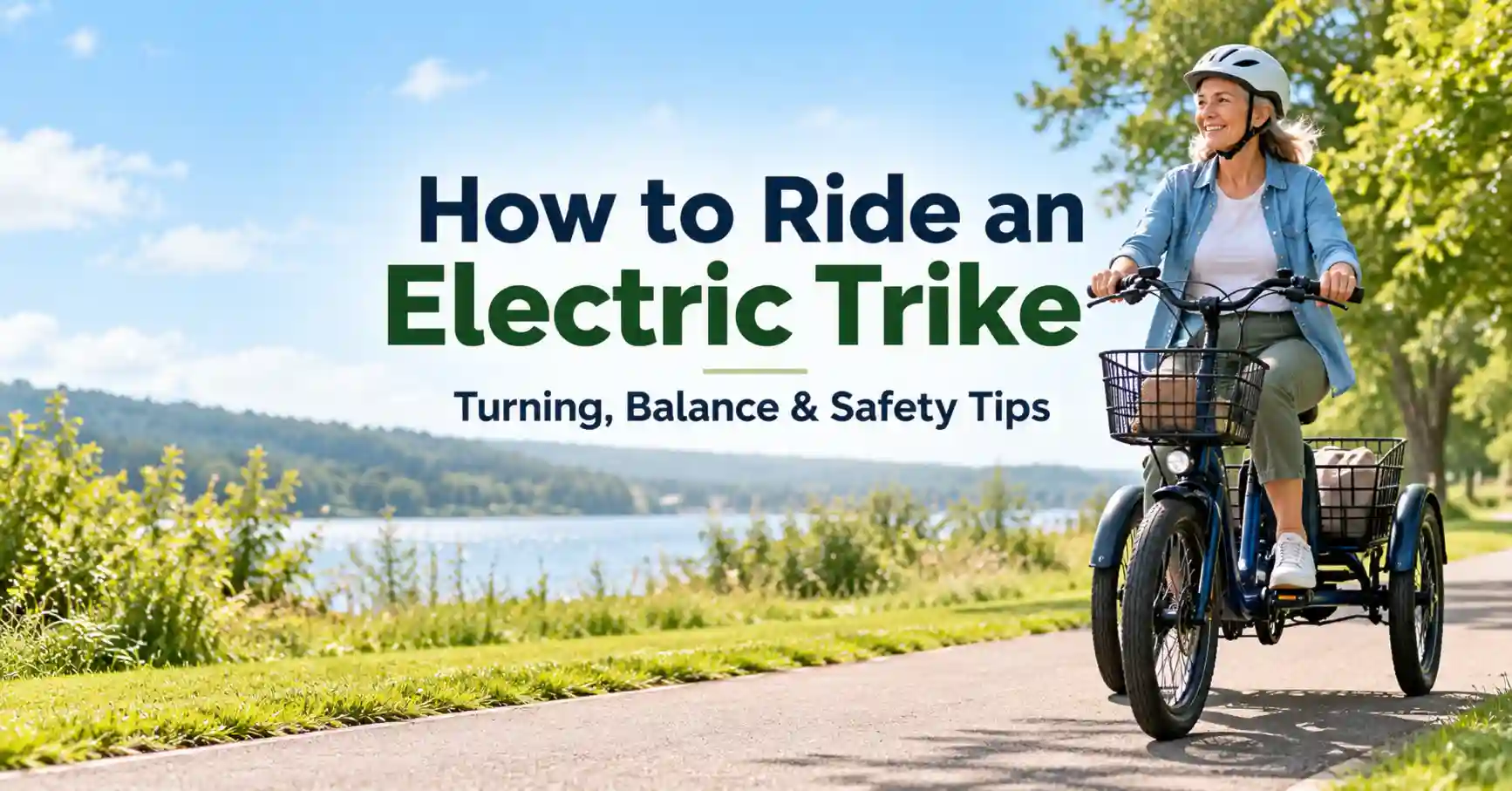
How to Ride an Electric Trike for Beginners: Turning, Balance, and Safety Tips
Last Updated on October 19, 2026 by Kristina
Learning how to ride an electric trike is not quite the same as learning to ride an electric bike. Three wheels mean you do not have to keep the trike upright by balancing on two wheels, but you still need to learn how it steers, how it responds on uneven ground, and why taking a turn too quickly can be risky.
I discovered this when I received and rode the Mooncool TK2 electric trike. It arrived very well packaged, with good instructions, and I found it smooth and enjoyable to ride. What surprised me was the adjustment from riding a regular two-wheel bicycle or e-bike. There was a learning curve, and at times I felt somewhat lopsided while sitting on and riding the trike. That experience made me realize how helpful a practical first-ride guide could be.
You can read more about my experience, including what I liked and what I think buyers should know, in my Mooncool TK2 hands-on review.
Below, I explain how to get started, practice turns and stops, deal with that sideways feeling, and decide when to pause and check the trike. If you are still comparing three-wheel models, see my best electric tricycles guide. For a broader look at protective gear and basic checks, read my electric bike safety guide.
The most important beginner tip: Start on flat, level ground, use no motor assistance or the lowest setting that your trike allows, ride slowly, and practice gentle turns before going near traffic or hills. Follow your own trike’s manual whenever its instructions differ from general advice.
Why Riding an Electric Trike Feels Different
On a bicycle, you make constant small balance corrections and the bicycle normally leans as you turn. On a conventional upright trike, the three wheels support the frame when you are stopped on level ground. You steer it around a corner rather than expecting it to lean naturally like a bicycle.
That can be reassuring at stop signs or when getting ready to ride, but it also changes the sensations coming through the seat and handlebars. On a sloping or uneven road, the trike follows the angle of the surface in a way that a two-wheel rider may find unfamiliar.
Three wheels do not mean tipping is impossible. A sharp turn at excessive speed, a rear wheel dropping off an edge, or an uneven sideways slope can upset a trike. Your speed, the height of the rider and cargo, tire grip, and the particular frame design all matter.
Upright trikes and recumbent trikes are not the same
Most traditional adult electric trikes have a relatively upright seating position, one front wheel, and two rear wheels. Recumbent trikes usually put the rider lower in a reclined seat and may have two wheels in front instead. These differences affect cornering, visibility, mounting, and how the rider should position their body.
For example, Sun’s traditional trike manual emphasizes slower turns and avoiding bicycle-style leaning, while Catrike’s guidance for its low recumbent models includes model-specific advice about leaning into a turn. These are not interchangeable instructions. Mooncool’s general upright-trike guidance also emphasizes controlled upright posture, slow speed, and wide, gentle turns. Learn the technique recommended for the trike you actually own.
Before Your First Ride: Check the Trike and Your Setup
Take a few minutes to get everything ready. It is easier to discover a fit or brake problem while you are standing still than during your first turn.
- Confirm assembly: Follow the manufacturer’s instructions, including any required checks of folding joints, locking pins, wheels, axles, pedals, and fasteners. If anything is unclear, have a qualified bicycle or e-bike mechanic inspect it before riding.
- Check all three tires: Look for damage and inflate to the pressure specified for the tire and trike. Uneven inflation can affect how a trike feels and steers.
- Test the brakes: Identify which controls operate which brakes. Test them while stationary and then at walking speed. Do not ride if stopping power is weak, uneven, or unpredictable.
- Check the seat and handlebars: Set them according to the manufacturer’s fit instructions. You should be able to reach the controls comfortably without stretching or twisting your body.
- Wear the right equipment: Use a properly fitted bicycle helmet that meets the applicable standard (in the United States, look for a CPSC-compliant bicycle helmet), and closed-toe shoes with secure soles. Keep loose clothing and shoelaces away from wheels, pedals, and moving parts.
- Learn the controls: Locate the display, power button, assist selector, brakes, bell, and throttle if fitted. Find out how the motor responds when you begin pedaling and whether assistance stops when you brake. Check whether the throttle can operate even when pedal assist is set to zero; on some models the two functions are separate.
- Understand the parking brake: If there is one, learn how to engage and release it. Do not mistake a parking brake for the normal service brakes used while moving.
- Pick the right space: Choose a large, flat, open, traffic-free paved area. Avoid slopes, curbs, loose gravel, potholes, pedestrians, and obstacles while learning.
Check your owner’s manual before riding. Every electric trike is a little different. Take time to understand your model’s brakes, throttle, pedal assist, parking brake, and other controls before your first ride. Make sure the trike is properly assembled and adjusted according to the manufacturer’s instructions.
🎬 Watch: How to Ride an Adult Tricycle
New to riding on three wheels? This helpful beginner video demonstrates how to get started, steer, turn, and brake safely. It’s a great way to see the basics in action before practicing on your own electric trike.
Step-by-Step: How to Ride an Electric Trike for the First Time
- Park on level ground. Turn motor power off and engage the parking brake if equipped. Make sure the trike cannot roll while you mount it. If mounting is difficult, arrange in-person help rather than using the handlebars to haul yourself into place.
- Sit and check your position. Settle into the center of the seat, place your feet on the pedals or ground as appropriate for the design, and check that you can comfortably reach the brakes. There should be no loose seat, twisting handlebar, or unstable support.
- Identify the brake controls before moving. Squeeze them gently to learn their feel. Check the manual for your trike’s specific brake arrangement; not all trikes brake in the same way.
- Begin without power if the design allows. Release the parking brake, then start pedaling gently with assistance off. If pedaling unassisted is impractical on your model, select its lowest available assist setting and be ready for the motor to engage.
- Travel straight at a very slow pace. Look ahead instead of down at the front wheel. Keep your hands relaxed on the bars and notice how the trike tracks without your normal bicycle balancing corrections.
- Practice gradual braking. On level ground, stop gently several times using the service brakes according to the manual. Keep enough space ahead to stop without having to grab a lever suddenly.
- Try shallow steering changes. Make wide, gradual curves in both directions. Start with only a small handlebar movement so you can feel how the front wheel and rear wheels travel through a turn.
- Add low pedal assistance. Only after you are comfortable starting, going straight, turning, and stopping should you test the lowest motor-assist level. Learn when it engages and how to disengage it.
- Try the throttle only if your trike has one. First confirm the manufacturer’s instructions and whether the throttle works from a stop. In a clear, flat area, use the smallest controlled input and release it promptly. A throttle can make a heavy trike move sooner than a beginner expects; there is no need to use it on your first few practice runs.
- Finish with a complete stop. Bring the trike to rest using its service brakes, disengage assistance, engage the parking brake if equipped, switch off the motor, and dismount carefully.
While the trike is moving, keep your feet securely on the pedals or designated foot supports. Do not try to catch a tilting trike by putting a foot down while it is rolling. Slow to a complete stop with the brakes before repositioning your feet or dismounting. For a trike with unusual foot supports or adaptive equipment, follow the manufacturer’s instructions.
Repeat these basics until you can perform them comfortably without surprise motor engagement, rushed steering, or difficulty reaching the brakes. You do not need to progress to higher speeds or traffic during the first practice session.
Your First Three Electric Trike Practice Sessions
Rather than trying to learn everything on one ride, I would break the basics into three practice stages. These are not timed lessons. You might repeat the same stage several times, and that is fine. Practice somewhere flat, clear, and free from traffic, and stop if you feel rushed or uncomfortable.
Session 1: Start, ride straight, and stop
With the trike unloaded, get comfortable mounting and dismounting while it is secure. Identify each control with the motor off, then practice very gentle straight-line starts and smooth stops. Concentrate on keeping your feet supported, recognizing when the motor engages, and securing the trike when you park.
Session 2: Wide turns and wheel clearance
Only after the first skills feel predictable, practice broad turns to the left and right. Use a wide, obstacle-free area and keep your speed very low. Pay attention to the position of both rear wheels and how the seat feels on a slightly sloped surface, without deliberately riding onto a pronounced side slope.
Session 3: Put the skills together
Use a simple, level loop with gentle corners and plenty of stopping room. Practice a sequence of starting, following a straight line, slowing before a turn, completing the turn, and stopping again. Keep assistance low and add no cargo until you can manage the empty trike comfortably.
Move on only when you can start, turn both ways, brake, and park consistently without a surprise or near-tip. If you still feel unsteady or the controls remain confusing, seek help from a knowledgeable dealer or adaptive cycling instructor before riding in public.
How to Turn an Electric Trike Without Feeling Unstable
Turning is probably the biggest adjustment for someone who is used to two wheels. A bicycle typically leans through a corner. An upright trike remains supported by its three wheels, and its body tends to stay aligned with the road surface. The sideways forces you feel during a turn can make it seem as though you are being pushed outward.
If you turn too tightly or too quickly, weight can shift enough that a wheel becomes light or lifts. A three-wheel layout is not a guarantee against a rollover. The best protection for a beginner is conservative speed, predictable steering, and a suitable surface.
Use this simple approach for each turn
- Check the entire path first. Look for pedestrians, gravel, parked vehicles, drains, curbs, and enough width for the two rear wheels. Remember that the back of many upright trikes is much wider than the front.
- Slow down before the corner. Reduce motor assistance and use the service brakes gently while traveling straight. Do not enter a tight corner at a speed you hope to correct halfway through.
- Choose a wide, smooth line. Steer gradually through the turn. Avoid sudden handlebar inputs, zigzags, or last-second corrections.
- Follow your model’s body-position guidance. Keep a stable, controlled seating position. Do not copy the leaning technique of a two-wheel bicycle or a low recumbent trike unless the manufacturer specifically instructs you to use it.
- Wait until the trike straightens before adding power. Avoid a sudden throttle burst or a jump to a higher assist level while cornering.
Practice turns in both directions
Start with broad U-shaped curves in a large open area, with plenty of clearance on both sides. Once those are predictable, try a simple rectangle with gentle corners. Do not practice abrupt figure-eights, wheel lifting, or tight turns at speed.
Notice whether one direction feels different from the other. Road slope and an uneven practice surface can contribute to that feeling, but a persistent difference on genuinely level ground deserves a fit and mechanical check.
Give the rear wheels extra space
You may clear an obstacle with the front wheel while the inside rear wheel still hits it. This is an easy mistake to make when passing bollards, curbs, parking stops, or narrow gates. Slow down and give the full width of your trike room to pass. Never assume that a path wide enough for a bicycle is automatically wide enough for your trike.
If a wheel seems to lift, the trike lurches, or you feel close to tipping, do not keep experimenting with that turn. Reduce speed safely, stop in a clear place, and reconsider the route, your technique, and the trike’s condition before continuing.
What does a rear differential change when turning?
Some trikes have a differential in the rear axle. During a turn, the outside rear wheel travels a longer path than the inside rear wheel. A differential lets those wheels rotate at different speeds, which can reduce tire scrubbing compared with a design that forces both rear wheels to rotate together.
Mooncool lists a rear differential on the TK2 specification page. That is a documented feature of this model, not something I measured during my ride. It may help explain differences in how trikes steer, but a differential does not eliminate sideways forces, lifting a wheel, or tipping risks. Slow, smooth turns still matter, regardless of the drivetrain.
Why Do I Feel Lopsided When Riding an Electric Trike?
At times while riding my Mooncool TK2, I felt somewhat lopsided. That was a personal sensation, not a diagnosis of a fault with the trike. I still found the ride smooth and enjoyable, but the difference from a bicycle took some getting used to.
One possible explanation is road camber. Many roads and paths slope slightly toward an edge so water can drain. When an upright trike follows that slope with three wheels, the seat and handlebars can feel tilted relative to the horizon. Someone accustomed to balancing a bicycle upright may notice that immediately.
Other possible contributors include uneven pavement, differences in tire pressure, seat or backrest positioning, how you are sitting, and the unfamiliar steering response. The sensation alone cannot tell you which factor is responsible.
When it may be part of getting used to the trike
If the feeling is mild, changes with the direction or slope of the path, and becomes less noticeable on truly level pavement, unfamiliar handling or surface camber may be involved. Practice at a slow speed on a flat, clear surface. Make sure you are comfortably centered and not twisting to reach a control.
When to stop and have the trike checked
Do not assume persistent lopsidedness is normal. Stop riding and arrange an inspection if the trike leans or pulls consistently on level ground, one tire repeatedly loses pressure, the seat or handlebar appears crooked or loose, a wheel wobbles, or you hear unusual mechanical noises. A mechanic can check wheel and axle alignment, tire and wheel condition, steering components, seat attachment, and assembly.
If you experience dizziness, weakness, pain, or a loss of bodily balance unrelated to the road surface, that is a separate reason to stop and seek appropriate medical advice. Getting used to a new vehicle should not mean pushing through a possible health or mechanical problem.
Riding on Uneven Ground, Side Slopes, and Hills
A small pothole that a bicycle rider might steer around can become more complicated with three separate wheel tracks. A rear wheel may hit the hole even after the front wheel passes it. Raised edges, curbs, drainage channels, and narrow paths deserve more space and slower speeds.
Side slopes are especially important. If the ground falls away to one side, the trike can tilt with it. A trike that feels secure on flat pavement can behave differently on a sideways incline. Avoid steep camber and never deliberately test the angle at which a wheel might lift.
For a beginner, the easiest choice is a smooth, level route. Walk and inspect an unfamiliar surface first when it is safe to do so. If there are deep ruts, loose stones, wet grass, ice, a steep cross-slope, or a drop-off near a wheel, choose another route rather than relying on three-wheel stability.
Watch for sloped driveways, speed bumps, and raised entrances
A driveway or shop entrance can be tricky even when the street looks fairly level. The pavement may slope sideways across the trike’s three wheel tracks, so the front wheel and two rear wheels may not be on the same height or angle at the same moment. That can produce the tilted feeling many riders notice on ordinary roads.
Raised speed cushions also deserve care. Unlike a full-width, smooth speed hump, a cushion may put only one of your wheels on the raised section. Cycling-accessibility guidance highlights uneven roadway features as a concern for wider, three-wheeled cycles. Do not assume a feature is safe to cross because a two-wheel bicycle can cross it.
Look ahead, slow early, and assess whether all three wheels have a suitable, relatively even route. If a raised edge, deep drainage channel, steep driveway transition, or pronounced side slope looks unsuitable, take a flatter alternative. Do not weave into traffic to avoid an obstacle, try to ride up a curb, or test whether the trike will tip.
What about climbing and descending hills?
Learn how your trike’s motor, gearing, and brakes respond on flat ground before attempting an incline. On a climb, keep your speed controlled and do not assume motor power alone means the trike is suitable for a steep hill. On a descent, reduce speed early and leave additional stopping space. Follow the manufacturer’s maximum grade and loading restrictions if published.
Do not make a tight turn on a steep hill or cross a steep side slope just to shorten your route. If you are uncertain the trike can handle the grade or surface, stop somewhere safe and choose a flatter alternative.
How to Stop and Park an Electric Trike Safely
Release the throttle if fitted, stop pedaling to end pedal assistance, and apply the normal service brakes smoothly according to your trike’s instructions. Some models have motor cut-off brake switches, but you should not assume yours does or rely on that feature to stop. Come to a full stop before preparing to get off.
Choose level ground to park whenever possible. Engage the parking brake or parking lock if your trike has one, then power the system off. Make sure the trike is secured before shifting your weight to dismount. Do not rely on the parking brake to hold the trike on a steep slope, and never use a parking-only mechanism as a substitute for the brakes while riding unless the manufacturer expressly designs it for that purpose.
If you carry bags or groceries, keep them within the manufacturer’s approved weight limits and arrange them so they cannot interfere with moving parts or shift unexpectedly. Take heavy items off the trike only after it is securely parked.
How to move or reverse a trike when you are not riding
Before your first outing, think about how you will get the trike out of the garage, turn it around, and put it away. A three-wheel trike can be wider and more awkward to reposition than a bicycle. Make sure there is clearance for the rear wheels, and do not try to lift or pivot a heavy trike if you cannot control its weight safely.
When pushing it by hand, switch off the motor so the throttle cannot be triggered accidentally. Keep your feet clear of the wheels, stand in a position where the trike cannot roll into you, and use help if the ground is sloped or the trike is too heavy to control.
Some electric trikes have a manufacturer-designed reverse or walk-assist mode. Mooncool lists powered reverse on the TK2, while Sun documents walk assist on certain E350 models. These are different systems: do not assume the same buttons, position, or operating method applies to both. If your trike has either feature, read its specific manual first, keep people and obstacles clear, and practice only on level ground at the manufacturer’s low maneuvering speed. Never use powered reverse as a substitute for securing the parking brake or for controlling a trike on a steep driveway.
Common Beginner Mistakes to Avoid
- Turning too quickly: A trike can tip even when it feels stable while stopped. Slow before corners, not after you enter them.
- Starting with too much motor assistance: High assist or an unfamiliar throttle can produce an abrupt start. Learn the lowest setting first.
- Assuming three wheels solve every balance problem: Trikes still respond to slopes, sudden steering, and shifting weight.
- Ignoring camber and potholes: Three wheel tracks create more ways to encounter a rough patch or road edge.
- Riding before checking fit and controls: A seat that moves or brake controls you cannot reach comfortably can turn a small mistake into a dangerous one.
- Loading baskets too heavily or unevenly: Cargo changes handling and stopping. Begin with empty baskets and keep later loads secure, low, and reasonably centered.
If load capacity is an important consideration, I explain the difference between rider limits, basket limits, and total payload in my guide to electric trikes for heavy riders.
How Long Does It Take to Get Comfortable Riding an Electric Trike?
There is no reliable timeline that applies to everyone. Someone who has ridden many types of bikes may still need time to adjust to trike steering. Other riders might find starting and stopping reassuring but need more practice with turns or mounting.
Your experience, confidence, mobility, the trike’s design, and where you practice all affect the process. Rather than counting days, judge progress by what you can do safely. Can you start without unexpected acceleration, travel straight, turn both ways gently, brake predictably, and dismount without the trike rolling?
Short, unhurried sessions on the same level practice area can be more useful than trying to master hills and public roads immediately. If you are struggling, instruction from a knowledgeable trike dealer or adaptive cycling instructor can help you identify whether the difficulty is technique, fit, or vehicle choice.
Electric Trike Reviews Worth Exploring
If you’re still deciding which electric trike might work best for you, I’ve covered several different models on Electric Bike Explorer. You can read my Lectric XP Trike 2 review, my Mooncool TK2 Trike review and Velotric Triker review to learn more about their features, comfort, and riding considerations.
Are Electric Trikes Easier for Seniors or Riders With Balance Concerns?
They can be. Not having to keep a two-wheel bicycle upright while stopped may help people who feel uncomfortable balancing, especially at a junction or during a slow start. Some models also have low step-through frames, supportive seats, and adjustable controls.
But an electric trike is not automatically the safest choice for every older adult or every person with a balance or mobility condition. Getting on and off may still be challenging. Turning requires practice, wider vehicles need more clearance, and the weight of an electric trike can make it difficult to maneuver or transport.
Cycling UK’s inclusive trike guidance explains the differences among upright, recumbent, and adapted cycles and the value of supported try-out sessions. If a rider has significant balance, strength, coordination, or mobility limitations, an adaptive cycling specialist, occupational therapist, physical therapist, or other qualified professional may help assess suitable equipment and riding conditions.
I also compare comfort, access, and rider-fit considerations in my electric bikes for seniors guide. If you have not yet chosen between two and three wheels, my complete electric bike buying guide covers the broader decisions.
Beginner Electric Trike Practice Checklist
Before taking your trike on public roads or shared paths, make sure you can comfortably do the following on a flat, open practice surface:
- ☐ Identify the power, assist, throttle (if fitted), service brakes, and parking brake.
- ☐ Mount and dismount without the trike moving.
- ☐ Start gently and ride straight without surprise motor assistance.
- ☐ Keep both feet on the pedals or intended supports while moving, without trying to steady the trike by putting a foot down.
- ☐ Stop smoothly at a chosen point several times.
- ☐ Make wide left and right turns slowly with plenty of clearance.
- ☐ Judge how far the rear wheels sit from curbs and obstacles.
- ☐ Recognize an unsuitable surface or sideways slope and choose another route.
- ☐ Secure the trike safely and turn the motor off when parking.
- ☐ Check tires, brakes, seat, wheels, and battery attachment before each ride.
- ☐ Know where you can legally ride your specific trike before entering traffic or a public path.
For the last item, begin with my state-by-state e-bike laws guide, but confirm that your particular electric trike qualifies under the applicable rules. Bicycle paths, sidewalks, trails, local ordinances, and vehicle classifications can differ.
Planning Your First Real Electric Trike Ride
Once the practice skills feel predictable, choose a short, familiar route instead of immediately heading into busy traffic. Look for smooth, fairly level pavement, good visibility, wide corners, and safe places to stop. A loop that lets you return without making a tight turn is a useful starting point.
Check the route for narrow gates, bollards, steep driveway entrances, speed cushions, side slopes, and places where one rear wheel could drop off an edge. Also make sure the path or road is open to your particular trike under local rules. If you are unsure about a crossing, hill, or obstacle, choose another route rather than improvising among moving vehicles.
Think about how easily other road users can see you. A working front and rear light, suitable reflectors, and a properly positioned mirror can help in the right conditions. Visibility flags are especially worth considering on some low recumbent trikes. The needs of an upright TK2 and a low recumbent trike are not identical, and accessories should be fitted according to the manufacturer’s advice. Cycling UK’s inclusive trike guide discusses visibility and fit differences among trike designs.
I would make the first public ride in daylight, in good weather, with the baskets empty and without the pressure of a deadline. Let someone know your route if that helps, and turn back if conditions are beyond what you have practiced. A short, uneventful ride is a much better first goal than covering a particular distance.
Frequently Asked Questions
Can I practice riding an electric trike with the motor switched off?
Often, yes, if the drivetrain and manufacturer instructions allow ordinary pedaling without assistance. Some trikes may be heavy or difficult to pedal unassisted. Use a flat area and do not force the pedals if something feels wrong. Otherwise, practice with the lowest available motor setting.
Does every electric trike have powered reverse?
No. Some trikes have powered reverse, some have walk assist, and others require manual repositioning. Do not assume your model has either feature. Read its manual before using any powered maneuvering mode, and learn basic forward riding, braking, and parking first.
What if my trike feels like it pulls to one side?
First stop and check for obvious tire-pressure differences, a poorly positioned seat, and uneven pavement. If the problem persists on level ground, do not continue riding until a qualified mechanic checks the steering, wheels, axles, and alignment.
Can I take my electric trike onto the same paths as a bicycle?
Not automatically. A trike may be wider, and the local rules may classify some three-wheel electric vehicles differently. Check path width, access signs, the governing agency’s rules, and the legal classification of your model before using the route.
Can I carry a passenger in an electric trike’s basket?
Do not use a cargo basket to carry a person or pet unless the manufacturer expressly approves that specific passenger setup. A basket designed for groceries does not become a safe passenger seat simply because the trike has three wheels.
Why You Can Trust This Guide
I personally received and rode the Mooncool TK2, and the observations about its packaging, ride feel, and my adjustment to three wheels are my own. The broader riding and safety guidance is based on manufacturer instructions and established cycling and inclusive-cycling resources. I do not assume my experience on one trike applies to every model.
My Take
I enjoyed riding the Mooncool TK2. It came very well packaged, the instructions were good, and the ride felt smooth. But I was surprised by how different it felt from a regular two-wheel bicycle or e-bike. The learning curve, including those moments when I felt lopsided, reminded me that adding a third wheel does not mean you can skip learning a new way to ride.
That is the advice I would give any new electric trike rider: choose a safe, flat place, start slowly, and give yourself time to get familiar with steering and turning. Three wheels can make some parts of riding easier, but knowing their limits is what helps you ride with more confidence.
Sources and Further Reading
- Catrike – Owner’s Guidance and Riding Safety
- Mooncool – Safety Measures: Maintaining Balance on Electric Trikes
- U.S. Consumer Product Safety Commission – Bicycle Helmet Safety Standard

Kristina is not just an enthusiast but a true authority on electric bikes. Nestled in the coastal beauty of Virginia, Kristina has found the perfect backdrop for her passion for electric biking. As a dedicated wife and homeschooling mom, her life revolves around family, faith, and the thrill of adventure.
Originally hailing from Ohio, Kristina's journey with electric bikes began as a curiosity and quickly evolved into a deep expertise. Her blog is a testament to her love for electric biking, combining her fascination for eco-friendly transportation with her coastal lifestyle.
When she's not cruising the beach on her electric bike, you'll find Kristina indulging in her other loves: long walks along the shore, getting lost in a good book, and cherishing moments with her loved ones. With a heart as big as her love for animals, especially cats, Kristina brings a unique perspective to the electric bike world, grounded in her strong faith in God and her dedication to a sustainable lifestyle.
Through her blog, Kristina shares her extensive knowledge of electric bikes, offering valuable insights, tips, and recommendations to fellow enthusiasts. Whether you're a seasoned rider or a newcomer to the electric bike scene, Kristina's blog is your go-to source for all things electric biking, fueled by her passion, expertise, and the scenic beauty of coastal Virginia.