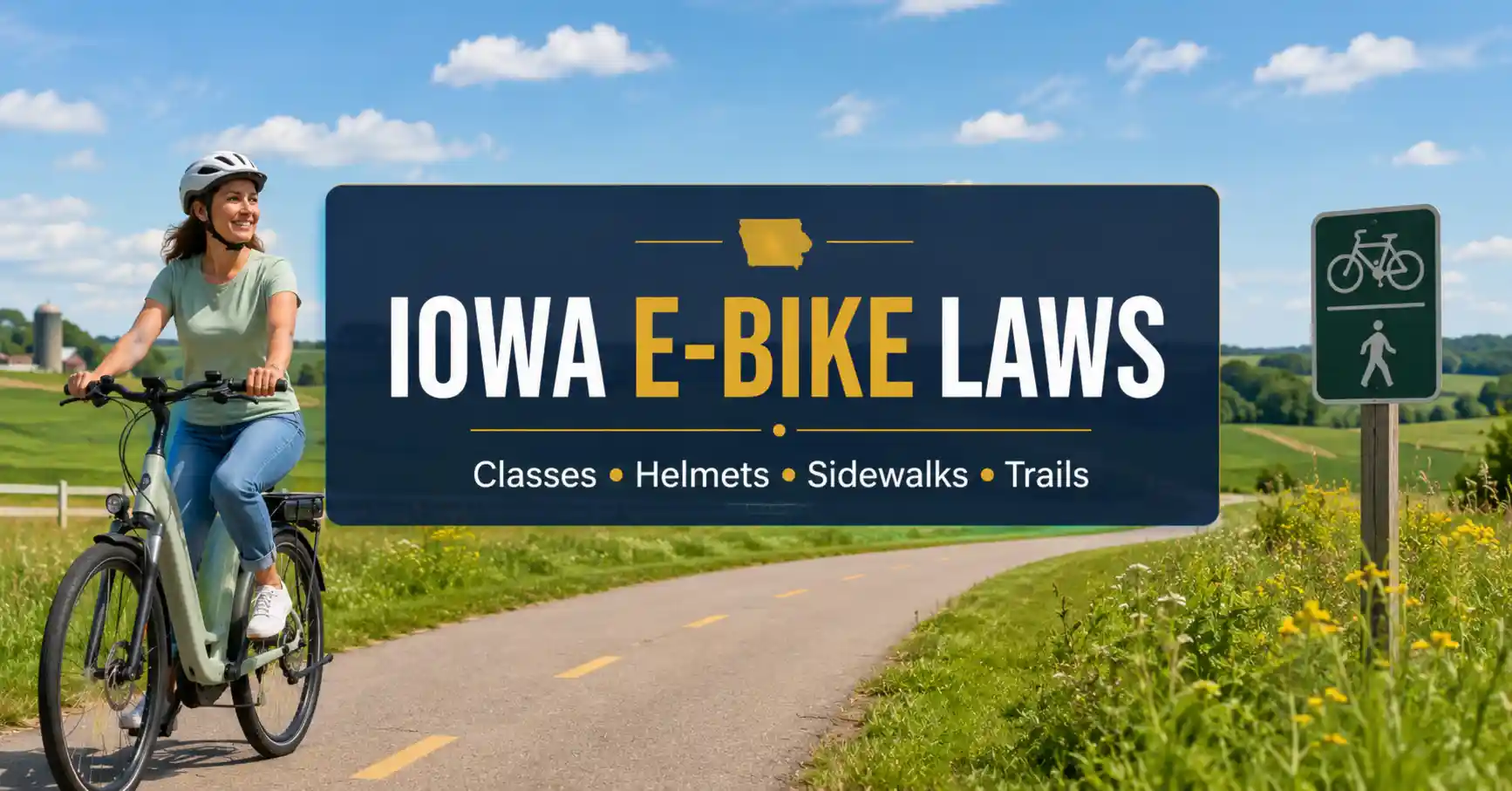
Iowa E-Bike Laws: Classes, Helmets, Sidewalks, Trails, Cities, and Campus Rules
Last Updated on September 4, 2026 by Kristina
Last researched and verified: September 2026
Iowa e-bike laws are relatively straightforward at the state level, but the rules become more complicated when you start looking at city sidewalks, local trails, state parks, and college campuses. Iowa recognizes Class 1, Class 2, and Class 3 low-speed electric bicycles, and a law that took effect July 1, 2026 changed the state’s motor limit so a qualifying e-bike may now have a motor that produces not more than 750 watts.
Qualifying low-speed e-bikes generally receive the same access as bicycles under Iowa law, including streets, shoulders, bike lanes, bikeways, and bicycle or multi-use paths. But that statewide rule does not mean every sidewalk, park trail, campus walkway, or locally managed recreation trail has identical operating rules.
If you are comparing Iowa with another state, start with my State-by-State E-Bike Law Guide. If the class system is unfamiliar, my guide to Class 1, Class 2, and Class 3 e-bikes explains how the three categories work.
⚖️ Law Research Note
I reviewed current state statutes, agency guidance, and available local rules when this guide was updated. E-bike laws can change, and cities, parks, trails, campuses, and property managers may impose additional restrictions. Confirm current requirements before riding.
Iowa E-Bike Laws at a Glance
- Maximum motor output: Not more than 750W as of July 1, 2026.
- Class 1: Pedal assist, with motor assistance ending at 20 mph.
- Class 2: The motor may propel the bicycle without pedaling, with assistance ending at 20 mph.
- Class 3: Pedal assist, with assistance ending at 28 mph.
- Class 3 minimum operator age: 16.
- Class 3 equipment: A speedometer displaying speed in mph is required.
- Driver’s license: Not required for a qualifying low-speed e-bike.
- Registration and title: Not required.
- Proof of financial liability: Not required under the low-speed e-bike statute.
- Helmet: Iowa’s low-speed e-bike statute does not impose a statewide helmet requirement, although Iowa DOT recommends wearing one.
- Road and path access: A qualifying low-speed e-bike may generally operate where bicycles are allowed.
- Class 3 path speed: Follow the posted or applicable limit. If there is no such limit on a bicycle lane or multi-use path, a Class 3 rider may not exceed 20 mph.
- Local rules: Bicycle-operation rules, signs, campus rules, and trail-manager policies still need to be checked for the place you plan to ride.
Who This Iowa E-Bike Law Guide Covers
This guide covers a vehicle that actually meets Iowa’s definition of a low-speed electric bicycle. It should not be automatically applied to mopeds, electric motorcycles, off-road motorcycles, high-powered e-motos, or modified devices that no longer qualify as a Class 1, Class 2, or Class 3 low-speed e-bike.
The marketing name does not decide the legal category. A manufacturer can call something an “e-bike,” but Iowa law looks at the vehicle’s design, motor, operating characteristics, pedals, speed, and legal classification.
Important 2026 Change: Iowa Now Allows Up to 750W
This is the most important recent change to Iowa e-bike law.
Earlier Iowa law defined a low-speed electric bicycle as having an electric motor of less than 750 watts. Senate File 490 changed that language to a motor that produces not more than 750 watts.
The Iowa House passed Senate File 490 on March 5, 2026. Governor Kim Reynolds signed it on April 30, 2026, and the change took effect July 1, 2026.
You may still see the older “less than 750 watts” language in the published 2026 Iowa Code PDF and on some city, county, trail, and university websites. Those materials either predate the July 1 amendment or have not yet been updated to reflect it.
One technical caution: Iowa’s amended law says the motor “produces not more than 750 watts.” It does not use common marketing terms such as “nominal power” or “peak power.” If a manufacturer advertises different nominal and peak wattage figures, the marketing label alone may not answer whether the bike fits Iowa’s statutory definition.
How Iowa Defines Class 1, Class 2, and Class 3 E-Bikes
Iowa Code section 321.1 defines a low-speed electric bicycle as a device with a saddle or seat for the rider, two or three wheels, fully operable pedals, and an electric motor meeting the state’s power requirement and one of the three class definitions.
| Class | How the motor works | Assisted speed | Important Iowa rule |
|---|---|---|---|
| Class 1 | Motor assistance only while the rider pedals | Assistance ends at 20 mph | Generally receives bicycle access |
| Class 2 | Motor may propel the bicycle without pedaling | Assistance ends at 20 mph | Motor-only propulsion is permitted within the Class 2 definition |
| Class 3 | Motor assistance only while the rider pedals | Assistance ends at 28 mph | Operator must be at least 16 and the bike must have a speedometer |
Iowa’s Class 3 definition is pedal-assist. A vehicle that uses motor-only propulsion at higher speeds should not automatically be described as a legal Iowa Class 3 e-bike.
Do You Need a License, Registration, Title, Plate, or Insurance?
Iowa Code section 321.235B exempts qualifying low-speed electric bicycles from several motor-vehicle requirements.
| Requirement | Qualifying Iowa low-speed e-bike |
|---|---|
| Driver’s license or permit | No |
| Motor-vehicle registration | No |
| Title | No |
| Motor-vehicle license plate | No registration-based plate requirement |
| Vehicle inspection | No |
| Proof of financial liability coverage | No |
These exemptions depend on the device remaining a qualifying low-speed electric bicycle. They should not be extended automatically to a moped or high-powered electric motorcycle.
Helmet and Age Rules in Iowa
Iowa Code section 321.235B does not impose a statewide helmet requirement on low-speed e-bike riders. Iowa DOT nevertheless recommends that bicyclists always wear a helmet.
I recommend one for e-bike riding as well. You can compare protective options in my guide to helmets for e-bike riders.
The clearest statewide e-bike age rule concerns Class 3. A person under 16 may not operate a Class 3 low-speed electric bicycle. A person under 16 may ride as a passenger on a Class 3 bike when the bicycle and passenger arrangement comply with Iowa law.
I did not find the same statewide minimum operator age in section 321.235B for Class 1 or Class 2. Schools, campuses, recreation areas, and other properties can still have rules affecting younger riders.
Where Can You Ride an E-Bike in Iowa?
Roads, streets, shoulders, and bike lanes
Iowa Code section 321.235B gives qualifying low-speed electric bicycles broad bicycle access. The statute says they may operate anywhere bicycles are allowed, including streets, highways, roadways, shoulders, bicycle lanes, bikeways, and bicycle or multi-use paths.
On a highway, the rider generally has the rights and duties that apply to a bicycle rider. My broader e-bike rules of the road guide explains how road, bike-lane, path, and sidewalk access can differ.
Interstates and controlled-access highways
Iowa DOT advises bicyclists that bicycles are permitted on Iowa roads except interstates, controlled-access highways, and highways with posted minimum speed limits. A qualifying low-speed e-bike should not be treated as permission to ride on a roadway from which bicycles are prohibited.
Sidewalks
There is no safe one-sentence answer for every Iowa sidewalk. Iowa treats qualifying low-speed e-bikes as bicycles for many purposes, while Iowa law also gives local authorities power to regulate bicycle operation within statutory limits.
That is why a legal e-bike can encounter different sidewalk rules in Des Moines, Ames, Cedar Rapids, or Iowa City.
See my complete guide to e-bike sidewalk laws for more on why local rules matter.
Class 3 e-bikes on bike lanes and multi-use paths
A Class 3 e-bike may not be operated on a bicycle lane or multi-use path above the posted or otherwise applicable speed limit. If there is no posted or applicable limit, Iowa sets a 20 mph maximum for Class 3 operation on that facility.
This does not change the Class 3 definition itself. A Class 3 bike may provide pedal assistance up to 28 mph where legally permitted, but the rider may have to travel more slowly on a particular path.
Iowa State Parks and Recreation Areas
The Iowa Department of Natural Resources says bicycle riding in state parks and recreation areas is restricted to roadways and designated and signed trails.
That makes the trail map and signs important. Do not assume that every hiking trail, natural-surface trail, or park path is open simply because Iowa generally treats your e-bike as a bicycle.
If a route is not clearly designated for bicycles or the signs are unclear, check with the park office before riding.
Why Some Local E-Bike Pages Do Not Match the New Iowa Law
Important local-rule check: Iowa changed its statewide motor-power wording on July 1, 2026, but several official local pages and policies still display older definitions.
For example, West Des Moines currently describes a trail-eligible e-bike as having a motor “under 750 watts.” The University of Iowa’s published e-mobility policy still uses “less than 750 watts.” Boone County’s High Trestle Trail regulations state that the bicycle definition follows Iowa Code and amendments, while the document also reproduces older electric-bicycle wording.
Those older pages should not be used to replace the current statewide definition. At the same time, riders should not assume that every local ordinance, trail policy, or campus rule has automatically been updated simply because state law changed.
If the difference matters for your bike – particularly an exact 750W model or a Class 3 e-bike – check the current rule with the city, trail manager, campus, or other authority responsible for the property before riding.
Iowa City E-Bike Rules Compared
| City | Local rule to know | Practical takeaway |
|---|---|---|
| Des Moines | Bicycles may generally use public sidewalks carefully unless signs prohibit riding. The city also permits certain electric-motorized devices of one horsepower or less on multi-use recreational trails. | Sidewalk access is relatively broad, but posted restrictions control. The city’s one-horsepower wording is not identical to Iowa’s new 750W wording. |
| West Des Moines | The city’s current trail page says e-bikes are permitted on city trails if they have functional pedals, a motor under 750W, and a maximum motor-assisted speed of no more than 20 mph. | The published local guidance appears narrower than the newly amended state definition and does not fit a normal 28 mph Class 3 e-bike as written. Confirm with the city if riding a 750W or Class 3 bike. |
| Ames | Bicycle riding is prohibited on specified sidewalks on portions of Main Street, Lincoln Way, Hayward Avenue, and Welch Avenue. | Pay close attention downtown and near Iowa State University and Campustown. |
| Cedar Rapids | Chapter 53 includes a downtown sidewalk and public-property riding restriction for bicycles and micromobility devices, subject to signed exceptions. | Use streets or designated bicycle facilities in the restricted area rather than assuming every downtown sidewalk is available. |
| Iowa City | Bicycles may not be ridden on sidewalks in the Central Downtown Business District. City park rules also specifically prohibit bicycles and electric-assist bicycles in Chauncey Swan Park and Black Hawk Mini Park. | Downtown and park-specific restrictions make route planning important even when the e-bike is legal under state law. |
Des Moines
Des Moines Code section 114-690 permits bicycles on public sidewalks when they are operated carefully and prudently, except where signs prohibit riding. Riders must yield to pedestrians and give an audible signal before overtaking and passing.
The city’s bicycle definition also includes certain devices with fully operable pedals and an electric motor of one horsepower or less. Des Moines’ multi-use trail ordinance permits electric-motorized devices of one horsepower or less.
One horsepower is approximately 746W, so that local wording is not precisely the same as Iowa’s new maximum of 750W. If you have a bike at the upper edge of the state definition and intend to rely on the Des Moines trail ordinance, it is reasonable to confirm current city interpretation.
West Des Moines
West Des Moines deserves its own section because the city’s official Trail Ethics page specifically addresses e-bikes.
The current page says an electric bicycle is permitted on city trails when it has functional pedals, a motor under 750W, and a maximum motor-assisted speed of no more than 20 mph.
That published guidance does not yet match Iowa’s July 1, 2026 statewide change from less than 750W to not more than 750W. Its 20 mph language is also narrower than the statewide definition of a Class 3 e-bike, which may provide pedal assistance up to 28 mph.
Because the city’s published trail guidance is more restrictive as written, I recommend following posted signs and confirming current West Des Moines Parks and Recreation guidance before riding an exact-750W or Class 3 e-bike on a city trail.
Ames
Ames identifies several sidewalks where bicycle riding is unlawful:
- Main Street from Duff Avenue to Clark Avenue.
- The south side of Lincoln Way from Stanton Avenue to Hayward Avenue.
- The east side of Hayward Avenue from Lincoln Way to Hunt Street.
- Welch Avenue from Lincoln Way to Knapp Street.
Where sidewalk riding is allowed, cyclists must yield to pedestrians and provide an audible warning before overtaking them.
These rules are particularly useful for riders traveling between Ames neighborhoods, Campustown, and Iowa State University.
Cedar Rapids
Cedar Rapids regulates bicycles and micromobility devices under Chapter 53 of its city code. Section 53.14 establishes restrictions on riding on sidewalks and public property in a defined downtown area and allows signs to regulate additional areas.
Because downtown boundaries and signs matter more than a statewide summary, I recommend checking the current Chapter 53 map or code language if your route goes through central Cedar Rapids.
Iowa City
Iowa City Code section 9-8-1 prohibits bicycle riding on sidewalks in the Central Downtown Business District. The district is bounded by and includes Capitol Street to the west, Burlington Street to the south, Gilbert Street to the east, and Jefferson Street to the north.
Where sidewalk riding is permitted, riders must yield to pedestrians and provide an audible signal before passing.
Iowa City’s park code adds another useful local detail. A bicycle, electric-assist bicycle, electric scooter, electric skateboard, or other listed device may not be operated within Chauncey Swan Park or Black Hawk Mini Park. These devices are permitted in other city parks unless posted as prohibited, subject to pedestrian-safety requirements.
Popular Iowa Trails: What the Official Rules Actually Say
Trail access is one of the more complicated parts of Iowa e-bike law because a trail may cross several jurisdictions and the managing agency’s published rules may use terminology that predates Iowa’s current three-class e-bike law.
| Trail | Official guidance I found | Practical e-bike takeaway |
|---|---|---|
| High Trestle Trail – Boone County segment | Boone County’s regulations say the bicycle definition follows Iowa Code and amendments, but the same document also reproduces older electric-bicycle language using less than 750W and a 20 mph motor-only threshold. | The document contains an internal inconsistency after Iowa’s July 2026 amendment. Riders with an exact-750W or Class 3 bike should confirm the current interpretation with Boone County Conservation. |
| Raccoon River Valley Trail | Dallas County describes the RRVT as a multi-use recreational trail and states that motorized vehicles are prohibited except for designated snowmobile use. Its public trail page does not clearly explain how statutory low-speed electric bicycles fit that wording. | I would not treat the general “motorized vehicles” language alone as a definitive answer for every e-bike class. Check with the conservation board responsible for the section you plan to ride. |
| Great Western Trail | Polk County lists bicycling as an allowed activity while also stating that motorized vehicles are prohibited on conservation trails, subject to stated exceptions. The public page does not separately classify Iowa low-speed e-bikes. | The available public guidance is not clear enough for me to give every e-bike class a categorical yes or no. Confirm with Polk County Conservation. |
| Neal Smith Trail | Different portions are managed by the U.S. Army Corps of Engineers, Iowa DNR, and the City of Des Moines. The Corps lists bicycling as an activity and prohibits motorized vehicles but does not clearly publish an e-bike class rule on the trail page reviewed for this guide. | Check the rules and posted signs for the specific segment because management changes along the route. |
| Cedar Valley Nature Trail | Linn County lists bicycling as an authorized recreational use. The current trail information reviewed for this guide does not state a specific e-bike class or wattage rule. | Because the trail crosses jurisdictions, verify the rules for the section you plan to use rather than assuming one county’s guidance controls the entire route. |
| Trout Run Trail – Decorah | Official trail materials describe the route as providing non-motorized recreation and list bicycling as a use, but the materials reviewed for this guide do not separately explain the status of Iowa low-speed electric bicycles. | Confirm with Decorah Parks and Recreation or Winneshiek County Conservation rather than assuming that the term “non-motorized” definitively includes or excludes a legal low-speed e-bike. |
Why I am not giving every Iowa trail a simple yes or no
A blanket statement that “e-bikes are legal on Iowa bike trails” would be too broad.
Iowa state law gives qualifying low-speed electric bicycles broad bicycle access, but trail managers may control particular properties, and several official pages use terms such as “motorized vehicles prohibited” or “non-motorized” without clearly reconciling that terminology with Iowa’s current Class 1, Class 2, and Class 3 definitions.
Where an official source does not clearly answer the current e-bike question, I would rather identify the uncertainty and tell riders which authority to contact than give a confident answer the source does not support.
High Trestle Trail
Boone County’s High Trestle Trail regulations require careful reading after Iowa’s 2026 law change.
The county document says its definition of a bicycle follows Iowa Code section 321.1 “and any amendments thereto.” That language suggests amendments to Iowa law are incorporated. However, the same document also reproduces an older electric-bicycle definition using the previous less-than-750W wording.
Because those two parts of the document no longer fit neatly together after the July 1, 2026 amendment, I would not claim that the older quoted wattage language controls without further confirmation. Riders with an exact-750W bike or a Class 3 e-bike should contact Boone County Conservation for the current interpretation before relying on the trail ordinance.
Iowa College, University, and School E-Bike Rules
A campus rule can matter even when the surrounding city and state allow the e-bike. Parking, storage, pedestrian zones, buildings, and registration are common areas where campus policies differ.
| School | Rule I verified | Practical takeaway |
|---|---|---|
| Iowa State University | Current ISU sustainability guidance says its “Walk Your Wheels” initiative prohibits bicyclists from riding on campus sidewalks. The latest official bike map I could verify is the 2024 edition, which also directs riders to racks and says bicycles are not allowed inside campus buildings. | Walk your bike on campus sidewalks and use designated parking. Because the detailed bike map predates this guide, verify current signs and parking rules. |
| University of Iowa | The university explicitly regulates e-bikes and other e-mobility devices. Bikes and e-mobility devices should use provided racks and generally may not be parked inside university buildings. | Campus storage and parking rules are enforceable separately from state road law. The policy’s current e-mobility definition still uses less than 750W, so exact-750W riders should ask Parking and Transportation how the updated state law affects campus treatment. |
| University of Northern Iowa | UNI’s current parking manual explicitly states that e-bikes are not allowed inside university buildings and are subject to the same rules as other bicycles. Bicycles must use university-provided racks. | Keep the e-bike outside, use a rack, and give pedestrians the right of way on campus walkways. |
| Iowa City Community School District | The current elementary handbook allows students in grades 3 through 5 to ride bicycles to school, strongly recommends helmets, requires bikes to use racks, and requires students to walk wheeled transportation equipment on school property. It does not specifically say that an e-bike qualifies. | Do not assume the bicycle permission automatically covers an e-bike for an elementary student. Ask the school or district before riding one to campus. |
Iowa State University in Ames
Iowa State’s current sustainability page says the university maintains a “Walk Your Wheels” initiative that prohibits bicyclists from riding on campus sidewalks.
The latest official ISU bicycle map I could verify is dated 2024. It identifies routes, dismount areas, bike parking, and repair stations and instructs riders to use provided bicycle racks. That map also says bicycles are not allowed in campus buildings.
Because the detailed map is older than this September 2026 guide, check current signs and Iowa State Parking information before relying on an older map for a particular parking or storage location.
University of Iowa in Iowa City
The University of Iowa has one of the more detailed e-mobility policies I found.
Bicycles and e-mobility devices must not be parked inside university buildings or attached to trees, shrubs, signs, handrails, street furniture, or in a manner that blocks a facility or safety device. Free voluntary registration is available through Bike Index.
The policy also permits fines, immobilization, and impoundment for parking violations. The university currently lists a $5 fine for each of the first five parking violations in a year, $10 for subsequent violations, a $10 immobilization fee, and a $25 impoundment fee, with additional storage charges after the first day.
One detail needs updating on the university side: Chapter 40 currently defines e-mobility devices as using a motor of less than 750 watts. Iowa state law changed to not more than 750W on July 1, 2026. If your bike is exactly at that boundary, ask University of Iowa Parking and Transportation how the campus rule is being applied.
University of Northern Iowa in Cedar Falls
UNI’s current parking manual is unusually clear about e-bikes. E-bikes are not allowed inside university buildings and are subject to the same parking rules as other bicycles.
Bicycles must be parked in university-provided racks rather than on lawns or sidewalks or chained to trees, poles, fences, or benches. Improperly parked bikes may be impounded.
Iowa City Community School District
The district’s current elementary handbook says students in grades 3 through 5 may ride bicycles to school. It strongly recommends helmets, requires bicycles to be parked in racks, and requires students to walk wheeled transportation equipment while on school property.
The handbook section reviewed for this guide does not specifically say that electric bicycles are included in that permission. For that reason, I would not describe the policy as authorizing elementary students to commute by e-bike.
Parents or students considering an e-bike should ask the individual school or district whether its bicycle permission extends to Class 1 or Class 2 e-bikes and whether separate battery, parking, or motorized-device rules apply.
What about other Iowa K-12 schools?
I did not find one statewide K-12 rule giving students blanket permission to park, store, or charge e-bikes at school.
District and individual-school rules may address bicycles, motorized devices, student parking, indoor storage, battery charging, and campus safety differently. Parents and students should check the current handbook or contact the school before commuting by e-bike.
Iowa E-Bike vs. Moped vs. E-Moto
This distinction is important because a device does not receive bicycle privileges simply because a retailer calls it an e-bike.
| Category | Basic Iowa definition | License / registration | Bicycle access? |
|---|---|---|---|
| Low-speed electric bicycle | Pedals, 2 or 3 wheels, motor producing not more than 750W, and meets Class 1, 2, or 3 limits | No driver’s license, motor-vehicle registration, title, or financial-liability proof under section 321.235B | Generally receives bicycle access under section 321.235B |
| Motorized bicycle / moped | Motor vehicle with a seat or saddle, no more than 3 wheels, and manufacturer-certified top speed not exceeding 39 mph on level ground without rider assistance, excluding a low-speed e-bike | Title and registration requirements apply, and the operator needs an appropriate driver or moped credential | Do not assume bicycle-path or sidewalk access |
| “E-moto” or high-powered “e-bike” | “E-moto” is a marketing term, not a single Iowa statutory class. A device over the low-speed e-bike power limit cannot qualify under Iowa’s low-speed e-bike definition. | Depends on the vehicle’s actual design, speed, manufacturer certification, and legal category | Do not assume bicycle exemptions or bicycle access apply |
Iowa DOT explains that a motorized bicycle, commonly called a moped, may use either a gas engine or an electric motor. Its classification depends heavily on the vehicle’s manufacturer certification and maximum operating speed.
A high-powered electric vehicle is not automatically a moped simply because it exceeds 750W. It might qualify as another motor-vehicle category, or it might not have the federal certification and documents needed for normal road registration.
What If My Bike Has a 1,000W Motor?
A device whose motor produces 1,000W does not fit Iowa’s low-speed electric bicycle power definition.
That means you should not automatically rely on the low-speed e-bike exemptions for driver’s licensing, registration, titling, or bicycle-path access.
The next legal category depends on the actual vehicle, including speed, construction, manufacturer certification, and other equipment. Calling the device an “e-bike” on a product page does not settle the issue.
Lights, Labels, and Equipment Rules
Iowa requires manufacturers or distributors covered by the low-speed e-bike labeling provision to permanently label qualifying e-bikes with the bicycle’s class, top assisted speed, and motor wattage.
Class 3 low-speed e-bikes must have a speedometer displaying speed in miles per hour.
Iowa’s bicycle lighting law requires a white front light visible from at least 300 feet and a red rear light visible from 300 feet during the legally specified nighttime conditions. A red reflector may be used instead of the rear lamp.
Lighting is worth using even beyond the legal minimum. E-bikes can close distances quickly, and good front and rear visibility helps drivers, pedestrians, and other cyclists judge your position.
What Happens If You Modify an E-Bike?
Iowa Code section 321.235B prohibits knowingly modifying the speed capability or motor engagement of a low-speed electric bicycle so that it no longer qualifies for one of Iowa’s classes.
If a person modifies the speed capability or engagement, Iowa law also requires a new label containing the applicable classification information.
In practical terms, unlocking a controller, changing motor behavior, or modifying a bike for higher assisted speeds can affect more than performance. It may affect whether the vehicle still qualifies for Iowa’s low-speed e-bike rules.
E-Bike Fines and Enforcement in Iowa
Iowa’s scheduled-fine statute lists a $25 scheduled fine for violations of section 321.235B, the state’s low-speed electric bicycle section.
A violation of Iowa’s bicycle-lighting law under section 321.397 carries a $35 scheduled fine.
Local ordinance, park, and campus violations may have their own enforcement systems. For example, the University of Iowa can fine, immobilize, or impound improperly parked bicycles and e-mobility devices, while UNI may impound improperly parked bicycles.
The exact consequence therefore depends on which rule was violated and which authority has jurisdiction.
What About Iowa House Study Bill 637?
You may encounter references to House Study Bill 637 while researching Iowa bicycle and electric-device laws in 2026.
As of this guide’s September 2026 verification, HSB 637 is proposed legislation, not current Iowa law.
The Iowa Legislature’s official bill history shows that HSB 637 was introduced and referred to the House Public Safety Committee on January 28, 2026, with a subcommittee assigned that day. The legislative history reviewed for this guide does not show final passage or enactment.
Some provisions discussed in HSB 637 would change rules involving bicycles and electric devices, but riders should not rely on proposed bill language as though it has already amended Iowa Code. This guide uses currently enacted law, including the July 1, 2026 changes made by Senate File 490.
Real-World Iowa E-Bike Examples
A 15-year-old riding a Class 2 e-bike in Ames
Iowa’s specific under-16 operator prohibition applies to Class 3. A qualifying Class 2 bike is not subject to that same Class 3 age rule under section 321.235B. The rider still needs to follow Ames bicycle rules and any school or property policy.
A 17-year-old riding a Class 3 e-bike on a multi-use path
The rider meets Iowa’s statewide minimum age for Class 3 operation. On a bicycle lane or multi-use path, the rider must obey the posted or applicable speed limit. If there is no such limit, the Class 3 bike may not be operated above 20 mph there.
A student riding an e-bike to the University of Iowa
State law determines the vehicle’s road classification, while university rules determine campus operation and parking. The student should use approved bicycle parking and should not bring the e-bike into a university building for parking.
A Class 3 rider headed for a West Des Moines trail
The bike may be a legal Class 3 e-bike under Iowa law, but the city’s current trail guidance says trail e-bikes must have a maximum motor-assisted speed no greater than 20 mph. Confirm the current city rule before assuming the Class 3 bike is permitted on that trail.
A rider taking an exact 750W bike to the High Trestle Trail
Iowa state law now allows a motor producing not more than 750W, but Boone County’s posted ordinance document reproduces an older less-than-750W definition even while saying it follows Iowa Code and amendments. This is a situation where contacting Boone County Conservation is more reliable than guessing how the outdated wording will be applied.
Nearby State Law Guides
Traveling outside Iowa? Laws change quickly.Check other states:
New Jersey e-bike laws
Pennsylvania e-bike laws
New York e-bike laws
Massachusetts e-bike laws
👉 Compare all states in the state-by-state e-bike law guide
Iowa E-Bike Law FAQs
Are 750W e-bikes legal in Iowa?
Yes. As of July 1, 2026, a motor producing not more than 750W can fit Iowa’s low-speed electric bicycle definition, provided the bicycle also satisfies the remaining requirements for Class 1, Class 2, or Class 3. Senate File 490 changed the previous “less than 750 watts” language.
Why does the published 2026 Iowa Code still say less than 750W?
The published 2026 Iowa Code volume reflects the law as compiled before Senate File 490’s later 2026 amendment took effect. Senate File 490 subsequently changed the motor-power language to “not more than 750 watts,” effective July 1, 2026.
For riding after July 1, 2026, the enacted amendment is the controlling statewide update even though some previously published code and local guidance still displays the older wording.
Are throttles legal on e-bikes in Iowa?
Iowa’s Class 2 definition allows the motor to propel the bicycle without the rider pedaling, with assistance ending at 20 mph. Iowa’s Class 3 definition is pedal-assist.
Do you need a driver’s license for an e-bike in Iowa?
No driver’s license or permit is required for a qualifying low-speed electric bicycle under section 321.235B.
Does an Iowa e-bike need registration or a license plate?
No motor-vehicle registration or title is required for a qualifying low-speed electric bicycle. A school or university may still have a separate bicycle-registration program for parking or theft recovery.
Do you have to wear a helmet on an e-bike in Iowa?
Iowa’s low-speed e-bike statute does not impose a statewide helmet requirement. Iowa DOT recommends helmet use, and a campus, event, trail program, or other property may have additional safety requirements.
Can I ride an e-bike on an Iowa sidewalk?
It depends on the location. Qualifying e-bikes receive bicycle treatment under state law, but local bicycle-operation rules matter. Ames, Cedar Rapids, and Iowa City have specific sidewalk restrictions, while Des Moines generally allows careful sidewalk bicycle operation unless signs prohibit it.
Can a Class 3 e-bike go 28 mph on an Iowa bike trail?
Not automatically. A Class 3 bike’s motor assistance may reach the Class 3 threshold under the definition, but on a bicycle lane or multi-use path the rider must obey the posted or applicable speed limit. If there is no such limit, Iowa limits Class 3 operation there to 20 mph.
Are e-bikes allowed on the High Trestle Trail?
Boone County’s ordinance treats certain electric bicycles as bicycles and says its bicycle definition follows Iowa Code and amendments, but the same ordinance still reproduces older power and speed language. Because of that inconsistency, I recommend confirming current Class 2, Class 3, and exact-750W access directly with Boone County Conservation.
Are e-bikes allowed on the Raccoon River Valley Trail?
The official Dallas County page says the trail is a multi-use recreational trail and prohibits motorized vehicles except certain snowmobile use, but it does not specifically explain how Iowa’s low-speed electric bicycle classes fit that wording. Check with the conservation board managing the section you plan to use.
Can a student bring an e-bike inside an Iowa university building?
Do not assume so. The University of Iowa prohibits parking bicycles and e-mobility devices inside university buildings, UNI specifically says e-bikes are not allowed inside university buildings, and Iowa State’s latest official bike map I could verify also says bicycles are not allowed in campus buildings.
Like Electric Bike Explorer?
Add Electric Bike Explorer as a Preferred Source on Google to make it easier to see more of our e-bike news, guides, reviews, and troubleshooting content in Google Search.
My Take
Iowa’s statewide e-bike framework is fairly easy to understand once you separate legal low-speed e-bikes from mopeds and e-motos. The three-class system is familiar, qualifying e-bikes receive broad bicycle access, and the July 2026 amendment removed the odd situation where a bike at exactly 750W fell outside the state’s definition.
The bigger challenge is no longer the state statute. It is the patchwork of local pages, trail ordinances, and campus policies that have not all caught up with the law.
That is why I would check three things before riding somewhere unfamiliar: your bike’s legal class, the local bicycle rule, and the rules or signs for the specific trail, park, campus, or property.
I would be especially careful with exact-750W bikes and Class 3 e-bikes on local recreation trails. The statewide law may be clear while the manager’s published guidance is older or more restrictive as written.
Legal disclaimer: This guide is for general informational purposes and is not legal advice. State, city, campus, park, trail, and property rules can change or differ. Confirm current requirements with the agency or authority responsible for the place where you plan to ride.
Official Sources
- Iowa Senate File 490 – Enrolled 2026 legislation changing the e-bike motor limit
- Iowa Legislature – Senate File 490 bill history
- Iowa Code Chapter 321 – Motor Vehicles and Law of the Road
- Iowa Code section 805.8A – Scheduled fines
- Iowa Legislature – House Study Bill 637 history
- Iowa Department of Transportation – Bicycle Safety and Rules
- Iowa DOT – Motorcycle and Moped Registration
- Iowa DOT – Motorcycle, Moped, and Autocycle Licensing
- Iowa DNR – State Park Rules and Trail Guidance
- City of Des Moines – Bicycle Regulations
- City of Des Moines – Multi-Use Recreational Trail Regulations
- West Des Moines – Trail Ethics and E-Bike Rules
- City of Ames – Bicycle Information
- City of Cedar Rapids – Chapter 53 Bicycle and Micromobility Regulations
- Iowa City Code section 9-8-1 – Bicycle Operation
- Iowa City Code – Park Bicycle and E-Device Rules
- Boone County Conservation – High Trestle Trail
- Boone County – High Trestle Trail Regulations
- Dallas County – Raccoon River Valley Trail
- Polk County Conservation – Great Western Trail
- U.S. Army Corps of Engineers – Saylorville Lake and Neal Smith Trail
- Linn County – Cedar Valley Nature Trail
- Winneshiek County – Trout Run Trail
- Iowa State University – Transportation and Walk Your Wheels
- Iowa State University – Official 2024 Bicycle Map
- University of Iowa – Bicycle and Electric Mobility Device Regulations
- University of Iowa – Bicycle and E-Mobility Parking Guidance
- University of Northern Iowa – Parking Manual and E-Bike Rules
- Iowa City Community School District – Elementary Handbook

Kristina is not just an enthusiast but a true authority on electric bikes. Nestled in the coastal beauty of Virginia, Kristina has found the perfect backdrop for her passion for electric biking. As a dedicated wife and homeschooling mom, her life revolves around family, faith, and the thrill of adventure.
Originally hailing from Ohio, Kristina's journey with electric bikes began as a curiosity and quickly evolved into a deep expertise. Her blog is a testament to her love for electric biking, combining her fascination for eco-friendly transportation with her coastal lifestyle.
When she's not cruising the beach on her electric bike, you'll find Kristina indulging in her other loves: long walks along the shore, getting lost in a good book, and cherishing moments with her loved ones. With a heart as big as her love for animals, especially cats, Kristina brings a unique perspective to the electric bike world, grounded in her strong faith in God and her dedication to a sustainable lifestyle.
Through her blog, Kristina shares her extensive knowledge of electric bikes, offering valuable insights, tips, and recommendations to fellow enthusiasts. Whether you're a seasoned rider or a newcomer to the electric bike scene, Kristina's blog is your go-to source for all things electric biking, fueled by her passion, expertise, and the scenic beauty of coastal Virginia.