Electric Scooter Battery Guide: Volts, Amp-Hours, Watt-Hours & How to Choose the Right Size
Last Updated on October 2, 2026 by Kristina
Introduction
If you are comparing electric scooter batteries, the most useful capacity number to look at first is usually watt-hours, or Wh. Watt-hours combine battery voltage and amp-hours into one simple measure of approximate stored energy.
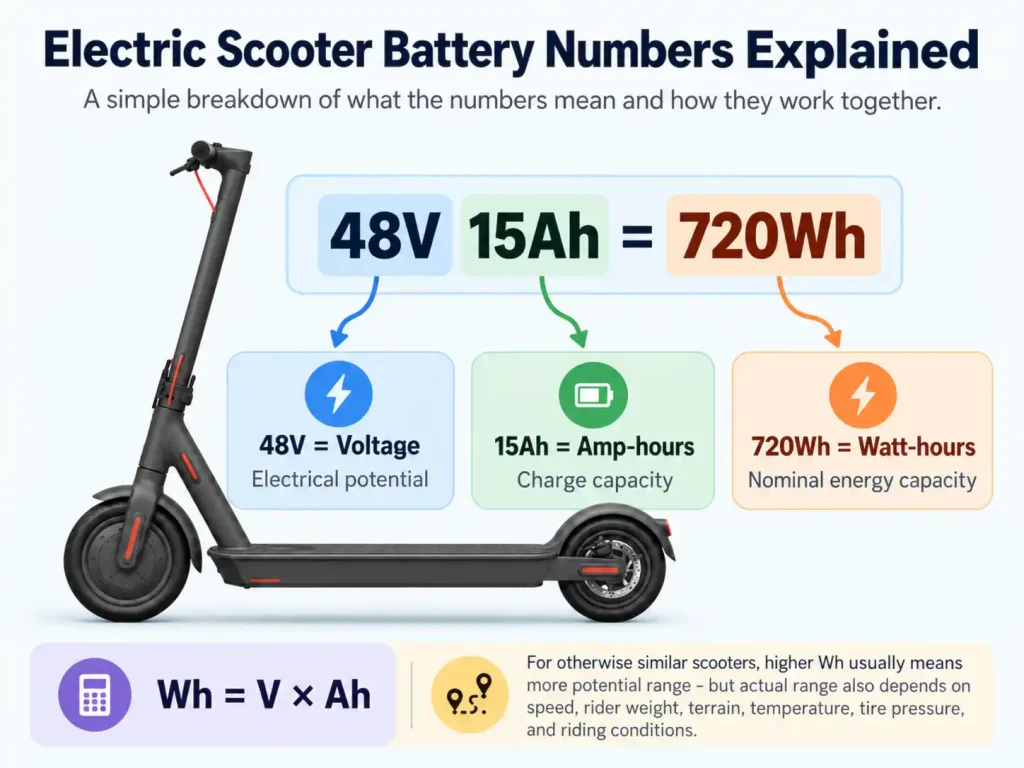
Volts × amp-hours = watt-hours
For example:
48V × 15Ah = 720Wh
Using the battery’s nominal ratings, that gives you approximately 720Wh of nominal stored energy. A 720Wh battery contains roughly twice the nominal energy of a 360Wh battery, but it does not automatically give you twice the riding range.
Real-world range also depends on speed, acceleration, rider and cargo weight, hills, wind, temperature, tires, scooter weight, motor and controller efficiency, stop-and-go riding, riding mode, and battery condition.
This guide explains volts, amp-hours, watt-hours, battery lifespan, charging, safety certification, replacement compatibility, storage, battery warning signs, and how to decide how much battery you actually need. For a deeper look at mileage, see how far an electric scooter can go in real-world conditions. If performance is your main concern, my guide to how fast electric scooters go explains why voltage alone does not determine speed.
Why You Can Trust Electric Bike Explorer
This is a research-based informational guide and does not claim personal scooter or battery testing. Important battery and safety information is checked against manufacturer documentation, current UL standards information, CPSC and government safety guidance, reputable technical sources, and real-world evidence when it helps explain how batteries behave.
I separate battery specifications, manufacturer claims, safety certifications, and reasonable real-world expectations. Affiliate relationships do not determine the conclusions in this guide. You can read more about Electric Bike Explorer’s research, review, and editorial process.
Like Electric Bike Explorer?
Add Electric Bike Explorer as a Preferred Source on Google to make it easier to see more of our e-bike news, guides, reviews, and troubleshooting content in Google Search.
Electric Scooter Battery Terms at a Glance
| Term | What It Means | Why It Matters |
|---|---|---|
| Volts (V) | The nominal electrical potential of the battery system | The battery must be compatible with the scooter’s electrical design |
| Amp-hours (Ah) | A measure of electric charge capacity | Useful, but incomplete when comparing batteries with different voltages |
| Watt-hours (Wh) | Approximate stored battery energy | Usually the best simple number for comparing total battery capacity |
| BMS | Battery Management System | Monitors and helps protect the battery within its designed operating limits |
| UL 2271 | Safety standard covering qualifying battery packs and related energy-storage assemblies for light electric vehicles | May apply to an electric scooter battery pack |
| UL 2272 | Safety standard for electrical systems in personal e-mobility devices, including electric scooters | Evaluates the electrical drive-train system and battery-charger combination |
One useful distinction: watts (W) measure power, while watt-hours (Wh) measure energy. A 1,000W motor rating and a 1,000Wh battery rating describe different things.
How to Read an Electric Scooter Battery Label
A battery label may show numbers such as:
48V | 15Ah | 720Wh
| Label | What It Tells You |
|---|---|
| 48V | The battery’s nominal voltage family |
| 15Ah | Its rated charge capacity |
| 720Wh | Its approximate nominal energy capacity |
If Wh is not printed on the pack, multiplying nominal voltage by amp-hours gives a useful approximate capacity figure:
48 × 15 = 720Wh
Do not confuse nominal battery voltage with maximum charging voltage. A lithium-ion pack’s voltage changes as it charges and discharges, and the charger’s specified output can be higher than the battery’s nominal-voltage label.
For example, Segway documentation for some 36V nominal scooter batteries specifies a 42V maximum charging voltage. That does not mean every 36V scooter should use any 42V charger. The charger still has to match the exact battery, charging system, connector, polarity, current requirements, and manufacturer specifications.
Never choose a charger by doing your own voltage conversion from the battery label. Use the charger supplied or specifically recommended for your scooter.
Understanding Electric Scooter Battery Voltage
Voltage describes electrical potential. In a scooter, the battery voltage has to work with the controller, motor, BMS, charger, wiring, firmware, display, and other electrical components.
At the same current, a higher voltage allows more electrical power because power is related to voltage multiplied by current. Real scooters, however, rarely keep every other variable identical.
That is why a higher-voltage scooter is not automatically faster, stronger, longer-range, more efficient, better built, or safer.
| Nominal Voltage | What It Generally Indicates |
|---|---|
| 36V | A scooter electrical system designed around a nominal 36V battery platform. Common on many everyday scooters, but the voltage alone does not define performance. |
| 48V | A higher nominal-voltage platform used across many commuter and performance-oriented designs. Battery size and controller limits still vary widely. |
| 52V | A nominal system voltage somewhat above 48V. It may be used in higher-output designs, but it does not guarantee greater range. |
| 60V | A higher-voltage electrical platform often used where substantial motor power is required. It is not a legal or quality classification. |
| 72V | A very high nominal voltage for a stand-up scooter and commonly associated with high-output systems. It does not make a scooter automatically appropriate for public-road use. |
There is no industry rule saying every 48V scooter performs one way or every 72V scooter performs another. Current limits, motor characteristics, battery capacity, controller programming, weight, gearing, tires, and overall design all matter.
Never install a higher-voltage battery unless the scooter manufacturer specifically supports that configuration. Components designed for one voltage range may be damaged or become unsafe when connected to a different system.
Higher performance can also change the legal picture. Before assuming a powerful scooter fits ordinary e-scooter rules, check the Electric Scooter Laws by State guide.
Understanding Amp-Hours
Amp-hours, abbreviated Ah, describe electric charge capacity. Within otherwise similar batteries at the same voltage, a higher Ah rating generally means more stored energy.
The problem comes when the voltages are different.
Consider two 15Ah batteries:
- 36V × 15Ah = 540Wh
- 48V × 15Ah = 720Wh
Both say 15Ah, but they do not contain the same nominal energy. The 48V battery calculates to about 720Wh, while the 36V battery calculates to about 540Wh.
This is why comparing electric scooter batteries by Ah alone can be misleading.
Why Watt-Hours Matter Most for Battery Capacity
Watt-hours combine nominal voltage and amp-hours into a measure of energy. For a beginner comparing scooter battery size, Wh is usually the clearest starting point.
| Battery | Approximate Nominal Capacity |
|---|---|
| 36V 10Ah | 360Wh |
| 36V 15Ah | 540Wh |
| 48V 10Ah | 480Wh |
| 48V 15Ah | 720Wh |
| 48V 20Ah | 960Wh |
| 52V 20Ah | 1,040Wh |
All six calculations above use nominal voltage. Manufacturers may round published figures, and actual energy delivered during a ride can differ with temperature, battery age, current demand, system cutoffs, and how the manufacturer rates the pack.
Wh is an energy-capacity figure, not a mileage guarantee.
Nominal Energy vs. Usable Energy
The number printed on a battery is normally a nominal or rated capacity figure. It is useful for comparison, but the exact energy you can use during a particular ride can differ.
Battery voltage changes during discharge. The BMS and controller also operate within defined limits, and high current, cold temperatures, battery aging, and other conditions can affect how much useful energy the scooter can deliver before it reduces power or shuts down.
That does not make the Wh rating meaningless. It simply means rated Wh should be treated as a battery-size specification, not a promise that every nominal watt-hour will become propulsion under every condition.
What Watt-Hours Do Not Tell You
A larger Wh number tells you the battery stores more nominal energy. It does not tell you:
- Cell quality
- Pack construction quality
- BMS design and protection features
- Maximum current capability
- Electrical-system efficiency
- Safety certification status
- Water or impact resistance
- Battery warranty
- Replacement availability
- How much the scooter weighs
- How aggressively the scooter uses that energy
Two 720Wh scooters can therefore provide very different ownership experiences.
What Does a Battery Management System Do?
The Battery Management System, or BMS, is the battery pack’s electronic monitoring and protection layer. Depending on the design, it can monitor conditions such as cell voltage, pack voltage, current, and temperature and can limit or disconnect charging or discharging when defined limits are exceeded.
A BMS is important, but it cannot make an incompatible charger, damaged battery, poorly rebuilt pack, incorrect voltage conversion, or submerged electrical system automatically safe.
How Battery Size Affects Electric Scooter Range
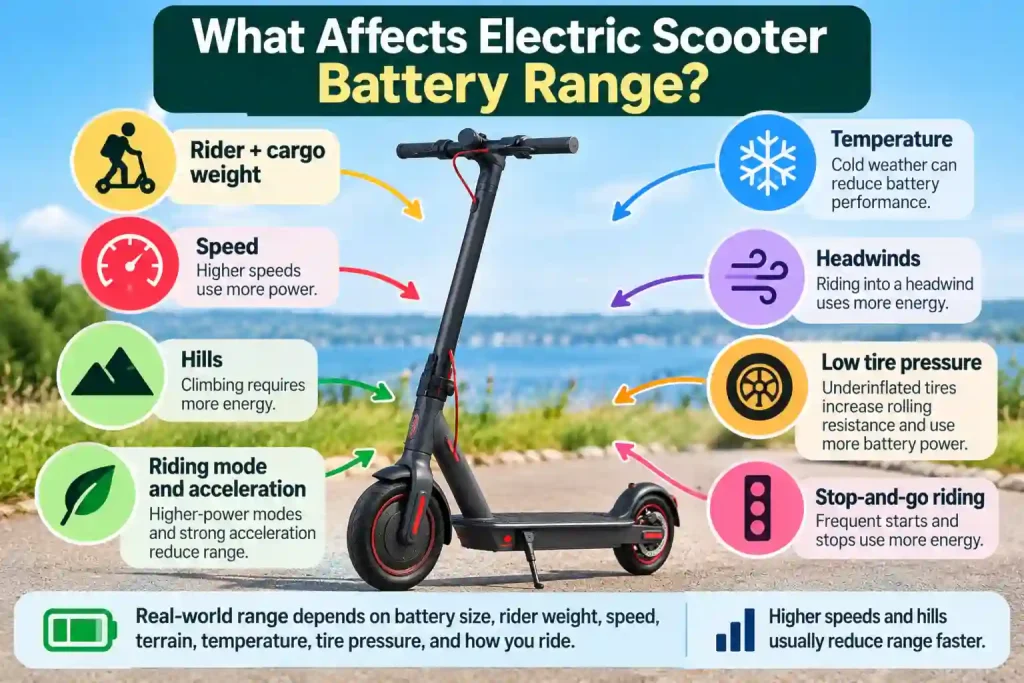
All else being equal, more Wh gives a scooter more stored energy to work with. In real riding, however, all else is rarely equal.
Range can change with:
- Rider weight and cargo
- Riding speed
- Acceleration
- Hills and repeated climbing
- Headwinds
- Ambient and battery temperature
- Tire pressure
- Tire size, construction, and rolling resistance
- Scooter weight
- Motor and controller efficiency
- Motor power and how much of it you use
- Stop-and-go riding
- Eco, standard, sport, and other riding modes
- Road surface
- Battery age and condition
That is why I do not recommend one universal “Wh equals miles” formula. A slower commuter scooter on level pavement can use its energy very differently from a heavy dual-motor scooter ridden quickly through hills.
Manufacturer maximum-range figures also need context. An “up to” range can come from favorable or standardized conditions that may involve moderate speeds, a specified rider load, mild temperatures, flat pavement, properly inflated tires, and a new battery.
Treat maximum range as a manufacturer claim under stated test conditions, not guaranteed commuting distance. My real-world electric scooter range guide goes deeper into this difference.
What Battery Size Do You Actually Need?
I would start with your route rather than starting with a voltage or Ah target.
Ask yourself how far you normally travel, whether you need to make the complete round trip without charging, how hilly the route is, how quickly you ride, and how much reserve you want for weather, detours, and battery aging.
A Simple Battery-Planning Worksheet
| Question | Your Answer |
|---|---|
| One-way trip distance | _____ miles |
| Normal round-trip distance | _____ miles |
| Longest normal day | _____ miles |
| Flat, rolling, or hilly route? | _____ |
| Typical riding speed | _____ mph |
| Rider plus typical cargo | _____ lb |
| Can you reliably charge at your destination? | Yes / No |
| Will you ride in cold weather? | Yes / No |
| How much reserve do you want? | _____ |
Then compare those needs against model-specific real-world range information, not just the largest advertised number.
There is no universal minimum Wh for a 5-mile, 10-mile, or 20-mile trip because scooter efficiency varies too much. The same route can require different amounts of battery depending on the scooter, rider, weather, speed, and terrain.
Battery Size Examples by Riding Need
| Riding Situation | How to Think About Battery Size |
|---|---|
| Short neighborhood trips | A smaller pack may be enough when credible range comfortably exceeds your normal trip. Lower scooter weight may matter more than unused battery capacity. |
| A few miles of daily commuting | Make sure realistic round-trip range leaves a useful reserve rather than matching the manufacturer’s maximum claim exactly. |
| Medium-distance commuting | Compare Wh, independent or manufacturer test conditions, normal speed, hills, and charging access. |
| Longer rides | More stored energy becomes increasingly useful, but larger packs also affect weight, price, portability, and charging time. |
| Heavier rider or frequent cargo | Plan more conservatively because acceleration and climbing require more energy. Always stay within the scooter’s payload rating. |
| Hilly routes | Leave additional reserve because repeated climbing can materially increase energy use. |
| Frequent high-speed riding | Expect more energy consumption than a low-speed range test may suggest. |
If you are choosing a scooter specifically for commuting, my commuter scooter buying guide covers brakes, tires, portability, comfort, and other factors that matter alongside battery capacity.
A 6-Mile Commute Each Way
Suppose your commute is 6 miles to work and 6 miles home. Your normal round trip is already 12 miles.
A scooter advertised for a maximum of 12 miles would leave no meaningful margin for wind, hills, cold weather, higher speeds, traffic detours, battery aging, or a day when you did not start with a complete charge.
I would look for a scooter whose reasonable real-world range comfortably exceeds the 12-mile trip, not one that reaches 12 miles only under favorable manufacturer testing.
The exact Wh required cannot be calculated from mileage alone without knowing how efficiently that particular scooter uses its battery.
Before You Buy: Check Replacement-Battery Support
Battery capacity matters on day one, but replacement support can matter even more several years later.
Before choosing between otherwise similar scooters, check:
- Whether the manufacturer sells an official replacement battery
- Whether the battery can be replaced by the owner or requires service
- How long the battery warranty lasts and what it excludes
- Whether the battery is proprietary to one scooter generation
- Whether replacement batteries are currently available in your country
- Whether shipping restrictions affect battery service or replacement
- Whether the manufacturer provides a documented replacement process
- Whether electrical safety certification information applies to the replacement pack or system
A scooter with slightly less battery capacity but strong parts support can be a better long-term ownership choice than a scooter with a huge battery and no clear replacement path.
What Affects Electric Scooter Battery Life?
Lithium-ion batteries gradually lose capacity and performance with both use and calendar time. There is no responsible single answer such as “every scooter battery lasts 3 years” or “every battery lasts 500 cycles.”
Battery chemistry, cell design, pack construction, use, temperature, charge rate, discharge rate, storage environment, operating window, and cycling patterns all affect degradation. The National Renewable Energy Laboratory’s battery-lifespan research specifically treats temperature, operating windows, charge and discharge rates, storage environment, and cycling patterns as important battery-life variables.
Important factors include:
- Number of charge-discharge cycles – repeated cycling contributes to wear.
- Depth of those cycles – the size of the state-of-charge swing can affect degradation.
- Heat – elevated temperature can accelerate unwanted battery-aging reactions.
- Cold – low temperature can reduce available performance, and charging outside the manufacturer’s permitted temperature range can create additional concerns.
- Long-term storage – temperature, time, and storage state of charge matter.
- Long periods at extreme states of charge – battery stress varies with chemistry and state of charge, which is why storage guidance should come from the manufacturer.
- High current demand – demanding charge or discharge conditions can generate additional heat and stress.
- Cell and pack quality – battery design and manufacturing quality matter.
- Charging practices – incompatible chargers, unsupported fast charging, and charging outside specified conditions can cause problems.
If a manufacturer publishes a cycle-life number, check what that number means. A laboratory cycle-life figure may use a defined temperature, charge rate, discharge rate, depth of discharge, and remaining-capacity threshold that does not match daily scooter use.
How to Store an Electric Scooter Battery
There is no single storage percentage or temperature range that I would apply to every scooter battery.
Instead:
- Follow the storage charge level specified in your scooter or battery manual.
- Follow the manufacturer’s storage-temperature range.
- Keep the scooter away from excessive heat, direct heat sources, and conditions outside its published limits.
- Do not leave a damaged battery sitting in normal indoor storage merely because the scooter is turned off.
- Check the manufacturer’s instructions for periodic charging during long storage.
- Before returning a stored scooter to service, inspect the battery, charger, connectors, and scooter for damage or abnormal behavior.
Manufacturers can publish different limits. Segway, for example, lists model-specific operating, charging, storage, and sometimes recommended storage-temperature ranges. That is a good reason to use the manual for your exact scooter instead of copying a storage rule from another model.
What Is Voltage Sag?
Voltage sag is a temporary drop in battery voltage when the scooter is under electrical load.
You may notice it during:
- Hard acceleration
- Steep climbs
- High-speed riding
- Heavy current demand
When current demand rises, the measured battery voltage can fall. When you ease off the throttle or stop, the load decreases and voltage can recover.
This can make some battery indicators temporarily show fewer bars or a lower percentage and then rise again when the scooter is resting. Manufacturer support information from Apollo, for example, describes this exact pattern during acceleration and hill climbing.
The effect can become more noticeable at a low state of charge, in cold conditions, or as a battery ages.
Do not dismiss every large drop as normal voltage sag. Severe or suddenly worsening drops, repeated shutdowns, rapid loss of range, abnormal heat, or dramatic changes under ordinary load can indicate battery degradation, a connection problem, a BMS event, or another electrical fault.
Electric Scooter Battery-Health Warning Checklist
A battery does not have to be completely dead before it deserves attention. Changes in behavior can be useful clues.
| What You Notice | What It May Mean |
|---|---|
| Range has gradually decreased over a long period | Normal battery aging may be contributing, although riding conditions should also be considered |
| Range suddenly drops | Check for changed conditions, tire pressure, charging problems, battery faults, or other electrical issues |
| Battery gauge falls sharply under ordinary acceleration | Could be voltage sag, but worsening sag can also point to battery or connection problems |
| Scooter repeatedly shuts down on hills | Could involve low battery voltage, BMS protection, degradation, wiring, controller, or another fault |
| Charging time or charger behavior suddenly changes | Battery, charger, charge port, temperature, or electrical-system problem may need investigation |
| Battery becomes unusually hot, swollen, damaged, leaks, smells unusual, smokes, or sparks | Stop using and charging it immediately |
This checklist is for recognizing changes, not for opening the battery or performing internal pack diagnostics. If a battery behaves abnormally and the cause is unclear, contact the manufacturer or an appropriately qualified repair professional.
Charging Your Electric Scooter Battery Safely
The charger is part of the battery system. A connector that physically fits does not prove that a charger is electrically compatible.
The U.S. Consumer Product Safety Commission specifically warns against chargers marketed as universal for micromobility products unless they have been tested and approved to work safely with the particular device. CPSC notes that an incompatible charger may physically fit the charging port and still create a fire hazard.
For safer charging:
- Use the charger supplied with the scooter or a replacement specifically recommended or approved for that scooter.
- Follow the manufacturer’s charging instructions and charging-temperature limits.
- Do not assume that matching one voltage number or connector shape proves compatibility.
- Do not bypass the BMS, charger protections, charging controls, or other safety systems.
- Do not use damaged chargers, cables, plugs, connectors, charge ports, or battery packs.
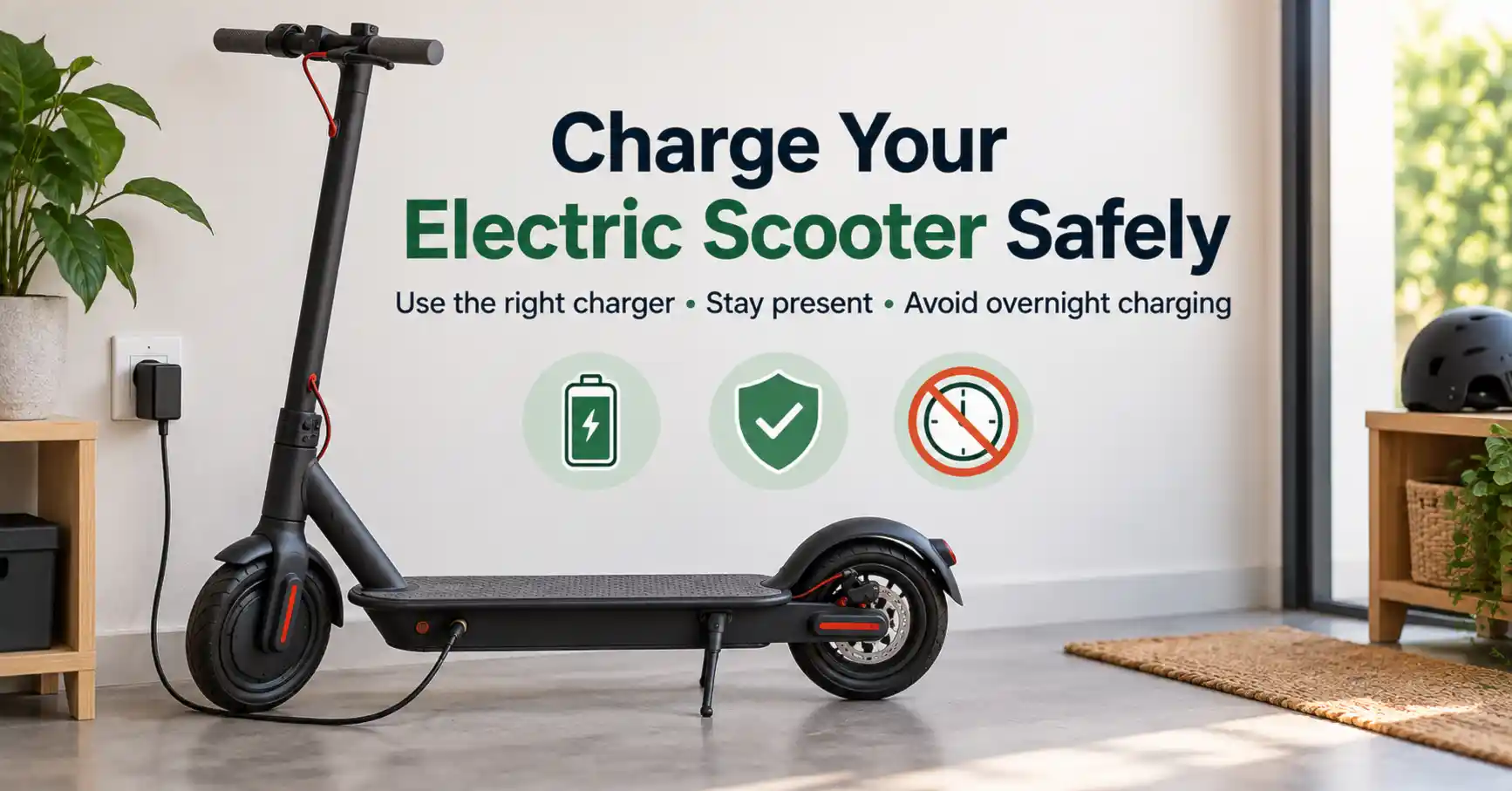
- Be present while the scooter is charging.
- Do not charge while sleeping or while nobody is home.
- Unplug the scooter when charging is complete according to the manufacturer’s instructions.
CPSC’s current micromobility safety guidance recommends using the supplied or manufacturer-recommended charger, being present while charging, and using only an approved replacement battery. CPSC has also issued a separate warning about incompatible universal micromobility chargers.
For additional charging information, see the Electric Scooter Charging Guide. Current CPSC guidance should take priority over older charging advice that suggests leaving a scooter charging while you sleep.
UL 2271 vs. UL 2272 for Electric Scooters
UL 2271 and UL 2272 are both relevant to micromobility electrical safety, but they have different scopes.
| Standard | Current Scope | Precise Wording |
|---|---|---|
| UL 2271 | Covers electrical energy-storage assemblies, including battery packs and related assemblies, for qualifying light electric vehicle applications | “The battery is certified to UL 2271” – when that claim is verified |
| UL 2272 | Covers the electrical drive-train system of personal e-mobility devices, including electric scooters, along with the battery system, circuitry, electrical components, and battery-charger combination | “The scooter’s electrical system is certified to UL 2272” – when that claim is verified |
The current UL 2271 standard is titled Batteries for Use In Light Electric Vehicle (LEV) Applications. Its scope covers qualifying electrical energy-storage assemblies such as battery packs. UL also states that the standard does not evaluate product performance or reliability.
The current UL 2272 standard, revised March 23, 2026, is titled Electrical Systems for Personal E-Mobility Devices. Its scope includes the electrical drive-train system for electric-powered scooters and evaluates the electrical system and battery-charger combination for energy and electrical-shock hazards. UL states that it does not evaluate performance, reliability, or physical hazards associated with riding the device.
A few distinctions matter:
- Do not say an entire scooter is certified to UL 2271 merely because its battery certification is verified.
- Do not assume a UL 2272 claim automatically proves a separate UL 2271 certification for the individual battery pack.
- Do not treat “designed to meet UL,” “tested to UL,” or similar marketing language as automatically equivalent to a verified certification.
- Verify the exact model, standard, and certification claim whenever electrical safety documentation affects your buying decision.
- No certification makes a lithium-ion battery or scooter risk-free.
Electric Scooter Battery Warning Signs
Safety First: Stop using and stop charging the scooter if you notice a serious battery problem. Do not keep riding or charging it to see whether the condition goes away.
- Swelling or a battery case changing shape
- Smoke
- Sparks
- Unusual or excessive heat
- Burning or unusual chemical odors
- Leaking
- Severe physical damage
- Melted, burned, or badly discolored connectors
- Known water intrusion or submersion
- A battery that suffered a serious impact in a crash
If the battery is smoking, burning, sparking, rapidly overheating, or creating an immediate fire threat, move people away from the hazard and contact emergency services. Do not open the pack or attempt a routine DIY lithium-ion battery repair.
A submerged, badly crushed, punctured, seriously impacted, or visibly damaged pack should not be charged simply to see whether it still works. Contact the scooter manufacturer for instructions or have the scooter evaluated by an appropriate qualified professional.
CPSC advises against using micromobility battery packs that have been modified or reworked by unqualified personnel or contain repurposed or used cells.
I do not recommend bypassing a BMS, replacing individual lithium-ion cells as a routine DIY repair, altering pack voltage, defeating temperature protections, or rewiring a scooter to work around a battery fault.
For normal riding precautions beyond the battery system, see my electric scooter safety guide.
Replacing an Electric Scooter Battery
A replacement battery must match much more than the physical dimensions or plug shape.
Compatibility can involve:
- Nominal voltage
- Controller voltage range
- Charging system and charger specifications
- BMS design and communication
- Connector type, wiring, and pinout
- Physical dimensions and mounting system
- Continuous and peak current requirements
- Wiring and connector current ratings
- Firmware or smart-battery communication when applicable
- Manufacturer safety and certification requirements
CPSC recommends using only replacement or secondary battery packs that have been tested and approved to work safely with the device and confirmed suitable by the device manufacturer.
A higher-capacity battery is not automatically a safe upgrade even when the nominal voltage looks the same. More Ah or Wh can come with different dimensions, current capability, BMS behavior, connectors, charging requirements, or communication systems.
Some manufacturers do not support battery upgrades at all because the battery, BMS, controller, charger, and firmware are designed as one system.
A plug that fits is not a compatibility test.
How to Recycle or Dispose of an Electric Scooter Battery
Lithium-ion scooter batteries should not go into household trash or normal curbside recycling.
The U.S. Environmental Protection Agency recommends taking lithium-ion batteries to a separate battery recycler, participating take-back program, electronics recycler when appropriate, or household hazardous-waste collection program.
For ordinary removable batteries being prepared for an appropriate collection facility, EPA recommends isolating the terminals with non-conductive tape or placing batteries separately in plastic bags to reduce the chance of a short circuit.
Damaged, swollen, defective, leaking, or recalled batteries may need different handling. Do not assume they should be transported or dropped into an ordinary retail battery-collection box. Contact the manufacturer, recall administrator when applicable, or your local hazardous-waste authority for instructions.
EPA provides additional guidance on proper management of used lithium-ion batteries.
Common Electric Scooter Battery-Buying Mistakes
Comparing Amp-Hours Without Looking at Voltage
A 15Ah battery at 36V calculates to about 540Wh, while a 15Ah battery at 48V calculates to about 720Wh. Compare Wh when you want a better picture of total nominal energy.
Assuming Higher Voltage Automatically Means Better
Voltage is one electrical-system specification. Motor characteristics, controller current, battery capacity, scooter weight, firmware, tires, chassis design, braking, and efficiency all matter too.
Buying Exactly Enough Advertised Range
If your regular route nearly equals the manufacturer’s maximum range claim, you have little margin for real-world conditions or battery aging.
Choosing a Charger Because the Plug Fits
CPSC specifically warns that an incompatible charger can physically connect to a micromobility device and still create a fire hazard.
Buying a Replacement Battery Because the Connector Looks Right
Electrical voltage, current limits, BMS communication, pinout, charger compatibility, firmware, and mounting can all matter.
Treating UL 2271 and UL 2272 as the Same Certification
UL 2271 is battery-focused. UL 2272 covers the personal e-mobility electrical system. Verify exactly what has been certified.
Assuming the Biggest Battery Is Always Best
More Wh can provide useful reserve, but a larger battery can also increase scooter weight, cost, bulk, and charging time.
Ignoring Replacement-Battery Availability
A large battery is less attractive if the manufacturer cannot provide a compatible replacement when the original pack eventually ages.
Opening or Rebuilding the Pack as Routine DIY Maintenance
Lithium-ion packs contain substantial stored energy and can create serious fire and injury hazards when damaged, incorrectly rebuilt, or bypassed. Internal pack work should be handled through the manufacturer or an appropriately qualified battery professional.
Electric Scooter Battery FAQs
Is a 48V Electric Scooter Better Than a 36V Scooter?
Not automatically. A 48V system has a higher nominal voltage, but overall performance depends on the controller, motor, battery capacity, current limits, software, scooter weight, tires, and other design choices. Voltage by itself is not a quality rating.
What Does Ah Mean on an Electric Scooter Battery?
Ah means amp-hours, a measure of electric charge capacity. It is most useful when comparing batteries at the same voltage. Watt-hours give you a better simple comparison when voltages differ.
How Many Watt-Hours Does an Electric Scooter Need?
There is no universal Wh requirement. Start with your actual round-trip distance, then consider speed, rider and cargo weight, hills, temperature, real-world model-specific range, charging access, and the reserve you want.
Is a Bigger Electric Scooter Battery Always Better?
No. More Wh provides more stored energy, but the tradeoffs can include more weight, greater cost, more bulk, and longer charging time. The best battery is large enough for your real needs and properly integrated into the scooter.
Can I Put a 48V Battery on a 36V Scooter?
Not unless the manufacturer specifically supports that configuration. A 48V battery can exceed the design limits of a controller, charger, display, motor system, or other electronics designed around a 36V platform.
How Long Does an Electric Scooter Battery Last?
There is no single lifespan that applies to every battery. Chemistry, cells, temperature, storage, charge and discharge rates, cycling patterns, state-of-charge history, current demand, physical condition, and pack quality all affect aging. Treat manufacturer cycle-life figures as model-specific claims under particular test conditions.
Why Does My Scooter Battery Percentage Drop When I Accelerate?
High current demand can cause temporary voltage sag. Some battery gauges then show fewer bars or a lower percentage under load and rise again when the scooter rests. If the drop becomes severe, suddenly worsens, or is accompanied by shutdowns, unusual heat, or sharply reduced range, have the system checked.
What Is the Difference Between UL 2271 and UL 2272?
UL 2271 covers qualifying battery packs and related energy-storage assemblies for light electric vehicle applications. UL 2272 covers the electrical drive-train system of personal e-mobility devices such as electric scooters, including the battery system and battery-charger combination. A claim involving one standard should not automatically be presented as certification to the other.
Can I Replace My Scooter Battery With a Higher-Capacity Battery?
Only when the manufacturer supports the replacement or compatibility has been properly verified. A same-voltage pack with more Ah can still differ in BMS communication, current capability, connector wiring, mounting dimensions, charging requirements, or firmware compatibility.
Should I Charge an Electric Scooter After Every Ride?
Not automatically. Follow the scooter manufacturer’s instructions based on the remaining charge, when you expect to ride again, and any storage guidance for your model. You do not need to invent a full-charge routine that conflicts with the manual. Whenever you do charge, use the correct charger and remain present rather than charging while asleep or away from home.
Can I Store My Scooter at 100% Charge?
For short periods, follow the manufacturer’s normal operating guidance. For long-term storage, use the storage state of charge specified for your particular scooter or battery. I would not apply one universal storage percentage to every brand or battery chemistry.
What Should I Check Before Buying a Scooter With a Large Battery?
Check Wh, realistic range, scooter weight, charger specifications, electrical safety documentation, warranty, manufacturer support, replacement-battery availability, charging time, and whether the extra battery capacity is actually useful for your riding.
My Take
If I were comparing electric scooter batteries, I would start with watt-hours. Wh lets me compare approximate stored energy without being misled by Ah numbers from different voltage systems.
Then I would move beyond the capacity number. I would check realistic range, how the range was tested, scooter weight, charger compatibility, replacement-battery availability, warranty support, electrical-system certification, and whether the scooter provides enough reserve for the way I actually ride.
I would not buy the highest-voltage scooter merely because the number looks more powerful, and I would not choose a scooter whose maximum advertised range barely covers my commute.
The best battery size is not the largest one you can afford. It is a properly designed, compatible battery that gives you enough energy for your real route, enough reserve for changing conditions, and a realistic path to safe charging and eventual replacement.
Sources
- UL Standards & Engagement – UL 2271, Batteries for Use In Light Electric Vehicle Applications
- UL Standards & Engagement – UL 2272, Electrical Systems for Personal E-Mobility Devices
- U.S. Consumer Product Safety Commission – Micromobility Safety Information
- U.S. Consumer Product Safety Commission – Universal Micromobility Charger Warning
- National Renewable Energy Laboratory – Battery Lifespan Research
- U.S. Environmental Protection Agency – Used Lithium-Ion Batteries

Kristina is not just an enthusiast but a true authority on electric bikes. Nestled in the coastal beauty of Virginia, Kristina has found the perfect backdrop for her passion for electric biking. As a dedicated wife and homeschooling mom, her life revolves around family, faith, and the thrill of adventure.
Originally hailing from Ohio, Kristina's journey with electric bikes began as a curiosity and quickly evolved into a deep expertise. Her blog is a testament to her love for electric biking, combining her fascination for eco-friendly transportation with her coastal lifestyle.
When she's not cruising the beach on her electric bike, you'll find Kristina indulging in her other loves: long walks along the shore, getting lost in a good book, and cherishing moments with her loved ones. With a heart as big as her love for animals, especially cats, Kristina brings a unique perspective to the electric bike world, grounded in her strong faith in God and her dedication to a sustainable lifestyle.
Through her blog, Kristina shares her extensive knowledge of electric bikes, offering valuable insights, tips, and recommendations to fellow enthusiasts. Whether you're a seasoned rider or a newcomer to the electric bike scene, Kristina's blog is your go-to source for all things electric biking, fueled by her passion, expertise, and the scenic beauty of coastal Virginia.