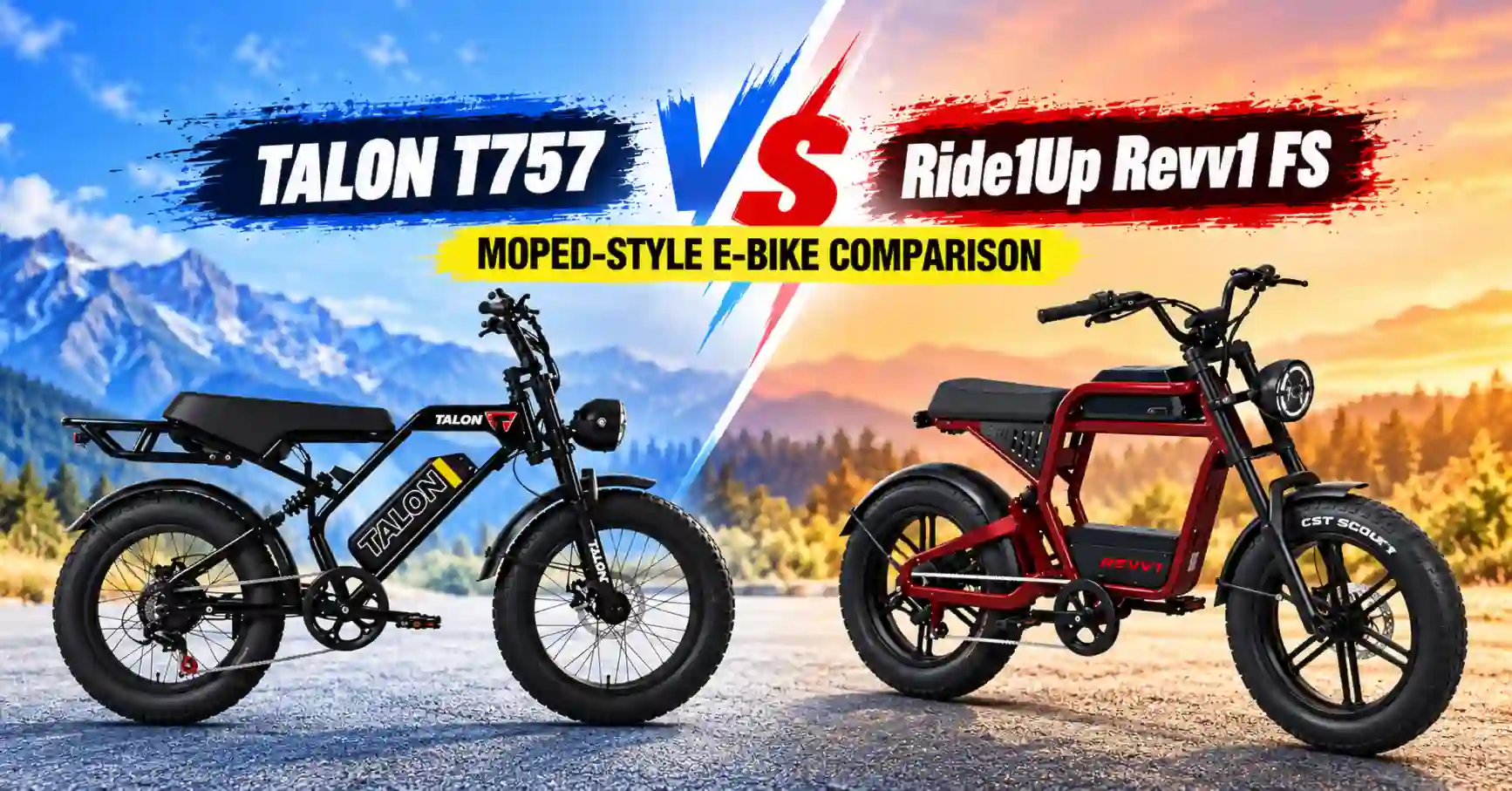
Talon T757 vs Ride1Up Revv1 FS: Is the Revv1 Worth the Extra Money?
Last Updated on September 26, 2026 by Kristina
🚴♀️ Hands-On + Research-Based Comparison
Introduction
Two full-suspension, fat-tire, moped-style e-bikes – but with a price difference of roughly $1,400. The real question is not simply which bike has better hardware. It is whether the extra performance, battery capacity, braking, and refinement of the Ride1Up Revv1 FS are worth paying for.
The TALON T757 vs Ride1Up Revv1 FS comparison is especially interesting because these bikes offer a similar moped-style riding experience at very different price points. As of September 25, 2026, Talon lists the T757 at $649, while Ride1Up lists the Revv1 FS starting at $2,095 – a difference of about $1,446 before taxes, accessories, or additional discounts.
I personally tested the TALON T757, and it surprised me with how comfortable and complete it felt for the money. I have not personally tested the Revv1 FS, so that side of this comparison is based on current Ride1Up specifications, independent performance testing, warranty and return information, and available rider feedback.
If you are still learning what matters when comparing motors, batteries, brakes, fit, and support, start with my complete e-bike buying guide. You can also see more options in my moped-style e-bike guide.
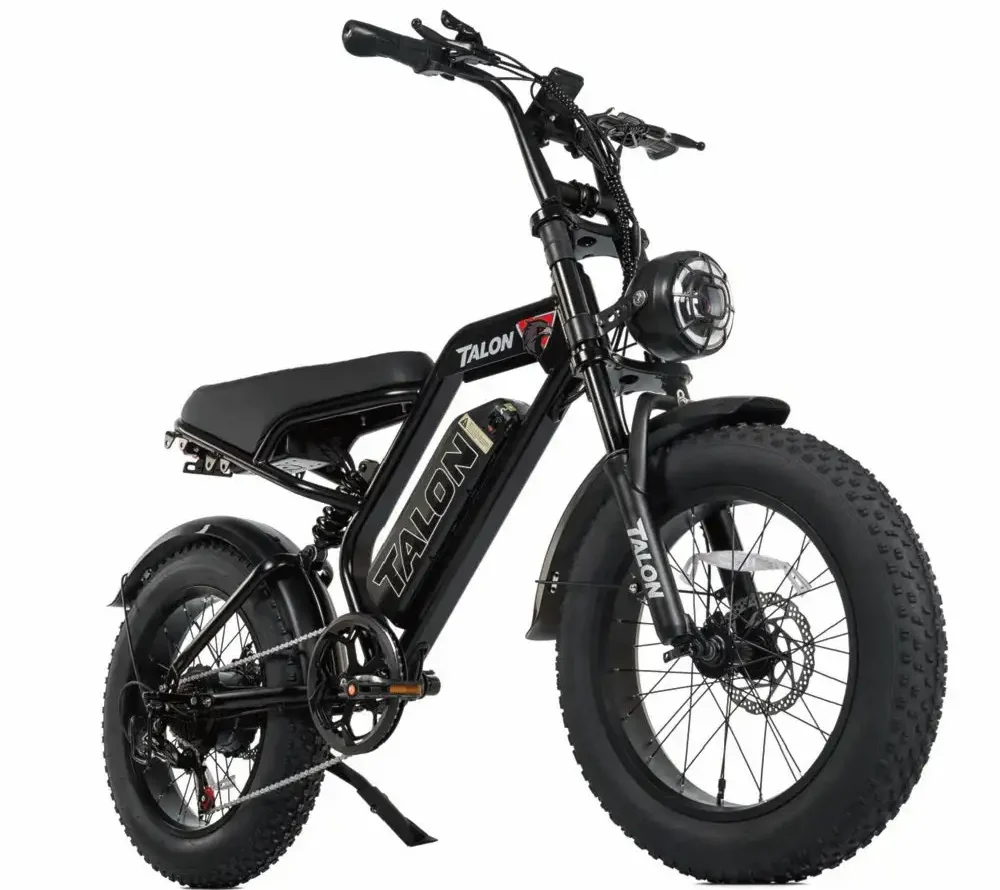
Talon T757
An unusually affordable full-suspension moped-style e-bike with a 750W rear hub motor, 48V 13Ah battery, NFC unlock, and the comfortable ride I liked during my hands-on testing.
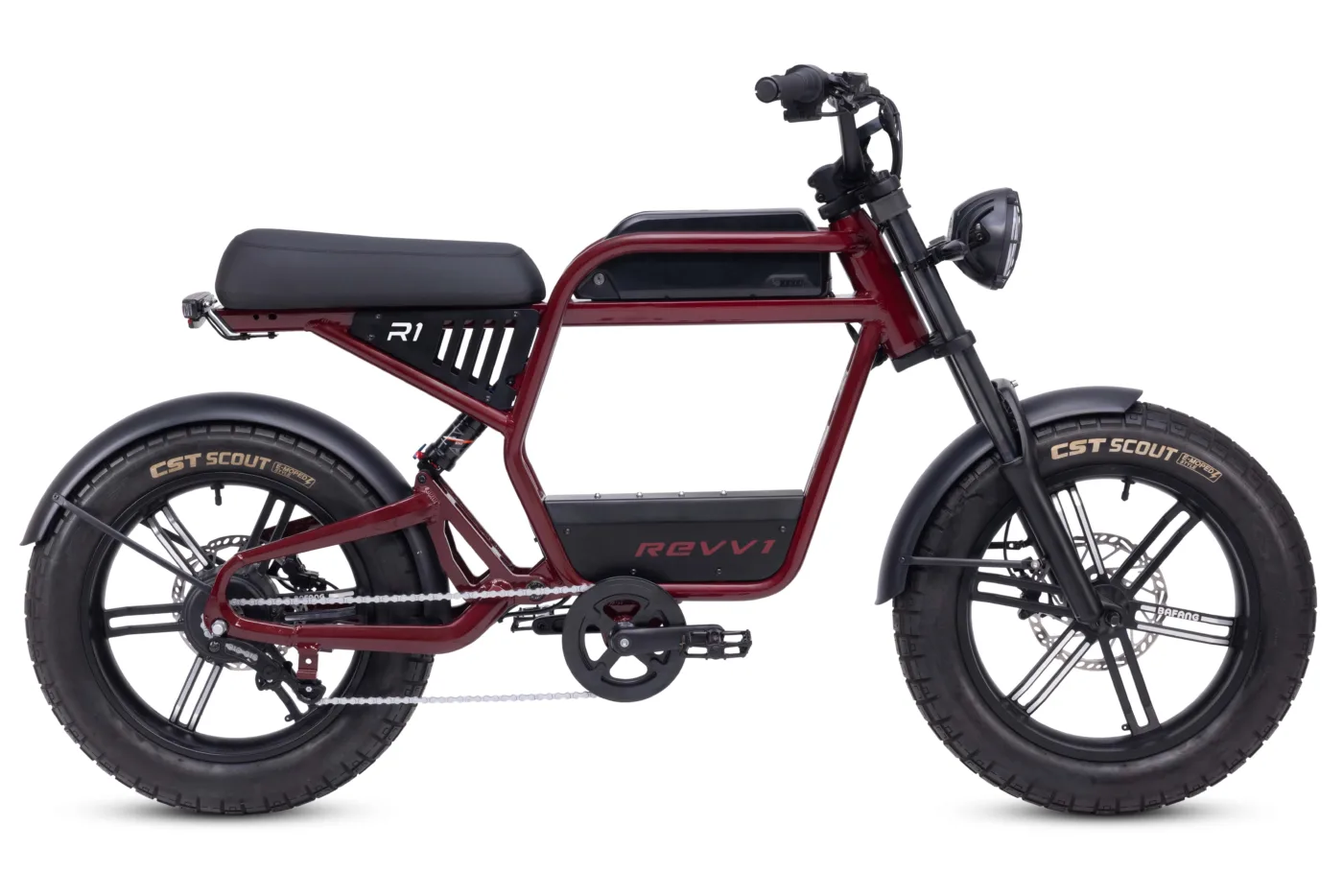
Ride1Up Revv1 FS
A more premium 52V moped-style e-bike with a 1,040Wh battery, a current 100 Nm torque claim, 4-piston hydraulic brakes, full suspension, and strong reported performance in earlier independent testing.
📌 Quick Verdict
Choose the Talon T757 if: value matters most, you mainly ride around town or recreationally, and you are comfortable with mechanical disc brakes and a smaller battery.
Choose the Ride1Up Revv1 FS if: you want significantly stronger braking hardware, a much larger battery, more aggressive performance, clearer published third-party electrical safety language, and a more premium suspension and component package.
The short version: the Revv1 FS is the better-equipped machine, but the T757 is the stronger value. The extra money makes the most sense for riders who will actually use the Revv1’s larger battery, stronger brakes, higher-output 52V system, and more advanced suspension.
🔎 Why You Can Trust This Comparison
I personally tested the TALON T757 and used my own ride, comfort, hill, speed, braking, and ownership observations throughout this comparison. I have not personally tested the Ride1Up Revv1 FS, so that side is based on current manufacturer specifications, independent performance testing, warranty and return policies, and available rider feedback.
I separate my hands-on results from manufacturer claims and reported third-party testing, and I note when older independent testing does not exactly match the current 2026 bike specification. Affiliate relationships do not determine the scores or conclusions.
You can also read more about how Electric Bike Explorer reviews and ranks e-bikes.
⭐ Talon T757
Overall Rating: 8.8 / 10 – Very Good
Comfort: 9.0 / 10
Motor & Performance: 8.2 / 10
Battery & Range: 7.8 / 10
Brakes & Safety: 7.6 / 10
Features & Practicality: 8.8 / 10
Value: 9.7 / 10
Best for budget-conscious riders who want full suspension, fat-tire comfort, and moped styling without spending more than $1,000.
⭐ Ride1Up Revv1 FS
Overall Rating: 8.9 / 10 – Very Good
Comfort: 9.2 / 10
Motor & Performance: 9.5 / 10
Battery & Range: 9.2 / 10
Brakes & Safety: 9.3 / 10
Features & Practicality: 9.1 / 10
Value: 8.3 / 10
Best for riders who want stronger performance, hydraulic braking, a 1,040Wh battery, and a more premium moped-style e-bike platform.
These scores are editorial judgments, not measured test scores or a simple mathematical average. The T757’s rating reflects my hands-on testing and its unusually strong value. The Revv1 FS score is research-based and reflects current official specifications, earlier independent testing of the Revv1 FS platform, ownership policies, and price. Evidence confidence: High for the T757; Moderate for the Revv1 FS because I have not personally tested it.
Short on time? Check current pricing and availability
TALON discount: Use code EXPLORER at checkout for the current Electric Bike Explorer discount. Promotions can change, so confirm the final price before completing your order.
Quick Comparison: Talon T757 vs Ride1Up Revv1 FS
| Feature | Talon T757 | Ride1Up Revv1 FS |
|---|---|---|
| Price checked Sept. 25, 2026 | $649 | $2,095 starting price |
| Motor | 750W rear hub | 52V Bafang RM G0F4 rear hub |
| Published torque | Not clearly listed on current product page | 100 Nm |
| Battery | 48V 13Ah – 624Wh | 52V 20Ah – 1,040Wh |
| Claimed range | Up to 40 miles | 30-60 miles |
| Street speed | 20 mph throttle / 28 mph pedal assist | Ships Class 2 at 20 mph; multi-class settings available |
| Suspension | 125mm front / 50mm rear | 120mm double-crown fork / air rear shock |
| Brakes | Mechanical disc | 4-piston hydraulic, 203mm rotors |
| Tires | 20 x 4.0 in. | 20 x 4.0 in. CST Scout |
| Weight | 84 lb | 93 lb |
| Payload | 330 lb | 350 lb |
| Rider height | 5’3″ to 6’5″ | 5’2″ to 6’4″ |
| Sensor | Cadence | Current-based cadence system |
| Drivetrain | Shimano 7-speed | Single-speed |
| Electrical safety language | Talon says tested to meet UL 2849 and UN 38.3; replacement battery listing says UL 2271 compliant | Ride1Up states TÜV ANSI/CAN/UL 2849 and 2271 compliance; battery listed as TÜV certified to UL 2271 |
| Warranty | 2 years frame/battery; 1 year motor/controller and several major components | 1-year limited manufacturer warranty |
| Return policy | 14 days; under 20 miles; fees may apply | 14 days, unopened and unused; restocking fee applies |
Overview: What These Bikes Are Built For
Both of these bikes fall into the full-suspension moped-style e-bike category, but they approach it from very different price points.
They are designed more for neighborhood riding, commuting, recreation, campground use, and throttle-friendly cruising than traditional bicycle-style fitness riding.
TALON T757

Built for riders who want a comfortable, affordable moped-style e-bike without spending $2,000 or more.
It emphasizes:
- full-suspension comfort
- 20 x 4 in. fat tire stability
- simple 750W rear-hub performance
- a Shimano 7-speed drivetrain
- NFC tap-to-unlock
- strong value for the included equipment
The T757’s biggest strength is how much bike you get for the money. During my hands-on testing, the suspension, fat tires, and long saddle made it more comfortable than I expected at this price.
Its biggest compromises are the smaller 624Wh battery, mechanical disc brakes, cadence sensor, and 84 lb weight.
Best for riders who want comfort, moped styling, and strong value without paying for premium performance hardware.
➡️ Read my full hands-on review of the TALON T757
Ride1Up Revv1 FS
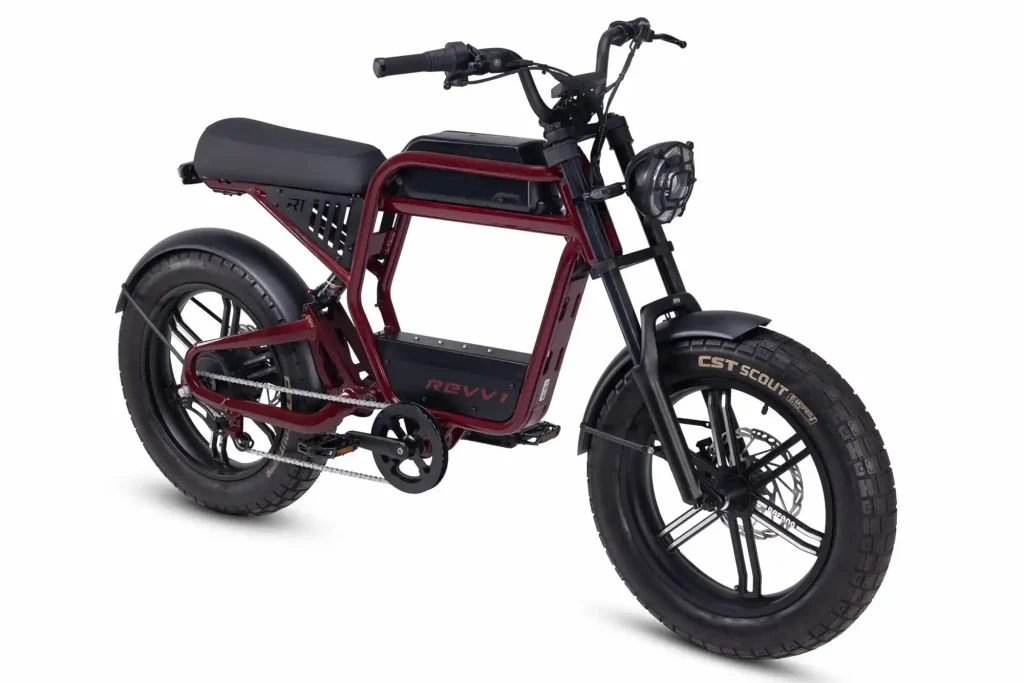
Built for riders who want a more powerful and refined moped-style e-bike with a larger battery, stronger brakes, and hardware better suited to frequent hills, longer rides, and higher-performance riding.
It emphasizes:
- a larger 1,040Wh battery
- stronger documented acceleration and hill performance
- 4-piston hydraulic disc brakes
- full suspension with a double-crown fork and rear air shock
- a more developed accessory ecosystem
- stronger published electrical-safety documentation
The Revv1 FS costs substantially more, but much of that additional money goes toward components that matter on a heavy, fast-feeling moped-style e-bike.
Its biggest compromises are the roughly 93 lb weight, single-speed drivetrain, cadence-based assistance, and restrictive return policy.
Best for riders who want more range, stronger braking, better hill performance, and a more premium moped-style platform.
➡️ Read my full Ride1Up Revv1 FS review
What Riders Are Saying
Owner feedback is much easier to find for the Ride1Up Revv1 FS than for the newer TALON T757, so I would not treat the amount of online discussion as equal evidence for both bikes.
TALON T757
Long-term owner feedback on the T757 is still fairly limited. Most of the detailed information currently available comes from hands-on reviewers rather than riders reporting thousands of miles of ownership.
The patterns I found are generally consistent with my own experience.
What people tend to like:
- comfortable full-suspension ride
- long padded moped-style saddle
- stable feel from the 20 x 4 in. tires
- smooth, manageable motor acceleration
- NFC unlock and included features
- unusually strong value for the price
Common concerns or tradeoffs:
- 84 lb weight
- relatively small 624Wh battery
- mechanical rather than hydraulic brakes
- pedaling is less natural than on a traditional e-bike
- higher-speed handling is not as refined as more expensive moped-style bikes
- limited long-term owner and service-history data compared with established brands
One recent independent tester also highlighted the T757’s comfort and value while noting that the steering felt less settled at higher speeds and that steeper hills benefited from rider pedaling.
That matches my overall impression: the T757’s strongest argument is comfort and value, not premium high-speed refinement.
Ride1Up Revv1 FS
The Revv1 has a much larger owner community, and there is considerably more long-term feedback available.
A recurring theme from owners is simply that the bike is fun to ride. Many riders also praise its substantial build, stable handling, acceleration, battery capacity, and usefulness for commuting or getting around town.
What owners tend to like:
- strong acceleration
- stable and planted ride
- solid frame and build quality
- good battery life
- comfortable full-suspension ride
- useful storage and accessory options
- moped-style appearance
- strong everyday commuting capability
Some owners report putting hundreds or even thousands of miles on their Revv1 while continuing to enjoy the bike.
Common complaints and tradeoffs include:
- heavy weight
- awkward traditional pedaling
- fixed moped-style seating
- controls and security features that some owners wish were better
- more difficult rear-wheel and drivetrain servicing
- occasional controller, sensor, or electrical issues
- mixed customer-service experiences
- some riders finding the stock seat uncomfortable on longer rides
Customer-service feedback is especially mixed. Some owners describe Ride1Up quickly replacing defective parts, while others report frustrating warranty or troubleshooting experiences.
The overall pattern is that riders who specifically want a throttle-friendly electric moped experience tend to be very enthusiastic about the Revv1. Riders expecting a lightweight, easy-to-service bicycle that feels natural to pedal are much more likely to notice its compromises.
For both bikes, rider reports are useful for identifying patterns, but individual comments do not prove how common a problem is. I give more weight to verified specifications, documented testing, and repeated owner experiences than to a single positive or negative review.
Price and Value: This Is the Biggest Difference
The T757 is currently less than one-third the price of the Revv1 FS. That changes how I look at almost every other category.
At $649, the T757 gives you full suspension, 20 x 4 in. fat tires, a 750W rear hub motor, integrated lights, fenders, NFC unlock, a long saddle, a Shimano 7-speed drivetrain, and a 330 lb payload rating. That is a lot of hardware for the money.
The Revv1 FS is not trying to win the same budget contest. At $2,095, you are paying for a larger 52V electrical system, a 1,040Wh battery, 100 Nm of claimed torque, 4-piston hydraulic brakes with 203mm rotors, a double-crown fork, rear air suspension, stronger lighting and turn-signal integration, and a more developed accessory ecosystem.
Value advantage: Talon T757. If you are judging purely by how much usable bike you get per dollar, the T757 is difficult to beat.
Ride Quality and Comfort
Talon T757
Comfort was the biggest strength I noticed during my own testing. The combination of the 125mm front fork, rear suspension, 20 x 4 in. tires, long padded saddle, and upright position does a very good job smoothing out rough pavement, cracks, gravel, and typical neighborhood riding.
The T757 feels stable and planted. Its 84 lb weight is a negative when you have to lift it, but that weight contributes to a substantial feel once the bike is moving.
Ride1Up Revv1 FS
The Revv1 FS goes further with a 120mm double-crown fork and an air rear shock. Independent testing has consistently described the bike as stable, comfortable, and confidence-inspiring at speed.
Its low center of gravity and 20 x 4 in. CST Scout tires help it feel planted, but it is even heavier than the T757 at about 93 lb. Neither of these bikes is something I would want to carry up a flight of stairs.
Comfort advantage: Ride1Up Revv1 FS, but the T757 is closer than the price difference suggests.
Motor, Acceleration, and Hill Performance
Both bikes use rear-hub motors, but the numbers do not tell the whole story.
The T757 uses a 750W rear hub motor. In my hands-on testing, it accelerated smoothly and felt happiest cruising around 20-25 mph. I recorded a top speed of 27.7 mph in Pedal Assist Level 5, which is very close to Talon’s advertised 28 mph pedal-assist street-mode speed. It handled moderate hills better than I expected, especially when I added pedaling instead of relying only on the throttle.
The current Revv1 FS uses a 52V Bafang RM G0F4 motor system with 100 Nm of claimed torque and a 52V 35A boost controller. A January 2025 Electric Bike Report test of an earlier Revv1 FS configuration – which that test listed at 95 Nm – reported strong acceleration and hill-climbing performance. Because Ride1Up’s current 2026 specification now lists 100 Nm, I treat that test as useful evidence for the Revv1 FS platform rather than a direct test of the exact current configuration. The Revv1 ships in Class 2 mode, with Class 3 and Off-Road settings available through Ride1Up’s Multi-Class Speed System.
If your routes include frequent hills, heavier loads, or you simply want harder acceleration, the Revv1 FS has the more convincing performance package.
Performance advantage: Ride1Up Revv1 FS.
Battery and Real-World Range
This is one of the clearest hardware differences.
The T757 uses a 48V 13Ah battery, which works out to about 624Wh. Talon claims up to 40 miles. I did not run the T757 to empty in a controlled range test, so I would not present 40 miles as a verified real-world result. Based on the battery capacity and my experience with similar battery sizes, I would treat it as an upper-end manufacturer claim that depends heavily on assist level, speed, terrain, wind, and rider weight.
The current Revv1 FS uses a 52V 20Ah battery, or 1,040Wh, and Ride1Up claims 30-60 miles. In a January 2025 Electric Bike Report range test of an earlier Revv1 FS configuration, the bike traveled 36.4 miles in PAS 5 and 52.2 miles in PAS 1. The current bike still uses a 52V 20Ah pack, but Ride1Up now lists different motor-torque specifications, so those results should be treated as reported testing of the Revv1 FS platform rather than guaranteed results for the exact current build.
That means the Revv1 gives you roughly 67% more battery capacity than the T757 before we even account for differences in motor tuning and riding style.
Range advantage: Ride1Up Revv1 FS.
Brakes and Safety
This is the category where I think the price difference matters most.
The T757 uses mechanical disc brakes. They worked during my testing, but they are the biggest compromise I would change on the bike. On an 84 lb e-bike that Talon advertises for up to 28 mph pedal assist in street mode, I would prefer hydraulic brakes for stronger stopping power and a lighter lever feel.
The Revv1 FS uses 4-piston hydraulic disc brakes with 203mm rotors. Independent brake testing has reported stable, competitive stopping distances for the category. That is the kind of brake hardware I prefer to see on a heavy, fast moped-style e-bike.
Ride1Up publishes clearer third-party electrical safety language for the current Revv1 FS. Ride1Up states that the bike is TÜV ANSI/CAN/UL 2849 and 2271 compliant and lists the 52V 20Ah battery as TÜV certified to UL 2271. Talon’s current T757 product page says the bike is tested to meet UL 2849 and UN 38.3, while Talon’s replacement T757 battery page says that battery is UL 2271 compliant. These are the manufacturers’ published statements. If a building, insurer, school, or property manager requires specific certification documentation, ask for the current certificate or database record before buying.
Braking and safety-hardware advantage: Ride1Up Revv1 FS.
Pedaling, Drivetrain, and Everyday Ride Feel
Neither bike is designed around traditional cycling, but the T757 has one practical advantage: it includes a Shimano 7-speed drivetrain.
The T757 still uses a cadence sensor, so the motor response is not as natural as a torque-sensor commuter. However, having multiple gears gives you more flexibility when starting, climbing, or pedaling with less motor assistance.
The Revv1 FS is a single-speed moped-style setup with a current-based cadence system. Independent testers have noted that the geometry and gearing encourage throttle use and casual “ghost pedaling” rather than efficient bicycle-style pedaling.
If you want to pedal more often, I prefer the T757’s 7-speed setup. If you mainly want a throttle-friendly electric moped feel, the Revv1 FS is more purpose-built for that experience.
Weight, Fit, and Portability
The T757 weighs about 84 lb. The Revv1 FS weighs about 93 lb.
That makes the T757 lighter, but neither bike is portable in the way a folding or lightweight commuter e-bike is. If you need to carry your bike upstairs, lift it into an SUV several times a week, or mount it on a rack with a lower weight limit, I would look at another category entirely.
Talon lists the T757 for riders from about 5’3″ to 6’5″. Ride1Up lists the Revv1 FS for about 5’2″ to 6’4″. Both use fixed moped-style seating, so those ranges do not guarantee the same comfort for every rider. Reach, leg length, and preferred riding posture still matter.
Use my e-bike size calculator as a starting point, but pay extra attention to the fixed saddle height on moped-style bikes.
Features, Security, Cargo, and Accessories
The T757 includes several features I did not expect at its price. The NFC tap-to-unlock system turned out to be more useful than I initially expected, and the bike also includes lighting, fenders, a color display, and rear passenger foot pegs.
The Revv1 FS has the more developed accessory system. Ride1Up offers options such as a center storage cage, rear rack and handle, passenger kit, wheel covers, and extra battery. The FS also includes a moto-style headlight and turn-signal integration.
For customization and utility, the Revv1 platform is stronger. For included features per dollar, the T757 remains impressive.
Warranty, Returns, and Long-Term Ownership
This is an important section because direct-to-consumer ownership is about more than the original specification sheet.
Talon T757
- 14-day return window
- Bike must generally remain under 20 miles and meet condition requirements
- Non-quality returns can involve a $150 shipping deduction
- Current warranty lists 2 years on the frame and battery
- Motor, controller/display, fork, and several other major components are generally covered for 1 year
- Talon’s current policy also describes up to $100 in approved local repair support during the first 6 months for certain covered issues
Ride1Up Revv1 FS
- 1-year limited warranty for manufacturing defects
- Revv1 return window is 14 days
- Returns are limited to unopened and unused bikes
- Approved returns are subject to a substantial restocking charge
- Ride1Up sells replacement batteries and a range of Revv1-specific accessories
Ride1Up currently lists a broader Revv1-specific accessory selection and maintains dedicated Revv1 support resources, but its published return policy is restrictive. Talon’s current written warranty gives longer stated coverage to the frame and battery. Warranty length alone does not establish how quickly or easily a claim will be resolved, so I would compare the actual terms as well as the number of years.
Real-World Testing: What We Actually Know
The evidence is different for these two bikes, so I do not want to present them as if I tested both side by side.
Talon T757 – my hands-on results
- I recorded 27.7 mph in Pedal Assist Level 5
- Acceleration felt smooth and predictable
- The bike felt most comfortable cruising around 20-25 mph
- It handled moderate hills better than I expected
- The full suspension and fat tires were the biggest ride-quality strengths
- The mechanical brakes and 84 lb weight were the clearest compromises
You can read my full Talon T757 hands-on review for the complete testing notes.
Ride1Up Revv1 FS – reported independent results
- Independent testing has supported Ride1Up’s claimed 30-60 mile range under varying assist levels and conditions
- A January 2025 Electric Bike Report test of an earlier Revv1 FS configuration reported strong steep-hill performance
- The same independent test reported a 19 ft 2 in. average stop from 20 mph and stable braking behavior
- Reviewers consistently describe the bike as stable, planted, and comfortable at speed
- The heavy frame and single-speed pedaling setup make it much more throttle-oriented than bicycle-like
✅ Talon T757 Pros
- Exceptional value at the current $649 price
- Comfortable full-suspension ride
- 750W motor felt capable in my testing
- 20 x 4 in. fat tires add stability
- NFC tap-to-unlock is genuinely convenient
- Shimano 7-speed drivetrain is more pedal-friendly than a single-speed moped setup
- 330 lb payload capacity
- Current warranty gives 2-year coverage to the frame and battery
❌ Talon T757 Cons
- Mechanical disc brakes are the biggest hardware compromise
- 624Wh battery is modest for a heavy moped-style e-bike
- 84 lb weight makes lifting difficult
- Cadence sensor is less natural than a torque sensor
- Less established accessory and service ecosystem
- Electrical certification wording is less straightforward than Ride1Up’s current documentation
✅ Ride1Up Revv1 FS Pros
- Strong 52V motor system with 100 Nm of claimed torque
- Large 1,040Wh battery
- 4-piston hydraulic brakes with 203mm rotors
- Full suspension with double-crown fork and rear air shock
- Strong independent hill, range, and braking results
- Clearer published third-party electrical safety language
- Good accessory ecosystem
- Stable, planted ride feel at speed
❌ Ride1Up Revv1 FS Cons
- About $1,446 more than the T757 at current listed prices
- Heavy at about 93 lb
- Single-speed setup is not ideal for riders who want traditional pedaling
- Restrictive Revv1 return policy
- 1-year warranty is shorter than Talon’s frame and battery coverage
- High-performance modes can create legal limitations depending on where you ride
Which Bike Is Better for Different Riders?
| Rider or Use | Better Fit | Why |
|---|---|---|
| Budget-conscious buyer | Talon T757 | Much lower purchase price with full suspension and solid everyday features |
| Frequent hills | Ride1Up Revv1 FS | Stronger 52V system, 100 Nm claim, and excellent independent hill results |
| Longer rides | Ride1Up Revv1 FS | 1,040Wh battery vs 624Wh |
| Neighborhood cruising | Talon T757 | Comfortable and capable without paying for performance you may not use |
| Higher-speed riding | Ride1Up Revv1 FS | Better brakes, suspension, and high-speed-oriented chassis |
| More actual pedaling | Talon T757 | Shimano 7-speed drivetrain offers more usable gearing |
| Throttle-heavy riding | Ride1Up Revv1 FS | Purpose-built moped feel and stronger power delivery |
| Frequent lifting | Neither | 84-93 lb is heavy for regular carrying |
Speed Modes and Legal Considerations
Both bikes can operate above 20 mph in some settings, but legal e-bike classification depends on the bike’s configuration and the law where you ride. Do not assume that every available speed mode is legal on public roads, bike lanes, paths, or trails.
The T757’s current product page lists 20 mph throttle operation and 28 mph pedal assist for street use, with a higher off-road mode. The Revv1 FS ships in Class 2 mode and supports additional Class 3 and off-road settings.
Before unlocking or using higher-speed settings, check your state and local rules. My guide to Class 1, Class 2, and Class 3 e-bikes explains the basic class system, and my state-by-state e-bike law guide can help you start checking the rules where you ride.
One Accessory Priority for Either E-Bike
If you plan to transport either bike by vehicle, think about the bike rack before buying smaller accessories.
At about 84 lb for the Talon T757 and 93 lb for the Ride1Up Revv1 FS, neither is a lightweight e-bike. Lifting either one onto a conventional platform rack can be difficult, especially if the rack sits high off the ground.
A heavy-duty hitch-mounted platform rack with a compatible loading ramp may be one of the most useful accessories you can buy. Before choosing a rack, check the per-bike weight limit, tire-width compatibility, wheelbase limits, hitch rating, and ramp capacity. Also check whether removing the battery before transport is recommended or practical for the bike you choose.
Because these are 20 x 4-inch fat-tire bikes, make sure the rack can securely accommodate 4-inch tires rather than assuming any standard e-bike rack will work.
For other useful gear such as helmets, mirrors, locks, pumps, phone mounts, and repair equipment, see my best e-bike accessories guide.
Which One Should You Buy?
TALON T757
Choose the TALON T757 if your priorities are comfort, full suspension, moped-style looks, useful included features, and keeping the purchase price as low as possible.
I personally rode and tested the T757, and its strongest qualities are not just specification-sheet advantages. The suspension, 20 x 4 in. fat tires, long bench-style saddle, and upright riding position made it noticeably comfortable on neighborhood streets, rough pavement, gravel, and everyday recreational riding.
The 750W rear hub motor also performed better than I expected for this price. I recorded a top speed of 27.7 mph in Pedal Assist Level 5, which is very close to Talon’s advertised 28 mph pedal-assist street-mode speed.
The biggest tradeoffs are the 624Wh battery, mechanical disc brakes, cadence sensor, and 84 lb weight. It also does not have the same battery capacity, braking hardware, suspension sophistication, or long-term ownership ecosystem as the Revv1 FS.
Electric Bike Explorer score: 8.8/10
Best for: Riders who want comfort, moped styling, and strong value without spending more than $2,000.
TALON discount: Use code EXPLORER at checkout for the current Electric Bike Explorer discount. Promotions can change, so confirm the final price before completing your order.
Ride1Up Revv1 FS
Choose the Ride1Up Revv1 FS if your priorities are stronger performance, longer range, better braking, more premium suspension, and a more developed moped-style e-bike platform.
Its 1,040Wh battery is a major advantage over the T757’s 624Wh battery, and the Revv1 also gets 4-piston hydraulic brakes with 203mm rotors, a 120mm double-crown fork, rear air suspension, and a current 100 Nm manufacturer torque claim.
Independent testing of an earlier Revv1 FS configuration also gives this bike stronger documented performance evidence for hill climbing, range, and braking than I have for most bikes in this category. I have not personally tested the Revv1 FS, so I treat those results as reported testing rather than my own experience.
The main tradeoffs are the much higher price, roughly 93 lb weight, single-speed drivetrain, cadence-based pedal assist, and restrictive return policy. It is also much more throttle-oriented than a traditional bicycle, which may not suit riders who want a natural pedaling experience.
Electric Bike Explorer score: 8.9/10
Best for: Riders who want more range, stronger braking, better hill performance, and a more premium moped-style platform.
Bottom Line
The Ride1Up Revv1 FS earns the slightly higher 8.9/10 research-based score because its larger battery, stronger braking hardware, suspension, documented hill performance, and more developed ownership ecosystem make it the more capable overall machine.
The TALON T757 keeps its 8.8/10 hands-on score and remains the much stronger value. At its current price, it delivers impressive comfort, usable performance, full suspension, fat tires, a 7-speed drivetrain, and NFC unlock for far less money.
If your main question is which bike gives you more performance and better hardware, I would choose the Revv1 FS.
If your main question is which bike gives you more value for the money, I would choose the TALON T757.
If neither one is quite right, browse my moped-style e-bike guide or shop electric bikes by category.
Before You Buy
- Confirm the current price because both brands run promotions.
- Check the return policy carefully, especially on the Revv1.
- Make sure your rack or storage setup can handle an 84-93 lb bike.
- Confirm rider fit because both use fixed moped-style saddles.
- Check local e-bike class and speed rules before using higher-performance settings.
- If UL certification is important to your building, insurer, school, or property manager, confirm the exact current documentation for the bike and battery before purchase.
FAQs
Is the Ride1Up Revv1 FS worth three times the price of the Talon T757?
Not for every rider. The Revv1 FS gives you substantially better braking hardware, more battery capacity, stronger reported performance, and a more premium suspension setup. If you mainly ride around town and want maximum value, the T757 gives you most of the moped-style experience for far less money.
Which bike has better range?
The Revv1 FS. Its 52V 20Ah battery stores about 1,040Wh compared with about 624Wh for the T757. Ride1Up claims 30-60 miles, while Talon claims up to 40 miles.
Which bike is better for hills?
The Revv1 FS has the stronger evidence for hill performance. Its 52V motor system, 100 Nm claimed torque, and independent hill-test results give it the advantage over the T757 for frequent steep climbs.
Which bike has better brakes?
The Revv1 FS. It uses 4-piston hydraulic disc brakes with 203mm rotors. The T757 uses mechanical disc brakes, which are one of the main compromises I noted during my hands-on review.
Which bike is easier to pedal?
The T757 has the more useful pedaling setup because it includes a Shimano 7-speed drivetrain. The Revv1 FS is single-speed and is designed more around throttle-heavy moped-style riding.
Are these good bikes for carrying upstairs?
No. The T757 weighs about 84 lb and the Revv1 FS about 93 lb. If stairs are part of your daily routine, I would choose a much lighter e-bike.
Read Me Next
- Read my hands-on TALON T757 review
- Read my current Ride1Up Revv1 FS review
- See my current best moped-style e-bikes
- Compare more affordable electric bikes
- Use my complete e-bike buying guide

Kristina is not just an enthusiast but a true authority on electric bikes. Nestled in the coastal beauty of Virginia, Kristina has found the perfect backdrop for her passion for electric biking. As a dedicated wife and homeschooling mom, her life revolves around family, faith, and the thrill of adventure.
Originally hailing from Ohio, Kristina's journey with electric bikes began as a curiosity and quickly evolved into a deep expertise. Her blog is a testament to her love for electric biking, combining her fascination for eco-friendly transportation with her coastal lifestyle.
When she's not cruising the beach on her electric bike, you'll find Kristina indulging in her other loves: long walks along the shore, getting lost in a good book, and cherishing moments with her loved ones. With a heart as big as her love for animals, especially cats, Kristina brings a unique perspective to the electric bike world, grounded in her strong faith in God and her dedication to a sustainable lifestyle.
Through her blog, Kristina shares her extensive knowledge of electric bikes, offering valuable insights, tips, and recommendations to fellow enthusiasts. Whether you're a seasoned rider or a newcomer to the electric bike scene, Kristina's blog is your go-to source for all things electric biking, fueled by her passion, expertise, and the scenic beauty of coastal Virginia.