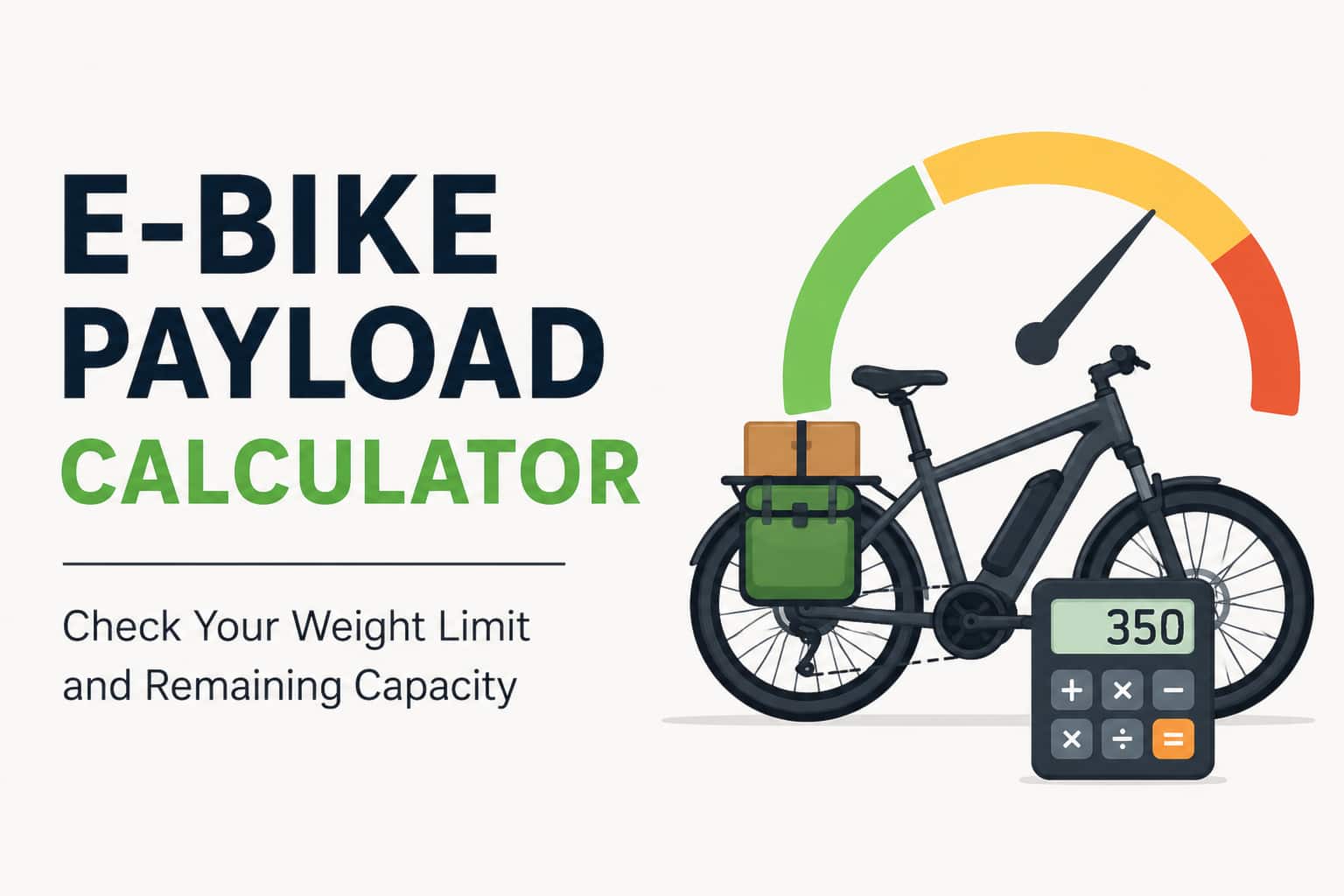
E-Bike Payload Calculator: Check Your Weight Limit and Remaining Capacity
Last Updated on June 11, 2026 by Kristina
Wondering if your e-bike can safely carry you, your gear, groceries, accessories, or a passenger?
Use this free E-Bike Payload Calculator to estimate your total payload, compare it to your bike’s listed weight capacity, check your rear rack limit, and see how close you are to the recommended safe range.
This is helpful for:
- Heavier riders
- Cargo e-bike owners
- Commuters carrying gear
- Parents carrying kids
- Riders hauling groceries
- Anyone adding racks, baskets, bags, or accessories
If you are shopping for a stronger e-bike, you may also want to read our guide to the Best Electric Bikes for Heavy Riders and our guide to the Best Cargo E-Bikes for Grocery Runs.
Use the E-Bike Payload Calculator
Add your estimated weight, cargo, accessories, and your bike’s official payload rating below.
Always use your manufacturer’s official specs when available.
E-Bike Payload Calculator
Enter your rider weight, cargo, accessories, bike payload rating, and rear rack limit to check your total carrying load.
Note: This calculator is for general guidance only. Always follow your e-bike manufacturer’s official payload rating, rear rack limit, passenger limit, tire recommendations, and owner’s manual.
Looking for an E-Bike With a Higher Weight Capacity?
If your results show you are close to your bike’s payload limit, these guides can help you compare stronger options:
What Counts Toward E-Bike Payload?
E-bike payload is the total weight your electric bike is designed to carry.
That usually includes:
- Rider weight
- Clothing
- Backpack or gear
- Cargo
- Groceries
- Child seat
- Passenger weight
- Pet carrier
- Locks
- Baskets
- Bags
- Accessories
Many riders only think about body weight, but gear can add up quickly.
For example:
- Rider: 220 lbs
- Backpack: 15 lbs
- Groceries: 25 lbs
- Lock and accessories: 8 lbs
That equals 268 pounds of total payload.
Why E-Bike Payload Capacity Matters
Payload capacity matters because extra weight affects how your e-bike rides.
A heavier load can affect:
- Braking distance
- Acceleration
- Hill climbing
- Battery range
- Tire wear
- Suspension
- Rear rack stress
- Frame and wheel durability
This does not mean heavier riders cannot safely ride e-bikes. Many e-bikes are designed with strong frames, powerful motors, hydraulic disc brakes, and higher payload ratings.
The key is choosing a bike that fits your actual riding weight.
What Is a Good Payload Capacity for an E-Bike?
Most electric bikes have a payload capacity somewhere between 250 and 400 pounds.
Cargo e-bikes and utility e-bikes may support 400 to 500 pounds or more.
Here is a general guide:
| Rider Weight | Recommended E-Bike Payload Rating |
|---|---|
| Under 200 lbs | 300 lbs |
| 200-250 lbs | 350 lbs |
| 250-300 lbs | 400 lbs |
| 300-350 lbs | 450 lbs |
| 350+ lbs | 500 lb+ rated e-bike |
I generally like seeing at least 50 pounds of extra payload room whenever possible. More headroom usually means better comfort, better handling, and less stress on components.
Do Not Forget Rear Rack Weight Limits
Your e-bike may have a 400-pound payload rating, but that does not mean the rear rack can hold 400 pounds.
Many rear racks are rated for much less, such as:
- 55 lbs
- 60 lbs
- 80 lbs
- 100 lbs
This matters if you are carrying groceries, pannier bags, a child seat, pet carrier, or cargo box.
A rear rack also needs to be specifically approved for passengers if someone will sit on it. Not every rack is passenger-rated.
Common E-Bike Payload Mistakes
Some of the most common mistakes include:
- Only counting rider weight
- Forgetting to include cargo and accessories
- Ignoring rear rack limits
- Assuming all rear racks can carry passengers
- Riding close to the maximum limit every time
- Carrying heavy cargo on a lightweight commuter e-bike
- Not adjusting tire pressure for extra weight
- Using weak aftermarket racks or bags
Taking a few minutes to calculate your payload can help you avoid safety problems and expensive repairs.
What If I Am Close to the Weight Limit?
If your calculator result shows you are close to your e-bike’s payload limit, consider:
- Reducing cargo weight
- Using a properly rated cargo trailer
- Choosing a higher-capacity e-bike
- Checking tire pressure more often
- Upgrading to stronger cargo accessories
- Avoiding passenger use unless the bike is designed for it
- Riding slower and allowing more braking distance
If you are shopping for a stronger model, start with our guide to the Best Electric Bikes for Heavy Riders or the Best Cargo E-Bikes for Grocery Runs.
FAQs
E-bike payload capacity is the total weight your electric bike is designed to carry. This usually includes the rider, cargo, accessories, bags, racks, child seats, and passengers if the bike is designed for passenger use.
Yes. Heavier total payload can reduce range because the motor and battery have to work harder, especially during acceleration, hill climbing, and riding into wind.
Yes, many e-bikes can support riders around 300 pounds, but you need to choose a bike with a high enough payload rating. A 400-pound rated e-bike is often a better starting point because it leaves room for gear and accessories.
Usually, yes, as long as the total weight stays within the bike’s payload rating and the groceries stay within the rear rack, basket, or pannier limits.
Usually not. Most standard e-bikes are designed for one rider. Some cargo and utility e-bikes are designed to carry passengers, but you should always follow the manufacturer’s passenger, seat, foot peg, rack, and total payload limits.
I would not recommend it. Going over the listed weight limit can affect braking, handling, wheels, tires, racks, frame stress, and warranty coverage.
Final Thoughts
An e-bike payload calculator is a simple tool, but it can make a big difference.
Before carrying groceries, adding a child seat, installing a cargo box, or riding with a passenger, it is worth checking how much total weight your e-bike is actually carrying.
The safest approach is simple:
Calculate your total payload, compare it to your manufacturer’s rating, check your rack limit, and leave yourself some extra room whenever possible.

Kristina is not just an enthusiast but a true authority on electric bikes. Nestled in the coastal beauty of Virginia, Kristina has found the perfect backdrop for her passion for electric biking. As a dedicated wife and homeschooling mom, her life revolves around family, faith, and the thrill of adventure.
Originally hailing from Ohio, Kristina's journey with electric bikes began as a curiosity and quickly evolved into a deep expertise. Her blog is a testament to her love for electric biking, combining her fascination for eco-friendly transportation with her coastal lifestyle.
When she's not cruising the beach on her electric bike, you'll find Kristina indulging in her other loves: long walks along the shore, getting lost in a good book, and cherishing moments with her loved ones. With a heart as big as her love for animals, especially cats, Kristina brings a unique perspective to the electric bike world, grounded in her strong faith in God and her dedication to a sustainable lifestyle.
Through her blog, Kristina shares her extensive knowledge of electric bikes, offering valuable insights, tips, and recommendations to fellow enthusiasts. Whether you're a seasoned rider or a newcomer to the electric bike scene, Kristina's blog is your go-to source for all things electric biking, fueled by her passion, expertise, and the scenic beauty of coastal Virginia.