Maximize Your E-Bike Savings: Rebates by State (2026 Guide)
Last Updated on May 31, 2026 by Kristina
Save Hundreds on Your E-Bike With State, City & Utility Programs
Last Updated: March 2026
Rebate availability changes frequently. Always confirm details on official program websites before purchasing.
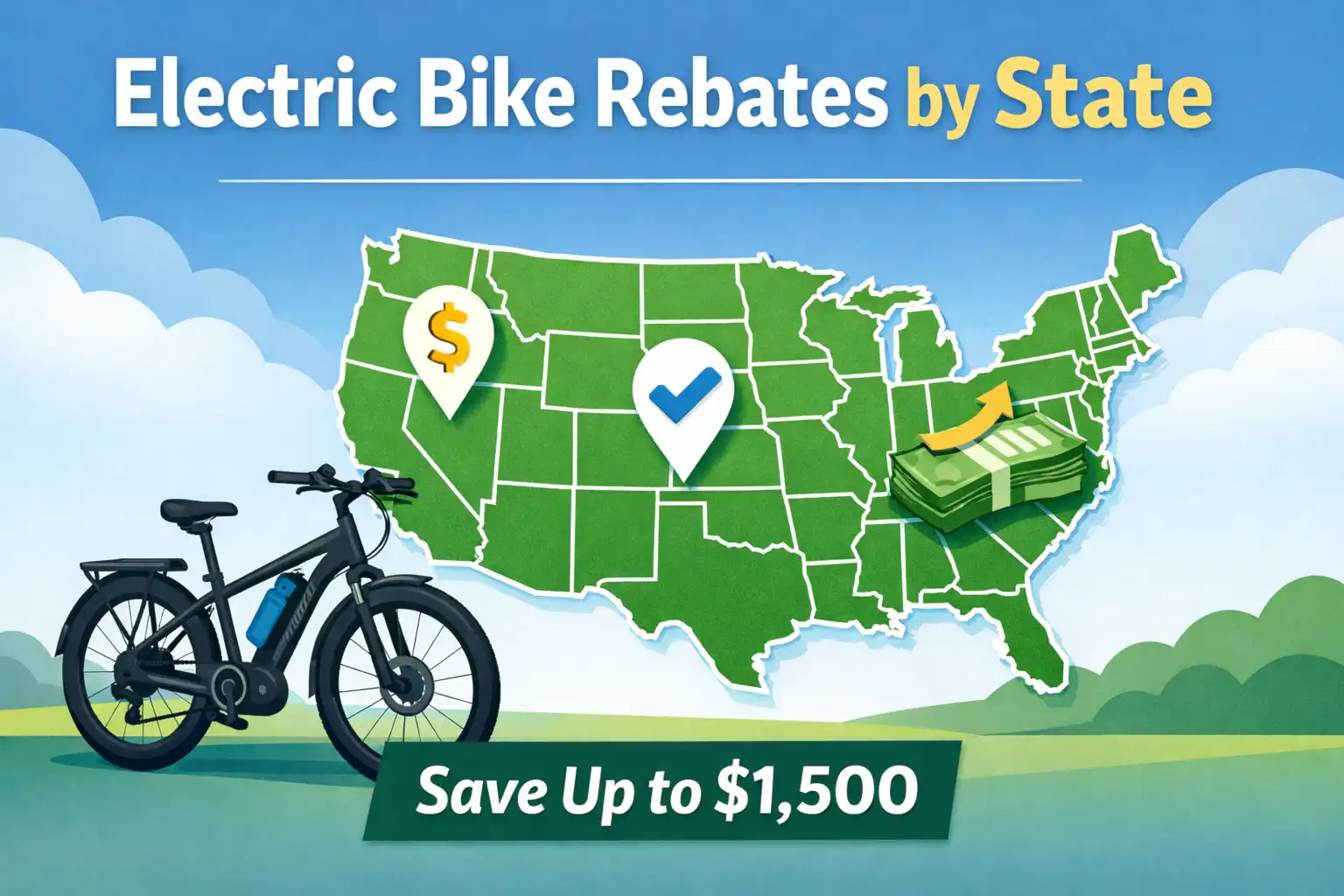
Electric bike rebates can significantly reduce the cost of owning an e-bike – in some cases cutting the price by hundreds or even over $1,500.
But here’s the catch:
👉 Rebates are not the same everywhere.
Unlike e-bike laws, which are relatively consistent within each state, rebate programs vary widely depending on:
- where you live
- available funding
- local and state policies
Some states offer strong, well-funded programs, while others only have limited city or utility incentives – or none at all.
Federal vs State Rebates
There has been discussion around a federal e-bike tax credit, but:
There is currently no active federal rebate or tax credit for e-bikes.
That means all available savings today come from:
- state programs
- city initiatives
- utility company incentives
💡 What This Guide Will Help You Do
This guide is designed to help you:
- Quickly check if your state offers rebates
- Understand how these programs work
- Avoid common mistakes that can cost you the rebate
- Find the best way to maximize your savings
Before You Start
Rebate programs can:
- open and close quickly
- run out of funding
- change requirements over time
Always double-check current program details before purchasing an e-bike.
Are There E-Bike Rebates in the U.S.?
Yes – some states, cities, and utility programs offer $300 to $1,500+ in e-bike rebates, but availability varies widely and many programs are limited, location-specific, or only open during certain funding periods.
Use the chart below as a starting point, then check your local area for current programs.
🧭 E-Bike Rebates by State (Quick Lookup Table)
Important: This table shows general availability trends. Many states only offer local or utility programs, and availability can change quickly based on funding.
| State | General Availability | Program Type | Availability |
|---|---|---|---|
| Alabama | None known | — | No statewide program |
| Alaska | None known | — | No statewide program |
| Arizona | Limited | Local/City | Check local programs |
| California | Strong | State + Local | Open / Waitlist common |
| Colorado | Strong | State + Local | Open / Funding rounds |
| Connecticut | Strong | State + Local | Active programs |
| Delaware | Strong | State | Active programs |
| Florida | Very limited | Local only | Check local programs |
| Georgia | Limited | Local/City | Check local programs |
| Hawaii | Limited | Local | Check local programs |
| Idaho | Limited | Local | Check local programs |
| Illinois | Limited | Local | Check local programs |
| Indiana | Limited | Local | Check local programs |
| Iowa | Limited | Local | Check local programs |
| Kansas | Limited | Local | Check local programs |
| Kentucky | Limited | Local | Check local programs |
| Louisiana | None known | — | No statewide program |
| Maine | Strong | State | Active programs |
| Maryland | Strong | State | Active programs |
| Massachusetts | Strong | State + Local | Active programs |
| Michigan | Limited | Local | Check local programs |
| Minnesota | Strong | State | Active programs |
| Mississippi | None known | — | No statewide program |
| Missouri | Limited | Local | Check local programs |
| Montana | Limited | Local | Check local programs |
| Nebraska | Limited | Local | Check local programs |
| Nevada | Limited | Local | Check local programs |
| New Hampshire | None known | — | No statewide program |
| New Jersey | Limited | Local | Check local programs |
| New Mexico | Limited | Local | Check local programs |
| New York | Strong | State + City | Expanding programs |
| North Carolina | Limited | Local | Check local programs |
| North Dakota | None known | — | No statewide program |
| Ohio | Limited | Local | Check local programs |
| Oklahoma | None known | — | No statewide program |
| Oregon | Moderate | City programs | Launching / limited |
| Pennsylvania | Limited | Local | Check local programs |
| Rhode Island | Strong | State | Active programs |
| South Carolina | Limited | Local | Check local programs |
| South Dakota | None known | — | No statewide program |
| Tennessee | Limited | Local | Check local programs |
| Texas | Limited | Local/Utility | Check local programs |
| Utah | Limited | Local | Check local programs |
| Vermont | Strong | State | Active programs |
| Virginia | Limited | Local/Utility | Check local programs |
| Washington | Strong | State + City | Active programs |
| West Virginia | None known | — | No statewide program |
| Wisconsin | Limited | Local | Check local programs |
| Wyoming | None known | — | No statewide program |
Even “active” programs may have waitlists or limited funding – always verify before buying.
How E-Bike Rebates Work (Step-by-Step)
E-bike rebates can feel confusing at first, but most programs follow a similar process.
Typical Rebate Process
- Check eligibility (income, location, bike requirements)
- Apply or reserve your spot (often required before buying)
- Get approved or receive a voucher
- Buy an eligible e-bike from an approved retailer
- Submit proof (receipt, serial number, etc.)
- Receive your rebate (instant discount or reimbursement)
Two Common Rebate Types
Instant rebate:
- Discount applied at checkout
- No waiting
Reimbursement rebate:
- Pay upfront
- Get money back later
Instant rebates are usually easier if you’re on a tight budget.
✅ Quick Eligibility Check (Before You Apply)
- You live in the program area
- Your income meets requirements (if applicable)
- You plan to buy a Class 1 or 2 e-bike
- You can buy from an approved retailer
- You haven’t already used the same program
If you check most of these, you likely qualify for at least one program.
How Much Can You Save?
Typical rebate ranges:
- $100 – $300 → utility programs
- $500 – $1,000 → city/state
- $1,200+ → income-qualified programs
🧮 Calculate Your Price After Rebate
Rebate Savings Calculator
Try different price points to estimate your real out-of-pocket cost.
Real-World Rebate Scenarios
Budget Commuter
- Bike: $1,200
- Rebate: $800
Final: $400
Mid-Range Upgrade
- Bike: $1,800
- Rebate: $1,000
Final: $800
Cargo / Family Use
- Bike: $2,500
- Rebate: $1,500
Final: $1,000
Rebates can significantly change what you can afford.
What E-Bikes Actually Qualify (Real-World Breakdown)
✅ Commonly Allowed
- Class 1 or Class 2 e-bikes
- Motors under 750W
- UL-certified batteries
- Commuter or cargo bikes
Sometimes Restricted
- Class 3 e-bikes
- Fat tire bikes
- Throttle-heavy setups
Usually Not Allowed
- DIY kits
- Uncertified imports
- Off-road-only bikes
👉 Not sure what to choose? Start here: E-Bike Buying Guide
Where Rebates Are Most Common
Strong Programs
- California
- Colorado
- New York
- Washington
Limited Availability
- Texas
- Florida
- Virginia
📅 When Do Rebates Open?
- Many launch in spring or summer
- Some reopen in funding rounds
- City programs follow local budgets
Programs may close quickly and reopen later depending on funding.
Common Mistakes to Avoid
Many people miss out on rebates because of small but critical mistakes. Here are the most common ones to watch for:
Buying the E-Bike Before Approval
This is the #1 mistake.
Many programs require:
- pre-approval
- voucher confirmation
- or application acceptance
If you buy before approval, you may not qualify at all, even if everything else is correct.
What to do instead:
Always confirm whether the program requires approval before purchasing.
Choosing a Non-Eligible E-Bike
Not all e-bikes qualify – even if they look similar.
Common issues include:
- Motor power exceeds limits (often 750W max)
- Bike class is not allowed (Class 3 is sometimes restricted)
- Battery is not UL-certified
- Brand or model not on the approved list
This can instantly disqualify your rebate.
What to do instead:
Check the program’s eligible bike list or requirements before buying.
Missing Deadlines or Funding Windows
Rebate programs are often:
- first-come, first-served
- limited by funding
- open only for short periods
Some programs close within days due to demand.
What to do instead:
Apply as early as possible and watch for reopening announcements.
Not Using an Approved Retailer
Many programs require you to buy from:
- specific bike shops
- approved online retailers
- participating dealers
Buying from the wrong seller can void your rebate.
What to do instead:
Always check the approved retailer list before purchasing.
Assuming Rebates Automatically Apply
Some riders think:
- the discount will be applied automatically
- or they’ll get money back without applying
This is not how most programs work.
What to do instead:
Follow the full application process and submit all required documentation.
Red Flags to Watch For
As rebates become more popular, scams and misleading offers are increasing. Here’s what to be careful of:
Fake “Rebate” or Incentive Websites
Be cautious of sites that:
- promise guaranteed rebates
- look unofficial or poorly designed
- don’t link to real government or utility programs
Legitimate programs are usually run by:
- state agencies
- cities
- or utility companies
What to do instead:
Verify the program through official sources before applying.
Upfront Fees to “Unlock” a Rebate
Legitimate rebate programs:
- do NOT require upfront fees
- do NOT charge application access costs
If a site asks for money just to apply, it’s a major red flag.
Unverified Sellers or “Too Cheap” E-Bikes
Some sellers advertise:
- “rebate-ready” bikes
- extremely low prices
- no certifications
These often:
- don’t qualify for rebates
- may have safety issues
Missing Safety Certifications
Many programs now require:
- UL-certified batteries
- safety-tested systems
Bikes without certification may:
- be rejected for rebates
- pose safety risks
Misleading “Stacking” Claims
Some sites claim you can:
- stack unlimited rebates
- combine every program
In reality:
- some programs allow stacking
- others specifically prohibit it
What to do instead:
Always check the official rules for each program before combining incentives.
Bottom Line
Rebates can save you hundreds – even thousands – but only if you follow the rules carefully.
A few minutes of checking requirements upfront can save you from losing the rebate entirely.
How to Maximize Your Rebate
Getting a rebate isn’t just about qualifying – it’s about using it strategically so you get the most value for your money.
Here’s how to do it the smart way:
Apply as Early as Possible
Most rebate programs are:
- first-come, first-served
- limited by funding
- closed quickly once demand spikes
Some programs fill up within days.
What to do:
- Apply the moment applications open
- Join waitlists if available
- Watch for new funding rounds
Choose Bikes Just Under Rebate Limits
Many programs have:
- maximum eligible price limits
- rebate caps based on bike cost
The best value often comes from choosing a bike just under those limits.
Example:
- Rebate covers up to $1,000
- Bike costs $1,200 → great value
- Bike costs $2,500 → much higher out-of-pocket
What to do:
Focus on bikes in the $1,000–$2,000 range, where rebates have the biggest impact.
Prepare Your Documents in Advance
Delays often happen because people aren’t ready with required paperwork.
Common requirements:
- proof of residency
- proof of income
- ID verification
- application forms
Missing documents can slow down or disqualify your application.
What to do:
Gather everything before applying so you can move quickly.
Look for Multiple Programs (But Verify First)
In some areas, you may be able to combine:
- state rebates
- city incentives
- utility company programs
This can significantly reduce your total cost.
Understand When Rebates Can (and Can’t) Be Combined
Not all programs allow stacking.
Some:
- allow multiple rebates
- others limit you to one
Assuming you can stack everything can lead to surprises.
What to do:
Check each program’s rules carefully before planning your purchase.
Choose Approved Retailers Carefully
Many programs require:
- specific retailers
- participating bike shops
- approved online sellers
Buying from the wrong place can void your rebate.
What to do:
Pick your retailer after confirming eligibility requirements.
Think Value, Not Just Price
The goal isn’t just to get the cheapest bike – it’s to get the best long-term value.
A slightly higher-priced bike with a rebate may give you:
- better battery life
- more reliable components
- longer lifespan
Rebates are best used to upgrade quality or reduce long-term cost.
Bottom Line
The smartest way to use a rebate is:
- Apply early
- Choose a qualifying, well-matched bike
- Follow the rules carefully
That’s how you turn a rebate into real savings – not frustration.
Rebates vs Total Cost of Ownership
Rebates reduce upfront cost, but long-term costs still matter.
What rebates help with:
- Purchase price
- Access to better bikes
What they don’t change:
- Battery replacement
- Maintenance
- Accessories
👉 See: How Much Does It Really Cost to Own an E-Bike?
How to Apply Successfully
- Check requirements carefully
- Confirm your bike qualifies
- Apply early
- Save all documents
- Follow instructions exactly
Small mistakes can delay or prevent approval.
Rebates vs Tax Credits
Rebates:
- Immediate or short-term savings
Tax credits:
- Applied during tax filing
- Less immediate
Most current programs are rebates.
Why Some States Don’t Offer Rebates
- Budget limitations
- Different transportation priorities
- Early adoption stages
More states may introduce programs over time.
Virginia E-Bike Rebates
Virginia currently does not have a major statewide e-bike rebate program.
Some local or utility incentives may occasionally be available, but options are limited compared to states like California or Colorado.
👉 Full Virginia rebate guide coming soon
Safety & Compliance Reminder
Many programs require:
- UL-certified batteries
- Approved retailers
- Legal e-bike classes
👉 See: State-by-State E-Bike Laws Guide
How We Evaluate E-Bike Incentive Programs
We analyze:
- Official sources
- Program availability
- Real-world accessibility
- Eligibility requirements
FAQs
Yes, you can use the e-bike tax credit to purchase a conversion kit that transforms a traditional bicycle into an electric one. However, the credit only applies to the kit’s cost and has limitations based on the e-bike’s overall specifications
An e-bike rebate is a direct reduction in the purchase price of an electric bike, typically provided by a government agency. A tax credit reduces your tax liability by a specific amount, effectively lowering your overall cost.
It depends on the specific rebate programs. Some programs may allow you to combine rebates from different levels of government (federal, state, local), while others may have restrictions. It’s essential to read the terms and conditions of each program carefully.
Yes, many e-bike rebate programs have income eligibility requirements. These programs often target low to moderate-income households to make e-bikes more accessible.
Typically, you can purchase your e-bike from any authorized retailer to qualify for a rebate. However, some programs might have specific requirements, such as purchasing from a local bike shop.
The processing time for e-bike rebates varies depending on the program. It can take anywhere from a few weeks to several months. It’s essential to follow up with the rebate program if you haven’t received your rebate within the expected timeframe.
If you move to a different state after claiming an e-bike rebate, it generally doesn’t affect your eligibility. However, you might not be eligible for rebates in your new state if you’ve already claimed a rebate elsewhere.
As of now, there is no dedicated federal e-bike rebate program. However, there’s been ongoing discussion and proposed legislation regarding potential federal incentives for e-bikes.
Most e-bike rebate programs are specifically for the purchase of new electric bikes. However, some programs might offer incentives for used e-bikes, so it’s worth checking.
Final Thoughts: Are E-Bike Rebates Worth It?
E-bike rebates can make a huge difference in what you can afford – in many cases turning a $1,500 bike into a $500 purchase.
But the key thing to understand is this:
👉 Rebates are not always predictable or easy to access.
Some programs are:
- limited by funding
- income-restricted
- only available in certain cities
That’s why the best approach is to:
- Check your local programs first
- Apply as early as possible
- Choose a bike that clearly meets eligibility requirements
The Smart Way to Use Rebates
Instead of just chasing the biggest rebate, focus on:
Getting a reliable e-bike that fits your needs
Using rebates to upgrade quality or reduce cost
Where to Go Next
If you’re ready to move forward:
- 👉 Start with the E-Bike Buying Guide to understand what to look for
- 👉 Compare real options in Best Budget Electric Bikes
- 👉 Check your local rules in the State-by-State E-Bike Laws Guide
External Sources

Kristina is not just an enthusiast but a true authority on electric bikes. Nestled in the coastal beauty of Virginia, Kristina has found the perfect backdrop for her passion for electric biking. As a dedicated wife and homeschooling mom, her life revolves around family, faith, and the thrill of adventure.
Originally hailing from Ohio, Kristina's journey with electric bikes began as a curiosity and quickly evolved into a deep expertise. Her blog is a testament to her love for electric biking, combining her fascination for eco-friendly transportation with her coastal lifestyle.
When she's not cruising the beach on her electric bike, you'll find Kristina indulging in her other loves: long walks along the shore, getting lost in a good book, and cherishing moments with her loved ones. With a heart as big as her love for animals, especially cats, Kristina brings a unique perspective to the electric bike world, grounded in her strong faith in God and her dedication to a sustainable lifestyle.
Through her blog, Kristina shares her extensive knowledge of electric bikes, offering valuable insights, tips, and recommendations to fellow enthusiasts. Whether you're a seasoned rider or a newcomer to the electric bike scene, Kristina's blog is your go-to source for all things electric biking, fueled by her passion, expertise, and the scenic beauty of coastal Virginia.