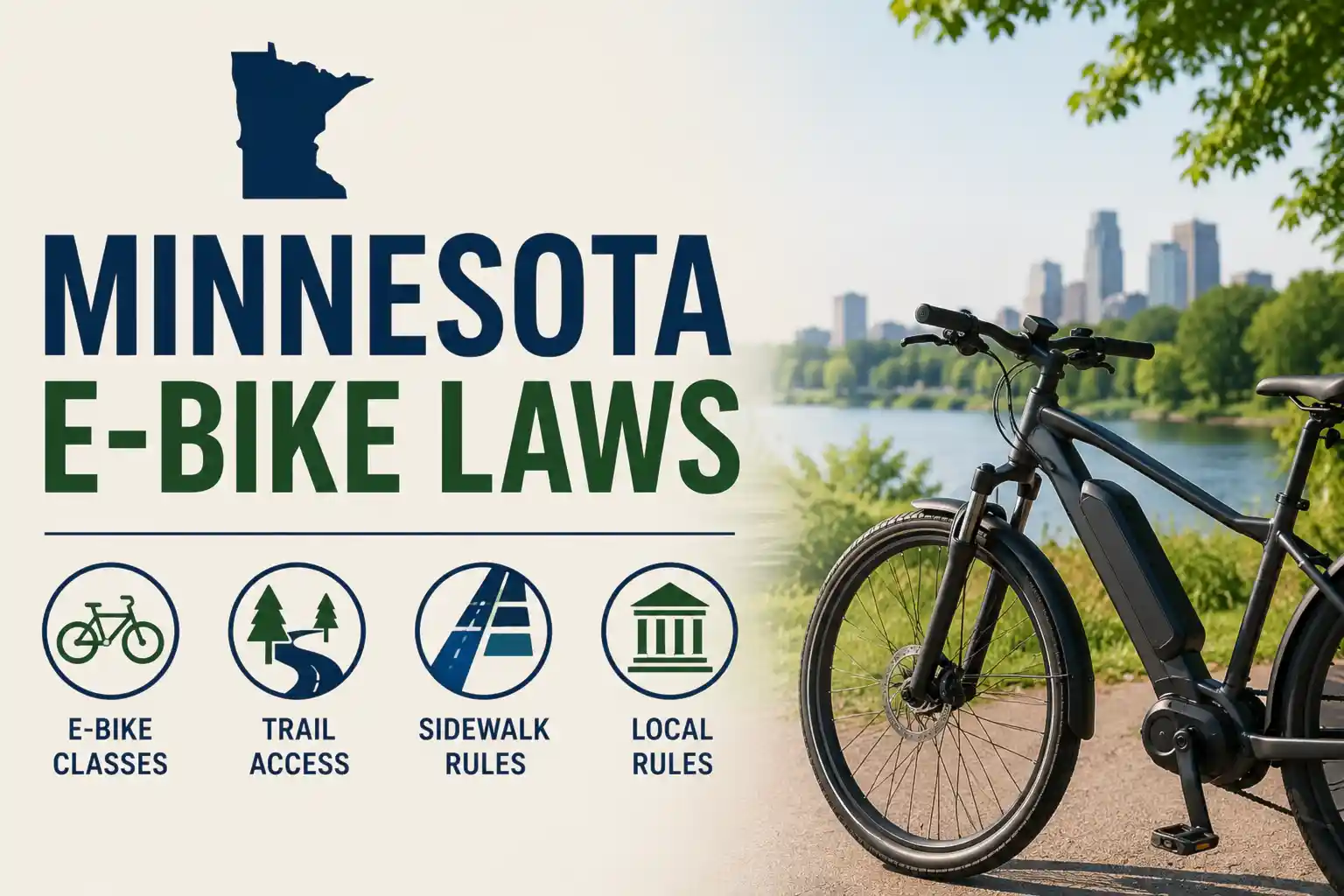
Minnesota E-Bike Laws Guide (2026): Classes, Sidewalk Rules, Trails, and Where You Can Ride
Last Updated on May 14, 2026 by Kristina
Last updated: May 2026
Minnesota has become increasingly friendly toward electric bikes, but there are still important rules riders need to know before hitting the road, trail, or bike path.
I’ve noticed many riders assume Minnesota follows the exact same e-bike rules as every other state, but local trail systems, park agencies, and city rules can change what’s allowed depending on where you ride.
In this guide, I’ll break down:
- Minnesota e-bike classes
- Speed and motor limits
- Helmet rules
- Sidewalk and bike path laws
- State trail access
- Local city differences
- Minnesota DNR trail considerations
- College campus policies
- Common legal mistakes riders make
- FAQs and real-world riding situations
I’ll also link to related Electric Bike Explorer resources throughout this guide so you can better understand where e-bikes are legally allowed.
👉 Related: State-by-State E-Bike Laws Guide
👉 Related: Can You Ride an E-Bike on the Sidewalk?
👉 Related: E-Bike Classes Explained
Who This Minnesota E-Bike Law Guide Is For (and Who It’s Not)
This guide is for:
- Minnesota commuters
- Recreational trail riders
- Riders using bike paths and greenways
- College students using e-bikes on campus
- Riders traveling through Minneapolis, St. Paul, Duluth, Rochester, and other cities
- People considering buying an e-bike in Minnesota
This guide may NOT be for:
- Riders using electric dirt bikes or Sur-Ron-style vehicles
- Riders modifying e-bikes beyond legal class limits
- Motorcycle or moped riders
- Off-road OHV users
Minnesota E-Bike Laws at a Glance
Minnesota generally follows the 3-class e-bike system used in many U.S. states.
Most Class 1, Class 2, and Class 3 e-bikes are legal on roads and many bike facilities, but local governments and trail managers can restrict access in certain locations.
Minnesota law defines an electric-assisted bicycle as a bicycle with:
- Fully operable pedals
- An electric motor of 750 watts or less
- Maximum assisted speed of 20 mph for Class 1 and 2
- Maximum assisted speed of 28 mph for Class 3
Minnesota strongly recommends helmets for all riders, and some local jurisdictions may impose additional helmet expectations or safety rules.
Some natural surface trails, DNR-managed areas, and local trail systems may restrict certain e-bike classes.
Minnesota E-Bike Class Definitions
Class 1 E-Bikes
Class 1 e-bikes:
- Are pedal-assist only
- Stop providing assistance at 20 mph
- Do not have a throttle
These are typically the most widely accepted e-bikes on bike paths and shared-use trails.
👉 Related: What Is a Class 1 E-Bike? (coming soon)
Class 2 E-Bikes
Class 2 e-bikes:
- Include a throttle
- Can assist up to 20 mph
- May also include pedal assist
These are legal in many of the same areas as Class 1 bikes, but some trail systems may treat throttle-equipped bikes differently.
👉 Related: What Is a Class 2 E-Bike? (coming soon)
Class 3 E-Bikes
Class 3 e-bikes:
- Use pedal assist only
- Assist up to 28 mph
- Must include a speedometer
Class 3 e-bikes often face additional restrictions on certain bike paths and trails.
Minnesota requires riders under 18 to wear a helmet on Class 3 e-bikes.
👉 Related: What Is a Class 3 E-Bike?
Minnesota Age Requirements for E-Bikes
Minnesota law requires riders to be at least 15 years old to operate an electric-assisted bicycle.
This rule applies statewide and is one of the most important Minnesota-specific e-bike laws many riders overlook.
I strongly recommend parents pay close attention to this rule because many younger riders incorrectly assume all e-bikes are treated the same as regular bicycles.
Minnesota has also increased focus on higher-powered e-motos and illegal electric dirt bikes being marketed as e-bikes.
👉 Related: E-Bike vs Electric Dirt Bike Differences (coming soon)
Minnesota Helmet Laws for E-Bikes
Minnesota Helmet Laws for E-Bikes
Minnesota does not currently have a universal statewide helmet law for adult e-bike riders.
However:
- Helmets are strongly recommended for all riders
- Some local organizations, schools, and riding programs may require helmets
- Faster Class 3 e-bikes can increase crash severity at higher speeds
I always recommend wearing a properly fitted bicycle or e-bike helmet, especially when commuting near traffic or riding on faster Class 3 models.
👉 Related: Best E-Bike Helmets for Commuters
Do You Need a License, Registration, or Insurance in Minnesota?
No.
Minnesota does not currently require:
- Driver’s licenses
- Vehicle registration
- License plates
- Motorcycle insurance
for legal low-speed electric bicycles that meet state e-bike definitions.
If your bike exceeds legal e-bike classifications, it may fall into moped or motor vehicle categories.
Where Can You Ride an E-Bike in Minnesota?
Minnesota generally allows e-bikes in many of the same places as traditional bicycles, but there are important exceptions.
Roads and Streets
E-bikes are generally allowed on:
- Public roads
- Streets
- Bike lanes
- Bicycle routes
Riders must follow normal traffic laws.
Bike Lanes and Multi-Use Paths
Many paved bike paths and multi-use trails allow e-bikes.
However, local agencies may:
- Restrict Class 3 e-bikes
- Restrict throttle use
- Set speed limits
- Ban e-bikes on crowded trails
Always check posted signage.
Sidewalk Riding in Minnesota
Minnesota sidewalk riding laws can vary by city.
In many areas, bicycles and e-bikes may be allowed on sidewalks unless prohibited locally.
However:
- Downtown business districts may prohibit riding
- Cities may restrict faster Class 3 bikes
- Pedestrians always have priority
I strongly recommend slowing down significantly when riding near pedestrians.
👉 Related: Can You Ride an E-Bike on the Sidewalk?
Minnesota Sidewalk Riding Quick Guide
| Area Type | Typical Rule |
|---|---|
| Residential neighborhoods | Often allowed unless locally prohibited |
| Downtown/business districts | Frequently restricted or discouraged |
| Shared pedestrian areas | Riders should slow down and yield |
| College campuses | Campus-specific rules often apply |
Because sidewalk laws can vary locally, riders should always watch for posted city and campus signage.
Minnesota State Trails and DNR Rules
Minnesota has one of the largest trail systems in the country, and the state is generally more e-bike-friendly than many other states when it comes to trail access.
According to Minnesota DNR guidance and Minnesota state law, electric-assisted bicycles are generally allowed anywhere traditional bicycles are permitted, as long as the bike meets Minnesota’s legal e-bike definition.
That means the e-bike must:
- Have fully operable pedals
- Have a motor rated at 750 watts or less
- Meet Class 1, Class 2, or Class 3 definitions
Minnesota law also states:
- Riders must be at least 15 years old to operate an e-bike
- Class 1 and Class 2 e-bikes are generally allowed on bicycle paths and trails unless specifically prohibited
- Class 3 e-bikes are also generally allowed unless restricted by a local authority or state agency
However, local trail managers and park systems can still create their own restrictions depending on the trail type and environment.
Paved State Trails
Many paved Minnesota trails allow e-bikes, especially lower-speed Class 1 and Class 2 models.
This commonly includes:
- Rail-trails
- Urban paved paths
- Commuter greenways
- Shared-use recreational trails
Popular Minnesota trail systems riders often research include:
- Root River State Trail
- Luce Line State Trail
- Cannon Valley Trail
- Gateway State Trail
Trail-specific rules can still vary, so riders should always verify current regulations before riding.
👉 Related: E-Bike Trail Access Checker Tool
Natural Surface Trails
Natural surface trails may have additional restrictions.
Some trail systems may:
- Allow only Class 1 e-bikes
- Restrict throttle-equipped bikes
- Limit access during muddy conditions
- Ban all motorized access entirely
Trail managers sometimes apply stricter rules on narrow or environmentally sensitive trails.
Mountain bike trail systems may also have separate local policies.
Minnesota E-Bike vs E-Moto Warning
One of the biggest areas of confusion in Minnesota involves the difference between legal e-bikes and higher-powered electric dirt bikes or e-motos.
Some products marketed online as “e-bikes” may:
- Exceed 750 watts
- Operate far above legal class speeds
- Lack proper pedal functionality
- Fail to meet Minnesota’s legal e-bike definition
That can create serious issues involving:
- Trail legality
- Liability after crashes
- Insurance coverage
- Traffic enforcement
- Public trail access
Minnesota agencies and cities have increasingly warned riders and parents about illegal e-motos being operated on bike trails and public paths.
Just because a product is marketed online as an “e-bike” does not automatically make it street-legal or trail-legal in Minnesota.
👉 Related: Can You Ride an E-Bike on Hiking Trails? (coming soon)
Proposed Minnesota E-Bike and E-Moto Law Changes
Minnesota lawmakers have recently considered several proposals related to e-bikes, e-motos, youth safety, and local enforcement.
The most important thing to understand is that these proposals do not all do the same thing.
SF 4186 / HF 3785: E-Motos vs. Legal E-Bikes
Senate File 4186 focuses on clarifying the difference between legal electric-assisted bicycles and higher-powered electric motorcycles often called “e-motos.”
The bill says its purpose is to address high-speed electric cycle devices that are often referred to as “E-Motos,” which may not legally qualify as e-bikes. It also says the bill does not modify Minnesota laws governing electric-assisted bicycles.
This matters because legal Minnesota e-bikes must stay within the state’s e-bike limits, including:
- Fully operable pedals
- 750-watt motor limit
- Class 1, Class 2, or Class 3 speed limits
Higher-powered vehicles, such as some Sur-Ron-style, Talaria-style, or electric dirt-bike-style vehicles, may instead be regulated as motorized bicycles, off-highway motorcycles, motorcycles, or other motor vehicles depending on their power, speed, and design.
SF 3280 / HF 2859: Proposed Local E-Bike Speed Limits and $60 Citations
The proposed $60 fine comes from a separate bill, SF 3280 / HF 2859, not SF 4186.
SF 3280 would allow local governments to set posted maximum speed limits for electric-assisted bicycles within business districts. The bill says those limits would only be effective when appropriate signs are posted.
Under the proposal, a peace officer could issue an administrative citation for violating one of those posted local e-bike speed limits, and the bill says the citation must list the actual speed the e-bike was traveling.
The fine amount listed in the administrative citation section is $60. The proposal also says these local e-bike speed-limit violations would not be recorded on a person’s driving record.
Why This Matters for Minnesota Riders
For regular Class 1, Class 2, and Class 3 e-bike riders, the biggest takeaway is this:
- SF 4186 is mainly about clarifying e-motos and higher-powered electric motorcycles
- SF 3280 / HF 2859 is where the proposed $60 local e-bike speed citation appears
- Minnesota’s 15+ minimum rider age remains important
- Legal e-bikes are still treated differently from high-powered e-motos
- Local signage may become more important if cities gain authority to set posted e-bike speed limits in business districts
At the time of this update, riders should treat these as proposed or developing legislative changes unless and until final enacted language is confirmed.
👉 Related: E-Bike Classes Explained
🎥 Watch: Deep Dive Into Minnesota’s Proposed E-Bike Crackdown and SF 4186
Minnesota City E-Bike Comparison Chart
Local enforcement and riding restrictions can vary across Minnesota cities.
Here’s a simplified comparison showing some of the biggest differences riders should pay attention to.
| City | What Riders Should Know |
|---|---|
| Minneapolis | Extensive bike lane and greenway network. Riders should slow down on crowded shared-use trails. |
| Saint Paul | E-bikes generally allowed where bicycles are allowed, but sidewalk riding in busy pedestrian areas may create issues. |
| Duluth | E-bikes allowed on many bicycle-designated trails, but mountain bike and natural surface trail access may vary. |
| Rochester | Downtown sidewalk riding restrictions exist in certain areas with posted signage and pavement markings. |
| Eden Prairie | City has specifically warned riders about illegal e-motos and high-powered electric dirt bikes. |
| Chanhassen | Confirms all 3 legal e-bike classes are allowed if compliant with Minnesota law. |
| Farmington | Emphasizes minimum rider age, lighting requirements, and standard bicycle traffic laws. |
I strongly recommend checking local park systems, trail managers, and city ordinances before riding in unfamiliar areas because local restrictions can change faster than state law.
👉 Related: E-Bike Trail Access Checker Tool
Local rules can matter more than many riders realize.
Below are some examples of areas where local enforcement and trail rules may differ.
Minneapolis
Minneapolis is highly bike-friendly and includes:
- Extensive bike lanes
- Greenways
- Shared-use paths
- Multi-use trail systems
Some crowded trails may discourage high-speed riding.
Higher-speed riding on crowded shared-use trails may attract enforcement attention, especially in busy pedestrian area
Saint Paul
Saint Paul generally allows e-bikes anywhere traditional bicycles are permitted.
However, riders should still watch for:
- Local sidewalk restrictions
- Shared-use trail signage
- Pedestrian-heavy downtown areas
- Park-specific rules
As with many cities, riders should slow down and yield to pedestrians in crowded areas.
Duluth
Duluth’s terrain makes e-bikes especially popular for climbing hills.
However:
- Mountain bike trail systems may have separate rules
- Natural surface trail access can vary
- Speed control matters on downhill sections
Rochester
Rochester has growing bike infrastructure and shared-use paths.
Riders should still verify:
- Park trail regulations
- Sidewalk restrictions
- Local speed rules
Minnesota College and University E-Bike Rules
College campuses often create their own e-bike policies.
Some campuses may:
- Restrict indoor charging
- Limit where bikes can park
- Ban riding inside pedestrian-heavy plazas
- Restrict throttle use
Common schools where riders should check campus policies include:
- University of Minnesota
- Minnesota State University campuses
- St. Cloud State University
- Private colleges and community colleges
Campus rules can change frequently.
Minnesota City E-Bike Comparison Chart
| City | Notable Rules or Enforcement |
|---|---|
| Minneapolis | Extensive bike network, crowded trail speed concerns |
| Saint Paul | Sidewalk riding discouraged in busy areas |
| Duluth | E-bikes allowed on bicycle-designated city trails |
| Rochester | Downtown sidewalk riding prohibited |
| Eden Prairie | Strong e-bike vs e-moto enforcement messaging |
| Chanhassen | All 3 classes legal if compliant |
| Farmington | Lighting and age rules emphasized |
Minnesota College and University E-Bike Rules
College campuses often have their own e-bike policies.
These rules may regulate:
- Charging
- Parking
- Sidewalk riding
- Indoor storage
- Pedestrian plaza riding
University of Minnesota
The University of Minnesota prohibits electric bikes and scooters from:
- Building elevators
- Indoor bicycle rooms
- Certain indoor storage spaces
Students are generally expected to park devices outdoors in approved areas.
Minnesota State University, Mankato
Minnesota State University, Mankato allows electric mobility devices on paved sidewalks and walkways.
However, the school restricts:
- Indoor charging
- Indoor storage in many buildings
- Unsafe operation in pedestrian-heavy areas
Campus policies can change regularly, so students should verify current rules before bringing an e-bike to campus.
Minnesota E-Bike Law Comparison Chart
| Topic | Minnesota Rule |
|---|---|
| E-Bike Classes | Class 1, 2, and 3 allowed |
| Max Motor Power | 750 watts |
| Class 1 Speed | 20 mph |
| Class 2 Speed | 20 mph |
| Class 3 Speed | 28 mph |
| Helmet Requirement | Required under 18 for Class 3 |
| License Required | No |
| Registration Required | No |
| Insurance Required | No |
| Sidewalk Riding | Depends on local rules |
| Trail Access | Varies by trail and agency |
Common Minnesota E-Bike Law Mistakes
Assuming Every Trail Allows E-Bikes
Many riders assume all bike trails automatically allow e-bikes.
That is not always true in Minnesota.
Trail managers may:
- Restrict throttle bikes
- Limit Class 3 access
- Ban motorized devices entirely
Riding Too Fast on Shared Paths
Even where e-bikes are legal, unsafe speeds can create problems.
On crowded trails, riders should slow down near:
- Walkers
- Children
- Pets
- Other cyclists
Fast riding on mixed-use paths is one of the biggest reasons local agencies consider tighter restrictions.
Modifying E-Bikes Beyond Legal Limits
Some riders unlock speed limiters or add oversized motors.
Once modified beyond legal classifications, the bike may no longer qualify as an electric bicycle under Minnesota law.
That can create:
- Liability issues
- Trail access problems
- Enforcement risks
👉 Related: Can You Make an E-Bike Faster?
Minnesota Night Riding Requirements
Minnesota riders using e-bikes at night should pay close attention to visibility and lighting requirements.
Most bicycle safety guidance recommends:
- White front light visible from at least 500 feet
- Rear red reflector or rear red light
- Reflective gear or reflective tire sidewalls when possible
I strongly recommend brighter lights during Minnesota winters because snow, fog, rain, and early sunsets can reduce visibility quickly.
👉 Related: Best E-Bike Lights for Night Riding (coming soon)
Safety Tips for Minnesota E-Bike Riders
Minnesota weather creates unique riding conditions.
I strongly recommend:
- Using bright lights during winter and cloudy conditions
- Running wider tires during wet seasons
- Checking battery temperature in extreme cold
- Slowing down on leaves, snow, and icy surfaces
- Wearing reflective gear during early sunsets
Cold weather can also reduce battery range significantly.
👉 Related: E-Bike Range Explained
👉 Related: How Cold Weather Affects E-Bike Batteries (coming soon)
⚠️ What You Need to Ride Legally
Depending on your e-bike class, certain safety equipment – like lights, helmets, and reflectors – may be required, especially for higher-speed bikes or road use.
What Happens If Your E-Bike Doesn’t Meet Minnesota Legal Definitions?
If your bike:
- Exceeds 750 watts
- Goes faster than legal class limits
- Lacks pedals
- Operates more like a dirt bike or motorcycle
it may no longer legally qualify as an e-bike.
In some cases, it could instead be treated as:
- A moped
- A motor-driven cycle
- An off-road vehicle
That can change:
- Registration requirements
- Insurance requirements
- Trail legality
- Licensing requirements
Nearby State Law Guides
Traveling outside Minnesota? Laws change quickly.Check other states:
California e-bike laws
Pennsylvania e-bike laws
Washington e-bike laws
Colorado e-bike laws
👉 Compare all states in the state-by-state e-bike law guide
Minnesota E-Bike Laws FAQs
Yes. Class 1, 2, and 3 e-bikes are generally legal in Minnesota if they meet state requirements.
Some trails allow e-bikes while others restrict certain classes or motorized access.
Always check local trail signage and DNR guidance.
No, legal low-speed e-bikes generally do not require insurance.
Yes, but riders under 18 using Class 3 e-bikes must wear helmets.
Yes. Class 2 throttle e-bikes are legal if they comply with state definitions.
Possibly. Sidewalk riding rules vary by city and local ordinances.
Many bicycle-designated trails in Duluth allow e-bikes, but some mountain bike and natural surface trail systems may have separate rules or restrictions.
Riders should always check local trail signage and park regulations before riding.
Rochester restricts bicycle and e-bike riding on sidewalks in certain Downtown District areas.
Riders should watch for pavement markings and posted signage identifying restricted zones.
Class 3 e-bikes are generally legal in Minneapolis if they meet Minnesota state definitions.
However, riders should use caution on crowded shared-use trails and pedestrian-heavy greenways.
Saint Paul generally allows e-bikes anywhere traditional bicycles are permitted unless specifically restricted.
Riders should still check local trail signage, park rules, and downtown pedestrian areas.
Many high-powered e-motos and electric dirt bikes are NOT legally classified as e-bikes in Minnesota.
If the vehicle exceeds legal e-bike limits or lacks proper pedals, it may not be allowed on bike trails or shared-use paths.
Final Thoughts on Minnesota E-Bike Laws
Minnesota is generally a good state for e-bike riders, especially with its growing network of bike lanes, rail-trails, and urban cycling infrastructure.
Still, local trail rules matter.
The biggest thing I’d recommend is paying attention to:
- Local signage
- Trail class restrictions
- Speed expectations on shared paths
- Winter riding conditions
Most legal issues happen when riders assume every trail or sidewalk follows the exact same rules.
If you stay within legal class limits and ride responsibly, Minnesota can be an excellent state for commuting and recreational e-bike riding.
External Sources
Minnesota Legislature
Minnesota Department of Natural Resources
Minnesota Department of Public Safety
Cannon Valley Trail E-Bike Policy

Kristina is not just an enthusiast but a true authority on electric bikes. Nestled in the coastal beauty of Virginia, Kristina has found the perfect backdrop for her passion for electric biking. As a dedicated wife and homeschooling mom, her life revolves around family, faith, and the thrill of adventure.
Originally hailing from Ohio, Kristina's journey with electric bikes began as a curiosity and quickly evolved into a deep expertise. Her blog is a testament to her love for electric biking, combining her fascination for eco-friendly transportation with her coastal lifestyle.
When she's not cruising the beach on her electric bike, you'll find Kristina indulging in her other loves: long walks along the shore, getting lost in a good book, and cherishing moments with her loved ones. With a heart as big as her love for animals, especially cats, Kristina brings a unique perspective to the electric bike world, grounded in her strong faith in God and her dedication to a sustainable lifestyle.
Through her blog, Kristina shares her extensive knowledge of electric bikes, offering valuable insights, tips, and recommendations to fellow enthusiasts. Whether you're a seasoned rider or a newcomer to the electric bike scene, Kristina's blog is your go-to source for all things electric biking, fueled by her passion, expertise, and the scenic beauty of coastal Virginia.