One Upgrade That Can Make Your E-Bike Much Safer (Most Riders Overlook This)
Last Updated on April 10, 2026 by Kristina
Introduction
If you only upgrade one thing on your e-bike, it shouldn’t be speed, power, or even battery.
It should be your brakes.
Many riders focus on motor wattage or range, but the truth is simple:
The faster and heavier your e-bike is, the more important your stopping power becomes.
👉 New to e-bikes or unsure what actually matters? Start here: E-Bike Buying Guide
👉 Riding in traffic or commuting daily? This helps you choose safer setups: Best Commuter E-Bikes for Daily Riding
Who This Guide Is For (and Who It’s Not)
This guide is for you if:
- You ride at 20–28 mph regularly
- You carry cargo, kids, or gear
- You ride in traffic, hills, or wet conditions
- Your bike feels slow to stop or “spongy”
This guide is NOT for you if:
- You ride casually at low speeds
- Your bike already has strong hydraulic brakes
- Your braking feels responsive and controlled
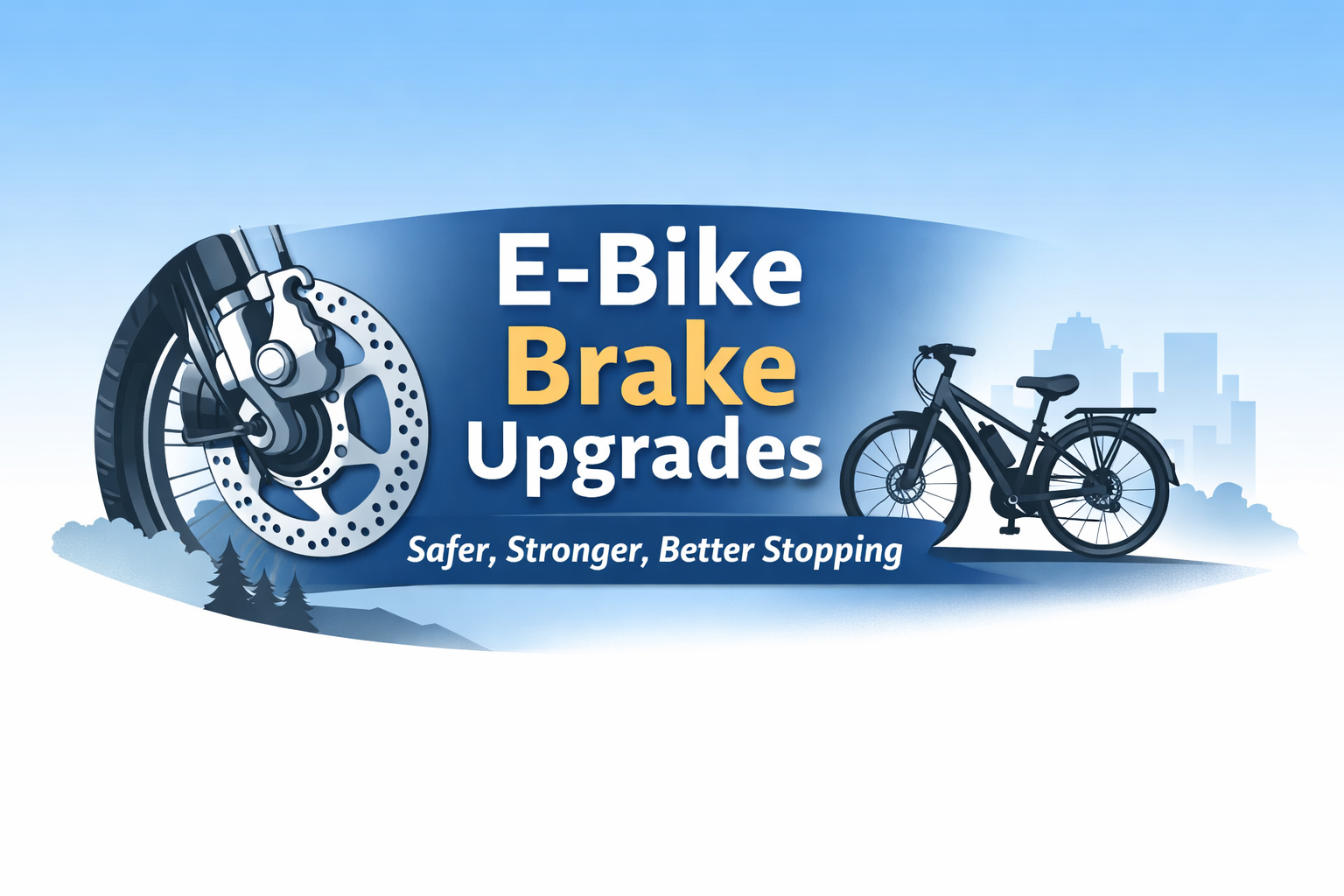
The One Upgrade That Matters Most: Hydraulic Disc Brakes
Best choice for most riders:
Upgrade to hydraulic disc brakes for stronger, more controlled stopping.
📖 Read Next
E-Bike Troubleshooting & Maintenance Guide
E-Bike Battery Guide: Types, Charging, Range, Lifespan, and Care
Understanding eBike Voltage: 36V vs 48V vs 52V — Which Is Right for You?
Top 10 E-Bike Maintenance Mistakes That Damage Your Motor (and How to Avoid Them)
E-Bike Software Updates: Why They Matter & How to Get Them
How to Build Your Own Ebike From Scratch
Why This Upgrade Is So Important (Real-World Safety)
E-bikes are:
- Heavier (50–80+ lbs)
- Faster (up to 28 mph)
- Harder to stop
According to the U.S. Consumer Product Safety Commission, higher-speed e-bikes require longer stopping distances and increased rider awareness.
Why Stopping Distance Matters More Than You Think
Stopping distance isn’t just about brakes – it’s a combination of speed, weight, and conditions.
At 20 mph, your stopping distance is already significantly longer than a traditional bicycle.
At 28 mph (Class 3), that distance increases dramatically – especially in real-world riding conditions.
What affects your stopping distance most
- Speed – higher speeds increase stopping distance exponentially
- Total weight – rider + bike + cargo all add momentum
- Terrain – downhill riding increases braking demand
- Surface conditions – wet roads reduce traction and control
Real-world example
If you’re riding:
- A 70 lb e-bike
- At 22–28 mph
- Carrying a backpack or cargo
Your braking system is handling significantly more force than a standard bicycle.
That’s why weaker brakes can quickly become a safety issue – especially in traffic or emergency stops.
👉 See how rider weight directly impacts performance and control
Stronger brakes don’t just stop you faster – they give you more control in the moments that matter most.
Mechanical vs Hydraulic Brakes
| Feature | Mechanical | Hydraulic |
|---|---|---|
| Stopping Power | Moderate | High |
| Effort | High | Low |
| Control | Basic | Excellent |
| Wet Performance | Good | Excellent |
Best Brake Kits for E-Bikes (Comparison Table)
| Brake Kit | Type | Best For | Price Range | Why It’s Good |
|---|---|---|---|---|
| Shimano MT200 | Hydraulic | Most riders | $70–$120 | Reliable, affordable, smooth braking |
| Tektro HD-E350 | Hydraulic | Commuters | $100–$180 | Designed for e-bikes, strong stopping |
| Magura MT5 eSTOP | Hydraulic | Heavy riders/cargo | $200–$350 | Premium power, excellent modulation |
| Juin Tech M1 | Hybrid | Budget upgrade | $60–$120 | Easier install, improved performance |
👉 Tip: Shimano MT200 is the best value upgrade for most riders.
Signs Your E-Bike Brakes Are Not Safe Enough (Don’t Ignore These)
If your brakes show any of these warning signs, your e-bike may not be safe to ride – especially at higher speeds.
Common brake warning signs
- You have to squeeze the brake lever hard to slow down
- The bike takes longer than expected to stop
- Braking feels inconsistent or “spongy”
- You hear grinding, squealing, or rubbing noises
- The bike feels unstable when braking downhill
- Your brakes fade or weaken during longer rides
What these symptoms usually mean
- Weak stopping power → Underpowered mechanical brakes
- Spongy feel → Air in hydraulic system or worn components
- Noise (grinding/squealing) → Worn brake pads or contaminated rotors
- Brake fade → Overheating (common on hills or heavy bikes)
These issues are more serious on e-bikes because of the added weight and speed.
Why this matters more on an e-bike
Unlike regular bikes, e-bikes:
- Carry more weight
- Reach higher speeds
- Require longer stopping distances
That means small brake issues can turn into real safety risks quickly.
Not sure what’s causing your issue?
Use this step-by-step diagnostic tool to pinpoint the exact problem and fix:
👉 Diagnose your e-bike problem step-by-step with this troubleshooting tool
Which Brake Upgrade Should You Choose?
Best choice for most riders:
Full hydraulic brakes (strongest performance and easiest control)
If you’re upgrading your e-bike brakes, here are the three main paths – and when each one makes sense:
Option 1: Full Hydraulic Brake Upgrade (Best for Most Riders)
✔ Best for commuters, higher speeds, and heavier bikes
- Strongest stopping power
- Smooth, consistent braking feel
- Less hand effort (great for longer rides)
- Performs better in wet and downhill conditions
👉 Choose this if:
You ride at 20+ mph, commute regularly, or want the biggest safety improvement.
Option 2: Cable-to-Hydraulic Hybrid (Best Budget Upgrade)
✔ Best for casual riders or simple upgrades
- Easier to install than full hydraulic
- Noticeable improvement over mechanical brakes
- More affordable
👉 Choose this if:
You want better braking without a full system replacement.
Option 3: Larger Brake Rotors (Best Add-On Upgrade)
✔ Best for hills, cargo, or heavier riders
- Increases stopping power
- Improves heat dissipation
- Works well combined with other upgrades
👉 Choose this if:
You ride downhill often or carry extra weight.
Brake Upgrade Calculator Tool
Not sure which brake upgrade makes sense for your e-bike?
Use this quick selector to get a simple recommendation based on your bike type, riding speed, weight, and terrain.
Brake Upgrade Selector Tool
Not sure what kind of brake upgrade makes sense for your e-bike? Use this tool to get a simple recommendation based on your riding style, speed, weight, and terrain.
Important: This tool gives a general recommendation based on common e-bike setups. Always check rotor clearance, frame compatibility, brake mount type, and motor cutoff compatibility before buying parts.
Still deciding if upgrading is worth it?
👉 Compare upgrade costs vs replacing your bike
Brake Upgrade Cost
| Upgrade | Cost |
|---|---|
| Hybrid | $50–$120 |
| Hydraulic | $120–$300 |
| Rotors | $20–$60 |
This is one of the highest ROI safety upgrades you can make.
Brake Safety Calculator Tool
Use this to estimate if your current braking setup is strong enough.
Brake Safety Calculator
Enter your bike weight, rider plus cargo weight, and typical speed to see whether your current braking setup may be under more demand.
Quick Safety Upgrade Checklist
- ✔ Upgrade to hydraulic brakes
- ✔ Check tire condition
- ✔ Improve visibility (lights)
- ✔ Adjust riding position
- ✔ Inspect brake pads regularly
Safety Note
⚠️ Brake performance is one of the most critical safety factors in preventing crashes.
According to PeopleForBikes, proper braking and control are key factors in reducing e-bike accidents.
If unsure, have a professional install your brakes.
How We Evaluate E-Bike Safety Upgrades
We prioritize:
- Real-world stopping performance
- Reliability over time
- Wet-condition performance
- Compatibility with e-bike systems
No hype. Safety first.
Should You Upgrade?
Upgrade if:
- You ride fast
- Your bike is heavy
- You ride in traffic
Wait if:
- You ride casually
- Your brakes feel strong
FAQs
Yes – especially at higher speeds. Better brakes improve stopping power, control, and confidence, which can significantly reduce your risk of accidents.
Underpowered brakes can lead to:
Longer stopping distances
Reduced control in emergencies
Increased wear and overheating
This becomes more dangerous on heavier or faster e-bikes.
Yes. Hydraulic brakes perform more consistently in rain and wet conditions because they apply more even pressure and maintain better control compared to mechanical systems.
You may need larger rotors if:
Your brakes fade on hills
Stopping feels weak at higher speeds
Your bike is heavy or carries cargo
Upgrading to 180mm or 203mm rotors can improve braking performance.
Yes. More weight increases momentum, which increases stopping distance. Heavier riders or those carrying cargo benefit significantly from stronger braking systems.
You can, and it will improve stopping power, but for best results, upgrading both front and rear brakes is recommended for balanced performance and safety.
Yes – especially for faster or heavier e-bikes.
Possible, but beginners should consider a shop.
Less frequent, but more technical.
Final Thoughts
Most riders upgrade for speed.
Smart riders upgrade for safety first.
Better brakes don’t just improve your ride – they protect it.
Not sure where to go next?
Some riders are brand new. Others are fixing a problem or thinking about a new bike. Choose what fits you.
Learn & Get Comfortable
Understand how e-bikes work and what to expect when riding.
Improve Your Current Ride
If your bike isn’t performing how you want, learn what affects speed, range, and power.
Compare Better Bikes
Looking for something that fits your riding style? Start here.
- Best Electric Bikes for Beginners
- Recommended Commuter Ebikes
- Most Comfortable City E-Bikes
- Best Fat Tire Ebikes
- Top Folding Ebikes
- Best Step Through Ebikes
- Top Cargo Electric Bikes
- Best Lightweight Ebikes
- Best Long Range Ebikes
- Top Moped Style E-Bikes
- E-bike Reviews
🛒 Ready to Buy?
Top picks and current availability from trusted brands.
👉 Still deciding?
Take our E-Bike Recommendation Quiz to get matched with the right riding style in under two minute

Kristina is not just an enthusiast but a true authority on electric bikes. Nestled in the coastal beauty of Virginia, Kristina has found the perfect backdrop for her passion for electric biking. As a dedicated wife and homeschooling mom, her life revolves around family, faith, and the thrill of adventure.
Originally hailing from Ohio, Kristina's journey with electric bikes began as a curiosity and quickly evolved into a deep expertise. Her blog is a testament to her love for electric biking, combining her fascination for eco-friendly transportation with her coastal lifestyle.
When she's not cruising the beach on her electric bike, you'll find Kristina indulging in her other loves: long walks along the shore, getting lost in a good book, and cherishing moments with her loved ones. With a heart as big as her love for animals, especially cats, Kristina brings a unique perspective to the electric bike world, grounded in her strong faith in God and her dedication to a sustainable lifestyle.
Through her blog, Kristina shares her extensive knowledge of electric bikes, offering valuable insights, tips, and recommendations to fellow enthusiasts. Whether you're a seasoned rider or a newcomer to the electric bike scene, Kristina's blog is your go-to source for all things electric biking, fueled by her passion, expertise, and the scenic beauty of coastal Virginia.