Best Folding E-Bikes for 2026: 8 Picks for Commuting, RV Travel & Storage
Last Updated on September 24, 2026 by Kristina
📚 Research-based buying guide: I have not personally tested every bike in this guide. These recommendations are based on current manufacturer specifications, safety documentation, warranty and return policies, independent testing, service information, and available rider feedback.
Introduction
Folding e-bikes can be excellent for commuting, RV travel, car-trunk transport, and small-space storage, but the best choice depends less on one headline specification and more on how often you need to lift it, where you ride, how much battery capacity you need, and whether the folded bike actually fits your space.
For most buyers, my best overall pick is the Lectric XP4 750 because it combines a strong 750W platform, an 840Wh battery, useful cargo capacity, and a folding frame at a competitive price. If lower weight matters more than maximum power or battery size, the Lectric XP Lite 2.0 and Mokwheel Slate are easier to live with. For rougher roads, the Heybike Ranger 3.0 Pro stands out because of its full-suspension setup.
If you are still comparing categories, my complete e-bike buying guide explains motor types, battery capacity, fit, braking, and other basics. If lifting a folding bike into a car, RV, apartment, or storage space is one of your biggest concerns, see my Best Lightweight Folding E-Bikes guide for models compared specifically by complete weight, battery-removal weight, folded dimensions, and real-world portability.
⭐ Quick Picks
- Lectric XP4 750 – Best Overall
- Ride1Up Portola 02 – Best Value for Commuting
- Velotric Fold 1 Plus – Best for High Payload + Tech Features
- Lectric XP Lite 2.0 – Best Lightweight
- Mooncool POP – Best for Comfort + Easy Folding
- Heybike Ranger 3.0 Pro – Best for Rough Roads + Full Suspension
- Mokwheel Slate – Best Lightweight Full-Featured Option
- RadExpand 5 Plus – Best for Wide-Tire Stability
👉 Short on time?
See today’s e-bike deals and limited-time discounts, then compare top picks below.
Best Folding E-Bikes for 2026 Compared
| Model | Best For | Motor | Battery | Listed Weight | Payload | Tires | Key Tradeoff |
|---|---|---|---|---|---|---|---|
| Lectric XP4 750 | Best Overall | 750W rear hub | 840Wh | About 68 lb | 330 lb total | 20×3-in. | Still heavy to lift regularly |
| Ride1Up Portola 02 | Best Value for Commuting | 750W rear hub, 90Nm claimed | 672Wh or 960Wh options | About 64 lb with smaller battery | 300 lb | 20×3-in. | Compact but not especially light |
| Velotric Fold 1 Plus | Best for High Payload + Tech Features | 750W rear hub | 608Wh | 63 lb* | 450 lb | 20×3-in. | Listed weight excludes several parts |
| Lectric XP Lite 2.0 | Best Lightweight | 300W rear hub, 819W peak claimed | 375Wh standard / 672Wh long-range | About 49 lb starting weight | 275 lb | 20×2.5-in. | Less motor and cargo capability than heavier folders |
| Mooncool POP | Best for Comfort + Easy Folding | 750W rated / 1,200W peak claimed, 85Nm claimed | 48V 13.6Ah, about 653Wh | 67 lb claimed net weight | 330 lb | 20×3-in. | Heavier to lift despite easy folding |
| Heybike Ranger 3.0 Pro | Best for Rough Roads + Full Suspension | 750W rear hub | 48V 15Ah, 720Wh | About 74 lb | 400 lb | 20×4-in. | Heavy for frequent lifting |
| Mokwheel Slate | Best Lightweight Full-Featured Option | 500W continuous / 860W peak, 70Nm+ claimed | 720Wh | 54 lb | 350 lb | 20×3-in. | Current configuration differs from older EBE coverage |
| RadExpand 5 Plus | Best for Wide-Tire Stability | 750W rear hub | About 720Wh | About 72.5 lb | 315 lb total / 225 lb max rider | 20×4-in. | Heavy, with a lower rider-weight limit than total payload |
Weight note: Manufacturer-listed weights are not always measured the same way. Some brands include accessories or the battery while others exclude certain installed parts, so listed weights are best used as a comparison starting point rather than assuming every bike was weighed under identical conditions.
* Velotric Fold 1 Plus: Velotric states that its 63 lb listed weight excludes the fenders, kickstand, and pedals.
*Velotric states that its 63 lb Fold 1 Plus weight excludes the fenders, kickstand, and pedals.
🔎 Why You Can Trust This Guide
I compare official specifications, safety information, independent testing, support policies, and real-world rider feedback. Affiliate relationships do not determine which products I recommend or how they are ranked. You can read more about how Electric Bike Explorer reviews and ranks e-bikes.
What matters most in a folding e-bike
I put extra weight on portability, actual folded size, frame and hinge design, braking, battery capacity, rider fit, payload, tire choice, suspension, electrical-safety information, and whether replacement parts and support appear practical to obtain. A folding bike that is powerful but too heavy for you to lift into your car may be a poor choice even if its motor specifications look excellent on paper.
1. Lectric XP4 750 – Best Overall

The Lectric XP4 750 is my best overall choice because it balances utility, battery capacity, everyday performance, folding convenience, and price better than most competitors. It is not a lightweight folder, but it makes sense for riders who want one compact e-bike to handle commuting, errands, campground riding, and occasional cargo use.
Key specs
- Motor: 750W rear hub
- Battery: 48V 17.5Ah, about 840Wh
- Tires: 20×3-in.
- Brakes: Hydraulic disc brakes
- Payload: 330 lb total
- Weight: About 68 lb, depending on configuration
Why it stands out
The XP4 gives you substantially more battery capacity than many compact folders, and its broad accessory ecosystem makes it easier to adapt for commuting, baskets, racks, or recreational use. The 3-in. tires strike a useful middle ground between narrow commuter tires and very bulky 4-in. fat tires.
Tradeoffs
At roughly the upper-60-lb range, this is still a bike you should think carefully about before planning to lift it up stairs or into a tall vehicle every day. Folding makes a bike smaller, but it does not make the weight disappear.
Read my full review of the Lectric XP4
2. Ride1Up Portola 02 – Best Value for Commuting

The Ride1Up Portola 02 replaces the original Portola in this guide. The current Portola 02 is a stronger fit for commuters who want a compact folding frame without giving up a 750W motor, hydraulic brakes, and a more sophisticated pedal-assist setup.
Key specs
- Motor: 750W rear hub
- Torque: 90Nm claimed
- Sensor: Selectable torque or cadence sensing
- Battery: Current battery options include roughly 672Wh and 960Wh configurations
- Brakes: Hydraulic disc brakes
- Tires: 20×3-in.
- Payload: 300 lb
- Weight: About 64 lb with the smaller battery configuration
Why it stands out
The ability to choose between torque- and cadence-sensor behavior is unusual at this price point and gives commuters more control over how natural or immediate pedal assist feels. The smaller folded footprint also helps when the bike needs to share an apartment, office, trunk, or RV compartment.
Tradeoffs
The Portola 02 is compact but not truly light. Riders who must carry a bike up stairs every day should compare it closely with the XP Lite 2.0 or Mokwheel Slate.
Read more on the Ride1UP Portola 02
3. Velotric Fold 1 Plus – Best for High Payload + Tech Features
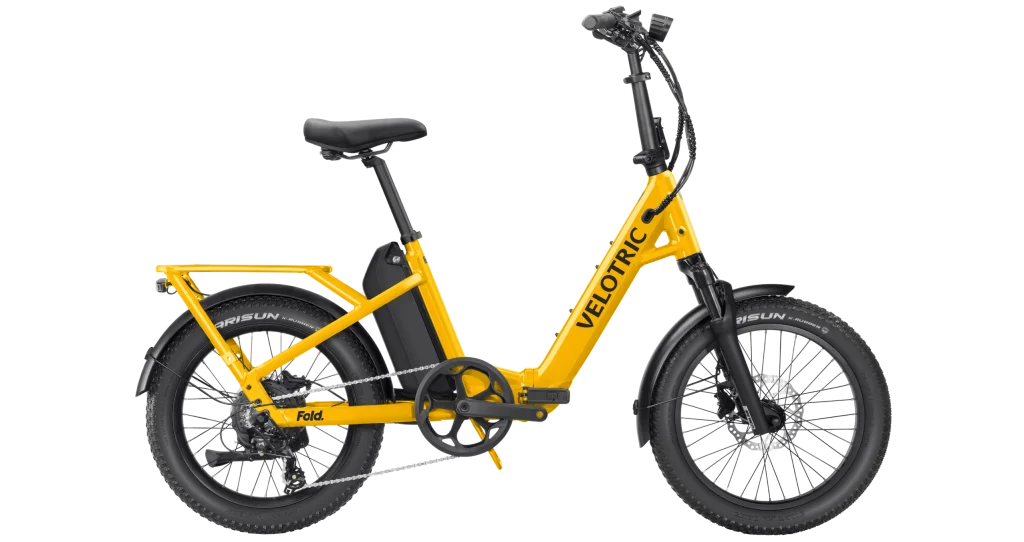
The Velotric Fold 1 Plus is the standout here for riders who want unusually high carrying capacity plus app-based features. Velotric lists a 450 lb payload capacity, which gives this folder substantially more headroom than most competitors in this guide.
Key specs
- Motor: 750W rear hub
- Battery: 48V 12.6Ah, about 608Wh
- Payload: 450 lb
- Tires: 20×3-in.
- Brakes: Hydraulic disc brakes
- Tech: App connectivity and Apple Find My support
- Listed weight: 63 lb, excluding fenders, kickstand, and pedals
Why it stands out
For larger riders, cargo-heavy errands, or households that want more payload margin, that 450 lb rating is a major differentiator. The connected features also make the Fold 1 Plus more appealing to riders who value app controls and location-related functionality.
Tradeoffs
Be careful when comparing its listed weight directly with competing bikes. Velotric states that the 63 lb figure excludes the fenders, kickstand, and pedals, so the real ready-to-ride weight is higher.
Read my full review of the Velotric Fold 1 Plus
4. Lectric XP Lite 2.0 – Best Lightweight
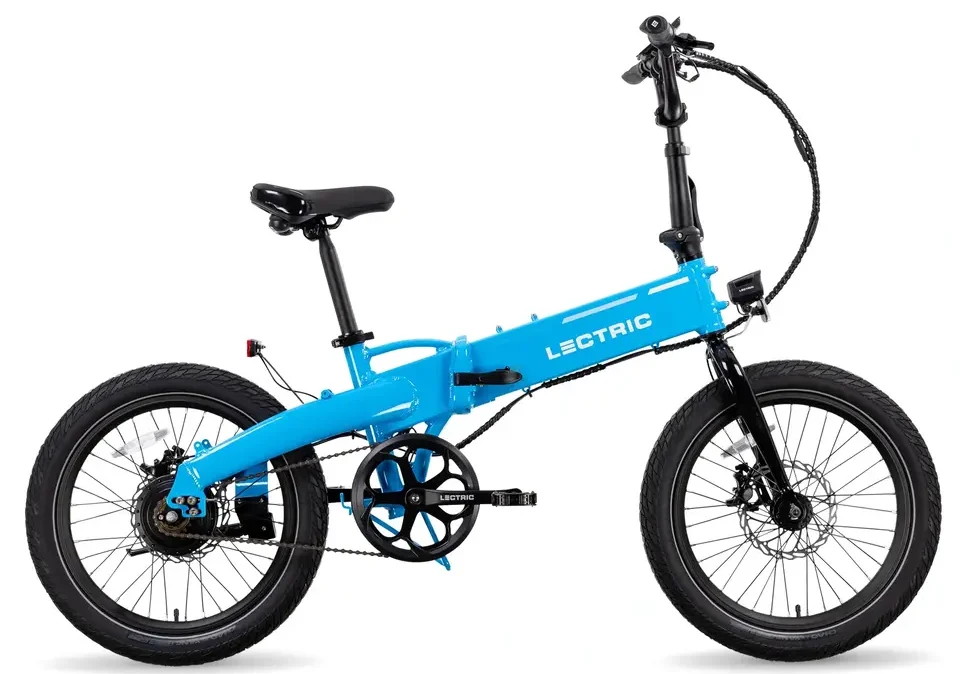
The Lectric XP Lite 2.0 is my lightweight pick because it starts around 49 lb and still gives you a practical 20-in. folding platform from a brand with a broad accessory and support ecosystem. That weight difference matters if you regularly load your bike into a car, RV compartment, apartment elevator, or storage area.
Key specs
- Motor: 300W rear hub, up to 819W peak claimed
- Battery: 375Wh standard or 672Wh long-range option
- Tires: 20×2.5-in.
- Payload: 275 lb
- Starting weight: About 49 lb, depending on configuration
Why it stands out
Many folding e-bikes weigh well over 60 lb, so getting close to the 50 lb mark makes a meaningful difference in actual ownership. The optional long-range battery also lets buyers trade some weight and cost for more capacity if they need it.
Tradeoffs
This is not the choice for riders seeking the strongest hill performance, highest payload, or maximum cargo capability. Its appeal is portability and simplicity rather than brute force.
Read my full review of the Lectric XP Lite 2.0
5. Mooncool POP – Best for Comfort + Easy Folding

The Mooncool POP is my pick for riders who want a folding e-bike with more comfort than a typical rigid-frame folder. It combines front and rear suspension, 20×3-in. tires, a torque sensor, hydraulic disc brakes, and a 750W rear hub motor. I also have firsthand experience with the POP because Mooncool provided Electric Bike Explorer with a review sample.
Key specs
- Motor: 750W rated rear hub
- Peak output: Up to 1,200W claimed
- Torque: 85Nm claimed
- Battery: 48V 13.6Ah, about 653Wh
- Claimed range: About 30 miles throttle-only / up to 60 miles in PAS 1
- Sensor: Torque sensor with selectable sensor mode
- Brakes: Hydraulic disc brakes with 180mm rotors
- Suspension: Front and rear
- Tires: 20×3-in.
- Weight: 67 lb claimed net weight
- Payload: 330 lb
Why it stands out
The POP stands out for its combination of folding convenience and ride comfort. The full-suspension setup and 3-in. tires can help take the edge off cracked pavement, campground roads, and other uneven surfaces, while the torque sensor gives pedal assist a more responsive feel than a basic cadence-only system.
The folding process also impressed us during hands-on use. We own another folding e-bike, and the POP is considerably easier for us to fold than that bike. That is a meaningful advantage if you expect to fold the bike regularly for an RV, vehicle, apartment, or storage space.
Tradeoffs
At a claimed 67 lb, the POP is still a fairly heavy bike to lift even though we found it easy to fold. Riders who need to carry a folding e-bike up stairs or load it into a vehicle frequently may prefer a lighter option such as the Lectric XP Lite 2.0 or Mokwheel Slate.
Mooncool provided the POP as a review sample, but that relationship does not influence its position in this guide. After receiving my review, Mooncool told me it updated some specifications and return-policy information after I pointed out discrepancies. I appreciate that the company responded, although some public documentation has still shown conflicting information, including throttle descriptions. Buyers should confirm the latest specifications and policies on Mooncool’s current product page before ordering.
Read my full review of the Mooncool POP
6. Heybike Ranger 3.0 Pro – Best for Rough Roads + Full Suspension
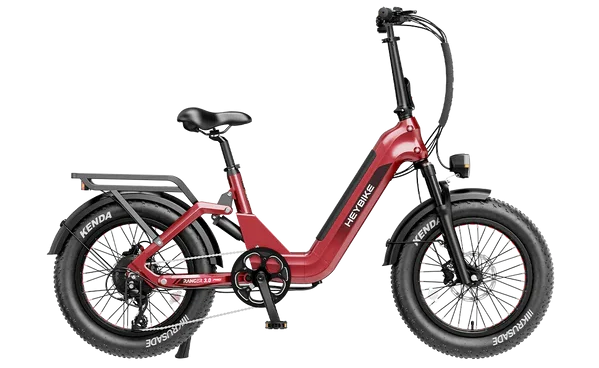
The Heybike Ranger 3.0 Pro is the most terrain-comfort-oriented option in the main eight. Its full suspension and 20×4-in. tires make it better suited to rough pavement, pothole-heavy routes, gravel connectors, campground roads, and riders who value cushioning more than minimum size or weight.
Key specs
- Motor: 750W rear hub
- Battery: 48V 15Ah, about 720Wh
- Suspension: Front and rear
- Tires: 20×4-in.
- Payload: 400 lb
- Weight: About 74 lb
Why it stands out
Wide tires plus suspension at both ends can reduce the harshness of broken roads and other uneven surfaces. This is the folder I would look at first if your definition of commuting includes rough shoulders, patched pavement, or recreational routes where comfort matters more than carrying the bike.
Tradeoffs
The Ranger 3.0 Pro is heavy. Folding it helps with storage dimensions, but riders who need to lift it into an SUV, up steps, or onto a rack frequently should think carefully about whether its comfort benefits justify the weight.
Read my full review of the Heybike Ranger 3.0 Pro
7. Mokwheel Slate – Best Lightweight Full-Featured Option

The Mokwheel Slate fills an important gap between stripped-down lightweight folders and heavier high-power utility models. Mokwheel currently lists it at 54 lb while still giving it a 720Wh battery, hydraulic brakes, 20×3-in. tires, and both torque and cadence sensing.
Current model specs
- Listed weight: 54 lb
- Motor: 500W continuous / 860W peak
- Torque: 70Nm+ claimed
- Battery: 720Wh
- Claimed range: 50-60 miles
- Sensing: Torque + cadence
- Brakes: Hydraulic
- Tires: 20×3-in.
- Payload: 350 lb
Why it stands out
A listed 54 lb weight combined with a 720Wh battery is attractive for riders who do not want the much smaller battery common on many lighter folding bikes. The 350 lb payload and hydraulic brakes also make it a more complete everyday platform than many minimalist folders.
Tradeoffs
The current Slate should be evaluated on its present specifications rather than assuming older reviews describe this configuration. As always, confirm the current fit range, included accessories, and model details before ordering.
Read my full Mokwheel Slate review
8. Rad Power RadExpand 5 Plus – Best for Wide-Tire Stability

The RadExpand 5 Plus is my pick for riders who prefer the stable, planted feel of 20×4-in. tires and want to stay within Rad Power Bikes’ established product and support ecosystem. It is less portable than the lighter picks, but its wide-tire setup can feel reassuring on imperfect pavement and loose surfaces.
Key specs
- Motor: 750W rear hub
- Battery: About 720Wh
- Tires: 20×4-in.
- Weight: About 72.5 lb
- Total payload: 315 lb
- Maximum rider weight: 225 lb
Why it stands out
The 4-in. tires provide a larger contact patch and more air volume than the 2.5- or 3-in. tires on many folding competitors. For riders prioritizing comfort and confidence over minimum folded bulk, that can be worthwhile.
Tradeoffs
Rad’s published limits need to be read carefully: the company lists a 315 lb total payload but a 225 lb maximum rider weight. The total-payload number should not be interpreted as meaning a 315 lb rider is within the stated limit.
Read my full review of the Rad Power RadExpand 5 Plus
How to Choose the Right Folding E-Bike
There is no single motor wattage or advertised range target that is automatically right for everyone. The better approach is to match the bike to how you will actually store, carry, ride, and maintain it.
Weight
Weight is one of the most important folding-bike specifications because you may need to lift the bike after folding it. A 70 lb bike can be manageable when rolling but difficult to load into a trunk or RV storage bay. Think about your own lifting ability, vehicle height, stairs, and how often the bike will leave the ground.
If frequent lifting is a priority, my guide to lightweight folding e-bikes that are actually easier to lift compares models under about 50 lb and explains why battery removal, folded shape, and gripping points matter almost as much as the number on the scale.
Also remember that manufacturer-listed weights are not always measured identically. Batteries, pedals, fenders, racks, kickstands, and other parts may or may not be included in a published figure.
Folded dimensions
Do not assume every 20-in. folding bike will fit the same space. Measure your trunk, closet, RV compartment, elevator, or office storage area first, then compare the manufacturer’s folded length, width, and height. Handlebar position and pedal width can matter as much as the frame hinge.
Folding mechanism
A folding bike should be easy enough that you will actually use the feature. Look at the frame latch, handlebar stem, pedal design, cable routing, and whether the folded bike stays together or rolls conveniently. A secure, intuitive hinge matters more than an impressive-looking folding claim.
Motor choice
Choose motor output based on rider weight, cargo, hills, stop-and-go traffic, and how much assistance you want. A lighter rider on flat urban streets may be perfectly happy with a smaller motor, while steep hills, heavier loads, or repeated acceleration can justify more torque and power. Also check your local e-bike classification and motor rules before assuming the highest output is the best choice.
My e-bike motor guide explains hub and mid-drive systems in more detail.
Battery capacity in watt-hours
Watt-hours are a more useful starting point than an advertised range number because range claims depend heavily on assist level, speed, rider weight, hills, temperature, tire pressure, wind, cargo, and throttle use. You can estimate watt-hours by multiplying battery voltage by amp-hours: for example, a 48V 15Ah battery is about 720Wh.
Choose capacity around your actual trip distance plus a reasonable reserve, not an arbitrary 40-mile advertising target. A smaller battery may be exactly right for a lightweight bike used for short city trips, while RV touring or long commutes may justify a larger pack.
See my guide to e-bike battery capacity and watt-hours for more detail.
Tires and suspension
Wider tires and suspension generally add comfort on rough surfaces but also add weight, bulk, rolling resistance, and maintenance. A 2.5- or 3-in. tire can make sense for paved commuting and easier transport. A 4-in. fat tire or full-suspension setup may be worth the tradeoff for rough roads, gravel, campground riding, or riders who strongly prioritize comfort.
Brakes
Folding e-bikes can be heavy and fast enough that braking quality matters. Hydraulic disc brakes are increasingly common and usually require less hand effort than mechanical discs. Rotor size, tire grip, bike weight, speed, maintenance, and rider load all affect stopping performance.
Rider fit
A compact-looking folding bike is not automatically a good fit for a shorter rider, and a tall seatpost does not guarantee comfortable reach for a taller rider. Check the manufacturer’s rider-height guidance, saddle adjustment, handlebar adjustment, standover, reach, and maximum rider weight.
You can also use the Electric Bike Explorer size calculator as a starting point.
Electrical safety and certification
Look for clear model-specific information about recognized electrical safety standards such as UL 2849 for the e-bike electrical system and UL 2271 for batteries when applicable. Be cautious with vague language such as “UL compliant” or references to a single component if the brand does not clearly explain what was actually tested or certified.
The U.S. Consumer Product Safety Commission recommends compliance with applicable UL standards for micromobility products and batteries. You can review the CPSC micromobility safety guidance.
Support and replacement parts
Before buying, look beyond the initial sale price. Check whether the company sells replacement batteries, chargers, displays, controllers, brake parts, derailleur hangers, tires, and folding-latch components. Read the warranty and return policy and consider whether local shops are willing to work on the bike.
Common Folding E-Bike Buying Mistakes
- Buying by folded appearance alone: Check actual dimensions and weight.
- Assuming folding means lightweight: Several excellent folding e-bikes weigh 65-75 lb.
- Choosing the biggest motor without considering terrain or law: More power can add cost and may not match your local rules or actual needs.
- Using advertised range as a guarantee: Range varies substantially with riding conditions and assist use.
- Ignoring fit: Compact wheels do not guarantee a compact rider fit.
- Ignoring parts support: A low purchase price becomes less attractive if replacement electrical components are hard to get.
- Forgetting the battery when planning air travel: Normal e-bike batteries are far larger than passenger-airline lithium battery limits.
Essential E-Bike Gear (Quick Picks)
Before you choose your e-bike, these are the accessories most riders end up needing for safety and everyday use:
Frequently Asked Questions
Are folding e-bikes good for commuting?
Yes, especially when storage is limited at home or work or when part of your trip involves a car, train, or other transport. But a folding hinge does not automatically make the bike easy to carry. For multimodal commuting, weight and folded dimensions may matter more than motor power.
Are folding e-bikes good for RV travel?
They can be. Folding frames reduce storage volume, and e-assist can make campground errands and local exploring easier. Measure the RV storage compartment carefully and account for battery charging, bike weight, tie-down points, and whether you can safely lift the bike into the compartment.
How much should a folding e-bike weigh?
There is no universal ideal. Models around 50-55 lb are substantially easier for many riders to lift than 65-75 lb fat-tire folders, but lighter bikes may give up battery capacity, motor output, suspension, or payload. The best number is one you can safely handle for your actual storage and transport routine.
How much range do I need?
Base the answer on your normal round trip plus reserve. Short urban trips may work well with a smaller pack, while longer commuting, hills, heavier riders, cargo, cold weather, or frequent throttle use can justify more battery capacity. Compare battery watt-hours rather than relying only on a brand’s maximum mileage claim.
Can I take a folding e-bike on an airplane?
The folding frame itself is not the main problem – the lithium-ion battery is. Under current FAA passenger-baggage rules, spare/rechargeable lithium-ion batteries up to 100Wh are generally permitted in carry-on baggage, batteries from 101Wh to 160Wh require airline approval and are subject to limits, and lithium-ion batteries over 160Wh are forbidden in passenger baggage.
Full-size folding e-bike batteries are usually several hundred watt-hours – for example, many bikes in this guide use packs around 600-800Wh – so you generally cannot take the normal e-bike battery on a passenger flight. Riders considering air travel need to check the airline’s current rules and arrange a compliant alternative, such as renting a battery or e-bike at the destination where practical. See the FAA’s current passenger battery guidance.
Are fat tires better on a folding e-bike?
Not automatically. Fat tires can improve cushioning, traction, and confidence on loose or rough surfaces, but they add weight and folded bulk. For paved commuting and frequent lifting, a 2.5- or 3-in. tire may be a better compromise.
Do I need full suspension?
Most paved-road riders do not need it. Full suspension can be helpful for rough streets, gravel connectors, or riders who prioritize comfort, but it adds weight, complexity, and cost. Tire size, tire pressure, saddle comfort, and front suspension can sometimes provide enough cushioning without rear suspension.
Are folding e-bikes safe?
A well-designed folding frame can be safe when the hinges and latches are correctly closed and maintained. Before riding, make sure the frame hinge and handlebar stem are fully locked, inspect them for looseness or damage, keep brakes and tires maintained, and follow the manufacturer’s inspection instructions. Electrical-system quality and battery safety also matter, so look for clear certification information and use the correct charger.
My Take
The Lectric XP4 750 is the strongest all-around choice in this lineup for riders who want a folding bike to handle commuting, RV travel, errands, and general recreation without specializing too narrowly. The Ride1Up Portola 02 is especially compelling for value-focused commuters, while the Velotric Fold 1 Plus makes more sense when payload and connected features matter most.
If lifting is your biggest concern, I would start with the Lectric XP Lite 2.0 or Mokwheel Slate. If comfort on rough roads matters more than weight, look closely at the Mooncool POP and Heybike Ranger 3.0 Pro. The RadExpand 5 Plus is the better fit for riders specifically seeking the planted feel of 4-in. tires and who fall within Rad’s separate rider-weight limit.
Most importantly, do not buy a folding e-bike just because it folds. Measure your storage space, decide how much weight you can safely lift, check rider fit, compare battery watt-hours to your real trip length, and verify current safety, warranty, return, and replacement-parts information before ordering.
Price and specification note: Prices, promotions, specifications, colors, bundles, policies, and availability can change. I verify details before publication, but readers should confirm current information on the official product or retailer page before purchasing.
Disclosure: As an Amazon Associate, I earn from qualifying purchases. This comes at no extra cost to you and helps support the content on this site.
📚 Read Me Next
- Compare these bikes to others → Best Commuter E-Bikes
- Not sure about budget? → Budget E-Bike Guide
- Want to learn first? → E-Bike Buying Guide
- See more ebike reviews → E-Bike Reviews

Kristina is not just an enthusiast but a true authority on electric bikes. Nestled in the coastal beauty of Virginia, Kristina has found the perfect backdrop for her passion for electric biking. As a dedicated wife and homeschooling mom, her life revolves around family, faith, and the thrill of adventure.
Originally hailing from Ohio, Kristina's journey with electric bikes began as a curiosity and quickly evolved into a deep expertise. Her blog is a testament to her love for electric biking, combining her fascination for eco-friendly transportation with her coastal lifestyle.
When she's not cruising the beach on her electric bike, you'll find Kristina indulging in her other loves: long walks along the shore, getting lost in a good book, and cherishing moments with her loved ones. With a heart as big as her love for animals, especially cats, Kristina brings a unique perspective to the electric bike world, grounded in her strong faith in God and her dedication to a sustainable lifestyle.
Through her blog, Kristina shares her extensive knowledge of electric bikes, offering valuable insights, tips, and recommendations to fellow enthusiasts. Whether you're a seasoned rider or a newcomer to the electric bike scene, Kristina's blog is your go-to source for all things electric biking, fueled by her passion, expertise, and the scenic beauty of coastal Virginia.