
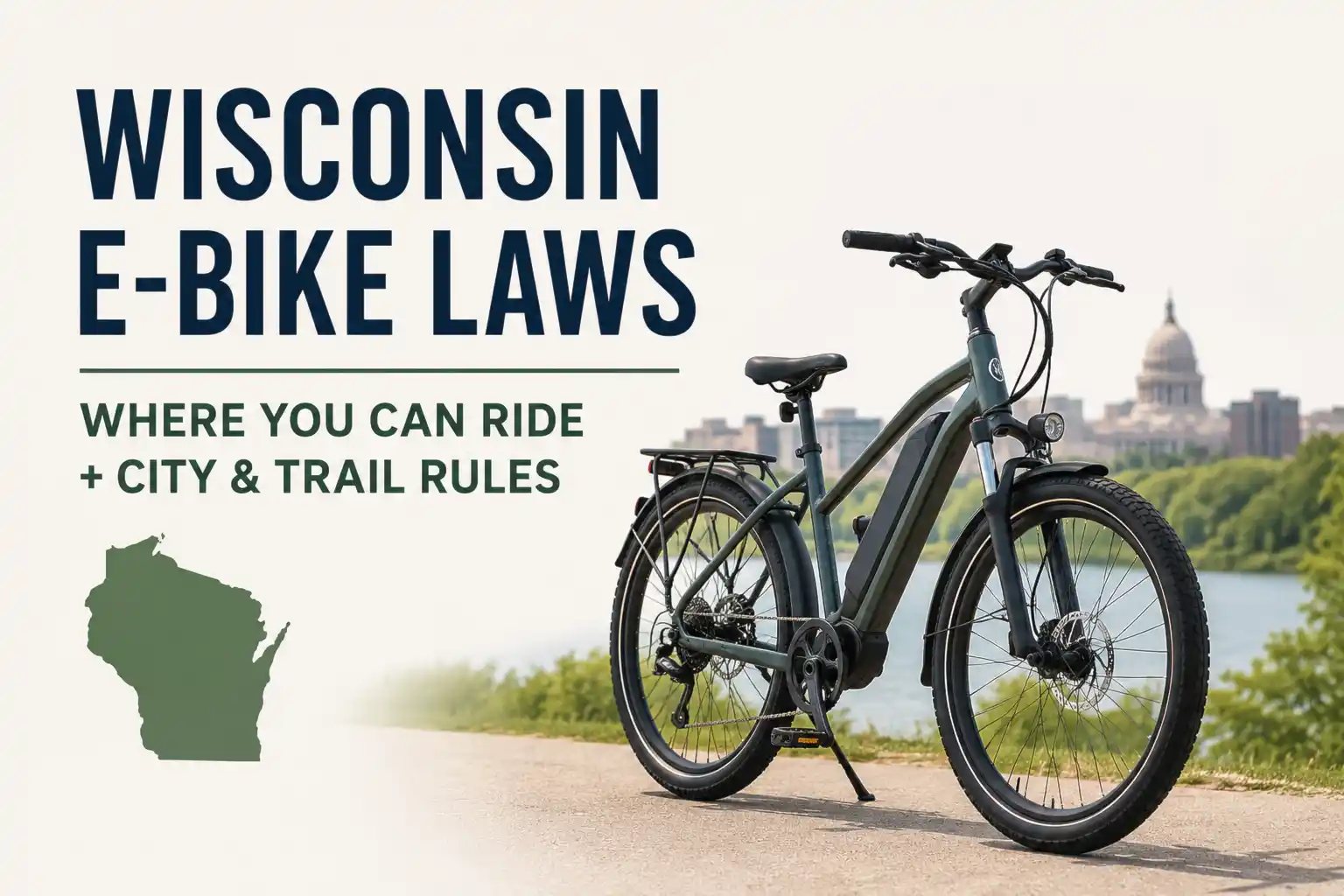
Wisconsin E-Bike Laws Explained (2026 Guide)
Last Updated on May 12, 2026 by Kristina
Electric bike laws in Wisconsin are relatively friendly, but where you can actually ride depends heavily on local rules, trails, and city enforcement.
Wisconsin follows the three-class e-bike system used across much of the U.S., but many riders get confused when rules change between:
- roads
- trails
- sidewalks
- downtown areas
- college campuses
I’ve found most confusion doesn’t come from state law – it comes from location-specific rules.
👉 New to e-bikes? Start with the E-Bike Buying Guide
👉 You may also want to read the full State-by-State E-Bike Laws Guide
Who This Wisconsin E-Bike Law Guide Is For
This guide is especially helpful for:
- Wisconsin commuters
- Trail and recreational riders
- Students riding to campus
- Parents buying e-bikes for teens
- Riders using state trails or city paths
- Anyone unsure where e-bikes are allowed
Are E-Bikes Legal in Wisconsin?
Yes. Wisconsin allows e-bikes on public roads and many bike facilities if they meet the legal definition.
Wisconsin uses the standard three-class system:
- Class 1: Pedal assist only, up to 20 mph
- Class 2: Throttle-assisted, up to 20 mph
- Class 3: Pedal assist up to 28 mph
E-bikes must have:
- Fully operable pedals
- Motor of 750W or less
- Proper class labeling
Where Can You Ride an E-Bike in Wisconsin?
E-bikes are generally allowed on:
- Roads and streets
- Bike lanes
- Areas where bicycles are permitted
However, cities, trails, and campuses can all override how and where you ride
Are E-Bikes Allowed on Sidewalks in Wisconsin?
There is no single statewide sidewalk rule for e-bikes in Wisconsin.
Sidewalk riding is controlled at the local city level, and rules vary significantly.
Some cities restrict sidewalk riding in downtown or business districts, while others allow it in limited situations.
Always check local ordinances before riding on sidewalks.
Wisconsin DNR E-Bike Trail Rules
Wisconsin DNR trails are one of the biggest areas of confusion.
- Class 1 and Class 3 e-bikes are often allowed
- A 15 mph speed limit is common
- Some trails restrict motor use unless specifically allowed
Key takeaway: Your e-bike may be legal on roads but not automatically allowed on every trail
Where Can You Ride in Wisconsin? (Trail Access Checker)
Instead of guessing whether your local trail allows e-bikes, you can quickly check common Wisconsin trail rules below.
What This Means
Trail rules vary based on:
- Trail surface
- Local vs state management
- Speed limits
- Pedestrian traffic
Always check posted signage.
Disclaimer: This tool is for general guidance only. Trail rules may change.
👉 Need more trails or checking another state? Use the full Trail Access Checker here →
Wisconsin City E-Bike Rules: What Riders Actually Need to Know
State law sets the foundation, but city rules determine real-world riding.
This is especially important for:
- sidewalks
- downtown districts
- waterfront paths
- parks
- campuses
Milwaukee E-Bike Rules (Most Restrictive)
Milwaukee has some of the clearest and strictest expectations.
- Sidewalk riding is generally restricted
- Riders are expected to use roads or bike lanes
- Park paths may restrict riding
Real-World Riding in Milwaukee
High enforcement and caution areas:
- Downtown Milwaukee
- Milwaukee Riverwalk
- Lakefront paths
- Festival areas
- Near Marquette University
These areas often include:
- heavy pedestrian traffic
- tourism congestion
- slower shared-use movement
Rider Tip
Milwaukee is one of the few cities where assuming sidewalk riding is allowed can actually lead to issues.
Madison E-Bike Rules (Most Bike-Friendly)
Madison is one of the easiest cities in Wisconsin to ride an e-bike.
E-bikes are allowed and treated like traditional bicycles.
Real-World Riding in Madison
Madison has:
- extensive bike paths
- strong cycling culture
- high commuter usage
Where Riders Need to Slow Down
- Shared-use paths
- State Street
- UW-Madison campus
- Lakeshore paths
These areas are heavily used by:
- pedestrians
- runners
- students
Rider Tip
Madison is very e-bike friendly, but speed and courtesy matter more than the law itself.
Green Bay E-Bike Rules (Event + Waterfront Focus)
Green Bay is less restrictive, but riding conditions vary.
Real-World Riding in Green Bay
Watch for changes during:
- Packers games
- downtown events
- waterfront activity
Key Riding Areas
- Fox River Trail
- downtown Green Bay
- parks and public spaces
Rider Tip
Green Bay relies more on practical enforcement—ride responsibly and follow posted rules.
Appleton E-Bike Rules (Pedestrian-Focused Areas)
Appleton feels relaxed, but local conditions matter.
Real-World Riding in Appleton
- Downtown areas can become pedestrian-heavy
- Trails connect frequently with city riding
- Park and sidewalk rules may vary
Watch These Areas
- College Avenue
- downtown sidewalks
- Fox River Trail
Rider Tip
Appleton is where riders often forget they’re sharing space with pedestrians.
Eau Claire E-Bike Rules (Trail + Campus Overlap)
Eau Claire combines:
- trails
- city riding
- campus rules
Real-World Riding in Eau Claire
- Riverfront trails are popular and busy
- Shared-use paths are common
- Campus areas have additional rules
Watch These Areas
- Phoenix Park
- riverfront paths
- UW-Eau Claire campus
- downtown
Rider Tip
This is one of the easiest cities to accidentally misunderstand rules due to overlapping systems.
Wisconsin City Comparison (Real-World Riding)
| City | Sidewalks | Trails | Enforcement | Key Risk |
|---|---|---|---|---|
| Milwaukee | Mostly restricted | Varies | Higher | Downtown & parks |
| Madison | Local rules | Extensive | Moderate | Shared path speed |
| Green Bay | Local rules | Varies | Moderate | Event congestion |
| Appleton | Local rules | Varies | Lower | Pedestrian areas |
| Eau Claire | Local + campus | Varies | Moderate | Trail overlap |
Wisconsin College Campus Rules
UW-Madison
- Bikes treated as vehicles
- Must follow traffic laws
- Parking restrictions enforced
UW-Milwaukee
- Scooter restrictions apply
- Riders should use streets
Marquette University
- Electric bikes restricted in many areas
Wisconsin E-Bike Law Gotchas
- Trail rules are often stricter than road rules
Even if your e-bike is fully legal on streets, some trails have lower speed limits, restrict motor use, or only allow certain classes of e-bikes. Always check trail-specific rules before riding. - Sidewalk laws vary by city
Wisconsin does not have a single statewide sidewalk rule. Some cities allow sidewalk riding in certain areas, while others restrict it—especially in downtown or pedestrian-heavy zones. - Campus rules can override city rules
College campuses often have their own policies for e-bikes, including where you can ride, park, or bring bikes indoors. These rules can be stricter than the surrounding city. - Class 3 bikes face more restrictions
Higher-speed Class 3 e-bikes are more likely to be restricted on trails and shared-use paths. They also require riders to be at least 16 years old and must include a speedometer. - Speed is the #1 enforcement trigger
Most issues don’t come from the bike itself—they come from how fast it’s being ridden. Riding too quickly near pedestrians or on busy paths is one of the most common reasons riders get stopped.
Before you ride, this quick reminder from the Wisconsin State Patrol highlights something many riders overlook — safety is a shared responsibility between riders and drivers.
🎥 Watch this short clip:
Quick Wisconsin Law Chart
| Topic | Rule |
|---|---|
| Legal | Yes |
| Classes | 3 |
| Max Speed | 28 mph |
| License | No |
| Registration | No |
| Trails | Varies |
| Sidewalks | Local |
How to Quickly Check Local Rules
- Search the city or trail name
- Check official sources
- Look for signage
- Assume stricter rules when unsure
Nearby State Law Guides
Traveling outside Wisconsin? Laws change quickly. Check other states:
Indiana e-bike laws
Pennsylvania e-bike laws
Ohio e-bike laws
Michigan e-bike laws
👉 Compare all states in the state-by-state e-bike law guide
FAQs
Yes. Wisconsin allows electric bicycles that meet the state’s legal definition, including the three-class system and a motor of 750 watts or less.
No. Wisconsin does not require a driver’s license for Class 1, Class 2, or Class 3 e-bikes that meet the legal definition.
However, if a bike is modified beyond legal limits, it may be reclassified as a moped or motor vehicle.
No. Wisconsin does not require registration or insurance for legal e-bikes.
A legal Class 3 e-bike can provide pedal-assist up to 28 mph.
Class 1 and Class 2 e-bikes are limited to 20 mph motor assistance.
Class 3 e-bikes in Wisconsin are pedal-assist only, must include a speedometer, and require the rider to be at least 16 years old.
Wisconsin limits e-bike motors to 750 watts or less.
Yes. Class 2 throttle-assisted e-bikes are legal if they stay within the 20 mph limit and meet Wisconsin’s e-bike definition.
It depends on local city ordinances.
Wisconsin does not have a single statewide sidewalk rule. Some cities allow sidewalk riding in limited situations, while others restrict it, especially in downtown or pedestrian-heavy areas.
Always check local rules before riding on sidewalks.
Some are, but not all.
Wisconsin DNR states that Class 1 and Class 3 e-bikes are allowed on many bicycle trails with a 15 mph speed limit. However, some trails restrict motorized use unless specifically authorized.
Local trail systems, counties, and parks may also have their own rules.
Yes, but with additional requirements.
Class 3 riders must:
Be at least 16 years old
Ride a pedal-assist only e-bike
Use a bike equipped with a speedometer
They may also face more restrictions on trails and shared-use paths.
Wisconsin requires riders to be at least 16 years old to operate a Class 3 e-bike.
There is no statewide minimum age for Class 1 or Class 2 e-bikes, but local rules or trail systems may impose additional restrictions.
Yes.
Police can stop e-bike riders for:
traffic violations
reckless riding
sidewalk violations
illegal modifications
unsafe speed in shared-use areas
E-bike riders must follow the same traffic laws as traditional bicycles.
Yes, but proper lighting and visibility equipment are required.
This generally includes:
a white front light
a rear reflector or red light
Wisconsin does not have a statewide helmet requirement for adult e-bike riders.
However, helmets are strongly recommended, especially for higher-speed riding and shared-use paths.
It depends on the campus.
Some universities allow e-bikes with restrictions, while others regulate where they can be ridden or parked. Campus-specific rules often apply to sidewalks, walkways, and building access.
You can modify an e-bike, but once it exceeds Wisconsin’s legal limits, it may no longer qualify as an electric bicycle.
This can lead to:
reclassification as a motor vehicle
legal and enforcement issues
liability risks in the event of an accident
Final Thoughts
Wisconsin is a great state for e-bike riding—but only if you understand where rules change.
Most issues happen when riders:
- assume all trails allow e-bikes
- ignore local restrictions
- ride too fast in shared areas
If you ride responsibly and stay aware of your surroundings, Wisconsin offers some of the best riding in the Midwest.
Helpful Gear for Riding
These items help you stay safe and follow the rules:
Not Sure Which E-Bike Is Right for You?
Use the Electric Bike Explorer interactive buying guide to narrow down your options based on how you ride, the features you need, your budget, and other important considerations.
External Sources
- Wisconsin DOT E-Bike Safety & Rules
- Wisconsin DMV Electric Bicycle Information
- Wisconsin Legislature E-Bike Definitions
- Wisconsin DNR Trail & Bicycle Information
- City of Madison Electric Bike Information
- Milwaukee Bicycle Ordinances

Kristina is not just an enthusiast but a true authority on electric bikes. Nestled in the coastal beauty of Virginia, Kristina has found the perfect backdrop for her passion for electric biking. As a dedicated wife and homeschooling mom, her life revolves around family, faith, and the thrill of adventure.
Originally hailing from Ohio, Kristina's journey with electric bikes began as a curiosity and quickly evolved into a deep expertise. Her blog is a testament to her love for electric biking, combining her fascination for eco-friendly transportation with her coastal lifestyle.
When she's not cruising the beach on her electric bike, you'll find Kristina indulging in her other loves: long walks along the shore, getting lost in a good book, and cherishing moments with her loved ones. With a heart as big as her love for animals, especially cats, Kristina brings a unique perspective to the electric bike world, grounded in her strong faith in God and her dedication to a sustainable lifestyle.
Through her blog, Kristina shares her extensive knowledge of electric bikes, offering valuable insights, tips, and recommendations to fellow enthusiasts. Whether you're a seasoned rider or a newcomer to the electric bike scene, Kristina's blog is your go-to source for all things electric biking, fueled by her passion, expertise, and the scenic beauty of coastal Virginia.




Up to date, thorough, and easy to read — a great job covering all of the caveats on where riding is allowed.
Thank you, I really appreciate that! I tried to make the guide useful not just for the statewide rules, but also for the smaller details and gray areas that can catch riders off guard. E-bike laws can get confusing once local trails, parks, and specific riding locations come into play, so I’m glad you found it helpful.
Who the **** cares when you let liberal idiots get away with murder the law that is niw your gonna tell me how fast I can ride a bike😂stop targeting abiding smart conservatives who don’t need your input
Editor’s note: Profanity removed. The commenter’s views have otherwise been left unchanged.
I understand that you may disagree with Wisconsin’s e-bike laws and speed restrictions. Electric Bike Explorer doesn’t make or enforce these laws – my goal with this guide is simply to explain the current rules so riders know what applies to them and can make their own informed decisions.
I’m happy to have different viewpoints in the comments, but I do ask that the discussion remain respectful and focused on e-bikes and the laws themselves.