How Much Does It Cost to Replace an E-Bike Battery?
Last Updated on June 12, 2026 by Kristina
One of the biggest long-term ownership costs with any electric bike is eventually replacing the battery.
And if you’ve recently searched replacement prices, you probably had the same reaction many riders do:
“Wait… the battery costs HOW much?”
The truth is that e-bike batteries are expensive – but there are good reasons for it.
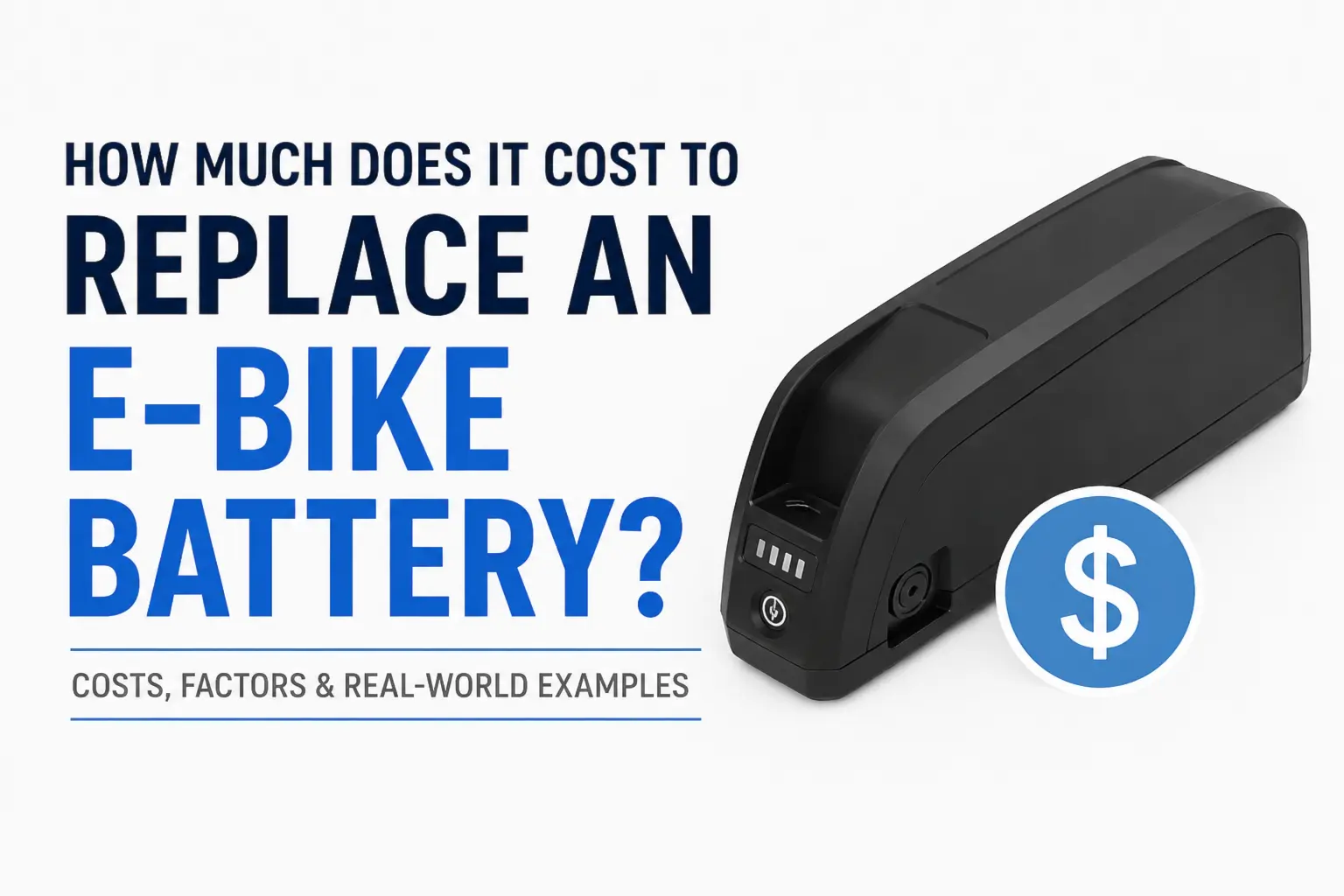
Most replacement e-bike batteries cost somewhere between $300 and $900+, depending on:
- Battery size
- Brand
- Battery quality
- UL certification
- Whether the battery is proprietary
- OEM vs aftermarket options
- Whether the battery is still easy to find
Related Content: New to e-bike batteries? Start with my complete E-Bike Battery Guide covering range, charging, lifespan, safety, and battery care.
In this guide, I’ll break down:
- Average e-bike battery replacement costs
- What affects battery pricing
- OEM vs aftermarket batteries
- Real-world brand examples
- Whether battery rebuilding is worth it
- How long e-bike batteries usually last
- Signs your battery may be failing
- Whether you should replace the battery or replace the entire bike
- Ways to make your e-bike battery last longer
If you’re newer to e-bikes, I’d also recommend reading:
👉 E-Bike Buying Guide
👉 Battery Capacity Explained
👉 E-Bike Range Explained
👉 E-Bike Battery Safety Guide
Who This Guide Is For
This guide is for riders who:
- Already own an e-bike and are pricing a replacement battery
- Are thinking about buying a used e-bike
- Want to understand long-term e-bike ownership costs
- Are comparing OEM vs aftermarket battery options
- Are wondering if replacing the battery is worth it
This guide is not meant to diagnose every electrical problem on an e-bike. If your bike cuts out, will not power on, or loses power under load, the issue could also involve the controller, display, charger, wiring, or battery management system.
👉 Related guide: E-Bike Cuts Out While Riding
How We Evaluate E-Bike Battery Replacement Costs
At Electric Bike Explorer, I look at battery replacement from a real-world ownership perspective, not just the cheapest price online.
For this guide, I consider:
- Typical replacement battery price ranges
- Battery size in watt-hours
- OEM vs aftermarket compatibility
- Safety certifications and charger compatibility
- Brand support and parts availability
- Whether replacing the battery makes sense compared with replacing the whole bike
Battery pricing changes often, so the ranges in this guide should be treated as estimates, not fixed prices.
Average E-Bike Battery Replacement Cost
Here’s the general price range most riders can expect:
| Battery Type | Typical Replacement Cost |
|---|---|
| Small commuter battery, 300–500Wh | $300–$500 |
| Mid-size battery, 500–700Wh | $450–$700 |
| Large high-capacity battery, 700Wh+ | $700–$1,200+ |
| Premium proprietary battery | $800–$1,500+ |
| Dual-battery cargo system | $1,000–$2,000+ |
From what I’ve seen, many mainstream commuter e-bike owners usually land somewhere around $500–$800 for an OEM replacement battery.
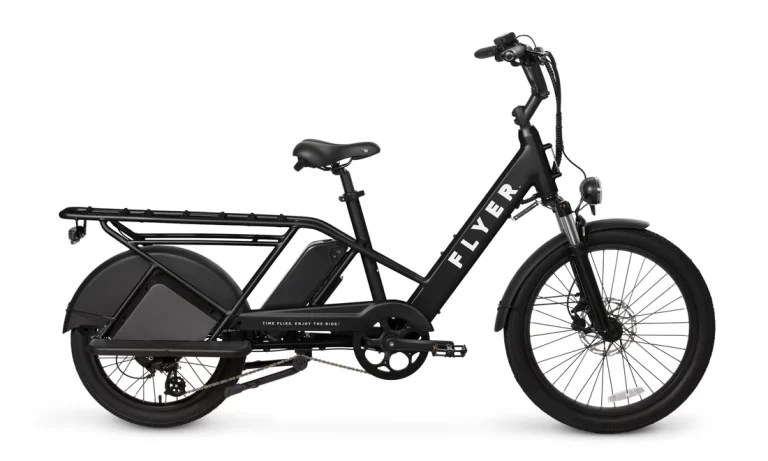
Premium mid-drive systems, integrated frame batteries, and cargo bike dual-battery setups can cost more.
E-Bike Battery Replacement Cost Calculator
Use this simple tool to estimate what a replacement e-bike battery might cost based on battery size, brand tier, battery type, bike age, and whether your bike uses one or two batteries.
This calculator is only an estimate. Always check your bike manufacturer’s official replacement battery pricing before buying.
E-Bike Battery Replacement Cost Calculator
Use this tool to estimate the cost of replacing an e-bike battery.
Disclaimer: This tool provides estimated battery replacement costs only. Actual pricing may vary by brand, battery size, availability, and compatibility.
Want a More Personalized Cost Estimate?
Battery replacement costs can vary significantly depending on battery size, brand, age, and whether you need an OEM or aftermarket replacement.
Before you start shopping, try my E-Bike Battery Replacement Cost Calculator to get a personalized estimate based on your specific setup.
👉 Use the E-Bike Battery Replacement Cost Calculator
Why E-Bike Batteries Are So Expensive
Many riders assume the motor is the most expensive part of an electric bike.
In reality, the battery is often one of the most expensive components.
A modern lithium-ion e-bike battery contains:
- Dozens of lithium-ion cells
- Battery management electronics
- Thermal protection systems
- Waterproofing
- Voltage regulation components
- Structural casing
- Communication systems with the controller or display
Higher-end batteries may also use premium cells from manufacturers such as Samsung, LG, or Panasonic.
Cheaper batteries often use lower-grade cells, weaker casing, less reliable battery management systems, or unclear safety testing.
That’s why battery quality matters for both performance and safety.
The U.S. Consumer Product Safety Commission recommends using only replacement batteries that have been tested, approved, and confirmed as suitable for the specific device. It also warns against modified, reworked, repurposed, or used battery cells when handled by unqualified personnel.
What Affects E-Bike Battery Replacement Cost?
Several major factors influence how much an electric bike battery costs.
Battery Capacity
Battery capacity is usually measured in watt-hours, or Wh.
In general:
- Higher watt-hours = more stored energy
- More stored energy = more lithium-ion cells
- More cells = higher replacement cost
| Battery Size | Typical Cost Level |
|---|---|
| 360Wh | Lower |
| 500Wh | Moderate |
| 720Wh | Higher |
| 960Wh+ | Very expensive |
If you’re unsure how battery capacity works, read:
👉 Related Guide: Battery Capacity Explained
Voltage and Amp-Hours
Some batteries list capacity as voltage and amp-hours instead of watt-hours.
The basic formula is:
Voltage × amp-hours = watt-hours
For example:
48V × 14Ah = 672Wh
That means a 48V 14Ah battery stores about 672 watt-hours of energy.
This matters because a 672Wh battery usually costs more than a 360Wh battery.
How to Find Your E-Bike Battery Specs
Before shopping for a replacement e-bike battery, find the exact battery specs for your bike.
Look for:
- Voltage, such as 36V, 48V, or 52V
- Amp-hours, such as 10Ah, 14Ah, or 20Ah
- Watt-hours, such as 500Wh, 672Wh, or 720Wh
- Connector type
- Mounting style
- Charger voltage
- Battery model number
You can usually find this information:
- On the battery label
- On the charger label
- In the owner’s manual
- On the manufacturer’s website
- On the original product page
- By contacting the bike brand directly
Do not guess on voltage or charger compatibility. Using the wrong battery or charger can damage the bike and create a safety risk.
Proprietary Battery Systems Usually Cost More
Some e-bike brands and drive systems use proprietary batteries.
These batteries are designed specifically for that bike, frame, controller, display, charger, or motor system.
Examples include:
- Bosch eBike systems
- Shimano STEPS systems
- Specialized e-bike systems
- Trek integrated systems
- Some Aventon, Velotric, Rad Power, and cargo-bike battery designs
These batteries usually cost more because they may include:
- Brand-specific mounting rails
- Smart battery communication
- Firmware compatibility
- Integrated frame design
- Specific charger requirements
- Diagnostic support
The upside is that proprietary systems often offer better fit, support, and safety integration.
The downside is that replacement batteries can become expensive or harder to find once a model is discontinued.
Bosch notes that battery service life depends heavily on the type and duration of use, and that proper use and treatment can significantly extend battery life.
UL Certification and Battery Safety Matter
UL-certified e-bike batteries typically cost more, but this is one area where the cheapest option is not always the best option.
UL certification helps verify that the electrical system has passed recognized safety testing.
This matters even more if you:
- Charge indoors
- Store your bike in a garage
- Live in an apartment
- Charge near anything flammable
- Leave the battery charging for long periods
NFPA warns that damaged lithium-ion batteries can overheat, catch fire, and in some cases lead to explosions. NFPA also recommends using only the charging equipment supplied with the device and stopping use if the battery shows signs of damage.
👉Related guide: UL-Certified E-Bikes Guide
Real-World E-Bike Battery Cost Examples
These are rough real-world price ranges riders commonly encounter.
| Brand or System | Typical Battery Cost |
|---|---|
| Lectric-style folding e-bikes | $300–$600 |
| Aventon-style commuter e-bikes | $500–$700 |
| Velotric-style commuter e-bikes | $500–$800 |
| Rad Power-style utility e-bikes | $500–$900 |
| Bosch-powered e-bikes | $700–$1,200+ |
| Premium cargo or dual-battery systems | $1,000–$2,000+ |
These are not guaranteed prices. Battery pricing can change based on:
- Availability
- Shipping
- Battery size
- Import costs
- Brand updates
- Warranty status
- Whether the battery is discontinued
Still, these ranges are useful for understanding why battery replacement should be part of long-term e-bike ownership planning.
OEM vs Aftermarket E-Bike Batteries
One of the biggest decisions riders face is whether to buy an OEM battery or an aftermarket replacement.
OEM E-Bike Batteries
OEM means Original Equipment Manufacturer.
These are replacement batteries sold directly by the bike brand or an approved dealer.
Pros
- Best compatibility
- Usually the safest option
- Better waterproofing
- Better charger integration
- Lower risk of electrical problems
- Better warranty support
Cons
- More expensive
- May be unavailable for older models
For most riders, an OEM battery is the safest first choice.
Aftermarket E-Bike Batteries
Aftermarket batteries are made by third-party companies.
Pros
- Lower upfront cost
- Easier to find for some older bikes
- Sometimes available in larger capacities
Cons
- Quality varies widely
- Compatibility can be confusing
- Charger mismatch risk
- Possible controller or display issues
- Higher safety concern with unknown brands
Aftermarket batteries can work, but I would be careful with unknown sellers, vague listings, or batteries that seem too cheap for the claimed capacity.
If a battery listing does not clearly show the voltage, amp-hours, connector type, charger compatibility, mounting style, and safety information, I would avoid it.
Are Used E-Bike Batteries Safe?
Used lithium-ion batteries can be risky because you often do not know their true condition.
A used battery may have:
- Hidden water damage
- Unknown charge cycles
- Internal cell degradation
- Previous overheating
- Cheap rebuilt internals
- Counterfeit labels
- Incorrect charger history
If you buy used, check:
- Battery age
- Manufacture date
- Physical damage
- Swelling
- Connector corrosion
- Charger compatibility
- Whether the seller can prove the battery model
A used battery may look fine from the outside and still have internal problems.
For safety, I would rather buy a known, compatible battery from a reputable source than take a chance on a suspiciously cheap used pack.
Can You Rebuild an E-Bike Battery?
Yes, some companies rebuild e-bike batteries by replacing the internal cells.
This can sometimes cost less than buying a new OEM battery.
Typical rebuild pricing:
| Battery Type | Approximate Rebuild Cost |
|---|---|
| Smaller battery packs | $250–$450 |
| Mid-size packs | $400–$700 |
| Larger premium packs | $500–$900+ |
Battery Rebuild Pros
- Can help with discontinued batteries
- Sometimes cheaper than OEM
- May restore lost range
- May allow a capacity upgrade
Battery Rebuild Cons
- Quality depends heavily on the rebuilder
- Warranty may be limited
- Not all packs are rebuildable
- Poor rebuilding can create safety issues
Battery rebuilding is not something I would trust to a random seller or general electronics hobbyist.
If you go this route, use a reputable specialist experienced with lithium-ion e-bike packs.
Signs Your E-Bike Battery May Need Replacement
A battery usually degrades gradually before fully failing.
Rapid Range Loss
One of the biggest warning signs is sudden range reduction.
Example:
A bike that once traveled 40 miles now only gets 15–20 miles under similar riding conditions.
That may mean the battery has lost a large amount of usable capacity.
Battery Percentage Drops Suddenly
The battery display may suddenly drop during:
- Hills
- Acceleration
- Heavy loads
- High assist settings
This is often called voltage sag.
Some voltage sag is normal under heavy load, but dramatic drops can point to an aging battery, weak cells, or a battery management system issue.
Charging Problems
Possible warning signs include:
- Battery will not fully charge
- Charger immediately turns green
- Charger flashes errors
- Charging stops randomly
- Battery gets unusually hot while charging
If the charger, outlet, or battery behaves strangely, stop charging until you can identify the problem.
Battery Cuts Out While Riding
If the bike suddenly powers off under load, the battery or battery management system may be failing.
However, this can also be caused by:
- Loose connectors
- Controller problems
- Display issues
- Brake sensor faults
- Wiring problems
👉 Related guide: E-Bike Cuts Out While Riding
Swelling, Heat, Smell, or Damage
Stop using the battery immediately if you notice:
- Swelling
- Cracks
- Burning smell
- Excessive heat
- Water intrusion
- Melted connectors
- Smoke
- Leaking
Damaged lithium-ion batteries can become dangerous. NFPA recommends stopping use if a battery shows signs of damage.
How Long Do E-Bike Batteries Usually Last?
Most quality e-bike batteries are commonly rated for roughly 500–1,000 full charge cycles before noticeable capacity degradation occurs.
That does not mean the battery instantly dies after 500 cycles.
It usually means the battery may hold less energy than it did when new.
A well-maintained battery may still work after that point, just with reduced range.
In real-world ownership, many e-bike batteries last around:
- 3–7 years
- 500–1,000+ charge cycles
- Thousands of miles of riding
Actual lifespan depends on:
- Heat exposure
- Charging habits
- Storage conditions
- Battery quality
- Riding conditions
- Charger quality
- How deeply the battery is discharged
Bosch notes that battery service life is mainly influenced by the type and duration of use, and with appropriate use, Bosch says one of its eBike batteries may cover up to 37,282 miles over its service life.
How to Make Your E-Bike Battery Last Longer
Battery replacement is expensive enough that prevention matters.
Avoid Extreme Heat
Heat is one of the biggest battery killers.
Avoid storing batteries in:
- Hot garages
- Cars during summer
- Direct sunlight
- Sheds with extreme temperature swings
If you ride in hot weather, give the battery time to cool before charging.
Don’t Store Fully Empty
Long-term storage at 0% can permanently damage lithium-ion cells.
If your battery is nearly empty, charge it before storing it.
Store Around 40–70% for Long-Term Storage
For longer storage, a partial charge is usually better than leaving the battery fully charged or fully empty for months.
A good storage range is often around 40–70%.
Use the Correct Charger
Always use:
- The manufacturer charger
- Or an approved replacement charger
Do not mix chargers just because the plug fits.
Voltage, amperage, connector polarity, and battery management compatibility all matter.
NFPA recommends using only the charging equipment supplied with the device.
Keep Battery Connections Dry
Water intrusion and corrosion can damage battery terminals and electronics.
After wet rides:
- Dry the bike
- Inspect battery contacts
- Avoid charging a wet battery
- Store the battery in a dry location
Winter Storage Tips for E-Bike Batteries
Seasonal riders can accidentally damage batteries during winter storage.
A safer approach is:
- Store the battery indoors if possible
- Avoid long-term freezing storage
- Leave the battery around 40–70%
- Check the charge every month or two
- Do not store the battery fully empty
- Let a cold battery warm up before charging
Cold weather usually affects temporary performance more than permanent battery health, but long-term freezing storage – especially while fully discharged – can still damage lithium-ion cells.
If you store your bike during colder months, read my full guide: E-Bike Battery Storage Tips for Winter: Keep Your Battery Safe and Ready for Spring
If your range drops in winter, that does not automatically mean the battery is ruined. Cold temperatures can temporarily reduce battery performance.
Should You Replace the Battery or Replace the Entire Bike?
This is one of the most important questions in this guide.
Replace the Battery If:
- The bike is still mechanically solid
- The motor and controller work properly
- The frame fits you well
- The brakes, tires, drivetrain, and display are still in good condition
- The replacement battery is easy to find
- The battery cost is reasonable compared with the bike’s value
Consider Replacing the Entire Bike If:
- The battery costs nearly as much as the bike
- Multiple electrical components are failing
- The battery is discontinued
- The brand is no longer supporting the model
- The bike was very low quality originally
- You already want better brakes, range, comfort, or safety features
Once battery replacement costs approach 60–80% of the bike’s value, it usually makes sense to compare newer e-bike options before spending the money.
That does not mean you should automatically replace the bike.
It just means the decision should be based on the whole bike, not only the battery.
Why Some E-Bike Batteries Suddenly Become Unavailable
Battery availability can disappear faster than riders expect.
This can happen because of:
- Brand shutdowns
- Discontinued models
- Frame redesigns
- Proprietary battery systems
- Import changes
- Supplier changes
- Safety recalls or warnings
This is one reason I prefer e-bikes from established brands with visible parts support.
A cheap e-bike can become expensive if the battery disappears after a few years.
My Take on Cheap E-Bike Batteries
I understand why riders look for cheaper replacement options.
Some OEM batteries are expensive.
But battery quality is one area where safety matters more than saving a few hundred dollars.
A good replacement battery should have:
- Correct voltage
- Correct connector
- Correct mounting system
- Compatible charger
- Proper battery management system
- Clear safety information
- Reputable seller support
A vague battery listing with a huge claimed capacity and very low price should raise red flags.
Especially if the battery will be charged inside a home, garage, or apartment.
Battery Replacement Cost Examples by Situation
Here are a few practical examples.
| Situation | Battery Replacement Decision |
|---|---|
| 2-year-old commuter e-bike, $600 OEM battery | Usually worth replacing |
| 5-year-old budget e-bike, $700 battery | Compare with replacing bike |
| Premium mid-drive e-bike, $1,000 battery | May be worth it if bike is in excellent condition |
| Cargo e-bike, dual batteries, $1,500+ total | Expensive, but often normal for cargo systems |
| Unknown used e-bike with no battery | Be very careful before buying |
This is why used e-bike buyers should always check battery replacement availability before purchasing.
A used e-bike with a weak or missing battery can turn into a much more expensive project than expected.
Final Thoughts
E-bike battery replacement is one of the biggest long-term ownership expenses riders eventually face.
Most riders should realistically expect somewhere around:
- $300–$900+ for many replacement batteries
- $700–$1,500+ for premium or proprietary systems
- $1,000–$2,000+ for some dual-battery cargo setups
The good news is that quality batteries can last for years with proper care.
The smartest long-term approach is usually:
- Buy from reputable brands
- Avoid suspiciously cheap batteries
- Prioritize safety certifications
- Use the correct charger
- Store and charge batteries properly
- Check battery replacement availability before buying used
If you’re researching battery ownership costs and long-term reliability, I’d also recommend reading:
👉 E-Bike Buying Guide
👉 Battery Capacity Explained
👉 E-Bike Range Explained
👉 E-Bike Battery Safety Guide
👉 E-Bike Charging Time Calculator
👉 E-Bike Tools Hub
👉 UL-Certified E-Bikes Guide
External Sources
- U.S. Consumer Product Safety Commission – Micromobility Information Center
- National Fire Protection Association – Lithium-Ion Battery Safety
- National Fire Protection Association – Safety with E-Bikes and E-Scooters
- Bosch eBike Systems – Battery Care and Maintenance

Kristina is not just an enthusiast but a true authority on electric bikes. Nestled in the coastal beauty of Virginia, Kristina has found the perfect backdrop for her passion for electric biking. As a dedicated wife and homeschooling mom, her life revolves around family, faith, and the thrill of adventure.
Originally hailing from Ohio, Kristina's journey with electric bikes began as a curiosity and quickly evolved into a deep expertise. Her blog is a testament to her love for electric biking, combining her fascination for eco-friendly transportation with her coastal lifestyle.
When she's not cruising the beach on her electric bike, you'll find Kristina indulging in her other loves: long walks along the shore, getting lost in a good book, and cherishing moments with her loved ones. With a heart as big as her love for animals, especially cats, Kristina brings a unique perspective to the electric bike world, grounded in her strong faith in God and her dedication to a sustainable lifestyle.
Through her blog, Kristina shares her extensive knowledge of electric bikes, offering valuable insights, tips, and recommendations to fellow enthusiasts. Whether you're a seasoned rider or a newcomer to the electric bike scene, Kristina's blog is your go-to source for all things electric biking, fueled by her passion, expertise, and the scenic beauty of coastal Virginia.