True Cost of E-Bike Ownership Calculator
Last Updated on July 25, 2026 by Kristina
An electric bike can cost much less to operate than a car, but the purchase price is only part of the expense.
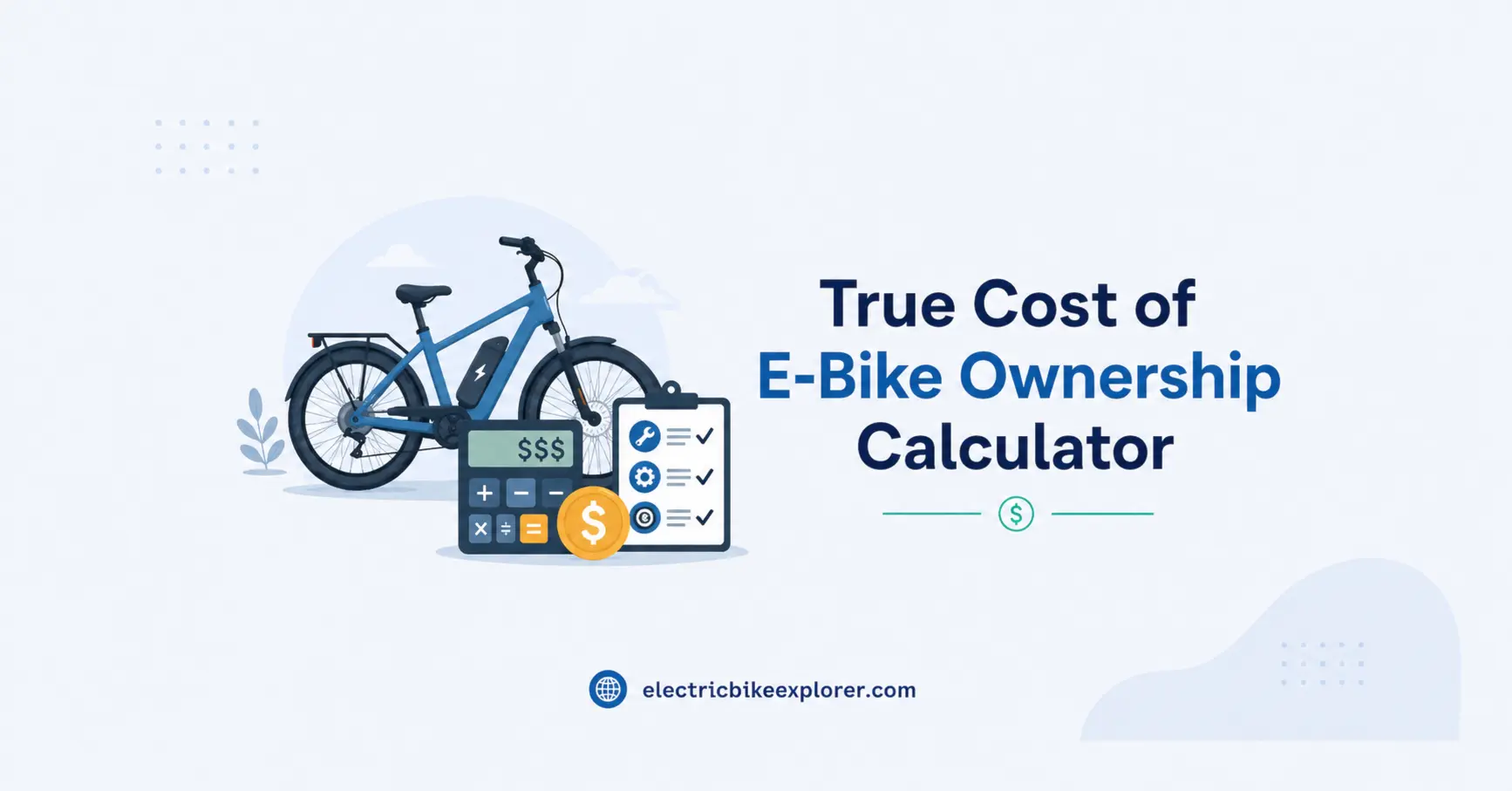
The True Cost of E-Bike Ownership Calculator helps you estimate how much an electric bike may realistically cost over several years. It includes expenses that are sometimes overlooked, such as replacement batteries, tires, brake service, accessories, charging, insurance, and other repairs.
Enter information about the e-bike you own or are considering, choose how long you expect to keep it, and the calculator will estimate your total ownership cost, average monthly cost, annual cost, and cost per mile.
Trying to decide which type of electric bike is right for you? Start with my electric bike buying guide before comparing specific models.
Calculate the True Cost of Owning an E-Bike
Use the calculator below to estimate the total amount you may spend during your ownership period.
For the most useful estimate, replace the default numbers with costs that match the e-bike you own or are considering.
True Cost of E-Bike Ownership Calculator
What will your e-bike really cost over time?
Estimate the total cost of buying and owning an electric bike, including the bike, accessories, battery replacement, maintenance, charging, insurance, and estimated resale value.
1. Ownership and riding
About 38 miles per week.
2. Purchase and accessories
Helmet, lock, rack, bags, mirrors, lights, or phone mount.
3. Battery and charging
The calculator adds a replacement when this interval is reached.
4. Maintenance and other yearly costs
Tire replacement estimate
Tire cost is spread across the estimated mileage instead of charged all at once.
5. Value at the end
Use $0 if you plan to keep the bike indefinitely or do not expect any resale value.
This calculator provides an estimate only. Actual battery life, repair costs, tire wear, electricity use, and resale value vary by bike, terrain, weather, rider weight, storage, and maintenance. Financing interest and the value of your time are not included.
Estimated ownership cost
Cost breakdown
Cumulative ownership cost
Battery replacement is added in the estimated replacement year. Resale value is deducted at the end.
| Year | Operating | Battery | Cumulative |
|---|
What the Calculator Includes
The calculator combines the upfront cost of buying an electric bike with the expenses that may occur throughout ownership.
E-Bike Purchase Price
Enter the regular price of the electric bike before any rebates or discounts.
You can also include:
- Sales tax
- Shipping
- Professional assembly
- Dealer setup charges
- Rebates
- Promotional discounts
The calculator subtracts the rebate or discount from the bike’s purchase and setup costs.
Accessories and Upgrades
Many new riders spend additional money on accessories shortly after buying an e-bike.
These may include:
- A properly fitted helmet
- A high-quality e-bike lock
- A rear rack
- Panniers or cargo bags
- Mirrors
- Additional lights
- A phone mount
- A suspension seat post
- A replacement saddle
- A GPS tracker or alarm
The calculator lets you enter both upfront accessory costs and additional accessories purchased during later years.
Battery Replacement
An e-bike battery is one of the most expensive components that may eventually need to be replaced.
Battery life varies considerably depending on:
- Battery quality
- Charging habits
- Storage temperature
- Number of charging cycles
- Rider weight
- Terrain
- How frequently the bike is used
- Whether the battery is stored fully charged or completely empty
Enter the estimated replacement cost and how many years you expect the battery to last. The calculator will add a replacement battery whenever that interval is reached during your selected ownership period.
For example, if you plan to keep the bike for five years and estimate a four-year battery life, the calculator will include one replacement battery.
How Charging Costs Are Estimated
Electric bikes are generally inexpensive to charge, but the exact cost depends on the battery size, electricity rate, and how far you travel on each charge.
The calculator uses:
- Battery capacity in watt-hours
- Real-world miles per charge
- Miles ridden per year
- Local electricity rate
- Estimated charging loss
Charging loss accounts for some of the electricity used by the charger that does not ultimately remain stored in the battery.
Advertised range figures are not always the same as the range riders experience in everyday use. Hills, wind, tire pressure, temperature, assistance level, and rider weight can all affect battery range.
Read my guide to real-world e-bike range for help choosing a realistic miles-per-charge estimate.
E-Bike Maintenance Costs to Consider
Electric bikes require many of the same wear-related repairs as traditional bicycles. Their additional weight, speed, and motor assistance can sometimes cause certain parts to wear more quickly.
Tune-Ups and Routine Service
Routine service may include:
- Brake adjustments
- Derailleur adjustments
- Wheel inspections
- Bolt tightening
- Chain lubrication
- Tire inspections
- Electrical connection inspections
- Firmware updates on supported models
Riders who perform their own maintenance may spend less than riders who rely on a bike shop for every service.
Brakes
E-bikes are heavier and often travel faster than regular bicycles, placing additional demand on the braking system.
Possible brake expenses include:
- Replacement brake pads
- Brake rotor replacement
- Hydraulic brake bleeding
- Cable replacement
- Brake adjustment labor
How often brake parts need replacement depends heavily on terrain, total bike weight, riding speed, and braking habits.
Chain, Belt, and Drivetrain
Hub-drive e-bikes generally place less motor force through the chain than mid-drive models. Mid-drive motors can cause chains, cassettes, and other drivetrain parts to wear more quickly, especially when shifting under heavy motor power.
Possible drivetrain expenses include:
- Chains
- Cassettes
- Chainrings
- Derailleur components
- Belt replacement
- Internal gear hub service
Tires and Tubes
E-bike tire costs vary considerably by wheel size and tire style.
Standard commuter tires may cost less to replace than:
- Fat tires
- Moped-style tires
- Premium puncture-resistant tires
- Specialized cargo-bike tires
The calculator estimates tire and tube costs based on how many miles you expect a set to last.
Insurance, Security, and Storage
E-bike insurance is optional for many riders, although requirements may vary depending on where you live and how your electric bike is classified.
Insurance may provide coverage for:
- Theft
- Accidental damage
- Liability
- Medical payments
- Roadside assistance
You can also use this section for recurring security expenses, such as a GPS tracking subscription.
Riders who live in apartments, college housing, or crowded cities may also pay for secure indoor storage, a bike locker, or designated parking.
What Does Cost Per Mile Mean?
Cost per mile is calculated by dividing your estimated total ownership cost by the number of miles you expect to ride during the selected period.
This figure includes the cost of buying the bike, not just electricity and maintenance.
A rider who uses an e-bike frequently will often have a lower cost per mile than someone who buys the same bike but rides only occasionally.
For example, a $2,000 e-bike ridden 5,000 miles spreads its purchase cost across many more miles than the same bike ridden only 500 miles.
How to Make the Estimate More Accurate
The calculator begins with general example figures. These defaults are not intended to represent every rider or electric bike.
For a more realistic result:
- Use the actual purchase price of the e-bike.
- Check the manufacturer’s price for a replacement battery.
- Use a realistic range rather than the highest advertised range.
- Estimate how many miles you will truly ride each week.
- Ask a local bike shop about typical service costs.
- Include the accessories you will need immediately.
- Use a conservative resale value.
- Add insurance, storage, or security subscriptions when applicable.
It is usually better to slightly overestimate future maintenance expenses than to assume the bike will never need repairs.
Costs the Calculator Does Not Include
The calculator provides a practical estimate, but it cannot predict every possible expense.
It does not automatically include:
- Financing interest
- Credit card interest
- Major accident damage
- Motor replacement
- Controller replacement
- Display replacement
- Theft losses not covered by insurance
- Transportation to a repair shop
- The value of your time
- Changes in electricity prices
- Inflation
- Car-related savings
For car replacement savings and estimated break-even time, use the separate E-Bike ROI Calculator. The ROI tool is designed to compare e-bike expenses with gas, car maintenance, depreciation, parking, tolls, and other driving costs.
Is an E-Bike Expensive to Maintain?
Many electric bikes are reasonably affordable to maintain when they use common bicycle components and replacement parts are readily available.
Maintenance may become more expensive when a bike has:
- Proprietary electronics
- Hard-to-find replacement parts
- Unusual wheel or tire sizes
- Integrated batteries
- Complicated full-suspension systems
- High-powered mid-drive motors
- Limited dealer support
- Heavy moped-style construction
Before buying an e-bike, check whether the manufacturer sells replacement batteries, displays, controllers, chargers, and other important parts.
You can also visit my e-bike troubleshooting and maintenance guide for help understanding common repair and maintenance issues.
FAQs
The cost of charging an electric bike is usually small compared with the purchase price, maintenance, accessories, and battery replacement. The exact amount depends on the battery’s watt-hour capacity, local electricity rates, charging efficiency, and how often the battery is charged.
There is no single replacement schedule for every battery. Some batteries may need replacement after several years of frequent use, while carefully maintained batteries used less often may last longer. Battery quality, charging cycles, heat exposure, storage, and riding conditions all affect battery life.
Replacement battery prices vary by brand, capacity, battery chemistry, and mounting system. Before purchasing an e-bike, check the manufacturer’s current replacement battery price and verify that replacement batteries are available.
Maintenance costs depend on annual mileage, bike style, terrain, component quality, and whether you perform basic repairs yourself. Riders who use an e-bike daily should generally budget more for tires, brakes, drivetrain parts, and tune-ups than occasional recreational riders.
They can. Electric bikes are generally heavier, travel at higher average speeds, and include electrical components that traditional bicycles do not have. However, many routine repairs involve the same parts found on regular bicycles, including tires, tubes, chains, brakes, and gears.
No. This calculator focuses on the cost of owning the electric bike itself. Use the E-Bike ROI Calculator when you want to compare e-bike costs with avoided gasoline, parking, tolls, car maintenance, and depreciation.
Include resale value only when you realistically expect to sell or trade in the bike at the end of the selected period. Use a conservative estimate because resale prices depend on the bike’s age, condition, battery health, brand reputation, and availability of replacement parts.
My Take
The sticker price does not always reveal whether an e-bike will be affordable over the long term.
A lower-priced bike may eventually cost more if batteries and replacement parts are difficult to find. A more expensive bike with strong dealer support, available components, and a dependable warranty may provide better long-term value.
Before buying, I recommend checking the replacement battery price, warranty terms, local repair options, and availability of important electrical parts. Those details can matter just as much as the bike’s motor size, range, or advertised top speed.
Important Disclaimer
This calculator provides a general estimate for educational purposes. It is not a guarantee of actual ownership costs or financial savings.
Maintenance needs, electricity rates, battery life, tire wear, insurance costs, resale value, and repair expenses vary by rider and electric bike. Always verify current prices with the manufacturer, retailer, insurance provider, utility company, or local repair shop.

Kristina is not just an enthusiast but a true authority on electric bikes. Nestled in the coastal beauty of Virginia, Kristina has found the perfect backdrop for her passion for electric biking. As a dedicated wife and homeschooling mom, her life revolves around family, faith, and the thrill of adventure.
Originally hailing from Ohio, Kristina's journey with electric bikes began as a curiosity and quickly evolved into a deep expertise. Her blog is a testament to her love for electric biking, combining her fascination for eco-friendly transportation with her coastal lifestyle.
When she's not cruising the beach on her electric bike, you'll find Kristina indulging in her other loves: long walks along the shore, getting lost in a good book, and cherishing moments with her loved ones. With a heart as big as her love for animals, especially cats, Kristina brings a unique perspective to the electric bike world, grounded in her strong faith in God and her dedication to a sustainable lifestyle.
Through her blog, Kristina shares her extensive knowledge of electric bikes, offering valuable insights, tips, and recommendations to fellow enthusiasts. Whether you're a seasoned rider or a newcomer to the electric bike scene, Kristina's blog is your go-to source for all things electric biking, fueled by her passion, expertise, and the scenic beauty of coastal Virginia.