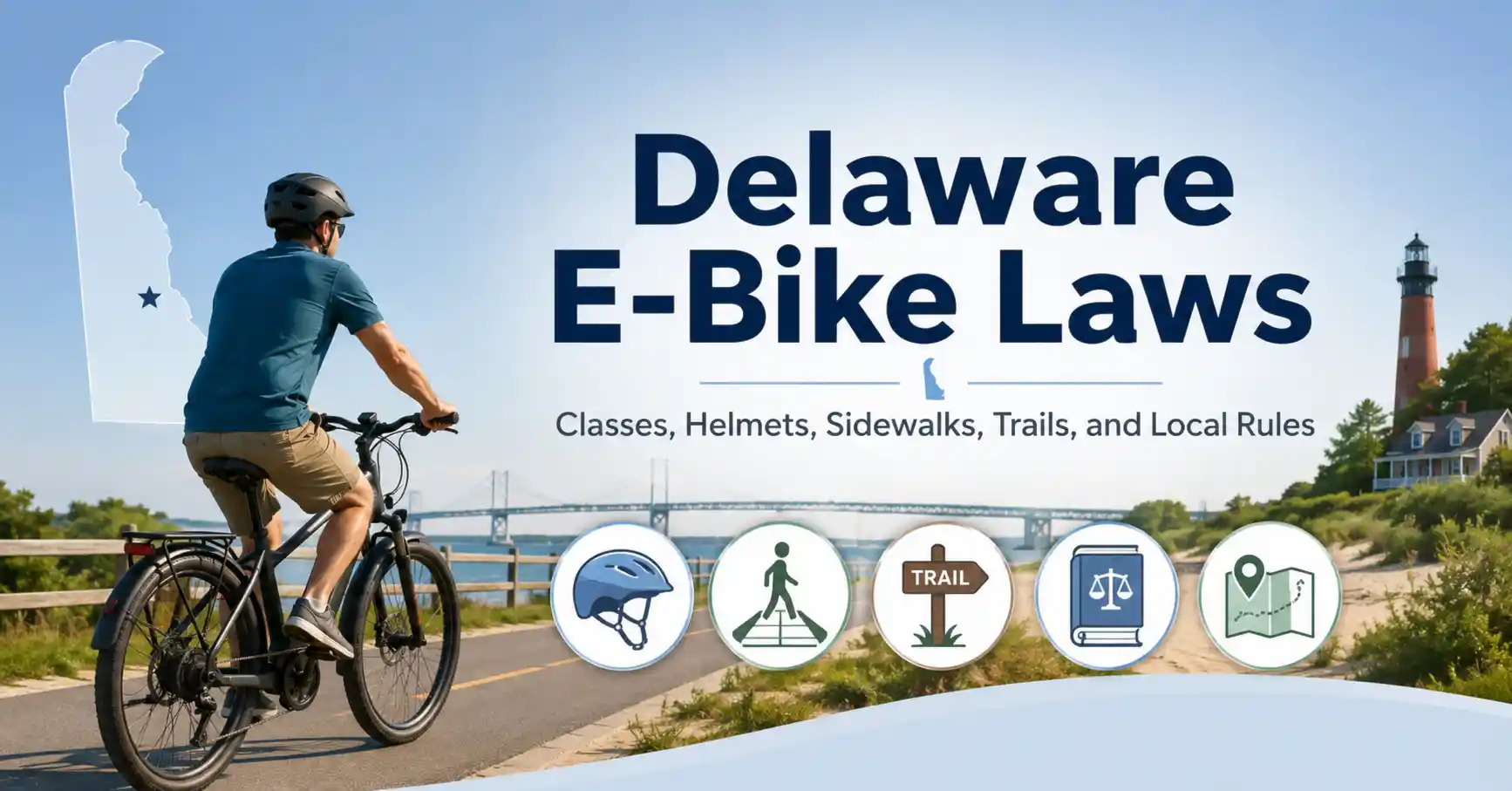
Delaware E-Bike Laws: Classes, Helmets, Sidewalks, Trails, and Local Rules
Last Updated on August 6, 2026 by Kristina
Last researched and verified: August 2026
Introduction
Delaware recognizes Class 1, Class 2, and Class 3 electric bicycles. A legal e-bike generally has 2 or 3 wheels, fully operable pedals, a seat, and an electric motor rated at 750W or less. Delaware usually gives these e-bikes the same road rights and duties as conventional bicycles, but important exceptions apply to sidewalks, Class 3 riders, local ordinances, parks, trails, campuses, and transit.
This guide explains the statewide rules and the local details most likely to affect a real ride. For a broader comparison, see the State-by-State E-Bike Law Guide. Riders who are unsure which category their bike fits can also review my guide to Class 1, Class 2, and Class 3 e-bikes.
🔎 Why You Can Trust Electric Bike Explorer
I reviewed current state statutes, transportation agency guidance, and available local rules when this guide was updated. When relevant, I also check city ordinances, park and trail policies, school or campus rules, and other official government sources.
E-bike laws can change, and local governments, parks, trails, and campuses may impose additional restrictions. Always confirm the latest requirements with the appropriate agency before riding.
Learn more about how Electric Bike Explorer researches law guides, buying guides, troubleshooting information, and e-bike recommendations.
Want to See More Electric Bike Explorer in Google Search?
Add Electric Bike Explorer as a preferred source to see more of our e-bike law guides, safety updates, reviews, buying guides, and troubleshooting posts when they are relevant to your searches.
Delaware E-Bike Laws at a Glance
- Three-class system: Delaware recognizes Class 1, Class 2, and Class 3 e-bikes.
- Motor limit: The statewide definition allows a motor rated at 750W or less.
- Pedals: A legal e-bike must have fully operable pedals.
- License and registration: Delaware does not require an e-bike operator’s license, registration, title, license plate, or mandatory motor-vehicle insurance for a legal e-bike.
- Class 3 age: A rider must be at least 16 to operate a Class 3 e-bike.
- Helmets: Everyone operating or riding as a passenger on a Class 3 e-bike must wear an approved helmet. Riders and passengers under 18 must wear a helmet on other bicycles and e-bikes.
- Sidewalks: State law does not allow the electric motor to be used on a sidewalk, even where ordinary bicycles may be ridden. Local rules can be stricter.
- Road and path access: E-bikes generally may use places open to bicycles, including roads, shoulders, bike lanes, bikeways, and bicycle or multi-use paths, subject to local or land-manager restrictions.
- Trails: Access differs among State Parks, State Forests, wildlife areas, federal lands, and individual trail systems.
What This Delaware Law Guide Covers
This guide covers vehicles that meet Delaware’s legal definition of an electric bicycle. It does not automatically apply to an e-moto, electric motorcycle, moped, triped, motorized scooter, or a modified bike that operates outside the e-bike limits.
The label on the frame is helpful, but the way the vehicle is actually equipped and operates matters. A product advertised as an “e-bike” may fall into another legal category if it lacks operable pedals, uses too much motor power, or continues providing assistance above Delaware’s class limits.
Delaware’s Legal E-Bike Definition and Classes
The Delaware Code definition of an electric bicycle requires 2 or 3 wheels, fully operable pedals, a saddle or seat, and an electric motor of 750W or less. The bike must meet one of the following class definitions.
| Class | How the motor works | Assisted-speed limit | Important Delaware rule |
|---|---|---|---|
| Class 1 | Assistance only while the rider is pedaling | Motor assistance stops at 20 mph or less | No statewide minimum operating age stated in the e-bike section, although local rules may add one |
| Class 2 | The motor may propel the bike without pedaling, normally through a throttle | Motor assistance stops at 20 mph or less | Throttle operation is legal within the class limit, but motor use is not allowed on sidewalks |
| Class 3 | Assistance only while the rider is pedaling | Assistance stops between 20 and 28 mph, with no assistance above 28 mph | Operator must be at least 16; every operator and passenger must wear a helmet; bike must have a speedometer |
Manufacturers and distributors have been required since January 1, 2023 to place a permanent label on new e-bikes showing the class number, top assisted speed, and motor wattage. Delaware also says a person who changes the motor-powered speed capability or engagement must replace the class label after the modification.
The 750W wording difference in Wilmington
State law uses “less than or equal to 750 watts.” Wilmington’s local ordinance instead defines an electric bicycle as having a motor of “less than 750 watts.” That is a real wording difference. A rider using a motor labeled exactly 750W should not assume the state and city definitions are interchangeable and may want clarification from the city before riding in Wilmington.
License, Registration, Title, Plate, and Insurance
Under Delaware’s electric-bicycle operating law, a legal e-bike and its operator are not subject to the motor-vehicle provisions covering:
- Financial responsibility or mandatory motor-vehicle insurance
- Driver’s licenses
- Registration
- Certificates of title
- License plates
- Off-highway vehicle rules
This does not mean insurance is never useful. A homeowners, renters, or specialty bicycle policy may help with theft, damage, or liability, but that is an ownership decision rather than a Delaware e-bike registration requirement.
Delaware Helmet and Age Rules
Class 1 and Class 2
Delaware’s general bicycle helmet law requires an approved, properly fitted, and fastened helmet for an operator or passenger under 18. The statewide e-bike section does not state a general minimum age for operating Class 1 or Class 2, but a city, campus, trail manager, or private property owner can impose a stricter rule.
Class 3
No person under 16 may operate a Class 3 e-bike. A person under 16 may ride as a passenger only if the Class 3 bike is designed to carry passengers. Every Class 3 operator and passenger, regardless of age, must wear an approved helmet. The e-bike must also have a speedometer that displays speed in mph.
Even where a helmet is not mandated for an adult on a Class 1 or Class 2 bike, I recommend wearing one. My guide to helmets for e-bike riders explains fit and useful safety features.
Roads, Shoulders, Bike Lanes, Sidewalks, and Paths
Roads, shoulders, and bike lanes
Delaware generally allows legal e-bikes anywhere conventional bicycles are allowed, including streets, highways, roadways, shoulders, bicycle lanes, and bikeways. E-bike riders receive bicycle rights but also inherit bicycle duties, including obeying traffic controls, riding prudently, signaling turns when required, yielding where required, and using required nighttime equipment.
Sidewalks
The statewide rule is easy to miss: an e-bike may not use its electric motor on a sidewalk, including a sidewalk where bicycles are otherwise permitted. A rider may be able to pedal the bike entirely by human power where local bicycle rules allow, or dismount and walk it. Cities can prohibit bicycle and e-bike riding on sidewalks altogether.
The distinction matters for Class 2 riders. A throttle is legal on an appropriate road or permitted path, but not for powered sidewalk travel. My separate guide to e-bike sidewalk laws explains why local signs and ordinances must also be checked.
Bicycle and multi-use paths
State law generally permits e-bikes on bicycle and multi-use paths. A state agency or local authority may restrict bicycles on a path after the required public process for safety or other legal reasons. A manager may also prohibit e-bikes on a natural-surface trail specifically designated as nonmotorized.
Posted signs, trail maps, temporary closures, and property rules therefore control at the individual location. Statewide bicycle access is the starting point, not a guarantee of access to every trail.
Delaware’s stop-sign rule for bicyclists
Delaware allows a bicyclist, including an e-bike rider receiving bicycle rights, to treat some stop signs as yield signs. At a stop sign where the crossing roadway has 2 or fewer moving lanes, the rider may slow to a reasonable speed, yield to immediate hazards, and proceed cautiously if safe.
A complete stop is still required when the crossing roadway has 3 or more moving lanes or when a vehicle is stopped at the same stop sign. This rule does not turn a red traffic light into a yield sign. Riders must obey traffic signals and always yield to traffic already in the intersection.
Required equipment and riding behavior
- A white front light visible from at least 500 feet is required at night.
- A red rear reflector visible from 600 feet under the statutory test is required.
- Side reflectivity visible from 600 feet, or side lights visible from at least 500 feet, is required at night.
- Brakes must stop the bike within 25 feet from 10 mph on dry, level, clean pavement.
- A rider may not use earplugs in both ears or a headset covering both ears.
- The rider must keep at least one hand on the handlebars.
Helpful Legal and Safety Accessories for E-Bike Riders
E-bike equipment requirements vary by state and city, but a few basic accessories can help you ride more safely, remain visible, and comply with local laws.
- Helmet – Protect your head with a properly fitted, CPSC-certified bicycle helmet, even if you’re not legally required to wear one.
- Front & Rear Bike Lights – Improve your visibility during early morning rides, evening commutes, and low-light conditions.
- Phone Mount – A sturdy handlebar phone mount can make it easier to follow maps, check your route, or use trail apps without having to stop and dig through a bag.
- Rear View Mirror – A handlebar or helmet-mounted mirror can help you keep an eye on traffic behind you, which is especially helpful when riding on roads, bike lanes, or narrow shoulders.
- Panniers or Rear Rack Bags – Panniers and bike bags are useful for carrying groceries, work items, jackets, tools, chargers, or extra layers without wearing a heavy backpack.
- Small Handlebar or Frame Bag – A compact bag gives you quick access to smaller items like keys, wallet, snacks, sunglasses, tire levers, or a portable charger.
- Heavy-Duty Bike Lock – Help protect your investment when stopping at stores, trailheads, or other public places.
- Mini Tire Pump & Flat Repair Kit – Be prepared for unexpected flats, especially if you’re riding longer distances.
- Compact Multi-Tool – Quickly tighten loose bolts or make minor adjustments while you’re away from home.
- High-Visibility Reflective Gear – Reflective vests, ankle bands, or jackets can help drivers see you sooner, especially at dawn, dusk, or in poor weather.
Trails, State Parks, State Forests, Wildlife Areas, and Federal Land
Delaware’s public-land rules differ by managing agency. Check the current map and trailhead signs rather than assuming one statewide trail policy applies everywhere.
Check E-Bike Access Before You Ride
Trail rules can change depending on the e-bike class, surface type, and agency managing the property. Use my E-Bike Trail Access Checker to research a specific trail or riding area, then confirm the current rules with posted signs or the responsible land manager before your trip.
| Land or trail manager | Current practical rule |
|---|---|
| Delaware State Parks | State Parks guidance says e-bikes may be used on park trails that allow bicycles. Individual trail closures, hunting-area routes, and posted restrictions still apply. |
| Delaware State Forests | Blackbird, Redden, and Taber State Forests prohibit off-road vehicles, including what the agency calls electronic bicycles. |
| State Wildlife Areas | Bicycles, including e-bikes, may be ridden only on roads or trails designated on the current area maps. |
| First State National Historical Park | The 2026 Superintendent’s Compendium allows e-bikes on trails, roads, and parking areas within the park. Riders must use designated routes and follow park yielding and safety rules. |
Delaware State Parks
Current Delaware State Parks guidance says e-bikes may be used on park trails that allow bicycles. That does not authorize riding from a trail onto every side path or restricted hunting area. Maps, closures, and signs for the specific park remain important.
Delaware State Forests
The Delaware Department of Agriculture states that off-road vehicles, including electronic bicycles, are prohibited in all State Forests. That applies to Blackbird, Redden, and Taber State Forests. Do not assume the more permissive State Parks policy carries over to forest property.
State Wildlife Areas
DNREC’s wildlife-area regulations allow bicycles, including e-bikes, only on roads or trails designated on current area maps. Seasonal closures, hunting activity, habitat protections, and area-specific maps may further affect a route.
First State National Historical Park
The current First State National Historical Park Superintendent’s Compendium, last updated May 30, 2026, says e-bikes are allowed on trails, roads, and parking areas within the park. It does not impose the previously reported blanket Class 2 trail ban.
Riders should stay on designated routes, obey closures, and yield as required. The compendium says bicycles and e-bikes must yield to equestrians and pedestrians, and downhill traffic must yield to uphill traffic. Federal regulations and posted instructions may also limit how motor power is used in a particular place, so check the current compendium and trail signs before riding.
Delaware City E-Bike Rules and Local Differences
| City | What e-bike riders should know |
|---|---|
| Wilmington | No bicycle or e-bike riding on sidewalks at any time. Minimum age 7 for Class 1 or Class 2 and 16 for Class 3. Additional helmet, lighting, brake, bell, path-use, passenger, and parking rules apply. |
| Rehoboth Beach | Electric bikes and other motorized vehicles are prohibited on the Boardwalk and beach. Adults may not bicycle on sidewalks, and wheeled riding is prohibited in the pedestrian-congested downtown area. |
| Lewes | Walk bikes on downtown sidewalks unless the rider is 12 or younger. At the Savannah Road canal bridge, riders may use the road or walk on the sidewalk. |
| Newark | I did not confirm a separate current citywide e-bike ordinance that adds a clear class rule beyond state law in the official materials reviewed. Posted city restrictions and University of Delaware policies still apply. |
| Middletown | A July 2026 town notice directed riders to Delaware’s statewide e-bike and e-scooter laws. The notice did not announce a separate additional town e-bike restriction. |
Wilmington
Wilmington Ordinance 25-065 creates a more detailed local framework. No person may ride or propel a bicycle, e-bike, or low-speed motorized scooter on any sidewalk at any time.
A rider must be at least 7 to operate a Class 1 or Class 2 e-bike and at least 16 to operate a Class 3. Every Class 3 operator or passenger must wear a helmet, and anyone under 18 must wear a helmet while operating or riding as a passenger on a bicycle, e-bike, or low-speed motorized scooter.
Wilmington also requires an audible bell or similar device that can be heard from at least 100 feet, while prohibiting sirens and whistles. The ordinance requires nighttime front lighting, a rear reflector, and brakes. It also says riders must use an adjacent usable bicycle path when one is provided and limits passengers to the capacity for which the bike was designed.
Rehoboth Beach
The city’s official Beach and Boardwalk rules prohibit motorized vehicles on the Boardwalk and beach, specifically including electric bikes and motorized scooters. The exception is for qualifying personal mobility devices used by people with disabilities.
Ordinary bicycles may use the Boardwalk from 5 a.m. to 10 a.m. between May 15 and September 15, with no stated time restriction during the rest of the year. That seasonal bicycle schedule does not override the separate prohibition on electric bikes. Adults may not bicycle on sidewalks, and no one may ride a bike or other wheeled vehicle on sidewalks in the defined pedestrian-congested downtown area.
Lewes
The City of Lewes tells riders to walk bicycles on downtown sidewalks unless the rider is under 12. At the Savannah Road canal bridge, cyclists can ride in the road with traffic or walk on the sidewalk. Only cyclists under 12 may ride on that sidewalk.
For an e-bike, Delaware’s statewide motor-off sidewalk rule still applies. Even a child who may legally ride a conventional bicycle on a sidewalk should not use the e-bike motor there.
Newark
I did not find a current official Newark rule that clearly creates a separate citywide e-bike class, age, or helmet framework beyond Delaware law. That does not mean every sidewalk, trail, park, event area, or private property is open. Riders should obey posted city restrictions and the University of Delaware rules discussed below.
Middletown
In a July 13, 2026 public notice, Middletown directed residents to statewide information about e-bike and e-scooter laws. I did not find an added townwide e-bike restriction in that notice. Riders should still follow signs, property rules, and any later ordinance.
University and School E-Bike Rules
University of Delaware
The University of Delaware’s e-mobility policy prohibits the use, storage, and charging of e-mobility devices inside campus buildings. This is especially important for students who planned to keep an e-bike or battery in a residence hall, classroom building, office, or other indoor campus space.
Students and employees should review current Parking Services rules for registration, approved parking locations, rack use, and Walk Your Wheels areas before bringing an e-bike to campus. A legal ride on a public street does not create a right to store or charge the bike inside a university building.
Delaware State University
Delaware State University’s residential policies say bicycles may not be operated in residence halls and may not be stored in student rooms or public areas of the halls. The published section is written as a bicycle rule and does not clearly explain how every e-bike or removable battery is treated.
Students should obtain a current answer from Housing or Police Services before arriving with an e-bike. Ask specifically about outdoor parking, battery removal, charging, residence-hall storage, and any fire-safety restrictions.
Can You Take an E-Bike on a DART Bus?
Do not assume an e-bike can ride on a DART bus rack. DART’s current bike-rack loading instructions say that bicycles with gas or electric motors are not allowed on the racks.
This can change trip planning for commuters and visitors. Before combining an e-bike ride with transit, check the current rack rules and consider secure parking, a conventional bicycle, or another approved transportation option.
Real-World Delaware E-Bike Scenarios
An adult wants to ride on a Wilmington sidewalk
Do not ride there. Wilmington prohibits riding or propelling bicycles and e-bikes on sidewalks at any time. Dismount and walk the bike, then resume riding where it is legal and safe.
A 15-year-old wants to operate a Class 3 e-bike
That is not allowed under statewide law. The minimum operating age for Class 3 is 16. A person under 16 may be a passenger only on a Class 3 e-bike designed to carry passengers, and the passenger must wear a helmet.
A visitor wants to use an e-bike on the Rehoboth Boardwalk at 7 a.m. in July
The morning schedule allows ordinary bicycles during those seasonal hours, but Rehoboth separately prohibits electric bikes and other motorized vehicles on the Boardwalk. The visitor should not treat the bicycle hours as permission to ride an e-bike there.
A rider reaches a sidewalk where bicycles are allowed
The e-bike motor still may not be used on the sidewalk under statewide law. Depending on local rules, the rider may pedal entirely without motor assistance or walk the bike. Where local law prohibits bicycle riding, walking is the safer legal choice.
A student wants to charge an e-bike battery in a University of Delaware building
The university’s e-mobility policy prohibits charging e-mobility devices inside campus buildings. The student should arrange approved outdoor parking and charging before bringing the bike to campus.
A rider wants to explore a natural-surface trail
Identify the land manager first. A State Park trail open to bicycles may allow e-bikes, a State Forest prohibits them off-road, a wildlife area limits them to mapped designated routes, and federal land follows its own compendium and posted rules.
A commuter wants to put an e-bike on a DART rack
DART’s published loading instructions exclude bikes with electric motors. The rider should not rely only on the bike’s weight or tire size.
Modified E-Bikes, E-Motos, Mopeds, and Other Vehicles
Delaware’s e-bike privileges apply only while the vehicle stays within the legal definition. A bike with a motor over 750W, no fully operable pedals, throttle propulsion above 20 mph, or pedal assistance above 28 mph may fall outside the e-bike category.
Delaware’s moped definition includes an electric motor that can propel the cycle without pedaling above 20 mph, or that continues assisting while the rider pedals above 28 mph. A 3-wheel cycle with an electric motor rated from 751W through 2,000W may fit Delaware’s separate “triped” definition. Those classifications can involve different equipment, licensing, access, and enforcement rules.
Changing a controller setting, removing a speed limiter, installing a higher-powered motor, or relabeling a vehicle does not guarantee it remains a legal e-bike. Check the actual power, motor behavior, assisted speed, pedals, and current vehicle category before riding on public roads or bicycle facilities.
Pending Delaware E-Bike Legislation
House Substitute 1 for House Bill 439, described as the Truth in E-Bike Marketing Act, passed the Delaware General Assembly on June 30, 2026. As of August 5, 2026, the official bill-status page listed it as ready for gubernatorial action.
It is not presented here as current law. The final outcome, signature status, effective date, and any amendments should be rechecked before relying on it.
Nearby State Law Guides
Traveling outside Delaware? Laws change quickly.Check other states:
New Jersey e-bike laws
Pennsylvania e-bike laws
New York e-bike laws
Massachusetts e-bike laws
👉 Compare all states in the state-by-state e-bike law guide
Delaware E-Bike Law FAQs
Do I need a driver’s license to ride an e-bike in Delaware?
No. A legal e-bike and its operator are exempt from Delaware’s driver’s-license provisions.
Does an e-bike need registration, a title, or a license plate?
No. Delaware does not require registration, a certificate of title, or a license plate for a legal e-bike.
Is e-bike insurance required in Delaware?
No mandatory motor-vehicle insurance or proof of financial responsibility is required for a legal e-bike. Optional bicycle or property insurance may still be useful.
Are throttles legal?
Yes, on a Class 2 e-bike that stays within Delaware’s definition and stops providing motor assistance at 20 mph or less. The motor may not be used on a sidewalk.
Can a Class 3 e-bike have a throttle?
Delaware defines Class 3 as pedal-assist. A vehicle that uses motor-only propulsion may instead fit Class 2 if it stops assisting at 20 mph or another vehicle category if it exceeds that limit.
Can children ride e-bikes?
State law prohibits anyone under 16 from operating Class 3. Riders and passengers under 18 must wear helmets. Wilmington separately requires a minimum age of 7 for Class 1 and Class 2. Other properties may add rules.
Can I ride an e-bike on a Delaware sidewalk with the motor turned off?
State law’s e-bike-specific prohibition applies while using the motor. Human-powered sidewalk riding may be possible where ordinary bicycles are allowed, but local rules can prohibit all bicycle riding. Wilmington prohibits sidewalk riding entirely, and Rehoboth and Lewes have their own restrictions.
Are e-bikes allowed in Delaware State Parks?
State Parks guidance says e-bikes may use park trails that allow bicycles. Individual trail signs, closures, maps, and restricted side paths still control.
Are e-bikes allowed in Delaware State Forests?
The Department of Agriculture says off-road vehicles, including electronic bicycles, are prohibited in all Delaware State Forests.
Can I ride an e-bike on the Rehoboth Beach Boardwalk?
No. The city’s rules prohibit motorized vehicles on the Boardwalk and beach, specifically including electric bikes.
Can I carry an e-bike on a DART bus rack?
DART’s published rack instructions say bicycles with electric motors are not allowed.
My Take
Delaware’s statewide e-bike framework is fairly easy to understand once you know the 3 classes: legal e-bikes receive bicycle access, Class 3 has stronger age and helmet rules, and powered sidewalk riding is off-limits. The confusing part begins when a route crosses different jurisdictions.
A ride can move from a state road to a city sidewalk, a university campus, a State Park trail, a wildlife area, or federal property in a few miles. Each manager may apply a different rule. I would check the bike’s class label, plan the route by land manager, carry a helmet, and read signs at every trailhead or destination rather than assuming one statewide answer covers the entire trip.
Legal Disclaimer
This guide is for general informational purposes and is not legal advice. State, city, campus, park, trail, transit, and private-property rules can change or differ. Confirm current requirements with the agency or authority responsible for the place where you plan to ride.
External Sources
- Delaware Code, Title 21, Section 101 – electric-bicycle and related vehicle definitions
- Delaware Code, Title 21, bicycle and electric-bicycle operating provisions
- Wilmington Ordinance 25-065
- City of Rehoboth Beach Boardwalk and sidewalk rules
- City of Lewes bicycle guidance
- Town of Middletown e-bike and e-scooter law notice
- Delaware State Parks guidance
- Delaware State Forest rules
- DNREC Wildlife Area regulations
- First State National Historical Park Superintendent’s Compendium
- University of Delaware e-mobility policy
- Delaware State University residential policies
- DART First State bike-rack instructions
- Delaware General Assembly bill-status page for HS 1 for HB 439

Kristina is not just an enthusiast but a true authority on electric bikes. Nestled in the coastal beauty of Virginia, Kristina has found the perfect backdrop for her passion for electric biking. As a dedicated wife and homeschooling mom, her life revolves around family, faith, and the thrill of adventure.
Originally hailing from Ohio, Kristina's journey with electric bikes began as a curiosity and quickly evolved into a deep expertise. Her blog is a testament to her love for electric biking, combining her fascination for eco-friendly transportation with her coastal lifestyle.
When she's not cruising the beach on her electric bike, you'll find Kristina indulging in her other loves: long walks along the shore, getting lost in a good book, and cherishing moments with her loved ones. With a heart as big as her love for animals, especially cats, Kristina brings a unique perspective to the electric bike world, grounded in her strong faith in God and her dedication to a sustainable lifestyle.
Through her blog, Kristina shares her extensive knowledge of electric bikes, offering valuable insights, tips, and recommendations to fellow enthusiasts. Whether you're a seasoned rider or a newcomer to the electric bike scene, Kristina's blog is your go-to source for all things electric biking, fueled by her passion, expertise, and the scenic beauty of coastal Virginia.