E-Bike Motor Keeps Running After You Stop Pedaling? Causes, Fixes, and When to Stop Riding
Last Updated on October 10, 2026 by Kristina
If your e-bike motor keeps running after you stop pedaling, do not assume the motor itself is bad. A very brief, predictable continuation of assist can be normal on some systems, but sustained power, unexpected acceleration, or assist that continues unpredictably can point to a throttle, sensor, wiring, controller, software, or settings problem.
The safest approach is to separate normal system behavior from a true fault before replacing parts. Start with the low-risk checks below, and use the E-Bike Troubleshooting & Maintenance Guide if you need a broader diagnostic path. If the problem appears related to pedal assist, also see my pedal assist troubleshooting guide.
If you want a better understanding of how hub motors, mid-drive motors, torque, sensors, and motor assistance work, see my E-Bike Motor Guide.
Is It Normal for the Motor to Keep Running After You Stop Pedaling?
A small amount of assist after you stop pedaling can be intentional on some e-bikes. Manufacturers do not all use the same shutoff timing. Rad Power Bikes, for example, has documented a 1-2 second pedal-assist shutoff delay on some cadence-sensor systems, while Shimano supports an adjustable “assist carry over” setting on certain drive units.
What is not something to ignore is a bike that keeps pulling for an unexpectedly long time, accelerates without a clear rider command, behaves differently from its normal pattern, or requires you to brake against motor power. In that situation, stop riding until the cause is identified.
Safety First
If the bike begins driving unexpectedly, focus on control rather than diagnosis. Stop pedaling, release the throttle if your bike has one, use the brakes to make a controlled stop, move out of traffic, and power the bike off after you have stopped.
Do not repeatedly ride the bike to recreate the problem at road speed. If you notice damaged wiring, sparks, smoke, unusual heat, swelling, leaking, or a strong chemical odor, stop using and charging the bike. Follow the manufacturer’s safety guidance and contact a qualified e-bike technician, the manufacturer, or emergency services when appropriate.
Unexpected acceleration is a real safety issue. The U.S. Consumer Product Safety Commission has documented e-bike recalls involving unexpected acceleration caused by controller software and electrical-cable faults. That does not mean your bike has the same defect, but it is a good reason to take sustained or uncommanded motor power seriously.
Symptoms and What They May Point To
| What you notice | What it may suggest | First safe check |
|---|---|---|
| Motor runs briefly and predictably after pedaling stops | Normal assist carry-over or programmed PAS delay | Check the owner’s manual, app, or drive-system settings |
| Motor keeps pulling for several seconds or longer than usual | Sensor input, throttle signal, wiring, controller, or software issue | Stop riding and inspect only low-risk external items |
| Bike accelerates without pedaling | Throttle input, cruise-control feature, wiring fault, or controller/software problem | Stop riding immediately and power the bike off after stopping |
| Motor stops when a brake lever is squeezed | A brake motor-cutoff may be interrupting power | Record this detail, but do not treat it as proof the underlying problem is fixed |
| Problem started after rain or washing | Moisture in a connector, control, or other electrical component | Power off and inspect for visible moisture or damage according to the manual |
| Problem started after crank or pedal work | PAS sensor, magnet ring, wiring, or connector may have been disturbed | Inspect the visible sensor area and connectors without opening sealed electronics |
| Problem happens only in one assist mode | Mode-specific setting, software behavior, or controller programming | Review the display/app settings and owner’s manual |
How Long Is Too Long After You Stop Pedaling?
There is no single shutoff time that is correct for every e-bike. The drive system, sensor type, controller programming, assist mode, and manufacturer settings all matter.
Rad Power Bikes has described a 1-2 second delay before pedal assist shuts off on some cadence-based systems. Shimano’s E-TUBE documentation shows that certain drive units can have an adjustable assist-carry-over setting. Those examples show why a brief delay should be compared with the expected behavior of your exact bike instead of judged by a universal number.
I would be more concerned when the motor continues longer than your bike normally does, the duration changes from ride to ride, the bike surges harder instead of smoothly tapering off, the motor activates without pedaling or throttle input, or you feel that you have to brake against the motor.
Could a Normal Feature Be Causing It?
Before assuming something has failed, check whether your bike has a feature designed to maintain assistance after normal pedaling input changes.
Assist carry-over
Some drive systems intentionally continue assistance briefly after pedal input stops. On certain Shimano drive units, assist carry-over can be adjusted through compatible settings. A brief and consistent continuation that matches the manual may therefore be normal.
Cruise control
Some current e-bikes include cruise-control functions that can maintain motor output without pedaling. Aventon, for example, documents cruise control on certain models that holds the selected speed until a cancellation condition is met. Check your display for a cruise indicator and review the manual for the exact cancellation steps.
If the bike has cruise control and you did not intentionally activate it, do not keep testing the feature while riding in traffic. Stop safely and review the controls before riding again.
Does Pulling the Brake Lever Stop the Motor?
This can be a useful clue, but only on bikes equipped with motor-cutoff brake sensors. These sensors are not universal, so check your manual before assuming your brake levers should interrupt motor power.
If your bike has brake cutoffs and the motor stopped when you squeezed a brake lever during the original incident, record that detail for troubleshooting. It may show that the cutoff circuit is still able to interrupt motor power. It does not prove that the throttle, PAS system, wiring, controller, or software is working correctly.
If a bike that is supposed to have functioning brake cutoffs continues driving while the brake lever is applied, stop riding and contact the manufacturer or a qualified shop. Do not bypass or disconnect a safety cutoff as a troubleshooting shortcut.
What Happened Right Before the Problem Started?
The timing of the first incident can narrow the diagnosis faster than replacing parts. Think about whether the problem began after any of these events:
- Rain, washing, deep puddles, or water exposure
- A crash, tip-over, or handlebar impact
- Throttle replacement or handlebar work
- Crank, chainring, bottom-bracket, or pedal work
- Battery removal or installation
- Controller, display, or wiring service
- A firmware or app update
- A display-setting change
- Transport on a vehicle rack or in a tightly packed cargo area
- A connector being unplugged and reconnected
If the symptom appeared immediately after service or a specific change, tell the shop or manufacturer exactly what was done. That history may be more useful than guessing which electrical component failed.
5-Minute Safe Check Before You Replace Anything
- Stop riding and power the bike off. Do not perform these checks while the motor is actively driving the wheel.
- Check the throttle physically. If your bike has a throttle, make sure the lever or twist grip moves freely and returns fully without sticking against a grip, accessory, damaged housing, or debris. If it feels sticky or damaged, do not ride until it is corrected.
- Look at the display. Check for an error code, cruise-control icon, unusual assist mode, walk mode, or other indicator you do not normally see. Use the E-Bike Error Code Finder if your display is showing a code.
- Inspect visible wiring. Look for a connector that is partly separated, pinched wiring near the handlebars or frame, abrasion, crushed insulation, or a cable pulled tight after a crash or repair. Do not open sealed connectors or probe live wires unless the manufacturer specifically instructs you to do so.
- Inspect the visible pedal-sensor area. If your bike uses an external cadence sensor or magnet ring, look for obvious looseness, damage, or a part that was disturbed during recent crank work. Do not guess at sensor spacing if the manual gives a specific setup procedure.
- Review the owner’s manual or app settings. Look specifically for pedal-assist delay, assist carry-over, cruise control, sensor mode, ride tuning, and firmware updates.
- Power-cycle only if the manufacturer recommends it. A single normal restart may clear a temporary software state on some systems, but repeated resets can hide an intermittent fault or erase useful diagnostic information.
If the bike still provides unexpected power after these checks, stop there. The next step is usually model-specific diagnosis by the manufacturer or a qualified e-bike technician.
🧰 Helpful Tools for Safe Checks
You do not need to open the battery or controller to perform the first troubleshooting steps in this guide. A few basic tools can help you safely inspect accessible components.
Metric hex key set – Useful for checking accessible throttle, display, sensor, brake-lever, and cable-mount hardware.
Bike torque wrench – If you loosen and reinstall a component, use the torque specification listed by your e-bike or component manufacturer rather than guessing how tight it should be.
Digital multimeter – Helpful for more advanced electrical checks only when your manufacturer provides a specific testing procedure and identifies the correct test points. Do not randomly probe battery, controller, or live wiring connections.
Before using any tool: Check your owner’s manual for the correct fastener sizes, torque specifications, electrical procedures, and any warnings specific to your bike.
Likely Causes in Practical Order
1. Normal programmed assist carry-over
If the motor continues only briefly, does it the same way every time, and the manual describes that behavior, there may be nothing wrong. Compare the current behavior with how the bike behaved when it was working normally.
2. Cruise control or another special operating mode
A special mode can make the bike feel as though the motor is ignoring your pedaling. Check the display and manual before replacing hardware. This is especially important on newer smart e-bikes where firmware updates can add or change ride features.
3. A sticking or faulty throttle input
A throttle that does not return freely can create an obvious mechanical problem. An electrical throttle fault can be less obvious. If your throttle feels damaged, behaves inconsistently, or the bike accelerates without pedaling, stop riding. My e-bike throttle troubleshooting guide covers the low-risk checks in more detail.
4. Pedal-assist or torque-sensor input problem
The controller relies on sensor information to decide when and how much to assist. If the sensor, magnet ring, connector, wiring, or related component is damaged or disturbed, the controller may receive incorrect information.
This is especially worth investigating if the problem started after crank or bottom-bracket work. Do not automatically replace the sensor, though. Model-specific alignment and calibration procedures vary.
5. Damaged, pinched, or wet wiring
Wiring deserves attention because unexpected acceleration has been tied to electrical-cable faults in real CPSC recalls. The 2020 Pedego recall involved an improperly manufactured electrical cable that could cause unexpected acceleration.
That does not mean every frayed wire will cause the motor to run on. It does mean visible wiring damage, water intrusion, or a problem that began immediately after cable movement should not be dismissed.
6. Controller or firmware fault
The controller interprets throttle, sensor, brake, and display inputs and commands the motor. A fault in that system can create unusual assist behavior. In a 2024 CPSC recall, certain Aventon Sinch.2 e-bikes could accelerate unexpectedly, and the repair included a software update to the controller.
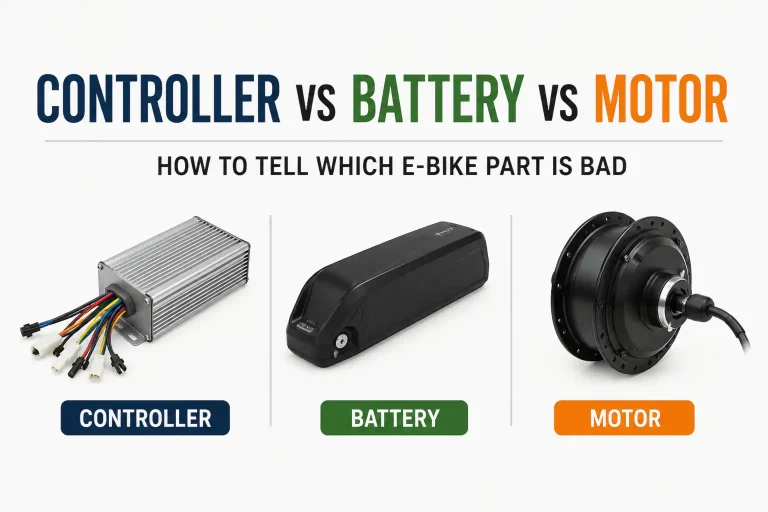
Because controller diagnosis can overlap with battery and motor symptoms, use the Controller vs Battery vs Motor diagnostic guide before buying an expensive replacement part.
7. Brake cutoff is not interrupting power
Again, this is usually a failed safety layer rather than the original reason the motor continued after pedaling. If your bike is designed with brake motor cutoffs, they should be checked according to the manufacturer’s procedure when unexpected motor power is reported.
Cadence Sensor vs Torque Sensor: Why It Matters
A cadence sensor detects pedal rotation. A torque sensor measures how much force the rider applies through the pedals. Those two systems can feel very different, but sensor type by itself does not tell you exactly how long the motor should continue assisting after you stop pedaling.
Controller programming, ride mode, firmware, and manufacturer tuning can change the response. That is why I would not diagnose a bike as faulty simply because it has a short delay, and I would not excuse a long or unpredictable delay simply because it uses a cadence sensor.
🎬 Watch: How to Troubleshoot a Cadence-Style Pedal Assist Sensor
This video shows how a cadence PAS sensor and magnet ring work and how to check for common problems. Sensor setups vary, so follow your e-bike manufacturer’s instructions before removing or adjusting parts.
What Not to Do
- Do not repeatedly recreate unexpected acceleration on a road, trail, driveway, or around people.
- Do not bypass brake motor cutoffs or other safety interlocks.
- Do not open the lithium-ion battery pack.
- Do not probe live throttle or controller wires unless the manufacturer provides a procedure and you have the appropriate electrical skills.
- Do not splice wires based only on wire color. Wiring standards vary between manufacturers.
- Do not install an incompatible controller or throttle just to see whether the symptom changes.
- Do not change hidden speed, current, or controller parameters as a troubleshooting shortcut.
- Do not assume a reset permanently fixed an intermittent unexpected-power problem.
When to Call the Manufacturer or an E-Bike Shop
Stop owner-level troubleshooting and contact the manufacturer or a qualified e-bike technician if:
- The bike accelerates without pedaling or throttle input.
- The motor continues strongly enough that you must brake against it.
- The problem is intermittent and unpredictable.
- The symptom began after a crash, water intrusion, or damaged wiring.
- A brake cutoff that should interrupt motor power does not appear to work.
- The display shows a recurring controller, throttle, sensor, or communication error.
- Visible wiring is damaged, crushed, melted, or discolored.
- The motor powers on again immediately after a normal restart.
- The manufacturer has issued a recall, service bulletin, or firmware update that may apply to your model.
What to Tell Support Before You Call
Good diagnostic information can save a lot of back-and-forth. Write down:
- Bike brand, model, model year, and serial number
- Motor and drive-system model if known
- Whether the bike uses cadence or torque sensing
- Whether it has a throttle
- Whether it has brake motor cutoffs
- How long the motor keeps running after you stop pedaling
- Whether the behavior happens in every assist level
- Whether the bike accelerates from a stop without input
- Any error code or warning shown on the display
- Whether squeezing a brake lever stopped the motor during the original incident
- What changed immediately before the first incident
- Whether the bike was recently exposed to rain, washing, a crash, service, or a firmware update
A short video can also help a manufacturer or shop if the symptom can be demonstrated without riding the bike or creating a dangerous situation. Do not put yourself at risk just to record the fault.
How to Reduce the Chance of Repeat Problems
- Follow the manufacturer’s washing and water-exposure guidance.
- Inspect handlebar and frame wiring after a crash, transport, or accessory installation.
- Keep throttle controls clear of grips, mirrors, phone mounts, and other accessories that could interfere with movement.
- After crank or bottom-bracket service, confirm that PAS or torque-sensor components were reassembled according to the manufacturer’s procedure.
- Install firmware updates only through the manufacturer’s approved method.
- After a major service, test basic controls in a controlled area at low speed before returning to normal riding.
Frequently Asked Questions
Is it normal for an e-bike motor to keep running after I stop pedaling?
Sometimes, briefly. Some systems intentionally use a short assist delay or configurable carry-over. What matters is whether the behavior matches the manual and the bike’s normal pattern. Sustained, unpredictable, or uncommanded power is different and should be investigated.
Why does my motor stop only when I squeeze the brake?
If your bike has motor-cutoff brake sensors, the brake may be interrupting power even though another input is still requesting assist. That is useful diagnostic information, but it does not identify the root cause by itself.
Can a throttle cause the motor to keep running?
Yes. A physically sticking throttle or an electrical throttle-input problem can contribute to continued or unexpected motor power. If the bike accelerates without pedaling, stop riding until the throttle and control system are checked.
Can rain or washing cause this problem?
Moisture can affect electrical connectors and controls on some bikes, particularly if water enters a damaged or poorly sealed connection. If the problem began after water exposure, power the bike off and follow the manufacturer’s drying and inspection guidance rather than repeatedly testing it.
Should I reset the controller?
Only if the manufacturer provides a normal reset procedure for your exact bike. A reset can sometimes clear a temporary software state, but it should not be used to dismiss an intermittent unexpected-acceleration problem.
Should I replace the controller first?
No. A similar symptom can come from settings, throttle input, sensors, wiring, software, or the controller itself. Replacing parts before isolating the cause can be expensive and may not fix the problem.
🔧 How This Guide Was Researched
This guide is based on manufacturer instructions, established safety guidance, technical references, and common rider experiences. Stop using or charging the bike if you notice smoke, swelling, unusual heat, damaged wiring, sparks, or a strong chemical odor.
For this topic, I also reviewed manufacturer documentation on pedal-assist timing, assist carry-over, cruise control, sensor behavior, and U.S. Consumer Product Safety Commission recall records involving unexpected e-bike acceleration. Manufacturer behavior varies by model, so the owner’s manual for your exact bike remains the most important reference for normal operation.
Disclosure: As an Amazon Associate, I earn from qualifying purchases. This comes at no extra cost to you and helps support the content on this site.
Sources and Safety References
- U.S. CPSC – Ride Aventon Sinch.2 recall for unexpected acceleration
- U.S. CPSC – Pedego electric-bike recall involving an electrical cable and unexpected acceleration
- Shimano E-TUBE PROJECT Professional documentation – assist settings and assist carry-over
- Rad Power Bikes – pedal-assist behavior and documented shutoff delay on some systems
- Aventon – cruise-control operation on supported models
If your bike’s behavior does not match its manual, or if it provides power when you are not expecting it, do not keep riding just to see whether the problem happens again. Treat unexpected propulsion as a safety issue and have the control system checked.

Kristina is not just an enthusiast but a true authority on electric bikes. Nestled in the coastal beauty of Virginia, Kristina has found the perfect backdrop for her passion for electric biking. As a dedicated wife and homeschooling mom, her life revolves around family, faith, and the thrill of adventure.
Originally hailing from Ohio, Kristina's journey with electric bikes began as a curiosity and quickly evolved into a deep expertise. Her blog is a testament to her love for electric biking, combining her fascination for eco-friendly transportation with her coastal lifestyle.
When she's not cruising the beach on her electric bike, you'll find Kristina indulging in her other loves: long walks along the shore, getting lost in a good book, and cherishing moments with her loved ones. With a heart as big as her love for animals, especially cats, Kristina brings a unique perspective to the electric bike world, grounded in her strong faith in God and her dedication to a sustainable lifestyle.
Through her blog, Kristina shares her extensive knowledge of electric bikes, offering valuable insights, tips, and recommendations to fellow enthusiasts. Whether you're a seasoned rider or a newcomer to the electric bike scene, Kristina's blog is your go-to source for all things electric biking, fueled by her passion, expertise, and the scenic beauty of coastal Virginia.