E-Bike Motor Hums but Wheel Won’t Move: Causes, Fixes, and When to Stop Riding
Last Updated on August 8, 2026 by Kristina
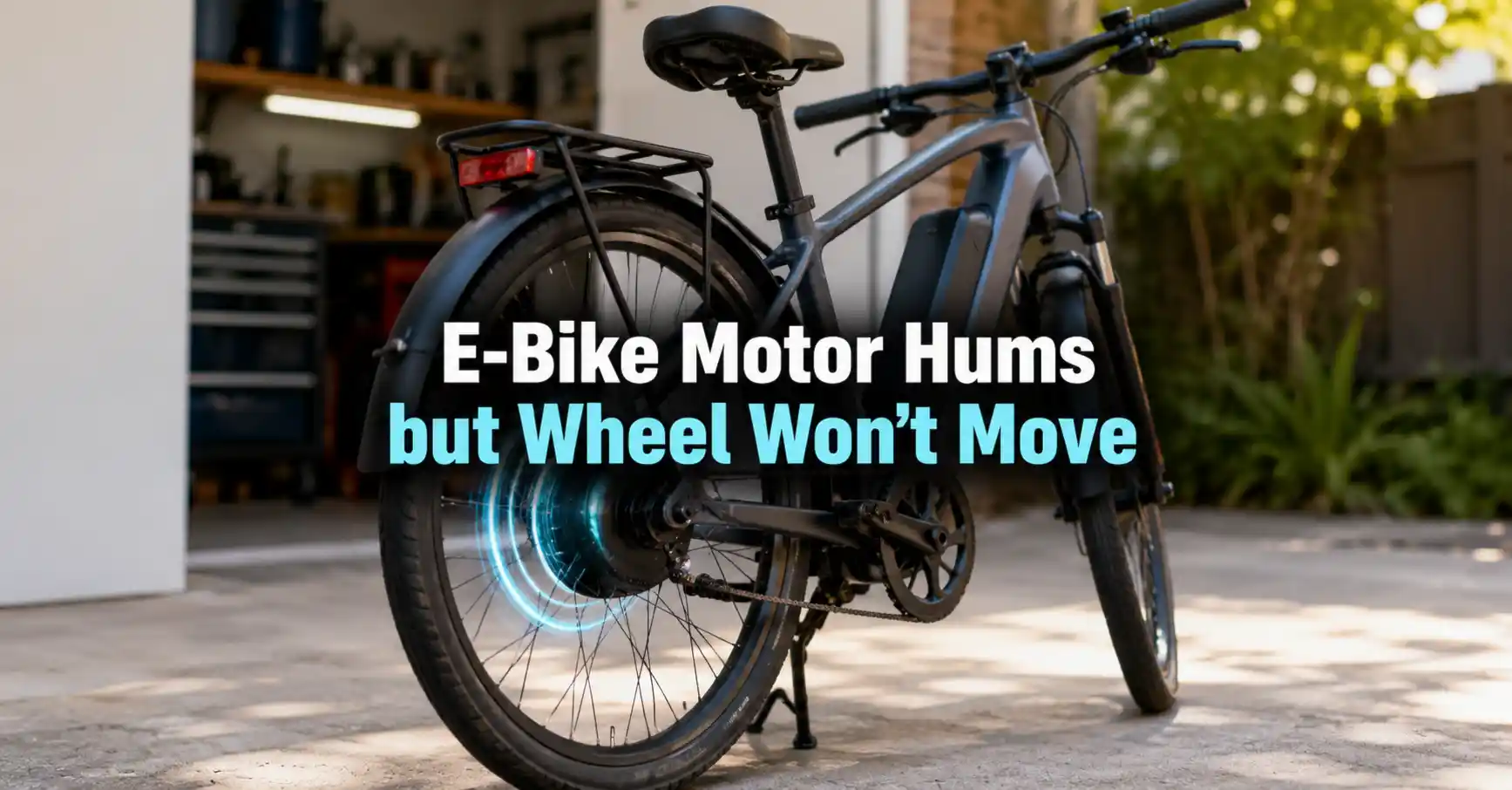
If your e-bike motor hums but the wheel will not move, do not keep holding the throttle or forcing pedal assist. The problem can be as simple as brake drag or a poorly seated wheel, but it can also involve damaged motor wiring, a hall or phase-signal fault, a controller problem, or an internal geared-hub failure.
The safest approach is to start with low-risk mechanical checks, then move toward wiring and system-specific diagnostics. If you are new to e-bike troubleshooting, start with the E-Bike Troubleshooting and Maintenance Guide. For a deeper explanation of hub and mid-drive systems, see the E-Bike Motor Guide.
What This Usually Means
An e-bike motor that hums while the wheel stays still usually means the motor is being asked to produce torque but something is preventing normal rotation or power transfer. Common causes include brake or drivetrain binding, a damaged motor cable or connector, hall or phase-signal problems, a controller fault, or failed internal gears or a clutch in a geared hub motor.
A hum by itself does not identify the failed part. The most useful clues are whether the wheel turns freely by hand, whether the problem affects throttle and pedal assist, whether the wheel works with no rider load, whether the display shows an error code, and what happened immediately before the problem started.
Safety First
Safety First: Stop using or charging the e-bike if you notice smoke, swelling, unusual heat, melted connectors, damaged battery wiring, sparks, a strong chemical odor, or evidence that the battery has been submerged or seriously impacted. Do not open a lithium-ion battery pack or probe live battery terminals.
If the motor hums but does not rotate, release the throttle or stop pedaling rather than repeatedly stalling the motor. Prolonged stalled-motor testing can create unnecessary heat in the motor, controller, wiring, or connectors.
🔎 Why You Can Trust This Guide
I use manufacturer instructions, established safety guidance, technical references, and common rider-reported symptoms to help identify likely e-bike problems and the safest checks to try first. I separate simple owner checks from advanced electrical diagnosis and avoid treating one symptom as proof that a specific part has failed. You can read more about how Electric Bike Explorer researches and verifies its information, including troubleshooting guides, e-bike reviews, buying guides, safety information, and e-bike laws.
Want to See More Electric Bike Explorer in Google Search?
Add Electric Bike Explorer as a preferred source to see more of our e-bike law guides, safety updates, reviews, buying guides, and troubleshooting posts when they are relevant to your searches.
60-Second Diagnosis
- Power the bike off. If the manufacturer allows battery removal, remove the battery before inspecting accessible wiring.
- Check the driven wheel by hand. If it is difficult or impossible to turn, inspect the brake, wheel seating, tire clearance, drivetrain, and obvious obstructions first.
- Remember the motor type matters. A direct-drive hub motor can have noticeable magnetic drag or cogging even when healthy. Many geared hubs freewheel more easily. Resistance alone does not prove a failure.
- Look for an error code. If the display shows one, use the E-Bike Error Code Finder and the bike manufacturer’s manual before replacing parts.
- Inspect accessible motor wiring. Look for loose connectors, bent pins, contamination, crushed cable sections, or damage near the axle.
- Note exactly what the motor does. Does it hum steadily, jerk, twitch, spin only with the wheel off the ground, or sound as though it is spinning internally while the wheel stays still?
- Stop before internal electrical work. If the basic checks do not reveal the problem, a qualified e-bike technician or the manufacturer is usually the safer next step.
Symptoms and What They Can Point To
| Symptom | Possible causes | First safe check |
|---|---|---|
| Motor hums and wheel will not turn at all | Brake drag, wheel binding, phase/hall issue, controller fault, internal motor problem | Power off and check wheel movement, brakes, and visible wiring |
| Motor hums and wheel jerks or twitches | Motor phase connection, hall-sensor signal, damaged connector, controller issue | Inspect connectors and check for display error codes |
| Wheel spins in the air but stalls with rider weight | Weak electrical connection, controller current limitation or fault, motor problem, severe drivetrain resistance | Stop repeated load tests and inspect connections, brakes, and recent repair history |
| Motor sounds like it spins but wheel does not drive | Possible geared-hub planetary gear or clutch/freewheel failure | Confirm the bike uses a geared hub motor and seek motor-specific service guidance |
| Problem started after tire or wheel work | Wheel seating, brake alignment, pinched or damaged motor cable, loose motor connector | Recheck wheel installation and axle-area wiring |
| Problem started after washing or heavy rain | Moisture at a connector or damaged seal | Power off and inspect only accessible external connectors; do not energize wet components |
1. Check for Brake Drag, Wheel Binding, or Drivetrain Resistance
Before assuming the motor or controller has failed, rule out the mechanical reasons the wheel may be resisting rotation. A severely rubbing disc brake, misaligned caliper, wheel installed incorrectly, tire rubbing the frame or fender, damaged bearing, or drivetrain jam can make the motor struggle or hum.
What to check
- With the bike powered off, rotate the driven wheel by hand if it is safe to do so.
- Listen for constant rotor scraping or look for a rotor that is visibly contacting a brake pad.
- Check that the wheel is seated correctly in the dropouts or axle mounts.
- Look for a tire, fender, chain, derailleur, belt, or other part physically blocking movement.
- If the problem started immediately after brake adjustment or wheel removal, recheck that work first.
Park Tool’s disc-brake guidance explains how rotor and caliper alignment can create rubbing and drag. See Park Tool’s hydraulic disc brake alignment guide.
2. Inspect the Motor Cable and Connectors
Hub-motor wiring deserves special attention because the cable commonly exits near the axle, where it can be twisted, pinched, stretched, or damaged during wheel removal, tire changes, shipping, crashes, or incorrect axle installation.
With the bike powered off, inspect only accessible external wiring. Look for connectors that are partly separated, bent pins, water or dirt contamination, crushed insulation, cuts, discoloration, or a cable that has been pulled tightly at the axle.
Do not force keyed connectors together. Many e-bike motor plugs have alignment marks or keyed pins that can be damaged if they are rotated or pushed together incorrectly.
3. Consider Hall-Sensor or Phase-Signal Problems
Many brushless e-bike motors use phase wires to energize the motor windings and hall sensors to tell the controller the rotor position. A damaged phase connection, hall-sensor signal, connector, or controller circuit can cause rough starting, jerking, humming, or failure to rotate.
This symptom is not proof that a hall sensor is bad. Some systems can operate sensorless, some use different control strategies, and several faults can produce similar behavior. Grin Technologies provides technical background on brushless motor control and hub-motor systems in its summary of e-bike components.
If the bike has a manufacturer-specific error code, use that code and the official service documentation before replacing a controller or motor.
🎬 Helpful Video: This video gives a clear visual look at hub-motor wiring, hall sensors, and common failure points that can cause an e-bike motor to hum without turning the wheel.
4. The Controller Can Be Part of the Problem
The controller switches battery power to the motor phases in a precise sequence. If its output stage, signal processing, connectors, or associated wiring is faulty, the motor may hum, twitch, or fail to start.
However, a humming motor does not automatically mean the controller is bad. Before replacing expensive parts, compare the symptoms with the Controller vs Battery vs Motor diagnostic guide. A correct diagnosis should consider the battery, wiring, brakes, error codes, motor type, and recent repairs together.
5. Geared Hub Motors Can Fail Internally
If your e-bike uses a geared hub motor, the motor spins through internal planetary gears and a clutch or freewheel mechanism before driving the wheel. If those internal parts fail, the motor may make noise or spin internally without transferring normal drive to the wheel.
This does not apply in the same way to a direct-drive hub motor, which has no internal reduction gears. Grin Technologies explains the differences between hub-motor designs in its hub motor technical guide.
Grinding, clicking, or a motor that audibly spins without driving the wheel can also overlap with problems covered in my guide to e-bike motor grinding noises.
6. Mid-Drive E-Bikes Need a Different Check
A mid-drive motor sends power through the bike’s drivetrain rather than directly through a powered hub. That means a humming or running motor with no wheel movement can also involve the chain, belt, chainring, cassette, freewheel or freehub, derailleur, or another drivetrain component.
If the motor appears to run but the rear wheel does not receive power, watch the drivetrain while the bike is safely supported and powered off first. A broken or derailed chain is obvious, but freehub and internal drivetrain failures may require shop diagnosis.
7. If It Works With the Wheel Off the Ground but Not Under Load
A wheel that turns with no rider load but stalls, hums, or cuts out under load provides a useful clue, but it does not identify one specific failed part. Possible causes include a poor high-current connection, controller limitation or fault, motor damage, excessive brake or drivetrain resistance, or a battery that cannot support the required load.
Do not keep repeating full-throttle tests to reproduce the symptom. Record what happens once or twice, then inspect for obvious drag, wiring damage, error codes, and battery or controller symptoms.
Did This Start After a Repair or Other Event?
The timing can narrow the diagnosis faster than the sound itself. Ask what happened immediately before the motor began humming.
- After a tire change or wheel removal: recheck wheel seating, brake alignment, axle hardware, and motor-cable routing.
- After brake adjustment: check for excessive rotor or pad drag.
- After controller replacement: verify that the controller is the correct model and that all keyed motor, hall, brake-cutoff, display, and sensor connectors match the manufacturer’s instructions.
- After a crash: inspect for axle-area cable damage, bent components, damaged connectors, or wheel misalignment.
- After washing, rain, or water exposure: stop and inspect external connectors for moisture or corrosion before applying power.
- After a motor replacement: confirm compatibility and connector pinout with the manufacturer rather than assuming similar-looking plugs are electrically identical.
Step-by-Step Safe Troubleshooting Order
- Power the bike off and stop repeated throttle testing.
- Check whether the driven wheel is mechanically blocked or severely dragging.
- Inspect the brake, wheel seating, tire clearance, chain or belt, derailleur, and drivetrain.
- Check the display for error codes.
- Inspect accessible motor and controller connectors for looseness or visible damage.
- Pay special attention to the motor cable where it exits a hub-motor axle.
- Identify whether the bike uses a direct-drive hub, geared hub, or mid-drive motor.
- Note whether the wheel jerks, hums steadily, works only unloaded, or sounds like the motor spins internally.
- Check the owner’s manual and manufacturer support documentation for model-specific diagnostics.
- If the problem remains, stop before internal battery, controller, or motor disassembly and contact a qualified e-bike technician or the manufacturer.
Helpful Tools for Diagnosing an E-Bike Motor Problem
A few basic tools can make these checks easier without jumping into risky electrical repairs:
- Bike repair stand – lets you safely lift the driven wheel so you can check for brake drag, wheel binding, unusual motor behavior, or drivetrain resistance.
- Metric hex key set – useful for checking brake calipers, fenders, drivetrain components, and other hardware that may be rubbing or misaligned.
- Bicycle torque wrench – helps you reinstall or tighten bolts to the manufacturer’s specified torque, especially after wheel or brake work.
- Bright inspection flashlight – useful for checking motor cables, axle-area wiring, connectors, and hard-to-see damage.
- Small inspection mirror – helps you look behind the motor, controller, frame, or axle area without disconnecting components unnecessarily.
- Basic bike cleaning brush and microfiber cloths – helpful for cleaning dirt away from connectors and wiring before inspecting them.
For advanced electrical diagnosis, a digital multimeter can be useful, but only when you have the correct wiring diagram and know what you are testing. Do not probe battery terminals, opened battery packs, or exposed high-current wiring unless you are properly trained.
Need a few essentials for e-bike maintenance and troubleshooting? See my guide to the Best E-Bike Accessories for practical tools, safety gear, locks, mirrors, lights, and repair equipment.
What Not to Do
- Do not repeatedly hold the throttle while the motor is stalled.
- Do not open or modify a lithium-ion battery pack.
- Do not probe energized battery terminals or exposed high-current wiring unless you are trained and using the correct procedures and equipment.
- Do not randomly swap phase or hall wires on an unfamiliar system.
- Do not force incompatible or misaligned connectors together.
- Do not bypass brake cutoffs, battery protection, fuses, or safety interlocks just to make the bike run.
- Do not ride the bike if wiring is melted, connectors are overheating, the wheel is binding badly, or the battery shows signs of damage.
DIY or Call a Shop?
| Check or repair | DIY level | Recommendation |
|---|---|---|
| Look for brake rub, tire interference, loose external connectors, or visible cable damage | Low risk | Reasonable for most owners with the bike powered off |
| Reseat an accessible keyed connector exactly as the manufacturer directs | Low to moderate | Proceed only if the connector is undamaged and clearly identified |
| Remove a hub-motor wheel or correct axle installation | Moderate | Use model-specific torque and installation instructions or a shop |
| Electrical continuity, phase, or hall testing | Advanced | Best for an experienced technician using the correct diagrams and tools |
| Open the controller or motor | Advanced | Usually a shop or manufacturer job, especially under warranty |
| Open, repair, or modify the battery pack | High hazard | Do not DIY; use qualified battery service or manufacturer support |
When to Call the Manufacturer or an E-Bike Shop
Stop troubleshooting and seek professional help if you find melted wiring, badly damaged axle cables, repeated motor or controller error codes, a wheel that remains mechanically locked after basic checks, severe overheating, internal grinding, or a motor that only works intermittently after connector inspection.
Also contact the manufacturer if the bike is under warranty. Opening a motor or controller can affect warranty coverage, and some brands have proprietary diagnostics that can identify faults more accurately than general troubleshooting.
Bosch, for example, recommends restarting the system for certain drive-unit errors and contacting a specialist dealer when the problem persists. See the Bosch eBike Systems error guidance. Treat this as Bosch-specific guidance rather than a universal reset procedure.
What to Tell the Repair Shop
You can often shorten diagnosis time by giving the technician a clear symptom history. Record:
- Bike brand, model, and approximate age.
- Motor type and model if known.
- Any display error code.
- Whether the wheel turns by hand when the bike is off.
- Whether the problem occurs with throttle, pedal assist, or both.
- Whether the motor jerks, hums steadily, cuts out, or spins only with no load.
- Whether the issue started after a wheel change, crash, repair, rain exposure, or controller/motor replacement.
- Photos of external motor and controller connectors if the shop requests them.
How to Prevent This Problem
- Protect motor cables from sharp bends, axle rotation, pinching, and abrasion.
- After wheel removal, confirm the wheel, axle hardware, brake, and motor cable are correctly installed before riding.
- Keep external electrical connectors clean, dry, and fully seated according to the manufacturer’s instructions.
- Address brake drag and drivetrain problems before they become severe.
- Do not pressure-wash the motor, controller, display, or connectors.
- Investigate unusual motor noise, heat, or intermittent cutouts early instead of continuing to ride until the fault worsens.
Frequently Asked Questions
Why does my e-bike motor hum but not turn?
The motor may be receiving a drive command while the wheel is mechanically blocked or the electrical commutation is not working normally. Brake drag, damaged motor wiring, hall or phase-signal faults, controller problems, and internal geared-hub failures are all possibilities.
Can a bad hall sensor make an e-bike motor hum?
Yes, on systems that depend on hall-sensor feedback, a missing or incorrect hall signal can contribute to jerking, rough starting, humming, or failure to start. But those symptoms are not unique to hall sensors, so do not replace them based on sound alone.
Can a bad controller make the motor hum but not spin?
Yes. A controller fault can prevent the motor phases from being energized correctly. Similar symptoms can also come from connectors, motor wiring, hall sensors, mechanical drag, or the motor itself, so the controller should not be diagnosed by humming alone.
Why does my e-bike wheel spin in the air but not with my weight on it?
That suggests the system can rotate under very light load but cannot produce or transfer enough torque under normal load. Possible causes include electrical connection problems, controller or motor faults, excessive mechanical resistance, or battery-related voltage sag. Avoid repeated full-power stall tests.
Can a seized or rubbing brake make the motor hum?
Yes. Severe brake drag can resist wheel rotation enough that the motor struggles. Always check the mechanical side before assuming an electrical component has failed.
Can stripped hub-motor gears cause this problem?
On a geared hub motor, damaged planetary gears or a failed clutch/freewheel can prevent normal power transfer to the wheel. Direct-drive hub motors do not use the same internal reduction gears.
My Take
A humming motor can sound like a major failure, but I would not jump straight to replacing the controller or motor. Start with the simple checks first – brake drag, wheel seating, drivetrain resistance, recent repair work, and accessible motor connections.
If the wheel turns freely and the problem still points toward hall sensors, phase wiring, the controller, or internal motor parts, that is where I would stop guessing and move to model-specific diagnostics or a qualified e-bike technician. Replacing expensive electrical parts without confirming the fault can quickly turn a simple repair into an expensive one.
Related E-Bike Troubleshooting Guides
- E-Bike Troubleshooting and Maintenance Guide
- Controller vs Battery vs Motor: How to Tell Which E-Bike Part Is Bad
- E-Bike Error Code Finder
- E-Bike Motor Makes Grinding Noise: Causes, Fixes and When to Stop Riding
- E-Bike Tools Hub
External Sources
- U.S. Consumer Product Safety Commission – Micromobility Information Center
- Grin Technologies – Hub Motor Technical Information
- Grin Technologies – Summary of E-Bike Components
- Park Tool – Hydraulic Disc Brake Alignment
- Bosch eBike Systems – Drive Unit Error Guidance

Kristina is not just an enthusiast but a true authority on electric bikes. Nestled in the coastal beauty of Virginia, Kristina has found the perfect backdrop for her passion for electric biking. As a dedicated wife and homeschooling mom, her life revolves around family, faith, and the thrill of adventure.
Originally hailing from Ohio, Kristina's journey with electric bikes began as a curiosity and quickly evolved into a deep expertise. Her blog is a testament to her love for electric biking, combining her fascination for eco-friendly transportation with her coastal lifestyle.
When she's not cruising the beach on her electric bike, you'll find Kristina indulging in her other loves: long walks along the shore, getting lost in a good book, and cherishing moments with her loved ones. With a heart as big as her love for animals, especially cats, Kristina brings a unique perspective to the electric bike world, grounded in her strong faith in God and her dedication to a sustainable lifestyle.
Through her blog, Kristina shares her extensive knowledge of electric bikes, offering valuable insights, tips, and recommendations to fellow enthusiasts. Whether you're a seasoned rider or a newcomer to the electric bike scene, Kristina's blog is your go-to source for all things electric biking, fueled by her passion, expertise, and the scenic beauty of coastal Virginia.