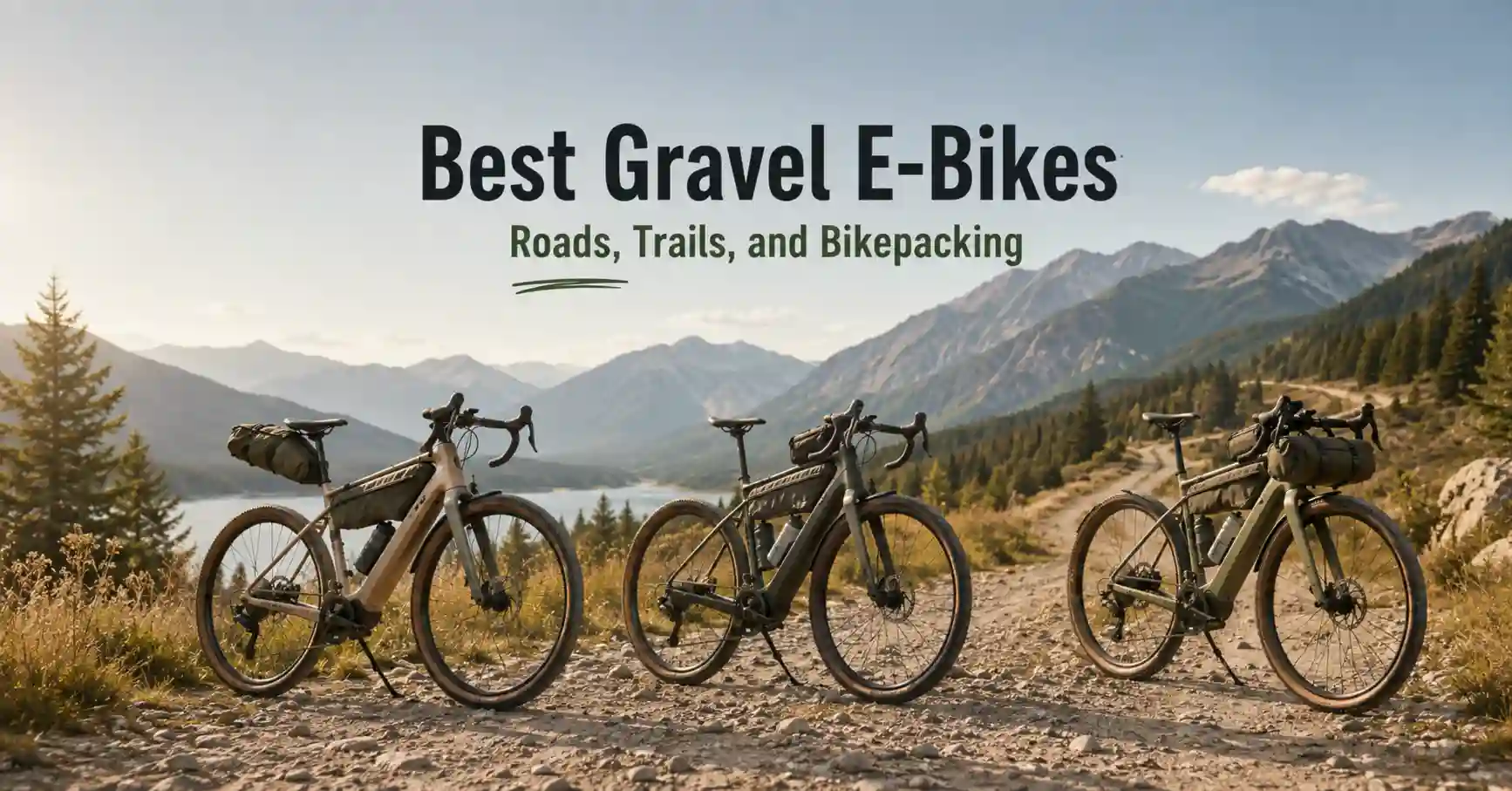
Best Gravel E-Bikes: 6 Picks for Roads, Trails, and Bikepacking
Last Updated on August 14, 2026 by Kristina
📚 Research-based buying guide: I have not personally tested every bike in this guide. These recommendations are based on current manufacturer specifications, safety documentation, warranty and return policies, independent testing, service information, and available rider feedback.
Introduction
Gravel e-bikes can look similar on paper, but the best choice depends on where you actually plan to ride. A lightweight bike can be ideal for pavement and smoother gravel, while steeper climbs, rough forest roads, and bikepacking routes may call for more torque, a larger battery, wider tires, and additional cargo capability.
For most riders, the Trek Checkpoint+ SL 5 is my best overall pick because it combines a relatively low weight with a true gravel-bike design and natural-feeling electric assistance. The Salsa Confluence GRX 600 2x stands out for value, while the Orbea Denna H30 28mph and Ridley E-Kanzo Adventure make more sense for riders tackling bigger climbs or more demanding adventure routes.
I focused on bikes designed for gravel and mixed-surface riding rather than fat-tire utility bikes or electric mountain bikes. If you are still deciding what type of e-bike fits your riding, start with my E-Bike Buying Guide. If your routes are mostly technical singletrack, jumps, rock gardens, or downhill terrain, one of my best electric mountain bikes will probably be a better fit.
⭐Quick Picks: Best Gravel E-Bikes
- Best Overall: Trek Checkpoint+ SL 5
- Best Value: Salsa Confluence GRX 600 2x
- Best Road/Gravel Performance Value: Specialized Turbo Creo 2 Comp E5
- Best for Powerful Gravel Climbing: Orbea Denna H30 28mph
- Best for Bikepacking and Rough Gravel: Ridley E-Kanzo Adventure
- Best Lightweight Road/Gravel Crossover: 2026 Santa Cruz Skitch Apex
👉 Short on time?
See today’s e-bike deals and limited-time discounts, then compare top picks below.
Gravel E-Bike Comparison Chart
| Bike | Best For | Current Price* | Motor + Battery |
|---|---|---|---|
| Trek Checkpoint+ SL 5 | Best Overall | $5,599.99 | TQ HPR60 + 360Wh |
| Salsa Confluence GRX 600 2x | Best Value | $2,959.99 sale | MAHLE X35+ + 250Wh |
| 2024 Specialized Turbo Creo 2 Comp E5 | Road + Gravel Value | $4,499.99 | Specialized SL 1.2 + 320Wh |
| 2026 Orbea Denna H30 28mph | Powerful Gravel Climbing | $4,630 | Shimano EP600 RS-Gravel + 420Wh |
| Ridley E-Kanzo Adventure Apex XPLR | Bikepacking + Rough Gravel | U.S. dealer pricing varies* | Bosch Performance Line CX + 600Wh |
| 2026 Santa Cruz Skitch Apex | Lightweight Road/Gravel | $6,799 | FAZUA Ride 60 + 430Wh |
*Prices checked August 14, 2026 and can change. Ridley’s current configurator lists the E-Kanzo Adventure Apex XPLR at €6,799, but U.S. buyers should confirm current dealer pricing.
How I Chose the Best Gravel E-Bikes
I compared motor and battery systems, bike weight where available, tire clearance, braking equipment, fit, cargo capability, electrical safety information, current availability, and the type of terrain each bike is designed to handle. I gave extra consideration to bikes that still preserve a natural bicycle feel, while excluding fat-tire utility bikes and true electric mountain bikes that serve a different purpose.
🔎 Why You Can Trust This Guide
I compare official specifications, safety information, independent testing, support policies, and real-world rider feedback. Affiliate relationships do not determine which products I recommend or how they are ranked. You can read more about how Electric Bike Explorer reviews and ranks e-bikes.
Want to See More Electric Bike Explorer in Google Search?
Add Electric Bike Explorer as a preferred source to see more of our e-bike law guides, safety updates, reviews, buying guides, and troubleshooting posts when they are relevant to your searches.
1. Trek Checkpoint+ SL 5 – Best Overall

The Trek Checkpoint+ SL 5 is my best overall pick because it hits the balance I want from a gravel e-bike: low weight, natural assistance, a real gravel frame, useful tire clearance, and enough electric help to make long days and repeated climbs more manageable.
Trek lists the Checkpoint+ SL 5 with a TQ HPR60 mid-drive system and a 360Wh battery. The motor assists up to 28 mph in the U.S., which places it in Class 3 territory where that classification applies. The listed weight is about 30.45 lb in size ML, which is remarkably light compared with many electric bikes.
Price note: Trek’s current U.S. pages show the Checkpoint+ SL 5 starting at $5,599.99, but current configuration and inventory pages can vary. I would confirm the exact build and final price before ordering rather than treating one number as universal.
Why It Stands Out
The biggest advantage is that the electric system does not overwhelm the bike. The TQ setup is compact, and the overall weight is low enough that the Checkpoint+ still makes sense for riders who care about handling, climbing feel, and carrying the bike up a few stairs.
Trek also builds the Checkpoint platform around gravel rather than commuting. That matters when you want space for larger tires, mounting points, and geometry that is comfortable when the pavement ends.
Main Tradeoffs
The 360Wh battery is intentionally smaller than the 625Wh pack on the Salsa Tributary. That helps keep weight down, but it means riders prioritizing maximum assisted range while carrying camping gear may prefer the heavier Salsa.
The price is also firmly premium. You are paying for a lightweight carbon gravel platform and a compact mid-drive system rather than maximum battery capacity per dollar.
Best for: Riders who want one refined e-bike for fast gravel, paved connectors, long mixed-surface rides, and occasional bikepacking without the weight of a typical full-power e-bike.
Read more on the Trek Checkpoint+ SL
2. Salsa Confluence GRX 600 2x – Best Value
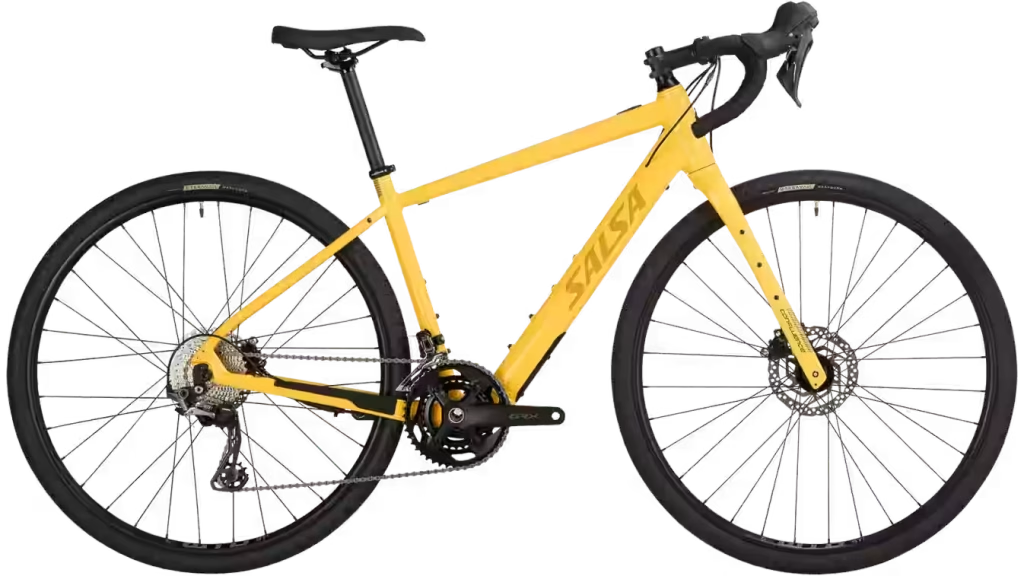
The Salsa Confluence GRX 600 2x is the bike I would look at first if you want a legitimate gravel e-bike without moving into the $5,000-to-$8,000 price range. Salsa currently lists it at $2,959.99 on sale, down from $3,699.
It uses the MAHLE X35+ rear-hub system with 40Nm of torque and a 250Wh battery. Salsa lists a 20 mph Class 1 assist limit, a 32 lb 2 oz weight for the 55cm bike, Shimano GRX RX400 hydraulic brake calipers, and 160mm rotors.
Salsa also states that the Confluence meets UL 2849 and UL 2271 certification. Its six frame sizes cover a particularly wide manufacturer-recommended rider-height range, from about 4 ft 8 in. to 6 ft 4 in.
Why It Stands Out
This is the most conventional-feeling gravel bike in the group for the money. The MAHLE system is light and visually discreet, and the 2x GRX drivetrain gives riders who spend a lot of time on pavement a broad gear range with smaller jumps between gears.
It also has practical cargo features, including rack and fork mounting options, making it much more than a fair-weather fitness bike.
Main Tradeoffs
The tradeoff is power. A 40Nm hub motor is a very different experience from the 85Nm Bosch mid-drive on the Tributary. Riders facing long, steep, loose climbs with heavy gear should not assume the Confluence will provide the same climbing support.
The 250Wh battery is also relatively small. Salsa gives a 40-mile range estimate, but actual range will depend heavily on rider weight, terrain, wind, temperature, tire pressure, and assist level.
Best for: Budget-conscious gravel riders who value low weight, Class 1 simplicity, broad sizing, and a natural bicycle feel more than maximum torque.
3. Specialized Turbo Creo 2 Comp E5 – Best Road/Gravel Performance Value
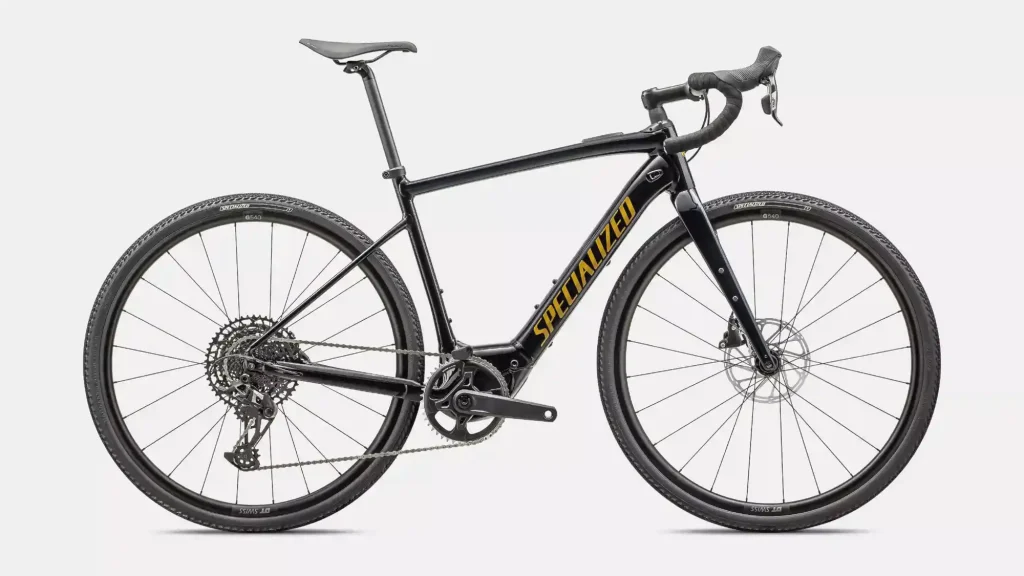
The Specialized Turbo Creo 2 Comp E5 is technically a 2024 model, but Specialized is still selling this build in 2026. That distinction matters. I am including it because the current $4,499.99 price makes it much more competitive than it was when new, not because I want to pass an older model off as a 2026 release.
The Creo 2 Comp E5 uses Specialized’s SL 1.2 motor with 50Nm of torque and a 320Wh integrated battery. Specialized lists the size-56 bike at 33 lb 5.3 oz. It comes in sizes 49 through 61 and has clearance for tires up to 700 x 47c.
Braking is handled by SRAM Apex hydraulic discs with a 180mm front rotor and 160mm rear rotor. Specialized also lists applicable UL 2849 and/or UL 2271 compliance certification for the e-system and battery on the current product page.
Why It Stands Out
This is one of the best choices here if your rides are genuinely split between paved roads and gravel. The Future Shock system adds 20mm of movement at the front of the cockpit to reduce impacts without turning the bike into a suspension-heavy machine.
The bike also accepts front, rear, and low-rider racks, so it can move beyond fast day rides into touring and lighter bikepacking setups.
Main Tradeoffs
The integrated 320Wh battery prioritizes a clean frame and lower weight over easy battery removal. The bike is also an older model year, so buyers should confirm size availability, current warranty treatment, replacement components, and whether the exact color/build shown online is still available.
Specialized also sells newer carbon Creo 2 builds. Those can be lighter and more sophisticated, but they cost more, which is exactly why the E5 alloy version remains interesting.
Best for: Road cyclists and performance-oriented gravel riders who want electric help without giving up a relatively light, responsive drop-bar bike.
4. Orbea Denna H30 28mph – Best for Powerful Gravel Climbing
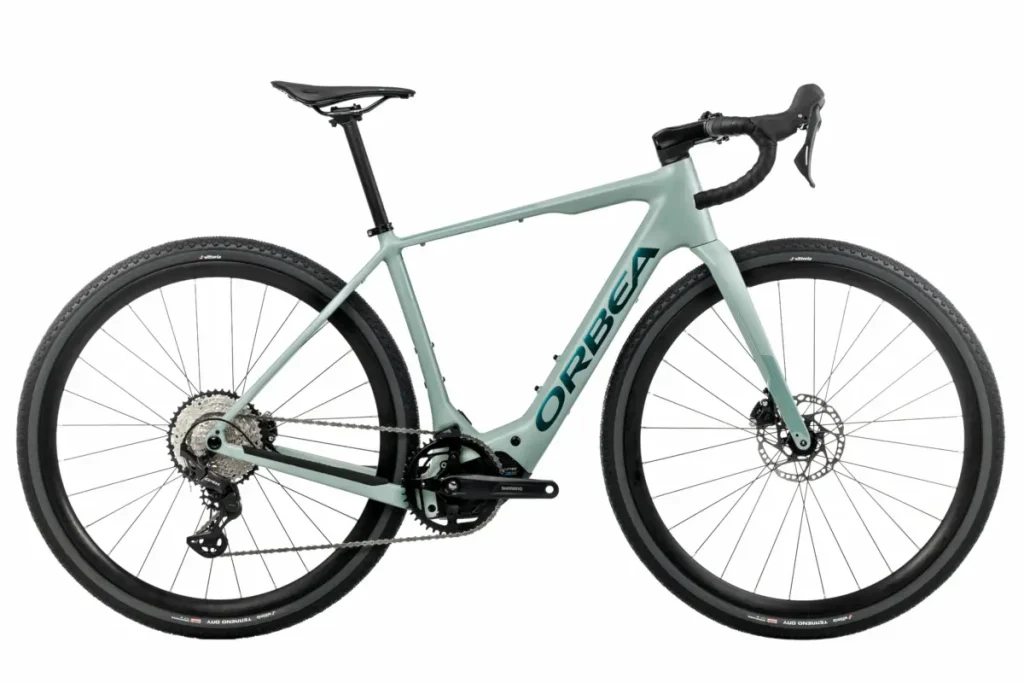
The 2026 Orbea Denna H30 28mph is the bike I would look at if your gravel riding includes longer or steeper climbs but you still want the geometry and feel of a drop-bar gravel bike.
Orbea currently lists the H30 28mph at $4,630 in the U.S. It uses a Shimano EP600 RS-Gravel mid-drive with a 420Wh internal battery, and Shimano rates the EP600 platform for up to 85Nm of torque. The Denna also has clearance for tires up to 50c, giving riders room to add more traction and comfort for rougher surfaces.
Another advantage is the optional 210Wh Orbea RS Range Extender, which can be useful for longer rides without requiring a permanently larger and heavier battery.
Why It Stands Out
The Denna offers substantially more climbing support than the lighter hub-drive gravel e-bikes in this guide while remaining purpose-built for gravel rather than mountain biking.
I also like the combination of the 420Wh battery, wide tire clearance, six available frame sizes, and the option to add extra battery capacity when needed.
Main Tradeoffs
The more powerful mid-drive system adds complexity compared with a simple lightweight hub motor, and the H30 is not the cheapest gravel e-bike here.
The 28 mph version may also face more access restrictions than a 20 mph Class 1 gravel bike on some trails and shared-use paths. Check the rules for the areas where you plan to ride before buying specifically for trail use.
Best for: Riders who regularly encounter steep gravel climbs and want stronger motor assistance without moving to a full-size electric mountain bike.
5. Ridley E-Kanzo Adventure – Best for Bikepacking and Rough Gravel
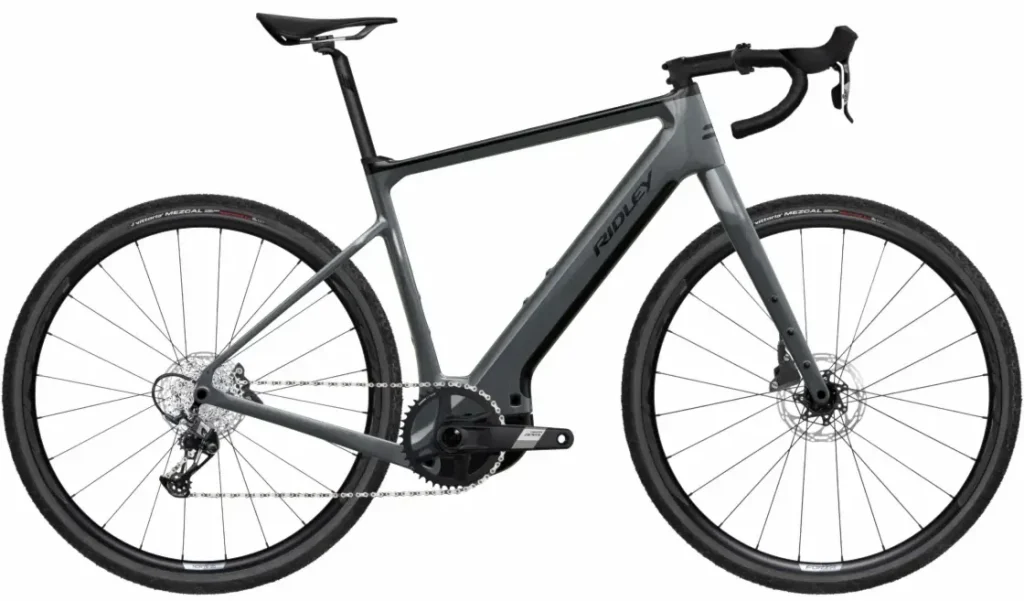
The Ridley E-Kanzo Adventure is one of the most adventure-focused gravel e-bikes in this group. It pairs a carbon gravel frame with a powerful Bosch Performance Line CX motor, a 600Wh PowerTube battery, wide tires, and geometry designed for rougher terrain.
Bosch’s current system on the E-Kanzo Adventure provides up to 100Nm of torque, giving it considerably more climbing assistance than most lightweight gravel e-bikes. Ridley also gives the bike clearance for tires up to 54mm, and the current Apex XPLR build comes with 29 x 2.1 in. Vittoria Mezcal tires.
Why It Stands Out
This bike makes the most sense when gravel riding starts to overlap with bikepacking, forest roads, rough tracks, and more technical terrain.
The fork includes multiple mounting points for bottles or bikepacking gear, and Ridley designed the frame so a suspension fork can be fitted without upsetting the intended geometry.
The 600Wh battery is another advantage for riders planning longer days or carrying extra gear.
Main Tradeoffs
The E-Kanzo Adventure is much more bike than most riders need for smooth rail trails or pavement-heavy routes.
It also does not have conventional bolt-on rear-rack mounts. Ridley recommends using bikepacking bags or a compatible alternative such as a Tailfin-style rack instead, which is worth knowing before buying it specifically for loaded touring.
Current U.S. pricing is also less straightforward than with the other bikes in this guide. Ridley’s configurator currently lists the Apex XPLR build at €6,799, so U.S. shoppers should confirm the actual dealer price before comparing its value directly with the other bikes.
Best for: Riders who want a powerful gravel e-bike for rough roads, long adventures, bikepacking, and routes where extra battery capacity and wide tires matter more than keeping the bike as light as possible.
6. Santa Cruz Skitch Apex – Best Lightweight Road/Gravel Crossover
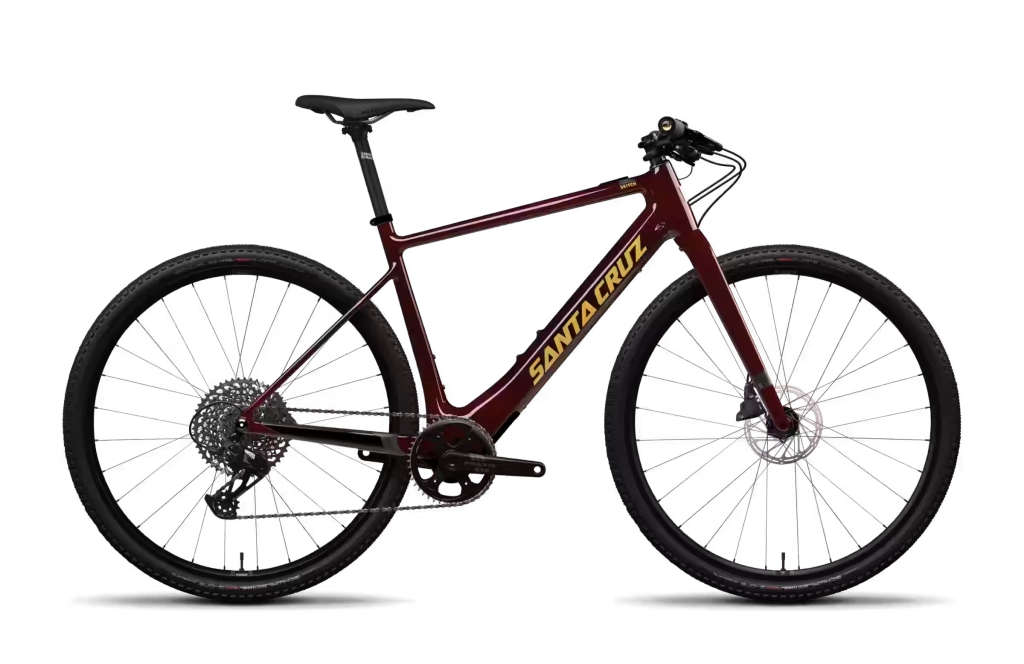
The 2026 Santa Cruz Skitch Apex is the bike I would choose for riders who want speed and low weight first, with gravel capability as part of a broader all-road setup. Santa Cruz itself positions the Skitch heavily around fast urban and road riding, so I would not describe it as a dedicated rough-gravel machine.
The current Apex build costs $6,799 and uses a carbon CC frame and fork, SRAM Apex Eagle drivetrain, FAZUA Ride 60 drive unit, and 430Wh battery. Santa Cruz lists the bike at just 30.58 lb and offers sizes S through XXL.
Why It Stands Out
The weight is the headline. A roughly 30.6 lb e-bike is much easier to live with than a 50-to-70 lb utility model, and that changes how the bike feels both under power and when the motor is off.
The FAZUA system also provides more torque than the MAHLE hub-drive used on the Confluence, while the carbon frame keeps the whole package relatively light.
Main Tradeoffs
The Skitch is expensive for a bike that is not as cargo-focused as the Tributary and not as rough-terrain-focused as the Wanderosa. Its value makes the most sense to riders who specifically care about low weight, premium carbon construction, and a fast all-road character.
Best for: Riders who want a lightweight electric road bike that can confidently extend onto gravel and mixed-surface routes.
How to Choose the Best Gravel E-Bike for You
Start With the Terrain, Not the Motor Number
For smoother gravel and pavement, low weight and natural assistance are usually more valuable than maximum torque. That is where the Trek, Confluence, Creo, and Skitch make sense.
For loaded bikepacking, sustained climbs, or rougher surfaces, a larger battery and more torque become more useful. The Tributary is the strongest example, while the Wanderosa adds suspension for riders whose routes go well beyond graded gravel roads.
Think About Hub Drive vs. Mid-Drive
The Confluence uses a rear-hub motor. It is light, simple, and helps keep the price down. The other bikes use mid-drive systems, which can take better advantage of the bicycle’s gearing when climbing.
If you want more detail before deciding, see my hub-drive vs. mid-drive e-bike motor guide.
Battery Size Is Only Part of the Range Story
A 625Wh battery has much more stored energy than a 250Wh battery, but that does not mean it will always travel exactly 2.5 times farther. Bike weight, motor efficiency, rider effort, tire choice, wind, climbing, temperature, cargo, and assist setting can dramatically change range.
For gravel riding, I prefer to treat manufacturer range numbers as planning estimates rather than promises.
Do Not Ignore Bike Weight
The difference between a 30 lb gravel e-bike and a 42 lb gravel e-bike is significant when loading a vehicle, carrying stairs, lifting onto a repair stand, or riding without assistance.
Heavier is not automatically worse. The Tributary’s weight brings a large battery, powerful Bosch system, and bikepacking hardware. Just make sure you are receiving something useful in exchange for the extra pounds.
Fit Matters More Than the Size Name
A medium from one brand can fit differently than a medium from another. Stack, reach, standover, handlebar position, crank length, and riding style all affect fit.
Use the manufacturer’s fit chart and, when possible, test ride before buying. You can also use my E-Bike Size Calculator as a starting point.
Check Brakes, Tires, and Electrical Safety
Hydraulic disc brakes are appropriate for this category because gravel e-bikes can carry more speed and weight than non-electric gravel bikes. Tire clearance matters too: wider tires can improve comfort and control on loose or rough surfaces, but extremely wide tires can add rolling resistance on pavement.
I also look for clear electrical certification information rather than vague safety wording. Salsa explicitly lists UL 2849 and UL 2271 certification for the Confluence, Tributary, and Wanderosa. Specialized lists applicable UL 2849 and/or UL 2271 compliance certification information on the current Creo product page. Check the exact bike and market before purchase because certification details can vary.
Check Class Rules Before Buying a 28 mph Bike
Several bikes here are capable of Class 3 assistance to 28 mph in the U.S. That can be useful on roads, but it can also restrict where you are allowed to ride. Trail access is often controlled by the land manager, not just statewide e-bike law.
Before buying specifically for a trail system, verify the rules for that property and review the differences between Class 1, Class 2, and Class 3 e-bikes.
Gravel E-Bike Accessories I’d Buy First
You do not need a long list of gear to get started. For most gravel e-bike riders, these are the accessories I would prioritize first:
- Flat Repair Kit – My first pick for gravel riding. Carry tire plugs, levers, patches, and a spare tube.
- Quality Helmet – My first safety purchase. Look for a well-fitting helmet with good coverage and a current safety certification
- Mini Pump or Inflator – Essential for fixing flats and adjusting tire pressure on rougher surfaces.
- Frame Bag – An easy way to carry tools, snacks, your phone, and other ride essentials.
- GPS Bike Computer – Helpful for following routes and navigating unfamiliar gravel roads or trails.
- Phone Mount – A more affordable navigation option if you prefer using your phone for maps.
- Front and Rear Lights – Important when your gravel ride includes road crossings or paved connectors.
- E-Bike Bike Rack – A must if you transport your bike by car. Check the rack’s weight and tire limits carefully.
- Seat Bag – Adds extra storage for longer gravel rides or overnight trips without needing a rear rack..
- Manufacturer-Approved Range Extender – Helpful for longer rides, but only use one specifically approved for your e-bike’s motor and battery system.
Common Gravel E-Bike Buying Mistakes
- Buying too much motor for the riding you actually do. A lighter bike can be more enjoyable than a full-power model on smooth gravel.
- Assuming every gravel trail allows Class 3 e-bikes. Check the managing agency before buying around a specific trail.
- Ignoring bike weight. Think about stairs, vehicle racks, storage, and how often you will lift the bike.
- Shopping by claimed range alone. Battery watt-hours and your real riding conditions are more useful than one optimistic range number.
- Skipping fit because the bike is on sale. A discounted bike that does not fit is still a bad purchase.
- Forgetting replacement batteries and proprietary parts. Ask how you will obtain a battery, motor service, display, charger, derailleur hanger, and other model-specific parts several years from now.
- Confusing gravel capability with mountain-bike capability. A drop-bar e-bike with 40mm tires is not the same tool as a full-suspension eMTB.
Best Gravel E-Bike FAQs
What is the best gravel e-bike overall?
For the broadest mix of gravel performance, low weight, and electric assistance, my overall pick is the Trek Checkpoint+ SL 5. Riders who prioritize value should look closely at the Salsa Confluence GRX 600 2x, while bikepackers may be better served by the Salsa Tributary C GRX 820.
Are gravel e-bikes good for pavement?
Yes. Most gravel e-bikes are very comfortable on pavement, especially with moderately fast-rolling tires. The Specialized Turbo Creo 2 Comp E5 and Santa Cruz Skitch Apex are especially appealing for riders who expect substantial road mileage.
Do I need suspension on a gravel e-bike?
Not for ordinary maintained gravel roads. Wider tires, lower pressures, a compliant frame, and a comfortable cockpit can do a lot. Suspension becomes more useful on repeated washboard, rocks, ruts, rough descents, and routes that blur the line between gravel and mountain biking.
Is a Class 1 gravel e-bike better for trails?
It can be, because some trail systems allow Class 1 e-bikes but restrict Class 3 models. That is not universal, however. Always check the specific land manager’s rules.
How much battery do I need for gravel riding?
For shorter rides with plenty of rider input, a 250Wh to 360Wh battery can be enough and helps keep weight down. Riders planning long, hilly, loaded routes may appreciate 430Wh, 480Wh, 625Wh, or a compatible range extender. The right capacity depends on how much assistance you expect to use.
Can I use a gravel e-bike for bikepacking?
Yes, but check mounting points, total weight limits, battery access, charger logistics, tire clearance, and whether your route permits your e-bike class. The Salsa Tributary is the most bikepacking-focused option in this guide.
My Take
I think the best gravel e-bike is the one that preserves the kind of riding you already enjoy instead of turning every ride into a search for the largest motor and battery.
For most riders with the budget, the Trek Checkpoint+ SL 5 is the most balanced choice here. It is light enough to still feel like a performance gravel bike, while the TQ system adds meaningful help on climbs and long days.
If value matters more, the Salsa Confluence GRX 600 2x is difficult to ignore at its current sale price. It gives up torque and battery capacity, but it is light, properly equipped for gravel, available in a very broad size range, and backed by clear UL certification claims.
For road-heavy riders, I would strongly consider the 2024 Specialized Turbo Creo 2 Comp E5 while it remains available at its discounted price. For serious bikepacking, the 2025 Salsa Tributary C GRX 820 is the more capable long-haul tool. If your gravel roads are truly rough, the Wanderosa is in a category of its own. And if low weight and speed matter more than cargo capacity, the 2026 Santa Cruz Skitch Apex is the premium crossover pick.
Before ordering any of them, confirm the current price, exact model year, frame size, local service options, replacement-battery availability, electrical certification for the exact model, and the e-bike rules where you plan to ride. Prices and specifications in this guide were checked August 10, 2026.
Disclosure: As an Amazon Associate, I earn from qualifying purchases. This comes at no extra cost to you and helps support the content on this site.
Sources
- Trek Checkpoint+ SL 5 official product page
- Salsa Confluence GRX 600 2x official product page
- Specialized Turbo Creo 2 Comp E5 official product page
- Salsa Tributary C GRX 820 official product page
- Salsa Wanderosa C Apex Eagle official product page
- Santa Cruz Skitch Apex official product page

Kristina is not just an enthusiast but a true authority on electric bikes. Nestled in the coastal beauty of Virginia, Kristina has found the perfect backdrop for her passion for electric biking. As a dedicated wife and homeschooling mom, her life revolves around family, faith, and the thrill of adventure.
Originally hailing from Ohio, Kristina's journey with electric bikes began as a curiosity and quickly evolved into a deep expertise. Her blog is a testament to her love for electric biking, combining her fascination for eco-friendly transportation with her coastal lifestyle.
When she's not cruising the beach on her electric bike, you'll find Kristina indulging in her other loves: long walks along the shore, getting lost in a good book, and cherishing moments with her loved ones. With a heart as big as her love for animals, especially cats, Kristina brings a unique perspective to the electric bike world, grounded in her strong faith in God and her dedication to a sustainable lifestyle.
Through her blog, Kristina shares her extensive knowledge of electric bikes, offering valuable insights, tips, and recommendations to fellow enthusiasts. Whether you're a seasoned rider or a newcomer to the electric bike scene, Kristina's blog is your go-to source for all things electric biking, fueled by her passion, expertise, and the scenic beauty of coastal Virginia.