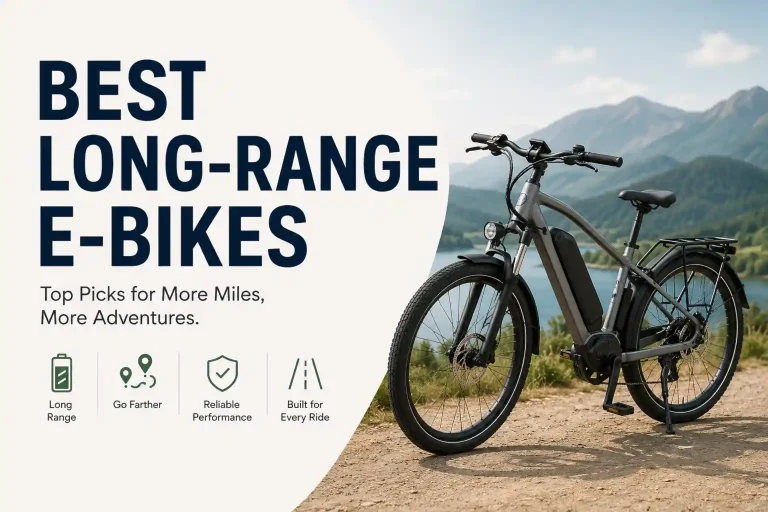

Monarc Marker Review: Is This Dual-Battery Fat-Tire E-Bike Worth $1,999?
Last Updated on September 10, 2026 by Kristina
📚 Research-Based Review – Built from independent sources, specs, and user reports
Introduction
When I first started researching the Monarc Marker, the specification that immediately caught my attention was not its 1,638W peak motor. It was the fact that Monarc includes two full-size 720Wh batteries with a $1,999 fat-tire e-bike.
That is unusual enough on its own, but the Marker also combines a Bafang rear-hub motor, Shimano CUES 9-speed drivetrain, 4-piston hydraulic brakes, a touchscreen display, 26 x 4-in. tires, an included MIK rear rack, and a fairly extensive electrical safety package.
On paper, it looks like Monarc built the Marker specifically to compete with established all-terrain models while giving buyers more battery capacity for their money. The question I wanted to answer was whether the rest of the bike actually supports that impressive specification sheet.
If you are still deciding whether a fat-tire bike is right for you, my fat-tire e-bike buying guide explains the advantages and tradeoffs of this style. First-time buyers may also want to start with my complete e-bike buying guide.
Monarc Marker Quick Verdict
Overall Rating: 8.7 out of 10 – Very Good
Best for: Riders who want a powerful, comfortable fat-tire e-bike for pavement, gravel, errands, recreation, camping, and light trail riding – especially riders who value having a second battery ready to go.
Strongest reason to buy: Two 720Wh batteries are included, giving you 1,440Wh of total swappable battery capacity without purchasing a second battery separately.
Biggest tradeoff: Weight. Monarc lists the Marker at 87 lb, and independent testing has measured approximately 88 lb.
Review type: Research-Based Review
Evidence confidence: Moderate
Price checked: August 29, 2026
My overall impression after researching the Marker is that Monarc has created one of the more interesting fat-tire e-bike packages around the $2,000 mark. I especially like the battery value, component selection, braking setup, and flexibility between torque and cadence sensing.
I am holding it below the 9-point range because this is still a relatively new model with limited long-term owner history, it is extremely heavy, Monarc’s return policy is restrictive, the batteries have less warranty coverage than the headline 5-year warranty might initially suggest, and part of the connected-app ecosystem was still upcoming when I checked.
🔎 Why You Can Trust This Review
I based this review on Monarc’s official specifications, product documentation, warranty and return policies, certification claims, independent performance testing, and the rider information currently available. I separate manufacturer claims from reported test results, and I point out specification or policy details that I think buyers need to understand before ordering.
My affiliate relationship with Monarc does not determine the score or conclusion. You can read more about how Electric Bike Explorer reviews and ranks e-bikes.
Who the Monarc Marker Is Good For – and Who Should Skip It
I think the Marker makes the most sense for someone who wants one large, capable e-bike that can handle several jobs. It has the battery capacity for longer recreational rides, fat tires for rough pavement and loose surfaces, a rear rack for cargo, and enough motor power for hills and heavier loads.
The Step-Thru version is particularly interesting to me for riders who want easier mounting and a more upright riding position. Monarc currently lists the Step-Thru for riders approximately 5 ft. 2 in. to 6 ft. 3 in., while the High-Step is listed for approximately 5 ft. 4 in. to 6 ft. 5 in.
However, I would skip the Marker if you regularly need to carry your bike upstairs, lift it into an SUV, or use a lightweight hitch rack. At around 87-88 lb with a battery installed, this is a substantial bike.
I would also look elsewhere if nearly all of your riding is on smooth pavement. Fat tires provide comfort and stability, but they also add weight and rolling resistance. A lighter commuter can make more sense if you never plan to use the Marker’s mixed-terrain capability.
Which Monarc Marker Version Should You Choose?
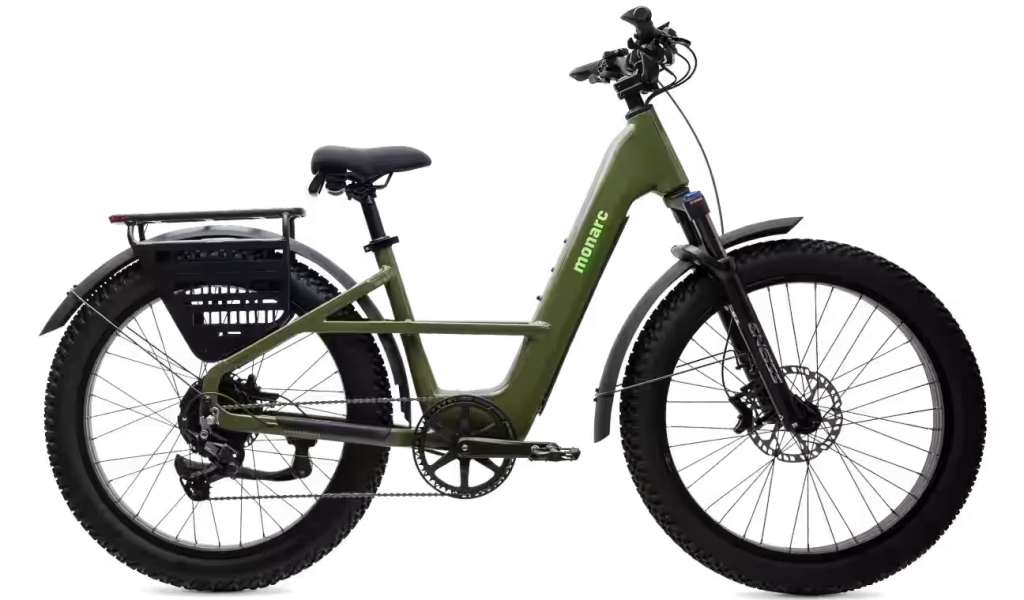
One thing that can be confusing when shopping for the Monarc Marker is that Monarc displays four separate Marker listings on its website. These are not four different performance versions of the bike. They are different combinations of the Step-Thru and High-Step frames and available colors.
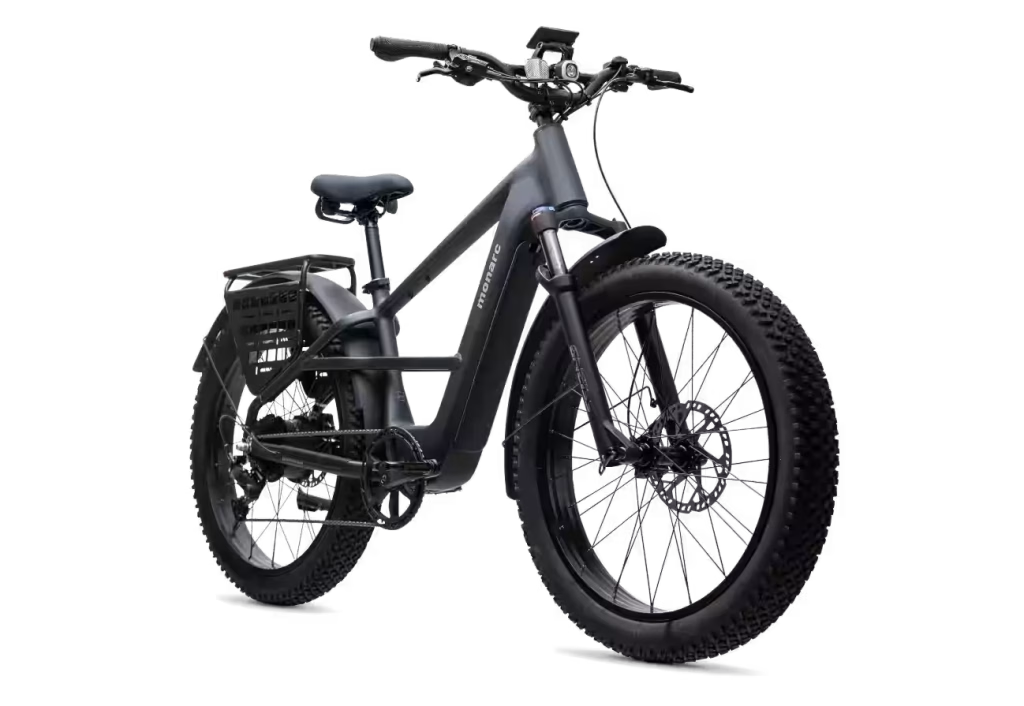
The core Marker package remains essentially the same across the lineup, including the 750W Bafang rear-hub motor, two 720Wh batteries, Shimano CUES 9-speed drivetrain, 4-piston hydraulic brakes, 26 x 4-in. fat tires, suspension fork, rear rack, and other major equipment. For most buyers, the more important decision is Step-Thru vs. High-Step, followed by which color you prefer.
| Marker Version | Frame | Color | Listed Rider Height | Best For |
|---|---|---|---|---|
| Marker Step-Thru Greenway | Step-Thru | Greenway | About 5 ft. 2 in. – 6 ft. 3 in. | Riders who want easier mounting and a lower frame |
| Marker Step-Thru Birchwood | Step-Thru | Birchwood | About 5 ft. 2 in. – 6 ft. 3 in. | Riders who want easier mounting and a lower frame |
| Marker High-Step Cedar | High-Step | Cedar | About 5 ft. 4 in. – 6 ft. 5 in. | Riders who prefer a traditional frame or need the taller fit range |
| Marker High-Step Taconite | High-Step | Taconite | About 5 ft. 4 in. – 6 ft. 5 in. | Riders who prefer a traditional frame or need the taller fit range |
The biggest practical difference is frame accessibility. Monarc lists the Step-Thru with an approximately 22.5-in. standover height, compared with approximately 31.4 in. for the High-Step. That is a substantial difference if swinging a leg over a traditional top tube is uncomfortable or difficult.
I would personally lean toward the Step-Thru Marker for riders who prioritize easier mounting, frequent stops, or everyday convenience. The High-Step Marker makes more sense if you prefer a traditional frame layout or need Monarc’s taller recommended fit range, which extends to approximately 6 ft. 5 in.
Color choice is tied to the frame style. The Step-Thru is offered in Greenway and Birchwood, while the High-Step is offered in Cedar and Taconite.
Because the major performance components are shared across the Marker lineup, I consider this review applicable to all four current Marker listings. The fit and frame-style differences are the main things I would decide before choosing a specific version.
See all current Monarc Marker versions and colors
Monarc Marker Specifications
| Specification | Monarc Marker |
|---|---|
| Price checked | $1,999 on August 29, 2026 |
| Motor | Bafang B750 rear hub, 750W nominal |
| Claimed peak output | 1,638W |
| Torque | 85 Nm |
| Controller | 30A |
| Batteries | 2 removable 48V 15Ah batteries with LG cells |
| Battery capacity | 720Wh each, 1,440Wh total swappable capacity |
| Claimed range | Up to 60 miles per battery, up to 120 miles using both |
| Reported testing | About 32-32.5 miles from one battery in demanding maximum-assist testing, including early testing on pre-production bikes |
| Charger | 48V 5A fast charger |
| Claimed charging time | About 3 hours per battery |
| Top assisted speed | Up to 28 mph when configured appropriately |
| Default class | Class 2 |
| Available configurations | Class 1, Class 2, or Class 3 settings |
| Pedal sensor | Switchable torque or cadence sensing, torque default |
| Throttle | Left-side thumb throttle |
| Drivetrain | Shimano CUES 9-speed |
| Cassette | 11-36T |
| Brakes | Star Union Talon P4 4-piston hydraulic disc |
| Rotors | 203mm front, 180mm rear |
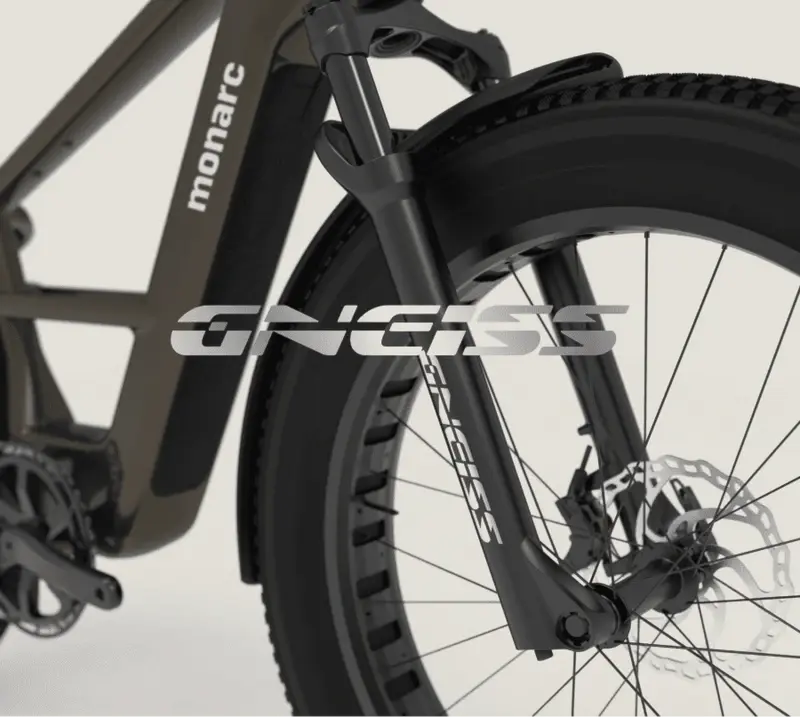
| Fork | Gneiss reverse-arch, 80mm travel, preload and lockout |
| Tires | Kenda 26 x 4-in. all-terrain |
| Listed bike weight | 87 lb |
| Independently reported weight | Approximately 88 lb |
| Maximum rider weight | 330 lb |
| Gross payload capacity | 420 lb |
| Rear rack capacity | 66 lb |
| Step-Thru rider height | Approximately 5 ft. 2 in. – 6 ft. 3 in. |
| High-Step rider height | Approximately 5 ft. 4 in. – 6 ft. 5 in. |
| Frame options | Step-Thru and High-Step |
| Colors | Birchwood, Greenway, Cedar, and Taconite depending on frame style |
| Display | 3.5-in. Monarc color touchscreen |
| Front light | Integrated 494-lumen light |
| Rear lighting | Taillight, brake light, and turn signals integrated into rack |
| Fenders | Included |
| Rear rack | Included, MIK-compatible |
| Bike water-resistance rating | IPX6 listed by Monarc |
| Battery water-resistance rating | IPX7 listed by Monarc |
| Bike certification | Monarc lists UL 2849 and ISO 4210 |
| Battery certification | Monarc lists UL 2271 |
| Warranty | 5 years on listed covered components; original batteries have a 1-year warranty under current written terms |
Specifications, prices, promotions, colors, availability, and policies can change. I recommend confirming the current details directly with Monarc before purchasing.
✅ Pros
- Two 720Wh batteries included
- 1,440Wh of total swappable battery capacity
- Strong Bafang 750W rear-hub motor
- 1,638W claimed peak output and 85 Nm torque
- Torque and cadence sensing can both be used
- Shimano CUES 9-speed drivetrain
- 4-piston hydraulic brakes
- 203mm front brake rotor
- 26 x 4-in. Kenda all-terrain tires
- 80mm adjustable suspension fork
- 3.5-in. touchscreen display
- Included fenders and MIK-compatible rear rack
- Integrated brake light and turn signals
- 330-lb maximum rider rating
- Monarc lists UL 2849 for the bike and UL 2271 for the batteries
- 5-year warranty on many covered bike components
❌ Cons
- Very heavy at approximately 87-88 lb
- Not easy to carry upstairs or load onto many bike racks
- Fat tires reduce efficiency and steering agility compared with a commuter bike
- The two batteries must be manually swapped rather than used together
- Original batteries receive only 1 year of warranty coverage under the current written warranty
- Return policy is considerably more restrictive than some major competitors
- Long-term owner reliability data is still limited
- Some app and connected features were still upcoming when checked
What Makes the Monarc Marker Different?
The second battery is the feature I keep coming back to because it changes the value calculation considerably.
Each battery has 720Wh of capacity. The Marker does not use both simultaneously – you ride with one installed and swap in the second when needed. That gives you 1,440Wh of total available energy across two packs.
As of August 29, 2026, Monarc separately listed a replacement 720Wh battery for $579. That makes the fact that a second battery is included with the Marker much more meaningful than a typical inexpensive launch accessory.
I also like the flexibility in the pedal-assist system. The bike defaults to torque sensing, which responds to how much force you put into the pedals, but Monarc allows the rider to switch to cadence sensing through the controls.
That gives two very different riding experiences in one bike. Riders who want more natural bicycle-like assistance can use the torque sensor. Riders who prefer easier pedaling with less pressure can use cadence mode.
Ride Quality and Comfort
I cannot give you my own ride impressions because I have not ridden the Marker, so I looked for consistency across independent tests instead.
Several testers described the Marker as stable and comfortable, which makes sense given its 26 x 4-in. fat tires, large frame, and 80mm suspension fork. Electric Bike Report also noted that the reinforced Step-Thru frame felt stiff rather than noticeably flexy during its early testing.
The downside is that all of this stability comes with mass. Independent testing has put the bike at roughly 88 lb with a battery installed. That weight can help the bike feel planted once moving, but it becomes a very different story when you need to lift or transport it.
I would pay particular attention to that if you’re an older rider, an RV owner loading bikes onto a rack, or anyone with limited lifting ability. A Step-Thru frame makes getting onto the bike easier, but it does not make an 87-plus-pound bike easier to pick up.
If easier mounting is one of your priorities, you can also compare other options in my guide to step-through e-bikes.
Motor and Performance
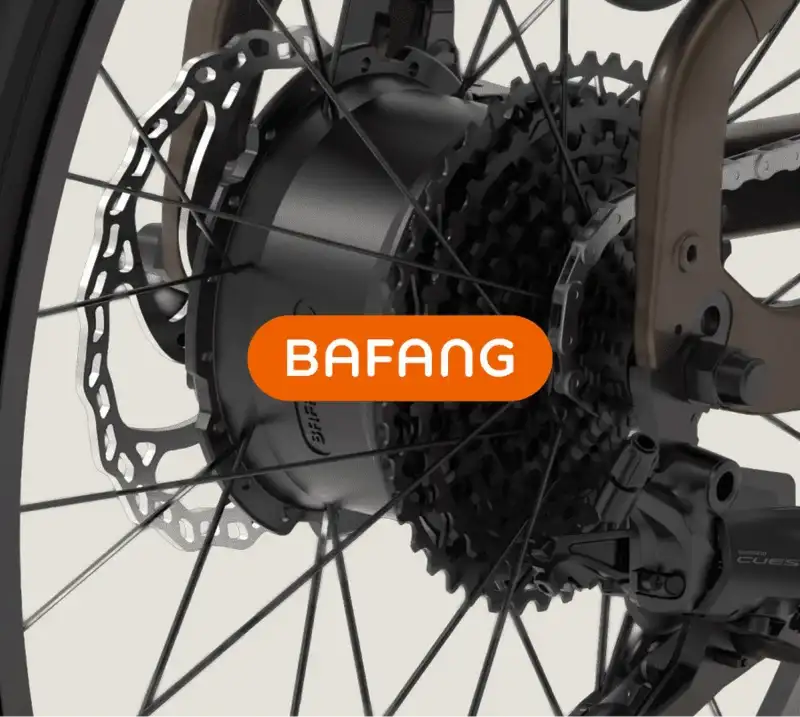
The Marker uses a 750W nominal Bafang rear-hub motor that Monarc rates at 85 Nm of torque and up to 1,638W peak output through a 30A controller.
Those are manufacturer-rated numbers, but the independent testing I reviewed supports the idea that this is a genuinely powerful bike rather than one that simply has an impressive peak-power claim.
RiderGuide reported strong hill performance and said the Marker was still able to climb a steep hill with only 9% battery remaining. The same outlet reported roughly 11 seconds to reach 28 mph during its highest-assist acceleration test.
Electric Bike Report also came away impressed by the climbing performance during its earlier testing, although some of that testing involved pre-production Marker bikes rather than the final retail configuration.
What interests me as much as the raw output is the amount of tuning available. The five assist modes are Cruise, Breeze, Explore, Sport, and Boost, and the rider can also choose between torque and cadence sensing.
That matters on a bike with this much available power. I would rather see a powerful e-bike give a rider the ability to calm the response down than force aggressive acceleration all the time.
The Marker ships in Class 2 configuration and can be configured for other class settings. Before changing speed or throttle settings, check the rules where you actually ride. My guide to Class 1, Class 2, and Class 3 e-bikes explains why those differences matter.
Battery, Charging, and Real-World Range
Monarc claims up to 60 miles from one 720Wh battery and up to 120 miles if you use both batteries.
I would not treat 120 miles as the range every rider should expect.
Independent early testing gives us a much more useful reality check. Electric Bike Report recorded approximately 32.5 miles using one battery in a maximum-assist range test on a pre-production Marker. Electric Bike Review reported approximately 32 miles in its own demanding maximum-assist test, which it said was affected by high winds. Some of the early review work involved pre-production equipment, so I would not treat those figures as definitive testing of every current retail configuration.
Those are demanding test conditions, so they do not prove that 32 miles is the maximum possible range. They do show how dramatically speed, wind, terrain, rider weight, tire pressure, and assist level can affect a 720Wh battery.
This is why I think the second battery is more valuable than the 120-mile marketing number itself. Even if a rider gets substantially less than 60 miles per battery in real-world use, having another fully charged 720Wh pack available can still provide a very large practical riding radius.
The included 5A charger is another advantage. Monarc lists approximately 3 hours for a 0-100% charge of one battery.
If watt-hours and battery capacity are still confusing, my e-bike battery capacity guide explains how Ah and Wh relate to range.
Brakes and Safety
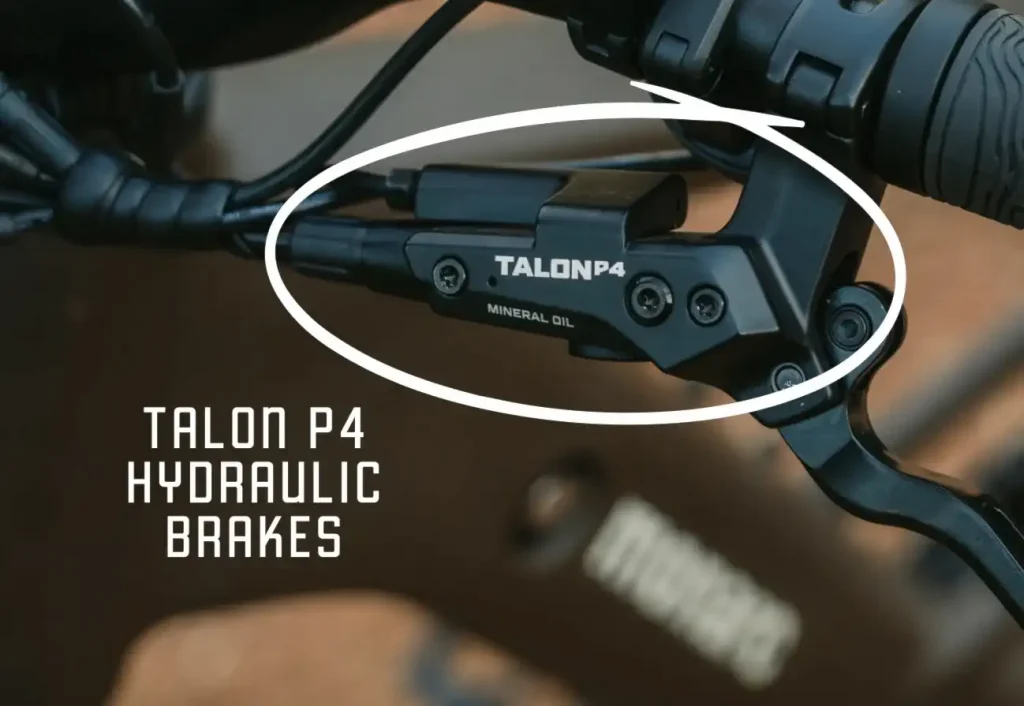
A bike this heavy and powerful needs better-than-minimum braking hardware, and this is one area where I think Monarc made a smart decision.
The Marker uses Star Union Talon P4 4-piston hydraulic brakes with a large 203mm front rotor and 180mm rear rotor.
RiderGuide reported stopping distances in the high-teens from 20 mph during its testing, which was better than the publication’s 20-ft. benchmark. Electric Bike Report also described the brakes as strong during its early test rides.
Monarc lists the Marker as UL 2849 certified and its batteries as UL 2271 certified. The company also lists ISO 4210 for the bike. I am treating those as manufacturer-listed certification claims rather than independently verifying the underlying certification records myself.
Monarc also lists an IPX6 water-resistance rating for the bike and IPX7 for the batteries.
I still would not treat an IP rating as permission to submerge, pressure-wash, or leave an e-bike exposed outside indefinitely. Water resistance is an extra layer of protection, not a substitute for proper storage and care.
Touchscreen, App, and Connected Features
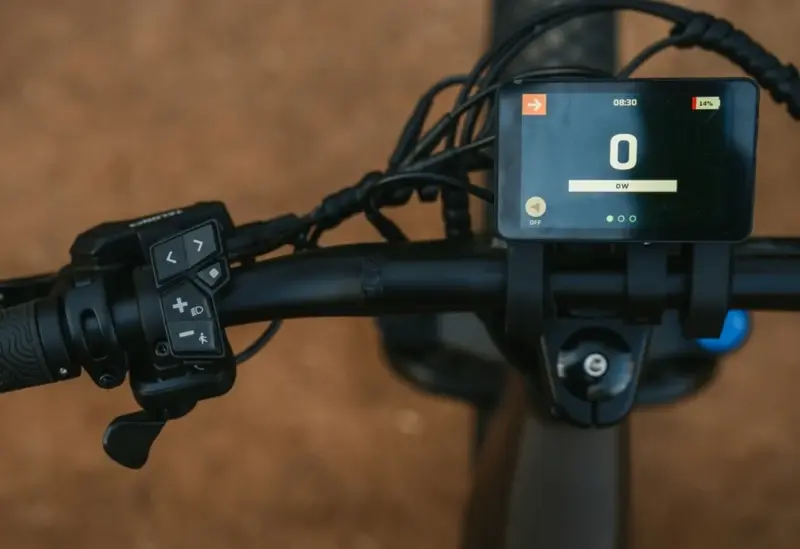
The 3.5-in. touchscreen is one of the Marker’s more unusual features at this price.
The display handles ride settings and can also be controlled from the handlebar buttons, which I think is important because touch-only controls would be awkward with gloves or while riding over rough surfaces.
Monarc lists Bluetooth connectivity, display locking, over-the-air updates, smart accessory integration, ride customization, and future navigation features as part of its connected platform.
However, I would not buy the Marker solely because of promised software.
When I checked on August 29, 2026, Monarc’s website said the app was scheduled to become available the week of September 14. That means some connected features should still be treated as upcoming until they are actually released and working reliably.
The bike itself already has plenty of hardware value without the app, so I see the software as potential upside rather than something I would build my entire buying decision around.
Cargo and Everyday Practicality
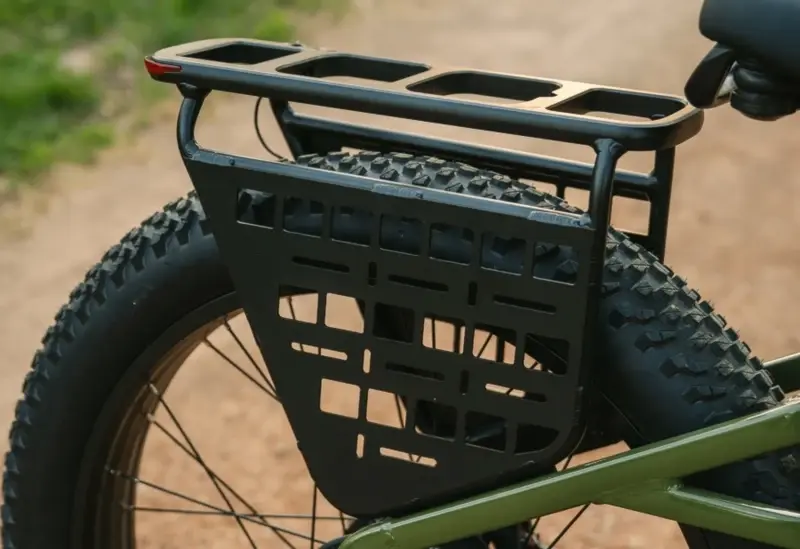
The Marker is marketed as an adventure bike, but I think one of its stronger uses may actually be everyday utility.
Monarc includes a rear rack rated for 66 lb. It is MIK-compatible and incorporates a modular attachment panel that can work with panniers, straps, and MOLLE-style attachments.
You also get fenders, an integrated 494-lumen front light, and rear lighting that functions as a taillight, brake light, and turn signals.
That equipment makes the Marker more practical for commuting, grocery runs, camping trips, and general car-replacement use than a stripped-down recreational fat bike.
Reported Independent Testing
Because this is not a hands-on Electric Bike Explorer review, independent testing played a significant role in my evaluation.
Electric Bike Report tested pre-production Marker bikes and reported strong climbing ability, a generally comfortable and stable ride, and approximately 32.5 miles in a single-battery maximum-assist range test. Because those were early bikes, I would not assume every specification was identical to the current retail version.
Electric Bike Review also reported about 32 miles from one battery during a demanding maximum-assist test affected by wind. Some of its testing also involved early or pre-production equipment.
RiderGuide later reported an approximately 88-lb measured weight, strong hill performance even with a low battery, controlled acceleration, and stopping performance better than its typical 20-ft. benchmark.
The consistency between these reports gives me more confidence in the Marker’s basic performance strengths, but I still distinguish third-party testing from my own experience because I have not personally ridden the bike.
🎬 Watch the Monarc Marker in Action
This video gives you a closer look at the Monarc Marker’s design, controls, components, and overall setup so you can see how the bike comes together beyond the specifications.
What Riders Are Saying
The Marker is still new enough that long-term owner data is limited, so I do not think there is enough evidence yet to make broad claims about multi-year reliability, battery longevity, or long-term customer-service patterns.
I did find a July 2026 Reddit post from a Marker owner who said they had received and ridden the bike. That owner reported strong power, the ability to maintain 28 mph, a generally comfortable ride from the suspension fork and fat tires, and positive interactions with Monarc’s customer service.
The same owner also reported that the drivetrain needed adjustment because it was not consistently staying in gears 4 through 7, and they expressed some frustration about accessory delivery timing. They described the initial assembly as relatively easy.
I also found an August 2026 post from a prospective Marker buyer who had not yet received the bike but described a positive experience communicating with Monarc about a military discount and rider-fit questions.
I see those reports as useful early signals, especially for customer-service responsiveness, but they are still only individual experiences. One positive or negative owner post does not establish how common a reliability or service issue may be.
Unboxing and Assembly
Monarc says its bikes arrive mostly assembled. The company describes final setup as including tasks such as installing the pedals, positioning or adjusting the handlebars, checking tire pressure, and setting the bike up for the rider.
I could not verify an official packaged shipping weight from the public information I reviewed, so I am not going to guess.
With the assembled bike itself weighing around 87 lb, I would plan on having another adult available to help move the box and position the bike during setup. I would also carefully check the brakes, wheel attachment, tire pressure, derailleur adjustment, handlebar alignment, and every safety-critical fastener before the first ride.
If you are not comfortable doing those checks, paying a qualified bicycle shop for final assembly and inspection is reasonable.
Customer Service, Warranty, Returns, and Financing
Monarc advertises customer-support hours of Monday through Friday from 7 a.m. to 7 p.m. Central Time.
Monarc’s written warranty identifies the company legally as Lectric eBikes LLC DBA Monarc Bikes. That connection gives Monarc ties to an established e-bike operation, although I would still judge Monarc’s customer support and long-term reliability on its own record.
The 5-year warranty sounds excellent at first glance, but I think the fine print is important.
Monarc’s written warranty currently provides 5 years of coverage for many listed components, including items such as the frame, fork, motor, controller, display, brakes, drivetrain components, and other covered parts.
The original batteries are an exception and currently have a 1-year warranty period. Wear items such as tires, tubes, chains, brake pads, rotors, and grips are also excluded.
The return policy is a bigger concern for me.
Monarc’s current policy describes sales as final and says a returned item generally must be unused, in its original condition and packaging, have what the company considers a good reason for return, and be returned before it has been in the buyer’s possession for 14 days. An e-bike that has been ridden is not eligible under the stated return terms, and Monarc says a restocking fee of up to $300 may apply. Return shipping can also be the buyer’s responsibility.
That is something I would read carefully before placing an order, especially if you are uncertain about fit.
I was not able to verify a specific public financing provider or financing terms from the Monarc pages I reviewed on August 29, 2026. If financing matters to you, check the actual checkout terms before ordering rather than assuming a particular monthly payment or interest rate.
Essential E-Bike Gear (Quick Picks)
Before you choose your e-bike, these are the accessories most riders end up needing for safety and everyday use:
Price and Value
At the time I checked on August 29, 2026, the Marker was listed for $1,999.
Monarc was also running a Labor Day promotion that included a Smart Helmet with an e-bike purchase. The Birchwood Step-Thru configuration I checked listed shipping for the week of September 7, while accessory shipping could follow a different schedule. Promotions, inventory, and shipping estimates can change quickly, so I would verify all three before ordering.
Even without a temporary promotional accessory, I think the Marker has an unusually strong value proposition.
The separately listed 720Wh replacement battery costs $579 as of my price check. Getting two batteries standard, along with the Shimano CUES drivetrain, 4-piston hydraulic brakes, fast charger, rear rack, fenders, lighting, and touchscreen, makes the $1,999 price much easier for me to justify.
The areas that keep me from calling it an automatic bargain for everyone are the weight, restrictive return policy, short battery warranty relative to the rest of the bike, and limited long-term ownership history.
Should You Buy the Monarc Marker?
After researching the Monarc Marker, I think it deserves serious consideration if you’re shopping for a fat-tire e-bike around $2,000.
The two included batteries are the headline feature, but I don’t think they are the only reason to buy it. What makes the Marker more convincing to me is that Monarc did not surround those batteries with obviously bargain-basement components. The Bafang motor, Shimano CUES drivetrain, 4-piston brakes, large rotors, Kenda fat tires, useful rack, lighting system, touchscreen, and switchable pedal sensors create a fairly complete package.
The strongest argument against it is equally clear: this is a very heavy bike. If I needed to regularly carry my e-bike, transport it on a low-capacity rack, or ride almost entirely on smooth city pavement, I would choose something lighter.
The warranty also deserves a careful read. Five years on many covered components is impressive, but I would not describe this as a blanket 5-year warranty on everything because the original batteries currently receive only 1 year. I also think Monarc’s restrictive return policy makes getting the frame choice and fit right before ordering especially important.
You should buy this bike if you want a stable, powerful fat-tire e-bike for mixed terrain, expect to ride longer distances, value having a charged spare battery, carry cargo, or want strong components without moving far above the $2,000 price point.
You should skip this bike if low weight, easy transport, sharp bicycle-like handling, a generous ride-and-return trial, or extensive long-term owner history matter more to you than maximum battery capacity and mixed-terrain capability.
Electric Bike Explorer Rating: 8.7 out of 10 – Very Good.
For the right rider, I recommend the Monarc Marker. I think its strongest combination is battery value, power, braking, comfort, and standard equipment. I would simply go into the purchase understanding the weight, battery-warranty limitation, return terms, manufacturer-listed certification claims, and still-developing software ecosystem.
Alternative 1: Aventon Aventure 3
I would choose the Aventon Aventure 3 instead if established dealer availability, integrated anti-theft technology, GPS/4G-connected features, and a lighter overall package matter more than receiving two batteries.
Aventon lists the Aventure 3 at approximately 76 lb for the Step-Over and 77 lb for the Step-Through, with a 750W motor, up to 1,440W peak output in Boost Mode, up to 65 miles of claimed range, 4-in. tires, and its ACU connected security platform. It gives up the Marker’s included second battery, but Aventon’s larger dealer and service footprint may be more reassuring for some buyers.
Read my full Aventon Aventure 3 Review
Alternative 2: Velotric Nomad 2
I would look at the Velotric Nomad 2 if rider capacity, sizing choices, dealer support, and more suspension travel are higher priorities.
Velotric currently lists a 750W motor with 90 Nm, up to 65 miles of claimed range, a 505-lb maximum payload rating, torque/cadence SensorSwap, a 100mm suspension fork, and multiple frame sizes. The Marker still has the advantage in included battery capacity and Shimano CUES drivetrain specification, but the Nomad 2 gives larger or harder-to-fit riders another compelling option.
Before buying any of these bikes, I would confirm your rider fit, current price, shipping schedule, return policy, warranty terms, local e-bike class rules, and whether your vehicle rack can safely handle the bike’s actual weight.
You can also browse my other electric bike reviews if you want to compare more options before deciding.
Read my full Velotric Nomad 2 Review
Disclosure: As an Amazon Associate, I earn from qualifying purchases. This comes at no extra cost to you and helps support the content on this site.
📚 Read Me Next
- Compare this bike to others → Best Fat Tire E-Bikes
- Not sure about budget? → Budget E-Bike Guide
- Want to learn first? → E-Bike Buying Guide
- See more ebike reviews → E-Bike Reviews
External Sources
- Monarc Marker official specifications
- Monarc manufacturer’s limited warranty
- Monarc return and refund policy
- Monarc 720Wh replacement battery
- Electric Bike Report Monarc Marker testing
- Electric Bike Review Monarc Marker testing
- RiderGuide Monarc Marker testing
- Early Monarc Marker owner report on Reddit
- Monarc prospective buyer customer-service discussion on Reddit

Kristina is not just an enthusiast but a true authority on electric bikes. Nestled in the coastal beauty of Virginia, Kristina has found the perfect backdrop for her passion for electric biking. As a dedicated wife and homeschooling mom, her life revolves around family, faith, and the thrill of adventure.
Originally hailing from Ohio, Kristina's journey with electric bikes began as a curiosity and quickly evolved into a deep expertise. Her blog is a testament to her love for electric biking, combining her fascination for eco-friendly transportation with her coastal lifestyle.
When she's not cruising the beach on her electric bike, you'll find Kristina indulging in her other loves: long walks along the shore, getting lost in a good book, and cherishing moments with her loved ones. With a heart as big as her love for animals, especially cats, Kristina brings a unique perspective to the electric bike world, grounded in her strong faith in God and her dedication to a sustainable lifestyle.
Through her blog, Kristina shares her extensive knowledge of electric bikes, offering valuable insights, tips, and recommendations to fellow enthusiasts. Whether you're a seasoned rider or a newcomer to the electric bike scene, Kristina's blog is your go-to source for all things electric biking, fueled by her passion, expertise, and the scenic beauty of coastal Virginia.