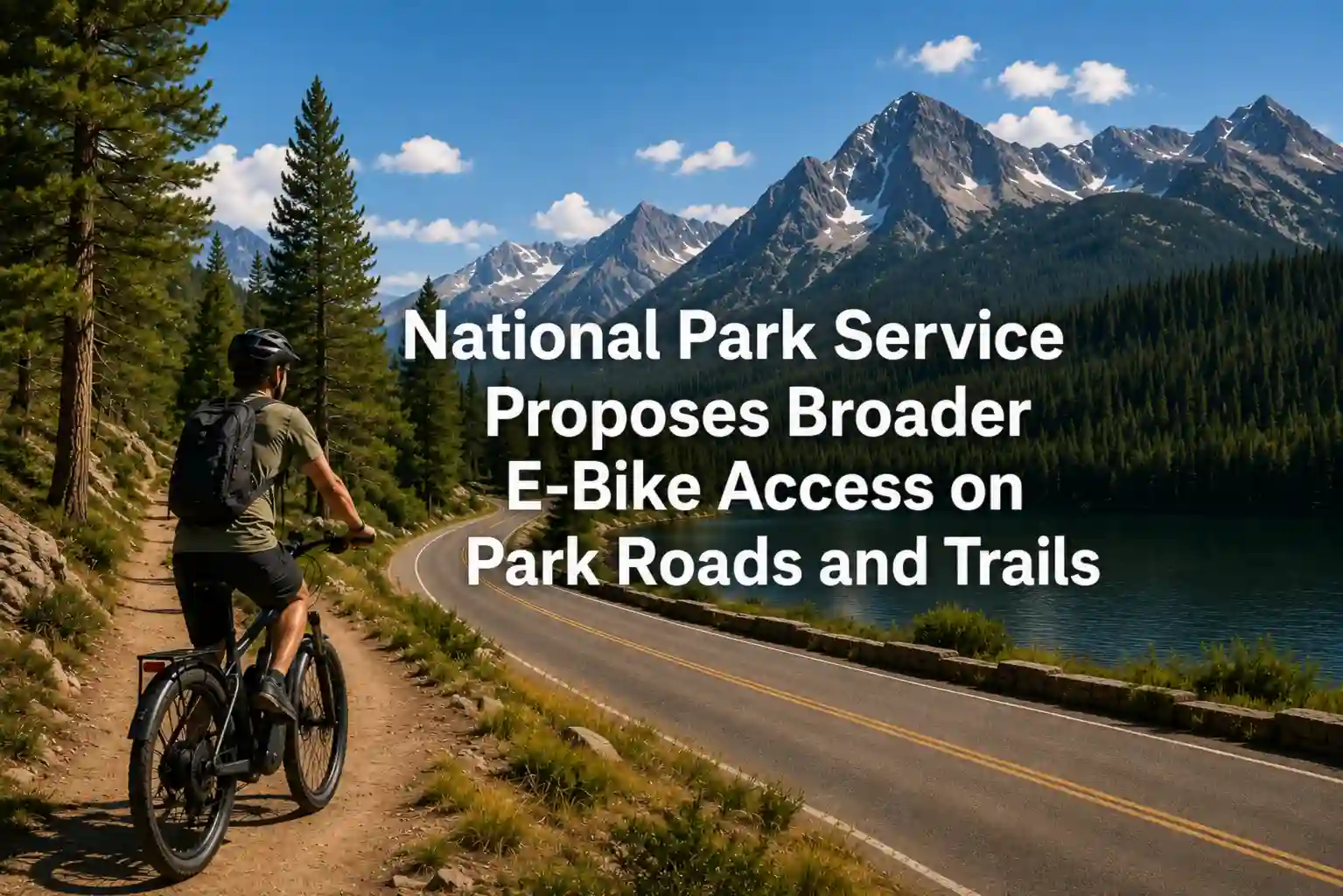
National Park Service Proposes Broader E-Bike Access on Park Roads and Trails
Last Updated on September 2, 2026 by Kristina
WASHINGTON – September 2, 2026: The National Park Service has proposed a major change to the way bicycles and electric bikes are allowed on roads and trails across the National Park System.
If finalized, the rule would establish a default allowing e-bikes on park roads and in parking areas already open to public motor vehicles, unless another applicable restriction or closure applies. It would also simplify the process park officials use to open additional trails and administrative roads to bicycles and e-bikes. Riders planning a park trip can also use my E-Bike Trail Access Checker to check current access before riding.
The proposal does not mean every trail in every national park would suddenly be open to electric bikes. Trail access would still depend on park-specific decisions, safety considerations, resource protection, state law, and other applicable restrictions. Riders can also review the State-by-State E-Bike Law Guide for additional legal information.
The National Park Service announced the proposal on August 31, 2026, and the proposed rule was published in the Federal Register on September 1. The public can submit comments through November 2, 2026.
You can follow the latest electric bike news and regulatory updates as this proposal moves through the federal rulemaking process.
Current Status: This Is a Proposed Rule
The most important thing for riders to understand is that these changes are not yet in effect.
The National Park Service is taking public comments on the proposal before making a final decision. Comments must be received by 11:59 p.m. ET on November 2, 2026.
The proposal is identified as RIN 1024-AE97 and is titled Bicycle Use in Park Areas.
Until a final rule is adopted and takes effect, riders should continue following each park’s current e-bike rules, posted signs, superintendent’s compendium, and applicable state laws.
What Would Change for E-Bikes on National Park Roads?
One of the most significant changes involves park roads and parking areas.
Under the proposed language, bicycles and electric bicycles would be allowed on park roads and in parking areas that are otherwise open to motor vehicle use by the general public, unless another applicable restriction or closure applies.
Traditional bicycles already generally have that baseline access. The meaningful change is for e-bikes.
The National Park Service explains that the proposal would remove the current need for a park superintendent to take affirmative action to specifically designate those roads and parking areas for e-bike use.
In practical terms, that could make the rule easier for riders to understand. If a park road is open to cars, an e-bike would generally begin from the same access baseline unless another restriction applies.
That still would not prevent a superintendent from closing or restricting a particular road or area when necessary.
Would the Proposal Open More National Park Trails to E-Bikes?
Potentially, but not automatically.
The proposal would simplify the administrative process used when a superintendent wants to allow bicycles or e-bikes on additional locations such as trails or administrative roads.
Current NPS bicycle regulations can require several procedural steps, including environmental documents, park planning documents, written determinations, regional approval, and in some circumstances Federal Register proceedings.
The National Park Service argues that those requirements can be unnecessarily burdensome for relatively minor decisions, such as allowing bicycle use on an existing paved trail that requires little or no modification.
The proposed rule would give superintendents more flexibility to designate appropriate locations while continuing to require additional review where federal law or the significance of the decision calls for it.
Environmental Review Would Not Simply Disappear
This is an important distinction because the proposal removes some automatic procedural requirements, but it does not eliminate the National Environmental Policy Act or the National Park Service’s responsibility to protect park resources.
Existing NPS bicycle regulations require an environmental assessment or environmental impact statement for certain bicycle-related actions even when that level of review might not otherwise be required under federal environmental law.
The proposed rule would remove that blanket requirement and allow the agency to use other NEPA compliance pathways, including categorical exclusions when appropriate.
If a project has environmental effects significant enough to require an environmental assessment or environmental impact statement under federal law, that review could still be required.
The National Park Service says the goal is to make the amount of review fit the actual scope and potential impact of the decision rather than automatically requiring the same process for every bicycle-access proposal.
Some Trail Decisions Would Still Require Federal Rulemaking
The proposed rule would not give superintendents unlimited authority to open any trail immediately.
Federal Register rulemaking would still be required in at least two important situations.
- Significant or highly controversial designations: A proposal meeting the significance criteria under NPS regulations would still require rulemaking.
- Locations that have never been improved with artificial or processed materials: Rulemaking would also be required before bicycles or e-bikes could be allowed in these locations.
The proposed rule lists examples of artificial or processed materials including gravel, asphalt, concrete, steel rail lines, wood boards, soil cement, and resin-based materials.
That distinction could matter for old rail corridors, paved paths, gravel trails, and truly undeveloped natural-surface areas.
Wilderness Areas Would Remain Off-Limits
The proposal would preserve the existing prohibition on possessing a bicycle or electric bicycle in a wilderness area established by federal statute.
That means the rule should not be interpreted as opening designated wilderness to e-bike riding or even allowing bicycles to be brought into those areas where the prohibition applies.
National parks also contain many different types of roads, paths, trails, wilderness areas, historic sites, and other managed spaces. An e-bike being allowed in one part of a park does not necessarily mean it is allowed everywhere else within that same park.
Park Superintendents Could Still Restrict E-Bikes
Local park management would remain an important part of the system.
Under the proposal, superintendents could continue to limit, restrict, place conditions on, or close areas to bicycle and e-bike use after considering factors such as:
- Public health and safety
- Natural-resource protection
- Cultural-resource protection
- Other park management activities and objectives
The proposal also limits how some closures could become permanent. Certain permanent closures of roads, parking areas, or locations that were originally designated through formal rulemaking would have to be established through a special regulation rather than remaining indefinitely through an administrative closure alone. The proposal includes an exception for certain road or parking-area closures resulting from applicable state law.
This means riders would still need to pay attention to the rules for the individual park they are visiting rather than assuming one national policy overrides every local restriction.
Class 2 E-Bike Throttle Restrictions Would Remain
The proposal also preserves a rule that is particularly important for riders using Class 2 e-bikes.
Except in places where public motor vehicles are allowed, riders generally could not use the electric motor exclusively to propel an e-bike for an extended period of time.
In other words, having a throttle-equipped Class 2 e-bike would not necessarily mean a rider could travel for an extended period using throttle power alone on a bicycle trail.
The National Park Service says this restriction is intended to keep e-bike use in those locations more similar to traditional bicycle recreation.
State E-Bike Laws Would Still Matter
The proposed federal rule would not replace state e-bike law.
The National Park Service says applicable state law would continue to govern bicycle and e-bike operation except where NPS regulations provide otherwise.
That is particularly important because states differ on e-bike classifications, throttle operation, equipment requirements, age restrictions, helmet requirements, and other rules.
A bike that legally qualifies as an e-bike in one jurisdiction may be classified differently somewhere else, especially if it has been modified or exceeds the state’s motor-power or assisted-speed limits.
Why Is the National Park Service Proposing the Change?
The National Park Service says bicycling is the most popular form of active recreation in the National Park System after hiking and walking.
The agency also points to e-bikes as a way to reduce the physical demands of cycling for people affected by age, illness, disability, fitness limitations, steep terrain, or high elevation.
According to the Federal Register notice, the agency believes easier bicycle access can also help connect parks with gateway communities, reduce some vehicle congestion, and support nearby businesses.
On the regulatory side, the agency argues that current bicycle-specific procedures sometimes require more documentation and administrative work than federal law would otherwise require.
The proposal is part of a broader federal effort under the Trump administration to review recreation-access regulations and remove requirements the administration considers unnecessary.
What Would Not Change?
Several important protections would remain even if the proposal becomes final.
- Bicycles and e-bikes would still be prohibited in federally designated wilderness areas where the possession prohibition applies.
- Superintendents could still impose safety and resource-protection restrictions.
- State law would continue to apply unless NPS regulations provide otherwise.
- Riders could not simply leave designated roads, parking areas, or approved locations and ride wherever they want.
- Existing lighting and other bicycle safety requirements would remain.
- Extended throttle-only riding would remain restricted in places where public motor vehicles are not allowed.
- Some new trail designations would still require formal Federal Register rulemaking.
How Riders Can Comment on the Proposal
The public comment period runs through November 2, 2026, at 11:59 p.m. ET.
The easiest way to find the proposal is through the federal rulemaking system and search for RIN 1024-AE97 or the title Bicycle Use in Park Areas.
The Federal Register page also provides a direct public-comment option.
People submitting comments should remember that comments filed in the federal docket become part of the public rulemaking record, and information included in a submission may be publicly visible.
What Happens Next?
The National Park Service will review public comments before deciding whether to move forward with a final rule.
The final version could remain substantially similar to the proposal, be modified in response to comments or agency review, or potentially not be finalized at all.
If a final rule is issued, the agency will publish the final regulatory text and an effective date.
Until then, nothing in this proposal should be treated as permission to ride an e-bike on a road or trail where it is currently prohibited.
📰 How This Story Was Verified
This report is based on available official documents, agency statements, meeting records, court filings, or other primary sources, with reliable reporting used for additional context. I clearly distinguish proposals from rules that have been finally approved or taken effect.
For this story, I reviewed the National Park Service’s August 31, 2026 announcement and the proposed rule published in the Federal Register on September 1, 2026.
My Take
I think the biggest thing riders should take away from this proposal is that it is about both access and process.
The headline change is easier e-bike access on park roads already open to cars, but the longer-term impact could come from making it simpler for individual parks to consider additional bicycle and e-bike routes without going through the same administrative process for every minor project.
That could create useful new riding opportunities, particularly on paved paths, gravel routes, former rail corridors, and connections between parks and nearby communities.
At the same time, I do not think riders should read this as a nationwide green light for every national park trail. Wilderness restrictions, park-specific closures, state laws, safety concerns, and resource protections would still matter.
If this rule becomes final, the details at the individual-park level will be just as important as the national regulation itself. I will be watching for the final rule and for parks that begin changing their e-bike access policies under the new framework.
Sources
- National Park Service – National Park Service Proposes Rule to Expand Bicycle and E-Bike Access in National Parks, August 31, 2026
- Federal Register – Bicycle Use in Park Areas, September 1, 2026, RIN 1024-AE97
E-bike rules can change and individual parks may impose additional restrictions. Check current National Park Service guidance, individual park rules, posted signs, and applicable state law before riding.

Kristina is not just an enthusiast but a true authority on electric bikes. Nestled in the coastal beauty of Virginia, Kristina has found the perfect backdrop for her passion for electric biking. As a dedicated wife and homeschooling mom, her life revolves around family, faith, and the thrill of adventure.
Originally hailing from Ohio, Kristina's journey with electric bikes began as a curiosity and quickly evolved into a deep expertise. Her blog is a testament to her love for electric biking, combining her fascination for eco-friendly transportation with her coastal lifestyle.
When she's not cruising the beach on her electric bike, you'll find Kristina indulging in her other loves: long walks along the shore, getting lost in a good book, and cherishing moments with her loved ones. With a heart as big as her love for animals, especially cats, Kristina brings a unique perspective to the electric bike world, grounded in her strong faith in God and her dedication to a sustainable lifestyle.
Through her blog, Kristina shares her extensive knowledge of electric bikes, offering valuable insights, tips, and recommendations to fellow enthusiasts. Whether you're a seasoned rider or a newcomer to the electric bike scene, Kristina's blog is your go-to source for all things electric biking, fueled by her passion, expertise, and the scenic beauty of coastal Virginia.