Utah Reminds Families of Under-21 E-Bike Helmet Law as School Resumes
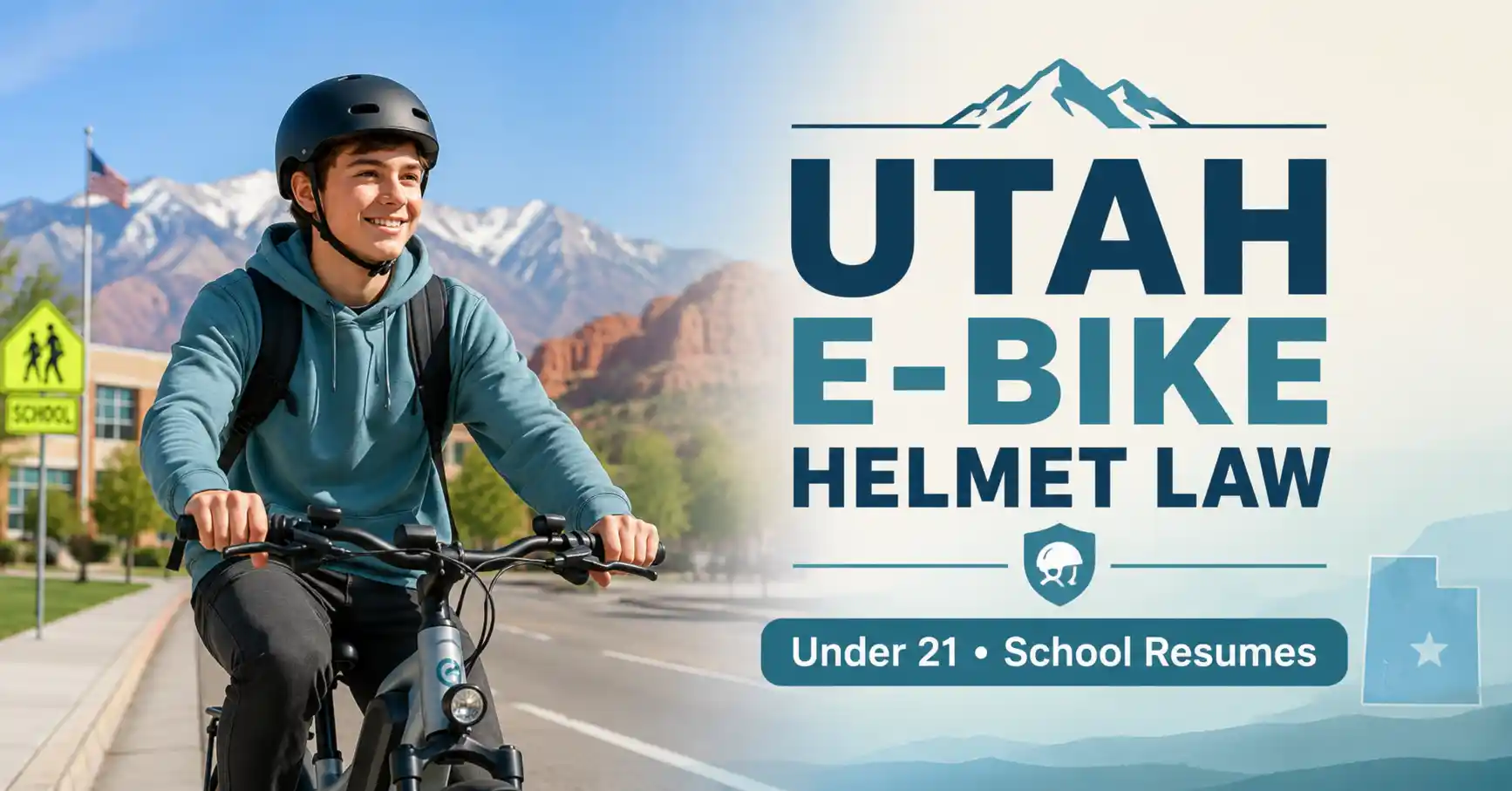
SALT LAKE CITY, Utah – August 31, 2026: Utah officials are reminding families about the state’s expanded e-bike helmet law as students return to school, including a requirement that riders under 21 generally wear qualifying protective headgear when riding an electric-assisted bicycle on a highway.
The helmet rule has been in effect since May 6, 2026, but the back-to-school season is bringing renewed attention to it as more children and teenagers use e-bikes and electric scooters for transportation. My Utah e-bike laws guide covers the state’s classes, age restrictions, sidewalks, trails, and other current riding rules in more detail.
Parents looking for protective gear can also review my e-bike helmet guide. For ongoing law, safety, recall, and industry developments, see the latest Electric Bike News coverage.
Current Status: Utah’s Under-21 Helmet Rule Is Already in Effect
Utah House Bill 381 made several significant changes to the state’s electric-mobility laws. Most of the legislation took effect May 6, 2026, including the expanded helmet requirement.
Under Utah Code Section 41-6a-1505, an individual under 21 may not operate or ride an electric-assisted bicycle on a highway unless the individual is wearing protective headgear that meets the applicable standard.
That means the rule is not limited only to the person controlling the e-bike. The statute uses the words “operate or ride,” so a passenger under 21 can also be covered.
This is also broader than Utah’s previous e-bike helmet requirement. Before the 2026 change, the statewide under-21 requirement applied to Class 3 e-bikes. The amended statute now covers electric-assisted bicycles generally.
What Does Utah Mean by “Highway”?
The word “highway” can make the new requirement sound narrower than it actually is.
Under the Utah Vehicle Code, a highway is generally the full width of a public way or place that is open as a matter of right for vehicular travel. That includes ordinary public streets and roads – not just interstates or high-speed highways.
Utah also defines a bicycle lane as a portion of a highway designated for bicycle, e-bike, and motor-assisted-scooter traffic. So riders should not assume that entering a marked bike lane removes the helmet requirement.
Which E-Bike Riders Have to Wear a Helmet?
For a legal electric-assisted bicycle, the simplest rule is:
- Under 21: Qualifying protective headgear is generally required when operating or riding an e-bike on a highway.
- Age 21 and older: Utah does not impose the same statewide e-bike helmet mandate under Section 41-6a-1505, although a school, campus, employer, rental company, park, event, or property owner may have additional requirements.
For ordinary e-bikes, Utah incorporates the federal bicycle helmet standard in 16 C.F.R. Part 1203.
Utah’s Highway Safety Office separately advises riders of high-powered electric devices and electric motorcycles under 21 to use helmets meeting the federal motorcycle standard, FMVSS 218. Those vehicles are legally different from ordinary Class 1, Class 2, and Class 3 e-bikes.
There Is a Limited Class 1 Rental Exception
The law includes a narrow exception that could easily be overlooked.
The helmet section does not apply to an individual operating a Class 1 electric-assisted bicycle rented from a business or corporate entity.
I would not read that as a broad exemption for rental bikes or every person riding one. The statutory exception specifically refers to the individual operating the rented Class 1 e-bike.
It also does not create a general exception for personally owned Class 1 bikes.
What Is the Fine for Riding Without a Helmet?
A violation of Utah’s helmet section is an infraction.
For an individual violating the helmet requirement while operating an electric-assisted bicycle or motor-assisted scooter, the court may not impose a fine greater than $25.
The maximum is higher for motorcycles and high-powered electric devices, where the statute allows a fine of up to $110.
Utah’s Current E-Bike Age Rules for Children
The helmet requirement is only one part of Utah’s youth e-bike law.
Under the law currently in effect through May 4, 2027:
- Under age 8: A child may not operate an electric-assisted bicycle with the electric motor engaged on public property, a highway, path, or sidewalk.
- Ages 8 through 13: A rider may operate an e-bike with the motor engaged in those areas only while under the direct supervision of a parent or guardian.
- Ages 14 and 15: The current under-14 supervision restriction no longer applies, but the rider still may not operate a Class 3 e-bike.
- Under age 16: A rider may not operate a Class 3 electric-assisted bicycle under the current version of Utah Code Section 41-6a-1115.5.
- Under age 21: The statewide helmet rule generally applies when riding on a highway.
There is an important source discrepancy here. Utah’s Highway Safety Office currently summarizes the existing supervision rule as applying to children “ages 8 to 14.” However, the controlling Utah statute says an individual under 14 years old needs direct parental or guardian supervision when riding with the motor engaged in the listed public areas.
For the current statewide legal requirement, I am relying on the statutory language. That means the existing supervision provision covers riders ages 8 through 13, while the separate under-16 Class 3 restriction remains in effect.
Police Can Temporarily Hold an E-Bike After Certain Youth Violations
HB 381 also gave law enforcement another tool involving riders under 18.
If a peace officer observes someone under 18 commit a violation of Utah’s traffic chapter while operating a personal electric vehicle, the officer may temporarily hold the vehicle.
If that happens, the law says the vehicle may be released only to the young rider’s parent or guardian.
This provision applies to more than ordinary e-bikes because Utah’s definition of a personal electric vehicle also includes certain high-powered electric devices and motor-assisted scooters.
Utah Officials Are Emphasizing the Law as Students Return to School
The renewed attention comes as e-bikes and electric scooters have become increasingly common transportation for Utah students.
KSL reported on August 27 that Herriman police and the Utah Department of Public Safety were reminding parents and students about the state’s new requirements during the back-to-school period.
The Utah Highway Safety Office is encouraging parents to check what kind of device their child is actually riding, make sure the rider has an appropriate helmet, and avoid aftermarket modifications that increase speed or power.
That distinction between e-bikes and higher-powered electric vehicles matters because a motorcycle-style electric machine marketed casually as an “e-bike” may fall outside Utah’s legal electric-assisted-bicycle definition.
Utah Is Reporting Concerning Youth E-Bike Injury Trends
Utah safety officials and health providers are also reporting concerning injury trends. Intermountain Health says its emergency departments treated 536 young patients injured while riding bicycles or scooters in 2025, and only 38% reported wearing a helmet.
More specifically for e-bikes, Intermountain’s Primary Children’s Hospital campuses reported a nearly 67% increase in e-bike-related injuries among children and teenagers in a single year.
The Utah Highway Safety Office currently describes the 536 figure as e-bike and e-scooter injuries, while Intermountain’s own release describes those patients more broadly as bicycle and scooter riders. Because the two official sources characterize that figure differently, I would not treat 536 as a confirmed e-bike-specific injury count.
Those figures do not by themselves establish the cause or severity of individual crashes, but they help explain why Utah lawmakers and safety officials are focusing on youth helmet use, rider education, device classification, and high-speed modifications.
More Youth Rules Arrive in May 2027
This is another important distinction: Utah’s future safety-certificate requirement is not in effect yet.
Beginning May 5, 2027, Utah will introduce a personal electric vehicle safety education and training program.
Under the enacted law, riders who are at least 8 but younger than 16 generally will not be allowed to operate a covered personal electric vehicle on a highway unless they:
- Obtain a Utah personal electric vehicle safety certificate, or
- Ride under direct supervision of a parent or responsible adult.
The Utah Department of Public Safety must make the program available online and may charge an application fee of no more than $10.
Riders younger than 8 will remain prohibited from operating a personal electric vehicle on a highway, and riders younger than 16 will not be permitted to operate a high-powered electric device on a highway.
The 2027 framework changes some of today’s youth rules, which is why parents should not assume the current supervision and Class 3 provisions will remain word-for-word the same next year.
What Counts as a Legal Utah E-Bike?
Before applying the helmet and age rules, it is worth confirming that the vehicle really qualifies as an electric-assisted bicycle.
Utah generally requires an electric-assisted bicycle to have:
- An electric motor with output of no more than 750W.
- Fully operable pedals.
- Permanently affixed cranks installed when originally manufactured.
- The ability to operate as a bicycle without the motor.
- Operating characteristics that fit Utah’s Class 1, Class 2, Class 3, or programmable e-bike framework.
A device that exceeds Utah’s legal e-bike definition can instead fall under motorcycle, high-powered electric-device, or another motor-vehicle category with different licensing, equipment, insurance, access, and helmet rules.
If you travel outside Utah, my state-by-state e-bike law guide can help you compare the rules because helmet and youth requirements vary considerably across the country.
What Parents Should Check Before a Child Rides to School
Before sending a child or teenager to school on an e-bike, I would check five things:
- Confirm the device is actually a legal e-bike. Do not rely only on the manufacturer’s marketing name.
- Check the class. Utah currently prohibits riders under 16 from operating a Class 3 e-bike.
- Use an appropriate helmet. Riders under 21 generally need qualifying protective headgear on public roads.
- Know the current supervision rule. Riders under 14 currently need direct parental or guardian supervision when operating an e-bike with the motor engaged in the public locations listed by statute.
- Check school and local rules. A city, school district, campus, park, or trail manager may impose additional riding, speed, parking, or helmet requirements.
📰 How This Story Was Verified
This report is based on available official documents, agency statements, meeting records, court filings, or other primary sources, with reliable reporting used for additional context. I clearly distinguish proposals from rules that have been finally approved or taken effect.
For this story, I reviewed Utah Code Sections 41-6a-1505 and 41-6a-1115.5, the enrolled version of H.B. 381, Utah Highway Safety Office guidance, Intermountain Health injury information, and current Utah reporting on the back-to-school safety reminder.
My Take
I think the most useful part of Utah’s new law is that it forces parents and riders to look beyond the word “e-bike.” A 20 mph Class 1 bike and a motorcycle-style electric machine capable of much higher speeds are not the same vehicle, even when both are advertised online with similar terminology.
The under-21 helmet rule is also relatively simple compared with some of the other youth provisions: if you’re younger than 21 and riding a legal e-bike on a Utah public road, plan on wearing a qualifying helmet.
The confusing part is the transition to the 2027 safety-certificate system. Parents need to distinguish the rules that apply now from the ones scheduled to start May 5, 2027. I would not rely on a social-media summary or an old school handout when deciding what a young rider can legally operate.
And regardless of the $25 maximum e-bike helmet fine, the bigger issue is injury prevention. With Utah hospitals reporting a sharp rise in youth e-bike injuries, a properly fitted helmet, a correctly classified bike, and basic road-riding education matter far more than avoiding a citation.
Sources
- Utah Code Section 41-6a-1505 – Protective headgear requirements
- Utah Code Section 41-6a-1115.5 – Current e-bike age and operating restrictions
- Utah Legislature – Enrolled H.B. 381, Electric Mobility Device Amendments
- Utah Highway Safety Office – E-Bike Safety
- KSL – Back-to-school reminder about Utah’s new e-bike law
- Intermountain Health – Youth bicycle, scooter, and e-bike injury information
This article is for general informational purposes and is not legal advice. Utah e-bike rules can change, and cities, schools, campuses, parks, trails, and property managers may impose additional requirements. Confirm current rules for the place where you plan to ride.

Kristina is not just an enthusiast but a true authority on electric bikes. Nestled in the coastal beauty of Virginia, Kristina has found the perfect backdrop for her passion for electric biking. As a dedicated wife and homeschooling mom, her life revolves around family, faith, and the thrill of adventure.
Originally hailing from Ohio, Kristina's journey with electric bikes began as a curiosity and quickly evolved into a deep expertise. Her blog is a testament to her love for electric biking, combining her fascination for eco-friendly transportation with her coastal lifestyle.
When she's not cruising the beach on her electric bike, you'll find Kristina indulging in her other loves: long walks along the shore, getting lost in a good book, and cherishing moments with her loved ones. With a heart as big as her love for animals, especially cats, Kristina brings a unique perspective to the electric bike world, grounded in her strong faith in God and her dedication to a sustainable lifestyle.
Through her blog, Kristina shares her extensive knowledge of electric bikes, offering valuable insights, tips, and recommendations to fellow enthusiasts. Whether you're a seasoned rider or a newcomer to the electric bike scene, Kristina's blog is your go-to source for all things electric biking, fueled by her passion, expertise, and the scenic beauty of coastal Virginia.