Orange Beach Adopts New E-Bike Rules With 15 MPH Path Limit and E-Moto Restrictions
Last Updated on September 2, 2026 by Kristina
ORANGE BEACH, Ala. – September 2, 2026: Orange Beach has adopted new rules for bicycles, e-bikes, scooters, and higher-powered electric motorcycles after months of City Council discussion over speeding, pedestrian conflicts, and the growing number of electric devices using local paths and trails.
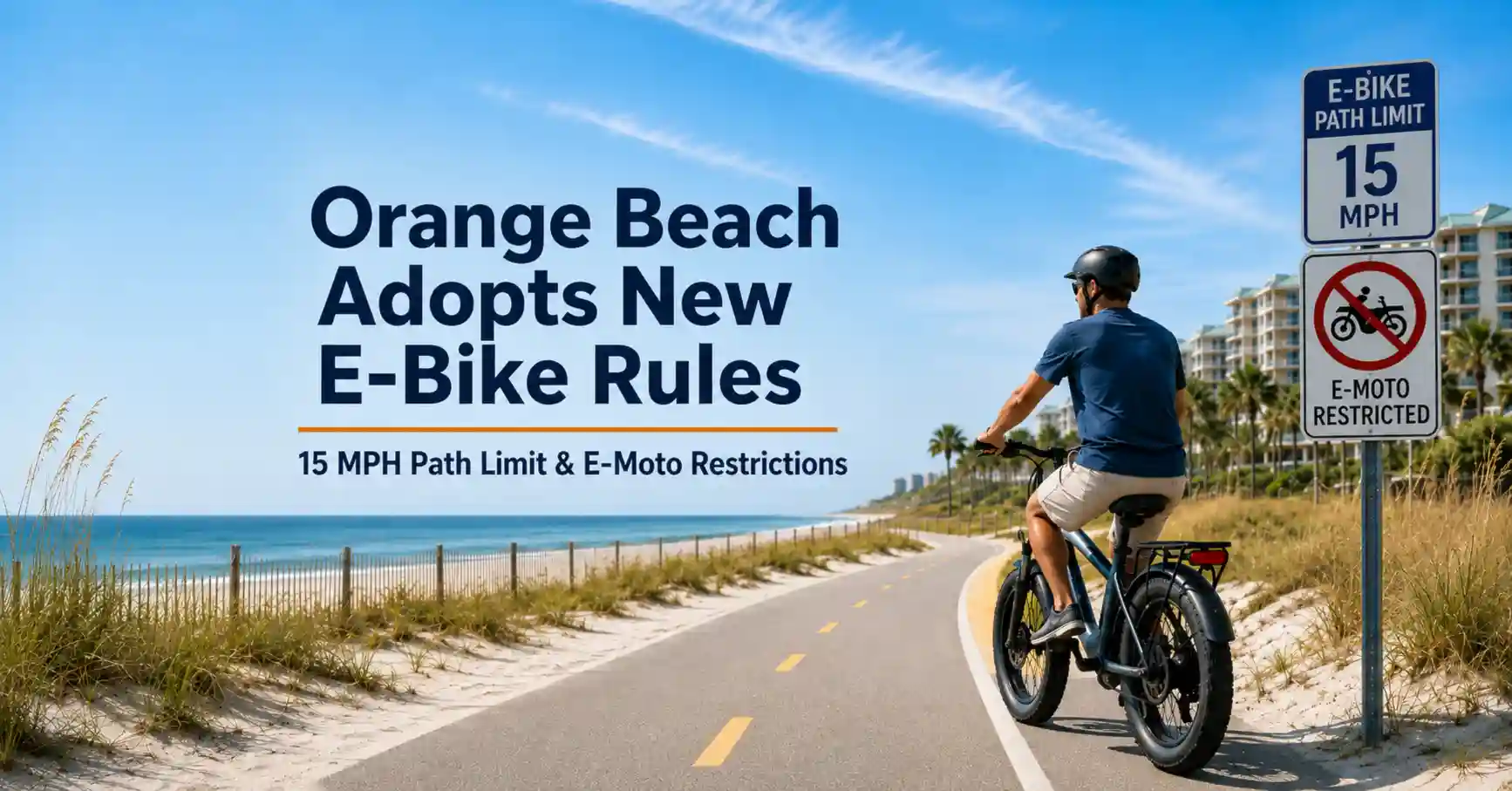
Post-vote local reporting says the updated Orange Beach e-bike rules include a 15 mph limit on sidewalks and multi-use or multimodal paths and a 12 mph limit on the Hugh S. Branyon Backcountry Trail. Riders should also review my Alabama Electric Bike Laws guide because state law still determines whether a device legally qualifies as an e-bike or falls into another vehicle category.
Post-vote reporting also says riders must slow around pedestrians, give an audible warning before passing, and follow an under-16 helmet requirement. Higher-powered e-moto-style vehicles face much stricter access rules than conventional e-bikes.
You can follow the latest Electric Bike News coverage as more cities adopt local rules aimed at separating conventional e-bikes from faster electric motorcycles and other high-powered devices.
Current Status: Orange Beach Adopted the New Rules September 1
The Orange Beach City Council had the bicycle and micromobility ordinance on its September 1 regular-meeting agenda under unfinished business after previously delaying action in August.
The proposal had originally been introduced July 21. The council postponed a scheduled August 4 adoption vote so members could review the rules in more detail and discussed the ordinance again during an August 18 work session.
Local reporting published September 2 says the council adopted the new rules, including a 15 mph path limit that is lower than the 20 mph limit contained in earlier ordinance drafts.
As of September 2, however, the city had not yet posted the final signed ordinance in its online ordinance library or Municode. Because of that, Electric Bike Explorer has not independently confirmed the final ordinance number or effective date.
Post-Vote Reporting Says the Path Limit Is 15 MPH
The biggest day-to-day change for many riders is the new reported speed limit.
September 2 local reporting says bicycles and micromobility devices are limited to 15 mph on sidewalks and multi-use or multimodal paths.
That is important because ordinance drafts circulated before the final vote listed a 20 mph limit on multi-use paths. During the August review process, city officials discussed lowering that proposed limit to 15 mph.
Until Orange Beach posts the final signed ordinance, riders should rely on current city guidance, posted signs, and the most recent official or post-vote information rather than older draft language.
The Backcountry Trail Limit Is 12 MPH
The Hugh S. Branyon Backcountry Trail has a 12 mph speed limit.
That figure is independently supported by the trail’s published rules, which list a 12 mph maximum and tell riders that the trail is not intended for high-speed road training.
The trail network extends through Orange Beach, Gulf Shores, and Gulf State Park, so riders should remember that a city ordinance does not necessarily replace rules imposed by the agency or land manager responsible for a particular section.
Check posted trail rules before riding, especially when moving between city property and state-park-managed areas.
Riders Must Slow Near Pedestrians
The reported rules are not based only on a maximum path speed.
Post-vote local reporting says riders must slow to 10 mph or less when approaching within 50 feet of a pedestrian.
Earlier ordinance drafts also required riders on sidewalks and multi-use paths to slow to 10 mph or less while passing pedestrians and other path users.
That means even a rider traveling below the normal reported 15 mph path limit may still need to slow further when people are nearby.
An Audible Warning Is Required Before Passing
Orange Beach also wants riders to communicate before overtaking pedestrians or other riders.
Post-vote reporting says riders must provide an audible warning before passing from behind.
Earlier ordinance language allowed warnings such as a bell, horn, whistle, or verbal call before passing. Because the final signed ordinance has not yet been posted, I am not assuming every detail of that earlier wording remained unchanged.
The basic safety idea is straightforward: riders should alert people before overtaking them on a shared path.
Under-16 Helmet Requirement Remained in the Adopted Rules
The pre-vote ordinance required operators and passengers under age 16 to wear properly fitted and fastened helmets.
Post-vote reporting confirms that an under-16 helmet requirement remained in the adopted rules, although the final signed ordinance has not yet been posted online for independent review of the exact passenger language.
Parents visiting Orange Beach with children should not assume Alabama’s statewide rules are the only requirements that apply. Cities can impose additional local restrictions in areas under their control.
Higher-Powered E-Motos Face Much Stricter Rules
One of the most important parts of the Orange Beach ordinance is the distinction between conventional e-bikes and faster electric motorcycles commonly described as e-motos.
The latest pre-vote ordinance text available for review defined an electric motorcycle as a device with a motor of at least 750 W that is also capable of speeds greater than 28 mph.
Because the final signed ordinance has not yet been posted online, I am using that definition as the latest available ordinance text rather than assuming the final wording remained identical.
Post-vote reporting says higher-powered electric motorcycles are treated much more like motor vehicles and are restricted from sidewalks, shared paths, trails, parks, and similar pedestrian areas.
This distinction matters because an electric vehicle can look similar to a fat-tire or moped-style e-bike while operating well outside normal e-bike performance limits.
If you are unsure how common e-bike categories work, my Class 1, Class 2, and Class 3 e-bike guide explains the differences.
Alabama’s State E-Bike Definition Still Matters
Orange Beach’s local rules sit on top of Alabama state law.
Alabama defines an electric bicycle as a bicycle with fully operable pedals, a seat or saddle, and an electric motor of less than 750 W, while also using the Class 1, Class 2, and Class 3 speed framework.
That means riders should not assume that every two-wheeled electric device with pedals is automatically an e-bike.
Motor power, assisted speed, throttle capability, pedals, and the applicable state and local definitions all matter.
Calling an E-Moto an E-Bike Does Not Change Its Legal Category
Orange Beach is addressing a problem appearing in communities around the country: electric motorcycles and other high-powered devices are sometimes marketed or casually described as e-bikes even when their performance falls outside normal legal e-bike limits.
The label used by a seller or rider does not necessarily determine how the vehicle is treated under the law.
Riders with modified bikes should be particularly careful. Earlier versions of the Orange Beach ordinance also contained restrictions aimed at modifications that increase a device’s speed capability.
Until the final signed ordinance is available, riders should check both Alabama law and current Orange Beach guidance before assuming a modified or high-powered device is allowed on a sidewalk, trail, or shared path.
Orange Beach Also Tightened Rental-Business Rules
The September e-bike and micromobility ordinance should not be confused with a separate recreational-vehicle rental ordinance Orange Beach adopted on August 4, 2026.
The city’s official ordinance records identify that measure as Ordinance 2026-1542, which amended the city’s recreational-vehicle rental regulations.
Local reporting on that separate ordinance says businesses renting vehicles such as bicycles, e-bikes, scooters, and golf carts face requirements including a physical operating location within the city or its police jurisdiction and significant liability-insurance requirements.
The two measures are related because Orange Beach is regulating both how micromobility devices are operated and how rental businesses provide them, but they were adopted through separate ordinances.
Why Orange Beach Is Tightening the Rules
Orange Beach is a coastal tourism community where sidewalks, multi-use paths, and the Backcountry Trail can carry pedestrians, families, conventional cyclists, rental riders, e-bikes, scooters, and increasingly powerful electric vehicles.
City officials spent several meetings discussing how to manage the difference in speed and weight between those users.
The August work-session discussion specifically included reducing the proposed multi-use-path limit from 20 mph to 15 mph.
The resulting approach appears designed to allow ordinary bicycle and micromobility use while creating a sharper boundary for faster e-moto-style machines.
What About Fines and Enforcement?
Earlier ordinance drafts included significant penalties, including a possible fine of up to $500 and other enforcement provisions.
However, because Orange Beach had not yet posted the final signed September 1 ordinance through its online ordinance library when this story was prepared, I am not treating the earlier draft’s complete penalty language as confirmed final law.
Post-vote reporting says enforcement will focus on behaviors including excessive speed, unsafe passing, and reckless operation.
Riders should check the final published ordinance or current Orange Beach Police guidance for exact penalties once the city posts the signed text.
What Riders Should Do in Orange Beach
- Follow the reported 15 mph limit on city sidewalks and multi-use or multimodal paths where the new rule applies.
- Stay at or below 12 mph on the Hugh S. Branyon Backcountry Trail.
- Slow to 10 mph or less when approaching pedestrians within 50 feet.
- Give an audible warning before passing from behind.
- Follow the under-16 helmet requirement.
- Do not assume a high-powered e-moto can legally use an e-bike path simply because it has pedals or is marketed as an e-bike.
- Check posted rules for the specific trail, park, sidewalk, or state-park property you plan to use.
- Watch for the final signed Orange Beach ordinance because the official ordinance number, effective date, and complete penalty language were not yet posted as of September 2.
📰 How This Story Was Verified
This report is based on available official documents, agency statements, meeting records, court filings, or other primary sources, with reliable reporting used for additional context. I clearly distinguish proposals from rules that have been finally approved or taken effect.
For this story, I reviewed the City of Orange Beach’s September 1 City Council agenda, the city’s current ordinance listings, Alabama’s e-bike law, the Hugh S. Branyon Backcountry Trail’s published rules, ordinance language circulated before the final vote, and September 2 local reporting describing the council’s adopted rules.
As of September 2, the final signed riding ordinance had not yet appeared in Orange Beach’s online ordinance library or Municode. Where the final enacted text could not yet be independently reviewed, I have identified information as coming from post-vote reporting or from the latest available ordinance draft.
My Take
I think Orange Beach is dealing with two different problems that are often lumped together under the phrase “e-bike safety.”
A legal low-speed e-bike being ridden carefully on a shared path is not the same thing as a heavier electric motorcycle capable of much higher speeds. Treating those devices differently makes more sense to me than simply banning anything with an electric motor.
The pedestrian rule may ultimately matter just as much as the 15 mph speed limit. A rider traveling 15 mph can still be moving too fast when approaching a family walking side by side or a child suddenly changing direction on a crowded path.
The one thing I would like to see quickly is the city’s final signed ordinance posted online. Earlier drafts listed 20 mph for multi-use paths, while post-vote reporting says the adopted rule is 15 mph. Making the final text easy for residents, tourists, rental businesses, and police officers to find will help eliminate that kind of confusion.
Sources
- City of Orange Beach – September 1, 2026 City Council Meeting
- City of Orange Beach – City Ordinances
- Orange Beach Code of Ordinances – Municode
- Hugh S. Branyon Backcountry Trail – Trail Rules
- OBA – Orange Beach Changes Rules on E-Bikes and Micro Mobility Transportation, September 2, 2026
- Baldwin Citizen – Orange Beach E-Bike Ordinance Before the September 1 Adoption Vote
Local rules can change and may differ depending on who manages a particular sidewalk, trail, park, or roadway. Check current Orange Beach and land-manager guidance before riding.

Kristina is not just an enthusiast but a true authority on electric bikes. Nestled in the coastal beauty of Virginia, Kristina has found the perfect backdrop for her passion for electric biking. As a dedicated wife and homeschooling mom, her life revolves around family, faith, and the thrill of adventure.
Originally hailing from Ohio, Kristina's journey with electric bikes began as a curiosity and quickly evolved into a deep expertise. Her blog is a testament to her love for electric biking, combining her fascination for eco-friendly transportation with her coastal lifestyle.
When she's not cruising the beach on her electric bike, you'll find Kristina indulging in her other loves: long walks along the shore, getting lost in a good book, and cherishing moments with her loved ones. With a heart as big as her love for animals, especially cats, Kristina brings a unique perspective to the electric bike world, grounded in her strong faith in God and her dedication to a sustainable lifestyle.
Through her blog, Kristina shares her extensive knowledge of electric bikes, offering valuable insights, tips, and recommendations to fellow enthusiasts. Whether you're a seasoned rider or a newcomer to the electric bike scene, Kristina's blog is your go-to source for all things electric biking, fueled by her passion, expertise, and the scenic beauty of coastal Virginia.