Idaho E-Bike Laws (2026): Complete Guide to Electric Bike Regulations
Last Updated on July 3, 2026 by Kristina
Last Updated: July 2026
Planning to ride an electric bike in Idaho? Whether you’re commuting through Boise, cruising a paved path in Coeur d’Alene, riding around a college campus, or exploring Idaho’s scenic roads and trails, it’s important to understand the current Idaho e-bike laws before you head out.
The good news is that Idaho is one of the more e-bike-friendly states. Electric-assisted bicycles are generally treated much like traditional bicycles under state law, and qualifying e-bikes do not require a driver’s license, registration, license plate, title, or insurance.
However, Idaho e-bike regulations are not the same everywhere. Cities, parks, schools, universities, and public land managers can create additional rules for sidewalks, shared-use paths, bike lanes, trails, and campus areas.
This Idaho electric bike law guide explains:
- Idaho’s three e-bike classes
- Whether you need a license, registration, insurance, title, or plate
- Helmet and age rules
- Where electric bikes are allowed in Idaho
- Sidewalk and path rules
- Local city regulations
- School and university policies
- Trail access rules for parks and public lands
Just getting started with e-bikes? Our Start Here section brings together beginner guides, buying tips, safety basics, and helpful tools to make your first rides easier and less confusing.
Still deciding which electric bike to buy? Explore our Best Electric Bikes guide to compare today’s top models for commuting, recreation, off-road riding, and everyday use.
For a deeper look at what to consider before you buy, our Electric Bike Buying Guide explains e-bike styles, motors, batteries, riding position, comfort features, and the key details that matter most.
Idaho E-Bike Laws at a Glance
Idaho recognizes the standard three-class electric bike system. A qualifying Idaho electric-assisted bicycle must have fully operable pedals, an electric motor of less than 750 watts, and fit into Class 1, Class 2, or Class 3.
In general, compliant e-bikes in Idaho do not require a driver’s license, registration, title, license plate, or insurance.
Electric bikes may usually be ridden where traditional bicycles are allowed, including many roads, bike lanes, and multi-use paths, unless a local ordinance or posted public-agency sign says otherwise.
The most important thing to remember is this: Idaho state law gives e-bikes broad access, but local rules still matter.
Idaho E-Bike Rules: Key Takeaways
Modified or high-powered electric motorbikes may be treated differently than legal e-bikes.
Idaho recognizes Class 1, Class 2, and Class 3 electric-assisted bicycles.
A qualifying e-bike must have fully operable pedals and a motor of less than 750 watts.
Class 1 and Class 2 e-bikes assist up to 20 mph.
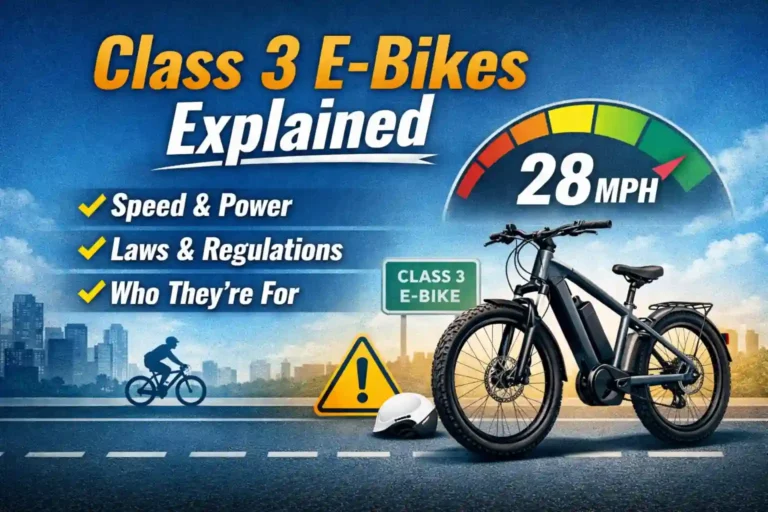
Class 3 e-bikes provide pedal assist up to 28 mph.
Qualifying e-bikes do not require a driver’s license, registration, title, license plate, or insurance.
Idaho does not appear to have a statewide e-bike helmet requirement.
I did not find a verified statewide minimum age requirement.
E-bikes may generally be ridden where bicycles are allowed unless a local ordinance or posted sign says otherwise.
Local rules matter, especially in cities, parks, trails, and college campuses.
Night riding requires a front light visible from 500 feet and a rear reflector.
🔍 Why You Can Trust Electric Bike Explorer
Electric Bike Explorer is dedicated to providing honest, well-researched, and easy-to-understand information for e-bike riders. Whenever possible, I personally test the e-bikes, accessories, and products I review. When I can’t test something directly, I rely on careful research, manufacturer specifications, real-world rider feedback, official sources, and trusted industry information.
For law guides, I review state statutes, local ordinances, transportation agencies, park rules, and official government resources whenever possible. For e-bike news, I review the original reporting along with available town documents, meeting agendas, proposed ordinances, police statements, government notices, and other primary sources. I also make a clear distinction between a proposal, an approved rule, and a law that has already taken effect.
For troubleshooting and safety guides, I focus on practical explanations, common rider experiences, manufacturer guidance, and safe maintenance practices.
My goal is to help you make informed decisions, understand the rules where you ride, solve common e-bike problems, and get the most out of your electric bike safely.
Want to know how I score bikes and research my guides? Read my full review and ranking process
How Idaho Defines an Electric Bike
Idaho law uses the term electric-assisted bicycle.
Under Idaho Code, an electric-assisted bicycle is a bicycle equipped with fully operable pedals and an electric motor of less than 750 watts that fits into one of Idaho’s three e-bike classes.
That “less than 750 watts” wording is important. Some e-bikes, electric motorbikes, and high-powered electric motorcycles may look similar, but they may not qualify as legal electric-assisted bicycles under Idaho law if they exceed the state definition.
This matters because a vehicle that does not qualify as an electric-assisted bicycle may be treated differently under motor vehicle laws.
Idaho’s Three E-Bike Classes
Idaho uses the familiar three-class e-bike system. This is the same basic structure used by many states, but local trail and city rules can still vary.
Class 1 Electric Bikes
A Class 1 e-bike provides motor assistance only when the rider is pedaling.
Class 1 e-bikes:
- Have fully operable pedals
- Provide pedal assist only
- Stop providing motor assistance at 20 mph
- Do not provide throttle-only power
Class 1 e-bikes are often the most accepted type of electric bike on shared-use paths and recreational trails, although local restrictions can still apply.
Class 2 Electric Bikes
A Class 2 e-bike can provide motor assistance without the rider pedaling.
Class 2 e-bikes:
- Have fully operable pedals
- May include a throttle
- Can assist without pedaling
- Stop providing motor assistance at 20 mph
Many commuter, folding, cruiser, and fat tire e-bikes fall into Class 2 because they include a throttle.
Class 3 Electric Bikes
A Class 3 e-bike provides pedal assistance up to a higher assisted speed.
Class 3 e-bikes:
- Have fully operable pedals
- Provide pedal assist
- Stop providing motor assistance at 28 mph
- Are often used for faster commuting
Because Class 3 e-bikes can assist up to 28 mph, some cities and trail systems restrict them more heavily than Class 1 or Class 2 e-bikes.
Not sure which class of e-bike you own? Our Understanding E-Bike Classes guide explains the differences between Class 1, Class 2, and Class 3 e-bikes in more detail.
Do You Need a Driver’s License to Ride an E-Bike in Idaho?
No. A qualifying electric-assisted bicycle in Idaho does not require a driver’s license.
Idaho Code Section 49-726 says electric-assisted bicycles are not subject to Idaho’s driver’s license requirements. It also states that an electric-assisted bicycle and its rider are not subject to Idaho Title 49 requirements for financial responsibility, driver’s licenses, titles, registration, and license plates.
This makes e-bikes a practical transportation option for commuters, students, older riders, and recreational cyclists who want an alternative to driving.
However, this only applies to vehicles that meet Idaho’s legal definition of an electric-assisted bicycle. High-powered electric motorbikes, electric motorcycles, mopeds, or modified vehicles may be treated differently.
Do You Have to Register an E-Bike in Idaho?
No. A qualifying Idaho electric-assisted bicycle does not need to be registered as a motor vehicle.
That means you do not need:
- Vehicle registration
- License plates
- A motor vehicle title
- Annual registration renewals
This is one reason electric bikes can be much less expensive to own than motorcycles, scooters, or cars.
Is E-Bike Insurance Required in Idaho?
No. Idaho does not require insurance for qualifying electric-assisted bicycles.
Under Idaho law, compliant electric-assisted bicycles and their riders are not subject to the state’s motor vehicle financial responsibility requirements.
That said, optional e-bike insurance may still be worth considering, especially if you own a higher-value electric bike. Some riders choose coverage for theft, crash damage, liability, or roadside assistance.
If you’re wondering whether optional coverage makes sense, read our complete E-Bike Insurance Guide
Are Helmets Required for E-Bikes in Idaho?
I did not find a statewide Idaho law requiring all e-bike riders to wear helmets.
The Bicycle Helmet Safety Institute’s e-bike helmet law summary lists Idaho as having no statewide e-bike helmet requirement.
Even so, wearing a properly fitted helmet is strongly recommended. Electric bikes can accelerate quickly and often travel at higher average speeds than traditional bicycles, especially on roads and shared-use paths.
Helmet rules may also vary by:
- City
- Park
- School
- University
- Organized event
- Rental company
- Private property owner
For example, a rental company or school campus may require helmets even if Idaho state law does not.
If you’re shopping for one, our Best E-Bike Helmets guide compares helmets designed for the higher speeds and riding conditions common with electric bikes.
Are There Age Restrictions for Riding an E-Bike in Idaho?
I did not find a verified statewide minimum age requirement for operating Class 1, Class 2, or Class 3 e-bikes in Idaho’s current state e-bike law materials.
Because some secondary sources conflict, it is best not to assume there is a statewide Idaho minimum age unless it is clearly stated in enacted Idaho law.
However, riders should still keep these practical rules in mind:
- Local governments may create additional restrictions.
- Schools and universities may set campus rules.
- Rental companies often require riders to be 16 or 18.
- Parents should carefully supervise younger riders.
- Class 3 e-bikes may be inappropriate for younger or inexperienced riders because of their higher assisted speed.
For families, this is especially important. Even when a child or teen is legally allowed to ride, the bike’s size, speed, weight, braking ability, and riding environment still matter.
Can Tourists Ride an E-Bike in Idaho?
Yes. Visitors can generally ride a qualifying electric-assisted bicycle in Idaho without needing a special Idaho license, registration, title, plate, or insurance.
Tourists still need to follow Idaho traffic laws and local riding rules.
Before bringing an e-bike to Idaho, check:
- The e-bike’s class
- Motor wattage
- Local city rules
- Park rules
- Trail access restrictions
- Campus rules if riding near a university
- Federal land rules if riding in national forests or on BLM land
This is especially important if you plan to ride in popular areas such as Boise, Coeur d’Alene, Idaho state parks, national forests, or multi-use trail systems.
Do E-Bikes Have the Same Rights as Regular Bicycles in Idaho?
Generally, yes.
Idaho law says electric-assisted bicycles may be ridden where bicycles are permitted, unless they are excluded by local ordinance or posted signage from the public agency with jurisdiction.
That means e-bike riders can generally use many of the same facilities as traditional bicyclists, including:
- Public roads
- Bike lanes
- Bicycle routes
- Shared roadways
- Many multi-use paths
However, local restrictions are very important. A city, park department, university, or land-management agency may limit certain classes of e-bikes in specific areas.
For example, Boise has special rules for Class 3 e-bikes on the Boise River Greenbelt, sidewalks, crosswalks, and bike lanes. We will cover those city-specific rules in Part 2.
2026 Idaho E-Bike Law Update
Idaho House Bill 500 was signed by the governor in March 2026 and became effective on July 1, 2026. The bill updated Idaho law to include electric-assisted bicycles in certain traffic-law provisions for bicycles and human-powered vehicles.
In plain English, Idaho continues to treat qualifying e-bikes much like bicycles, while also clarifying how e-bike riders fit into traffic-law responsibilities.
This is separate from Boise’s July 1, 2026 ordinance for high-powered electric motorbikes. The Idaho Transportation Department explained that Boise’s ordinance applies to high-powered e-motorbikes of 750 watts or more or capable of 28 mph or more, while state law for compliant e-bikes remains unchanged.
The main takeaway for riders is simple: make sure your vehicle actually qualifies as an Idaho electric-assisted bicycle. If it has too much power, has been modified beyond the legal e-bike definition, or functions more like an electric motorcycle, different rules may apply.
Where Can You Ride an E-Bike in Idaho?
Under Idaho state law, electric-assisted bicycles may generally be ridden where traditional bicycles are allowed, unless a local ordinance or posted public-agency sign excludes them.
This commonly includes:
- Public streets
- Bike lanes
- Bicycle routes
- Shared roadways
- Many multi-use paths
- Some local park paths
- Some paved recreational trails
However, e-bike access is not automatic everywhere.
Different rules may apply on:
- City sidewalks
- Downtown business districts
- City parks
- County parks
- Idaho state parks
- National forests
- Bureau of Land Management land
- Mountain bike trails
- University campuses
- Private trail systems
This is where riders often get confused. Idaho state law may allow e-bikes where bicycles are permitted, but a local rule or posted sign can still limit access.
Before heading out, use our E-Bike Trail Access Checker Tool to research general trail access, and always confirm with local signs or the agency managing the trail.
Idaho Rules of the Road for E-Bike Riders
Electric bike riders in Idaho generally need to follow the same traffic rules that apply to bicycle riders and other road users.
That means e-bike riders should:
- Ride in the same direction as traffic.
- Obey traffic signs and signals.
- Yield when required.
- Use hand signals when turning or stopping.
- Ride predictably.
- Use lights and reflectors when riding after dark.
- Exercise care around pedestrians, cyclists, and drivers.
Idaho law gives bicycle riders many of the same rights and duties as drivers when riding on the road, and Idaho House Bill 500 updated state law to include electric-assisted bicycles in certain traffic-law provisions. The bill was signed by the governor and became effective on July 1, 2026.
In simple terms, Idaho e-bike riders should treat the road seriously. Even when an e-bike does not require a driver’s license, registration, insurance, title, or license plate, the rider is still expected to operate safely and responsibly.
Do Idaho E-Bike Riders Have to Stop at Stop Signs?
Idaho is known for its bicycle stop law, often called the Idaho Stop. This rule allows bicycle riders, under certain circumstances, to treat a stop sign differently than a motor vehicle driver.
Because Idaho’s 2026 law update added electric-assisted bicycles to certain bicycle traffic-law provisions, e-bike riders should understand how these rules work. However, riders should still use caution and follow posted signs, local ordinances, and current Idaho law.
The safest way to think about it is this:
- Slow down when approaching a stop sign.
- Yield to traffic and pedestrians that have the right-of-way.
- Proceed only when it is safe.
- Stop fully when traffic conditions require it.
- Never assume a driver sees you.
At red lights, Idaho bicycle law includes special rules for bicycles after stopping and yielding, but e-bike riders should be especially careful at intersections. When in doubt, stop and wait for the signal like a motor vehicle.
Can You Ride an E-Bike on Idaho Sidewalks?
Idaho does not have one simple statewide rule that allows or bans e-bikes on every sidewalk.
Instead, Idaho’s bicycle sidewalk law says that a person riding a bicycle on a sidewalk or in a crosswalk must yield the right-of-way to pedestrians and give an audible signal before passing. It also says bicycles are not allowed on sidewalks or crosswalks where official traffic-control devices prohibit them.
Because Idaho electric-assisted bicycles may generally be ridden where bicycles are permitted unless excluded by local ordinance or posted signage, sidewalk rules often depend on the city or location.
When riding on a sidewalk where e-bikes are allowed:
- Ride slowly.
- Yield to pedestrians.
- Give an audible warning before passing.
- Watch for driveways and parking lot entrances.
- Be extra cautious near storefronts, schools, parks, and intersections.
- Obey signs that prohibit bicycle or e-bike riding.
This is especially important in downtown areas, where some cities may restrict sidewalk riding in business districts or high-foot-traffic zones.
Sidewalk rules can change from one Idaho city to another. Before riding on sidewalks or through downtown areas, read our E-Bike Sidewalk Riding Guide to understand when sidewalk riding is allowed, when it may be restricted, and how to ride safely around pedestrians.
Can You Ride an E-Bike in Idaho Bike Lanes?
In most situations, yes. Idaho electric-assisted bicycles may generally be ridden where bicycles are allowed, unless a local ordinance or posted public-agency sign excludes them.
That usually includes many public roads, bicycle routes, and bike lanes.
However, local rules can still matter. Boise, for example, has specific restrictions for Class 3 e-bikes on bike lanes, sidewalks, crosswalks, and the Boise River Greenbelt, which we cover in the city section of this guide.
When riding in a bike lane:
- Stay alert for opening car doors.
- Watch for turning vehicles.
- Use lights in low visibility.
- Avoid weaving between the bike lane and traffic.
- Do not assume drivers can judge your speed correctly.
- Use extra caution on Class 3 e-bikes because they can travel faster than many drivers expect from a bicycle.
Looking for an e-bike that works well for daily rides, errands, and city commuting? Check out our Best Commuter E-Bikes Guide to compare practical models built for everyday transportation.
Night Riding Requirements in Idaho
Idaho law requires bicycles used at night to have a front light and rear reflector.
A bicycle operated during required lighting times must have a light-emitting device visible from at least 500 feet to the front. The light may be attached to the bicycle or the rider. The bicycle must also have a reflector clearly visible from the rear.
For e-bike riders, I recommend going beyond the minimum requirement whenever possible.
Good night-riding equipment includes:
- A bright front headlight.
- A rear red reflector.
- A rear red light.
- Side reflectors or reflective tire strips.
- Reflective clothing or ankle bands.
- Brake lights if your e-bike has them.
- Turn signals if your e-bike is equipped with them.
E-bikes often travel faster than traditional bicycles, so visibility matters. Drivers, pedestrians, and other riders need enough time to see you and react.
Before a longer ride, our Complete E-Bike Maintenance Checklist can help you inspect your brakes, tires, lights, battery, and drivetrain.
Recommended Gear for Riding in Idaho
Whether you’re commuting through Boise, riding a shared-use path in Coeur d’Alene, exploring Idaho State Parks, or heading out on a longer scenic ride, the right gear can make your e-bike safer, more comfortable, and more practical. Here are a few accessories I recommend for most Idaho e-bike riders.
- Helmet – Protect your head with a properly fitted, CPSC-certified bicycle helmet, even if you’re not legally required to wear one.
- Front & Rear Bike Lights – Improve your visibility during early morning rides, evening commutes, and low-light conditions.
- Phone Mount – A sturdy handlebar phone mount can make it easier to follow maps, check your route, or use trail apps without having to stop and dig through a bag.
- Rear View Mirror – A handlebar or helmet-mounted mirror can help you keep an eye on traffic behind you, which is especially helpful when riding on roads, bike lanes, or narrow shoulders.
- Panniers or Rear Rack Bags – Panniers and bike bags are useful for carrying groceries, work items, jackets, tools, chargers, or extra layers without wearing a heavy backpack.
- Small Handlebar or Frame Bag – A compact bag gives you quick access to smaller items like keys, wallet, snacks, sunglasses, tire levers, or a portable charger.
- Heavy-Duty Bike Lock – Help protect your investment when stopping at stores, trailheads, or other public places.
- Mini Tire Pump & Flat Repair Kit – Be prepared for unexpected flats, especially if you’re riding longer distances.
- Compact Multi-Tool – Quickly tighten loose bolts or make minor adjustments while you’re away from home.
- High-Visibility Reflective Gear – Reflective vests, ankle bands, or jackets can help drivers see you sooner, especially at dawn, dusk, or in poor weather.
Are Bells or Horns Required on Idaho E-Bikes?
I did not find a statewide Idaho law requiring every e-bike to have a bell or horn.
However, Idaho’s sidewalk rule does require a bicycle rider to give an audible signal before passing a pedestrian or another bicyclist on a sidewalk or crosswalk.
That means a bell can be very helpful, especially if you ride on:
- Shared-use paths
- Greenways
- Sidewalks where riding is allowed
- Campus pathways
- Parks
- Busy recreational trails
A polite bell ring or a clear “passing on your left” can prevent confusion and make shared spaces safer for everyone.
Can You Ride an E-Bike on Idaho Trails?
Sometimes.
Under Idaho state law, electric-assisted bicycles may generally be used where bicycles are permitted, including multi-use paths, unless excluded by local ordinance or posted signage from the public agency with jurisdiction.
However, trail access depends heavily on who manages the land.
E-bike rules may be different on:
- City trails
- County parks
- Idaho state parks
- National forests
- Bureau of Land Management land
- Mountain bike trail systems
- Private trail networks
- University campuses
The biggest thing to remember is this: a trail that allows regular bicycles does not always allow every class of e-bike.
Some trails allow Class 1 and Class 2 e-bikes but restrict Class 3. Some public lands treat e-bikes as motorized vehicles for trail access. Some city pathways have posted speed limits.
Can Local Governments Restrict E-Bikes in Idaho?
Yes.
Idaho law allows electric-assisted bicycles to be used where bicycles are permitted, but it also allows restrictions by local ordinance or by signage posted by the public agency with jurisdiction.
That means a city, park department, university, or public agency may limit e-bike access in certain places.
Local restrictions may apply to:
- Sidewalks
- Bike lanes
- Crosswalks
- Shared-use paths
- Greenways
- Mountain bike trails
- Parks
- Downtown areas
- School campuses
- Waterfront paths
- High-traffic pedestrian areas
This is why Idaho riders should always look for posted signs. A statewide law may give broad access, but a local rule can still create a restriction for a specific path, park, or facility.
What Happens If You Modify Your E-Bike?
Modifying an e-bike can affect whether it still qualifies as a legal electric-assisted bicycle in Idaho.
Idaho defines an electric-assisted bicycle as having fully operable pedals, an electric motor of less than 750 watts, and a class-based assistance limit. Class 1 and Class 2 e-bikes assist up to 20 mph, while Class 3 e-bikes assist up to 28 mph.
If you modify your e-bike so it exceeds Idaho’s legal e-bike definition, it may no longer be treated as a standard electric-assisted bicycle.
Examples of modifications that may create legal problems include:
- Increasing motor output beyond the legal limit.
- Removing or bypassing speed limits.
- Changing a Class 2 throttle bike to assist beyond 20 mph.
- Making a bike capable of speeds or power levels closer to an electric motorcycle.
- Altering the bike so the manufacturer’s class label is no longer accurate.
This is especially important after Boise’s 2026 high-powered electric motorbike ordinance. The Idaho Transportation Department explained that Boise’s ordinance applies to certain high-powered e-motorbikes, while compliant e-bikes under Idaho state law remain treated differently.
Before changing controllers, displays, batteries, motors, or speed settings, make sure the bike will still meet Idaho’s electric-assisted bicycle definition.
Our E-Bike Battery Safety Guide is also worth reading before making any electrical changes, especially if you are replacing or upgrading batteries.
Can You Tow a Child Trailer or Cargo Trailer With an E-Bike in Idaho?
Idaho’s statewide e-bike law does not appear to create a special ban on towing a bicycle trailer with a compliant electric-assisted bicycle.
However, riders should use common sense and check local rules before towing a trailer on sidewalks, parks, campuses, or shared-use paths.
When towing a trailer:
- Ride slower than usual.
- Allow extra braking distance.
- Use a visible safety flag.
- Make sure the trailer is properly attached.
- Avoid crowded sidewalks and narrow paths.
- Check your e-bike’s payload and towing limits.
- Be especially cautious on hills, curves, and road crossings.
A trailer changes how your e-bike handles. It can make turning wider, braking slower, and hill climbing harder.
For families and cargo riders, our E-Bike Payload Calculator can help estimate whether your bike is being loaded within a safe weight range.
Can You Get a Ticket for Riding an E-Bike Incorrectly in Idaho?
Yes. Even though compliant e-bikes do not need registration, insurance, a title, a license plate, or a driver’s license, riders can still be cited for unsafe or unlawful riding.
Possible reasons for a ticket may include:
- Ignoring traffic signals.
- Riding where bicycles or e-bikes are prohibited.
- Failing to yield to pedestrians.
- Riding at unsafe speeds.
- Not using required lights at night.
- Violating local park or trail rules.
- Operating a modified vehicle that no longer qualifies as a legal e-bike.
Most riders will avoid problems by following traffic laws, respecting pedestrians, using proper lights, and checking local rules before riding trails or sidewalks.
Practical Safety Tips for Idaho E-Bike Riders
Idaho offers a wide range of riding conditions, from city streets and college campuses to scenic paved trails, mountain roads, and rural highways.
Before riding, keep these safety tips in mind:
- Know your e-bike’s class.
- Check whether local rules restrict your bike.
- Use a helmet, even if state law does not require one.
- Use lights during low visibility.
- Ride at a speed that fits the conditions.
- Slow down around pedestrians.
- Watch carefully at intersections.
- Keep both hands ready near the brakes.
- Avoid sudden swerving.
- Check your tire pressure before longer rides.
- Keep your battery charged but do not overcharge it.
- Never block sidewalks, ramps, doorways, or emergency access points when parking.
New to electric bikes? Our New Owner’s E-Bike guide walks through the important first steps before your first ride, including handlebar adjustment, tire checks, brake checks, battery setup, and basic safety inspection.
Idaho E-Bike Laws in Cities, Parks, Trails, and Schools
Idaho’s statewide electric bike laws give riders broad access, but local rules still matter. Cities, parks, universities, and public land managers may create additional regulations for sidewalks, bike lanes, shared-use paths, parks, trails, and campus areas.
This is especially important in Idaho because several popular riding areas have their own local rules. Boise has specific Class 3 e-bike restrictions, Meridian limits Class 3 e-bikes in parks and on pathways, Coeur d’Alene has a 15 mph trail speed rule, Idaho Falls has downtown sidewalk restrictions, and Twin Falls has specific park and trail rules for the Canyon Rim and Rock Creek areas.
Before riding in a new city or trail system, always check posted signs and the agency that manages the property. Our E-Bike Trail Access Checker Tool can also help you research general trail access before heading out.
Idaho City E-Bike Rules Comparison Chart
| City | Bike Lanes | Shared-Use Paths | Sidewalk Riding | Class 3 Restrictions | Key Local Rule |
|---|---|---|---|---|---|
| Boise | Class 1 and 2 allowed where bicycles are allowed | Class 1 and 2 allowed on the Boise River Greenbelt | Class 1 and 2 allowed where bicycles are allowed | Yes | Class 3 e-bikes are not allowed on the Boise River Greenbelt, sidewalks, crosswalks, or bike lanes. |
| Meridian | Follow Idaho state law and posted signs | Class 1 and 2 generally allowed on park pathways | Class 1 and 2 generally allowed where permitted | Yes in parks/pathways/sidewalks | Class 3 e-bikes and e-motorcycles are not allowed in parks or on pathways and sidewalks. |
| Nampa | Generally allowed where bicycles are allowed | Allowed, but speed-limited | Local ordinances apply | No verified citywide Class 3 rule found | E-bikes may not exceed 20 mph on public pathways, multi-use paths, or sidewalks. |
| Coeur d’Alene | Generally allowed where bicycles are allowed | E-bikes allowed where conventional bikes are allowed if they have pedals | Local ordinances apply | No verified citywide Class 3 ban found | E-bikes on trails must not exceed 15 mph. |
| Idaho Falls | Generally allowed where bicycles are allowed | Generally allowed where bicycles are allowed | Allowed except in the Central Downtown Area | No verified citywide Class 3 rule found | Riders on sidewalks/crosswalks must yield to pedestrians and give an audible warning before passing. |
| Twin Falls | Follow Idaho state law and posted signs | Limited to designated paved roads or paths in park areas | Local ordinances apply | E-motorbikes/non-pedalable devices restricted | E-bikes and similar devices must stay on paved vehicular roads or paths designated for that purpose in city park areas. |
| Pocatello | Generally follows Idaho state law | Check trail maps and posted signs | Local ordinances apply | No verified citywide Class 3 rule found | Use posted trail rules, especially in City Creek and Portneuf Greenway areas. |
| Moscow | City code includes e-bikes in roadway and bike lane rules | City code includes e-bikes on bike paths | City code includes e-bikes on sidewalks | Follow posted signs and city code | Moscow regulates bicycles, e-bikes, e-scooters, and e-boards together in its traffic code. |
Local ordinances can change. Always follow posted signs, city code, campus rules, and agency regulations before riding.
Looking for an electric bike that works well for city streets, bike lanes, and paved paths? Our Best Electric Bikes guide compares several options for commuting, recreation, and everyday riding.
Boise E-Bike Laws
Boise has some of the clearest local e-bike rules in Idaho. The most important thing riders need to know is that Class 3 e-bikes are restricted in several places where Class 1 and Class 2 e-bikes are allowed.
According to the City of Boise, e-bikes that can reach or exceed 28 mph, which are Class 3 e-bikes, are not allowed on the Boise River Greenbelt, sidewalks, crosswalks, or bike lanes. Class 1 and Class 2 e-bikes are generally allowed where bicycles are permitted.
Not sure which class your bike falls into? Our Understanding E-Bike Classes guide explains the difference between Class 1, Class 2, and Class 3 electric bikes.
Boise River Greenbelt E-Bike Rules
The Boise River Greenbelt is one of Idaho’s most popular places to ride, but it is also a busy shared-use corridor with walkers, runners, families, cyclists, scooters, and e-bike riders.
On the Greenbelt, Boise says pedestrians have the right of way and cyclists must communicate their intent to pass, either verbally or with a bell. The city also says anyone using a bike, scooter, e-bike, or other assistive device must ride at a speed that fits the conditions and the rider’s own ability.
When riding the Boise River Greenbelt:
- Use only a Class 1 or Class 2 e-bike.
- Do not ride a Class 3 e-bike on the Greenbelt.
- Yield to pedestrians.
- Stay to the right except when passing.
- Announce yourself before passing.
- Slow down in crowded areas.
- Watch carefully around children, pets, and blind corners.
- Ride at a safe speed for the conditions.
Quick Tip: Before riding the Boise River Greenbelt, double-check your e-bike’s class. A Class 3 e-bike may be legal on some roads, but it is not allowed on the Greenbelt, sidewalks, crosswalks, or bike lanes in Boise.
Busy shared-use trails are one of the best places to wear a quality helmet, even when state law does not require one. Our Best E-Bike Helmets guide compares helmets designed for the speeds and riding conditions common with electric bikes.
🎬 Watch: Boise E-Bike and Greenbelt Safety
Boise has been paying close attention to e-bike and scooter speeds on busy shared-use areas like the Greenbelt. This video gives helpful local context for why speed, courtesy, and knowing where your e-bike is allowed matter when riding in Boise.
Boise’s 2026 High-Powered E-Motorbike Ordinance
Boise also adopted rules for high-powered electric motorbikes beginning July 1, 2026. The Idaho Transportation Department explains that Boise’s ordinance applies to high-powered e-motorbikes that are 750 watts or more or capable of 28 mph or more. ITD also notes that state law is unchanged and compliant e-bikes and e-scooters remain untitled under state law.
This matters because some vehicles look like e-bikes but are really closer to electric motorcycles. If a bike exceeds Idaho’s legal e-bike definition, it may not receive the same treatment as a Class 1, Class 2, or Class 3 electric-assisted bicycle.
Ridge to Rivers Trails Near Boise
Do not assume Boise Greenbelt rules apply to all Boise-area trails. The Ridge to Rivers trail system has separate rules.
Ridge to Rivers says e-bikes are allowed only on trails and roads that already allow motorized vehicles. It also states that e-bikes and other motorized devices are not allowed on non-motorized trails that cross Bureau of Land Management or U.S. Forest Service land because of federal regulations.
Planning to ride dirt trails or public lands? Our E-Bike Trail Access Checker Tool is a good starting point, but you should still confirm with posted signs and the trail manager before riding.
Meridian E-Bike Laws
Meridian’s rules are more specific than many riders realize.
The City of Meridian says electric bicycles with factory-installed pedals are allowed in parks, on pathways, and on sidewalks. However, the city also says e-bikes are not allowed in skate parks or on the Discovery Park bike track.
Meridian also states that, generally, Class 1 and Class 2 e-bikes with factory-installed working pedals and a maximum speed of 20 mph are allowed in parks and on pathways and sidewalks. The city specifically says Class 3 e-bikes and e-motorcycles are not allowed in parks or on pathways and sidewalks.
While riding in Meridian:
- Use a Class 1 or Class 2 e-bike on park pathways and sidewalks.
- Do not ride Class 3 e-bikes in parks or on pathways and sidewalks.
- Do not ride e-bikes in skate parks.
- Do not ride e-bikes on the Discovery Park bike track.
- Yield to pedestrians.
- Ride at a safe speed.
- Follow posted park and pathway rules.
Shopping for an e-bike that works well for paved pathways and neighborhood riding? Our Electric Bike Buying Guide explains which styles are best for commuting, recreation, comfort, and daily use.
Nampa E-Bike Laws
Nampa allows e-bikes in many places where bicycles are allowed, but the city has an important speed rule.
City of Nampa ordinance materials state that e-scooters, e-bikes, and gas-powered bicycles may not be operated faster than 20 mph on any public pathway, multi-use path, or sidewalk within city limits. The same materials also note sidewalk and downtown-area restrictions in city code, so riders should watch for signs and location-specific rules.
While riding in Nampa:
- Keep your speed at or below 20 mph on public pathways, multi-use paths, and sidewalks.
- Watch for downtown sidewalk restrictions.
- Yield to pedestrians.
- Slow down in crowded areas.
- Follow all posted signs.
- Use extra care near parks, schools, and business districts.
Coeur d’Alene E-Bike Laws
Coeur d’Alene is one of Idaho’s best-known cycling destinations, especially because of its waterfront paths, regional trails, and access to northern Idaho’s scenic riding areas.
The City of Coeur d’Alene says trail users should travel at a safe speed on pedestrian trails and states that the trail speed limit is 15 mph for the safety of all users. The city also tells faster riders to use the street if they need to travel faster.
A City of Coeur d’Alene newsletter explains the e-bike rule more directly: e-bikes are allowed on trails where conventional bikes are allowed as long as they have pedals, but they must not be operated faster than 15 mph. It also says other electric equipment such as e-motorcycles, e-scooters, e-mopeds, one-wheeled skateboards, and e-skateboards are not allowed on trails or in city parks.
While riding in Coeur d’Alene:
- Use trails only where bicycles are allowed.
- Make sure your e-bike has pedals.
- Keep trail speed at or below 15 mph.
- Yield to pedestrians.
- Announce before passing.
- Use nearby streets if you need to travel faster.
- Do not treat e-motorcycles or non-pedal electric devices like e-bikes.
For longer scenic rides, our E-Bike Battery Safety Guide can help you think through charging, storage, battery care, and safe range planning.
Idaho Falls E-Bike Laws
Idaho Falls has detailed local rules for e-bikes and e-scooters.
The city’s traffic code says e-bikes and e-scooters may be operated on sidewalks except in the Central Downtown Area, and they may be operated in crosswalks unless conditions make sidewalk or crosswalk riding unsafe. The code also says pedestrians have primary use of sidewalks and crosswalks, and e-bike or e-scooter riders must yield to pedestrians and give an audible warning before passing.
Idaho Falls also prohibits reckless, inattentive, careless, or unsafe operation of an e-bike or e-scooter in a public place, and riders must obey posted regulations, including posted speed limits.
While riding in Idaho Falls:
- Do not ride e-bikes on sidewalks in the Central Downtown Area.
- Yield to pedestrians on sidewalks and crosswalks.
- Give an audible warning before passing.
- Do not suddenly leave a curb into the path of traffic.
- Do not park in a way that blocks pedestrians, vehicles, bicycles, or e-bikes.
- Follow posted speed limits and regulations.
If this is your first electric bike, our New E-Bike Owner’s Guide can help you learn safer habits before riding in mixed pedestrian and vehicle areas.
Twin Falls E-Bike Laws
Twin Falls has updated park and trail rules that are especially important around the Rock Creek Canyon Parkway and the Snake River Canyon Rim Trail System.
Twin Falls city code says no person may drive a motorized vehicle, or a vehicle that is not capable of being solely human powered, in any area of the Rock Creek Canyon Parkway or the Snake River Canyon Rim Trail System. The code lists prohibited vehicles such as one-wheel vehicles, hoverboards, electric motorbikes, or other vehicles that cannot be pedaled or propelled.
Twin Falls code also says non-motorized vehicles, e-bikes, electric scooters, monowheels, and other devices are confined to paved vehicular roads or paths designated for that purpose in park areas. It also sets a general 15 mph park vehicle speed limit unless otherwise posted.
While riding in Twin Falls:
- Stay on paved vehicular roads or paths designated for e-bike use in park areas.
- Do not ride electric motorbikes or non-pedalable electric devices on the Canyon Rim or Rock Creek trail areas.
- Follow posted signs.
- Keep speeds safe and reasonable.
- Slow down near pedestrians and canyon overlooks.
- Be careful around families, runners, and sightseeing areas.
Pocatello E-Bike Laws
I did not find a verified citywide Pocatello e-bike ordinance comparable to Boise, Meridian, Idaho Falls, or Twin Falls. For that reason, Pocatello riders should follow Idaho state law, watch for posted signs, and check rules for specific trails and parks.
The City of Pocatello does support bicycle registration through Bike Index, which can help with recovery if a bike is lost or stolen. The city also provides trail resources for the City Creek Management Area, which contains an extensive trail network used by multiple types of trail users.
When riding in Pocatello:
- Follow Idaho state e-bike law.
- Check posted signs before entering trail systems.
- Use designated trails only.
- Respect hikers, runners, mountain bikers, and other users.
- Register your bike with Bike Index for theft recovery.
- Check City Creek and Portneuf Greenway maps before riding.
Our Complete E-Bike Maintenance Checklist is especially useful before trail rides, where a flat tire, loose brake, or low battery can become a bigger problem.
Moscow E-Bike Laws
Moscow is an important Idaho e-bike city because it is home to the University of Idaho and has a compact, bike-friendly downtown and campus area.
Moscow’s city code includes bicycles, e-bikes, e-scooters, and e-boards together in its traffic rules. The code applies to operation on roadways, public parking lots, sidewalks, bike paths, bike lanes, and other public vehicular rights-of-way in the city. It also includes rules for riding on roadways and using bike lanes.
While riding in Moscow:
- Follow city traffic rules for e-bikes.
- Ride with the flow of traffic on roadways.
- Use bike lanes where required and appropriate.
- Watch for posted campus and downtown rules.
- Yield to pedestrians on sidewalks and shared paths.
- Park responsibly and avoid blocking walkways.
Idaho State Parks E-Bike Rules
Idaho State Parks are some of the best places in the state for scenic e-bike riding, but riders should understand the class rules.
The Idaho Department of Parks and Recreation says Class 1 and Class 2 e-bikes are allowed in Idaho State Parks and on department-administered trails and paths, except for the Lewiston Levee Parkway, a portion of which runs through Hells Gate State Park.
This means Class 3 e-bikes are not automatically treated the same as Class 1 and Class 2 e-bikes in Idaho State Parks. Always check the specific park page before visiting.
Before planning a park ride, our E-Bike Trail Access Checker Tool can help you research whether e-bikes are generally allowed on similar trail systems.
Trail of the Coeur d’Alenes E-Bike Rules
The Trail of the Coeur d’Alenes is one of Idaho’s signature paved cycling routes.
Idaho Parks and Recreation says Class 1 and Class 2 e-bikes are allowed on the Trail of the Coeur d’Alenes. The park page also lists the trail as allowing walking, biking including Class 1 and Class 2 e-bikes, inline skating, electric wheelchairs, Nordic skiing, and snowshoeing.
When riding the Trail of the Coeur d’Alenes:
- Use a Class 1 or Class 2 e-bike.
- Ride at a courteous speed.
- Yield to pedestrians.
- Announce before passing.
- Prepare for changing weather.
- Carry enough battery range for your planned distance.
Ashton to Tetonia Trail E-Bike Rules
The Ashton to Tetonia Trail is another Idaho Parks and Recreation trail where riders should pay attention to e-bike class.
Idaho Parks and Recreation says Class 3 e-bikes, motorized ATVs, OHVs, and vehicles are not permitted on the Ashton to Tetonia Trail.
Because Idaho State Parks generally allow Class 1 and Class 2 e-bikes on department-managed trails and paths, riders should treat Class 3 access more cautiously and always check the trail page before visiting.
National Forest E-Bike Rules in Idaho
National forest rules are different from Idaho city or state park rules.
The U.S. Forest Service says Class 1, Class 2, and Class 3 e-bikes are allowed on motorized trails and roads on national forests and grasslands. However, e-bikes are generally treated as motorized vehicles for trail-access purposes, which means a trail marked for non-motorized use does not automatically allow e-bikes.
The Boise National Forest says e-bikes are considered motorized and riders should follow the ranger district Motor Vehicle Use Map for specifics. The Forest Service also explains that a Motor Vehicle Use Map is the legal document showing which roads and trails are open to public motor vehicle use.
When riding on national forest land:
- Use e-bikes only on roads or trails open to motorized use unless specifically authorized.
- Check the Motor Vehicle Use Map.
- Contact the local ranger district if unsure.
- Do not assume regular mountain bike access means e-bike access.
- Obey seasonal closures and posted trail signs.
BLM Land and E-Bikes in Idaho
Idaho has many recreation areas managed by the Bureau of Land Management. In general, e-bike access on BLM land depends on whether the specific road or trail is open to motorized use, whether a local travel management plan allows e-bikes, and whether posted signs restrict use.
Because BLM rules can vary by field office and trail system, always check the local BLM office, official maps, and posted trail signs before riding.
This is especially important near Boise-area trails because Ridge to Rivers states that e-bikes and other motorized devices are not allowed on non-motorized trails that cross BLM or U.S. Forest Service land, as required by federal regulations.
Riding an E-Bike on Idaho College Campuses
Idaho colleges and universities may allow bicycles and e-bikes on campus, but they can also create their own transportation, parking, storage, and battery-charging rules.
Students should always check campus policy before bringing an e-bike to school, especially if they plan to store or charge the bike near dorms or classrooms.
Boise State University E-Bike Rules
Boise State University has detailed rules for bicycles, scooters, skateboards, and other personal conveyance vehicles.
Boise State policy says pedestrians have the right-of-way and riders must exercise caution. Personal conveyance vehicles may not be used inside buildings or parking garages. The university also designates wheeled priority routes, and bicycles and other personal conveyance vehicles must be parked in official university-provided racks.
Boise State also states that e-bikes, e-scooters, and other battery-powered personal conveyance vehicles must not be charged inside campus buildings, including offices, classrooms, or residence halls. They must be charged at designated outdoor charging stations.
Boise State housing standards also say personal conveyance vehicles and their batteries are not permitted to be stored or charged inside residence halls.
University of Idaho E-Bike Rules
The University of Idaho encourages biking as an alternative transportation option and says bicycle registration through Parking and Transportation Services can be completed at no cost through the Moscow Police Department process. The university also recommends using a U-lock, securing the frame and wheel to a rack, wearing a helmet, using hand signals, and using front and rear lights at night.
University of Idaho parking regulations treat electric bicycles differently from motorcycles for parking purposes, noting that motorized two-wheeled vehicles are considered motorcycles except electric bicycles. The regulations also state that motorized vehicles other than electric scooters or electric bikes parked at bicycle racks are subject to citation.
For housing, University of Idaho move-in guidance says lithium-ion batteries used in e-bikes, scooters, and similar devices are prohibited under campus fire safety policies.
Students shopping for a campus commuter should read our Electric Bike Buying Guide before choosing a bike, especially if storage, weight, and removable batteries matter.
Idaho State University E-Bike and Bicycle Rules
Idaho State University recommends registering bicycles through Bike Index. The university says Bike Index registration is free and helps students, faculty, and staff maintain bike details and improve the chances of recovering a stolen bike.
ISU riders should also follow campus parking and building rules, use proper racks, and avoid blocking walkways, ramps, entrances, or accessibility routes.
School District and Youth E-Bike Rules
Idaho state law does not appear to set one simple statewide e-bike rule for every school campus. Schools and districts may set their own campus rules for student safety.
Coeur d’Alene Public Schools, for example, warns about e-bikes and e-motorbikes around school grounds. The district says Sur-Ron-style electric motorcycles, non-pedal scooters, and similar vehicles are not legal on school grounds or on public roads, sidewalks, or trails in Coeur d’Alene. It also says only pedal-equipped e-bikes with a maximum speed of 15 mph are allowed on school grounds, riders must wear helmets, and riders must walk e-bikes or scooters once on campus.
Parents should check their own school district’s transportation and student handbook rules before allowing a child or teen to ride an e-bike to school.
Nearby State Law Guides
Traveling outside Idaho? Laws change quickly.Check other states:
Indiana e-bike laws
Pennsylvania e-bike laws
Kentucky e-bike laws
New York e-bike laws
Ohio e-bike laws
👉 Compare all states in the state-by-state e-bike law guide
Idaho E-Bike Law FAQs
Yes. Electric-assisted bicycles are legal in Idaho as long as they meet the state’s definition. A qualifying Idaho e-bike must have fully operable pedals, an electric motor of less than 750 watts, and fit into Class 1, Class 2, or Class 3. Class 1 and Class 2 e-bikes assist up to 20 mph, while Class 3 e-bikes provide pedal assist up to 28 mph.
No. A qualifying electric-assisted bicycle in Idaho does not require a driver’s license, vehicle title, license plate, registration, or insurance. This only applies to e-bikes that meet Idaho’s legal definition. High-powered electric motorbikes or modified vehicles may fall under different rules.
No. Idaho electric-assisted bicycles that meet the state definition are not treated like registered motor vehicles. You do not need a title, plate, or vehicle registration for a compliant Class 1, Class 2, or Class 3 e-bike.
No. Idaho does not require insurance for qualifying electric-assisted bicycles. However, optional e-bike insurance may still be worth considering if you own an expensive bike, ride often, or want protection for theft, damage, or liability.
I did not find a statewide Idaho e-bike helmet requirement. The Bicycle Helmet Safety Institute also lists Idaho as having no statewide e-bike helmet requirement. That said, riders should still wear a properly fitted helmet, especially on faster e-bikes, roads, shared-use paths, and busy trails. Schools, rental companies, parks, or local agencies may still require helmets in specific places.
I did not find a verified statewide Idaho minimum age requirement for Class 1, Class 2, or Class 3 e-bikes. Because local rules, rental policies, school rules, and trail rules may differ, parents should check the specific location before allowing a child or teen to ride. Even when a young rider is legally allowed, the bike’s speed, weight, braking power, and riding environment still matter.
Yes. Idaho recognizes Class 2 electric-assisted bicycles. A Class 2 e-bike may use motor power without pedaling, but the motor must stop providing assistance when the bike reaches 20 mph. Class 2 e-bikes are common for commuting, cruising, and recreational riding, but local trail or park rules may still restrict where they can be used.
Yes. Idaho recognizes Class 3 electric-assisted bicycles, which provide pedal assist up to 28 mph. However, Class 3 e-bikes are more likely to be restricted on shared-use paths, parks, trails, and local facilities. For example, Boise does not allow Class 3 e-bikes on the Boise River Greenbelt, sidewalks, crosswalks, or bike lanes.
Sometimes. Idaho’s bicycle sidewalk law requires riders on sidewalks or crosswalks to yield to pedestrians and give an audible warning before passing. Idaho also allows electric-assisted bicycles where bicycles are permitted unless a local ordinance or posted sign says otherwise. That means sidewalk access can vary by city, downtown district, campus, or park.
Generally, yes, where bicycles are allowed and no local restriction applies. Idaho law allows electric-assisted bicycles where bicycles are permitted unless excluded by local ordinance or posted public-agency signage. However, some cities have stricter rules. Boise, for example, restricts Class 3 e-bikes from bike lanes.
It depends on who manages the trail. Idaho law generally allows electric-assisted bicycles where bicycles are permitted unless locally restricted or posted otherwise, but city parks, Idaho State Parks, federal lands, universities, and private trail systems may all have different rules. Idaho State Parks generally allow Class 1 and Class 2 e-bikes on department-administered trails and paths, with some exceptions.
Yes, but only certain classes. Idaho Parks and Recreation states that Class 1 and Class 2 e-bikes are allowed on the Trail of the Coeur d’Alenes. Riders should still follow posted rules, ride courteously, yield to pedestrians, and plan their battery range carefully before longer rides.
Yes, but class matters. Idaho Parks and Recreation says Class 1 and Class 2 e-bikes are allowed in Idaho State Parks and on department-administered trails and paths, except for the Lewiston Levee Parkway section that runs through Hells Gate State Park. Class 3 e-bike riders should check the specific park rules before visiting.
Be very careful. Idaho Fish and Game reminds hunters that e-bikes are subject to motor-vehicle-use restrictions on many public lands. E-bikes are not allowed on roads, trails, or areas closed to motorized travel, including Wildlife Management Areas, Wildlife Habitat Areas, Access Yes! properties, and Large Tracts Access lands. Hunters should check Idaho Fish and Game rules, land manager maps, and seasonal motorized-use restrictions before using an e-bike during a hunt.
Be very careful. Idaho Fish and Game reminds hunters that e-bikes are subject to motor-vehicle-use restrictions on many public lands. E-bikes are not allowed on roads, trails, or areas closed to motorized travel, including Wildlife Management Areas, Wildlife Habitat Areas, Access Yes! properties, and Large Tracts Access lands. Hunters should check Idaho Fish and Game rules, land manager maps, and seasonal motorized-use restrictions before using an e-bike during a hunt.
Do not ride impaired. Idaho’s motor-vehicle definition excludes electric-assisted bicycles for Title 49 purposes, which makes traditional DUI treatment different from cars and motorcycles, but that does not make impaired riding safe or consequence-free. Riders may still face citations or other legal problems for unsafe, reckless, or unlawful operation, especially on roads, sidewalks, trails, or public property. The safest answer is simple: do not operate an e-bike after drinking or using impairing substances.
I did not find a statewide Idaho e-bike law that specifically bans towing a child trailer with a qualifying electric-assisted bicycle. However, riders should check local rules for parks, paths, campuses, and trails. Towing a trailer changes braking distance, turning radius, and overall handling, so riders should stay well within the bike’s payload and towing limits.
Passenger rules depend on the bike’s design and the riding location. As a safety rule, only carry a passenger if the e-bike is specifically designed for that purpose with a proper seat, footrests, and weight capacity. Do not let someone ride on a rack, handlebars, or frame area that is not designed for passengers. Local ordinances and campus rules may also apply.
You can modify parts of an e-bike, but changes that increase motor power or assisted speed may cause the bike to no longer qualify as an Idaho electric-assisted bicycle. Idaho’s definition requires fully operable pedals, a motor of less than 750 watts, and class-based assisted speed limits. Once a bike exceeds those limits, it may be treated differently under state or local law.
A legal Idaho e-bike must fit the state’s electric-assisted bicycle definition, including operable pedals, less than 750 watts, and the Class 1, Class 2, or Class 3 assistance limits. Some high-powered electric motorbikes look similar to e-bikes but exceed those limits. Boise’s 2026 ordinance specifically addresses high-powered e-motorbikes that are 750 watts or more or capable of 28 mph or more, while Idaho Transportation Department notes that compliant e-bikes remain untitled under state law.
Common Mistakes Idaho E-Bike Riders Should Avoid
One of the biggest mistakes riders make is assuming that every trail open to regular bicycles is also open to e-bikes. Idaho state law gives e-bikes broad access where bicycles are allowed, but public agencies can still restrict access with local ordinances or posted signs. This is especially important on federal lands, mountain bike trails, wildlife areas, and college campuses.
Another common mistake is assuming a fast electric motorbike is still legally an e-bike. If the vehicle does not have operable pedals, exceeds the motor limit, or operates more like a motorcycle than a bicycle, it may not receive the same treatment as a Class 1, Class 2, or Class 3 electric-assisted bicycle.
Riders should also avoid ignoring local speed limits. Coeur d’Alene has a 15 mph trail speed rule, Nampa limits e-bikes to 20 mph on public pathways, multi-use paths, and sidewalks, and many parks or campuses may require slower speeds around pedestrians. Safe riding is not just about the maximum speed your e-bike can reach; it is about riding at a speed that fits the location.
Best Idaho E-Bike Safety Tips
Idaho is a beautiful place to ride, but e-bike riders should adjust their habits based on the riding environment. A bike lane in Boise, a waterfront path in Coeur d’Alene, a state park trail, and a national forest road all require different levels of caution.
Before heading out, know your e-bike class and understand whether you are riding a Class 1, Class 2, or Class 3 bike. Use a helmet, even when it is not required. Ride slower around pedestrians, children, dogs, horses, and blind corners. Use a bell or verbal warning before passing. Keep your speed reasonable on shared paths. Use front and rear lights in low visibility, and make sure your battery is secure before longer rides.
New to electric bikes? Read our New E-Bike Owner’s Guide to learn the basics before your first ride, including safety tips, charging, controls, maintenance, and what to expect.
My Take on Idaho E-Bike Laws
My take is that Idaho is generally a friendly state for e-bike riders, but it is not a free-for-all. The statewide law is fairly straightforward, and qualifying electric-assisted bicycles do not need a driver’s license, registration, title, license plate, or insurance. That makes Idaho easier to understand than some states.
The biggest thing riders need to know is the difference between a legal electric-assisted bicycle and a high-powered electric motorbike. A qualifying Idaho e-bike must have working pedals, a motor of less than 750 watts, and fit within Class 1, Class 2, or Class 3. Once a bike exceeds those limits, it may not be treated the same way under state or local rules.
I also think Idaho riders should pay close attention to local trail access. A city path, state park trail, national forest road, wildlife area, and college campus can all have different rules. Boise, Meridian, Nampa, Coeur d’Alene, Idaho Falls, Twin Falls, Idaho State Parks, national forests, BLM areas, and universities each have details riders should check before heading out.
For most everyday riders, a Class 1 or Class 2 e-bike will usually be the easiest fit because those classes are more commonly allowed on shared-use paths and state park trails. Class 3 e-bikes can still be useful for commuting, but riders need to be more careful about where they use them, especially in Boise and other areas with posted restrictions.
The safest approach is simple: know your e-bike class, ride where that class is allowed, slow down around pedestrians, use lights, wear a helmet, avoid modifying your bike beyond legal limits, and respect posted signs.
Traveling outside Idaho? Visit our complete E-Bike Laws by State guide to compare electric bike laws across the country before your next trip. You can also use our E-Bike Trail Access Checker Tool before riding unfamiliar trails.
Disclosure: As an Amazon Associate, I earn from qualifying purchases. This comes at no extra cost to you and helps support the content on this site.
External Sources
https://legislature.idaho.gov/statutesrules/idstat/title49/t49ch1/sect49-106
https://www.cityofboise.org/departments/finance/how-to-use-e-scooters-and-e-bikes
https://parksandrecreation.idaho.gov/park-activity/biking/
https://www.fs.usda.gov/visit/e-bikes
https://www.blm.gov/programs/recreation/e-bikes

Kristina is not just an enthusiast but a true authority on electric bikes. Nestled in the coastal beauty of Virginia, Kristina has found the perfect backdrop for her passion for electric biking. As a dedicated wife and homeschooling mom, her life revolves around family, faith, and the thrill of adventure.
Originally hailing from Ohio, Kristina's journey with electric bikes began as a curiosity and quickly evolved into a deep expertise. Her blog is a testament to her love for electric biking, combining her fascination for eco-friendly transportation with her coastal lifestyle.
When she's not cruising the beach on her electric bike, you'll find Kristina indulging in her other loves: long walks along the shore, getting lost in a good book, and cherishing moments with her loved ones. With a heart as big as her love for animals, especially cats, Kristina brings a unique perspective to the electric bike world, grounded in her strong faith in God and her dedication to a sustainable lifestyle.
Through her blog, Kristina shares her extensive knowledge of electric bikes, offering valuable insights, tips, and recommendations to fellow enthusiasts. Whether you're a seasoned rider or a newcomer to the electric bike scene, Kristina's blog is your go-to source for all things electric biking, fueled by her passion, expertise, and the scenic beauty of coastal Virginia.