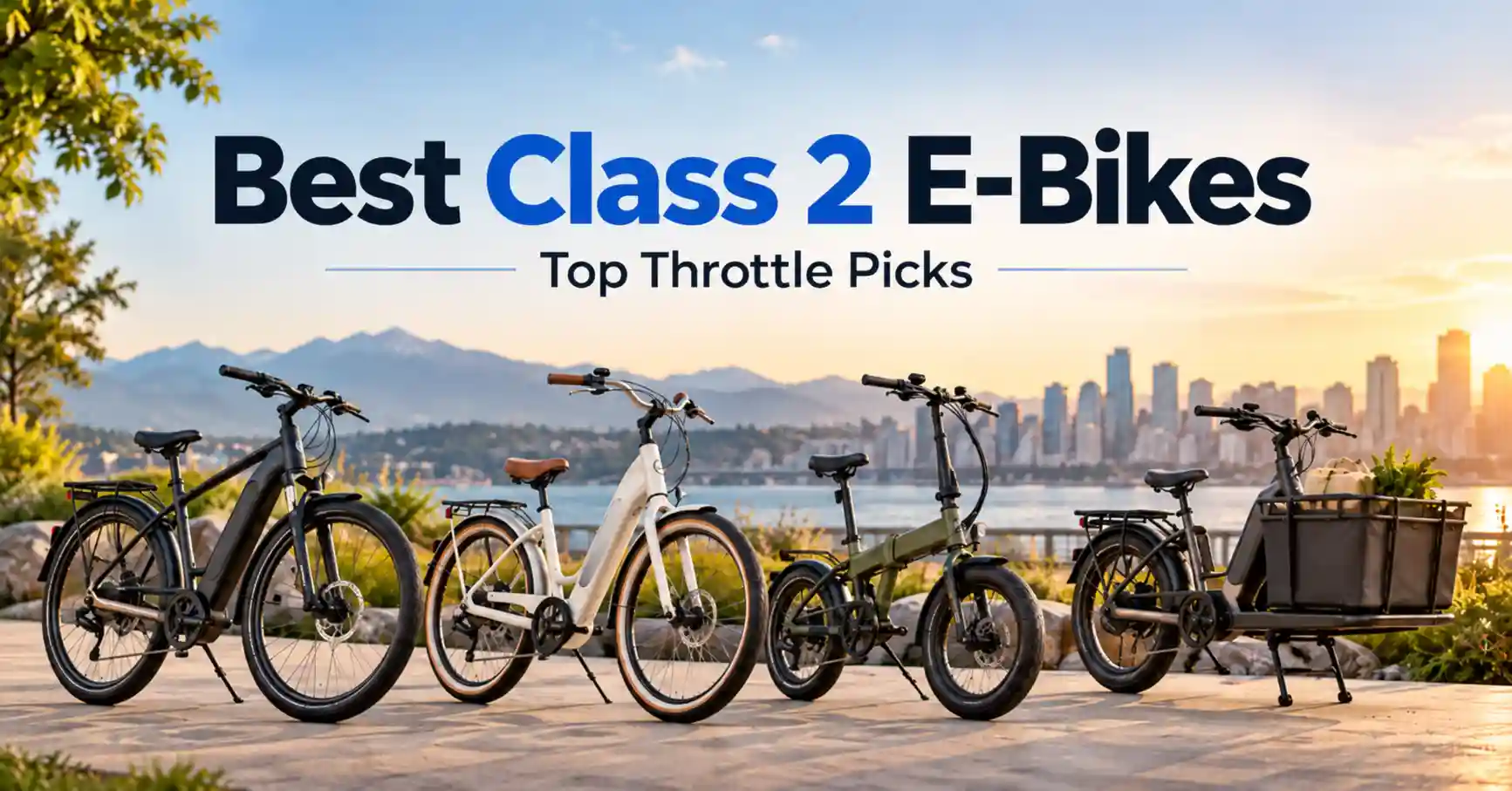
Best Class 2 Electric Bikes for 2026: 7 Throttle E-Bikes Compared
Last Updated on October 12, 2026 by Kristina
📚 Research-based buying guide: I have not personally tested every bike in this guide. These recommendations are based on current manufacturer specifications, safety documentation, warranty and return policies, independent testing, service information, and available rider feedback.
Price and model check: October 10, 2026. Prices, configurations, promotions, certifications, and availability can change.
If you want an electric bike with a throttle but do not need motor assistance above 20 mph, a Class 2 e-bike is worth considering. In the common U.S. three-class system, Class 2 means the motor can assist while you pedal or through a throttle, but the motor assistance must stop at 20 mph in Class 2 mode.
The important catch is that some bikes can switch between classes. A manufacturer may advertise a 28 mph top pedal-assist speed even when a bike ships in Class 2. That does not make 28 mph operation Class 2. I focused on bikes with a documented Class 2 setting or classification, and I explain the tradeoffs rather than treating every bike with a throttle as a Class 2 pick.
If you are new to e-bikes, start with my complete electric bike buying guide. You can also review how Class 1, Class 2, and Class 3 e-bikes differ before deciding what is allowed on your routes.
⭐Quick Picks: Best Class 2 E-Bikes
- Lectric XPedition2 Dual-Battery: Best Cargo E-Bike
- Velotric Discover 3: Best Overall
- Aventon Pace 5 REC: Best Comfort Cruiser
- Ride1Up Portola 02: Best Budget Pick
- Best Folding E-Bike: Blix Vika X: Best Folding E-Bike
- Retrospec Koa Rev 3 26-inch: Best Value Oriented Fat Tire
- Himiway D5 2.0 20-inch: Best Full Suspension Fat Tire
👉 Short on time?
See today’s e-bike deals and limited-time discounts, then compare top picks below.
Class 2 E-Bike Comparison Chart
The figures below are manufacturer specifications for the versions identified, checked October 10, 2026. Prices are snapshots, not promised sale prices. A total load rating is not the same as a maximum rider or rear-rack rating. “Manufacturer says certified” does not mean I independently verified a certification record.
| Bike / award | Listed price* | Bike weight | Motor / battery | Published load limits | Class 2 basis | Key tradeoff |
|---|---|---|---|---|---|---|
| Velotric Discover 3 – overall | $1,999 | 61 lb, listed | 750W / 730Wh | 440 lb total | 20 mph default; configurable classes | Substantial to lift |
| Aventon Pace 5 REC – comfort cruiser | Check current listing | 60.48 lb, listed | 750W / 733Wh | 330 lb total | Manufacturer labels Class 2; also advertises 28 mph maximum in alternate setting | Rigid fork and connected features |
| Ride1Up Portola 02 standard, 10Ah – budget | From $995 | 61 lb with 10Ah battery | 750W / approx. 480Wh (48V × 10Ah) | 342 lb total; 150 lb rear rack | 20 mph throttle; configurable Class 1-3 | Heavy when folded |
| Blix Vika X – folding | $1,799 | 55 lb in spec table; 61 lb with battery in FAQ | 500W / 614.4Wh | 312 lb total; 270 lb rider; 60 lb rack | Class 2 default; switchable to Class 3 with app | Conflicting published weight |
| Retrospec Koa Rev 3, 26-inch – fat tire value | $1,599.99 | Not clearly published in current spec table | 500W / 500Wh | 350 lb recommended weight limit (manufacturer wording) | Native Class 2; throttle up to 20 mph | Wide 26 × 4-inch tires; verify lifting weight |
| Himiway D5 2.0, 20-inch – full-suspension fat tire | Check current listing | 80 lb, listed | 750W / approx. 720Wh (48V × 15Ah) | 440 lb total; 265 lb maximum rider; 120 lb rear rack | 20 mph default; Class 1/2/3 settings | Heavy; separate rider restriction |
| Lectric XPedition2, dual 624Wh batteries – cargo | $1,799 listed | About 83 lb with both batteries | 750W / 1,248Wh combined | 450 lb total; 330 lb rider; 300 lb rear rack | Class 2 at delivery; alternate class settings | Long, heavy cargo platform |
*Prices and configurations can change, and some offers require a particular build or color. For all configurable bikes, a 28 mph assisted mode is not Class 2 operation. Approximate Wh values are calculated from manufacturer-listed voltage and Ah and should not be treated as separately verified measured capacity.
How I Chose These Class 2 Electric Bikes
I prioritized seven different brands for wider choice, but a brand did not earn a recommendation just for variety. Each model needed manufacturer documentation describing Class 2 operation, a throttle, a 20 mph motor-assist configuration, useful braking and fit information, and a credible path to parts or support. A few also permit a faster operating mode, which I identify clearly instead of treating their 28 mph advertising as Class 2 performance.
I compared battery energy in watt-hours (Wh), battery-installed weight where documented, manufacturer-stated load and rider limits, suspension, equipment, warranty, and realistic ownership needs. Manufacturer-listed maximum range is not independent range testing. I did not personally ride these seven bikes, and the awards represent research-based judgments, not directly comparable instrumented ride tests.
🔎 Why You Can Trust This Guide: I compare official specifications, safety information, published policies, and available independent reporting. I flag specification conflicts and distinguish certification claims from independently checked records. Affiliate relationships do not determine rankings. Read how Electric Bike Explorer researches and ranks e-bikes.
Who This Guide Is For – and Who Should Look Elsewhere
This guide is for adult shoppers who want throttle assistance for daily travel, leisure, compact storage, rougher roads, or carrying cargo while riding in a documented Class 2 setup. It is not a list of the fastest e-bikes or a guarantee that all paths allow throttles. If you prefer pedal assistance without a throttle, see my Best Class 1 E-Bikes for 2026 instead.
Best Overall: Velotric Discover 3
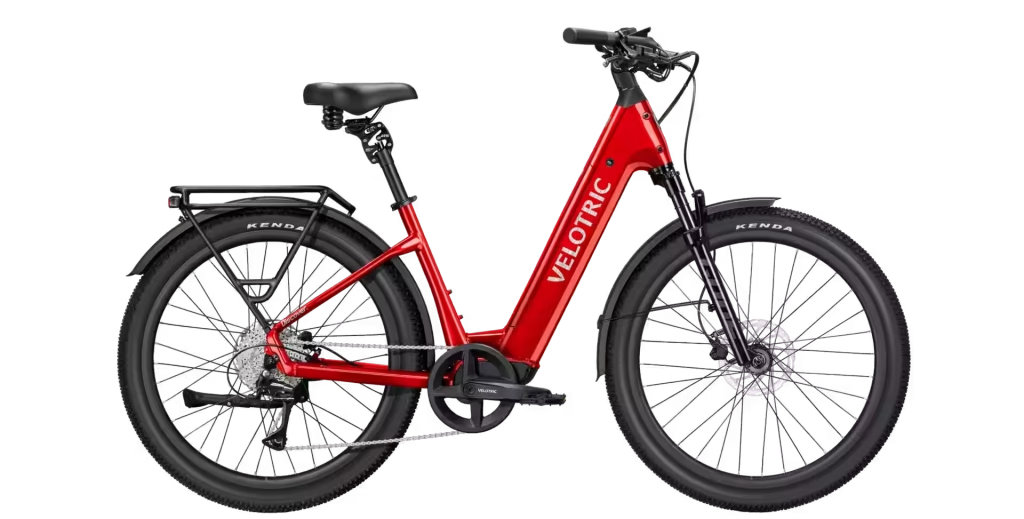
Best for: Riders who want a comfortable, practical commuter with a substantial published load rating.
Velotric lists the Discover 3 with a 750W rear hub motor, 730Wh removable battery, hydraulic disc brakes, integrated rack and fenders, and a 61 lb bike weight. The published total bike load capacity is 440 lb, which is unusually useful for shoppers who must account for rider weight, bags, and accessories. The company offers regular and large sizes with overlapping height recommendations.
The Discover 3 starts at a default 20 mph limit, and Velotric documents Class 1, 2, and 3 switching. It also offers a removable throttle, torque or cadence sensing, an air-suspension fork, tracking features, and manufacturer-listed UL 2849 / UL 2271 certification. Velotric lists a 2-year limited warranty, subject to its policy terms.
Why it wins: This is a strong all-around package for a rider who wants both comfort and everyday utility. The suspension, lighting, rack, battery capacity, and claimed payload matter more to most buyers than an inflated peak-power figure.
What to know: A 61 lb bike is still substantial when loading it onto a rack or moving it upstairs. The manufacturer’s up-to-80-mile range is an ideal-condition claim and will be lower for many riders using the throttle, riding hills, or carrying heavy loads.
My buying advice: Choose the Discover 3 if you want one versatile everyday bike and can manage the weight.
Best Comfort Cruiser: Aventon Pace 5 REC
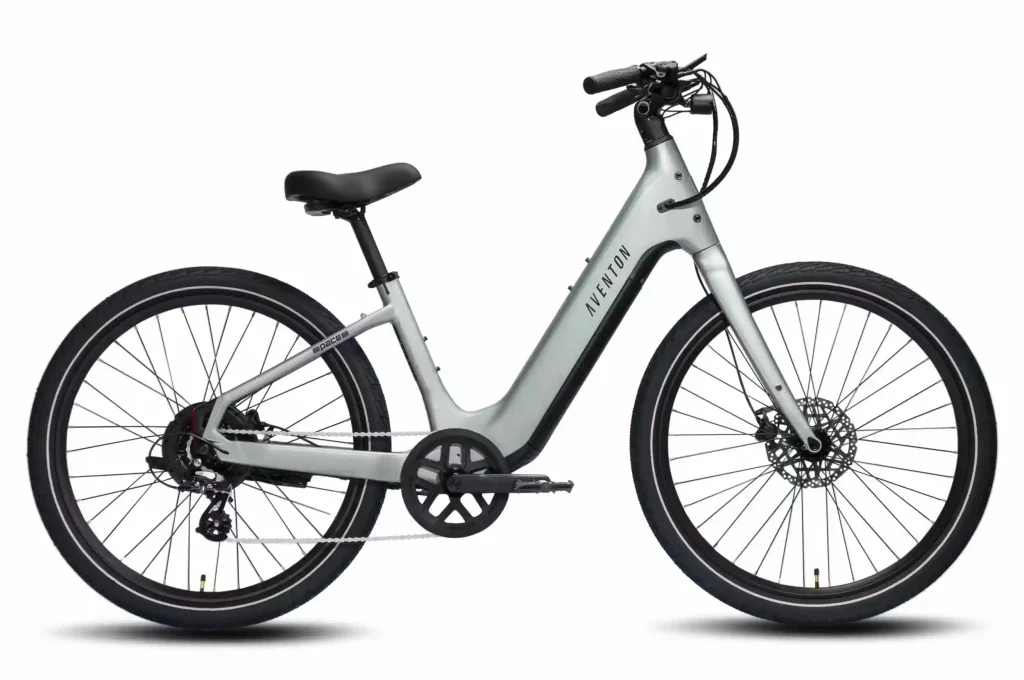
Best for: Riders who prioritize upright posture, easy mounting, and relaxed neighborhood or path riding.
The Pace 5 REC replaces the older Pace 4 as Aventon’s current comfort-cruiser option. Its step-through geometry, swept-back handlebars, adjustable stem, and broad saddle focus on rider position. Aventon lists a 750W hub motor, 733Wh removable battery, 60.48 lb bike weight, 330 lb total weight limit, and two sizes covering rider heights of approximately 5’0″ to 6’3″.
Aventon identifies this as a Class 2 bike and lists hydraulic disc brakes, UL 2849 and battery UL 2271 certifications, and a 2-year warranty. The brand also advertises a maximum 28 mph speed, so buyers need to distinguish a permitted Class 2 setting from any faster operating configuration. Do not assume a 28 mph setting is Class 2 just because the product belongs to a Class 2 collection.
Why it stands out: A relaxed cockpit and low step-through are meaningful features for riders who value comfort or sometimes want throttle assistance when starting. The built-in security and GPS functions may help owners who regularly park away from home.
What to know: It has a rigid fork rather than a suspension fork, and the connected technology may be more than some riders want. A wider saddle also does not automatically guarantee the correct fit; a test ride remains worthwhile.
My buying advice: Choose it if comfort, fit, and accessible service matter more than a sporty feel.
Best Budget Pick: Ride1Up Portola 02

Best for: Cost-conscious riders who want a throttle, hydraulic brakes, and cargo options without moving to a large dedicated cargo bike.
The Portola 02 should not be confused with the earlier Portola or the Portola 02 Lite. Ride1Up lists a 750W hub motor, hydraulic disc brakes, torque/cadence sensor options, a folding frame, 10Ah or 15Ah battery choices, a 342 lb total load rating, and a 150 lb rear-rack rating on the standard Portola 02. At the brand’s listed 48V battery voltage, those sizes correspond to approximately 480Wh and 720Wh, respectively. The standard version’s 10Ah listed weight is 61 lb; the 15Ah version is 63 lb in Ride1Up’s size chart.
Ride1Up’s support documentation says the Portola 02 ships as Class 2 and can be changed through its display where other modes are allowed. The listed 10Ah configuration weighs about 61 lb, and the 15Ah option weighs more. This is an affordable bike, but it should not be confused with a truly lightweight travel bike.
Why it stands out: Strong practical equipment at its price, with the ability to fold for smaller storage spaces. The rack and lighting on the standard Portola 02 are part of its appeal.
What to know: A 61 lb folded e-bike is still difficult for many people to carry. Carefully compare Portola 02 against Portola Lite, because equipment and price differ. Ride1Up advertises a 1-year warranty and conditional returns.
My buying advice: If your budget is tight and you can handle the weight, it is a compelling value pick.
Best Folding E-Bike: Blix Vika X
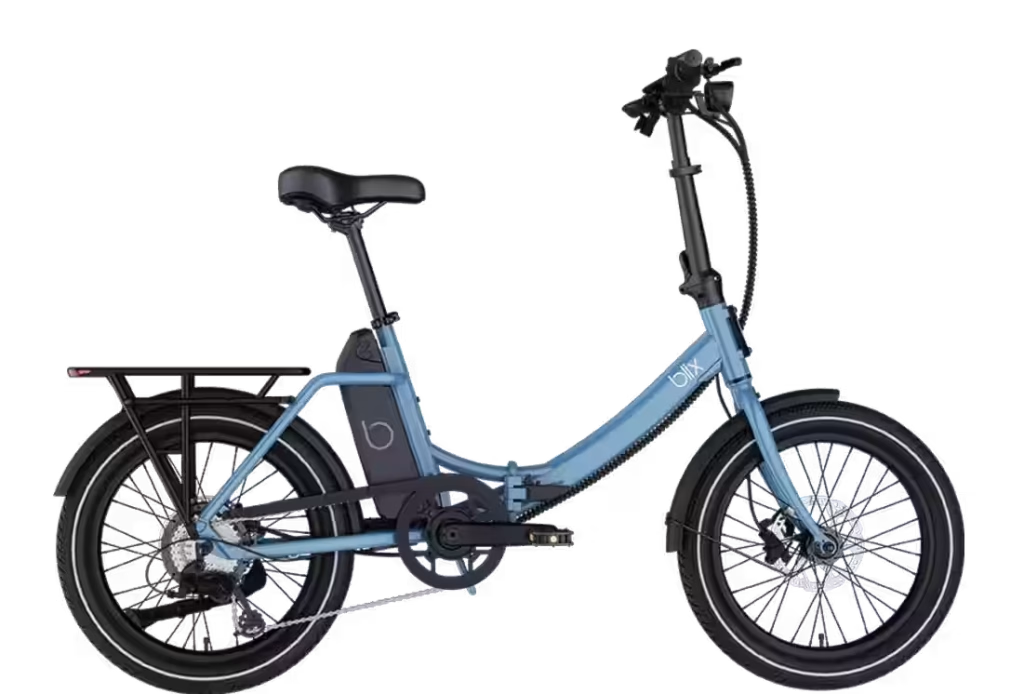
Best for: Riders who want compact storage along with a refined, feature-rich folding bike, not necessarily the lightest possible carry.
Blix lists a 500W geared rear-hub motor, a 614.4Wh battery, a torque sensor, an 8-speed electronic drivetrain with an automatic-shift feature, 180mm hydraulic disc brakes, 20 × 2.4-inch tires, and integrated front and rear lights with brake light and turn indicators. The bike folds to approximately 36 × 21 × 29 inches according to the published spec sheet. The claimed range is up to 70 miles under favorable conditions.
Blix explicitly calls the Vika X a Class 2 e-bike. Its app can change the pedal-assist speed ceiling from 20 mph to 28 mph for Class 3 operation where that configuration is allowed. The twist throttle is a standard feature. Blix lists a 312 lb total payload, a 270 lb maximum rider weight, and a 60 lb rear-rack limit.
Important weight discrepancy: The technical table says 55 lb, but the FAQ on the same official product page says 61 lb with the battery installed and 56 lb without it. I would plan around the heavier battery-installed figure until Blix confirms the correct current shipping weight. Buyers should not regard this as a 55 lb bike without resolving the inconsistency.
Why it stands out: A folding bike with electronic shifting, adjustable assistance, lighting, hydraulic brakes, and an integrated rack offers more than portability alone.
Tradeoffs: It is not a budget choice, the published weight conflict reduces certainty for riders who need to lift it, and electronic shifting introduces additional proprietary components to consider for long-term service. Blix lists a 1-year warranty and 14-day return window, subject to terms.
My buying advice: Choose the Vika X for compact storage and integrated features, but verify the real weight, folded dimensions, and warranty details before ordering.
Best Value-Oriented Fat Tire: Retrospec Koa Rev 3 26-Inch
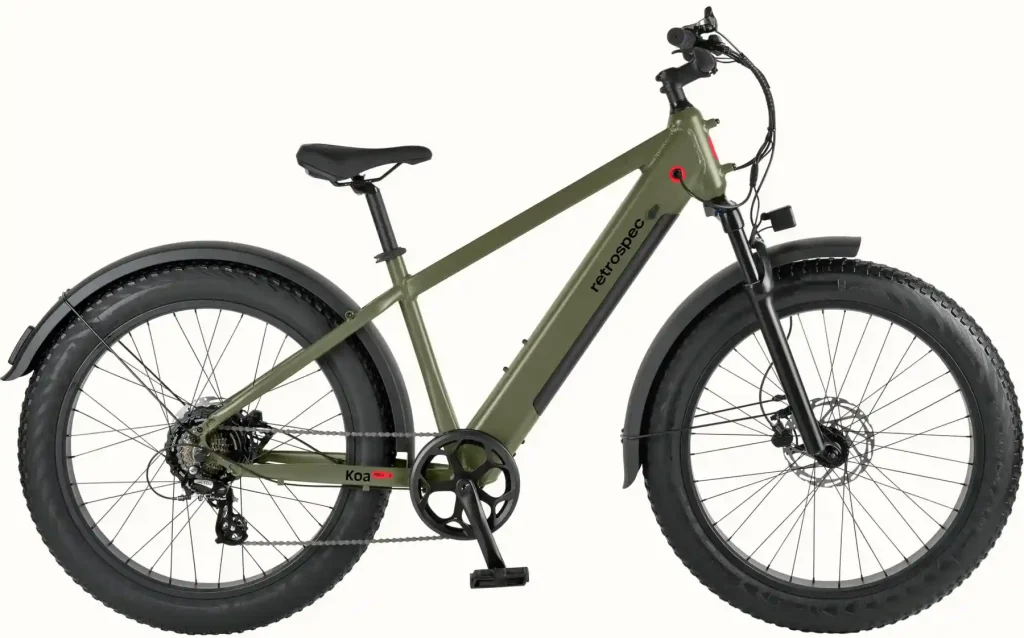
Best for: Riders looking for a full-size fat-tire bike with native Class 2 operation for paved roads, gravel, and some rougher surfaces.
Retrospec lists the Koa Rev 3 with a 500W motor (770W claimed peak), 65Nm torque, removable 48V / 500Wh battery, 26 × 4-inch tires, 80mm front suspension fork, seven-speed drivetrain, integrated lights, and Tektro hydraulic disc brakes with 180mm rotors. The manufacturer explicitly describes it as Class 2 with throttle assistance up to 20 mph.
Retrospec advertises up to 75 miles of range. That figure is a manufacturer claim under unspecified real-world conditions, not a throttle-only or independently tested result. Retrospec states that the Koa Rev 3 is certified to UL 2849 and its battery to UL 2271; I have not independently verified its certification listing. The official page also gives a 350 lb “recommended weight limit” without clearly breaking it down into rider, rack, and cargo limits.
Why it stands out: At the manufacturer’s $1,599.99 listing checked for this guide, it combines a documented Class 2 setup, hydraulic brakes, and full-size fat tires without requiring class-mode changes.
Tradeoffs: Fat tires can be bulky and create extra rolling resistance. The current spec table does not clearly state a battery-installed bike weight, so I would confirm that figure with Retrospec rather than estimate it. The 18-inch frame listing recommends riders approximately 5’6″ to 6’4″; shorter buyers should check the separate step-through Koa variant instead of assuming both frames fit alike.
My buying advice: Consider it if you prefer a native Class 2 bike and want large tires, but confirm weight, fit, the current warranty, and battery replacement availability.
Best Full-Suspension Fat Tire: Himiway D5 2.0 20-Inch
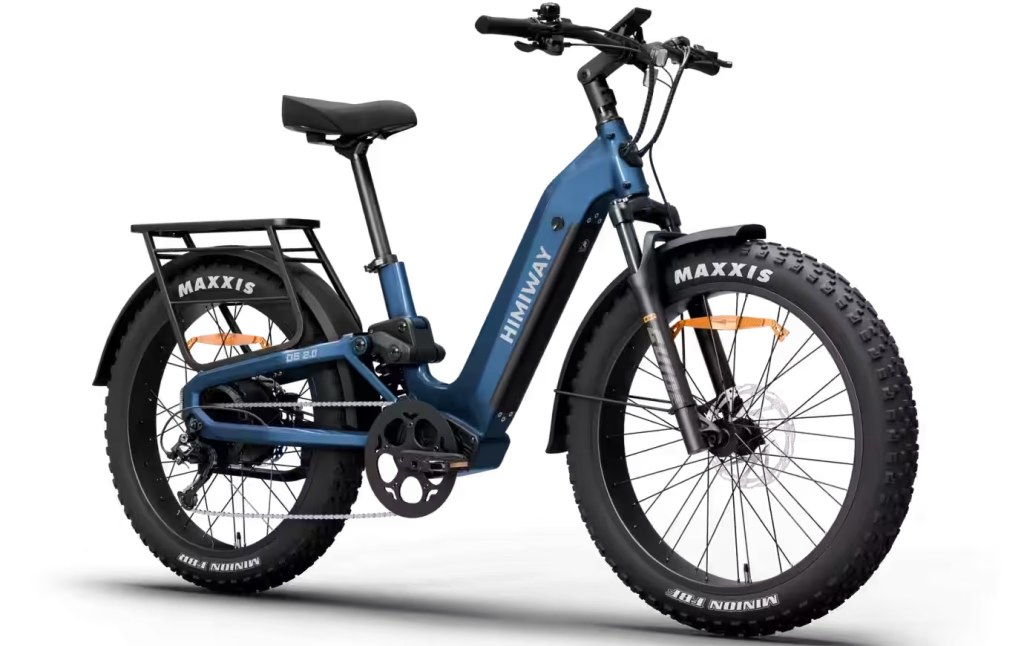
Best for: Riders who want front and rear suspension, wide 20-inch tires, and an upright bike for rough pavement and recreational riding.
Himiway lists a 750W hub motor rated at 90Nm, a 48V / 15Ah battery (about 720Wh by calculation), 20 × 4-inch tires, switchable torque/cadence sensing, an adjustable suspension fork with 90mm travel and rear suspension with 100mm travel, and hydraulic disc brakes. The official listing says the bike’s default speed is 20 mph and supports Class 1, 2, and 3 configurations with an adjustable maximum of up to 28 mph. Keep assistance within 20 mph to use it as a Class 2 e-bike.
Do not confuse three separate weight limits: Himiway advertises a 440 lb total bike load, but separately states a 265 lb maximum rider weight for the 20-inch model and a 120 lb rear-rack capacity. Those numbers are not interchangeable or additive beyond the total limit. The bike itself is listed at 80 lb.
Why it stands out: Its suspension and 4-inch tires differentiate it from the Retrospec Koa’s hardtail design. Himiway claims up to 70 miles with pedal assist and up to 40 miles using the throttle under its stated conditions; these are not independent measured results.
Tradeoffs: At 80 lb, this is a difficult bike to lift. The 265 lb rider ceiling rules out some people who might otherwise assume its 440 lb overall rating applies to rider body weight. Added suspension and mass mean more service needs. I did not independently confirm a model-specific third-party battery or electrical-system certification database entry.
My buying advice: Choose the D5 2.0 20-inch over the Koa when full suspension is more important than portability and the specific rider, rack, and total load limits fit your needs.
Best Cargo E-Bike: Lectric XPedition2 Dual-Battery

Best for: Adults replacing short car trips, carrying large grocery loads, or transporting a permitted passenger with the correct accessories.
The XPedition2 is a purpose-built long-tail cargo bike. Lectric lists a 450 lb maximum combined payload, with separate limits of 330 lb for the rider, 300 lb for the rear rack, and 30 lb for the front basket on the official XPedition2 listing. The listed dual-battery version has two 624Wh batteries for 1,248Wh combined. It also features a 750W rear hub motor, hydraulic disc brakes, torque sensing, and a recommended rider height of 4’11” to 6’5″. These individual limits are not permission to load all locations to their maximum simultaneously.
Lectric’s published shipping policy identifies its e-bikes as Class 2 out of the box, including the XPedition2, with faster pedal-assist settings available only if configured and legally permitted. Lectric lists UL 2849 for the bike and UL 2271 for the batteries.
Why it stands out: Unlike a normal commuter with a rear rack, this bike is designed around hauling. The dual batteries also give it a substantial energy reserve, although the manufacturer’s range claim is not a guarantee for heavily loaded riding.
What to know: With both batteries installed it is approximately 83 lb, and the long frame requires significant parking space. Cargo and passengers change the balance and stopping distance. Use only manufacturer-approved passenger equipment, respect each individual rack and rider limit, and hold the bike securely whenever loading it. Lectric specifically warns not to rely on the kickstand to stabilize the bike while loading cargo or passengers.
My buying advice: Buy it for regular cargo needs, not because the biggest battery sounds appealing.
How to Choose the Right Class 2 E-Bike
Check the shipping class and all operating modes
Under the common three-class framework, Class 2 permits motor assistance by throttle or pedaling up to 20 mph. A bike may still go faster under human power, but motor assistance above the Class 2 limit is a different issue. A bike advertised as “up to 28 mph” needs a closer look at its default settings and what each mode actually does.
Class rules are not uniform across the United States. Local trails, parks, campuses, and municipalities may restrict or prohibit throttles even when state law recognizes Class 2. Check your state’s e-bike laws and local access rules before buying.
Think about the full weight and your storage routine
If you need to carry your e-bike up stairs or load it into a vehicle, weight may matter more than range. Do not assume folding means lightweight. Confirm the weight with the battery installed, then consider whether you can safely lift that amount on your own.
Compare battery capacity, not only claimed mileage
Watt-hours (Wh) tell you roughly how much energy the battery stores. Bigger batteries often allow longer rides, but hill climbing, headwinds, heavier loads, tire pressure, temperature, and frequent throttle use can reduce actual range. Check battery replacement cost and availability before buying.
Find a frame that really fits
Manufacturer height ranges are starting points. Standover clearance, reach, saddle height, handlebar adjustment, and your confidence at a stop are equally important. Try my e-bike size and fit calculator, then test ride if possible.
Look beyond a certification badge
For battery and electrical safety, look for verifiable certification specific to the model or battery system, such as UL 2849 for the electrical system and UL 2271 for batteries. Manufacturers’ listing claims are useful starting points but should not be mistaken for independent confirmation without the relevant documentation. Read my guide to UL-certified e-bikes for a deeper explanation.
Plan for support and ownership
Confirm the current warranty, return shipping conditions, assembly requirements, nearby authorized service, replacement battery cost, brake pad availability, and whether a proprietary display or app is essential to operating the bike. These details matter more over several years than a temporary discount.
Essential E-Bike Gear (Quick Picks)
Before you choose your e-bike, these are the accessories most riders end up needing for safety and everyday use:
Common Class 2 Buying Mistakes
- Assuming any bike advertised at 28 mph is operating as Class 2: Confirm the active motor-assist setting and legally required class label.
- Confusing manufacturer certification claims with independent record verification: Ask for the exact model and battery certification documentation.
- Treating a bike’s total payload as the rider limit: Himiway’s 440 lb total rating does not supersede its 265 lb maximum rider weight; cargo models also have separate rack limits.
- Ignoring specification conflicts: Blix publishes different Vika X weights in its spec table and FAQ, so confirm the actual with-battery weight if lifting matters.
- Using claimed maximum range as a guarantee: Actual battery range changes with assistance level, rider and cargo load, terrain, speed, and temperature.
- Assuming fat tires, a folding frame, or a big battery are automatically better: Match bike features to storage, fit, service access, and daily use.
- Forgetting local riding access: Class 2 legality on paths and trails depends on applicable rules.
Frequently Asked Questions
Can a Class 2 e-bike go faster than 20 mph?
You can exceed 20 mph through your own pedaling or on a downhill, but under the common Class 2 definition the motor does not continue providing assistance above 20 mph. A configurable bike may have other legal classifications or operating modes, but those should not be described as Class 2 operation.
Are Class 2 e-bikes better for beginners than Class 1?
Not automatically. The throttle can help a rider start moving or rest from pedaling briefly, but it also requires practice and careful low-speed control. Fit, brake response, weight, and predictable assistance matter more than class alone.
Can I ride a Class 2 electric bike on bike paths or trails?
It depends on the state and the exact path or land manager. Some allow Class 1 and Class 2 but restrict Class 3, while others have different rules or prohibit motorized assistance. Always check the current posted or official rules for your intended route.
Does UL 2849 mean an e-bike cannot catch fire?
No. Certification to an applicable safety standard is an important risk-reduction measure, but it cannot eliminate all battery or electrical hazards. Use the correct manufacturer-approved charger, inspect for damage, and stop charging or riding if you notice unusual heat, swelling, smoke, or a strong odor.
Should I choose a 500W or 750W motor?
Motor wattage is only part of the decision. Compare torque, gearing, total load, hills, handling, controller behavior, and legal restrictions. A smooth 500W bike with good fit may be more pleasant for daily use than a heavier 750W bike that does not suit you.
My Take: Which Class 2 E-Bike Would I Choose?
For a rider who wants one practical throttle-equipped bike for regular pavement riding, the Velotric Discover 3 remains my research-based overall choice for its comfort features, equipment, battery capacity, and manufacturer-listed load rating. I would pick the Aventon Pace 5 REC instead for a more laid-back cruiser fit, especially when local dealer support is a priority.
The Ride1Up Portola 02 makes the strongest budget argument. The Blix Vika X gives folding-bike shoppers a different set of features, though I would verify the actual with-battery weight before buying. If fat tires are important, I’d compare the native Class 2 Retrospec Koa Rev 3 with the more suspension-focused Himiway D5 2.0 20-inch, noting Himiway’s 265 lb rider limit. Lectric’s XPedition2 remains the specialist choice for people who need a real cargo platform.
I also considered the Lectric XP4 as a practical folding alternative, the Velotric Breeze 1 as a lighter upright cruiser alternative, and the Ride1Up Roadster V3 for a more bicycle-like lightweight urban build. They remain worth comparing even though seven other bikes occupy this year’s featured spots.
Before buying, verify the exact model version, fully equipped weight, suitable fit, Class 2 shipping setting, approved charger and battery, current documentation supporting any claimed certifications, written warranty and returns, and the local rules for your route. No listed bike is right for every person or trail.
Disclosure: As an Amazon Associate, I earn from qualifying purchases. This comes at no extra cost to you and helps support the content on this site.

Kristina is not just an enthusiast but a true authority on electric bikes. Nestled in the coastal beauty of Virginia, Kristina has found the perfect backdrop for her passion for electric biking. As a dedicated wife and homeschooling mom, her life revolves around family, faith, and the thrill of adventure.
Originally hailing from Ohio, Kristina's journey with electric bikes began as a curiosity and quickly evolved into a deep expertise. Her blog is a testament to her love for electric biking, combining her fascination for eco-friendly transportation with her coastal lifestyle.
When she's not cruising the beach on her electric bike, you'll find Kristina indulging in her other loves: long walks along the shore, getting lost in a good book, and cherishing moments with her loved ones. With a heart as big as her love for animals, especially cats, Kristina brings a unique perspective to the electric bike world, grounded in her strong faith in God and her dedication to a sustainable lifestyle.
Through her blog, Kristina shares her extensive knowledge of electric bikes, offering valuable insights, tips, and recommendations to fellow enthusiasts. Whether you're a seasoned rider or a newcomer to the electric bike scene, Kristina's blog is your go-to source for all things electric biking, fueled by her passion, expertise, and the scenic beauty of coastal Virginia.