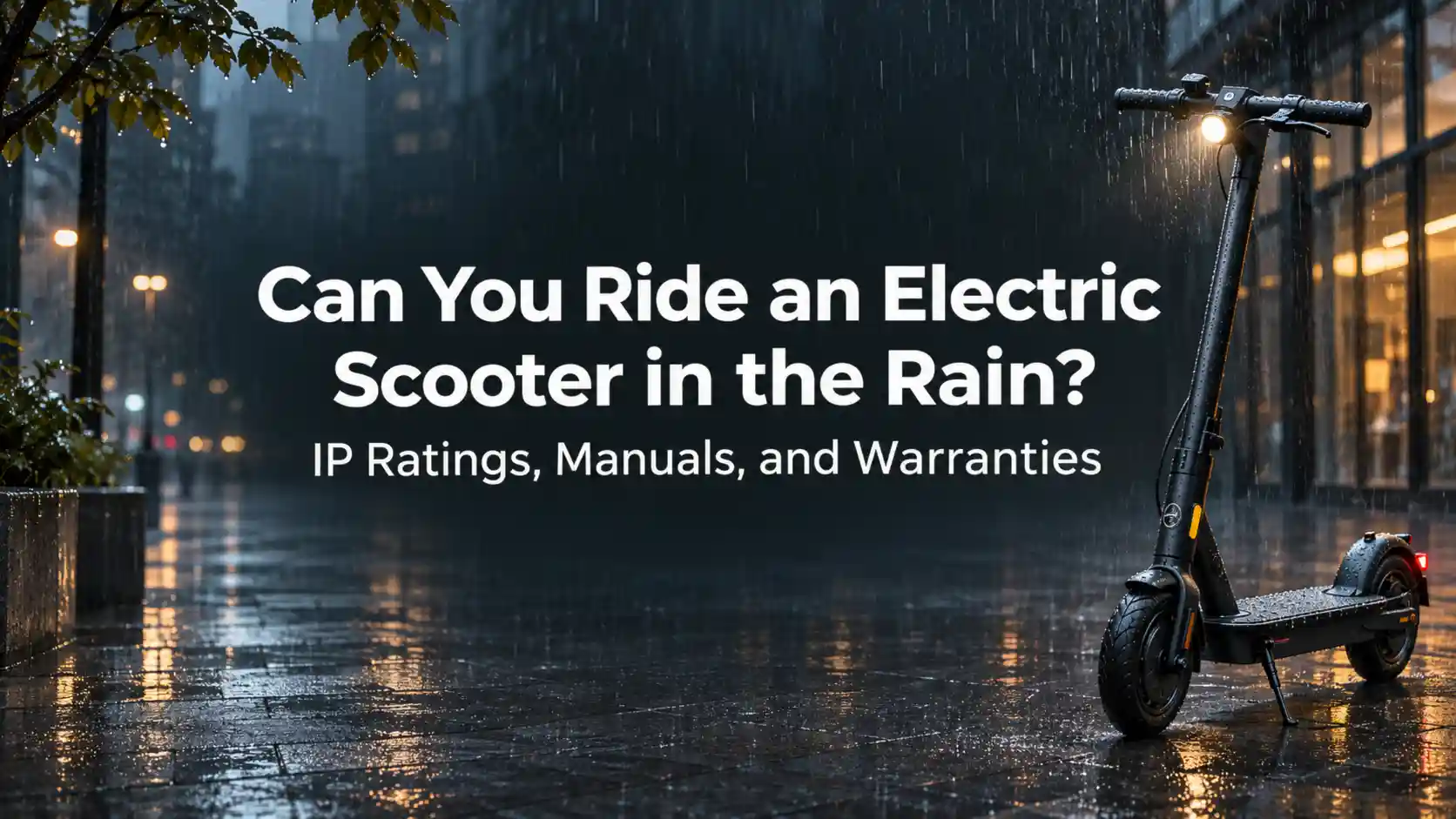
Can You Ride an Electric Scooter in the Rain? IP Ratings, Manuals, and Warranties
Last Updated on November 21, 2026 by Kristina
If rain is in the forecast, check the manual for your exact electric scooter before you leave. Ride in light rain only if your model’s manual permits it and you can see clearly and maintain traction. If the manual advises against rain or wet pavement, make another plan. Skip the ride in heavy rain, standing water, or poor visibility. An IP rating describes how an enclosure performed in a water exposure test. Your manual tells you how the scooter should be used, and the warranty tells you which kinds of damage are covered.
Below, I compare the Segway Ninebot MAX G2 and NIU KQi3 Pro so you can see how those three pieces of information fit together. For everyday riding basics, see EBE’s electric scooter safety guide.
I Got Caught in the Rain. What Now?
| What happened | What to do first |
|---|---|
| A few splashes on the outside | Stop under cover and follow your model’s drying and inspection instructions. Wait until the charging port, plug, charger, and outlet are completely dry before charging. If you suspect water got inside, follow the guidance in the next row. |
| Soaked, submerged, or possibly wet inside | Leave the scooter off and unplugged. Contact the manufacturer or an authorized service center before turning it on or charging it. A dry-looking exterior or a working display cannot tell you whether water reached the electronics. Keep the deck and battery enclosure closed. |
| Exposed to floodwater | Keep it off and do not charge it. If flooding may have reached the battery in your home or garage, notify your local fire department. See the U.S. Fire Administration’s flood safety guidance. |
If you see smoke or flames, or hear hissing or popping from the battery area after flooding, move away and call 911. If you suspect water reached the electronics or battery, get the scooter assessed. For routine charging precautions, see EBE’s scooter charging guide.
What Do IPX4, IP54, and IPX5 Mean on an Electric Scooter?
In an IP code, the first position covers protection against solids and the second covers water. An X means a rating for that position is unspecified in the code. For example, IP54 and IPX4 have the same water protection digit. IP54 also specifies a level of dust protection.
| Rating | What the code describes |
|---|---|
| IPX4 | Protection against splashing water. The code leaves solids protection unspecified. |
| IP54 | Dust-protected enclosure with the same splash protection level as IPX4. |
| IPX5 | Protection against water jets under specified test conditions. The code leaves solids protection unspecified. |
Check what the rating applies to. A rating for the battery enclosure tells you about that enclosure. A rating for the scooter body may be listed separately. Splash and jet ratings leave immersion outside their stated scope, so check the manual’s instructions for puddles, washing, and charge-port care. See the European Commission’s explanation of the IEC water-protection levels and ABB’s IP code reference.
Segway MAX G2 vs. NIU KQi3 Pro: Rating, Rain Guidance, and Warranty
These examples show how a spec sheet, riding instructions, and warranty can give you different information about the same scooter. The warranty column summarizes published U.S. or North American terms.
| Scooter | Published rating | Rain guidance | Water damage and warranty |
|---|---|---|---|
| Segway Ninebot MAX G2 | IPX5 in the U.S. product manual. | Segway’s North American safety booklet tells riders to avoid rain and wet, muddy, icy, or slippery roads. It also gives inspection instructions for possible water intrusion. | Section 4.5 of the North American limited warranty lists water damage and high-pressure water spray among its exclusions. |
| NIU KQi3 Pro | IP54 on the U.S. product page. | NIU’s KQi3 manual downloads include a North American edition. The general English KQi3 manual warns against rain riding. NIU’s general FAQ gives more permissive light-rain guidance. Follow the instructions supplied with your scooter and ask NIU to clarify if they differ. | The U.S. product page lists water damage under its abuse, misuse, or neglect exclusion. It also separately excludes water damage to electrical parts. |
How to Check Your Own Scooter Before a Wet Commute
- Identify your exact model and variant. Use the label or app, then download the manual for your market.
- Look up rain and wet pavement separately. Even after the rain stops, wet surfaces can reduce traction and increase stopping distance. Check the manual’s limits for puddles and wet roads too.
- Read the exclusions in the warranty. Search the warranty for water, liquid, and misuse. If you commute in wet weather and the documents disagree, ask the manufacturer what conditions it permits and how it handles water damage claims.
For other symptoms, see EBE’s electric scooter troubleshooting guide.
What If the Pavement Is Still Wet After the Rain Stops?
Check whether your manual allows wet pavement. If it does and visibility is good, slow down before turns, brake gradually, and leave more room to stop. Avoid painted road markings, metal covers, wet leaves, and puddles that can hide potholes. If the route is too slippery or visibility drops, pull over somewhere safe and walk the scooter where you can or arrange another ride.
Electric Scooter Rain FAQs
How long should I wait to charge after getting caught in the rain?
Follow your model’s drying and inspection instructions. There is no universal waiting period. For surface splashes, check that the port, plug, charger, and outlet are fully dry. For a soaked or submerged scooter, wait for guidance from the manufacturer or an authorized service center before charging.
Can I rinse mud off an IPX5 scooter?
Follow the cleaning instructions for your model. For example, Segway’s MAX G2 booklet calls for wiping the frame with a damp cloth and warns against rinsing or pressure washing the scooter. Power it off, unplug the charger, and close the charging-port cover before cleaning.
🔎 Why You Can Trust Electric Bike Explorer
This research-based guide uses manufacturer manuals, published warranty terms, IEC rating references, and U.S. Fire Administration guidance. The comparison reflects published documentation. Affiliate relationships do not determine our recommendations.

Kristina is not just an enthusiast but a true authority on electric bikes. Nestled in the coastal beauty of Virginia, Kristina has found the perfect backdrop for her passion for electric biking. As a dedicated wife and homeschooling mom, her life revolves around family, faith, and the thrill of adventure.
Originally hailing from Ohio, Kristina's journey with electric bikes began as a curiosity and quickly evolved into a deep expertise. Her blog is a testament to her love for electric biking, combining her fascination for eco-friendly transportation with her coastal lifestyle.
When she's not cruising the beach on her electric bike, you'll find Kristina indulging in her other loves: long walks along the shore, getting lost in a good book, and cherishing moments with her loved ones. With a heart as big as her love for animals, especially cats, Kristina brings a unique perspective to the electric bike world, grounded in her strong faith in God and her dedication to a sustainable lifestyle.
Through her blog, Kristina shares her extensive knowledge of electric bikes, offering valuable insights, tips, and recommendations to fellow enthusiasts. Whether you're a seasoned rider or a newcomer to the electric bike scene, Kristina's blog is your go-to source for all things electric biking, fueled by her passion, expertise, and the scenic beauty of coastal Virginia.