How to Charge an Electric Scooter the Right Way: Complete Beginner’s Guide
Last Updated on September 15, 2026 by Kristina
Introduction
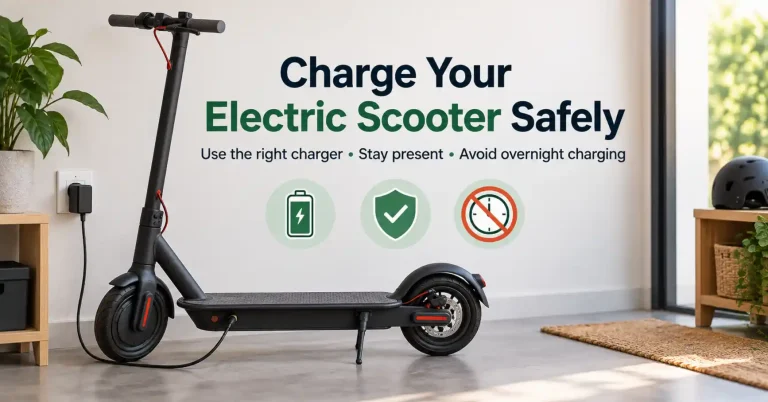
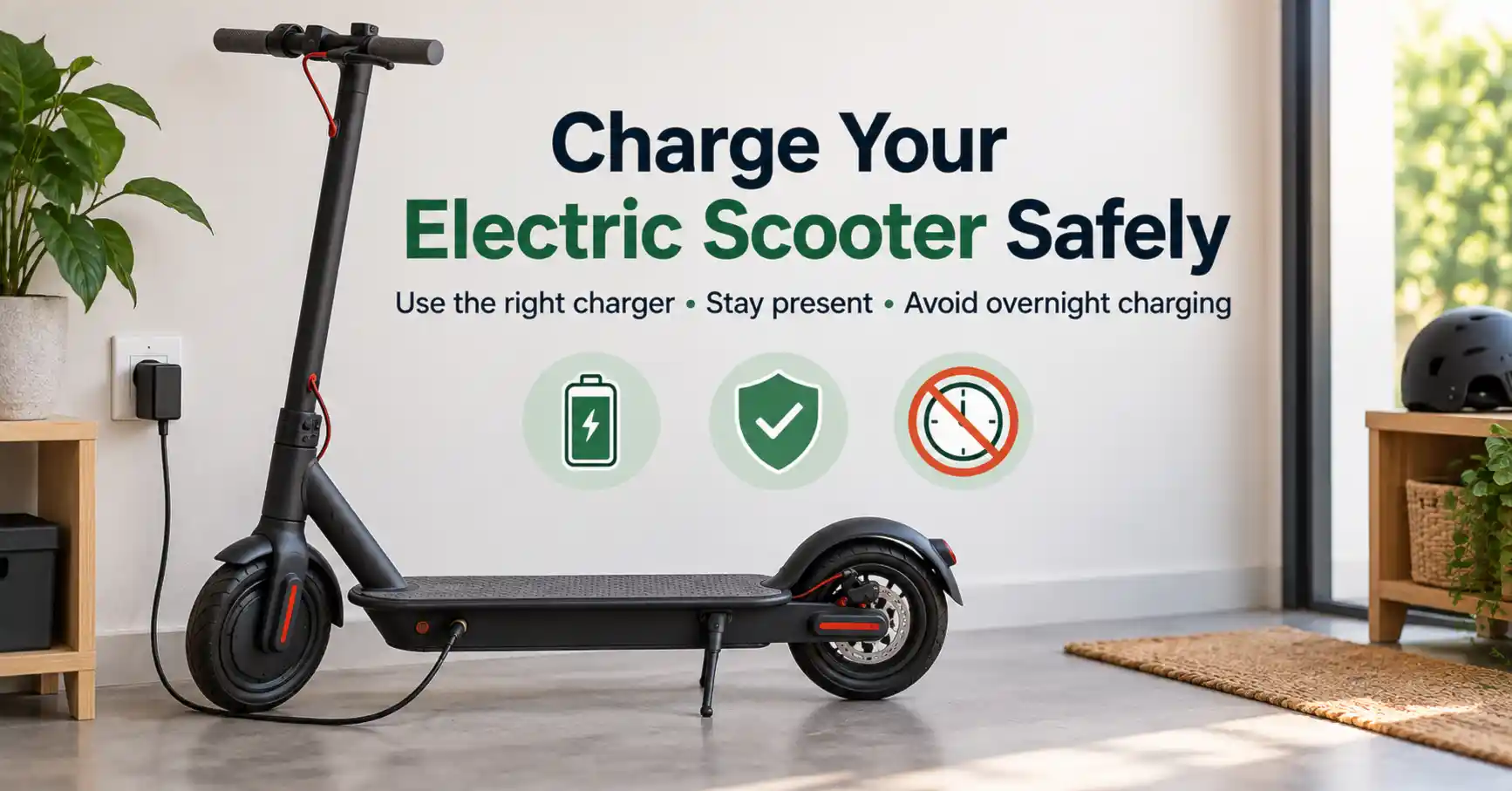
Charging an electric scooter is simple, but the safest approach is more specific than just plugging in any charger that fits. Use the charger supplied with your scooter or a replacement specifically recommended or approved for that model, follow the manufacturer’s charging instructions, and stay present while the scooter is charging.
The U.S. Consumer Product Safety Commission (CPSC) advises consumers to never charge a micromobility device while sleeping and to unplug it when charging is complete. If you are also trying to understand how battery size affects how far you can ride, see the Electric Scooter Range Guide. For riding precautions beyond charging, see the Electric Scooter Safety Guide.
🔎 Why You Can Trust This Guide
This guide is based on current CPSC micromobility safety guidance, manufacturer instructions, UL standards information, and official scooter specifications. Charging recommendations can vary by model, so your scooter manual should control when it gives more specific instructions. You can also read more about how Electric Bike Explorer researches, reviews, and evaluates products and safety information.
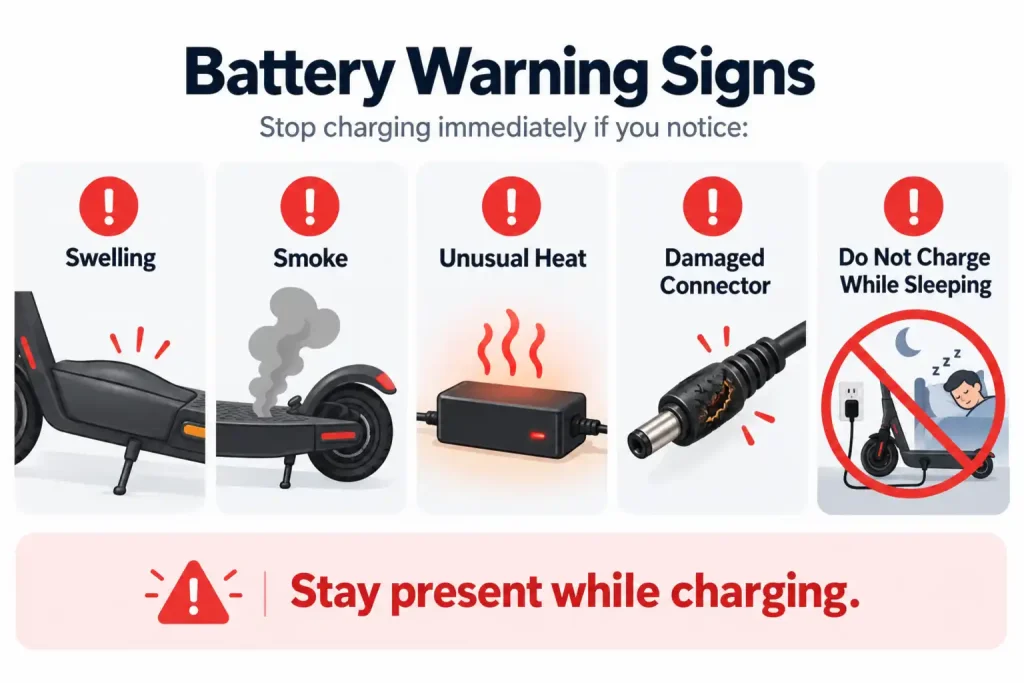
Safety First: Stop using or charging the scooter if you notice smoke, swelling, unusual heat, sparks, leaking, a strong chemical or burning odor, melted connectors, damaged wiring, serious impact damage, or known water intrusion. Do not open or rebuild a lithium-ion battery pack as a routine DIY repair. Contact the manufacturer, an appropriately qualified repair professional, or emergency services when warranted.
How to Charge an Electric Scooter Safely
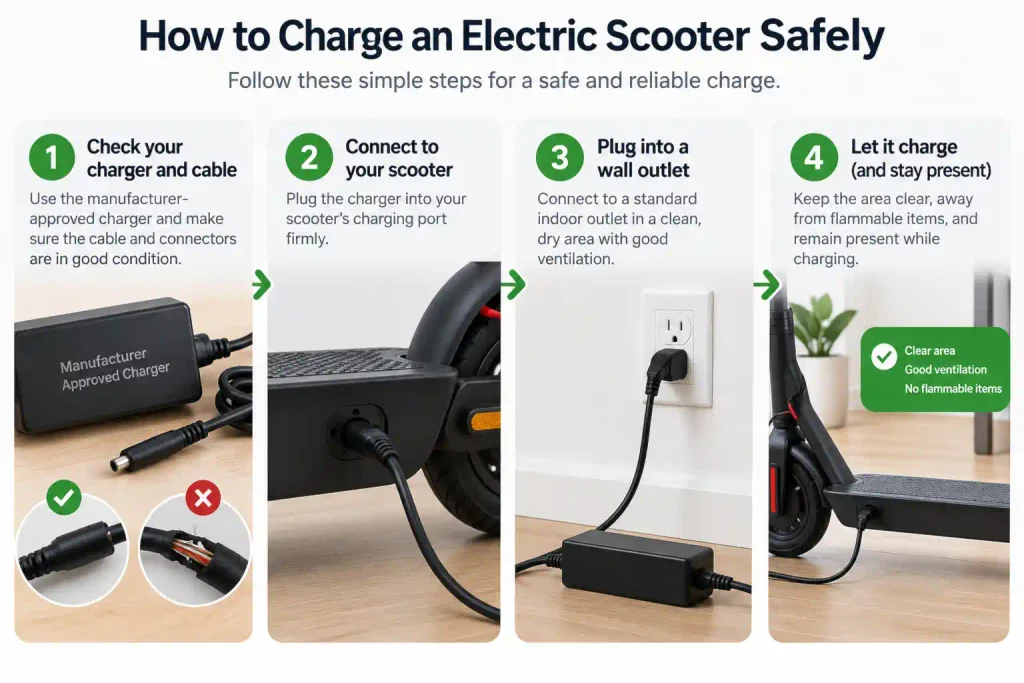
- Park the scooter in a suitable location. Follow the manufacturer’s instructions for charging location and temperature. Keep the scooter and charger away from water, obvious heat sources, and combustible clutter.
- Inspect the charger, cable, plug, charge port, and battery area. Do not charge with damaged wiring, melted connectors, a cracked charger, a badly damaged charge port, or a battery showing warning signs.
- Use the correct charger. Use the charger supplied with the scooter or a replacement specifically recommended or approved for your exact model.
- Connect the charger according to the manual. Some manufacturers specify whether the charger should be connected to the wall or scooter first. Follow the sequence in your scooter’s instructions rather than assuming every model is the same.
- Stay present while charging. CPSC advises consumers to always be present when charging micromobility products and never charge them while sleeping.
- Unplug when charging is complete. Follow the manufacturer’s instructions for disconnecting the charger and storing it.
A Battery Management System, or BMS, can monitor and protect against certain electrical conditions, but it does not make an incompatible charger, damaged battery, or unattended charging risk-free.
Can You Charge an Electric Scooter Overnight?
I do not recommend charging an electric scooter while you sleep. Current CPSC guidance says consumers should always be present when charging micromobility products and never charge them while sleeping.
This is more conservative than older advice that treated a BMS or automatic charger shutoff as enough protection for overnight charging. Those protections are valuable, but they do not eliminate every possible charger, battery, wiring, connector, or thermal fault.
If your scooter needs several hours to charge, plan the charge for a time when you are awake and able to notice unusual heat, odor, smoke, sparks, or other abnormal behavior.
How Long Does an Electric Scooter Take to Charge?
There is no reliable universal charging-time chart based only on amp-hours. Charging time depends on the battery’s energy capacity, the charger’s output, how depleted the battery is, charging temperature, BMS behavior, and the charge profile specified by the manufacturer.
The best starting point is the charging time published for your exact scooter model. For example, Segway lists the Ninebot KickScooter F65 with a 561Wh battery, a 160W built-in charger, and an approximate full charging time of 5 hours.
A simple calculation can explain why charging time cannot be reduced to battery Ah alone:
Battery energy (Wh) ÷ charger output (W) = rough theoretical hours
For the F65, 561Wh ÷ 160W is about 3.5 hours. Segway’s published full charge time is approximately 5 hours. The difference illustrates why a simple watt-hour calculation is only a rough theoretical starting point. Real charging includes conversion losses, charge tapering, battery-management limits, and other model-specific behavior.
If you are estimating when a scooter will be ready to ride, use the manufacturer’s published charging time rather than assuming a fixed relationship between Ah and hours.
What Actually Affects Charging Time?
The main factors that can affect how long charging takes include:
- Battery capacity: A battery storing more energy generally requires more energy to refill.
- Charger output: A manufacturer-approved higher-output charger can shorten charging time on a scooter designed to accept it.
- Starting state of charge: A partly depleted battery usually needs less time than one near empty.
- Charge taper: Lithium-ion charging commonly slows as the battery approaches full charge.
- Battery and ambient temperature: The BMS or charger may reduce or stop charging outside permitted temperature conditions.
- Battery age and condition: A degraded or faulty battery may behave differently from a healthy new pack.
- Model-specific limits: The controller, charger, BMS, connectors, and firmware can all influence charging behavior.
Rider weight, hills, and riding speed affect how quickly you use battery energy during a ride, but they do not directly determine the charger’s electrical charging rate. They can affect how depleted the battery is when you plug in, which indirectly changes how much charging is required.
Fast Charging vs. Standard Charging
Some electric scooters support a faster manufacturer-approved charger, dual charging, or another higher-rate charging method. Others do not.
Do not upgrade to a higher-amperage or higher-wattage charger just because the connector fits. The battery, BMS, charge port, wiring, and electrical system have to support the charging rate.
CPSC warns consumers not to use chargers marketed as “universal” for micromobility devices unless they have been tested and approved to work safely with the specific device. CPSC notes that a charger can physically fit the port and still be electrically incompatible.
If you want faster charging, check the scooter manual or manufacturer support information for an approved fast charger or supported charging method. If the manufacturer does not list one, I would not improvise a faster charger.
Why Charger Compatibility Matters
A charger has to match more than one number. Important compatibility factors can include:
- Output voltage
- Charging current
- Connector type
- Connector pinout and polarity
- Battery chemistry and pack configuration
- BMS requirements
- Communication or firmware requirements on some scooters
A charger from another scooter can therefore be unsafe even if the plug looks identical. Start with the original manufacturer when you need a replacement charger.
CPSC’s warning about universal micromobility chargers specifically advises consumers to use the charger provided with the device or obtain a replacement that has been tested and approved for that device.
Charging Temperature: Follow the Scooter Manual
I would not apply one universal charging-temperature range to every electric scooter. Manufacturers publish model-specific limits, and those limits can differ.
For example, Segway lists a charging temperature of 32-113°F (0-45°C) for the F65. That is a specification for that model, not a universal rule for all scooters.
If a scooter or battery has been sitting in unusually hot or cold conditions, follow the manufacturer’s instructions before charging. Do not try to force charging when the scooter reports a temperature-related fault or the manual says conditions are outside the permitted range.
Should You Charge After Every Ride?
Not necessarily. The right routine depends on how much charge remains, when you plan to ride again, and the manufacturer’s guidance for normal use and storage.
You do not need to invent a charging routine based on a universal percentage. Some riders need a full charge before a long commute, while a short ride may leave plenty of energy for the next trip.
For long-term storage, follow the storage state-of-charge and recharge interval in the manual for your exact scooter rather than relying on a one-size-fits-all percentage.
Do You Need to Let an Electric Scooter Cool Down Before Charging?
If the battery or scooter is unusually hot after riding, do not ignore it and immediately force a charge. Follow the manufacturer’s stated charging-temperature range and any cool-down instructions in the manual.
A battery that is merely warm after normal riding is different from one that is abnormally hot, smells unusual, swells, smokes, or shows another warning sign. If you notice those more serious symptoms, stop using and charging the scooter and seek appropriate help.
What UL 2272 Means for an Electric Scooter
UL 2272 is the current safety standard for electrical systems in personal e-mobility devices such as electric scooters. Its scope covers the electrical drive-train system, including the battery system, other circuitry and electrical components, and the battery-charger combination.
That does not mean every scooter on the market is certified to UL 2272, and it does not mean a UL 2272 certification makes a scooter risk-free. It also does not evaluate ride performance or physical riding hazards.
When a manufacturer makes a UL 2272 certification claim, verify the exact scooter or electrical system rather than relying on vague wording such as “UL compliant.” You can review the current UL 2272 scope from UL Standards & Engagement.
When to Stop Charging Immediately
Disconnect power if it is safe to do so and stop using the scooter if you notice:
- Smoke
- Sparks
- Swelling
- Leaking
- Unusual or rapidly increasing heat
- A burning or unusual chemical odor
- Melted, burned, or badly discolored connectors
- A damaged charging port or cable
- Water intrusion or submersion
- A battery that was seriously damaged in a crash
If there is an active fire, smoke, rapid overheating, or another immediate danger, move people away and contact emergency services. Do not open the battery pack or attempt to bypass its protection systems.
How to Make Charging More Convenient Without Taking Shortcuts
- Charge before you actually need the scooter. Use the model’s published charging time to plan ahead.
- Keep the approved charger accessible. Do not substitute another charger simply because it has the same-looking connector.
- Check the charge level before a long trip. Leave enough reserve for hills, wind, temperature, detours, and battery aging.
- Keep the charge port clean and protected. Follow the manufacturer’s maintenance instructions and do not charge a wet or damaged port.
- Use approved faster charging only when supported. A properly supported fast charger is different from an improvised higher-output charger.
Electric Scooter Charging FAQs
Can I leave my electric scooter plugged in overnight?
No. Current CPSC guidance says to always be present while charging micromobility products and never charge them while sleeping. Unplug the scooter when charging is complete according to the manufacturer’s instructions.
Can I use a different charger if the plug fits?
Not unless the charger has been confirmed compatible with your exact scooter. CPSC warns that so-called universal chargers can physically fit a device and still be incompatible. Use the supplied charger or a replacement specifically recommended or approved for your scooter.
How do I know how long my scooter needs to charge?
Check the manual or official manufacturer specifications for your exact model. Battery Ah alone is not enough to calculate charge time accurately.
Can a fast charger damage an electric scooter battery?
An unsupported charger can create electrical and safety problems. Use a faster charger only when the scooter manufacturer specifically supports that charger or charging rate for your model.
Should I charge my scooter to 100% every time?
Not necessarily. Follow the manufacturer’s charging guidance and consider how much range you need for the next ride. For long-term storage, use the storage instructions for your exact scooter rather than a universal percentage.
Can I charge an electric scooter immediately after riding?
Follow the manufacturer’s charging-temperature limits and cool-down instructions. If the scooter or battery is abnormally hot, damaged, swollen, leaking, smoking, or smells unusual, do not charge it.
Can I replace my electric scooter battery myself?
Some scooters use owner-replaceable packs, while others require service procedures or proprietary components. Follow the manufacturer’s instructions. Do not open or rebuild a lithium-ion battery pack as routine DIY maintenance.
My Take
The most important charging rule is simple: treat the charger as part of the scooter’s electrical system, not as a generic accessory. Use the charger the manufacturer specifies, follow the model’s temperature and charging instructions, and stay present while the battery is charging.
I would also rely on the scooter’s published charging time instead of an internet chart based only on amp-hours. Battery capacity matters, but charger output, charge taper, BMS limits, temperature, and the scooter’s electrical design matter too.
Most charging problems are easier to avoid than to repair. Correct equipment, manufacturer instructions, and attention during charging are safer than trying to save time with an unverified charger or an improvised battery workaround.
Like Electric Bike Explorer?
Add Electric Bike Explorer as a Preferred Source on Google to make it easier to see more of our e-bike news, guides, reviews, and troubleshooting content in Google Search.
External Sources
- U.S. Consumer Product Safety Commission – Micromobility Safety Information
- U.S. Consumer Product Safety Commission – Universal Micromobility Charger Warning
- U.S. Consumer Product Safety Commission – Micromobility Battery Charging Safety
- UL Standards & Engagement – UL 2272 Electrical Systems for Personal E-Mobility Devices
- Segway Support – Ninebot KickScooter F65 Specifications and Manuals

Kristina is not just an enthusiast but a true authority on electric bikes. Nestled in the coastal beauty of Virginia, Kristina has found the perfect backdrop for her passion for electric biking. As a dedicated wife and homeschooling mom, her life revolves around family, faith, and the thrill of adventure.
Originally hailing from Ohio, Kristina's journey with electric bikes began as a curiosity and quickly evolved into a deep expertise. Her blog is a testament to her love for electric biking, combining her fascination for eco-friendly transportation with her coastal lifestyle.
When she's not cruising the beach on her electric bike, you'll find Kristina indulging in her other loves: long walks along the shore, getting lost in a good book, and cherishing moments with her loved ones. With a heart as big as her love for animals, especially cats, Kristina brings a unique perspective to the electric bike world, grounded in her strong faith in God and her dedication to a sustainable lifestyle.
Through her blog, Kristina shares her extensive knowledge of electric bikes, offering valuable insights, tips, and recommendations to fellow enthusiasts. Whether you're a seasoned rider or a newcomer to the electric bike scene, Kristina's blog is your go-to source for all things electric biking, fueled by her passion, expertise, and the scenic beauty of coastal Virginia.