New E-Bike Owner’s Guide: Everything You Need to Know Before Your First Ride
Last Updated on August 27, 2026 by Kristina
Buying your first e-bike is exciting, but the first few days can also bring a lot of questions. Should you charge the battery before riding? What needs to be checked after assembly? How should pedal assist and a throttle feel? What should you inspect before every ride?
This New E-Bike Owner’s Guide is designed for e-bikes for beginners and for riders returning to cycling after a long break. It focuses on what happens after the bike arrives: setup, first-ride skills, battery charging, basic maintenance, safety checks, security, laws, and the warning signs that mean you should stop riding or charging.
If you are still deciding which bike to buy, start with my complete e-bike buying guide. If you already have your bike, the roadmap below will help you get started in the right order.
New E-Bike Owner Roadmap
| When | What to Focus On |
|---|---|
| Before Ride 1 | Read the bike-specific manual, inspect the bike, charge the battery as directed, adjust fit, learn the controls, and verify the brakes and tires. |
| First Ride | Choose a quiet area, start in low assist, practice starts, stops, turns, braking, signaling, and assist-level changes. |
| First Week | Learn how the bike handles, monitor brakes, wheels, shifting, battery fit, and fasteners, and establish a charging routine. |
| First Month | Record serial numbers, register the warranty if applicable, check recalls, review security and insurance, and follow the manufacturer’s break-in or service schedule. |
| Ongoing | Do a quick pre-ride check, maintain tires and brakes, inspect the battery and wiring, charge safely, and deal with unusual changes promptly. |
Your First 10 Minutes With a New E-Bike
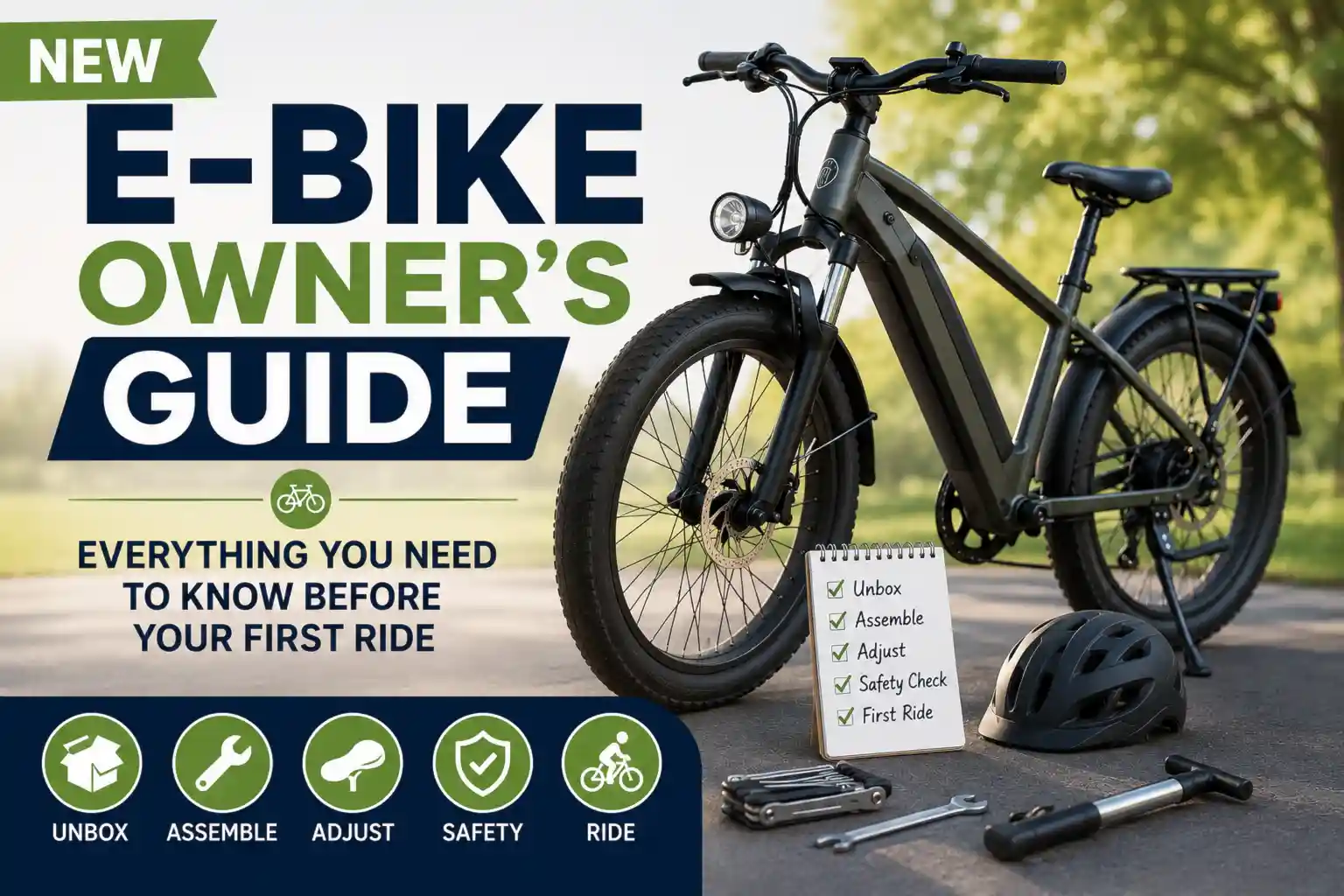
Before worrying about range, speed, or accessories, spend a few minutes making sure the bike is ready for a safe first ride.
- Read the bike-specific owner’s manual. Pay particular attention to charging, battery installation, wheel installation, folding mechanisms, torque specifications, brake bedding, and any first-use instructions.
- Confirm the battery is fully seated and locked. It should not rattle, slide, or unexpectedly release.
- Check both brakes. Squeeze each brake lever firmly before moving the bike.
- Check the tires. Inflate them according to the tire and bike manufacturer’s guidance rather than using one pressure for every e-bike.
- Check the wheels and handlebars. Nothing should feel loose, crooked, or improperly seated.
- Adjust your saddle. Make sure you can confidently start, stop, and put a foot down as needed.
- Turn on the display and identify the controls. Know how to change assist levels, operate the lights, and use the throttle if your bike has one.
- Wear a properly fitted helmet and choose a quiet practice area.
If your bike requires substantial assembly and you are not confident that the wheels, handlebars, brakes, drivetrain, or other safety-critical components are installed correctly, consider having the bike checked by a qualified bicycle or e-bike mechanic before the first ride.
Want to make sure your new e-bike is really ready to ride? Work through the interactive checklist below. It will flag any important setup or safety checks you still need to complete.
Interactive New Owner Tool
Is Your New E-Bike Ready to Ride?
Work through this quick setup and safety check. Check each item you have completed, then get a personalized readiness result and a list of anything you should handle next.
1. Assembly & Basic Setup
2. Battery & Electrical System
3. Brakes, Tires & Wheels
4. Drivetrain & Controls
5. Rider Safety & First-Ride Prep
6. Ownership Basics
This checklist is a general educational aid, not a substitute for your e-bike manufacturer’s instructions or a professional bicycle inspection. If anything feels loose, damaged, unstable, or unsafe, stop riding until the issue is corrected.
60-Second Pre-Ride Safety Check
A quick inspection before each ride can catch many problems while the bike is still parked.
| Check | What to Look For |
|---|---|
| Tires | Reasonable pressure for your bike and tires, no major cuts, bulges, exposed casing, or obvious damage. |
| Wheels | Properly secured, no severe wobble, and no loose axle or quick-release hardware. |
| Brakes | Both levers operate normally and the bike can be stopped firmly before entering traffic. |
| Battery | Securely latched, no unusual heat, swelling, leaking, cracks, or impact damage. |
| Controls | Display, assist controls, throttle if equipped, and lights operate normally. |
| Handlebars | Straight, secure, and free from unexpected movement. |
| Wiring and frame | No loose, pinched, exposed, cut, melted, or obviously damaged wiring and no obvious frame damage. |
| Lights and visibility | Use appropriate front and rear lighting and reflectors for the conditions and local requirements. |
Stop Riding or Charging If You Notice These Warning Signs
Stop using or charging the e-bike if you notice smoke, sparks, swelling, leaking, unusual battery heat, a strong chemical odor, damaged wiring, a battery that has been seriously impacted, brake failure, a loose wheel, severe steering looseness, or another problem that could affect safe control of the bike.
Do not open a lithium-ion battery pack or try to bypass its protection system. Move away from a smoking or burning battery and contact emergency services when appropriate. For non-emergency problems, contact the manufacturer or a qualified e-bike technician before using the bike again.
Before Your First Ride: Read This First
An e-bike can accelerate faster, weigh more, and travel at higher assisted speeds than a conventional bicycle. That does not make it difficult to ride, but it does mean a beginner should learn the bike gradually rather than immediately using the highest assist setting.
Start somewhere quiet and predictable. Avoid heavy traffic, steep hills, crowded paths, or complicated intersections until you are comfortable starting, stopping, turning, signaling, and controlling your speed.
Know What Type of E-Bike You Own
You do not need to become an electrical engineer to ride safely, but you should know the basic configuration of your bike. Identify whether it uses a hub motor or mid-drive, whether it has a cadence or torque-style pedal-assist sensor, whether it has a throttle, and what its manufacturer says about maximum assisted speed and operating modes.
If you want a deeper explanation, my e-bike motor guide explains hub motors, mid-drives, sensors, wattage, torque, and the tradeoffs between common systems.
Motor Power and Torque in Plain English
Motor wattage and torque figures can be useful, but neither number alone tells you exactly how an e-bike will climb, accelerate, or feel. Real-world performance also depends on controller limits, gearing, wheel size, bike and rider weight, terrain, battery state, and how the manufacturer tunes the system.
Use the specifications to understand your bike, but judge its behavior by learning how your particular model responds in a controlled environment.
Understand Pedal Assist and the Throttle
Pedal assist adds motor support while you pedal. Assist levels are not standardized from one brand to another, so Level 1 on one bike may feel very different from Level 1 on another.
For your first rides, begin with a low assist setting. Increase assistance gradually once you understand how quickly the bike responds.
If your bike has a throttle, learn exactly when it becomes active and whether it operates from a stop. Keep fingers and objects away from the throttle while mounting, dismounting, walking the bike, loading cargo, or working near the handlebars.
E-Bike Classes: What New Owners Need to Know
Many U.S. states use a three-class framework, but the definitions and access rules are not universal. A common model is:
- Class 1: motor assistance while pedaling, with assistance ending at 20 mph.
- Class 2: the motor may propel the bicycle without pedaling, with motor assistance ending at 20 mph.
- Class 3: motor assistance designed for speeds up to 28 mph, with additional equipment, age, helmet, or access rules in some places.
Do not assume the label on your bike automatically tells you where you may ride. State, city, trail, park, campus, and property rules can differ. See my guide to Class 1, Class 2, and Class 3 e-bikes and check the e-bike laws in your state before riding in unfamiliar areas.
Skills to Practice on Your First Few Rides
A new e-bike owner should build confidence before adding traffic, hills, passengers, or higher speeds. Practice the following in a quiet area:
- Smooth starts. Begin with low assist and learn how quickly the motor engages.
- Controlled stops. Use both brakes progressively and learn how the bike behaves under firmer braking.
- Straight-line riding. Practice maintaining a predictable path at low and moderate speeds.
- Wide and tighter turns. Learn how the bike’s weight and tire size affect steering.
- Looking behind you. Practice checking over a shoulder without drifting across your lane.
- Hand signals. Learn to signal while maintaining control.
- Assist-level changes. Become familiar with changing assistance without staring at the display.
- Stopping from gradually higher speeds. Increase speed only after you can consistently stop under control.
Braking on an E-Bike
Higher speeds increase stopping distance, and an e-bike may feel different from the conventional bicycle you are used to. Braking performance also depends on brake design, tires, road surface, total load, weather, and rider technique.
Practice progressive braking with both brakes. Avoid grabbing a brake suddenly unless you are responding to an emergency, and give yourself more room as speed, load, traffic complexity, or surface conditions increase.
New brake pads and rotors may also require a manufacturer-specified bedding process before they reach normal performance. Check your bike or brake manufacturer’s instructions.
Fit and Comfort Matter More Than Beginners Expect
An e-bike that fits poorly can be harder to control at low speed and less comfortable on longer rides. Check saddle height, reach to the handlebars, brake-lever position, and whether you can confidently start and stop.
If the bike feels too tall, too stretched out, or difficult to stabilize, do not assume you will simply “get used to it.” Small adjustments can help, but a bike that is fundamentally the wrong size may remain difficult to control.
If you are unsure, use the e-bike size calculator as a starting point and compare the result with the manufacturer’s fit guidance.
Your First Week With an E-Bike
Your first week is mainly about learning how the bike behaves and noticing anything that changes after the first few rides.
- Ride in increasingly varied conditions only as your confidence improves.
- Listen for new rubbing, clicking, grinding, or rattling sounds.
- Pay attention to brake feel and shifting.
- Check that the battery remains securely mounted.
- Watch for wheel looseness, severe spoke noise, or developing wheel wobble.
- Learn how quickly your battery drops under different assist levels and terrain.
- Follow any first-week inspection or break-in instructions in your owner’s manual.
Your First 30 Days: New Owner Checklist
- Save your receipt and order records.
- Photograph the bike. Include identifying features and accessories.
- Record the frame serial number. Also record the battery model or serial information when available.
- Keep spare keys and key numbers somewhere safe.
- Register the bike or warranty with the manufacturer if applicable.
- Bookmark or download the owner’s manual.
- Save manufacturer support information.
- Review the return and warranty deadlines.
- Check for recalls or current safety warnings.
- Review theft protection, insurance, and tracking options.
- Follow the manufacturer’s break-in and service schedule.
Battery Charging Safety for New Owners
Lithium-ion batteries store a large amount of energy, so charging habits matter. Use the charger supplied with the bike or another charger specifically approved by the manufacturer for that battery and charging system.
- Charge in a dry, well-ventilated location away from combustible materials.
- Be present while the battery is charging.
- Do not charge while sleeping or while you are away from home.
- Follow the manufacturer’s charging-temperature instructions.
- Do not use a damaged charger, cable, connector, or battery.
- Do not use an unapproved so-called universal charger merely because the plug fits.
- Do not cover the charger or battery while charging unless the manufacturer specifically instructs otherwise.
- Keep exits and escape routes clear.
- Stop charging if you notice unusual heat, swelling, leaking, smoke, sparks, or a strong chemical odor.
For the first charge, follow your manufacturer’s specific instructions. Some brands recommend a full charge before the first ride, while others provide different storage, activation, or charging guidance.
UL 2849 vs. UL 2271
UL 2849 is a safety standard used for the electrical system of an e-bike, including combinations of the electrical drivetrain, battery system, and charger. UL 2271 addresses batteries used in light electric vehicle applications.
Certification language matters. A claim that a product was “tested to” a UL standard is not automatically the same thing as third-party certification. When electrical safety certification is important to you, look for clear certification information and verify the certifying organization when possible.
Battery Storage and Long-Term Care
Storage recommendations vary by battery manufacturer, so use the instructions for your specific battery rather than treating one charge percentage as universal.
In general, avoid storing a lithium-ion e-bike battery in extreme heat, direct sun, freezing conditions outside its allowed storage range, or somewhere that exposes it to water or physical damage. If the bike will sit unused for an extended period, follow the manufacturer’s storage-charge and periodic-check recommendations.
Do not continue charging or using a battery that has swollen, leaked, overheated abnormally, produced unusual odor, been severely damaged, or otherwise behaves abnormally.
What to Do With an Old or Damaged E-Bike Battery
Do not place lithium-ion e-bike batteries in household trash or general recycling. Damaged and end-of-life batteries need an appropriate battery recycling or hazardous-waste pathway.
Check with the manufacturer, local household hazardous-waste program, or an appropriate battery recycling service for instructions in your area. Damaged batteries may require special handling, so do not transport one casually if it is hot, swollen, leaking, smoking, or otherwise unstable.
Protect Your New E-Bike From Theft
Security should begin before the first trip to a store, trailhead, workplace, or transit stop.
- Record the frame serial number and keep it somewhere separate from the bike.
- Photograph the entire bike and unique identifying features.
- Save proof of purchase.
- Use a lock appropriate to the bike’s value and your parking environment.
- Lock the frame to a secure fixed object when possible.
- Consider a second lock or wheel-security method in higher-risk locations.
- Consider GPS or another tracking system for a higher-value e-bike.
- Do not assume your homeowners or renters insurance automatically provides adequate e-bike theft coverage.
My guide to homeowners insurance and e-bike theft explains why coverage can vary. You can also compare e-bikes and security systems with GPS tracking.
Passenger, Child Seat, and Cargo Safety
Do not assume that a powerful motor means an e-bike is designed to carry another adult, a child seat, or heavy cargo. Check the manufacturer’s instructions first.
Important limits can include the bike’s total payload, rear-rack rating, front-rack rating, child-seat compatibility, passenger footrests or guards, and approved accessory mounting points. A rack’s stated capacity is not necessarily the same thing as the entire bike’s payload capacity.
Additional weight changes acceleration, handling, turning, braking, and hill performance. Practice with cargo gradually, secure the load carefully, and never exceed the relevant manufacturer limits.
Transporting an E-Bike on a Car Rack
E-bikes are often substantially heavier than conventional bicycles, and not every bicycle rack is designed to carry them.
Before transport, check:
- the rack’s per-bike weight rating;
- the vehicle or hitch limits;
- wheelbase and tire-width compatibility;
- whether the frame shape can be secured properly;
- the bike manufacturer’s instructions about transporting the battery installed or removed;
- the rack manufacturer’s instructions for e-bikes.
Use the actual listed weight of your e-bike rather than assuming it is within the range of a conventional rack.
What to Do After a Fall, Crash, or Dropped Battery
Take care of yourself first. If you are injured or the crash involved another road user, deal with the medical and emergency situation before inspecting the bike.
Before riding again, power the bike off and inspect the wheels, handlebars, brake controls, frame, cables, battery mount, and battery casing. Look for looseness, cracks, severe wheel wobble, damaged wiring, brake problems, or anything that has moved out of position.
If the battery took a serious impact, do not charge it merely to “see if it still works.” If you see deformation, cracks, leaking, swelling, unusual heat, odor, smoke, sparks, or other abnormal behavior, stop using it and contact the manufacturer or an appropriate qualified service provider.
Basic E-Bike Maintenance for Beginners
You do not need to perform advanced electrical repairs to keep an e-bike in good condition. Focus on routine inspection and simple mechanical care.
Tires
Check tire pressure regularly using the bike and tire manufacturer’s recommended range. Riding pressure depends on the specific tire, rider and cargo load, terrain, wheel size, and riding conditions.
Brakes
Watch for changing lever feel, rubbing, reduced stopping performance, contamination, unusual noise, or pads approaching their wear limit. If you are unsure whether the brakes are safe, have them inspected rather than continuing to ride.
Chain and Drivetrain
Keep the chain reasonably clean and lubricated using a lubricant appropriate to your riding conditions. Wet, dusty, muddy, salty, or high-mileage riding may require more frequent attention.
For more detail, see the e-bike chain cleaning and lubrication guide.
Fasteners, Wheels, and Spokes
Pay attention to looseness, new rattles, spoke noise, wheel movement, or anything that changes after the first rides. Follow your manufacturer’s inspection and torque instructions rather than applying generic torque values.
Cleaning
Follow the manufacturer’s cleaning instructions and water-resistance guidance. Avoid pressure washing an e-bike and avoid directing water at electrical connectors, bearings, display openings, or other vulnerable areas.
If you ride in rain or wet conditions, see my guide to riding an e-bike in the rain.
Having Trouble With Your E-Bike?
If something doesn’t seem right with your e-bike, start with my E-Bike Troubleshooting and Maintenance Guide. It covers common battery, motor, brake, throttle, pedal-assist, display, and charging problems, along with basic maintenance tips that can help you prevent issues before they start.
Normal Learning Curve vs. Stop and Check
| May Be Part of Learning the Bike | Stop and Check Before Continuing |
|---|---|
| Assist feels stronger or weaker than expected while you learn the settings. | Motor continues driving unexpectedly when controls are released. |
| Battery range changes noticeably with hills, wind, load, temperature, and assist level. | Battery swells, leaks, smokes, sparks, becomes abnormally hot, or smells strongly chemical. |
| Minor drivetrain noise while you learn correct shifting. | Severe grinding, chain derailment that compromises control, or visibly damaged drivetrain parts. |
| Different steering feel because of bike weight or tire size. | Loose handlebars, steering play, severe wheel wobble, or a loose wheel. |
| Brake feel changes slightly as new pads bed in according to manufacturer instructions. | Brake failure, dramatic loss of braking power, fluid leaks, or a lever that suddenly behaves abnormally. |
Common New E-Bike Owner Mistakes
- Starting in the highest assist level. Learn the bike at lower assistance first.
- Looking down at the display too much. Learn the controls while stationary so your attention stays on the road.
- Using the throttle accidentally while walking or mounting. Know when it is active and keep fingers clear when appropriate.
- Ignoring tire pressure. Low or excessive pressure can affect handling, comfort, traction, and tire reliability.
- Waiting for a brake problem to become severe. Changing brake feel deserves attention.
- Charging with an unapproved charger. Use equipment approved for your battery and system.
- Leaving the bike unsecured because the stop is short. Theft can happen quickly.
- Assuming every path allows your class of e-bike. Check the actual local or land-manager rules.
- Ignoring new noises or looseness. A new bike may need adjustment after initial use.
Check for E-Bike Recalls and Safety Warnings
New owners should know the exact brand, model, and battery identification for their bike. This makes it easier to determine whether a recall or safety warning applies later.
Check the U.S. Consumer Product Safety Commission recall database and your manufacturer’s support or safety pages for current information. If a recall or stop-use warning applies to your model, follow the official instructions rather than improvising a repair.
What Should You Carry on an E-Bike Ride?
The exact kit depends on where and how far you ride, but a practical beginner setup often includes:
- a properly fitted helmet;
- a suitable lock when you will leave the bike unattended;
- a way to inflate your specific valve type;
- basic flat-repair supplies appropriate to your tires;
- a small multi-tool if you know how to use it safely;
- water and weather-appropriate clothing for longer rides;
- identification and a charged phone where practical.
Do not carry a charger simply because you own one. If you need destination charging, transport and use it according to the manufacturer’s instructions. For helmets, locks, mirrors, pumps, tools, and other useful gear, see my guide to the best e-bike accessories.
Essential Accessories for New E-Bike Owners
You do not need to buy every accessory immediately. Start with equipment that improves safety, security, or basic roadside preparedness.
Where Can You Ride Your E-Bike?
E-bike access depends on more than the bike’s class label. State law, local ordinances, park rules, trail managers, campuses, private property rules, and specific facilities can impose different restrictions.
Before riding somewhere unfamiliar, check the State-by-State E-Bike Law Guide, and the rules of the agency or property manager responsible for the specific route.
This article provides general information and is not legal advice. Rules change, and local requirements may differ from statewide rules.
When Something Does Not Feel Right
If your e-bike suddenly will not power on, cuts out, shows an error code, loses pedal assist, has brake problems, or behaves differently than normal, start with simple and safe checks rather than opening electrical components.
- Confirm the battery is charged, correctly installed, and securely latched.
- Check whether the display shows an error code.
- Look for obvious loose or damaged external connectors without dismantling the battery.
- Check whether a brake cutoff sensor is keeping the motor disabled.
- Review the bike-specific manual.
- Contact manufacturer support or a qualified shop when the problem is unclear.
My e-bike troubleshooting and maintenance guide can help you narrow down common problems safely.
When to Call a Bike Shop or the Manufacturer
Professional help is appropriate when a problem affects safety, involves internal battery or electrical work, or requires skills or tools you do not have.
Examples include brake failure, wheel or steering looseness you cannot correct confidently, damaged battery cases, electrical burning odor, recurring error codes, damaged wiring, frame damage, severe wheel problems, or a motor/control issue that cannot be resolved with the manufacturer’s basic troubleshooting steps.
🔎 Why You Can Trust This Guide
I compare manufacturer instructions, current safety information, technical references, and practical ownership guidance when updating this guide. Because e-bike designs vary, I separate general safety principles from instructions that should come from your specific bike or battery manufacturer.
You can also read how Electric Bike Explorer researches and evaluates e-bikes.
New E-Bike Owner FAQs
Should I fully charge my e-bike battery before the first ride?
Follow the manufacturer’s first-charge instructions. Many manufacturers recommend charging before the first ride, but battery activation and storage procedures differ by model.
What assist level should a beginner use?
Start with a low assist setting and increase it gradually as you learn how quickly your specific bike responds. Assist levels are not standardized between brands.
How often should I service a new e-bike?
Follow the manufacturer’s break-in and maintenance schedule. Have the bike inspected sooner if braking, steering, wheel security, shifting, battery mounting, or another safety-critical system changes.
Can I wash an e-bike with water?
Follow the manufacturer’s cleaning and water-resistance instructions. Avoid pressure washing and avoid directing water at electrical connections and other vulnerable areas.
Can I ride my e-bike in the rain?
It depends on the bike’s design, water-resistance guidance, riding conditions, and manufacturer instructions. See the e-bike rain-riding guide for more detail.
Can I use any charger that fits my battery?
No. Use the charger supplied with the bike or a replacement specifically approved by the manufacturer for that battery and charging system.
What should I do if my e-bike battery gets very hot?
Stop using or charging it if the heat is unusual or accompanied by swelling, leaking, odor, smoke, sparks, or other abnormal behavior. Move away from a dangerous battery and contact emergency services when appropriate. Otherwise contact the manufacturer or a qualified service provider before using it again.
How do I know if my e-bike has been recalled?
Record the bike and battery identification and check the CPSC recall database plus the manufacturer’s support pages. Follow official recall instructions exactly if your product is affected.
My Take
The best first week with an e-bike is not about seeing how fast it can go. It is about learning how the bike starts, stops, turns, charges, and behaves before those things become automatic.
I would rather see a new owner spend 20 minutes practicing braking and low-speed handling than spend that time changing settings or buying accessories. Once you are comfortable controlling the bike and have a safe charging and maintenance routine, everything else becomes easier.
Your Next Steps
If you are a new owner, I recommend this order:
- Complete the first-ride and pre-ride checks in this guide.
- Practice the riding skills somewhere quiet.
- Establish a safe charging location and routine.
- Record your serial numbers and protect the bike against theft.
- Check your state and local riding rules.
- Bookmark the troubleshooting guide for later.
For more beginner-friendly information, visit the Electric Bike Explorer resource library or the free e-bike tools hub.
Disclosure: As an Amazon Associate, I earn from qualifying purchases. This comes at no extra cost to you and helps support the content on this site.
Sources and Safety References
- U.S. Consumer Product Safety Commission – Micromobility Safety
- U.S. Consumer Product Safety Commission – Recalls
- National Highway Traffic Safety Administration – Bicycle Safety
- UL Solutions – UL 2849 E-Bike Electrical System Certification
- UL Solutions – Micromobility Product Certification
- PeopleForBikes – E-Bike Policies and Laws

Kristina is not just an enthusiast but a true authority on electric bikes. Nestled in the coastal beauty of Virginia, Kristina has found the perfect backdrop for her passion for electric biking. As a dedicated wife and homeschooling mom, her life revolves around family, faith, and the thrill of adventure.
Originally hailing from Ohio, Kristina's journey with electric bikes began as a curiosity and quickly evolved into a deep expertise. Her blog is a testament to her love for electric biking, combining her fascination for eco-friendly transportation with her coastal lifestyle.
When she's not cruising the beach on her electric bike, you'll find Kristina indulging in her other loves: long walks along the shore, getting lost in a good book, and cherishing moments with her loved ones. With a heart as big as her love for animals, especially cats, Kristina brings a unique perspective to the electric bike world, grounded in her strong faith in God and her dedication to a sustainable lifestyle.
Through her blog, Kristina shares her extensive knowledge of electric bikes, offering valuable insights, tips, and recommendations to fellow enthusiasts. Whether you're a seasoned rider or a newcomer to the electric bike scene, Kristina's blog is your go-to source for all things electric biking, fueled by her passion, expertise, and the scenic beauty of coastal Virginia.