New Jersey E-Bike Law 2026: License, Registration & Insurance Rules Explained
Last Updated on July 24, 2026 by Kristina
Update – July 2026: New Jersey’s e-bike licensing and registration system is now active. The New Jersey Motor Vehicle Commission began issuing e-bike licenses and registrations on June 26, 2026, and the six-month compliance period expired on July 19, 2026. Riders must generally be at least 15 years old, possess a valid driver’s license or motorized bicycle license, and register their e-bike with the NJMVC. Liability insurance is required only for e-bikes classified as motorized bicycles. A pedal-assist-only bike that stops providing assistance at 20 mph must still be licensed and registered, but it does not require insurance. The NJMVC currently instructs all e-bike riders to wear a helmet, regardless of age.
Introduction
New Jersey has made major changes to how electric bicycles are classified and regulated.
Instead of relying entirely on the familiar Class 1, Class 2 and Class 3 system used in many other states, New Jersey separates qualifying two-wheeled e-bikes into two primary legal categories:
- Low-speed electric bicycles
- Motorized bicycles
The category your bike falls into determines whether you need liability insurance. Both categories, however, generally require the rider to possess a qualifying license and register the bike with the NJMVC.
One of the most important distinctions is whether the bike has a throttle. A common 20 mph throttle-equipped e-bike will generally be treated as a motorized bicycle in New Jersey, even though the same bike may be marketed as a Class 2 e-bike elsewhere.
For a broader look at how this compares with the rest of the country, see the State-by-State E-Bike Laws Guide.
🔎 Why You Can Trust Electric Bike Explorer
I reviewed current state statutes, transportation agency guidance, and available local rules when this guide was updated. When relevant, I also check city ordinances, park and trail policies, school or campus rules, and other official government sources.
E-bike laws can change, and local governments, parks, trails, and campuses may impose additional restrictions. Always confirm the latest requirements with the appropriate agency before riding.
Learn more about how Electric Bike Explorer researches law guides, buying guides, troubleshooting information, and e-bike recommendations.
Want to See More Electric Bike Explorer in Google Search?
Add Electric Bike Explorer as a preferred source to see more of our e-bike law guides, safety updates, reviews, buying guides, and troubleshooting posts when they are relevant to your searches.
New Jersey E-Bike Laws at a Glance
| E-bike type | Minimum age | License required | NJMVC registration | Liability insurance | Helmet |
|---|---|---|---|---|---|
| Pedal assist only, with assistance ending at 20 mph | 15 | Yes | Yes | No | Yes, according to current NJMVC instructions |
| Throttle-equipped bike capable of moving without pedaling | 15 | Yes | Yes | Yes | Yes |
| Pedal-assist bike providing assistance from 21 to 28 mph | 15 | Yes | Yes | Yes | Yes |
| Throttle-powered bike capable of more than 15 mph but no more than 28 mph | 15 | Yes | Yes | Yes | Yes |
| Qualifying shared low-speed rental e-bike operated under a local government contract | 16 | Individual license exemption | Operator uses a fleet-reporting process | No motorized-bicycle insurance | Follow NJMVC and operator helmet rules |
| Electric tricycle | Depends on other applicable laws | Excluded from this particular e-bike law | Excluded from this particular e-bike law | Excluded from this particular e-bike law | Check other state and local rules |
The NJMVC law-enforcement advisory confirms that low-speed and motorized e-bikes must be registered, that only motorized bicycles require insurance, and that electric tricycles are not included in the new electric-bicycle definitions.
How New Jersey Defines an E-Bike
Knowing whether your bike has a throttle and how fast its motor continues assisting is more important in New Jersey than the class number printed on the frame.
Low-Speed Electric Bicycle
A low-speed electric bicycle is a two-wheeled bicycle with fully operational pedals and an electric motor that:
- provides assistance only while the rider is pedaling
- stops providing assistance when the bike reaches 20 mph
A qualifying low-speed electric bicycle must be licensed and registered, but liability insurance is not required.
Motorized Bicycle
An electric bike is generally classified as a motorized bicycle when it has one or more of the following:
- a throttle that can move the bike without pedaling
- a motor that can propel the bike by throttle at up to 15 mph
- pedal assistance that continues above 20 mph but not above 28 mph
- throttle-powered propulsion above 15 mph but not above 28 mph
A motorized bicycle requires licensing, registration and liability insurance.
Does a 20 MPH Throttle E-Bike Need Insurance?
Generally, yes.
A bike does not qualify for the low-speed pedal-assist insurance exemption when a throttle can propel it without pedaling. That means many bikes commonly marketed as Class 2 e-bikes are treated as motorized bicycles under New Jersey law.
What About an E-Bike Faster Than 28 MPH?
Do not assume that a bike capable of exceeding 28 mph qualifies for the standard e-bike registration process.
A high-powered, modified or off-road-style electric bike may fall under a different motorcycle or motor-vehicle classification. Riders should confirm the bike’s status with the NJMVC before using it on public roads.
For help understanding the classifications commonly used elsewhere, see my E-Bike Classes Explained guide.
Do You Need a License to Ride an E-Bike in New Jersey?
Yes. Most people operating a low-speed electric bicycle or motorized bicycle must possess either:
- a valid driver’s license of any class, or
- a New Jersey Class F motorized bicycle or moped license
Riders who are 17 or older may use a valid driver’s license. Riders who are 15 or 16 must obtain a motorized bicycle license or permit. A person 17 or older who does not hold a driver’s license must also obtain the separate motorized bicycle license.
A person whose driving privileges have been suspended or revoked may not apply for or receive a motorized bicycle license during that suspension or revocation.
How to Get a New Jersey E-Bike License
You do not need a separate e-bike license when you already hold a valid driver’s license.
Anyone who needs the Class F motorized bicycle license must complete the NJMVC licensing process.
Apply for an E-Bike Permit
Schedule an initial e-bike permit appointment at an NJMVC Licensing Center and complete the BA-208 permit application.
Applicants must bring the required identification documents. A rider under 18 may also need parental or guardian consent.
Pass the Knowledge and Vision Tests
Applicants must pass:
- the NJMVC e-bike knowledge test
- a vision screening
Someone who fails the knowledge test may retake it after seven days.
Practice During the Permit Period
A validated permit allows the applicant to practice without supervision during daylight hours.
The road test must be scheduled at least 20 days, but no more than 45 days, after the permit is validated.
Take the Road Test
The applicant must bring:
- a registered e-bike
- both registration stickers properly displayed
- a helmet
- the validated permit
- the required identification
- proof of insurance when the test bike is a motorized bicycle
A rider who fails the road test may retake it after 14 days. After passing, the rider takes the permit, identification, proof of address and test results to a Licensing Center to receive the Class F license.
Do E-Bikes Have to Be Registered in New Jersey?
Yes. Qualifying two-wheeled low-speed electric bicycles and motorized bicycles must be registered before they are operated on New Jersey public highways or public land.
That includes a pedal-assist-only bike that stops assisting at 20 mph, even though that bike does not require insurance.
What You Need to Register an E-Bike
Registration is completed through an NJMVC Vehicle Center. Riders generally need:
- the completed BA-49EB registration form
- qualifying identification
- parental consent when applicable
- proof of ownership
- proof of insurance when registering a motorized bicycle
The NJMVC accepts several forms of ownership documentation:
- Manufacturer’s Certificate of Origin
- purchase receipt
- notarized bill of sale
- ownership affidavit completed on the BA-49EB form
An ownership affidavit may be accepted when a bike was purchased before registration became mandatory and the owner no longer possesses a formal receipt or bill of sale. Knowingly submitting false ownership documents can result in criminal penalties.
Where Do the Registration Stickers Go?
The NJMVC issues two registration stickers. One sticker must be displayed on each side of the bike’s front fork.
Proof of registration must also be carried while riding. The NJMVC says it may be carried in paper or electronic form.
How Long Is Registration Valid?
Registration expires on the last day of the eleventh calendar month following the month in which it was issued. In practical terms, riders should expect to renew the registration approximately once a year.
Are the NJMVC Fees Waived?
The law waives the examination, registration and licensing fees for the first year following enactment. The NJMVC currently states that the usual $5 permit examination fee is waived until January 2027. Insurance premiums are not included in the waiver.
Do E-Bikes Need Insurance in New Jersey?
Not every e-bike needs insurance.
Insurance Is Not Required When
The bike:
- provides motor assistance only while the rider is pedaling
- stops providing assistance at 20 mph
- cannot propel itself by throttle without pedaling
This bike must still be registered, and the rider must still possess a qualifying license.
Insurance Is Required When
The bike is classified as a motorized bicycle, including most:
- throttle-equipped e-bikes
- pedal-assist bikes that continue assisting above 20 mph
- bikes capable of motor-powered operation between 21 and 28 mph
New Jersey’s Department of Banking and Insurance established the following minimum liability limits:
| Coverage | Minimum amount |
|---|---|
| Injury or death to one person | $15,000 |
| Injury or death to more than one person in one accident | $30,000 |
| Property damage in one accident | $5,000 |
The insurance policy should identify the bike using its make, model, serial number or VIN when one is available.
Do not assume that homeowners or renters insurance satisfies this requirement. Ask the insurance company specifically whether the policy meets New Jersey’s motorized-bicycle liability requirements.
New Jersey E-Bike Age Rules
A person under 15 may not operate a qualifying low-speed electric bicycle or motorized bicycle.
Riders who are 15 or 16 must obtain a Class F motorized bicycle license or permit. Riders who are 17 or older may use either a valid driver’s license or the separate motorized bicycle credential.
The minimum-age rule applies even when the bike is limited to 20 mph and used only for recreation or transportation to school.
New Jersey E-Bike Helmet Rules
The NJMVC’s current e-bike requirements state that a helmet is mandatory for all e-bike riders, regardless of age. A helmet is also required when taking the NJMVC road test.
New Jersey’s older bicycle helmet law separately requires riders under 17 to wear a helmet. A bill introduced in June 2026 would place the all-ages low-speed e-bike helmet requirement more explicitly into the statute. Because the current agency instructions and underlying statutory language are still being aligned, the practical compliance rule is simple: every New Jersey e-bike rider should wear a properly fitted helmet.
Required E-Bike Equipment
New Jersey’s micromobility guidance says e-bikes must have:
- a white front light
- a red rear light
- a bell or other qualifying audible device
- working brakes
- the required manufacturer label
- a reflector for nighttime riding
- both NJMVC registration stickers
The manufacturer label should identify the bike’s classification, assisted speed and motor wattage. Riders must also travel in the direction of traffic and obey stop signs, traffic signals and other applicable traffic rules.
What Documents Must Riders Carry?
When riding with the motor engaged, carry:
- your valid driver’s license, Class F license or permit
- proof of registration
- proof of insurance when operating a motorized bicycle
Failing to possess or display the required documents may result in a fine of up to $50.
A municipal court may dismiss the document-possession charge if the rider proves the documents were valid on the date of the stop, although the court may still impose court costs.
Where Can You Ride an E-Bike in New Jersey?
Where an e-bike may be operated depends on its legal category and the agency controlling the road, path, park or property.
Streets and Public Roads
Low-speed electric bicycles may generally be used on streets, highways and roadways unless another state law, local restriction or posted sign prohibits them.
Motorized bicycles may not be operated on:
- interstate highways
- public highways divided by a grass or concrete median
- highways with speed limits above 50 mph
- railroad tracks or an operating railroad right-of-way
- public land where the responsible agency expressly prohibits them
The New Jersey transportation commissioner may also restrict motorized bicycles on roads with speed limits above 40 mph when those roads are considered hazardous.
Bike Paths
Low-speed electric bicycles may generally use bicycle paths. However, a local government or state agency may prohibit them on paths under its control.
Motorized bicycles can face additional restrictions and should not be assumed legal on every bike path simply because the bike is licensed, registered and insured.
Sidewalks
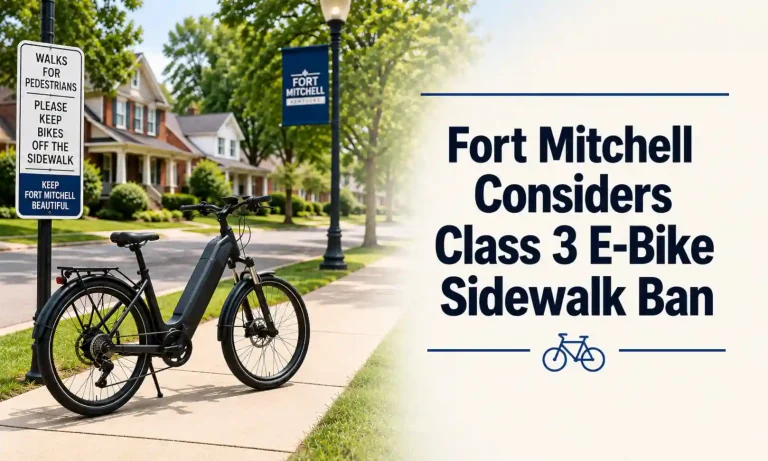
New Jersey law expressly allows an unobstructed low-speed e-bike to be parked on a sidewalk. It does not create a clear statewide right to ride an e-bike on every sidewalk.
Cities may prohibit sidewalk riding, and several New Jersey municipalities have adopted or published their own sidewalk restrictions.
The safest approach is to ride on the street or in an available bike lane and dismount before entering a sidewalk unless the local rules clearly permit riding there.
See my E-Bike Sidewalk Rules by State Guide for a broader comparison.
Natural-Surface Trails
A low-speed e-bike may not be operated on a natural-surface trail designated for nonmotorized traffic unless the government agency responsible for the trail has specifically permitted e-bikes.
A paved greenway and a natural-surface mountain-bike trail can therefore have different rules, even when both are within the same park.
Before visiting a park, use my E-Bike Trail Access Checker and confirm the current rules with the park or land-management agency.
Selected New Jersey City and Boardwalk E-Bike Rules
Local rules vary across New Jersey. The chart below contains specific, verified examples, but it is not a list of every municipality in the state.
Always check current municipal codes, posted signs, police guidance, boardwalk schedules and park rules before riding.
| Location | Specific local e-bike rule |
|---|---|
| Hoboken | Electric and motorized bicycles may not be ridden on sidewalks, and riders must dismount and walk them. E-bikes are also prohibited on portions of the waterfront walkway. Commercial e-delivery riders must obtain a city license, pay a $5 fee, pass a five-question test, carry the license and wear the city-issued reflective vest. The commercial license is valid for two years, and violations can result in a $50 fine. |
| Jersey City | Official city e-mobility guidance directs e-bike riders to stay off sidewalks, wear a helmet, yield to pedestrians, obey traffic laws and watch for turning vehicles. |
| Asbury Park | E-bikes are prohibited on the beach and boardwalk at all times. Violations may result in a $150 fine. The city also states that e-bikes may not be ridden on sidewalks. |
| Ocean City | The city’s published 2026 boardwalk bicycle schedule generally allows bicycles all day during the off-season and from 5 a.m. until noon between June 19 and September 7. Special events may create additional closures. Because the schedule refers broadly to bicycles, e-bike riders should also check posted signs and confirm that their particular e-bike category is permitted. |
| Cape May | Electric-powered bicycles, scooters and skateboards are prohibited on the promenade. Conventional bicycles have separate seasonal hours, generally between 4 a.m. and 10 a.m. from May 16 through September 14. |
| Moorestown Township | E-bikes and other covered motor-assisted devices are generally prohibited on township sidewalks. They are prohibited on township trails unless permission is given by signage or resolution, and permitted trail riding is limited to 15 mph. An exception allows riding on sidewalks or bike paths adjacent to county routes at no more than 10 mph while yielding to pedestrians. |
State registration does not override these local rules. A registered e-bike can still be prohibited on a particular sidewalk, boardwalk, trail, park or pedestrian area.
New Jersey School and College E-Bike Rules
State licensing and registration do not create an automatic right to ride, park, store or charge an e-bike on school property.
School districts, colleges and universities can establish additional rules covering:
- campus riding
- bicycle parking
- indoor storage
- battery charging
- campus registration
- approved travel routes
The following are selected verified examples, not a complete list of every New Jersey school.
| School or campus | Specific e-bike rule |
|---|---|
| Moorestown school grounds | The township ordinance applies to the exterior grounds of public, private and parochial schools. Covered devices may be used only on designated roadways, approaches to bicycle racks and drop-off lanes, with a maximum speed of 10 mph. |
| Princeton University | Beginning June 1, 2026, e-bikes and other personal electric vehicles may not generally be operated, parked, stored or charged within the university’s restricted campus zone. Certain eligible commuters may apply for an e-bike permit and use designated exterior parking areas. |
| New Jersey Institute of Technology | Storage, charging, operation and maintenance of lithium-ion e-bikes inside NJIT-owned or operated buildings, including residence halls, is prohibited. E-bikes must be stored outside at an available bicycle rack. |
| Montclair State University | E-bikes may be ridden on designated campus roadways but not on sidewalks. They may not be brought into, stored in or charged inside university buildings. Exterior storage is allowed at designated areas or bicycle racks. |
| Seton Hall University | E-bikes require a no-cost university permit and must be secured at approved racks. The university’s newer micromobility policy prohibits their use, possession, storage or charging inside or within 50 feet of buildings, sheds, tents, canopies, parking decks and other covered structures. Students should follow the newer, stricter micromobility policy where it overlaps with the university’s older riding policy. |
| Monmouth University | E-bike batteries may not be charged inside residence halls because of the university’s fire-safety rules. |
Parents and students should review the current school transportation handbook, parking policy and battery-storage rules before commuting by e-bike.
Shared Rental E-Bike Rules
A limited licensing exception applies to certain shared low-speed rental e-bikes.
The rider must:
- be at least 16 years old
- use a qualifying low-speed rental e-bike
- rent from a company operating under a contract with a local government
Under that arrangement, the rider does not need an individual driver’s license or Class F e-bike license.
The rental company may report the serial numbers of its fleet to the NJMVC quarterly instead of registering each shared bike through the ordinary individual process. This exception does not automatically apply to a normal rental from a private bike shop.
Rules for Out-of-State Riders
The NJMVC currently says an out-of-state visitor bringing a personally owned e-bike into New Jersey must:
- be at least 15 years old
- possess a valid license
- register the e-bike with the NJMVC
- obtain insurance when it is classified as a motorized bicycle
A low-speed pedal-assist bike does not require insurance, but the NJMVC still directs visiting riders to register it before riding in the state.
This is unusually restrictive for visiting e-bike riders, so anyone planning to bring a bike into New Jersey should complete the required process before the trip.
Are Electric Tricycles Covered?
The NJMVC’s law-enforcement advisory states that e-trikes are not defined as an electric bicycle under this law and are exempt from its licensing, registration and insurance requirements.
That does not necessarily mean an e-trike can be ridden anywhere without restriction. Traffic laws, local ordinances, park rules and private-property policies may still apply.
Can You Modify an E-Bike?
New Jersey prohibits tampering with a low-speed electric bicycle to change its motor-powered speed capability or the way its motor engages.
The law also prohibits selling modification kits designed to turn a low-speed electric bicycle into a motorized bicycle or electric motorized bicycle.
Removing a speed limiter, changing the controller, installing a more powerful motor or adding a throttle could:
- change the bike’s legal classification
- create an insurance requirement
- make the registration information inaccurate
- make the bike unlawful on certain roads or paths
New Jersey E-Bike Compliance Checklist
Before riding a personally owned e-bike in New Jersey:
- Check whether the bike is pedal assist only or has a throttle.
- Confirm the maximum pedal-assisted speed.
- Confirm the maximum throttle-powered speed.
- Determine whether it is a low-speed electric bicycle or motorized bicycle.
- Obtain motorized-bicycle liability insurance when required.
- Schedule an NJMVC registration appointment.
- Gather your identification and proof of ownership.
- Complete the BA-49EB registration form.
- Place one registration sticker on each side of the front fork.
- Obtain a Class F license if you do not possess a valid driver’s license.
- Carry your license, registration and applicable insurance proof.
- Wear a helmet.
- Check local sidewalk, boardwalk, trail, park and campus rules.
How New Jersey Compares With a Typical Three-Class State
| Requirement | New Jersey low-speed pedal assist | New Jersey throttle or 21-28 mph bike | Typical Class 1 or Class 2 treatment in many states |
|---|---|---|---|
| Minimum rider age | 15 | 15 | Varies by state |
| License | Yes | Yes | Usually no |
| Registration | Yes | Yes | Usually no |
| Liability insurance | No | Yes | Usually no |
| Helmet | NJMVC says yes for all riders | Yes | Depends on state and rider age |
| Local path restrictions | Yes | Yes | Yes |
Because state rules vary and continue to change, use the U.S. E-Bike Laws Guide for current information about another state rather than assuming New Jersey’s requirements apply elsewhere.
Nearby State Law Guides
Traveling outside New Jersey? Laws change quickly.Check other states:
New York e-bike laws
Pennsylvania e-bike laws
Ohio e-bike laws
Massachusetts e-bike laws
👉 Compare all states in the state-by-state e-bike law guide
Helpful Legal and Safety Accessories for E-Bike Riders
E-bike equipment requirements vary by state and city, but a few basic accessories can help you ride more safely, remain visible, and comply with local laws.
- Helmet – Protect your head with a properly fitted, CPSC-certified bicycle helmet, even if you’re not legally required to wear one.
- Front & Rear Bike Lights – Improve your visibility during early morning rides, evening commutes, and low-light conditions.
- Phone Mount – A sturdy handlebar phone mount can make it easier to follow maps, check your route, or use trail apps without having to stop and dig through a bag.
- Rear View Mirror – A handlebar or helmet-mounted mirror can help you keep an eye on traffic behind you, which is especially helpful when riding on roads, bike lanes, or narrow shoulders.
- Panniers or Rear Rack Bags – Panniers and bike bags are useful for carrying groceries, work items, jackets, tools, chargers, or extra layers without wearing a heavy backpack.
- Small Handlebar or Frame Bag – A compact bag gives you quick access to smaller items like keys, wallet, snacks, sunglasses, tire levers, or a portable charger.
- Heavy-Duty Bike Lock – Help protect your investment when stopping at stores, trailheads, or other public places.
- Mini Tire Pump & Flat Repair Kit – Be prepared for unexpected flats, especially if you’re riding longer distances.
- Compact Multi-Tool – Quickly tighten loose bolts or make minor adjustments while you’re away from home.
- High-Visibility Reflective Gear – Reflective vests, ankle bands, or jackets can help drivers see you sooner, especially at dawn, dusk, or in poor weather.
FAQs
No. A pedal-assist-only bike that stops providing assistance at 20 mph does not require insurance. Throttle-equipped bikes and pedal-assist bikes that continue assisting above 20 mph generally do.
Qualifying two-wheeled low-speed electric bicycles and motorized bicycles must be registered before they are used on public highways or public land. Shared rental fleets and e-trikes are treated differently.
No. A valid driver’s license satisfies the licensing requirement.
No. A person under 15 may not operate a qualifying low-speed electric bicycle or motorized bicycle under the new law.
Yes, but the rider must obtain a Class F motorized bicycle license or permit and the bike must be registered. Insurance is also required if the bike is a motorized bicycle.
Generally, yes. The low-speed insurance exemption applies to bikes that assist only while the rider pedals. A throttle capable of moving the bike without pedaling generally puts it in the motorized-bicycle category.
Do not assume sidewalk riding is permitted. State law addresses sidewalk parking, while cities can prohibit riding. Hoboken, Jersey City, Asbury Park and Moorestown are examples of communities with local sidewalk restrictions or guidance.
A low-speed pedal-assist e-bike may generally use a bicycle path unless the local government or state agency responsible for it has prohibited e-bikes. Motorized bicycles may face stricter rules.
Only when the agency controlling the natural-surface trail has specifically permitted e-bikes. Natural-surface trails designated for nonmotorized use are otherwise off-limits.
The NJMVC currently states that helmets are mandatory for all e-bike riders, regardless of age.
The NJMVC may accept a notarized bill of sale or, under qualifying circumstances, an ownership affidavit completed on the BA-49EB registration form.
Registration expires on the last day of the eleventh calendar month after the month in which it was issued.
The NJMVC says an out-of-state rider must possess a valid license and register a personally owned e-bike with the NJMVC. Motorized bicycles also need insurance.
The NJMVC says e-trikes are excluded from this particular law. Other traffic and local property rules may still apply.
My Take
I understand why New Jersey wants greater accountability for throttle-powered, modified and higher-speed electric bikes. A vehicle capable of approaching 30 mph without ordinary bicycle-style effort creates different risks from a traditional bike.
My concern is that the law also requires licensing and registration for a basic pedal-assist bike that stops assisting at 20 mph. These bikes are commonly used by commuters, seniors and recreational riders and are treated much more like regular bicycles in many other states.
The insurance distinction is more reasonable because low-speed pedal-assist bikes are exempt while throttle-equipped and higher-speed bikes must be insured. However, many owners may not realize that simply having a throttle can move their bike into the motorized-bicycle category.
I believe a clear tiered system based on speed, throttle capability and motor performance could address unsafe riding without placing the same administrative burden on every low-speed rider. Until the law changes, New Jersey riders should carefully check their bike’s specifications, complete the NJMVC process and review local rules before riding.
Disclosure: As an Amazon Associate, I earn from qualifying purchases. This comes at no extra cost to you and helps support the content on this site.
External Sources
- New Jersey Motor Vehicle Commission e-bike requirements
- New Jersey P.L.2025, Chapter 285
- NJMVC law-enforcement implementation advisory
- New Jersey motorized-bicycle insurance guidance
This guide is for general informational purposes and is not legal advice. State and local e-bike rules can change, so confirm current requirements with the NJMVC or the agency controlling the road, trail, park, boardwalk or campus before riding.

Kristina is not just an enthusiast but a true authority on electric bikes. Nestled in the coastal beauty of Virginia, Kristina has found the perfect backdrop for her passion for electric biking. As a dedicated wife and homeschooling mom, her life revolves around family, faith, and the thrill of adventure.
Originally hailing from Ohio, Kristina's journey with electric bikes began as a curiosity and quickly evolved into a deep expertise. Her blog is a testament to her love for electric biking, combining her fascination for eco-friendly transportation with her coastal lifestyle.
When she's not cruising the beach on her electric bike, you'll find Kristina indulging in her other loves: long walks along the shore, getting lost in a good book, and cherishing moments with her loved ones. With a heart as big as her love for animals, especially cats, Kristina brings a unique perspective to the electric bike world, grounded in her strong faith in God and her dedication to a sustainable lifestyle.
Through her blog, Kristina shares her extensive knowledge of electric bikes, offering valuable insights, tips, and recommendations to fellow enthusiasts. Whether you're a seasoned rider or a newcomer to the electric bike scene, Kristina's blog is your go-to source for all things electric biking, fueled by her passion, expertise, and the scenic beauty of coastal Virginia.





New Jersey Sucks
So the license, registration & insurance is gonna cost how much? $3000 or $4000 dollars?
Probably not anywhere near $3,000–$4,000 for most riders. New Jersey’s new law does require licensing, registration, and in many cases insurance, but the state waived the first year of licensing/registration fees during the rollout period. Insurance costs will likely vary depending on the type of e-bike and coverage, but early estimates being discussed are much closer to regular liability-style policies than thousands of dollars. The bigger concern for many riders is the added bureaucracy and barriers for everyday commuting.