Heybike Titan Review: Big Range and Moped Style, but Should You Buy It?
Last Updated on August 26, 2026 by Kristina
📚 Research-Based Review – Built from independent sources, specs, and user reports
Introduction
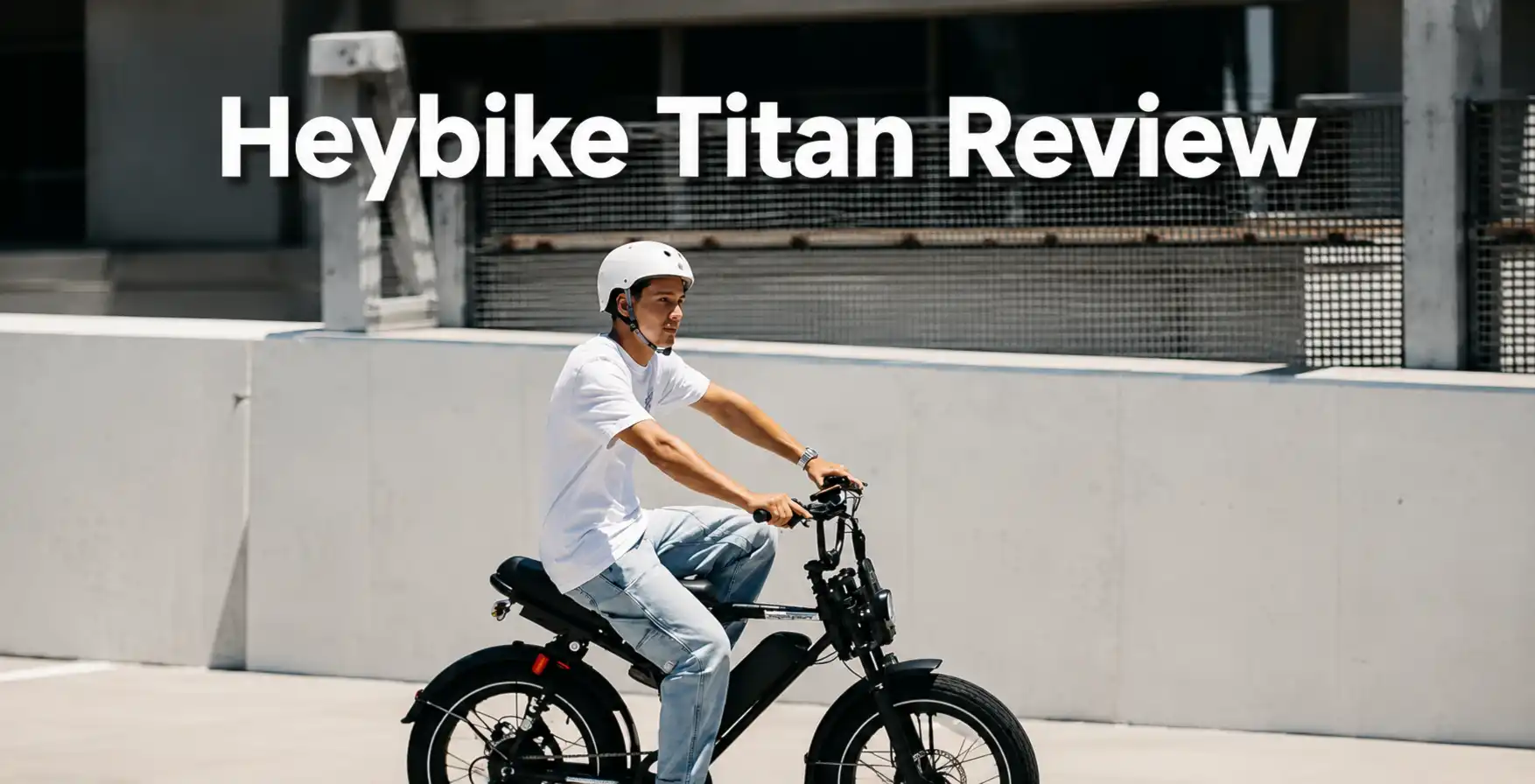
The Heybike Titan caught my attention because it packs a lot of the features riders usually look for in a moped-style e-bike into a fairly accessible price range. You get fat tires, front and rear suspension, hydraulic brakes, a 750W rated rear hub motor, an optional second battery, integrated lighting, app connectivity, and the motorcycle-inspired look that has become increasingly popular.
On paper, I think the Titan has a strong value argument. Heybike claims 1500W peak motor output, 65 Nm of torque, up to 40 miles of range with one battery, and up to 80 miles with two. It ships in a factory-set Class 2 configuration at 20 mph, while the Heybike app can increase the top-speed setting to as much as 28 mph where local rules permit.
When I checked the main U.S. Heybike page on August 25, 2026, the single-battery Titan was listed at a $1,399 early-bird price against a $1,499 regular price. The page showed an Add to Cart button and stated that orders ship in 1-2 business days.
What keeps me from giving the Titan a stronger recommendation is not a lack of interesting hardware. It is a lack of independent evidence. This is a new model, I could not find meaningful independent range, hill, braking, or long-term ride testing, and Heybike’s own current websites contain several conflicting specifications and policy statements.
If you like this style of bike, I recommend starting with my moped-style e-bike buying guide. If this would be your first electric bike, my complete e-bike buying guide can also help you decide whether a heavy moto-style bike fits the way you actually plan to ride.
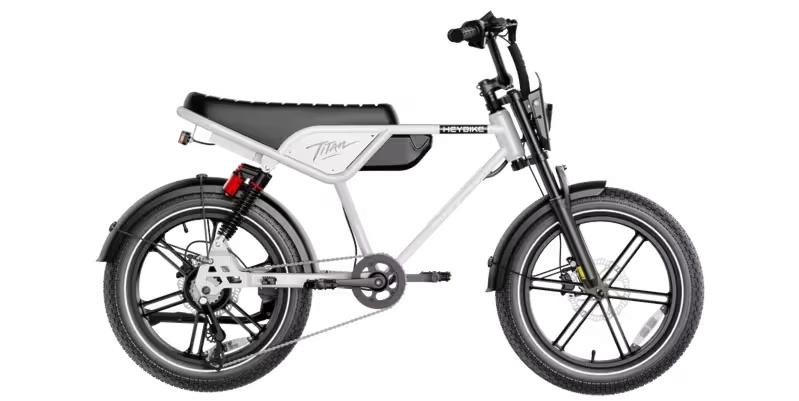
Heybike Titan Quick Verdict
Overall Rating: 7.5 out of 10 – Good with Tradeoffs
Best for: Riders who want an affordable full-suspension moped-style e-bike for neighborhood riding, commuting, casual cruising, and longer recreational trips.
Strongest reason to buy: A strong equipment package for the price, especially the hydraulic brakes, full suspension, optional dual-battery configuration, and manufacturer-stated UL 2849 certification.
Biggest tradeoff: The Titan is heavy and still lacks meaningful independent testing and long-term owner history.
Review type: Research-Based Review
Evidence confidence: Limited
Price checked: August 25, 2026
🔎 Why You Can Trust This Review
I researched the Titan using Heybike’s current product pages, launch specifications, warranty and return policies, financing information, safety claims, and the independent information I could locate. I separate Heybike’s marketing claims from independently established results, and when Heybike’s own pages disagree, I point that out rather than choosing the number that makes the bike look better.
Affiliate relationships do not influence my rating or conclusion. You can read more about how I research and rate electric bikes at Electric Bike Explorer.
Who the Heybike Titan Is Good For – and Who Should Skip It
I think the Titan makes the most sense for riders who specifically want the look and seating style of a moped-inspired electric bike. The long saddle, 20 x 4.0 in. tires, wide handlebar, rear footrests, and low-slung steel frame make this feel like a different category of machine than a traditional upright commuter.
I also see a strong case for riders who want longer-range flexibility. The single-battery version keeps the price and weight lower, while the dual-battery version is intended for people who would rather carry extra battery capacity than worry as much about recharging during longer days.
I would skip the Titan if you need a lightweight bike. Heybike lists the single-battery version at 85 lb and the dual-battery version at 93 lb. That is a lot of bike to carry upstairs, lift into an SUV, or place onto a hitch rack.
I would also look elsewhere if natural bicycle-like pedaling is a top priority. Heybike does not clearly identify the Titan’s pedal-assist sensor type in its current specifications. Because I have not ridden it, I cannot tell you how naturally the assist responds when you start pedaling or how well it modulates power at low speeds.
Heybike Titan Specifications
| Specification | Heybike Titan |
|---|---|
| Price checked | August 25, 2026 |
| Single-battery price | $1,399 early-bird / $1,499 listed regular price |
| Dual-battery price | $1,699 early-bird / $1,799 listed MSRP in Heybike launch material |
| Main-site availability | heybike.com showed Add to Cart and stated ships in 1-2 business days when checked |
| Motor | 750W rated rear hub motor |
| Peak motor output | 1500W claimed on Heybike’s main Titan page and launch material; one Heybike Sports specification table still lists 1200W |
| Torque | 65 Nm claimed |
| Factory speed | 20 mph, Class 2 configuration |
| Adjustable speed | Up to 28 mph through the Heybike app where permitted |
| Single battery | 48V 15Ah, 720Wh |
| Dual battery | Dual-battery option available; Heybike does not clearly state combined Wh in the main Titan specification table |
| Claimed range | Up to 40 miles single battery / up to 80 miles dual battery |
| Independent tested range | No credible Titan-specific independent range test located as of August 25, 2026 |
| Charging time | 5-6 hours single battery / 10-12 hours dual battery |
| Pedal-assist sensor | Not clearly specified |
| Controller | 48V 30A smart controller listed by Heybike Sports |
| Display | LED display |
| Bluetooth | Yes, through Heybike app |
| Brakes | Hydraulic brakes |
| Brake rotor size | Not clearly published in current Titan specifications |
| Front suspension | 80 mm travel |
| Rear suspension | 55 mm travel |
| Tires | 20 x 4.0 in. fat tires |
| Frame | Carbon/high-carbon steel, depending on Heybike page wording |
| Bike weight | 85 lb single battery / 93 lb dual battery |
| Payload | 300 lb claimed maximum |
| Recommended rider height | 5 ft. 3 in. to 6 ft. 3 in. |
| Seat height | 31.5 in. |
| Wheelbase | 1050 mm |
| Colors | White and black; Heybike Sports calls them Glacier White and Shadow Black |
| Lights | LED headlight, taillight, and turn signals listed on Heybike’s main Titan page |
| Fenders | Front and rear |
| Water resistance | IPX4 |
| Certification | Heybike states UL 2849 certification |
| Main-site warranty | 2-year limited warranty for qualifying direct purchases from heybike.com |
| Returns | Policy and possible fees depend on the sales channel and condition of the bike |
| Financing | Klarna available through heybike.com |
Prices, specifications, colors, promotions, policies, and availability can change. I recommend confirming the current details on the exact sales channel you plan to use before ordering.
✅ Pros
- Strong equipment package for the price
- 750W rated rear hub motor
- 1500W peak output claimed in Heybike’s primary Titan materials
- 65 Nm torque claim
- Factory-set 20 mph Class 2 configuration
- App-adjustable speed up to 28 mph where permitted
- Full front and rear suspension
- Hydraulic brakes
- 20 x 4.0 in. fat tires
- Single- and dual-battery choices
- Up to 80 miles of manufacturer-claimed dual-battery range
- Heybike states UL 2849 certification
- Integrated headlight, taillight, and turn signals listed on main product page
- Bluetooth app connectivity
- LED display
- IPX4 water-resistance rating
- Competitive early-bird pricing
❌ Cons
- No meaningful independent Titan ride or range testing located yet
- 85 lb single-battery weight is heavy
- 93 lb dual-battery weight makes portability even harder
- Heybike’s own pages conflict on 1200W versus 1500W peak output
- Pedal-assist sensor type is not clearly identified
- Brake rotor size is not clearly published
- Real-world range remains unverified
- Very limited model-specific owner history
- Return costs can be significant for non-quality returns
- Heybike Sports contains conflicting warranty language
Key Features That Matter
Full Suspension
One of the first things I like about the Titan’s specification sheet is that Heybike did not pair a heavy moped-style frame with only a basic rigid rear end. The bike has 80 mm of front travel and 55 mm of rear suspension travel.
I think rear suspension matters more on a long-seat moped-style e-bike than many buyers realize. On a normal bicycle, you can stand on the pedals and use your legs to help absorb bumps. A long bench-style saddle encourages you to stay seated, so the suspension has more work to do.
What I cannot tell you yet is how well controlled that suspension feels. Travel numbers alone do not tell me whether the fork feels smooth or harsh, how much the rear end bounces, or whether the suspension remains composed under braking.
20 x 4.0-Inch Fat Tires
I think the 20 x 4.0 in. tires fit the Titan’s intended use well. They reinforce the moto-inspired appearance, add cushioning, and should provide a stable footprint for casual street riding.
The downside is efficiency and weight. Fat tires generally create more rolling resistance than narrower commuter tires, and the complete bike is already 85-93 lb. I would keep tire pressure properly adjusted because underinflated fat tires can make an already-heavy bike feel noticeably more sluggish.
Single or Dual Batteries
The battery choice is probably the Titan feature I find most interesting. Instead of forcing every buyer into the heavier long-range configuration, Heybike offers a single-battery version for normal riding and a dual-battery version for riders who want more range.
I like that approach because not everyone needs to carry 93 lb of bike every day. If most of my rides were short neighborhood trips, I would lean toward the 85 lb single-battery version. If I routinely rode longer routes and had secure ground-level storage, the dual-battery setup would be much more appealing.
Integrated Lighting and Turn Signals
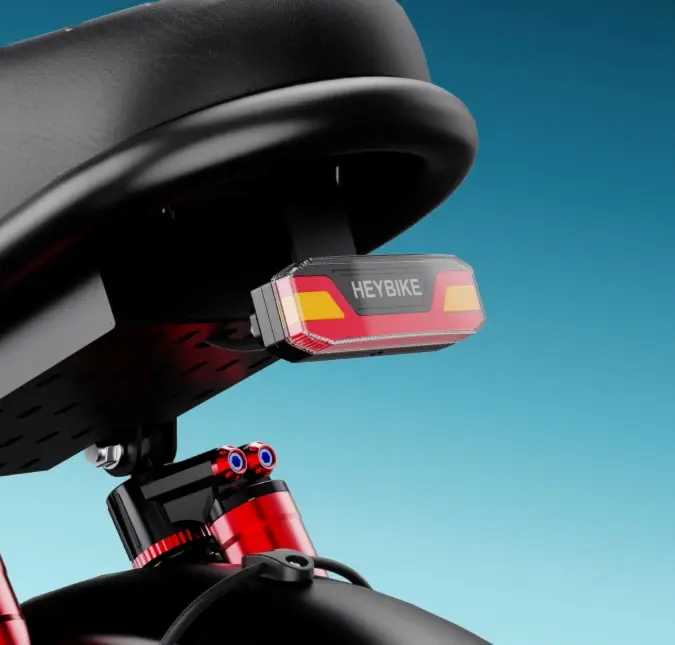
The main Heybike Titan page lists an LED headlight, taillight, and turn signals. I consider that a useful feature on this type of bike because moped-style e-bikes are often ridden in street environments where visibility and clear intentions matter.
I would still use normal hand signals where appropriate and make sure drivers can actually see the bike. Integrated signals are helpful, but I would never treat them as a substitute for defensive riding.
Ride Quality and Comfort
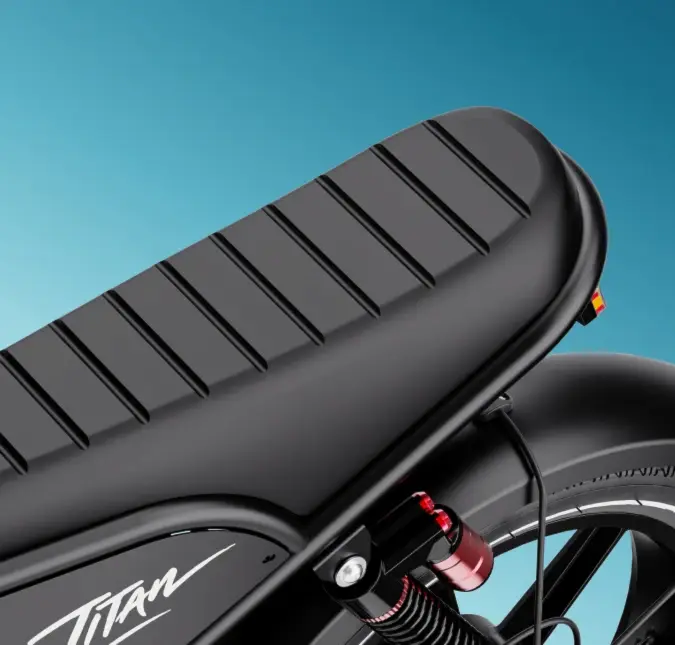
Without riding the Titan myself, I do not want to pretend I know exactly how it feels. What I can do is look at the geometry and components and explain what I would expect.
The long padded saddle, wide handlebar, fat tires, front and rear suspension, and 1050 mm wheelbase suggest a relaxed compact-cruiser riding position rather than a traditional commuter-bike posture. Heybike recommends the Titan for riders from 5 ft. 3 in. to 6 ft. 3 in. and lists a 31.5 in. seat height.
I expect the fat tires and suspension to help isolate the rider from broken pavement and expansion joints. I also expect the bike’s low-slung shape to feel planted at normal street speeds.
My concern is the fixed moped-style seating arrangement. A long saddle can look comfortable while still fitting different rider heights differently. Unlike a conventional bicycle with a highly adjustable seatpost, a moped-style layout gives you fewer options to fine-tune the relationship between your hips, knees, pedals, and handlebars.
That is one reason I would pay attention to fit rather than relying only on Heybike’s 5 ft. 3 in. to 6 ft. 3 in. recommendation.
Motor and Performance
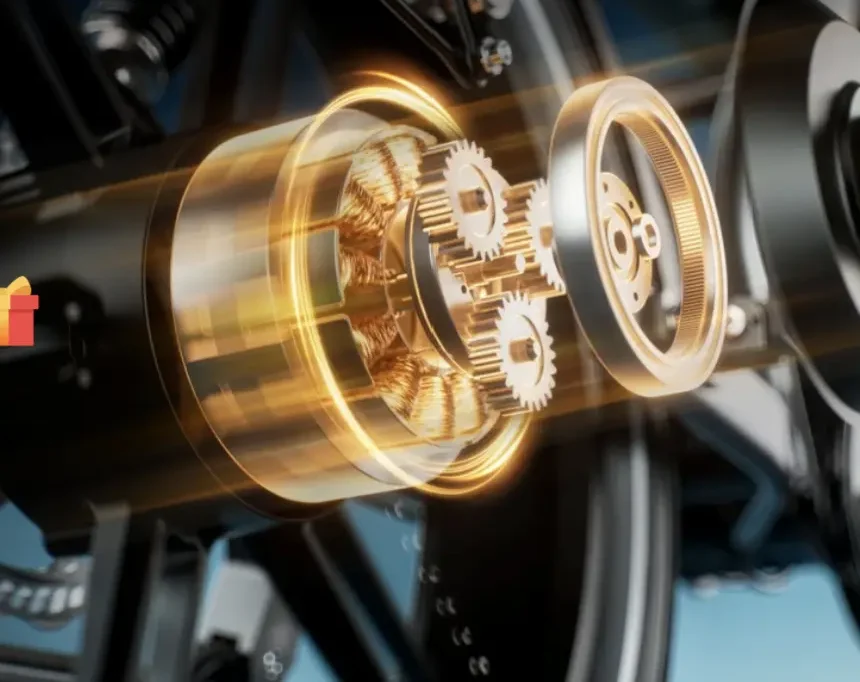
Heybike’s main Titan page lists a 750W rated rear hub motor with 1500W peak output and 65 Nm of torque. The bike ships at 20 mph in its Class 2 configuration, and Heybike says the app can increase the maximum setting to 28 mph where permitted.
Those numbers look reasonable for a street-oriented fat-tire bike, but I am keeping the word claimed attached to the peak-power and torque figures because I have not seen independent Titan dynamometer testing or hill testing.
I also found an important conflict in Heybike’s own documentation. Heybike’s primary Titan page and August 2026 launch article state 1500W peak power, but a detailed electronics table on Heybike Sports still lists the motor as 48V 750W/1200W.
Because the main current product page and newer launch material consistently use 1500W peak, I believe that is the specification Heybike intends to advertise. Still, I think the company should correct the conflicting 1200W table. I would rather disclose the inconsistency than quietly choose one figure.
Heybike also advertises approximately 10-13 degrees of climbing capability. I am treating that as a manufacturer claim. Until someone tests the Titan on a measured grade with rider weight and starting conditions documented, I would not use that number as proof of hill performance.
I am more confident saying the 750W rated hub motor should provide meaningful assistance for normal street riding than I am predicting exactly how quickly the bike accelerates or how much speed it holds on a long climb.
If you plan to change the speed setting, I recommend reading my guide to Class 1, Class 2, and Class 3 e-bikes and checking the e-bike laws in your state. Changing a factory speed setting can affect classification and where you are allowed to ride.
Display and Tech
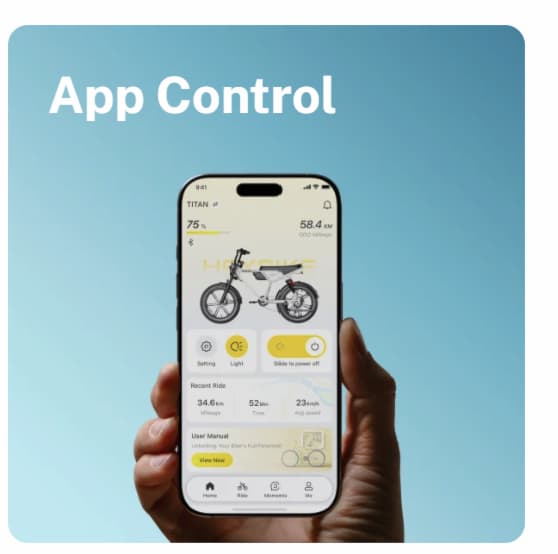
The Titan uses an LED display, and Heybike describes it as a bright display intended to keep essential ride information visible. I like the idea of a simple, readable screen on a bike like this because I would rather be able to glance down quickly than dig through menus while riding.
What Heybike does not clearly publish is a Titan-specific list of every metric shown on the display. I could not verify whether the screen includes all of the trip, power, average-speed, navigation, or diagnostic functions available on some more sophisticated displays, so I am not going to assume those features are present.
The more interesting technology feature for me is Bluetooth connectivity through the Heybike app. Heybike specifically says the Titan connects to the app and lets the rider customize the riding experience. The main product page confirms that the top-speed setting can be adjusted in the app from the factory 20 mph configuration up to 28 mph where permitted.
I like having app-based adjustment because it avoids the need for hardware modifications. At the same time, I would treat the app as a convenience rather than a core reason to buy the bike. Heybike does not currently provide enough Titan-specific documentation for me to confidently promise features such as GPS theft tracking, navigation, over-the-air firmware updates, or detailed ride-history analytics.
Heybike Sports also lists a 48V 30A smart controller. That tells me more about the electrical architecture, but it does not tell me how refined the assist feels. I want to see actual ride testing before making claims about throttle smoothness, low-speed modulation, or how naturally the motor responds when pedal assist engages.
One technology specification I would like Heybike to publish more clearly is the pedal-assist sensor type. Whether the Titan uses a cadence sensor, torque sensor, or another arrangement can make a noticeable difference in how natural the bike feels when pedaling.
Battery, Charging, and Range
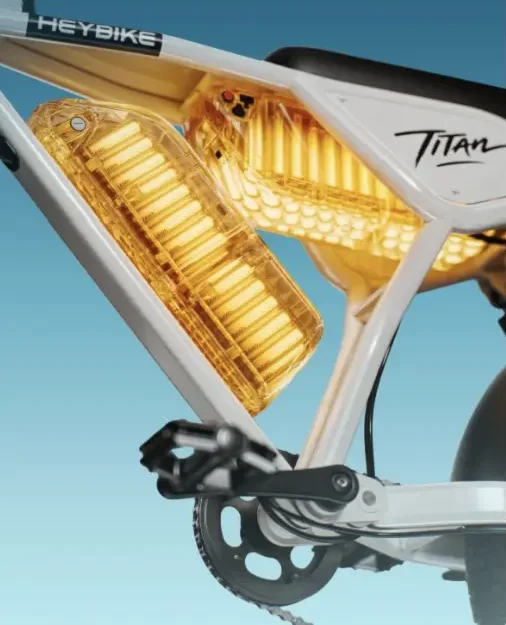
The single-battery Titan uses a 48V 15Ah battery. That works out to 720Wh, which is a respectable amount of energy for a 750W hub-motor e-bike.
Heybike claims up to 40 miles from the single-battery version and up to 80 miles from the dual-battery setup. Charging time is listed at 5-6 hours for one battery and 10-12 hours for the dual-battery version.
I would not buy the Titan assuming I would automatically get 40 or 80 miles. Those are maximum manufacturer claims. I expect actual range to change substantially with rider weight, speed, throttle use, hills, stop-and-go riding, wind, temperature, and tire pressure.
That does not make the dual-battery option unimportant. In fact, I think the second battery is valuable precisely because real-world range is rarely as simple as a marketing maximum. Extra capacity gives you more margin when conditions are less than ideal.
The tradeoff is weight. Heybike lists 85 lb for the single-battery model and 93 lb for the dual-battery model. I would think carefully about whether the extra range is worth carrying the additional weight every time I move or transport the bike.
Brakes and Safety
I consider hydraulic brakes one of the strongest parts of the Titan’s equipment list. On an 85-93 lb moped-style e-bike, especially one that can be adjusted beyond its factory 20 mph setting, I strongly prefer hydraulic brakes over inexpensive mechanical discs.
What Heybike does not clearly publish on the current Titan specification pages is the rotor diameter. I would like to know that because rotor size affects heat management and braking leverage on a heavy bike.
Heybike states that the Titan is UL 2849 certified. I consider that an important positive safety claim, but I am deliberately describing it as a manufacturer-stated certification because I did not independently verify a Titan-specific certification record through a separate certification database during this review.
The Titan is also rated IPX4. I interpret that as protection against ordinary splashes and light rain, not waterproofing. I would not submerge the bike, pressure-wash its electrical components, or assume an IPX4 rating eliminates normal lithium-ion battery precautions.
I also like that the main Titan page lists a headlight, taillight, and turn signals. Visibility is particularly important on a dark-colored, low-slung moped-style bike that may spend significant time around traffic.
Reported Testing
This is one section where I think being brief is more honest than trying to make the review look more complete.
As of August 25, 2026, I did not locate a credible independent Titan-specific range test, hill test, measured braking test, or extended ride evaluation that I was comfortable treating as independent performance evidence.
I found launch coverage repeating Heybike’s specifications, but that is not the same thing as independent testing.
Because of that, I cannot tell you how close the Titan gets to 40 or 80 miles in normal riding, how the brakes feel during repeated hard stops, how well the motor sustains speed on long climbs, or how the suspension behaves after several hundred miles.
I would rather leave those questions unanswered for now than repeat marketing claims and call them testing.
What Riders Are Saying
I also do not think there is enough useful Titan owner feedback yet to draw meaningful conclusions about reliability or long-term satisfaction.
When I checked Heybike’s main U.S. Titan page, it showed no customer reviews. The Heybike Sports Titan page showed two entries, but neither provided meaningful firsthand Titan ownership or ride experience that I would consider useful evidence for this review.
For that reason, I am not going to manufacture a positive or negative owner consensus where one does not yet exist.
I would want to revisit this section after riders have had enough time to put real mileage on the bike. That is when patterns around brakes, battery performance, shipping damage, app stability, motor reliability, and customer support become much more meaningful.
Unboxing and Assembly
Heybike Sports lists the package as including the unassembled e-bike frame, front wheel, front wheel axle, front mudguard, headlight, pedals, charger, battery lock keys, axle protection caps, assembly tools, hangtag, and owner’s manual.
Based on that list, I would expect more setup than simply removing a fully assembled bike from a box. The front wheel, pedals, headlight, and related components need to be installed or checked.
I would inspect brake alignment, tire pressure, axle security, handlebar alignment, and fastener torque carefully before the first ride. If you are not comfortable installing a front wheel or checking hydraulic brake alignment, I think paying a qualified bike shop for final assembly and inspection is reasonable.
I would also plan ahead for the weight. An 85 lb or 93 lb bike can be awkward even before you factor in a large shipping box and packaging. If the delivery location involves stairs, I would not assume one person can comfortably handle it.
Customer Service, Warranty, Returns, and Financing
Warranty
If I were ordering the Titan, this is one area where I would pay close attention to the exact website used for the purchase.
Heybike’s main U.S. Titan page advertises a 2-year warranty. Heybike’s main warranty policy states that e-bikes purchased directly through heybike.com receive a 2-year limited warranty beginning when the bike is received, subject to exclusions and the detailed policy terms.
The main policy also specifically says it applies to products sold through heybike.com and that other sales channels can have different warranty policies.
Heybike Sports is less clear. Its site footer and dedicated electric dirt bike warranty page state a 1-year warranty, while the Heybike Sports terms of service say there is a two-year limited warranty against manufacturing defects.
Because those statements conflict, I would not tell a Titan buyer that a Heybike Sports purchase definitely receives either one or two years without written confirmation. If I were ordering through Heybike Sports, I would ask customer service to confirm the Titan’s exact warranty in writing before checkout.
Returns
The main heybike.com return policy is clearer, but I still think buyers should read it before ordering.
For a non-quality return of an unused bike within 14 days, the policy states that the buyer pays $200 return shipping for most e-bikes. From days 15-30, an unused non-quality return can also be charged a 20% restocking fee.
For a used bike returned within 30 days for a non-quality reason, the policy states that the buyer pays the $200 return-shipping fee for most models plus a 50% restocking fee.
That is important because the Titan product page also advertises a “14-day Free Trial.” I would not interpret that phrase as meaning every change-of-mind return is free. I would read the detailed return policy before riding the bike if I thought there was any chance I might send it back.
Heybike Sports publishes a separate 14-day return policy that lists $180 return shipping per bike for non-quality returns and says a 25% restocking fee may apply to unauthorized returns. However, that policy is titled for Heybike electric dirt bikes. Because the Titan is presented as an electric bike on the Sports site, I would confirm the exact Titan return terms with Heybike Sports rather than assuming every dirt-bike policy provision applies without qualification.
Financing
Heybike’s main U.S. website offers Klarna at checkout. Heybike’s financing page describes the option to split a qualifying purchase into four interest-free payments when paid on time, as well as monthly financing subject to approval and applicable terms.
I view financing as a convenience, not a reason to stretch the budget for a bike. I would compare the total cost and repayment terms before choosing monthly financing.
Essential E-Bike Gear (Quick Picks)
Before you choose your e-bike, these are the accessories most riders end up needing for safety and everyday use:
Price and Value
This is where I think the Titan makes its strongest argument.
On August 25, 2026, the main Heybike U.S. page listed the single-battery Titan at $1,399 early-bird pricing against a $1,499 regular price. Heybike’s August 2026 launch material lists the dual-battery model at $1,699 early-bird pricing against a $1,799 MSRP.
At those prices, I think the component package looks competitive. You are getting full suspension, hydraulic brakes, 20 x 4.0 in. fat tires, integrated lighting, Bluetooth app connectivity, an LED display, a 750W rated motor, and a manufacturer-stated UL 2849 certification.
The dual-battery option is particularly interesting at $1,699 because long-range configurations often push moped-style bikes into a noticeably higher price bracket.
But value is not just a list of specifications. I also care about how well those parts work together, how long the battery lasts, how the bike handles, what replacement parts cost, how responsive customer support is, and whether the motor and controller remain reliable after a year or two.
That is why I am keeping the Titan at 7.5 out of 10 rather than pushing the score into the 8s based on specifications alone.
Should You Buy the Heybike Titan?
I think the Heybike Titan is a promising value-focused moped-style e-bike, but I would approach it as an early-adopter purchase rather than a proven long-term recommendation.
The strongest reasons I see to buy it are the price, hydraulic brakes, full suspension, optional second battery, factory Class 2 setup, integrated lighting, app adjustment, and manufacturer-stated UL 2849 certification. I also like that Heybike gives riders a meaningful choice between a lighter single-battery version and a longer-range dual-battery version.
The biggest drawbacks are the 85-93 lb weight, limited independent testing, lack of meaningful owner history, unspecified pedal-assist sensor, and conflicting information within Heybike’s own current documentation.
You should buy this bike if you specifically want moped-style looks, ride mostly on streets and neighborhood routes, value hydraulic brakes and full suspension, and want the flexibility to choose between one or two batteries. At the current early-bird pricing, I think the Titan is especially interesting for a rider trying to stay roughly in the $1,400-$1,700 range.
You should skip this bike if you need something easy to lift, want traditional bicycle-like pedaling, require a clearly documented torque sensor, prefer a dealer-heavy service network, or do not want to buy a model before independent reviewers and long-term owners have had time to test it.
Final Electric Bike Explorer Rating: 7.5 out of 10 – Good with Tradeoffs.
I consider that a provisional research-based rating with limited evidence. The hardware and pricing are promising enough for me to take the Titan seriously, but I want independent range, braking, hill, handling, and durability data before I would give it a stronger recommendation.
Alternative 1: Ride1Up Revv1 DRT
If I wanted a more established performance-oriented moped-style e-bike and was comfortable spending more, I would compare the Titan with the Ride1Up Revv1 DRT.
The Revv1 platform has been on the market longer, has much more independent coverage and owner history, and gives buyers more real-world information to examine before purchasing. That maturity is valuable if you are uncomfortable being an early adopter.
I would still give the Titan an advantage for buyers focused on lower purchase price and dual-battery value. You can see other models worth considering in my moped-style electric bike guide.
Read my full review on the Ride1UP Revv1 DRT
Alternative 2: SUPER73-S2
If brand recognition, styling, and an established moped-style ecosystem matter more to me than getting the most specifications per dollar, I would also compare the Titan with the SUPER73-S2.
SUPER73 sits at a much higher price point, so I do not consider it a direct budget competitor. I see it as an alternative for someone who likes this category but places more value on an established platform and brand ecosystem.
I would lean toward the Titan when price, suspension, and battery flexibility are the priorities. I would investigate the SUPER73 more closely when the established ecosystem and longer model history matter more than purchase price.
Before you buy: I recommend confirming the Titan’s current price and stock status, deciding whether an 85 lb or 93 lb bike will work with your storage and transportation setup, checking the warranty and return policy for the exact website or retailer you use, and verifying local e-bike rules. If you plan to increase the speed above the factory 20 mph setting, do not assume the bike remains legal everywhere a Class 2 e-bike is allowed.
You can also browse my other Electric Bike Explorer reviews before making your final decision.
Disclosure: As an Amazon Associate, I earn from qualifying purchases. This comes at no extra cost to you and helps support the content on this site.
📚 Read Me Next
- Compare this bike to others → Best Moped Style E-Bikes
- Not sure about budget? → Budget E-Bike Guide
- Want to learn first? → E-Bike Buying Guide
- See more ebike reviews → E-Bike Reviews
External Sources
- Heybike Titan official U.S. product page
- Heybike Sports Titan product and specification page
- Heybike Titan August 2026 launch specifications
- Heybike U.S. warranty policy
- Heybike U.S. return and refund policy
- Heybike Sports warranty policy
- Heybike Sports return and refund policy
- Heybike Sports terms of service
- Heybike Klarna financing information
- Ride1Up Revv1 official product page
- SUPER73-S2 official product page

Kristina is not just an enthusiast but a true authority on electric bikes. Nestled in the coastal beauty of Virginia, Kristina has found the perfect backdrop for her passion for electric biking. As a dedicated wife and homeschooling mom, her life revolves around family, faith, and the thrill of adventure.
Originally hailing from Ohio, Kristina's journey with electric bikes began as a curiosity and quickly evolved into a deep expertise. Her blog is a testament to her love for electric biking, combining her fascination for eco-friendly transportation with her coastal lifestyle.
When she's not cruising the beach on her electric bike, you'll find Kristina indulging in her other loves: long walks along the shore, getting lost in a good book, and cherishing moments with her loved ones. With a heart as big as her love for animals, especially cats, Kristina brings a unique perspective to the electric bike world, grounded in her strong faith in God and her dedication to a sustainable lifestyle.
Through her blog, Kristina shares her extensive knowledge of electric bikes, offering valuable insights, tips, and recommendations to fellow enthusiasts. Whether you're a seasoned rider or a newcomer to the electric bike scene, Kristina's blog is your go-to source for all things electric biking, fueled by her passion, expertise, and the scenic beauty of coastal Virginia.