
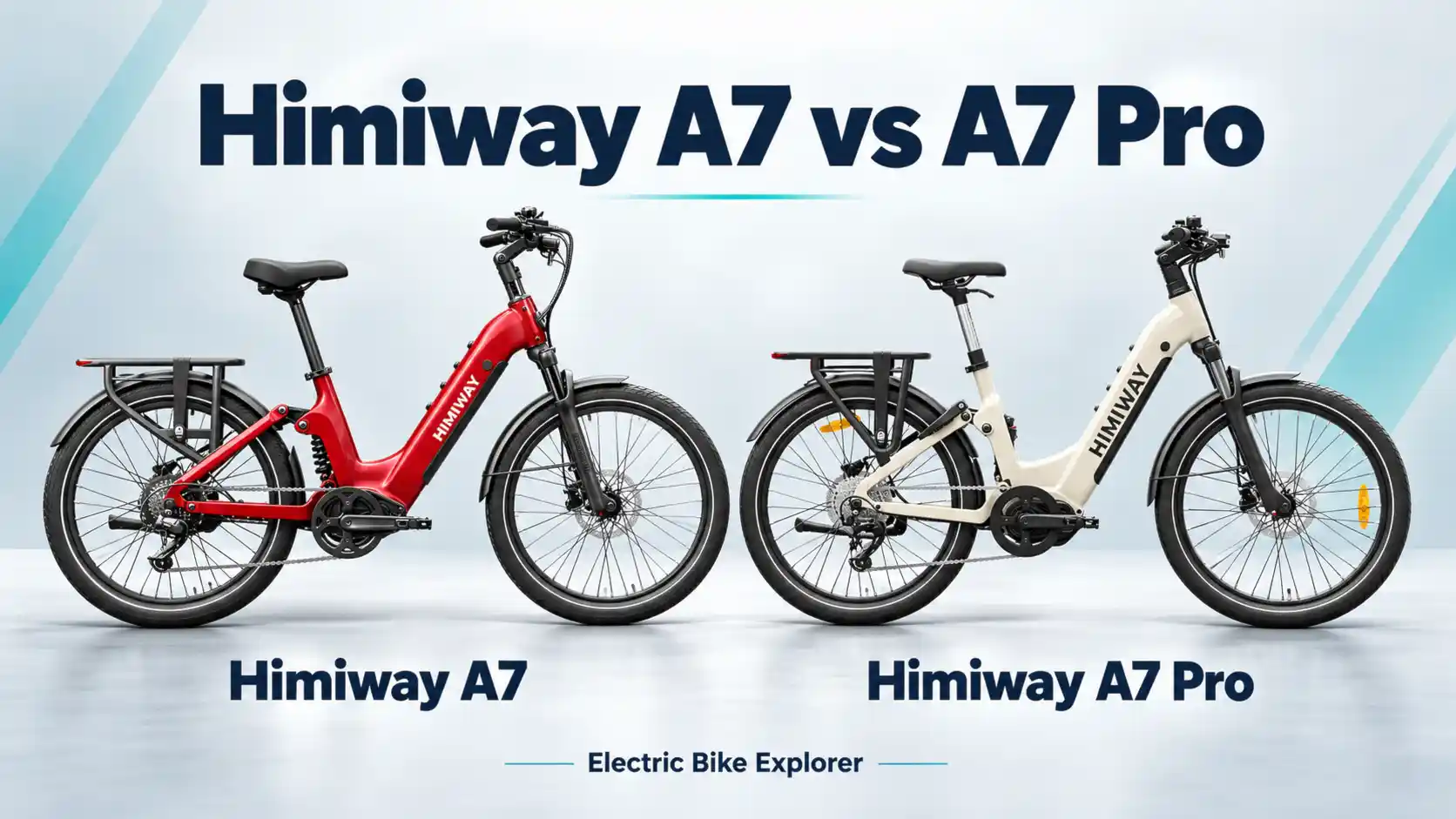
Himiway A7 vs A7 Pro: Which Commuter E-Bike Should You Buy?
Last Updated on October 13, 2026 by Kristina
📚 Research-Based Review – Built from independent sources, specs, and user reports
Introduction
In the Himiway A7 vs A7 Pro decision, the motor matters more than the shared name. The regular A7 is a lower-cost, full-suspension commuter with a rear-hub motor. The A7 Pro costs more but moves the motor to the cranks, where it can use the bicycle’s gears to help on steep hills.
My short answer: choose the regular A7 for flatter commutes, comfort and simpler drivetrain upkeep; choose the A7 Pro for repeated serious climbs. The A7’s higher advertised wattage does not automatically make it the stronger hill climber. My separate Himiway A7 Commuter Review explains the standard model in greater depth, and the E-Bike Buying Guide can help if you’re still deciding which features you need.
I researched the current U.S. Regular A7, not the different Large-motor configuration, and the current U.S. A7 Pro. Prices, product listings and policies were checked October 10, 2026. Bike availability varies by color and configuration, so a listed price is not proof that your chosen option can be ordered.
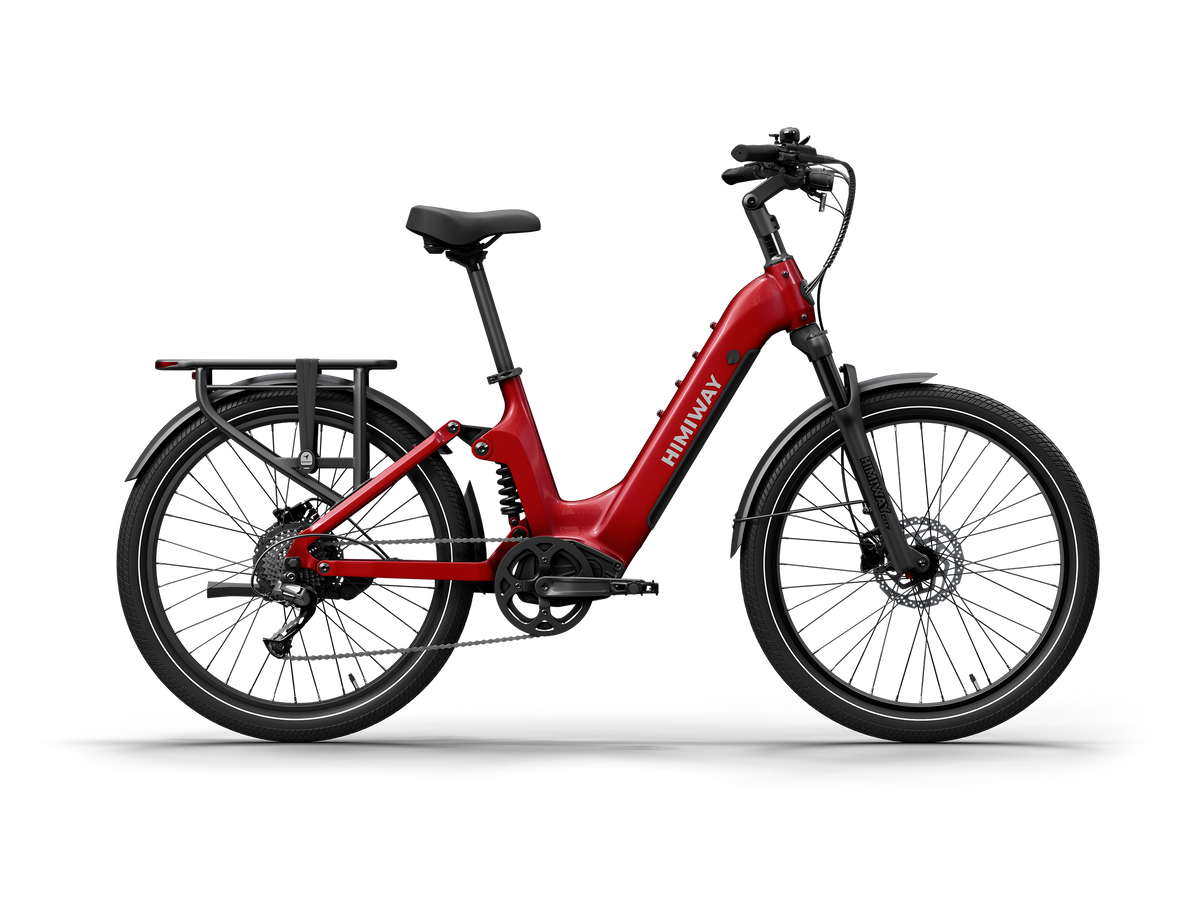
Rear-hub commuter
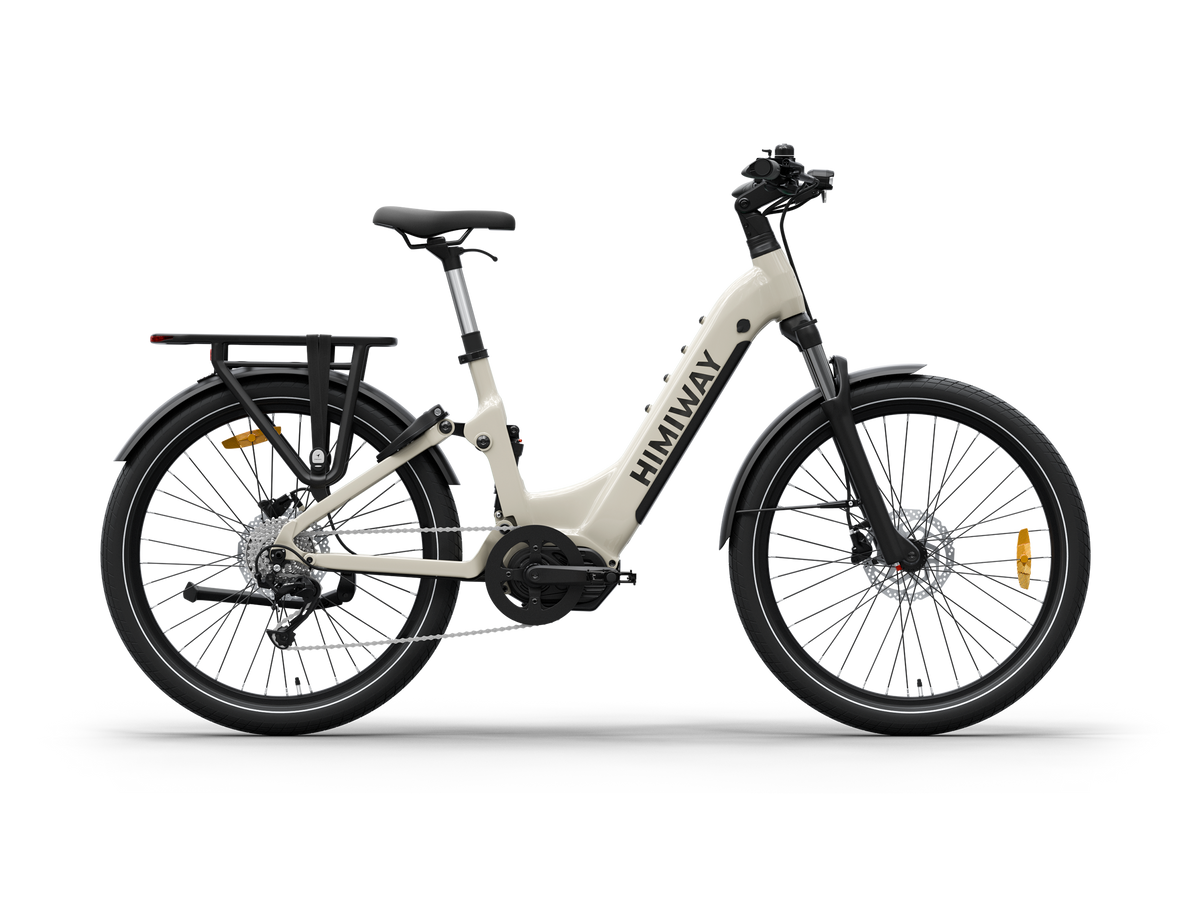
Mid-drive commuter
Official Himiway U.S. product images. Bike colors are illustrative; confirm the exact configuration before ordering.
📌 Quick Decision Guide
- Choose the Himiway A7 if you ride mainly flat or rolling streets, want front and rear suspension, value a thumb throttle that works independently of pedal-shift gearing, and would rather spend less up front.
- Choose the Himiway A7 Pro if you face long or repeated steep climbs, enjoy responsive torque-sensor pedaling, or want a lighter bike with a dropper seatpost and integrated rear-wheel lock.
- Skip both if you must regularly carry a bike upstairs, need a light car-rack load, require a confirmed heavy-duty cargo limit, or need a separately verified UL 2271 battery certificate before placing an order.
Himiway A7
8.5 / 10 – Very Good
Ride quality and comfort: 9.2 / 10
Motor performance and hill climbing: 8.5 / 10
Battery capacity and range: 8.5 / 10
Braking and safety equipment: 8.8 / 10
Weight and portability: 6.0 / 10
Features and everyday usability: 9.0 / 10
Warranty, service and ownership support: 8.0 / 10
Value for the price: 10.0 / 10
Best for: Riders who want full-suspension comfort and everyday value for flat or gently rolling routes.
Himiway A7 Pro
8.6 / 10 – Very Good
Ride quality and comfort: 9.4 / 10
Motor performance and hill climbing: 9.5 / 10
Battery capacity and range: 8.5 / 10
Braking and safety equipment: 8.5 / 10
Weight and portability: 6.5 / 10
Features and everyday usability: 9.3 / 10
Warranty, service and ownership support: 8.0 / 10
Value for the price: 9.1 / 10
Best for: Riders who want strong hill climbing, full-suspension comfort, and upgraded commuter features.
These are research-based recommendations rather than new 10-point scores. Electric Bike Explorer’s existing A7 review has its own score; I am not inventing a score for the A7 Pro. How Electric Bike Explorer Reviews and Ranks E-Bikes explains the evidence standard.
Himiway A7 vs A7 Pro: Complete Specifications Comparison
| Feature | Current U.S. A7 Regular | Current U.S. A7 Pro |
|---|---|---|
| Listed price, Oct. 10, 2026 | $1,999 | From $2,499 on default color selection; other variant listing showed $2,899 |
| Drive | Rear hub | ANANDA M100 mid-drive |
| Published motor | 750W Regular; Large A7 is 500W | 500W |
| Claimed motor torque | 70 Nm Regular; Large A7 60 Nm | Himiway advertises up to 130 Nm; independent review documentation also references 100 Nm |
| Sensor | Switchable torque/cadence, Smart Auto | Torque sensor, plus shift/speed/brake sensors |
| Throttle | Thumb throttle | Thumb throttle; independent tests differ about throttle-only starting from a stop |
| Speed settings | 20 mph default; 4-28 mph adjustable; Himiway lists classes 1/2/3 | Tested as Class 2 at about 20 mph; higher pedal assist about 28 mph with settings/passcode |
| Battery | 48V 15Ah, 720Wh, Samsung/LG cells | 48V 15Ah, 720Wh, Samsung/LG cells |
| Claimed range | Up to 40 miles throttle, 70 miles pedal assist | 35-50 miles, not separated by throttle/PAS in current specification |
| Current-model independent range | Not verified for present 750W Regular | 2024 tested bike: 36.5 miles PAS 5, 85.1 miles PAS 1 (Electric Bike Report) |
| Charger / charge time | 48V 2A; current model charge time not confirmed | 2A smart charger; published charging time not confirmed |
| Suspension | 120mm front, 90mm rear; coil-spring manual and hydraulic-damping product wording may be compatible | SR Suntour X1-BOOST 120mm front, DNM rear; 90mm rear travel advertised |
| Brakes | Shimano MT200 hydraulic; 180mm rotors front/rear | Shimano MT200 hydraulic; 180mm rotors front/rear |
| Drivetrain | Shimano 8-speed, 13-32T freewheel | Shimano Alivio 9-speed, 11-34T cassette |
| Tires | Innova 27.5 x 2.4 in., reflective strip | Schwalbe Super Moto-X 27.5 x 2.4 in. |
| Published bike weight | 84 lb | 77 lb |
| Published battery weight | 8.4 lb replacement-pack listing | 8.8 lb product copy versus 8.4 lb shared replacement listing |
| Rider heights | Regular 5’1″-6’3″; Large 5’3″-6’1″ | 5’3″-6’5″ |
| Min saddle / standover | 31.5 in. / 20.2 in. (Regular) | Product geometry states 24 in. / 21.6 in.; saddle measurement needs clarification |
| Total payload | 400 lb current A7 product page; a manual linked as A7 Regular / A7 2.0 labels A7 2.0 at 330 lb. Applicability to current Regular needs written confirmation. | 300 lb current A7 Pro product page |
| Rear rack | Included MIK-compatible; 120 lb current A7 product page; A7 2.0-labeled manual lists 55 lb. Clarify exact Regular rating before loading. | Included; 55 lb reported in an independent 2024 Pro review, but current official capacity not confirmed |
| Fenders / lights | Included; 120-lux front, brake-indicating rear | Included; front LED and brake-indicating rear |
| Display / connectivity | 3.5-in. color, Bluetooth; full current app functions not verified | BIGSTONE M300C-TFT; app/GPS features not verified |
| Security extras | No integrated wheel lock verified | Integrated ABUS rear-wheel lock advertised |
| UL documentation | UL Solutions UL 2849 Product iQ QGNS.E534537 listing includes A7; Himiway also states UL 2271. Confirm exact battery identifiers. | UL Solutions UL 2849 Product iQ QGNS.E534537 listing explicitly includes A7 PRO. Himiway’s model table omits the Pro; separate UL 2271 battery certification not independently confirmed. |
| Warranty | 2-year limited manufacturer warranty | Same 2-year limited manufacturer warranty |
Sources: Himiway U.S. product pages, A7/A7 2.0 resource manual, A7 Pro owner-resource listing, certification and warranty pages, and named independent A7 Pro testing below. Claimed values are not guarantees.
Who Each Bike Is Best For
Himiway A7
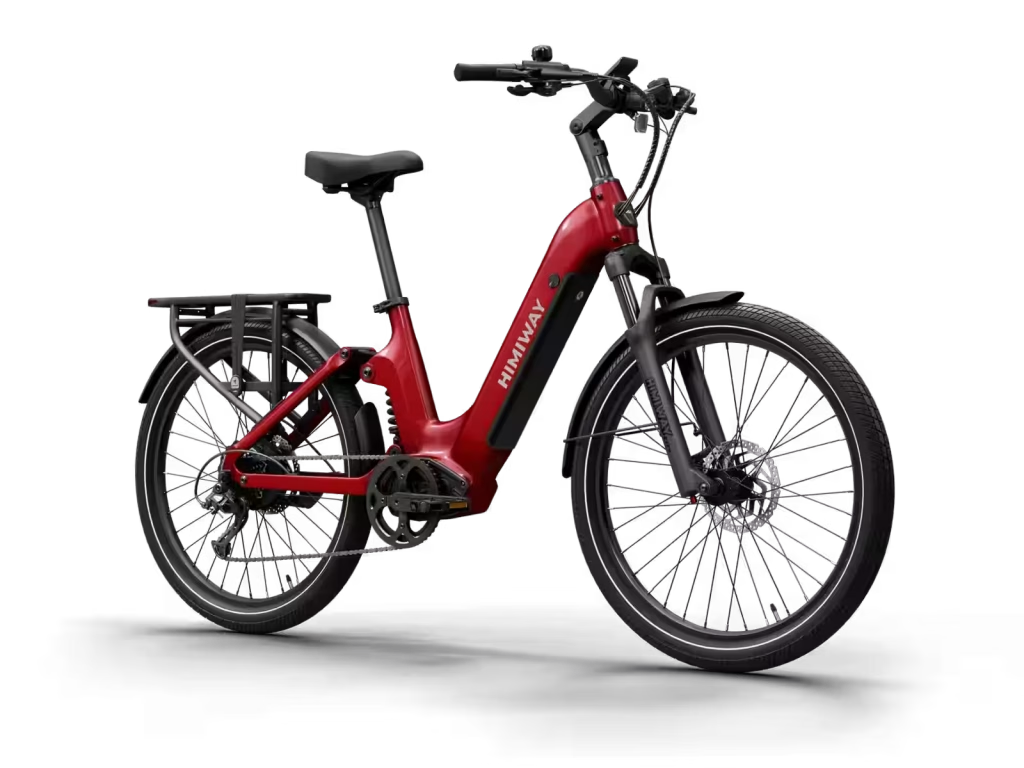
I’d put the A7 first for everyday commuting on flatter or mildly rolling routes, leisurely rides on rough pavement, and buyers who want torque sensing but sometimes prefer cadence-style assist. Its adjustable stem, padded saddle, front and rear suspension, and full commuter equipment make it a comfort-led choice.
For riders who want low drivetrain wear from motor power, a hub-drive setup is especially attractive. The motor pushes the rear wheel without transmitting its power through the chain.
Himiway A7 Pro
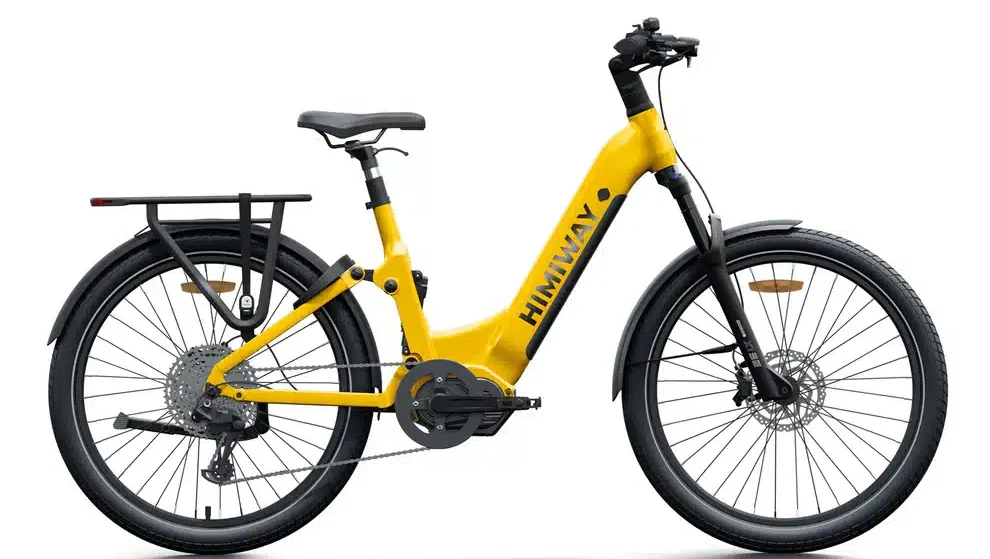
I’d put the Pro first for frequent steep hills, hilly neighborhoods, and riders who enjoy selecting a low gear and pedaling with the motor. The Pro also appeals to someone who appreciates a dropper seatpost, a 9-speed drivetrain, and an integrated wheel lock.
For riders with knee, hip, wrist or back sensitivity, neither model is automatically therapeutic. The suspension and upright posture may help with jolts, while the Pro’s geared climbing may make steep grades easier, but the correct frame fit, pedaling cadence, saddle adjustment and a safe test ride matter far more than the badge.
Price and Overall Value
Himiway’s U.S. pages showed $1,999 for the A7 and $2,499 for the default A7 Pro selection on October 10, 2026, a $500 difference for those displayed selections. A separate Pro color variant displayed $2,899, making the gap as much as $900. The product collection showed sold-out labels in some views, so I would confirm the actual checkout price and stock for the desired color.
Is the premium justified? For a flat or gently rolling 5- to 15-mile commute, not necessarily. Both bikes advertise 720Wh batteries, full suspension, hydraulic brakes, racks and fenders. The A7 covers those basics without requiring a mid-drive budget.
For repeated steep grades, the Pro can justify its premium through useful gearing, reported climbing performance and the more involved components. I would not pay that premium simply because 130 Nm sounds impressive.
Prices, color availability, financing offers and gifts may change.
Frame, Rider Fit and Accessibility
Both use low step-through frames, but step-through does not mean identical fit. Himiway lists the A7 Regular at 5’1″ to 6’3″ and the Pro at 5’3″ to 6’5″. The Regular A7 lists a 20.2-in. standover and 31.5-in. minimum saddle height. The Pro lists a 21.6-in. standover.
One Pro geometry panel labels its minimum saddle height as only 24 in. and maximum as 28.7 in. That is sufficiently unusual that I would verify precisely how Himiway measured it before recommending the Pro for a shorter rider. Standover clearance and a suitable leg extension are different measurements.
The Large A7 is not just a stretched version of the Regular: its published motor drops to 500W and 60 Nm, versus 750W and 70 Nm for Regular. If a buyer chooses a Large frame, the motor comparison must be redone for that actual variant.
Weight, Storage and Vehicle Transport
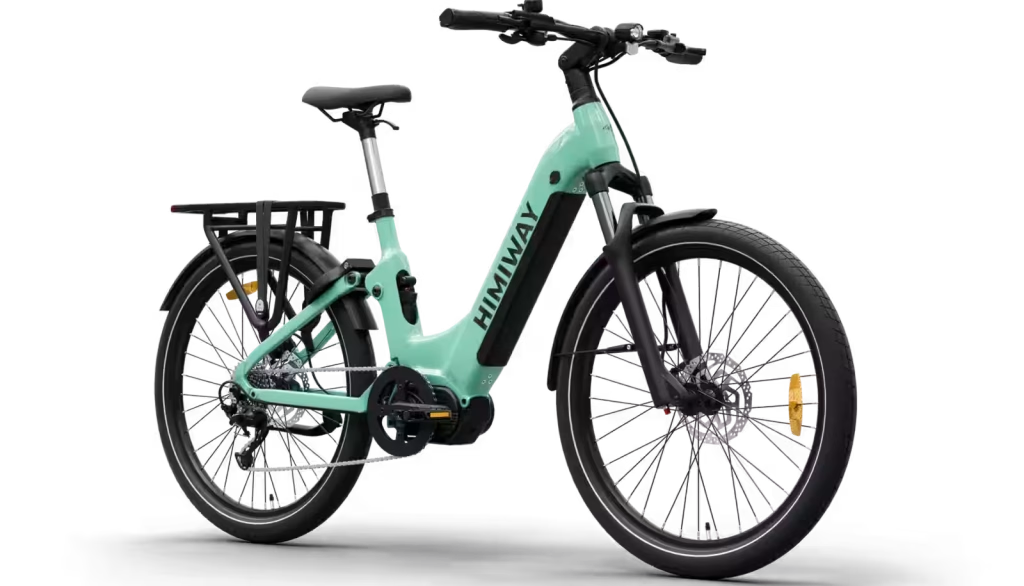
At 84 lb, the current advertised A7 Regular is heavy even by equipped commuter standards. The current A7 Pro listing says 77 lb, about 7 lb lighter. Electric Bike Report weighed its 2024 Pro test sample at 74.3 lb, which is an independent measurement on that older example, not a corrected current product specification. Neither is something I would recommend for daily stair carrying.
For a hitch rack, check its per-bike load rating, tire width, wheelbase, clamp style and whether its manufacturer approves carrying an e-bike with the battery removed. The listed replacement batteries are about 8.4 lb, although the Pro’s own marketing copy says 8.8 lb. Removing a battery helps, but it does not make either bike lightweight.
Ride Comfort and Suspension
Both bikes advertise 120mm of front travel and 90mm of rear travel. Those figures are promising for broken asphalt, potholes and relaxed recreational riding. Both also use 27.5 x 2.4-in. tires, which add air volume and comfort.
The Regular A7’s product page describes hydraulic fork damping, while the owner-resource manual for Regular A7/A7 2.0 describes a coil-spring fork. Both descriptions can be compatible because a coil spring and hydraulic damper can be used together; this is not a proven hardware contradiction. The Pro lists an SR Suntour X1-BOOST fork and DNM rear shock. Those named components and adjustment potential make the Pro my suspension-hardware winner, though actual comfort remains fit-dependent.
The Pro’s dropper post can lower the saddle when stopping or mounting. It is a convenience and accessibility aid for some riders, not a substitute for a correctly sized frame.
Hub Motor Versus Mid-Drive Performance
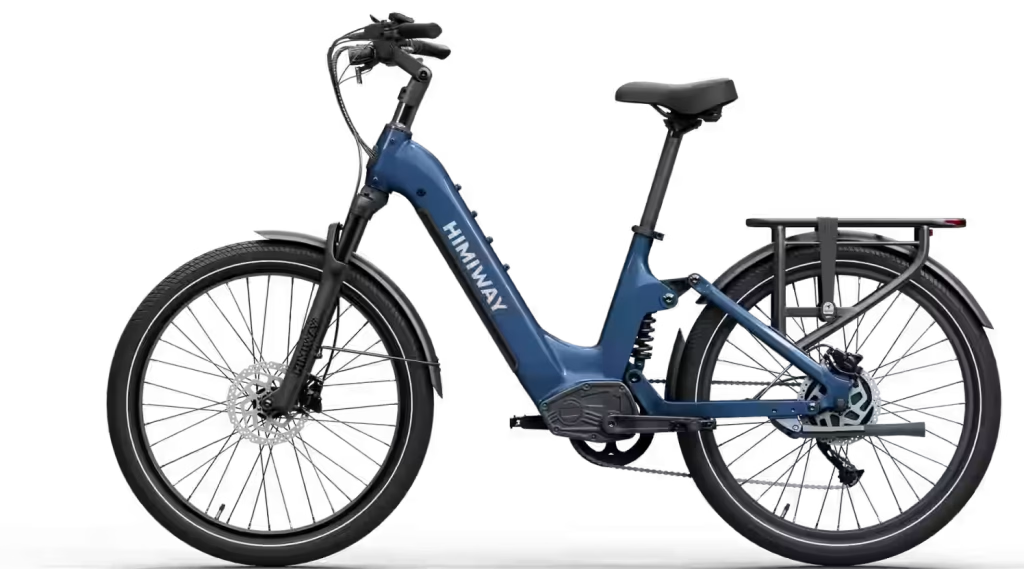
The A7 Regular’s 750W/70 Nm and the A7 Pro’s 500W/up to 130 Nm are manufacturer specifications, not numbers measured under a standardized head-to-head test. Electric Bike Report’s Pro review itself has differing torque descriptions (100 Nm in its specification list and up to 130 Nm in its performance discussion), so I treat 130 Nm as Himiway’s claim. More advertised watts on the A7 do not mean it will outclimb the Pro.
The A7 rear hub drives the wheel independently of the chain. The Pro’s mid-drive sends power through the cranks, chain and cassette. When you downshift on a hill, you also change the mechanical gearing available to the Pro’s motor. This can be much more useful than a higher nominal motor wattage on a long, steep ascent.
The cost is extra load on the chain and cassette. I would downshift before a climb, ease pedal pressure while shifting, keep the drivetrain clean, and budget for chain and cassette wear. The Pro lists a shift sensor, but that does not make high-load shifting harmless. For more detail, read my E-Bike Motor Guide.
Hill-Climbing Differences
This is the Pro’s strongest win. In Electric Bike Report’s 2024 test of the 500W A7 Pro, a rider completed its difficult Hell Hole Trail climb in 1 minute 39 seconds on throttle and 1 minute 31 seconds in PAS 5. That publication also reported good climbing control. These are results from its specific tested bike and course, not a promised speed on your hill.
For the Regular A7, the widely circulated BikeRide measurements are from an older 500W/60 Nm A7 weighing approximately 72.7 lb. Those are not verified performance numbers for the current 84-lb, 750W/70 Nm Regular A7, so I will not transfer those results to it. Electric Bike Report’s 2024 A7 Pro test also used an earlier test bike: its measured weight was 74.3 lb, versus Himiway’s currently published 77 lb. These are not side-by-side tests of the models now on sale.
The Pro is my recommendation when climbing is central to the commute. On moderate slopes, the A7 may still be entirely adequate, but we need a valid current-model head-to-head test to quantify the margin.
Torque Sensor, Cadence Sensor and Ride Feel
The A7 lets riders switch between torque and cadence sensing, plus Himiway’s Smart Auto assistance. A torque sensor responds to pedal pressure, while a cadence sensor responds mainly to crank rotation. That flexibility is useful if you prefer a lighter-effort style on some rides and a more bicycle-like feel on others.
The Pro is built around a torque sensor and a geared mid-drive. Independent testers described natural, responsive pedaling, and one independent reviewer reported needing a minor derailleur adjustment after assembly. I give A7 the versatility win and Pro the geared-pedaling win.
Throttle, Speed and E-Bike Class Differences
Yes, both have throttles. The A7 product page lists an ergonomic thumb throttle. Electric Bike Report said its tested A7 Pro needed initial pedaling before throttle engagement from a stop. Consumer Reports described its tested A7 Pro as capable of accelerating without pedaling. Because these reports differ, I would ask Himiway to confirm how the current U.S. Pro’s throttle works before buying for throttle-assisted starts.
The Regular A7 page lists 20 mph default and an adjustable 4-28 mph maximum, with configurations Himiway labels Classes 1, 2 and 3. Electric Bike Report tested the Pro as a 20-mph Class 2 setup and reported approximately 28.5 mph after obtaining access to a higher assist setting. That test does not prove every current Pro ships with identical controls.
A switchable display does not override legal limits. Class definitions, throttles and permitted paths vary by jurisdiction. Read Understanding E-Bike Classes and check the State-by-State E-Bike Laws before changing settings.
Battery Capacity and Realistic Range Expectations
Both list 48V x 15Ah = 720Wh. Watt-hours measure stored battery energy, not guaranteed mileage. Higher assist, steep hills, greater payload, headwinds, cold weather, low tire pressure and higher speeds all reduce range.
Himiway claims 40 miles throttle and 70 miles pedal assist for the A7 Regular on its current spec table, although other A7 copy has said 65 miles. Current independent range results for this exact 750W Regular version were not found.
Himiway advertises 35-50 miles for the Pro. In 2024, Electric Bike Report measured 36.5 miles in PAS 5 and 85.1 miles in PAS 1 on its tested A7 Pro. Those figures show how dramatically assist level and testing conditions matter; they are not a promise that today’s buyer will get 85 miles. Consumer Reports separately reported a little over 21 miles with hills, flats and maximum assistance. Crucially, Consumer Reports lists a 691Wh (48V, 14.4Ah) battery for its test bike, rather than the 720Wh (48V, 15Ah) battery in Himiway’s current listing. That is a tested-unit difference, so the range results should not be treated as an exact head-to-head comparison of today’s configuration.
Both use 2A chargers according to the current listings. I could not confirm a current, model-specific published full charging time from a primary source, so I’d plan charging around the actual owner’s instructions rather than advertise an unsupported number.
Brakes, Lighting and Safety Equipment
Both specify Shimano MT200 hydraulic disc brakes with 180mm rotors front and rear. The A7 lists a 120-lux integrated headlight and a brake-indicating rear light; the Pro also has an integrated front LED and rear brake-light function.
Neither bike’s weight should be ignored. Brake condition, rotor alignment, appropriate tire pressure and a controlled first ride matter. I would have a qualified shop check a newly assembled bike if anything feels wrong with the brakes, steering or suspension.
UL Certification
Independent UL Solutions evidence is available for both bikes: the UL Product iQ Electrical Systems for E-Bikes listing QGNS.E534537 names A7 and A7 PRO among Himiway models. UL Solutions explains that complete e-bike electrical systems in its QGNS category are listed under UL 2849, so this is independent confirmation of UL 2849 listing for those model names. It is stronger evidence than a shopping-category label alone, but I have not matched the listing against each individual bike’s electrical-system serial number or battery identifier.
Himiway’s own UL-certified model table explicitly mentions A7 and A7 2.0 under UL 2849 and UL 2271, but oddly omits A7 Pro even while displaying the Pro in its certified-bike shopping collection. The third-party UL electrical-system listing resolves much of the Pro uncertainty, not the separate model-specific UL 2271 battery-pack evidence. For a building, employer or insurer that requires a particular certification, ask Himiway for the exact bike and battery certificate numbers and match them to your purchase.
Rack, Cargo and Accessory Capability
Both include racks and fenders, and both can handle ordinary commuting luggage within their actual ratings. For heavy cargo, however, the limits matter more than any attractive accessory photo.
A7 documentation needs a model-specific clarification: the current Regular A7 product page advertises 400 lb total payload and 120 lb rear-rack capacity. Himiway links an owner manual as A7 Regular Size / A7 2.0, but its load table is explicitly headed A7 2.0 and gives 330 lb total and 55 lb rear-rack capacity. Those lower figures cannot automatically be assigned to every current A7 Regular; nor should buyers assume the higher 120-lb rack figure is safe for a child seat or heavy load without written confirmation for the exact frame and rack. I would plan conservatively until Himiway resolves which limits apply.
The Pro product page lists 300 lb total payload. Electric Bike Report’s 2024 test lists a 55-lb rear-rack capacity, but I could not independently verify a current official manufacturer rack rating from accessible documentation. Neither model gets my recommendation for passenger use or a heavily loaded rear rack without manufacturer-confirmed accessory compatibility and limits.
Display, App and Security Features
The A7 has a 3.5-in. color display with Bluetooth and an adjustable screen angle. Himiway does not clearly document every present-day app function for the exact Regular configuration, so I would not promise GPS tracking, phone unlocking or a specific app security feature.
The Pro lists a BIGSTONE M300C-TFT display, a 100mm-travel dropper seatpost, and an advertised integrated ABUS rear-wheel lock. The lock is a convenience for brief stops, not a substitute for securing the frame to a fixed object with a quality lock.
Warranty, Returns, Service and Replacement Parts
Himiway lists a 2-year limited manufacturer warranty for both. Its battery terms use the word prorated while also stating qualifying defective batteries will be repaired or replaced without customer charge during the first two years. Wear items and many accident, misuse and labor expenses are excluded. Save purchase records and ask a prospective service shop whether it works on the model’s electrical system before ordering.
The direct-purchase return terms deserve careful reading. A new, unused bike returned within 15 days can incur $300 return shipping. A used bike with 0-10 miles within 15 days can incur return shipping plus a 30% restocking fee. The policy also describes higher deductions and rejection conditions for later or more-used returns. I would confirm the policy again before checking out, especially if buying for someone whose fit is uncertain.
Himiway catalogs a compatible A7/A7 Pro 48V 15Ah replacement-battery variant, but the 15Ah choice was sold out/unavailable when checked. A price appearing for another selected 20Ah option is not a confirmed price for the sold-out 15Ah battery. Himiway also says all battery purchases are final, which makes checking compatibility especially important. Some other replacement parts are listed, but a catalog entry does not establish inventory for a proprietary motor, controller or display. Independent testers reported a minor derailleur adjustment on an earlier A7 Pro after assembly; that is setup context, not a verified failure pattern. Confirm local dealer service support before buying.
Himiway describes checkout financing through Affirm, PayPal Credit and Klarna. Eligibility and the actual APR, term and total repayment must be checked at checkout. Do not assume an example monthly payment is an offer for these bikes.
Himiway A7 Pros and Cons
✅ Pros
- Lower listed purchase price, with a full-suspension commuter setup.
- Switchable torque and cadence sensing plus Smart Auto.
- 720Wh battery, full fenders, rack, lights and Shimano hydraulic brakes.
- Rear-hub drive does not feed motor torque through the chain.
- Lower step-through height than the Pro according to current geometry.
❌ Cons
- Very heavy at 84 lb.
- Regular and Large variants have different motor ratings.
- Model-specific cargo limits are unclear between the current Regular listing and an A7 2.0-labeled owner manual.
- No sound independent range or hill test for the current 750W Regular version.
- Current fork construction and available adjustments need confirmation for the exact Regular bike.
Himiway A7 Pro Pros and Cons
✅ Pros
- Mid-drive can use the bike’s gears on steep hills.
- Independent testing of the 500W Pro configuration supports strong climbing.
- About 7 lb lighter on published figures.
- Named SR Suntour fork, DNM rear shock, 9-speed Alivio and dropper seatpost.
- Integrated ABUS rear-wheel lock advertised.
❌ Cons
- Higher and color-dependent advertised purchase price.
- Motor power through the drivetrain makes shifting technique and wear more important.
- Still a 77-lb bike, unsuitable for regular stair carrying.
- Independent reviewers disagree about whether the throttle starts from rest without pedaling.
- Separate battery UL 2271 evidence and current official Pro rear-rack maximum remain unconfirmed; UL lists the Pro electrical system.
Category Winners
| Buyer priority | Winner | Why |
|---|---|---|
| Flat to rolling commute | A7 | Less money for the key comfort and commuter equipment |
| Repeated steep hills | A7 Pro | Mid-drive gearing and supportive independent climbing test |
| Full-suspension hardware | A7 Pro | Named fork/shock components and dropper post |
| Shorter-rider published fit | A7 Regular | Listed starting height 5’1″ vs 5’3″; verify real saddle fit |
| Less weight to transport | A7 Pro | 77 lb vs 84 lb, although both are heavy |
| Simpler chain and cassette maintenance | A7 | Rear hub does not put motor power through the gears |
| Pedal responsiveness on steep grades | A7 Pro | Motor uses cassette ratios |
| Built-in security features | A7 Pro | Advertised integrated ABUS wheel lock |
| Evidence for actual range | A7 Pro | Specific independent PAS range tests, unlike current 750W Regular A7 |
Electrical certification is not treated as a category winner: UL Solutions lists both bikes’ electrical systems under QGNS.E534537; the exact battery pack evidence still needs confirmation. Performance scores and category awards are research judgments, not firsthand riding tests.
Essential E-Bike Gear (Quick Picks)
Before you choose your e-bike, these are the accessories most riders end up needing for safety and everyday use:
Which One Should You Buy?
Himiway A7
Choose the Himiway A7 if your priorities are full-suspension comfort, useful commuter equipment, simpler drivetrain upkeep, and a lower purchase price.
For mostly flat or gently rolling routes, I think the standard A7 is the better value. Its rear-hub motor, adjustable stem, and included rack, fenders, and lights make it a practical option for commuting and relaxed everyday rides.
The main tradeoffs are its substantial weight and less climbing flexibility than the Pro’s mid-drive. Himiway also publishes conflicting payload and rack limits, so confirm those ratings before carrying heavier loads.
Electric Bike Explorer research-based score: 8.5/10
Best for: Riders who want full-suspension comfort and everyday value for flat or gently rolling routes.
Read my full review of the Himiway A7
Himiway A7 Pro
Choose the Himiway A7 Pro if your priorities are frequent steep climbs, responsive mid-drive assistance, and upgraded commuter features.
Its mid-drive motor can use the bike’s gears on hills, making it my pick for more demanding routes. The nine-speed drivetrain, upgraded suspension equipment, dropper seatpost, and integrated rear-wheel lock add to its appeal.
The tradeoffs are the higher price, more attention to chain and shifting maintenance, and considerable weight despite being lighter than the A7. I would also request documentation confirming the current Pro’s UL certification before purchasing.
Electric Bike Explorer research-based score: 8.6/10
Best for: Riders who want strong hill climbing, full-suspension comfort, and upgraded commuter features.
Before buying either: Check fit, whether you can manage the bike’s weight, and the confirmed cargo limits. If certification documentation matters to your purchase, request paperwork matching the exact model and battery. You can compare alternatives in Best Commuter E-Bikes and explore detailed reports in the Electric Bike Reviews Hub.
Frequently Asked Questions
What is the main difference between the Himiway A7 and A7 Pro?
The regular A7 uses a rear-hub motor. The A7 Pro uses a 500W ANANDA M100 mid-drive that powers the bicycle’s chain and 9-speed gears. That difference matters most on steep hills and for maintenance.
Is the Himiway A7 Pro better for hills?
It is my choice for repeated steep climbs. Independent testing of the 500W A7 Pro reported strong climbing, and the mid-drive can use lower gears. We lack a directly comparable test of the current 750W Regular A7.
Does the Himiway A7 have a throttle?
Yes. Himiway lists a thumb throttle for the current A7 Regular. The A7 Pro also has a thumb throttle, but independent reviewers describe different behavior when starting without pedaling. Confirm the currently sold Pro’s throttle mode with Himiway.
Which bike is lighter?
Himiway publishes 77 lb for the A7 Pro and 84 lb for the current A7. The Pro is approximately 7 lb lighter, but neither is a lightweight commuter.
Is the A7 Pro worth the extra money?
Yes for regular steep hills, not automatically for flat commuting. The premium purchases a geared mid-drive, more specialized suspension equipment, 9-speed drivetrain and security extras. Check the exact color-specific price.
Which model is better for commuting?
For mostly flat streets, I’d choose the A7 for value. For a hilly commute, I’d choose the A7 Pro. In either case, check fit, parking and whether you must lift the bike.
Which model is easier to maintain?
The A7’s hub motor puts less stress on the chain and gears. The Pro is more sensitive to chain condition and shifting under motor load. Both still need regular brakes, tires, suspension and electrical-system service.
Are both UL-certified?
UL Solutions independently lists the A7 and A7 PRO in its QGNS.E534537 UL 2849 e-bike electrical-systems certification. Himiway separately publishes an A7/A7 2.0 UL 2849 and UL 2271 table, but leaves A7 Pro out of that table despite selling it in its UL-certified collection. I would still request documentation tying the exact bike and battery to the relevant certification before relying on it for building or workplace requirements.
Disclosure: As an Amazon Associate, I earn from qualifying purchases. This comes at no extra cost to you and helps support the content on this site.

Kristina is not just an enthusiast but a true authority on electric bikes. Nestled in the coastal beauty of Virginia, Kristina has found the perfect backdrop for her passion for electric biking. As a dedicated wife and homeschooling mom, her life revolves around family, faith, and the thrill of adventure.
Originally hailing from Ohio, Kristina's journey with electric bikes began as a curiosity and quickly evolved into a deep expertise. Her blog is a testament to her love for electric biking, combining her fascination for eco-friendly transportation with her coastal lifestyle.
When she's not cruising the beach on her electric bike, you'll find Kristina indulging in her other loves: long walks along the shore, getting lost in a good book, and cherishing moments with her loved ones. With a heart as big as her love for animals, especially cats, Kristina brings a unique perspective to the electric bike world, grounded in her strong faith in God and her dedication to a sustainable lifestyle.
Through her blog, Kristina shares her extensive knowledge of electric bikes, offering valuable insights, tips, and recommendations to fellow enthusiasts. Whether you're a seasoned rider or a newcomer to the electric bike scene, Kristina's blog is your go-to source for all things electric biking, fueled by her passion, expertise, and the scenic beauty of coastal Virginia.


