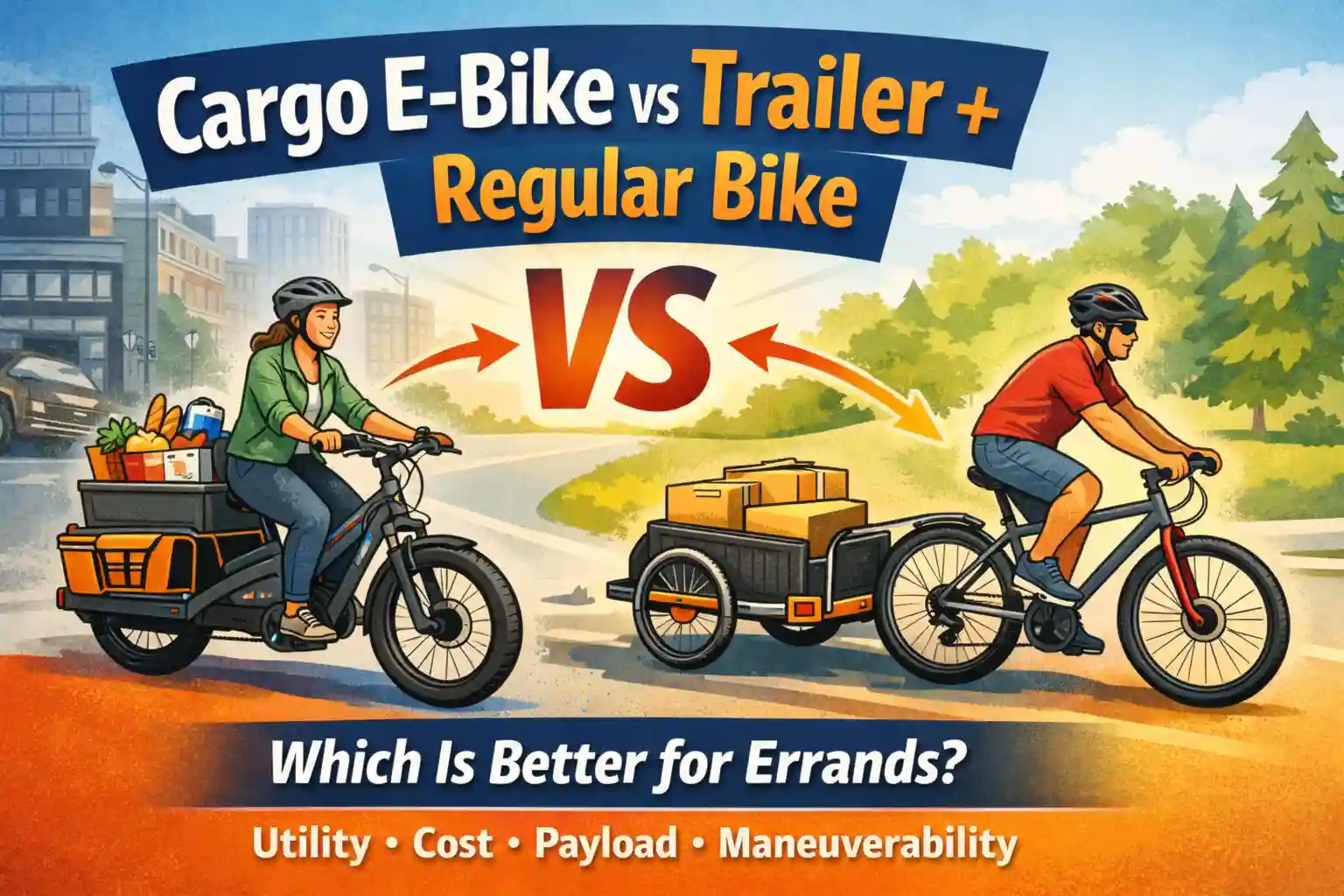
Cargo E-Bike vs Trailer for Errands – Cost, Safety, and Real-World Comparison
Last Updated on May 20, 2026 by Kristina
Introduction
Running errands by bike is one of the most practical ways to replace short car trips. But once groceries, pet food, packages, or kid gear enter the picture, most riders face the same decision:
Do you invest in a dedicated cargo e-bike, or use a trailer behind a regular bike?
If you are still learning the basics of motors, classes, and what actually makes an e-bike practical for everyday use, our E-Bike Buying Guide is a helpful place to start before comparing specific hauling setups.
This guide focuses on real-world usability, safety, cost, handling, and long-term ownership, not just specs or marketing claims. We break down how each option performs in everyday errands like grocery runs, school pickups, hardware store trips, and urban commuting.
📖 Read Next
Understanding Electric Bike Classes: A Comprehensive Guide
Best Cargo E-bikes for Families: A Detailed Comparison
Best Cargo E-Bikes for Commuting in 2026: A Comprehensive Guide
How to Size an E-Bike for Your Height
Electric Bike Battery Capacity: Amp Hours (Ah) Explained
How Motor Placement Affects Balance
Who This Guide Is For (and Who It’s Not)
This is for you if:
- You run errands weekly or multiple times per week by bike
- You carry groceries, packages, kids, or pets
- You care about braking performance and traffic safety
- You want a car-replacement solution, not just a backup option
You may want to skip this if:
- You haul cargo only a few times per year
- You ride mainly on rural roads with wide shoulders
- You prioritize lightweight bikes and minimal storage needs
Short on time? Jump to the comparison table below for a fast decision.
Trust & How We Evaluate
This guide is based on a combination of:
- Manufacturer specifications for cargo e-bikes and bicycle trailers
- Rider feedback from daily commuters and family riders
- Geometry and load handling principles used in bicycle design
- Independent safety and transportation research
We do not accept paid placements or rankings. “Better” here means safer, more predictable, and more practical for everyday errands, not just higher payload numbers.
We reference safety guidance and design principles from:
- The National Highway Traffic Safety Administration (NHTSA) for bicycle visibility and roadway safety concepts
- The International Organization for Standardization (ISO) for bicycle design and testing standards related to load, braking, and stability
📌 Quick Verdict
Best choice for most urban errands:
A cargo e-bike is usually the better long-term solution for convenience, stability, and daily usability.
Best budget and flexibility option:
A regular bike with a trailer works well for occasional hauling and riders who already own a bike and want a lower upfront cost.
Side-by-Side Comparison
| Feature | Cargo E-Bike | Regular Bike + Trailer |
|---|---|---|
| Typical Cost | $1,800 to $4,500+ | $150 to $600 (plus bike) |
| Payload Capacity | 300 to 450 lb total system | 80 to 150 lb (trailer dependent) |
| Electric Assist | Built-in motor and battery | Optional add-on kits only |
| Maneuverability | Wider, longer, but stable | Narrow bike, wide rear footprint |
| Parking & Storage | Takes more space | Trailer can detach |
| Hill Performance | Strong, motor-assisted | Fully human-powered |
| Braking Power | Heavy-duty hydraulic brakes | Depends on bike’s brakes |
| Visibility in Traffic | Tall, highly visible | Low-profile, needs flags/lights |
Payload vs Real-World Carrying Capacity (What Specs Don’t Tell You)
Most riders see a “400 lb capacity” or “150 lb trailer rating” and assume that means everything feels stable and safe up to that number. In reality, where the weight sits matters just as much as how much it weighs.
How Weight Placement Changes the Ride
Cargo E-Bike
- Weight is centered between the wheels or over a reinforced rear rack
- Keeps steering predictable
- Reduces fishtailing at speed
- Maintains braking balance
Trailer Setup
- Weight sits behind the rear axle
- Increases stopping distance
- Can push the bike forward during sudden braking
- Makes downhill riding feel “pulled” instead of planted
Practical Rule of Thumb
- Cargo e-bike: Feels stable up to about 75 to 85 percent of its rated load in daily use
- Trailer: Often feels unstable beyond about 60 to 70 percent of its rating in traffic or hills
This explains why riders who stay within technical limits still report very different confidence levels between these two setups.
Range and Energy Use Under Load
Most advertised ranges assume one rider, flat ground, and light cargo. Errands change all of that.
Cargo E-Bike
- Heavy loads increase battery draw by 20 to 40 percent
- Mid-drive motors handle hills more efficiently under weight
- Dual-battery systems can extend real-world errand range significantly
Trailer Setup
- No electric assist means your legs provide all the power
- Hills and wind become major limiting factors
- Long grocery runs can turn into endurance rides
Real-World Example
A 12-mile grocery loop:
- Cargo e-bike with load: Often 15 to 20 miles of remaining range
- Regular bike with trailer: Rider fatigue becomes the limiting factor, not distance
🛠 Maintenance and Wear Over Time
Errand bikes live a harder life than recreational bikes because weight accelerates wear on every component.
Cargo E-Bike
Higher wear on:
- Brake pads and rotors
- Chains and cassettes
- Tires under constant load
These parts usually last longer because they are purpose-built, but replacement costs are higher.
Trailer Setup
Higher wear on:
- Rear wheel spokes
- Axles and quick-release skewers
- Brakes that were not designed for towing loads
Hidden Cost Factor
Over 2 to 3 years of regular hauling, many trailer riders end up replacing wheels or brake systems that would have lasted much longer on a non-hauling bike.
👉For more on maintenance see our Maintenance for Beginners Guide
Apartment, Storage, and Theft Reality Check
This is one of the biggest decision factors riders only discover after buying.
Cargo E-Bike
- May not fit in elevators or bike rooms
- Harder to carry upstairs
- Needs heavy-duty locks and multiple anchor points
- Some models weigh 80 to 100 lb before cargo
Trailer Setup
- Bike stores normally
- Trailer detaches and can be carried inside
- Easier to secure discreetly
Quick takeaway: If you live above the first floor or rely on shared bike storage, trailers often win on logistics alone.
Traffic and Visibility Comparison
Cargo E-Bike
- Tall profile improves visibility at intersections
- Built-in lights usually run off the main battery
- Drivers often treat them more like small vehicles than bicycles
Trailer Setup
- Low profile can disappear behind parked cars
- Safety flags and rear lights become essential, not optional
- Drivers may misjudge your total length when passing
🔒 Insurance and Liability Notes
Many riders are surprised to learn:
- Some renters and homeowners policies cover e-bikes but not trailers under theft claims
- High-value cargo e-bikes may need to be scheduled as personal property
- Carrying children can increase liability considerations in accidents
It is worth checking your policy before making a major investment.
Upgrade Paths and Long-Term Ownership
Most riders evolve over their first year of hauling.
Starting with a Trailer
Common path:
- Add panniers
- Add front rack
- Add e-bike conversion kit
- Eventually switch to a cargo e-bike
Starting with a Cargo E-Bike
Common upgrades:
- Larger baskets or cargo boxes
- Weather covers for kids or pets
- Second battery for extended range
- Locking lids for theft prevention
This helps frame the decision as a long-term system, not just a single purchase.
Fast Choice Guide
- Live in an apartment or upstairs? → Trailer
- Ride in traffic or hills? → Cargo e-bike
- Errands more than once a week? → Cargo e-bike
- Budget under $500? → Trailer
- Kids or pets onboard? → Cargo e-bike
⚠️ Legal and Local Safety Reminder
Before riding:
- Check your local e-bike class system and motor limits
- Confirm trailers are allowed on shared paths and bike lanes
- Use rear lights and safety flags for low-profile trailers
- Load weight evenly to prevent fishtailing
For state and local rules, visit our State-by-State E-Bike Laws Guide before riding in traffic or on multi-use paths.
Final Recommendation
Choose a cargo e-bike if:
- You run errands weekly or daily
- You carry kids, pets, or heavy loads
- You ride in traffic or hilly areas
- You want a true car-replacement solution
Choose a trailer setup if:
- You haul occasionally
- You already own a solid bike
- You want the lowest upfront cost
- You ride mostly on wide paths or quiet roads

Kristina is not just an enthusiast but a true authority on electric bikes. Nestled in the coastal beauty of Virginia, Kristina has found the perfect backdrop for her passion for electric biking. As a dedicated wife and homeschooling mom, her life revolves around family, faith, and the thrill of adventure.
Originally hailing from Ohio, Kristina's journey with electric bikes began as a curiosity and quickly evolved into a deep expertise. Her blog is a testament to her love for electric biking, combining her fascination for eco-friendly transportation with her coastal lifestyle.
When she's not cruising the beach on her electric bike, you'll find Kristina indulging in her other loves: long walks along the shore, getting lost in a good book, and cherishing moments with her loved ones. With a heart as big as her love for animals, especially cats, Kristina brings a unique perspective to the electric bike world, grounded in her strong faith in God and her dedication to a sustainable lifestyle.
Through her blog, Kristina shares her extensive knowledge of electric bikes, offering valuable insights, tips, and recommendations to fellow enthusiasts. Whether you're a seasoned rider or a newcomer to the electric bike scene, Kristina's blog is your go-to source for all things electric biking, fueled by her passion, expertise, and the scenic beauty of coastal Virginia.