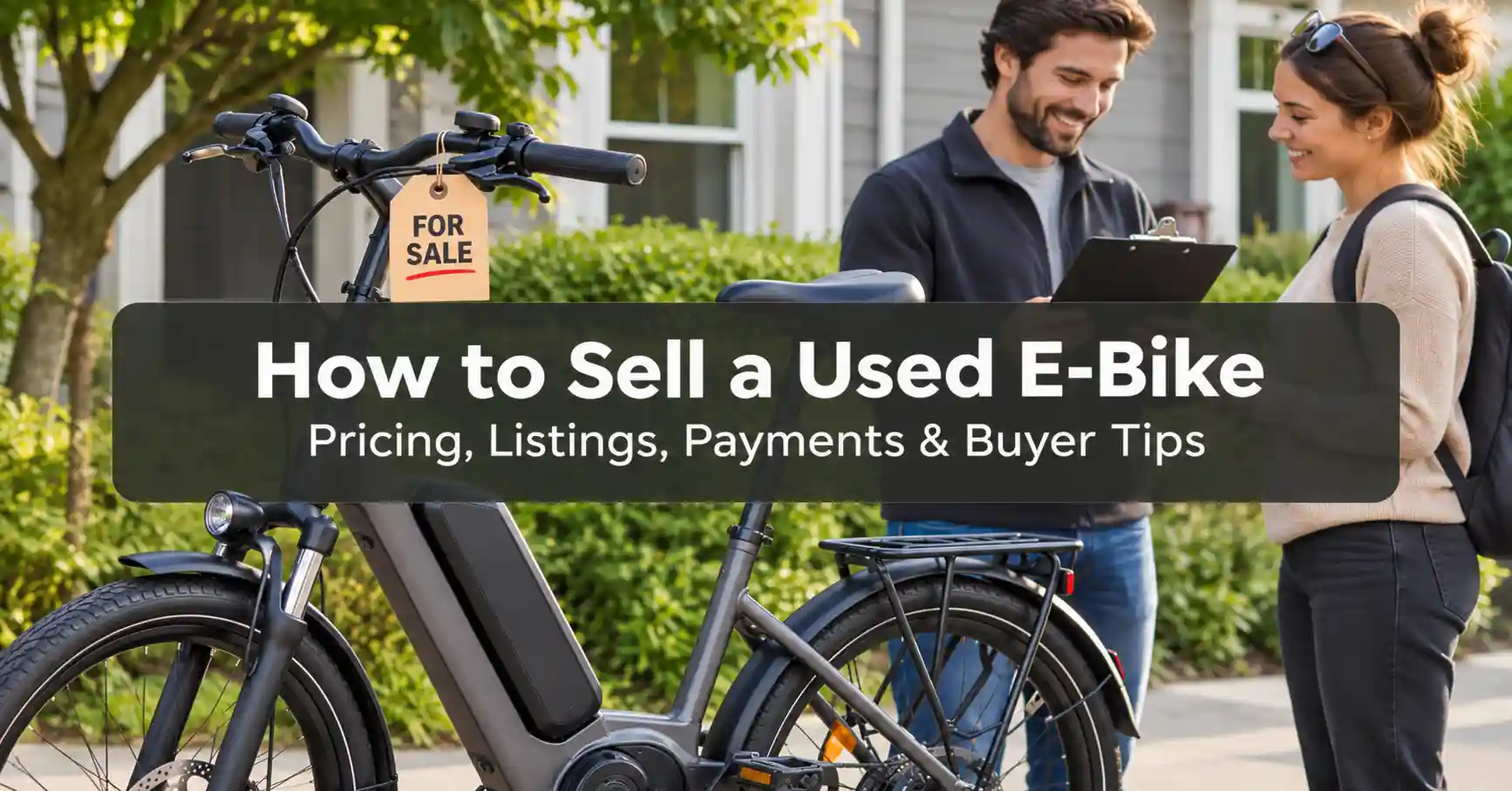
How to Sell a Used E-Bike Safely: Pricing, Listings, Payments & Buyer Tips

Selling a used e-bike is different from selling an ordinary bicycle. Buyers want to know whether the battery still performs well, whether replacement parts are available, and whether the bike has been maintained safely. You also need to decide where to list it and how to get paid without becoming a scam target.
The practical approach is to price the bike against comparable listings, explain its condition accurately, meet buyers safely, and document the handover. If you are unsure what to ask, start with my used e-bike value calculator. It helps compare similar bikes and account for battery uncertainty and needed repairs.
Quick answer: For a private sale, start with local buyers or a bike-focused marketplace, use recent comparable asking prices as a starting point, disclose battery and mechanical issues, check for recalls, and verify payment before handing over the bike. A specialist buyout service may be simpler, but its offer reflects its inspection, transport, and resale costs.
Where Can You Sell a Used E-Bike?
There is no single best selling method. The right choice depends on whether you care most about your final price, speed, or avoiding the work of dealing with private buyers.
| Selling option | Why consider it | What to watch |
|---|---|---|
| Local marketplace or classifieds | Meet a nearby buyer; avoid shipping a large bike and battery | Screen inquiries, confirm listing rules, and arrange a safe handover |
| Bike Index Marketplace | Bike-specific listings connected to a registration; ownership transfer is built into the process | Buyers and sellers arrange their own payment and delivery |
| Upway direct sale | Request an offer from a specialist used-e-bike buyer | Accepted brands and condition rules vary; compare the net offer and packing obligations |
| Local bike shop or consignment seller | May handle buyer contact, presentation, or inspection | Ask whether it accepts used e-bikes, its fees, and who bears liability |
| Local cycling groups | Reach riders who may understand the specific model | Check group rules; use the same payment and meeting precautions as any private sale |
Important eBay restriction: eBay currently states that used e-bikes are not allowed under its product safety policy. Eligible sellers can list certain refurbished e-bikes with new batteries, subject to eBay’s certification and listing requirements. Do not assume an ordinary private owner can list a used e-bike there. Check eBay’s current micromobility policy before choosing a platform.
If you are replacing the bike with a new one, ask local dealers whether they offer a trade-in. An immediate credit may be convenient even when it is not the same as a private-sale price.
How Much Is Your Used E-Bike Worth?
Avoid relying on a fixed depreciation percentage or the original retail price. Two bikes of the same age can have very different resale values if one has a healthy original battery and good service records while the other needs expensive repairs.
- Find genuine comparables. Look for the same brand, model, approximate model year, frame size, battery configuration, and region. Check current new-bike discounts as well.
- Separate asking prices from completed sales. A seller can ask anything. An advertised price does not prove a bike sold for that amount.
- Account for condition. Note mileage, tire and brake wear, damage, firmware or electrical faults, and whether the original charger and keys are present.
- Consider the battery. Document age and known behavior. Battery replacement can materially change the value, especially if a proprietary pack is difficult to obtain.
- Compare your real net proceeds. Subtract any selling fees, transport, packing, and agreed repairs from the price you expect to receive.
Illustrative example, not a market quote: If three close local listings ask $950, $1,050, and $1,100, the middle asking price is $1,050. That is only a starting reference. Adjust for the actual differences between the bikes and remember that these are advertised prices, not verified completed transactions.
For a more tailored starting point, use the EBE used e-bike value calculator. If the battery is questionable, the e-bike battery replacement cost guide can help you understand why a buyer may factor that risk into an offer.
Compare what you actually take home
A higher selling price is not always a better deal once you account for fees and time. This is especially useful when comparing a private buyer with an e-bike buyout service or a local consignment shop.
Hypothetical example: You accept an offer of $900, spend $45 on professional packing, and pay a $30 selling fee. Your net proceeds are $825. A local cash offer of $850 with no selling or packing expenses would leave you with more money, even though the headline sale price is lower. These are example numbers, not typical marketplace fees.
Use this simple comparison: agreed price – selling fees – packing and transport – agreed repair costs = amount you keep. If you are trading in the bike, compare the real value of the credit and any conditions attached to it.
Check the Bike Before Listing It
The goal is not to make a used bike look new. It is to describe its condition honestly, correct straightforward safety problems, and avoid inviting someone to test-ride an unsafe machine.
- Identify it: Record the brand, model, approximate model year, frame size, wheel size, and frame serial number for your records.
- Check the basics: Inspect tires, brakes, wheels, lights, drivetrain, folding joints if applicable, and loose or damaged components. Have safety-critical concerns evaluated by a qualified mechanic.
- Check the electrical system: Confirm whether the bike powers on, charges normally, changes assist levels, and reports any error messages. Do not open the battery or attempt improvised electrical repairs.
- Document battery information: Include its stated capacity and age if known, any manufacturer-app health report available, and genuine range observations only if you have reliable records. Do not invent a battery-health percentage.
- Gather what belongs with the bike: The correct charger, removable battery, original keys, manuals, purchase receipt if available, and service paperwork.
- Record known faults: Note scratches, dents, corrosion, repairs, and modifications so they are disclosed in the listing.
Check for recalls before advertising
Check the CPSC recalls database for the bike’s brand and model, battery, and other relevant components. The CPSC says selling or offering a recalled product for sale is illegal, including for individuals reselling used items. If you find a recall, follow the official notice and complete any applicable remedy before considering resale; if the recall remains unresolved, do not offer the bike or affected component for sale. If the battery is swollen, damaged, overheating, or otherwise unsafe, do not charge it, ride it, or offer it for a test ride. Seek manufacturer or qualified professional guidance about safe handling and disposal.
If you are uncertain about electrical certifications, my guide to checking whether an e-bike is UL certified explains why the exact system and battery documentation matter.
Should you repair the bike before selling?
Not every cosmetic issue needs fixing, but selling an unsafe bike as ready to ride is different from honestly disclosing a scratch. Before spending money, get a repair quote and compare it with what the repair is likely to add to the selling price.
- Usually worth doing: Clean the bike, check tire inflation against the tire and bike instructions, replace clearly inexpensive missing items when appropriate, and organize the charger, keys, and records.
- Get a quote first: Worn tires, brake work, drivetrain replacement, and electrical problems may cost more than you recover in the sale. Explain any unrepaired faults plainly.
- Safety comes first: Do not offer a test ride with defective brakes, an unsafe frame or hinge, or a suspect battery. Do not offer a product for sale while an applicable recall remains unresolved.
How to Write an E-Bike Listing That Buyers Can Trust
A useful listing gives buyers enough information to decide whether the bike fits them before they arrange a meeting. Use clear daylight photographs of the actual bike, not manufacturer stock photos.
Photos worth including
- The complete bike from each side, plus a clear view of the frame size and overall shape
- The display showing current odometer mileage, if the bike has one, with an explanation if it has been reset
- The battery, charger, keys, and any included accessories
- The tires, brakes, drivetrain, and any recently replaced major components
- Close-ups of scratches, rust, cracked plastics, or other known damage
- Any relevant model labels or certifications you can verify, without exposing account credentials or sensitive personal details
Keep a record of the full frame serial number, but avoid posting your entire receipt, home address, or personal-account information in the public listing. Let a serious buyer verify the serial number on the bike during a safe inspection.
- Identify the bike: Brand, model, size, model year if known, and what is included.
- Describe use: Odometer mileage if the display reports it, how you used the bike, and relevant maintenance history.
- Describe the battery accurately: Original or replacement, age if known, charger availability, and any known charging or range problems.
- Disclose modifications: Controller, motor, throttle, speed-limit, wiring, and battery changes are particularly important.
- Set sale terms: Asking price, general location, whether the price is negotiable, and how you will arrange inspection and pickup.
Copy-and-Edit Used E-Bike Listing Template
Copy the example below, replace the details in brackets with facts about your bike, and delete anything that does not apply. Be specific about the battery and any known issues.
READY-TO-EDIT LISTING
[Brand and model] - [Frame size] - $[Asking price]

Year and mileage: [Model year] | [Odometer miles, or not available]
Battery and charging: [Battery age, known charging behavior, and any range limitations]
Condition and maintenance: [Overall condition, recent work, and service history]
Included: [Original battery, correct charger, keys, accessories]
Known issues or modifications: [List them clearly, or write "None known"]
Location: [General area only]
Sale arrangements: Inspection by appointment. Payment must be verified before handover.
Privacy tip: Do not publish your home address, account credentials, full purchase receipt, or unnecessary personal details. Keep the full serial number and proof of ownership available for a serious buyer to check during a safe inspection.
How to Meet Buyers and Handle Test Rides Safely
A genuine buyer may reasonably want to check fit, hear the motor operate, and confirm the brakes function. You can accommodate that without giving a stranger unrestricted possession of the bike.
- Arrange a daytime meeting at a populated, well-lit place; consider bringing another person. Use a location where a short test ride can be conducted lawfully and safely.
- Agree on a short route and clear test-ride conditions before anyone rides. You can decline a test ride if you are uncomfortable with the arrangements; holding a stranger’s keys or wallet does not guarantee that the bike will be returned.
- Explain any operating quirks and the relevant assist controls before the test ride. Ask the rider to use appropriate protective gear.
- Do not permit a test ride if the brakes, frame, folding mechanism, battery, or controls are unsafe or have unresolved stop-riding symptoms.
- Stay present during inspections and do not hand over the bike permanently, its keys, charger, or ownership documents until you have verified payment through an agreed, reliable method.
How to Get Paid Without Falling for a Scam
The Federal Trade Commission’s advice for online sellers warns about fake payment messages, overpayment checks, refund requests, and scammers asking for verification codes.
- For a local sale: Cash exchanged in a safe public setting or at a bank can be straightforward. For larger amounts, consider completing the exchange inside the buyer’s or seller’s bank, where cash can be checked.
- For electronic payments: The FTC advises against accepting mobile-app payments from strangers. If you choose an electronic method, check its seller protections, potential holds and reversal risks beforehand. Verify any payment directly with your bank or payment provider, rather than trusting a screenshot, email, or message from the buyer. A displayed balance or payment notification is not necessarily a guarantee against later reversal.
- Never send back an “accidental overpayment.” A fake payment or bad check can leave you out the money and the bike.
- Never share one-time security codes. A buyer does not need a login, authentication, or verification code to buy your e-bike.
- Do not let urgency override verification. Requests for couriers, surprise third-party pickup, or unusual payment arrangements deserve extra scrutiny.
For additional red flags, see my guide to avoiding e-bike scams. It focuses mainly on buyers, but several marketplace warning signs apply to sellers too.
Finish the Sale With a Clear Record and Ownership Transfer
Once payment is verified, give the buyer a dated bill of sale or receipt. It can include both parties’ names, the bike’s make and model, serial number, selling price, included battery and charger, and a factual statement of disclosed defects and agreed terms. Keep a copy. Check any applicable state or local registration rules and any financing or lien obligations before transfer.
Also hand over the proper keys, charger, manuals, and relevant service information. Remove personal location data, unlink your own app or anti-theft accounts when the manufacturer permits, and follow the manufacturer’s ownership-transfer procedure where one exists.
If the bike is registered with Bike Index, transfer its registration to the buyer after payment and as part of the handover. Bike Index provides this option through its marketplace process, but it does not handle the payment. A registration transfer is separate from getting paid, so complete both steps.
Printable Used E-Bike Bill of Sale
Use the blank bill of sale below as a preview. For a cleaner paper copy, select the print option to open a one-page PDF, then use your browser or PDF viewer’s Print command. Fill in the form and have both parties keep a signed copy. Check any applicable local requirements before the sale.
Free Printable Used E-Bike Bill of Sale
Print just the blank bill of sale, not the entire article. The PDF is formatted as a single US letter-size page with room for names, bike details, payment, disclosures, and both signatures.
Opens the printable form in a new tab. Choose Print in your PDF viewer, or save a copy for later.
USED E-BIKE BILL OF SALE
Sale date: ____________________________________
Seller name and contact: __________________________________________
Buyer name and contact: __________________________________________
Bike brand and model: __________________________________________
Model year (if known) / frame size: _________________________________
Frame serial number: ____________________________________________
Included battery, charger, keys, and accessories:
_________________________________________________________________
Agreed sale price: $_________________ Payment method: ______________
Payment verified on: ____________________________________________
Known defects or modifications: ___________________________________
_________________________________________________________________
Recall check date: __________________ Applicable remedy completed (if any):
_________________________________________________________________
Other agreed conditions: _________________________________________
_________________________________________________________________
Seller signature: __________________________ Date: ______________
Buyer signature: __________________________ Date: ______________
This example is a practical record, not legal advice or a replacement for any required local paperwork. Resolve outstanding loans or liens before selling, and do not offer a product with an unresolved applicable recall for sale. Disclosing a recall does not make a prohibited sale permissible.
Should You Ship a Used E-Bike to a Buyer?
Local pickup is usually simpler. E-bikes are heavy and can have lithium-ion batteries that require specific shipping classification, packaging, documentation, and carrier approval. Removing the battery does not automatically make the remaining shipment or the battery simple to mail.
Before promising shipping, ask a qualified bike shipper or the receiving service exactly how the complete bike and battery will be handled. U.S. Department of Transportation lithium-battery guidance explains why shipping requirements matter. Declare lithium batteries accurately and follow the carrier and hazardous-materials requirements; never conceal a battery or send a damaged battery through an ordinary parcel service. A specialist buyout service may provide its own logistics instructions, which should be followed rather than improvised.
Is a Private Sale Better Than a Trade-In?
A private sale gives you the opportunity to negotiate directly but also means handling questions, appointments, payment, and pickup. A shop or specialist buyer may make the process easier while accounting for its own inspection, reconditioning, warranty, and resale expenses in the offer.
I would compare the net amount you keep, not just the headline quote. A slightly lower offer can be reasonable if it saves substantial effort, but there is no reason to assume every dealer or trade-in program gives the best price. Review your options before committing.
Frequently Asked Questions
Can I sell a used e-bike without its original charger or battery key?
You may find a buyer willing to accept missing items, but disclose them prominently. Some specialized buying services require the correct charger and keys. Never substitute an unverified charger or battery as a quick fix.
Can I sell an e-bike if the battery has lost range?
A bike with normal battery aging and less range than when new may still interest a buyer if its condition is disclosed accurately. Be clear about what you know and what you have not tested. An unsafe, damaged, or recalled battery is different; resolve safety and recall issues first.
Does an e-bike warranty transfer to the next owner?
It depends on the particular manufacturer and warranty. Some require proof of the original purchase or restrict coverage to the original buyer. Do not promise transferable warranty protection without checking the current written terms for your model.
Can I sell my used e-bike on eBay?
Under eBay’s current product safety policy, ordinary used e-bikes are not allowed. Eligible sellers can list certain refurbished e-bikes with new batteries if the applicable certification and listing requirements are met. Check the rules again before listing because platform policies can change.
What if the bike has a mechanical problem?
Get the problem assessed when it affects safety, and disclose the issue and any repair estimates. A bike that is unsafe to ride should not be presented as ready for a test ride. If you are unsure whether repairs are economically sensible, compare repair costs with a realistic selling price first.
Why You Can Trust Electric Bike Explorer: This is a research-based selling guide, not a claim that I personally sold a bike through each platform. The advice draws on current platform rules, CPSC product-safety guidance, the FTC’s scam warnings, and EBE’s existing value-estimation resource. Platform acceptance criteria and seller protections can change, so check them before listing.
The bottom line: A fair price and a well-documented bike make the sale easier. Accurate battery and condition details, a safe meeting plan, verified payment, and a proper ownership transfer matter more than trying to make the bike sound flawless.
Want more independent e-bike guidance in Google? You can add Electric Bike Explorer as a Preferred Source where Google’s Preferred Sources feature is available.
Sources and Further Reading
- eBay – Product Safety Policy (micromobility and used e-bikes)
- Upway – Sell Your E-Bike (selling and acceptance process)
- Bike Index – Marketplace Selling and Ownership Transfer
- Federal Trade Commission – Selling Stuff Online: Avoiding Scams
- U.S. Consumer Product Safety Commission – Selling Recalled Products
- U.S. Department of Transportation – Transporting Lithium Batteries

Kristina is not just an enthusiast but a true authority on electric bikes. Nestled in the coastal beauty of Virginia, Kristina has found the perfect backdrop for her passion for electric biking. As a dedicated wife and homeschooling mom, her life revolves around family, faith, and the thrill of adventure.
Originally hailing from Ohio, Kristina's journey with electric bikes began as a curiosity and quickly evolved into a deep expertise. Her blog is a testament to her love for electric biking, combining her fascination for eco-friendly transportation with her coastal lifestyle.
When she's not cruising the beach on her electric bike, you'll find Kristina indulging in her other loves: long walks along the shore, getting lost in a good book, and cherishing moments with her loved ones. With a heart as big as her love for animals, especially cats, Kristina brings a unique perspective to the electric bike world, grounded in her strong faith in God and her dedication to a sustainable lifestyle.
Through her blog, Kristina shares her extensive knowledge of electric bikes, offering valuable insights, tips, and recommendations to fellow enthusiasts. Whether you're a seasoned rider or a newcomer to the electric bike scene, Kristina's blog is your go-to source for all things electric biking, fueled by her passion, expertise, and the scenic beauty of coastal Virginia.