
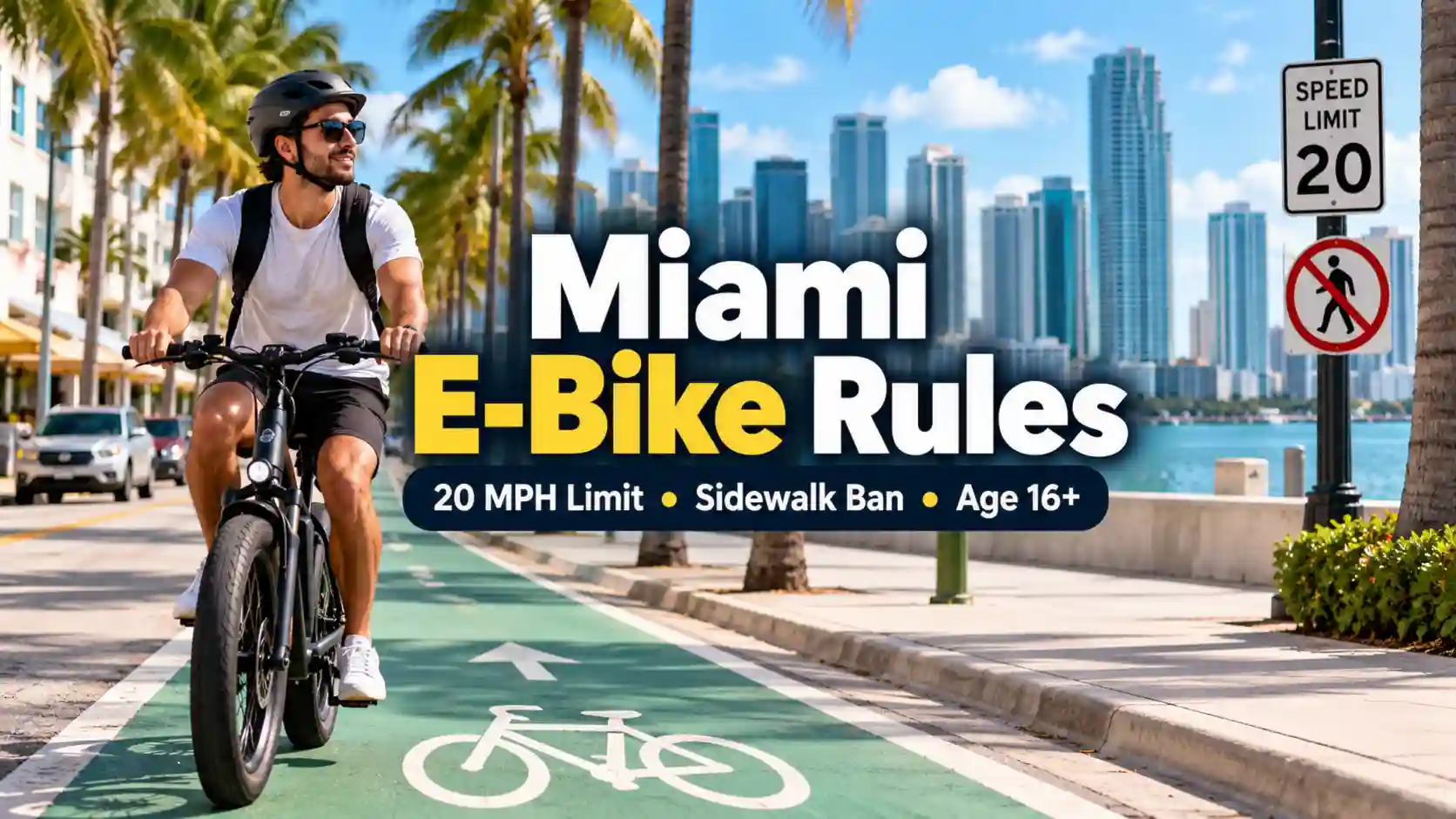
Miami Approves New E-Bike Rules: 20 MPH Limit, Sidewalk Ban and $100 Fines
Last Updated on October 29, 2026 by Kristina
Published October 29, 2026 | Miami, Florida
Miami’s City Commission has approved new rules for electric bicycles, motorized scooters and similar micromobility devices. The October 22, 2026 vote brings a proposed 16-year minimum riding age, 20-mph city speed limit, limits on where e-bikes can be ridden, a sidewalk-riding ban and potential $100 fines. The change matters to riders who commute through Miami, use an e-bike for errands or ride near crowded pedestrian areas.
Important: This is a City of Miami ordinance, not a new statewide Florida rule or a blanket ban throughout Miami-Dade County. And although the commission approved the measure, news reports disagree on its exact effective date. More on that below. For the statewide baseline, start with our Florida e-bike law guide.
Miami’s New E-Bike Rules at a Glance
| Rule | What the ordinance says |
|---|---|
| Minimum rider age | 16 to operate covered e-bikes, motorized scooters and other devices on city streets and rights-of-way |
| Photo identification | Carry valid government-issued photo ID while operating a covered device |
| Maximum riding speed | 20 mph on covered city street rights-of-way |
| Where riding is allowed | Use a bike lane when one is available; otherwise use a city street with a posted speed limit of 30 mph or less, subject to the ordinance’s jurisdiction |
| Sidewalks and pedestrian walkways | No riding on covered sidewalks or pedestrian walkways; walking the device is permitted |
| Sidewalk parking | Designated spaces only; no blocked entrances/exits and at least 3 feet of pedestrian clearance |
| Passengers | Generally one rider, except devices designed for multiple riders; an appropriately secured, helmeted child passenger is specifically addressed |
| Possible penalty | $100 civil fine for each violation, or a traffic citation under applicable state law |
These are the principal requirements in the ordinance approved on October 22. They concern covered devices and places in the City of Miami’s jurisdiction. They should not be interpreted as restrictions on traditional nonmotorized bicycles everywhere in Florida. The ordinance also exempts wheelchairs and qualifying mobility devices covered under the Americans with Disabilities Act.
Where Can You Ride an E-Bike in Miami?
The ordinance directs micromobility riders to use bike lanes where available. Where a bike lane is not available, it allows riding on covered city streets and rights-of-way with a posted speed limit of 30 mph or less. A street’s posted 30-mph limit is not permission to ride an e-bike at 30 mph: the ordinance separately sets a 20-mph maximum operating speed. Riders must still obey applicable traffic laws and posted restrictions.
The jurisdiction matters. County- and state-controlled roads run through Miami, and the city cannot simply apply every local restriction to them without the necessary legal authority or county arrangements. If you use a route crossing city, county and state roads, verify who controls it rather than assuming one rule covers the whole trip.
Does Miami Ban E-Bikes on Sidewalks?
Under the approved ordinance, riding an e-bike or motorized scooter on a covered public sidewalk or pedestrian walkway is prohibited. You may walk the device on the sidewalk, which is different from riding it. The parking provision is separate: leaving a device on a sidewalk is generally limited to designated parking areas, and it must not block doors or pedestrian passage. The ordinance specifically calls for at least three feet of clear space for pedestrians.
This is stricter than a general assumption that e-bikes may ride wherever conventional bikes can. Florida allows local governments to regulate e-bike sidewalk use within their jurisdiction. Our e-bike sidewalk laws by state explains how those restrictions vary across the country.
Is There a New Minimum Age or E-Bike License Requirement?
The ordinance prohibits riders younger than 16 from operating the covered devices on city streets and rights-of-way. Riders must also carry valid government-issued photo identification. That ID requirement is not the same thing as needing a driver’s license: Florida’s general e-bike law does not require a driver’s license or registration for qualifying electric bicycles, but it does allow local age and photo-ID rules.
The 16-year minimum applies to operation in the spaces covered by the city ordinance; it does not create an across-the-board statewide prohibition on every child riding an e-bike or imply a new statewide license. Parents and teen riders should check the exact routes they use and any separate school or campus requirements.
What About Class 3 E-Bikes That Can Assist Up to 28 MPH?
Some Class 3 e-bikes can provide pedal assistance up to 28 mph under their usual classification. That does not mean a rider may travel 28 mph on a Miami city road where the new 20-mph local limit applies. The ordinance regulates where and how fast a covered bike may be operated; it does not, by itself, say that owning every Class 3 bicycle is illegal.
E-bikes are also not interchangeable with higher-powered electric dirt bikes or motorcycles. If a device does not meet the relevant bicycle definition, different vehicle laws may apply. See our guide to how e-bikes differ from mopeds and scooters for the key distinctions.
What Are the Fines? Will Police Give Warnings First?
The approved rule provides for a $100 civil fine per violation and also allows applicable state traffic citations. It does not mean every rider will automatically receive a $100 fine on a first encounter. Miami Police Chief Edwin Lopez has said officers intend to emphasize education first and treat citations as a last resort. That is an enforcement approach, not an exemption riders can count on.
There is also a reported warning-and-safety-materials option involving under-16 riders or their parents in the final substitute. Parents should not read that as permission for someone under 16 to ride where the ordinance prohibits it.
When Do Miami’s New Rules Actually Take Effect?
As of October 29, 2026, the City Commission has approved the ordinance, but the precise effective date remains uncertain in published reports. The Miami Lookout reporting on the approved substitute and start date explains that the substitute text approved at the October 22 vote calls for the rules to begin 30 days after adoption—approximately November 21, 2026—unless the mayor vetoes the measure. Earlier news reports cited immediate implementation or the first week of November based on a different draft. The city’s formal signed text and any veto action should be checked before treating one date as definitive.
This distinction is important: approval of an ordinance and the date it becomes enforceable are not always the same. You can follow City of Miami legislative file 19877 (Ordinance 14497) for the city’s legislative record. Regardless of the effective-date uncertainty, riding cautiously at pedestrian crossings and following posted local rules are sensible now.
Are Miami, Miami Beach and Miami-Dade County Rules the Same?
No. City of Miami, City of Miami Beach, Sunny Isles Beach and unincorporated Miami-Dade County are separate jurisdictions. Miami’s October 22 ordinance should not be described as automatically changing the rules in each of them. County-owned roads can also require separate authorization for municipal restrictions. Riders should check each local jurisdiction before traveling across municipal boundaries.
Miami is not alone in revisiting micromobility rules. On EBE, we’ve already reported on Sunny Isles Beach e-bike enforcement rules, Fort Lauderdale’s proposed e-bike rules and University of Miami campus restrictions. Those are related developments, not proof that the exact new Miami ordinance applies in those locations.
Practical Tips for Riders in Miami
- Plan your route: prioritize bike lanes and look at the posted speed limit of any city street you intend to use.
- Keep it at or below 20 mph: do not assume a Class 3 bike’s assisted capability overrides a local operating limit.
- Do not ride on pedestrian sidewalks: dismount and walk through areas where riding is restricted.
- Carry photo ID: the new ordinance requires government-issued identification from riders covered by its provisions.
- Check youth riders’ routes: the city measure sets a 16-year threshold for riding covered devices on its streets and rights-of-way.
- Park considerately: use designated parking and leave pedestrian routes and entrances clear.
- Monitor the effective date: confirm the final signed ordinance and any mayoral action before assuming enforcement has started.
Frequently Asked Questions
Did Miami ban all electric bikes?
No. The city approved restrictions on operation, including where covered e-bikes may be ridden, how fast they may travel, and who may ride them on city rights-of-way. It is not a citywide ban on owning an e-bike.
Can you ride a Class 3 e-bike at 28 mph in Miami?
Not on a covered city road where the ordinance’s 20-mph operating limit applies. Your bike’s maximum assisted speed and the legal speed at a particular location are different things.
Do adults need a driver’s license to ride an e-bike in Miami?
Florida generally does not require a driver’s license for a qualifying e-bike. Under the newly approved Miami ordinance, covered riders must carry government-issued photo ID. A photo ID is not necessarily a driver’s license.
Does the sidewalk rule apply in Miami Beach too?
No, this particular ordinance applies to the City of Miami’s jurisdiction. Miami Beach has its own ordinances. Do not assume the two cities’ rules or effective dates are identical.
Is the $100 fine already being enforced?
The commission approved a possible $100 civil penalty, but reports conflict about when the final ordinance becomes effective. As of October 29, 2026, a definitive effective date should be verified against the final city record.
🎥 Watch: NBC 6 South Florida’s Coverage of Miami’s New E-Bike Rules
NBC 6 South Florida reports on Miami’s newly approved e-bike and scooter restrictions and what the changes could mean for local riders.
My Take
I’m in favor of clear, understandable rules that protect people walking without confusing ordinary, legal e-bikes with much faster electric motorcycles. Miami’s new ordinance is significant not just because of its 20-mph limit, but because riders must now think about which street they use, whether there is a bike lane, and which local government controls the road. Those details can be hard to work out in practice, so clear public signage and accurate implementation guidance will be important.
If you’re riding elsewhere in the state, our Florida e-bike law guide is a better starting point than assuming Miami’s rules apply throughout Florida. We will distinguish confirmed legal changes from proposals and unresolved implementation details in future coverage.
Sources and Further Reading
- City of Miami legislative file 19877 (Ordinance 14497)
- October 22 commission agenda and Section 8-20 draft
- 2026 Florida Statute §316.20655
- Miami Lookout reporting on the approved substitute and start date
- Miami Today, October 28 coverage
- Miami-Dade County’s separate micromobility ordinance (No. 26-51)

Kristina is not just an enthusiast but a true authority on electric bikes. Nestled in the coastal beauty of Virginia, Kristina has found the perfect backdrop for her passion for electric biking. As a dedicated wife and homeschooling mom, her life revolves around family, faith, and the thrill of adventure.
Originally hailing from Ohio, Kristina's journey with electric bikes began as a curiosity and quickly evolved into a deep expertise. Her blog is a testament to her love for electric biking, combining her fascination for eco-friendly transportation with her coastal lifestyle.
When she's not cruising the beach on her electric bike, you'll find Kristina indulging in her other loves: long walks along the shore, getting lost in a good book, and cherishing moments with her loved ones. With a heart as big as her love for animals, especially cats, Kristina brings a unique perspective to the electric bike world, grounded in her strong faith in God and her dedication to a sustainable lifestyle.
Through her blog, Kristina shares her extensive knowledge of electric bikes, offering valuable insights, tips, and recommendations to fellow enthusiasts. Whether you're a seasoned rider or a newcomer to the electric bike scene, Kristina's blog is your go-to source for all things electric biking, fueled by her passion, expertise, and the scenic beauty of coastal Virginia.