Are Smaller E-Bike Wheels Better or Worse for Stability?
Last Updated on February 4, 2026 by Kristina
Choosing an e-bike often comes down to one simple question: “Will this feel stable and safe when I ride it?”
Wheel size plays a big role in how confident an e-bike feels, especially when you compare compact folding bikes with full-size commuter and trail models.
Smaller wheels can make a bike easier to handle in tight spaces and at low speeds, while larger wheels tend to feel smoother and more planted as speed and terrain increase. The challenge is knowing which type of stability actually matters for your riding style, roads, and daily use.
In this guide, we break down how e-bike wheel size affects balance, comfort, braking, and real-world control so you can choose confidently, not just based on specs.
If you are still narrowing down bike types, our E-Bike Buying Guide walks through the bigger picture of motors, batteries, and frame design that also shape how stable a bike feels.
🔍 Trust & How We Evaluate
We base this guide on a combination of manufacturer specifications, rider feedback, geometry principles, and independent cycling research on wheel dynamics and stability. We do not accept paid placements or rankings. Stability here means how predictable and controlled an e-bike feels across speed, terrain, braking, and turning, not just whether it can stay upright.
We also reference safety and design principles from organizations like:
- The National Highway Traffic Safety Administration (NHTSA) for bicycle and e-bike safety concepts
- The International Organization for Standardization (ISO) for bicycle design and testing standards
Quick Answer
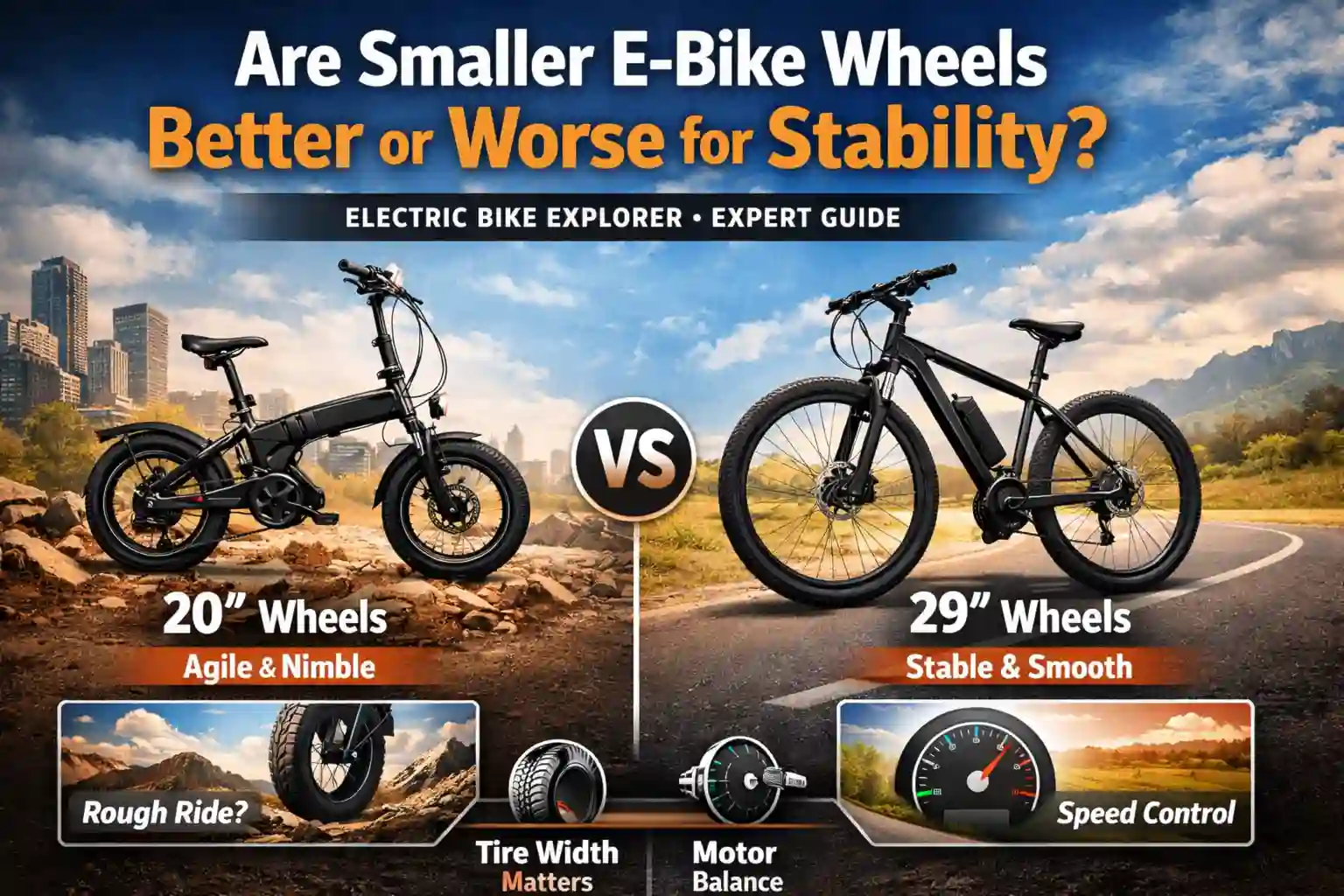
For most riders, larger wheels (26”–29”) feel more stable at speed and on rough roads, while smaller wheels (16”–20”) feel more nimble and controllable at low speeds but can feel twitchier on bumps and descents.
Who This Guide Is For (and Who It’s Not)
This is for you if:
- You are choosing between a folding e-bike and a full-size commuter
- You ride in mixed city and suburban conditions
- You care about comfort and safety at real-world speeds
You may want a different guide if:
- You are shopping for a performance trail e-bike
- You are focused purely on racing or speed riding
What “Stability” Actually Means on an E-Bike
Stability is not one single feeling. It is a mix of:
- Straight-line tracking: How steady the bike feels when riding fast
- Low-speed balance: How easy it is to control in traffic, tight paths, or parking lots
- Bump response: How the bike behaves when it hits cracks, curbs, gravel, or roots
- Cornering confidence: How planted the bike feels when turning
- Braking control: How predictable it feels when slowing down quickly
Wheel size affects all five, but so do tire width, frame geometry, rider position, and suspension.
Common E-Bike Wheel Sizes (Quick Reference)
| Wheel Size | Common On | Typical Feel |
|---|---|---|
| 16”–20” | Folding e-bikes, compact city bikes | Nimble, easy to maneuver, more sensitive to bumps |
| 24” | Some compact commuters, youth/smaller-frame bikes | Balanced middle ground |
| 26” | Fat tire e-bikes, cruisers, older MTB styles | Stable, cushioned, versatile |
| 27.5” (650B) | Modern commuters, trail e-bikes | Smooth rolling, good balance of agility and stability |
| 29” (700C) | Road-style commuters, performance e-bikes | Fast, efficient, very stable at speed |
How Smaller Wheels Affect Stability
Key idea: Smaller wheels change how quickly the bike responds. That can feel easier in tight spaces and more demanding on rough or fast riding.
Geometry Snapshot (Why It Feels This Way)
Smaller wheels usually come with a shorter wheelbase and steeper head tube angle. That combination makes the front wheel turn more easily, which is great for maneuvering but can feel nervous at speed. Many folding e-bikes also have shorter trail (the distance the tire contact patch follows behind the steering axis), which increases agility but reduces self-centering stability.
1) Low-Speed Control
1) Low-Speed Control
Smaller wheels often feel more stable at walking speeds. This is because:
- They have a lower center of gravity
- The bike is usually more compact
- Steering inputs feel lighter
This makes small-wheel e-bikes popular for:
- Urban riding
- Crowded paths
- Short commutes with frequent stops
2) Bumps and Obstacles
This is where smaller wheels can feel less stable.
A smaller wheel hits a bump at a steeper angle than a larger wheel. That means:
- You feel cracks, potholes, and curbs more
- The bike can get deflected sideways more easily
- You may need to slow down more on rough surfaces
This is one reason many fat tire and trail e-bikes use 26”–29” wheels instead of 20”.
3) High-Speed Riding
At higher speeds, smaller wheels can feel twitchier. This is because:
- They have less rotational stability
- Steering reacts more quickly to small movements
Some riders like this “quick” feeling. Others find it nervous or tiring over long distances.
How Larger Wheels Improve Stability
Key idea: Larger wheels increase forgiveness. They smooth out the ride and resist sudden changes in direction.
Geometry Snapshot (Why It Feels This Way)
Larger wheels are often paired with a longer wheelbase and slacker head tube angle. This increases trail and straight-line stability, which is why many commuters and trail e-bikes feel planted at 20–28 mph.
1) Straight-Line Confidence
1) Straight-Line Confidence
Larger wheels have more rotational inertia. Once they are rolling, they naturally resist sudden direction changes, which contributes to a more planted feel at speed. This makes the bike feel:
- More planted on descents
- Smoother at 20–28 mph
- Easier to ride hands-free briefly (where legal and safe)
2) Rough Terrain Performance
A larger wheel rolls over obstacles instead of dropping into them. This means:
- Less jolt from potholes
- Better control on gravel, dirt, and broken pavement
- More confidence on curbs and trail features
3) Braking Stability
With more contact length and smoother rolling, larger wheels often feel more predictable under hard braking, especially when paired with wider tires.
Stability Is Not Just Wheel Size
Wheel size works together with:
- Tire width: A 20” wheel with a 4” fat tire can feel more stable than a 29” wheel with a skinny road tire
- Frame geometry: Head tube angle, wheelbase, and handlebar height matter a lot
- Suspension: Front forks and seat suspension can reduce the harshness small wheels feel
- Rider position: Upright bikes often feel more stable at low speeds, while forward-leaning bikes feel better at speed
- Motor placement & weight: Hub motors add mass to a wheel (rear or front), while mid-drive motors keep weight centered in the frame. Centered weight usually improves balance and cornering stability.
Tire Width vs Wheel Size (Quick Stability Matrix)
| Setup | Low-Speed Stability | High-Speed Stability | Bump Absorption | Best Use Case |
|---|---|---|---|---|
| 20” x 2.2” | Good | Fair | Fair | Compact commuters, RV travel |
| 20” x 4.0” (fat) | Very Good | Good | Very Good | Beach, snow, urban comfort |
| 27.5” x 2.0” | Good | Very Good | Good | Daily commuting |
| 29” x 2.4” | Fair | Excellent | Very Good | Trails, fast riding |
If you want a deeper breakdown of geometry, motors, and handling, our E-Bike Buying Guide explains how these factors work together.
Wheel size works together with:
- Tire width: A 20” wheel with a 4” fat tire can feel more stable than a 29” wheel with a skinny road tire
- Frame geometry: Head tube angle, wheelbase, and handlebar height matter a lot
- Suspension: Front forks and seat suspension can reduce the harshness small wheels feel
- Rider position: Upright bikes often feel more stable at low speeds, while forward-leaning bikes feel better at speed
If you want a deeper breakdown of geometry and handling, our E-Bike Buying Guide explains how these factors work together.
Real-World Scenarios
City Commuter
- Best feel: 27.5” or 700C
- Why: Smooth over cracks, stable in traffic, efficient for longer distances
- Tip: Look for 2.0”–2.4” tires for comfort without sacrificing speed
Folding E-Bike for Apartments or RVs
- Best feel: 20”
- Why: Easy to maneuver and store, stable at low speeds, great for short trips
- Tip: Prioritize wider tires and a front suspension fork to reduce road shock
Gravel or Trail Riding
- Best feel: 27.5” or 29”
- Why: Rolls over rocks and roots, better downhill control
- Tip: Pair with tubeless-ready tires for lower pressure and extra grip
Beach or Snow Riding
- Best feel: 26” fat tire
- Why: Wide contact patch and stability on soft surfaces
- Tip: Lower tire pressure improves flotation and control
Senior or Comfort-Focused Riders
- Best feel: 24”–27.5”
- Why: Easier mounting, predictable handling, good balance of stability and maneuverability
Heavy Riders or Cargo Hauling
- Best feel: 26” or 27.5”
- Why: Stronger wheel builds and better load stability
- Tip: Look for double-wall rims and higher spoke counts
City Commuter
- Best feel: 27.5” or 700C
- Why: Smooth over cracks, stable in traffic, efficient for longer distances
Folding E-Bike for Apartments or RVs
- Best feel: 20”
- Why: Easy to maneuver and store, stable at low speeds, great for short trips
Gravel or Trail Riding
- Best feel: 27.5” or 29”
- Why: Rolls over rocks and roots, better downhill control
Beach or Snow Riding
- Best feel: 26” fat tire
- Why: Wide contact patch and stability on soft surfaces
Smaller Wheels: Pros and Cons
Pros
- Easier low-speed balance
- More compact and portable
- Lighter steering feel
- Often lighter overall bike weight
- Better fit for shorter riders
Cons
- Harsher on bumps
- Can feel nervous at higher speeds
- Less efficient for long-distance riding
- Smaller contact patch with narrow tires
Larger Wheels: Pros and Cons
Pros
- More stable at speed
- Smoother ride over rough ground
- Better long-distance efficiency
- More predictable braking feel
- Better obstacle rollover
Cons
- Larger turning radius
- Heavier feel at low speeds
- Bigger bike footprint for storage
- Can feel tall for shorter riders
⚠️ Safety & Local Laws Reminder
🟡 Safety First
No matter the wheel size, always match your riding style to your local e-bike laws. Speed class limits, helmet requirements, and where e-bikes can legally ride vary by state and city.
We maintain a full, regularly updated State-by-State E-Bike Laws Guide to help you stay compliant and safe.
For national safety guidance, you can also reference materials from the U.S. Consumer Product Safety Commission (CPSC) on bicycle and e-bike standards, as well as design and testing standards from the International Organization for Standardization (ISO 4210).
Quick Test Ride Checklist (Use This at the Bike Shop)
Bring this with you and test both a small-wheel and large-wheel e-bike:
- Start-stop test: Can you smoothly balance and steer at walking speed?
- Bump test: Roll over a curb cut or rough patch. How harsh does it feel?
- Brake test: From 15–20 mph, do controlled stops. Does the bike track straight?
- Turn test: Make a tight U-turn. Does it feel planted or twitchy?
- Comfort test: After 10 minutes, do your hands or back feel fatigued?
FAQs
Do smaller wheels make an e-bike safer?
They can feel safer at low speeds and in tight spaces, but larger wheels usually feel safer at higher speeds and on rough terrain.
Are fat tires more important than wheel size for stability?
Often, yes. Tire width and pressure can dramatically change how stable a bike feels.
Does motor type change wheel stability?
Yes. Mid-drive motors keep weight centered, which often improves balance compared to heavy rear hub motors.
So, Are Smaller Wheels Better or Worse?
Smaller wheels are better for low-speed control, tight spaces, and portability.
Larger wheels are better for high-speed stability, rough terrain, and long rides.
The “best” choice depends on how and where you actually ride, not just what feels stable in a parking lot test.
Final Takeaway
If stability is your top concern, do not look at wheel size alone. Look at the whole system: tire width, frame design, suspension, motor placement, and how fast and far you actually ride.
For most everyday riders, a 27.5” or 700C commuter-style e-bike offers the best balance of comfort, confidence, and efficiency. Smaller wheels shine when space, portability, and stop-and-go control matter more than speed and terrain.
If you are torn between two bikes, use the Quick Test Ride Checklist above. Ten minutes of real riding will tell you more than any spec sheet.
If stability is your top concern, do not look at wheel size alone. Look at the whole system: tire width, frame design, suspension, and how fast and far you actually ride.
For most everyday riders, a 27.5” or 700C commuter-style e-bike offers the best balance of comfort, confidence, and efficiency. Smaller wheels shine when space, portability, and stop-and-go control matter more than speed and terrain.
This guide is part of Electric Bike Explorer’s trust-first approach to e-bike education. We focus on real-world use, safety, and transparent research to help riders make confident, informed decisions.
Not sure where to go next?
Some riders are brand new. Others are fixing a problem or thinking about a new bike. Choose what fits you.
Learn & Get Comfortable
Understand how e-bikes work and what to expect when riding.
Improve Your Current Ride
If your bike isn’t performing how you want, learn what affects speed, range, and power.
Compare Better Bikes
Looking for something that fits your riding style? Start here.
- Best Electric Bikes for Beginners
- Recommended Commuter Ebikes
- Most Comfortable City E-Bikes
- Best Fat Tire Ebikes
- Top Folding Ebikes
- Best Step Through Ebikes
- Top Cargo Electric Bikes
- Best Lightweight Ebikes
- Best Long Range Ebikes
- Top Moped Style E-Bikes
- E-bike Reviews
🛒 Ready to Buy?
Top picks and current availability from trusted brands.
👉 Still deciding?
Take our E-Bike Recommendation Quiz to get matched with the right riding style in under two minute

Kristina is not just an enthusiast but a true authority on electric bikes. Nestled in the coastal beauty of Virginia, Kristina has found the perfect backdrop for her passion for electric biking. As a dedicated wife and homeschooling mom, her life revolves around family, faith, and the thrill of adventure.
Originally hailing from Ohio, Kristina's journey with electric bikes began as a curiosity and quickly evolved into a deep expertise. Her blog is a testament to her love for electric biking, combining her fascination for eco-friendly transportation with her coastal lifestyle.
When she's not cruising the beach on her electric bike, you'll find Kristina indulging in her other loves: long walks along the shore, getting lost in a good book, and cherishing moments with her loved ones. With a heart as big as her love for animals, especially cats, Kristina brings a unique perspective to the electric bike world, grounded in her strong faith in God and her dedication to a sustainable lifestyle.
Through her blog, Kristina shares her extensive knowledge of electric bikes, offering valuable insights, tips, and recommendations to fellow enthusiasts. Whether you're a seasoned rider or a newcomer to the electric bike scene, Kristina's blog is your go-to source for all things electric biking, fueled by her passion, expertise, and the scenic beauty of coastal Virginia.