Best E-Bike Battery Size for a 10–20 Mile Commute (Real-World Guide)
Last Updated on March 19, 2026 by Kristina
Quick Answer for Most Riders:
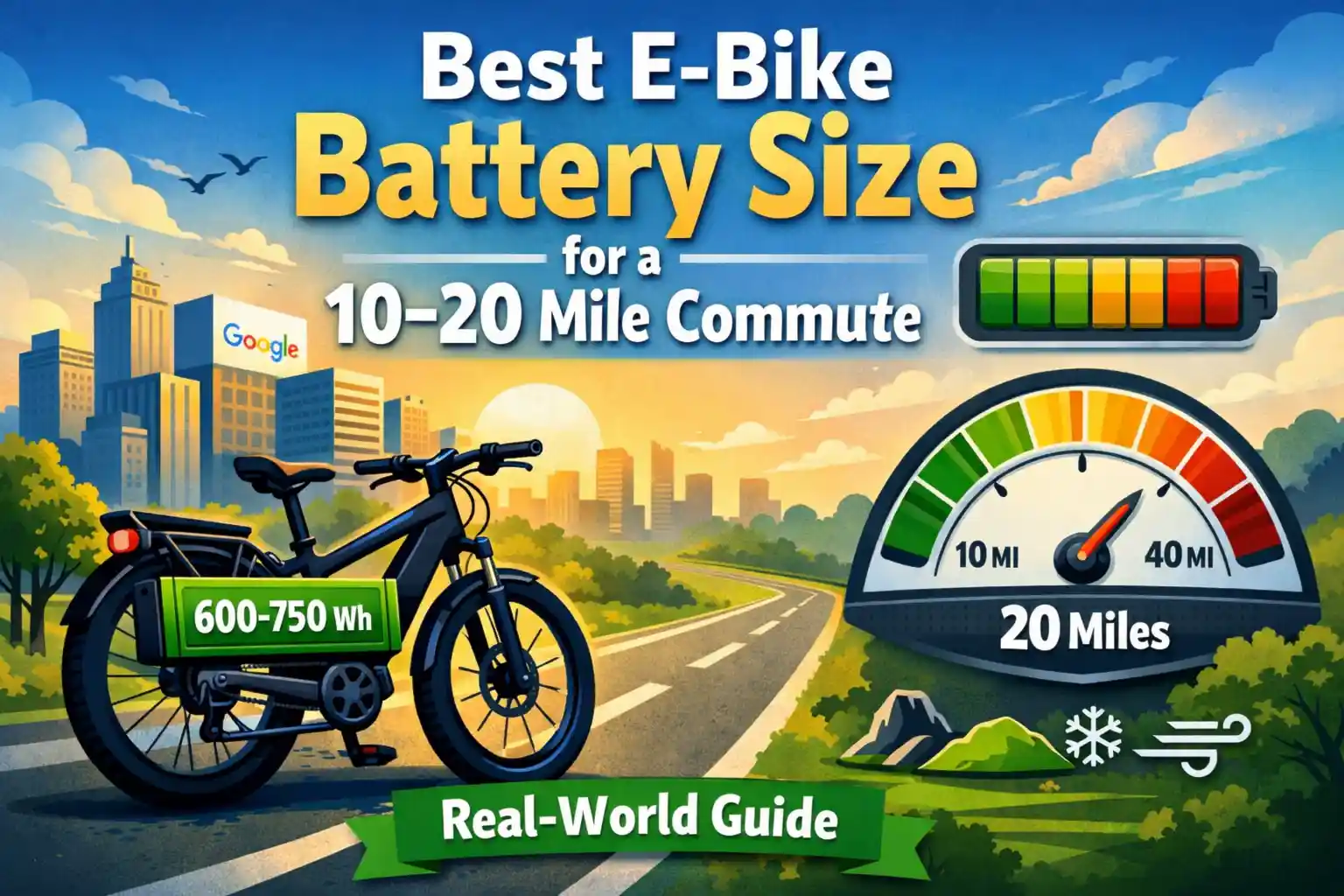
If your daily commute is 10–20 miles round trip, a battery between 500Wh and 750Wh is the sweet spot for reliability, battery longevity, and year-round range confidence.
Choosing the right e-bike battery size is one of the most important decisions you’ll make as a commuter. Go too small, and you risk range anxiety, faster battery wear, and cold-weather failures. Go too large, and you may pay more than you need for weight and capacity you never use.
This guide breaks down exactly how many watt-hours you need for a 10 to 20 mile commute, how real-world factors change your range, and how to size your battery for long-term reliability, not just marketing numbers.
🔗 New to e-bikes? Start with the E-Bike Buying Guide to understand motors, classes, and riding styles before locking in a battery size.
📖 Read Next
How to Choose the Best eBike Battery for Your Commute (With Top Picks)
Understanding E-Bike Battery Capacity: Amp Hours (Ah) Explained
5 Signs It’s Time to Replace Your E-Bike Battery
The Ultimate Guide to Electric Bike Chargers: Types, Features, and Recommendations
Why Your E-Bike Battery Loses Charge Overnight — and How to Fix It
How Long Do E-Bike Batteries Last?
E-Bike Battery Charging Mistakes
E-Bike Battery Health Checker
Who This Guide Is For (and Who It’s Not)
This guide is for you if:
- You commute 5 to 10 miles each way
- You ride on paved roads or bike paths
- You want consistent range in heat, cold, and wind
- You plan to ride 3 or more days per week
- You care about battery lifespan, not just advertised range
This guide is not for you if:
- You ride less than 5 miles per day total
- You only use your e-bike occasionally on weekends
- You rely mostly on throttle-only riding
- You are shopping strictly for the cheapest possible e-bike
👉 Short on time? Jump to the Recommended Battery Sizes by Rider Type section below.
What Battery Size Means (Simple Explanation)
E-bike batteries are measured in watt-hours (Wh). This number tells you how much energy the battery can store.
Think of it like a fuel tank:
- 400Wh = small tank
- 500–600Wh = mid-size tank
- 700–900Wh = large tank
The more watt-hours you have, the farther you can ride and the less stress you put on the battery over time.
Simple Battery Sizing Formula (Real-World Friendly)
If you like numbers, here’s a practical way to estimate how much battery you actually need.
Rule of thumb:
Most commuters use 15–25 watt-hours per mile
Step 1 – Estimate daily energy use
Miles per day × 20Wh = Estimated daily usageExamples:
- 10 miles total × 20Wh = 200Wh
- 20 miles total × 20Wh = 400Wh
Step 2 – Add a battery health buffer
Multiply by 1.5 to 2x so you don’t drain the battery daily.
So for a 20-mile commute:
- 400Wh × 1.5 = 600Wh minimum target
This is why most daily commuters naturally land in the 500–750Wh range, even if the math suggests they could “get by” with less.
Real-World Range vs Marketing Claims
Manufacturers often advertise ranges like “Up to 80 miles.” Those numbers usually assume:
- Flat terrain
- Light rider
- Low pedal assist
- No wind
- Warm weather
In real commuting conditions, most riders get:
- 15–30 miles from a 400Wh battery
- 25–45 miles from a 500–600Wh battery
- 35–60 miles from a 700–900Wh battery
These numbers reflect pedal-assist riding. Frequent throttle use or high assist on hills can push consumption above 25Wh per mile and reduce range further.
Recommended Battery Sizes for a 10–20 Mile Commute
🟢 Best Choice for Most Commuters: 500–600Wh
This range gives you:
- Enough capacity to ride 20 miles without draining below 30 percent
- Better performance in cold weather
- Slower battery wear over time
- Flexibility for detours, errands, or headwinds
If you commute 10 miles each way, this is the safest long-term choice.
🟡 Budget Option: 400–450Wh
Works if:
- Your route is mostly flat
- You pedal consistently
- You charge every day
- You ride in mild weather
This can work for 10-mile round trips but starts to feel tight closer to 20 miles, especially in winter.
🔵 Premium Comfort Option: 700–750Wh
Ideal if:
- You ride hills
- You carry a backpack or cargo
- You want to charge every other day
- You plan to keep your bike for many years
This size reduces battery strain and delivers the most consistent year-round performance.
How Much Range You Actually Use Per Ride
A healthy battery lasts longest when you avoid draining it below 20–30 percent regularly.
If your commute is:
- 10 miles total
Look for a battery that can realistically deliver 25–30 miles - 20 miles total
Look for a battery that can realistically deliver 40–50 miles
This buffer protects the battery’s internal cells and helps maintain capacity after hundreds of charge cycles.
Range depends on more than just battery size – terrain, assist level, and riding habits all play a role. This commuter e-bike guide breaks down how to plan your setup for daily riding.
What Affects Your Battery Range the Most
Rider Weight and Cargo
Heavier riders and backpacks draw more power, especially when accelerating and climbing.
Hills
Hills are the fastest way to drain a small battery. Power draw spikes on climbs, especially at higher assist levels.
Assist Level
Higher pedal assist means higher energy use. Most commuters ride in levels 2–4.
Temperature
Cold weather can reduce usable capacity by 20–30 percent, especially near freezing.
Wind
Strong headwinds act like invisible hills and increase power demand.
How Motor Type Changes Battery Needs
Hub-Drive Motors
- Less efficient on hills
- Draw more power when starting and climbing
- Benefit from larger batteries (600Wh or more) on hilly routes
Mid-Drive Motors
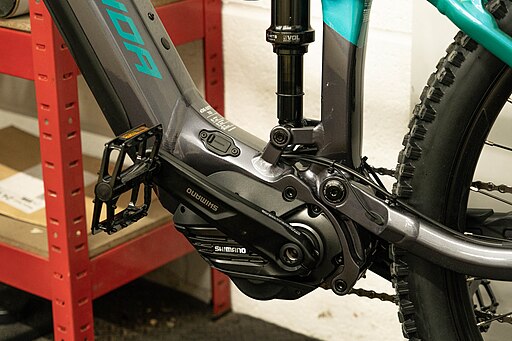
- Use the bike’s gears to climb more efficiently
- Often get better range per watt-hour
- Can work well with 500Wh batteries on moderate hills
Buying tip:
If you’re choosing a hub motor for a hilly 10–20 mile commute, size your battery one tier larger than you think you need.
How Battery Voltage Affects Your Ride (Not Just Range)
Most commuter e-bikes run:
- 36V systems – Efficient and lightweight, best for flat to moderate terrain
- 48V systems – Stronger acceleration and hill performance
Important clarification:
Voltage alone does not determine range. Total watt-hours (Wh) matter most. A 48V and 36V battery with the same Wh rating contain similar total energy.
Practical advice:
Higher-voltage systems often encourage higher assist levels and faster acceleration, which can increase real-world consumption. If your bike uses a 48V system, aim for 600Wh or more for a 20-mile commute, especially in hills or wind.
How Long Your Battery Should Last (Years, Not Just Miles)
Most quality e-bike batteries are rated for:
- 500–800 full charge cycles
Real-World Example
- Small battery (400Wh), charged almost daily
Often shows noticeable wear in 2–3 years - Medium battery (600Wh), charged every other day
Can last 3–5 years before major capacity loss
This is one of the strongest long-term financial reasons not to undersize your battery.
Removable vs Integrated Batteries for Commuting
Removable Batteries
Best for:
- Apartment living
- Office charging
- Cold weather storage
Integrated Batteries
Best for:
- Clean look
- Slightly better weather sealing
- Theft deterrence
Most daily commuters prefer removable batteries for flexibility and better battery care.
Charging at Work or in Apartments (What to Plan For)
Office Charging
Look for:
- Removable battery
- Charger under 3 pounds
- Standard wall outlet compatibility
Apartment Storage
Best practices:
- Store between 50–70°F indoors
- Avoid balconies or unheated garages in winter
- Use a fire-resistant charging bag or mat if charging overnight
Public Charging Reality
Most cities do not yet support secure public e-bike charging. Plan your battery size assuming home charging only.
Charging Time Expectations
Typical charging times using standard chargers:
- 400–500Wh: 4–5 hours
- 600–700Wh: 5–7 hours
- 750Wh+: 6–8 hours
Fast chargers can reduce this, but these estimates reflect most stock commuter setups.
Safety and Battery Quality Standards
Always look for:
- UL 2849 (full e-bike system certification)
- UL 2271 (battery pack certification)
- Brand-name cells such as Samsung, LG, or Panasonic
- A proper Battery Management System (BMS) with:
- Cell balancing
- Overcharge protection
- Thermal cutoff protection
- Short-circuit protection
⚠️ Safety Reminder: Many U.S. cities and fire departments now recommend UL-certified e-bike battery systems due to increased fire risk from uncertified lithium-ion packs. Never charge your battery unattended near flammable materials, and store it indoors during freezing temperatures.
Battery Replacement Costs (Plan for the Future)
Batteries are a wear item and should be planned for long-term ownership.
Typical U.S. Replacement Prices
- 400–500Wh: $350–$550
- 600–700Wh: $450–$700
- 750Wh+: $600–$900
Smart Buying Tip
Check whether the brand:
- Sells replacement batteries directly
- Keeps stock in the U.S.
- Uses a model-specific battery or a more universal form factor
A slightly larger battery now can delay replacement later.
When You Should Consider a Dual-Battery Setup
Most commuters do not need this, but it makes sense if:
- Your round trip is 20+ miles
- You cannot charge at work
- You ride in winter or strong winds regularly
Dual systems reduce daily battery strain and can significantly extend overall battery lifespan.
Real-World Example Scenarios
Rider A:
10 miles each way, flat city, 500Wh battery
Result: Charges nightly, finishes rides above 40 percent
Rider B:
8 miles each way, hilly route, 600Wh battery
Result: Ends rides around 35 percent, consistent year-round
Rider C:
10 miles each way, winter riding, 400Wh battery
Result: Frequent low-battery warnings, faster battery wear
How This Guide Is Built (Our Research Method)
This guide is educational, not a ranking or product review. We focus on helping commuters understand how battery size affects real-world range, safety, and long-term ownership.
We base this information on:
- Manufacturer battery specifications and published energy ratings
- Independent range testing and technical breakdowns from the e-bike industry
- Commuter riding data and rider reports from urban and suburban routes
- Battery degradation research and charge cycle standards
- Public safety and certification guidance for lithium-ion e-bike systems
We do not promote or rank specific battery brands or bike models in this guide.
Final Buying Guidance
For a 10–20 mile daily commute, a 500–600Wh battery is the best balance of price, range, reliability, and long-term value.
If you ride hills, carry cargo, or commute in cold weather, step up to 700–750Wh for stress-free riding and longer battery life.
Not sure where to go next?
Some riders are brand new. Others are fixing a problem or thinking about a new bike. Choose what fits you.
Learn & Get Comfortable
Understand how e-bikes work and what to expect when riding.
Improve Your Current Ride
If your bike isn’t performing how you want, learn what affects speed, range, and power.
Compare Better Bikes
Looking for something that fits your riding style? Start here.
- Best Electric Bikes for Beginners
- Recommended Commuter Ebikes
- Most Comfortable City E-Bikes
- Best Fat Tire Ebikes
- Top Folding Ebikes
- Best Step Through Ebikes
- Top Cargo Electric Bikes
- Best Lightweight Ebikes
- Best Long Range Ebikes
- Top Moped Style E-Bikes
- E-bike Reviews
🛒 Ready to Buy?
Top picks and current availability from trusted brands.
👉 Still deciding?
Take our E-Bike Recommendation Quiz to get matched with the right riding style in under two minute
External Resources
UL’s Official E-Bike Certification Standard (UL 2849)
PeopleForBikes on E-Bike Battery Certification

Kristina is not just an enthusiast but a true authority on electric bikes. Nestled in the coastal beauty of Virginia, Kristina has found the perfect backdrop for her passion for electric biking. As a dedicated wife and homeschooling mom, her life revolves around family, faith, and the thrill of adventure.
Originally hailing from Ohio, Kristina's journey with electric bikes began as a curiosity and quickly evolved into a deep expertise. Her blog is a testament to her love for electric biking, combining her fascination for eco-friendly transportation with her coastal lifestyle.
When she's not cruising the beach on her electric bike, you'll find Kristina indulging in her other loves: long walks along the shore, getting lost in a good book, and cherishing moments with her loved ones. With a heart as big as her love for animals, especially cats, Kristina brings a unique perspective to the electric bike world, grounded in her strong faith in God and her dedication to a sustainable lifestyle.
Through her blog, Kristina shares her extensive knowledge of electric bikes, offering valuable insights, tips, and recommendations to fellow enthusiasts. Whether you're a seasoned rider or a newcomer to the electric bike scene, Kristina's blog is your go-to source for all things electric biking, fueled by her passion, expertise, and the scenic beauty of coastal Virginia.