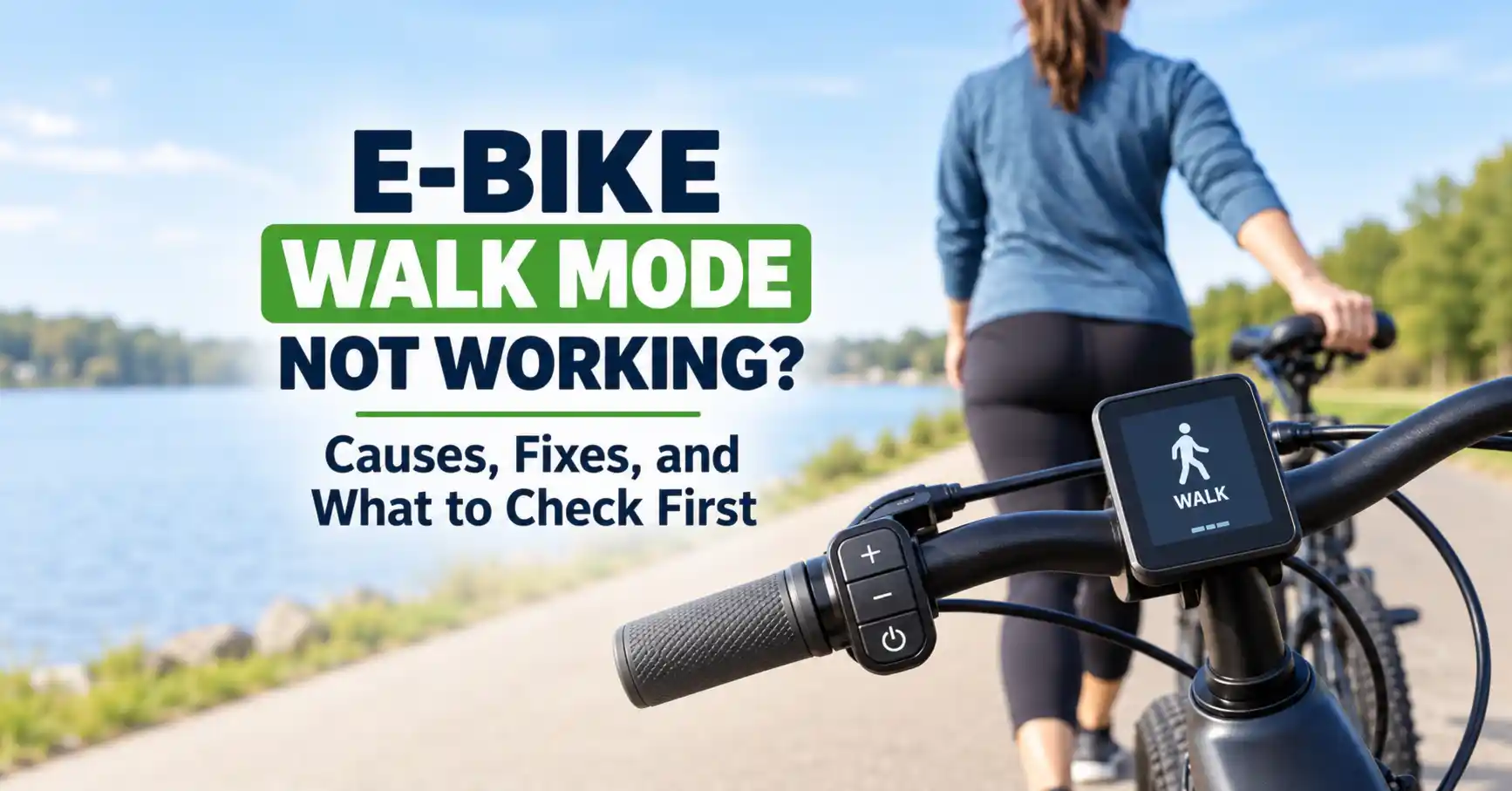
E-Bike Walk Mode Not Working? Causes, Fixes, and What to Check First
Last Updated on September 17, 2026 by Kristina
If your e-bike walk mode is not working, do not assume the motor has failed. Walk assist can stop working because of the activation sequence, a disabled setting, a control-pad problem, an error code, a loose connection, a sensor issue, or a drive-system fault. On some systems, walk assist also stops if you pedal, release the button, block the wheel, or exceed the allowed walking speed.
The first step is to check the instructions for your exact bike or drive system. Walk-assist controls are not standardized. If the display or buttons are not responding normally, start with my e-bike display troubleshooting guide. For broader electrical and drive-system problems, use the E-Bike Troubleshooting Guide.
Quick Answer: Why E-Bike Walk Mode Stops Working
The most common possibilities are:
- The wrong button sequence is being used.
- Walk assist is not enabled on that bike, display, region, or configuration.
- The bike needs to be moved slightly before walk assist engages.
- The button or control pad is not registering the command.
- The system is canceling walk assist because of pedaling, braking, wheel blockage, or another operating condition.
- An error code or sensor fault is preventing walk assist.
- An accessible connector is loose or damaged.
- The display, controller, sensor, or drive system needs manufacturer or dealer diagnosis.
A failed walk-mode test by itself does not prove that the motor, controller, or display is bad.
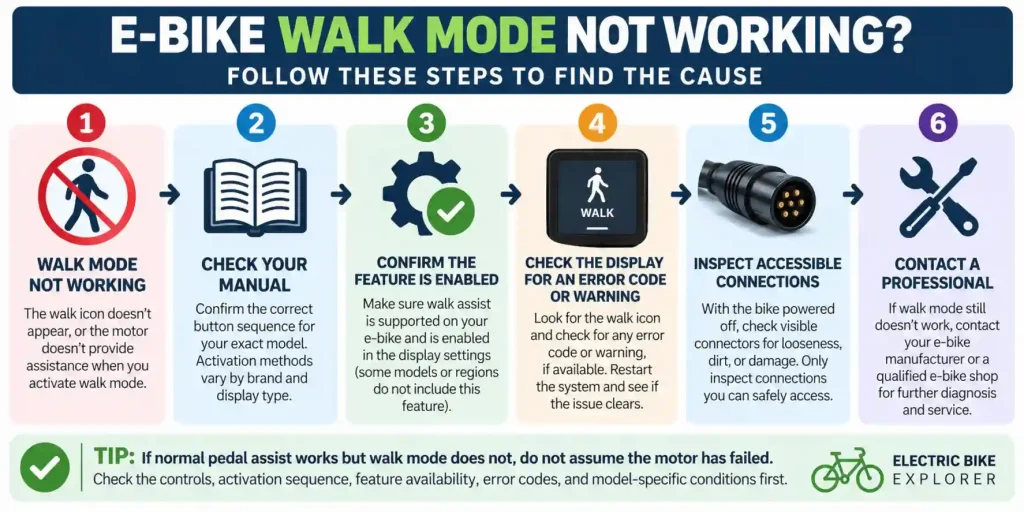
5-Minute Walk Mode Check
- Turn the e-bike fully on and confirm that the battery and display appear to be operating normally.
- Check the owner’s manual for the exact walk-assist activation sequence.
- Confirm that your bike, display, and regional configuration actually support walk assist.
- Look for a walk icon or other confirmation on the display when you activate the function.
- Keep both wheels on the ground and maintain control of the bike while testing.
- If the manual says the bike must begin moving before assist starts, gently push it while holding the required control.
- Restart the e-bike once and try again.
- Check the display for an error code before replacing any parts.
If normal pedal assist works but walk mode does not, that can point toward the controls, settings, feature availability, or a walk-assist-specific fault rather than a completely failed motor. It is still not enough by itself to identify the bad component.
🔎 Why You Can Trust This Guide
This guide is based on manufacturer instructions, established safety guidance, technical references, and common rider experiences. You can read more about how I research, verify, and review information in the Electric Bike Explorer research, review, and editorial process.
Stop using or charging the bike if you notice smoke, swelling, unusual heat, damaged wiring, sparks, or a strong chemical odor.
Safety First
Test walk assist while standing beside the bike and keeping it under control. Keep the wheels on the ground unless the manufacturer specifically instructs otherwise. Do not put your hands near the chain, chainring, belt, gears, spokes, or rotating tire while testing.
Stop troubleshooting and power the bike down if you find damaged wiring, melted connectors, sparking, unusual heat, a burning smell, or signs of water intrusion. Do not open the battery, controller, motor, or other sealed electrical components just to diagnose a walk-mode problem.
What Happens When You Try Walk Mode?
| Symptom | Likely possibilities | First check |
|---|---|---|
| No walk icon or confirmation appears | Wrong activation sequence, disabled feature, control-pad problem, unsupported configuration | Check the exact owner’s manual and confirm the button sequence |
| Walk icon appears but the motor does nothing | Bike must begin moving first, wheel is blocked, system error, sensor fault, drive-system problem | Follow the manual’s activation steps and check for error codes |
| Motor starts and immediately stops | Button released, pedaling detected, wheel blocked, another control pressed, speed condition reached | Repeat the procedure exactly as the manual describes |
| Walk mode works only sometimes | Intermittent button, control-pad, connector, or sensor issue | Check whether the same control behaves inconsistently in other functions |
| Pedal assist works but walk mode does not | Walk-assist setting, control input, configuration, or system-specific fault | Do not replace the motor based on this symptom alone |
1. Make Sure You Are Activating Walk Mode Correctly
There is no single universal walk-mode button sequence. Different manufacturers and drive systems use different controls, and procedures can change between display generations.
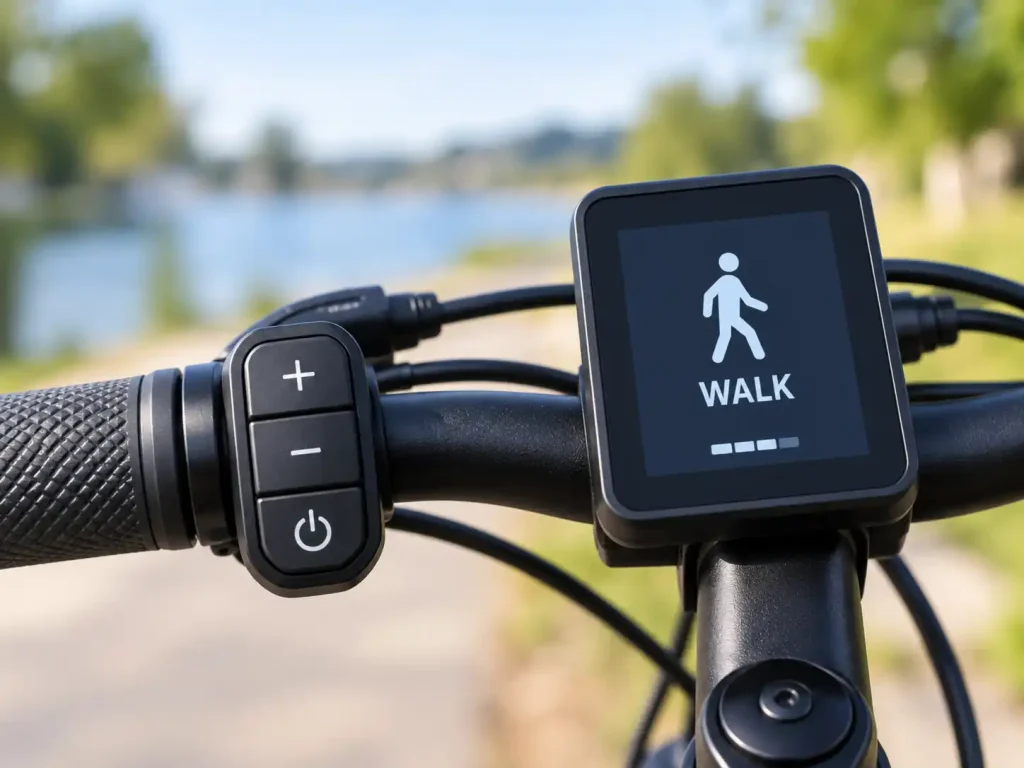
For example, Bosch smart-system instructions require a specific control sequence and may require the bicycle to be moved before walk assistance begins. Shimano STEPS systems also use system-specific button procedures. Some direct-to-consumer bikes use a long press on a minus button, but that should never be assumed without checking the manual for the exact model.
If you recently changed the display, control pad, firmware, or other electronics, verify that the replacement component supports the same functions as the original.
2. Make Sure Walk Assist Is Actually Available and Enabled
Some e-bikes do not have walk assist even if a similar model does. On some systems, feature availability can depend on the installed controls, firmware, configuration, region, or bicycle manufacturer’s setup.
Shimano documentation, for example, notes that walk-assist availability can vary by region and system configuration. This is an important check because a missing function can look like a failure when the bike was never configured to provide it.
If you cannot find walk assist in the manual, display menu, or official feature list for your exact model, contact the manufacturer before buying replacement parts.
3. The Bike May Need to Move Before Walk Assist Starts
Some systems do not immediately drive the wheel just because the walk-assist button is pressed. Bosch smart-system guidance, for example, instructs the rider to activate walk assist and then move the bicycle so the system can begin helping.
This means testing the feature with the bike perfectly stationary can sometimes produce the wrong conclusion. Follow the manufacturer’s procedure and gently begin pushing the bicycle if the manual requires movement.
🎬 Bosch Walk-Assist Example: The video below shows how walk assistance works on a Bosch smart-system e-bike with the LED Remote. Your e-bike may use a different button sequence, so always check the instructions for your exact model.
4. Check Whether the System Is Canceling Walk Assist
Walk assist is designed as a controlled low-speed pushing aid, so manufacturers can program conditions that cancel it. These conditions are not identical on every e-bike.
Yamaha documentation for certain systems says walk assist can stop when the walk switch is released, another switch is pressed, the rider begins pedaling, the bicycle exceeds the permitted walking speed, Off mode is selected, or the wheels cannot turn because of braking or an obstacle.
Use those as examples of why walk assist may stop – not as universal rules for every brand. Your owner’s manual is the final authority for your bike.
5. Check the Walk-Assist Button and Control Pad
If walk assist is activated through a display remote or handlebar control, a worn, sticky, damaged, wet, or unresponsive button can prevent the command from reaching the system.
Check whether the same button works normally for its other functions. For example, if the minus button also lowers assist levels but no longer does that reliably, the control pad itself becomes a stronger suspect.
If several display buttons are unresponsive, blank, or behaving unpredictably, use my guide to an e-bike display that is not responding to buttons before replacing the motor or controller.
6. Restart the E-Bike Before Replacing Anything
A simple power cycle is a reasonable low-risk check when the system otherwise appears normal. Turn the e-bike off, wait briefly, and restart it according to the manufacturer’s instructions.
If the bike repeatedly shows an error after restarting, do not keep cycling the power indefinitely. Record the exact error code and look it up in the manufacturer’s documentation.
7. Look for an Error Code
An error code can be more useful than the walk-mode symptom itself. Some drive systems specifically restrict walk assistance when a sensor, configuration, or drive-system fault is detected.
Bosch provides examples of system faults that can make walk assistance unavailable or restricted. When a code appears, use the exact code rather than guessing from the symptom. My E-Bike Error Code Finder can help you identify what to check next.
8. Inspect Accessible Wiring and Connectors
A loose external connector between the display, remote, controller, sensor, or drive system can cause intermittent controls. Power the bike off before inspecting accessible connectors, and follow the manufacturer’s instructions for battery removal if removal is required and safe.
Look for a connector that is visibly loose, partly separated, dirty, corroded, pinched, or damaged. Do not force keyed connectors together, probe live wiring, cut insulation, or open sealed electronics.
For a safer step-by-step approach, use my guide to finding loose electrical connections on an e-bike.
9. Consider a Sensor or Drive-System Fault
If the activation procedure is correct, the feature is enabled, the controls respond normally, and no obvious connector problem is present, the issue may be deeper in the system.
Depending on the bike, walk assist may rely on information from the controller, motor, speed sensor, torque sensor, cadence sensor, gear information, display, or another module. A fault in one of those systems can prevent walk assist even when the bike powers on normally.
This is where manufacturer diagnostics or an e-bike shop can become more useful than replacing parts by trial and error.
Does Changing Gears Affect Walk Assist?
It can on some systems. Bosch smart-system documentation notes that walk-assist speed can vary with the selected gear, and Shimano also documents gear-related behavior on certain systems.
Do not assume shifting gears will fix a failed walk mode on every bike. If your system supports gear-dependent walk assist, the owner’s manual should explain it.
Walk Assist vs. Throttle: They Are Not the Same Thing
Walk assist is designed to help you push a heavy e-bike while walking beside it. A throttle is designed to provide motor power while riding on bikes that are equipped and legally configured to use one.
A bike can have walk assist without a throttle, a throttle without the same type of walk function, both, or neither. A throttle working normally does not automatically prove that the walk-assist controls and configuration are working.
Before You Buy a Display, Controller, or Motor
Do not order expensive electrical parts based only on walk mode not working. First confirm:
- The bike actually supports walk assist.
- You are using the correct activation sequence.
- The display or control pad is responding normally.
- The bike does not require movement before assist begins.
- No operating condition is immediately canceling the function.
- There is no useful error code pointing to another problem.
- Accessible connectors appear secure and undamaged.
- The manufacturer has not disabled the feature for that configuration or region.
If normal pedal assist works, the motor may still be capable of operating correctly. That does not rule out every motor or drive-system problem, but it is another reason not to replace the motor solely because walk assist failed.
What Not to Do
- Do not open or rebuild the lithium-ion battery to diagnose walk mode.
- Do not bypass brake sensors, speed sensors, controller protections, or other safety systems.
- Do not short wires together to imitate a button press.
- Do not probe unknown live connectors unless you have the correct service documentation and training.
- Do not force incompatible display or controller connectors together.
- Do not replace the motor, display, or controller just because one walk-mode test failed.
- Do not test walk assist with fingers, clothing, or tools near moving drivetrain parts.
When to Call the Manufacturer or an E-Bike Shop
Contact the manufacturer or a qualified e-bike shop when:
- The correct activation procedure still does nothing.
- An error code returns after a normal restart.
- The control pad or display is physically damaged.
- Walk assist became intermittent after a crash, impact, rain exposure, or electrical repair.
- You find damaged wiring or connectors.
- The manufacturer says dealer software or diagnostics are required.
- Normal pedal assist is also failing.
- The motor behaves erratically, surges, or runs unexpectedly.
- You are unsure whether the bike’s configuration supports walk assist.
Have the bike model, display model, drive-system name, serial number, firmware information if available, and any error code ready when you contact support.
Frequently Asked Questions
Why does my e-bike walk mode icon appear but the bike does not move?
The system may require you to begin pushing the bike before assistance engages, the wheel may be blocked, or a sensor or drive-system fault may be preventing motor assistance. Follow the exact manufacturer’s procedure and check for error codes.
Why does walk mode start and then stop immediately?
On some systems, releasing the button, pedaling, pressing another control, blocking the wheel, or reaching the system’s walk-assist speed limit can cancel the function. The exact conditions depend on the bike.
Can walk mode be disabled?
Yes, depending on the system. Some manufacturers or bicycle configurations can disable or omit walk assist, and regional requirements can also affect availability. Check the documentation for your exact model.
Does walk assist work without pedaling?
Walk assist is generally intended to move the bike while you walk beside it rather than pedal it. However, the activation process varies by manufacturer, so use the manual for your bike.
Is walk mode the same as a throttle?
No. Walk assist is a low-speed pushing aid. A throttle is a separate riding control found on some e-bikes.
Does walk mode not working mean my motor is bad?
No. The motor is only one possibility. Controls, settings, feature availability, error codes, sensors, connectors, and system configuration can all prevent walk assist. If pedal assist works normally, do not replace the motor based on walk mode alone.
My Take
Walk mode seems simple, but it sits at the intersection of the display, controls, sensors, controller, and drive system. That is why I would start with the exact activation procedure and error codes before touching any hardware.
If the bike powers on, rides normally, and only walk assist is missing, I would be especially cautious about replacing expensive parts. Confirm that the feature is supported and enabled, test the controls, check accessible connections, and contact the manufacturer if the behavior still does not match the manual.
Sources
- Bosch eBike Systems walk-assistance guidance
- Shimano STEPS user manual and walk-assist guidance
- Yamaha e-bike owner’s manual with walk-assist operating conditions

Kristina is not just an enthusiast but a true authority on electric bikes. Nestled in the coastal beauty of Virginia, Kristina has found the perfect backdrop for her passion for electric biking. As a dedicated wife and homeschooling mom, her life revolves around family, faith, and the thrill of adventure.
Originally hailing from Ohio, Kristina's journey with electric bikes began as a curiosity and quickly evolved into a deep expertise. Her blog is a testament to her love for electric biking, combining her fascination for eco-friendly transportation with her coastal lifestyle.
When she's not cruising the beach on her electric bike, you'll find Kristina indulging in her other loves: long walks along the shore, getting lost in a good book, and cherishing moments with her loved ones. With a heart as big as her love for animals, especially cats, Kristina brings a unique perspective to the electric bike world, grounded in her strong faith in God and her dedication to a sustainable lifestyle.
Through her blog, Kristina shares her extensive knowledge of electric bikes, offering valuable insights, tips, and recommendations to fellow enthusiasts. Whether you're a seasoned rider or a newcomer to the electric bike scene, Kristina's blog is your go-to source for all things electric biking, fueled by her passion, expertise, and the scenic beauty of coastal Virginia.