How Much E-Bike Battery Reserve Should You Keep? Avoid Getting Stranded
Last Updated on September 16, 2026 by Kristina
If you are planning an e-bike ride, I would not plan around using every last percent of the battery.
Real-world range can change because of hills, wind, temperature, rider weight, cargo, tire pressure, assist level, speed, stop-and-go riding, and the condition of the battery itself. Even a route you ride regularly can use more battery than expected when the conditions change.
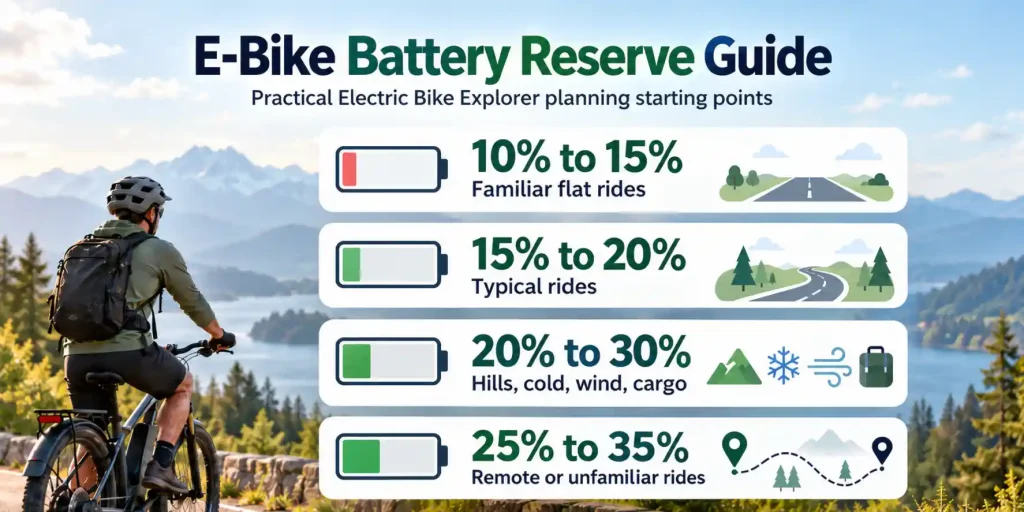
There is no universal battery-reserve percentage that works for every e-bike and every ride. As a practical starting point, I would usually plan an ordinary ride so I expect to finish with about 15% to 20% of the battery remaining.
I would leave a larger margin for cold weather, long climbs, strong headwinds, heavy cargo, unfamiliar routes, remote riding, or a battery that no longer performs as consistently as it did when new.
Important: The percentages in this guide are Electric Bike Explorer trip-planning guidelines. They are not manufacturer requirements, battery-health rules, or universal industry standards. Your bike manufacturer’s instructions and your own observed real-world range should take priority.
Before a longer ride, use the E-Bike Range Calculator to estimate your likely range under the conditions you actually expect to encounter. If you are still learning how battery capacity affects range, the E-Bike Battery Guide explains watt-hours, amp-hours, charging, and real-world battery performance.
Quick Answer: How Much E-Bike Battery Reserve Should You Keep?
For many normal rides, 15% to 20% is a reasonable EBE planning starting point.
The more uncertainty there is in the ride, the more reserve I would leave.
| Riding situation | Practical EBE planning starting point |
|---|---|
| Familiar, relatively flat route in mild weather | 10% to 15% |
| Typical commuting or recreational riding | 15% to 20% |
| Hills, cold weather, strong wind, or substantial cargo | 20% to 30% |
| Remote, unfamiliar, or difficult route | 25% to 35% or more |
| Older or inconsistent battery | Use a larger margin and investigate the battery before depending on its full indicated range |
These numbers are planning suggestions, not specifications.
Your goal is not to finish every ride at exactly 20%. The goal is to avoid making your trip depend on the final few percent of a battery whose actual range can change with conditions.
Why an E-Bike Battery Reserve Matters
An e-bike range estimate is not a guarantee.
You might leave home expecting a 30-mile ride and encounter stronger wind on the way back, a detour, more climbing than expected, colder temperatures, additional cargo, low tire pressure, or more stop-and-go riding than usual.
You may also use more assistance than expected because you are tired or running late.
Battery condition matters too. An aging battery may still work normally but hold less usable energy than it did when new.
That is why I prefer to think of the last part of the battery as a buffer for uncertainty, rather than miles I have already committed to using.
Plan the Return Trip Separately
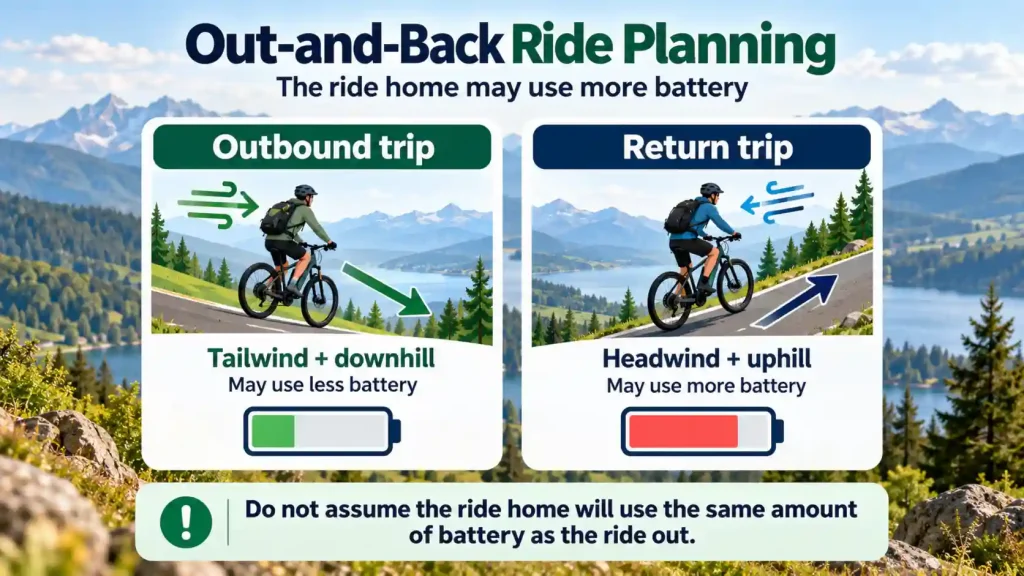
One of the easiest range-planning mistakes is assuming the trip home will require exactly the same amount of battery as the trip out.
It may not.
Imagine riding 12 miles away from home with a slight downhill grade and a tailwind. You might arrive at your destination surprised by how little battery you used.
The return trip could be completely different. Now you are climbing gradually and riding into the wind.
Even though the distance is identical, the energy required may be substantially higher.
Before a longer out-and-back ride, consider the return leg separately:
- Is the return mostly uphill or downhill?
- Will the wind direction make the trip home harder?
- Will temperatures drop later in the day?
- Are there sections where you are likely to use more assist?
- Do you have a safe alternate route if your remaining range becomes questionable?
For rides close to the limit of your battery, I would rather turn around a little early than discover several miles from home that the outbound trip gave me a false sense of security.
Don’t Automatically Turn Around at 50%
You may have heard the advice to ride until your battery reaches 50%, then turn around.
That can work on a predictable out-and-back route, but I would not treat 50% as an automatic rule.
If the first half was downhill with a tailwind and the return is uphill into a headwind, half of the battery may not get you halfway home.
Instead of relying only on a percentage, consider your remaining distance, terrain, wind, temperature, battery behavior, and how much assistance you expect to use.
Planning Reserve Is Not the Same as Built-In Battery Protection
There are two different ideas that can easily get confused.
Your planning reserve is the percentage you deliberately try to have left when your ride ends.
The bike’s battery management system, or BMS, monitors and protects the battery according to the way that particular system is designed. Depending on the battery, it can monitor voltage, current, temperature, and other conditions and may interrupt operation when programmed safety limits are reached.
That does not mean you should plan trips around running the display all the way to 0%.
The percentage shown on your display is an estimate of remaining usable charge. It is not a promise that the final 10% will deliver exactly one-tenth of the distance you received from the first 90%.
Riding Reserve Is Not the Same as Storage Charge
This distinction is important.
The 15% to 20% figure discussed in this article is a ride-planning reserve. It has nothing to do with the percentage at which a battery should be stored for weeks or months.
Manufacturers give their own storage instructions.
For example, Bosch currently recommends storing applicable e-bike batteries at roughly 30% to 60% charge for long storage periods, while Shimano guidance for applicable systems recommends approximately 70%.
Those recommendations are different because storage instructions are manufacturer and battery-system specific.
So do not take a statement such as “keep a 20% riding reserve” and turn it into “store my battery at 20%.”
For long-term storage, follow the instructions for your specific battery.
How to Calculate Your Range With a Battery Reserve
Once you have a realistic range estimate, you can subtract your chosen reserve to get a more conservative trip-planning distance.
A simple planning formula is:
Planned distance = estimated full-charge range × usable battery percentage
If you start at less than 100%, subtract your desired reserve from your starting percentage first.
Example: Starting With a Full Battery
Suppose the E-Bike Range Calculator estimates that your bike can travel about 40 miles under the conditions you expect.
You start at 100% and choose a 20% reserve.
That leaves 80% of the battery available for your planned ride.
40 miles × 0.80 = about 32 planned miles
I would use roughly 32 miles as my planning distance rather than assuming all 40 estimated miles are available.
Example: Starting at 80%
Suppose you start the same ride at 80% and still want to finish with approximately 20%.
You have about 60% of the full battery available for the planned portion of the ride.
40 miles × 0.60 = about 24 planned miles
Again, this is an estimate.
Battery gauges are not laboratory fuel meters, and battery use may not be perfectly linear throughout the ride.
Build Your Own Real-World Range Baseline
One of the best ways to improve your range planning is to stop relying only on the manufacturer’s advertised maximum and learn what your bike normally does for you.
Choose a familiar route and record:
- Starting battery percentage.
- Distance ridden.
- Ending battery percentage.
- Assist level used.
- Major conditions such as wind, temperature, hills, and cargo.
Repeat the ride several times under reasonably similar conditions.
For example, you may discover that a familiar 18-mile ride normally uses about 40% of your battery in mild weather but 50% or more when it is cold and windy.
That personal information can be far more useful than a product page that says “up to 60 miles.”
Do not expect every ride to produce identical results. The purpose is to establish a useful baseline, not a laboratory measurement.
What If My E-Bike Shows Bars Instead of a Percentage?
Some e-bike displays show four, five, or another number of battery bars instead of a numerical percentage.
Do not automatically assume that a five-bar display means each bar represents exactly 20% of your usable riding range.
Battery gauges estimate state of charge based on information available to the system, and the display behavior varies by bike.
You may also notice a bar disappear during a long climb and reappear after the motor load decreases.
That can happen because battery voltage temporarily falls under heavy load, a behavior commonly called voltage sag.
The safest approach is to learn how your own battery indicator behaves on familiar rides.
If the display has suddenly become erratic, loses several bars unusually quickly, or changes dramatically under modest loads, see the EBE guide explaining why an e-bike battery percentage jumps up and down and consider using the E-Bike Battery Health Checker.
What Does 20% Battery Left Really Mean?
If your display says 20%, it does not necessarily mean you have exactly 20% of your original riding distance remaining.
Heavy Motor Load
Steep climbs, hard acceleration, high assist, and frequent throttle use can demand considerably more current than easy cruising.
Cold Temperatures
Lithium-ion batteries can temporarily provide less usable performance in colder conditions.
Battery Age
As batteries age, their usable capacity may decline. A battery that once supported a long ride may no longer provide the same practical range.
Voltage Sag
Heavy motor demand can temporarily reduce battery voltage. That is why some riders see the displayed percentage or battery bars fall while climbing and recover somewhat when the load decreases.
Gauge Accuracy
The state-of-charge estimate itself may not behave like a perfectly linear fuel gauge.
This is another reason I would not plan a ride that depends on extracting a precise number of miles from the last few percent.
A 30% / 20% / 10% Ride Check
This is not a battery rule. It is an example of how a rider who chose roughly a 20% planning reserve might monitor a longer ride.
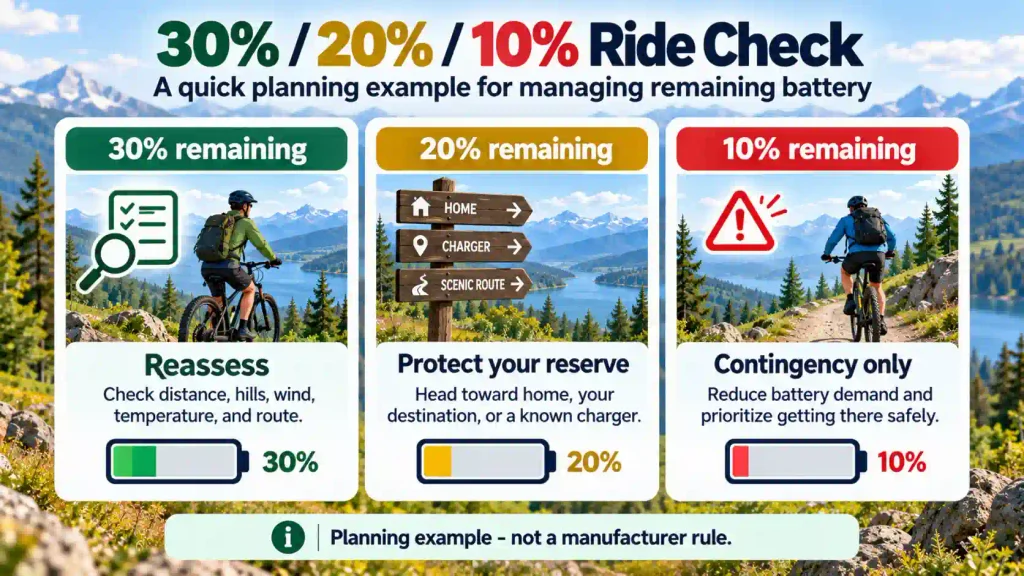
Around 30% Remaining: Reassess
Check your remaining distance, hills, wind, temperature, and route.
If conditions are worse than expected, this is a good time to adjust your plan while you still have options.
Around 20% Remaining: Protect Your Planned Reserve
If 20% was the reserve you intended to keep, reaching it means your planned riding budget has essentially been used.
Consider heading directly toward home, your destination, or a known charging location rather than continuing to add unnecessary distance.
Around 10% Remaining: Treat It as Contingency
I would not assume the final indicated 10% guarantees a specific number of miles.
Reduce unnecessary battery demand and prioritize getting safely to an appropriate destination.
Again, these percentages are an example of trip management, not instructions from the battery manufacturer.
When I Would Increase the Reserve
A 15% to 20% planning reserve may be adequate for a familiar ride in mild conditions. I would increase the margin when there is more uncertainty.
Long or Steep Hills
Climbing can significantly increase motor energy use, particularly with heavier loads or high assistance.
Strong Headwinds
Wind can make a return trip much more energy intensive than the trip in the opposite direction.
Cold Weather
Cold conditions can temporarily reduce battery performance. If I were planning a winter ride close to the bike’s normal range limit, I would use actual cold-weather experience rather than assuming my summer range still applies.
Heavy Cargo, a Passenger, or a Trailer
Additional weight increases the work required during acceleration and climbing.
High Assist or Frequent Throttle Use
More motor assistance generally consumes battery energy faster than lower assistance combined with greater rider effort.
Unfamiliar Routes
A route that looks straightforward on a map can contain unexpected climbing, rough surfaces, detours, or sections that cause you to use considerably more assistance.
Remote Riding
Running low on battery several blocks from home is inconvenient. Running low miles from help on a rural road or trail can be a much bigger problem.
An Older or Inconsistent Battery
If your battery has begun delivering substantially less range or showing unpredictable percentage behavior, increasing your reserve is not the whole solution. Investigate why the battery’s behavior changed.
How to Stretch Your Remaining E-Bike Range
If you notice during a ride that you are using more battery than expected, there are several low-risk ways to reduce demand.
Lower the assist level when terrain and traffic conditions allow. Ride smoothly instead of repeatedly accelerating hard.
If your bike has gears, use appropriate gearing so you and the motor are not struggling unnecessarily.
Keep your tires within the tire manufacturer’s appropriate pressure range for your load, terrain, and riding needs. Underinflated tires can increase rolling resistance.
Remove unnecessary cargo when practical.
If you have a safe route choice, a somewhat longer but flatter route may sometimes require less battery than a shorter route with difficult climbing.
Contributing more pedal effort when you comfortably can can also reduce motor demand.
What If You Keep Finishing Rides Almost Empty?
If your normal commute or recreational ride repeatedly leaves you at 5% or 10%, the problem may not be your riding technique.
Your battery may simply be too small for the route and conditions you regularly ride.
The E-Bike Battery Size Calculator estimates battery capacity based on factors including trip distance, terrain, assist level, rider and cargo weight, temperature, and riding conditions.
That can help answer a different question: Instead of asking how close to empty you can safely plan every ride, would a larger battery make your normal riding more reliable?
For someone shopping for another bike or replacement battery, that may be the more useful long-term question.
If Your E-Bike Range Suddenly Dropped
A planning reserve is useful when your battery and bike are behaving normally.
It is not a substitute for troubleshooting a sudden change.
If the same bike, rider, route, weather, and riding style used to consume much less battery, look for a cause rather than simply accepting the lost range.
Check things such as tire pressure, brake drag, colder weather, unusually strong wind, additional cargo, changed assist settings, charger behavior, battery contacts, and battery condition.
EBE’s E-Bike Not Holding Charge? guide is the better starting point if you are seeing fast drain, substantially declining range, sudden battery-bar drops, or a battery that no longer performs like it used to.
If the bike actually shuts off while you are riding, use the separate guide to fixing an e-bike that shuts off while riding, because an electrical cutout is not necessarily the same thing as simply reaching the end of the battery’s normal range.
Safety First
Stop using or charging the e-bike if you notice smoke, unusual heat, swelling, leaking, sparks, damaged wiring, a strong chemical odor, or serious impact or water damage.
Do not open a lithium-ion battery pack to investigate a range problem.
Use only the charger supplied with the bike or battery, or another charger specifically approved by the manufacturer for that battery system.
A plug that physically fits does not prove that a charger is electrically compatible.
Be present while the battery is charging. Do not charge an e-bike battery while you are sleeping or away from home, and unplug it when charging is complete.
If a battery has become very cold, follow the manufacturer’s charging-temperature instructions before connecting the charger. Charging-temperature limits differ among battery systems, so I would not rely on one universal temperature rule.
What Not to Do When You Are Worried About Range
Do not deliberately run your battery to 0% on every ride just because you paid for the entire capacity.
Modern lithium-ion e-bike batteries generally do not need routine complete discharge cycles simply to prevent a so-called memory effect.
Do not repeatedly deep-discharge the battery in an attempt to “train” it unless the manufacturer of your particular system specifically instructs you to perform a diagnostic or calibration procedure.
Do not open the battery case, bypass the BMS, rebuild the pack, or attempt internal electrical repairs unless the work is being handled by an appropriately qualified professional.
Do not substitute an unapproved universal charger simply because the connector fits.
Do not assume one unusually successful long-distance ride proves that the bike will always provide that range.
And do not ignore a sudden decline in normal range.
What If You’re Already Running Low?
If you realize during a ride that your battery may not be enough to get home, make changes early.
Lower the assist level where it is practical and safe, ride smoothly, and choose a safe route that reduces unnecessary climbing when possible.
If you are on an out-and-back ride, consider turning around before the situation becomes urgent.
If the battery completely runs out of usable charge, many e-bikes can still be pedaled, but weight, gearing, terrain, tire size, cargo, and drivetrain or motor resistance can make the bike much harder to ride than a conventional bicycle.
Read What Happens If Your E-Bike Battery Dies Mid-Ride? for more guidance, and use the E-Bike Ride Home Estimator to think through how difficult the trip home may be without motor assistance.
For camping, RV travel, and certain longer trips, a properly sized portable power station may provide another charging option. EBE’s guide to charging an e-bike with a portable power station explains capacity, inverter output, and why you should still use the charger supplied or specifically approved for the e-bike rather than trying to bypass it.
A portable power station should be part of a planned charging strategy, not an excuse to use an incompatible charger or improvised battery connection.
A Simple Battery-Reserve Routine Before a Longer Ride
Before leaving, I would check the starting battery percentage and estimate realistic range for the weather, terrain, load, and assistance level I expect to use.
Then I would choose a reserve based on how predictable the ride is.
Compare your planned distance with the amount of range available after that reserve, and reassess during the ride instead of waiting until the battery is almost empty.
For example, if my realistic range estimate is 45 miles, I would not plan a 44-mile unfamiliar trip simply because the math technically fits.
I would build in room for the unexpected.
🔎 Why You Can Trust This Guide
This guide is based on manufacturer instructions, established safety guidance, technical references, and common rider experiences. Stop using or charging the bike if you notice smoke, swelling, unusual heat, damaged wiring, sparks, or a strong chemical odor. You can read more about how Electric Bike Explorer researches, evaluates, and verifies information in my research and review methodology.
The battery-reserve percentages in this article are practical Electric Bike Explorer trip-planning suggestions, not universal manufacturer specifications. Actual range and low-battery behavior vary by bike, battery, rider, terrain, weather, and riding style.
Frequently Asked Questions
Is 20% a good e-bike battery reserve?
For an ordinary, familiar ride, I think 20% is a useful planning starting point. It is not a universal requirement. I would increase the reserve for cold weather, difficult terrain, strong wind, heavy loads, unfamiliar routes, remote riding, or an older battery.
Can I ride my e-bike below 20%?
Generally, a display falling below 20% does not by itself mean something is wrong. The reason I suggest keeping a reserve is trip planning, not because 20% is a universal battery cutoff. Follow the guidance for your particular bike and battery.
Does one battery bar equal 20%?
Not necessarily. If your display has five bars, you should not assume each bar represents exactly 20% of usable riding distance. Learn how the gauge on your particular bike behaves during familiar rides.
Why does my e-bike battery drop faster near the end?
Battery-display behavior can be affected by motor load, voltage sag, temperature, battery condition, and the way the system estimates state of charge. If the behavior has changed substantially or become erratic, troubleshoot the battery rather than assuming it is normal.
Should I fully discharge my e-bike battery to recalibrate it?
I would not routinely drain a lithium-ion e-bike battery completely for calibration unless the manufacturer of that specific system instructs you to do so. Follow the battery manufacturer’s diagnostic and charging instructions.
Is a 20% riding reserve the same as storing the battery at 20%?
No. A riding reserve is a trip-planning concept. Long-term battery storage recommendations are manufacturer specific. Follow the instructions for your battery rather than using the riding percentages in this guide.
Does keeping a battery reserve make the battery last longer?
The reserve discussed here is primarily a ride-planning buffer, not a battery-longevity program. Battery lifespan depends on the specific battery system, temperature, charging and storage conditions, usage, age, and other factors. Follow your manufacturer’s battery-care guidance.
How much extra reserve should I leave in winter?
There is no percentage that applies to every battery and temperature. Because cold can reduce practical battery performance, I would leave more margin than I use in mild weather and base my plans on my actual cold-weather range rather than summer range.
How much reserve should I keep for a hilly ride?
I would usually increase my margin when a route contains substantial climbing, particularly when the hardest climbs are on the return trip. Your own previous rides and the E-Bike Range Calculator are better starting points than one universal percentage.
How can I tell whether I need a larger e-bike battery?
If your ordinary rides repeatedly consume nearly the entire battery even when the battery is healthy and the bike is operating normally, your battery capacity may simply be marginal for your needs. Use the E-Bike Battery Size Calculator to compare your regular distance, terrain, assistance level, load, weather, and charging opportunities with a more appropriate battery capacity.
My Take
I would rather arrive home with battery left than spend the final few miles watching the display and wondering whether the motor is going to quit.
For a normal, familiar ride, 15% to 20% is the planning margin I would start with. I would increase that buffer whenever the route, weather, load, battery condition, or consequences of getting stranded add uncertainty.
But I would not become obsessed with hitting one perfect percentage.
The better goal is to learn how your own bike uses energy, understand how the return trip may differ from the outbound trip, and plan around realistic conditions instead of the best-case range printed on a product page.
If you repeatedly finish normal rides almost empty, consider whether you need more battery capacity.
And if your bike suddenly stops delivering the range it normally does, treat that as a troubleshooting problem rather than simply giving yourself a bigger reserve.
Sources
- U.S. Consumer Product Safety Commission – Micromobility Information Center
- U.S. Consumer Product Safety Commission – Universal Charger Safety Warning
- Bosch eBike Systems – Battery and Range Guidance
- Shimano – E-Bike Battery Storage Guidance
- Electric Bike Explorer – E-Bike Range Calculator
- Electric Bike Explorer – E-Bike Battery Size Calculator
- Electric Bike Explorer – E-Bike Battery Health Checker
- Electric Bike Explorer – E-Bike Not Holding Charge?
- Electric Bike Explorer – Why E-Bike Battery Percentage Jumps Up and Down
- Electric Bike Explorer – What Happens If Your E-Bike Battery Dies Mid-Ride?
- Electric Bike Explorer – E-Bike Ride Home Estimator
- Electric Bike Explorer – Can You Charge an E-Bike With a Portable Power Station?

Kristina is not just an enthusiast but a true authority on electric bikes. Nestled in the coastal beauty of Virginia, Kristina has found the perfect backdrop for her passion for electric biking. As a dedicated wife and homeschooling mom, her life revolves around family, faith, and the thrill of adventure.
Originally hailing from Ohio, Kristina's journey with electric bikes began as a curiosity and quickly evolved into a deep expertise. Her blog is a testament to her love for electric biking, combining her fascination for eco-friendly transportation with her coastal lifestyle.
When she's not cruising the beach on her electric bike, you'll find Kristina indulging in her other loves: long walks along the shore, getting lost in a good book, and cherishing moments with her loved ones. With a heart as big as her love for animals, especially cats, Kristina brings a unique perspective to the electric bike world, grounded in her strong faith in God and her dedication to a sustainable lifestyle.
Through her blog, Kristina shares her extensive knowledge of electric bikes, offering valuable insights, tips, and recommendations to fellow enthusiasts. Whether you're a seasoned rider or a newcomer to the electric bike scene, Kristina's blog is your go-to source for all things electric biking, fueled by her passion, expertise, and the scenic beauty of coastal Virginia.