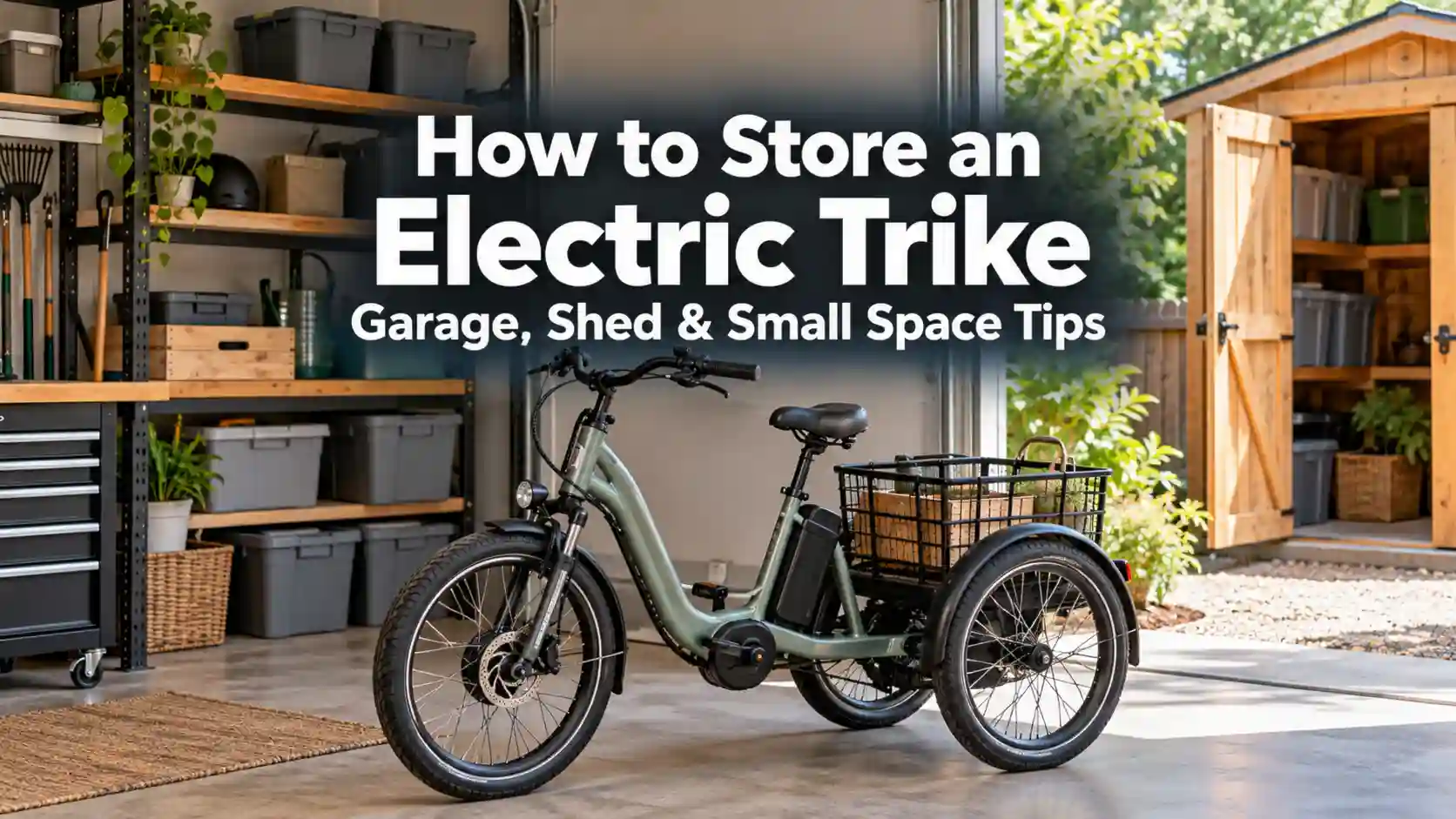
How to Store an Electric Trike: Garage, Shed & Small Space Tips
Last Updated on October 28, 2026 by Kristina

Finding a place to store an electric trike can be surprisingly challenging. Three wheels provide stability while parked, but the wider rear axle, cargo baskets, and overall weight can make a trike difficult to fit through doorways or into a crowded garage.
So, what’s the best way to store an electric trike?
For most owners, a dry, well-ventilated garage, shed, or indoor storage area with enough floor space is the best option. If space is limited, a folding electric trike may help, but you need to check its actual folded dimensions before assuming it will fit.
There are also important differences between parking a trike overnight and storing it for several months. Battery care, tire maintenance, moisture protection, and even parking-brake instructions can vary.
In this guide, I’ll explain how to measure your available space, choose a suitable storage location, position a heavy electric trike safely, and prepare it for everyday or long-term storage.
If you’re still shopping, my best electric tricycles buying guide can help you compare models. I’d also consider where you’ll keep your trike before deciding which one to purchase.
Quick Answer: Best Ways to Store an Electric Trike
Here are the most practical storage options.
| Storage location | Advantages | Things to consider |
|---|---|---|
| Garage | Weather protection, convenient access, room for security hardware | Available floor space, vehicles, and temperature changes |
| Weather-tight shed | Dedicated storage without taking up garage space | Door width, ventilation, moisture, and security |
| Apartment or indoor storage room | Protection from weather | Building restrictions, hallways, elevators, and fire exits |
| Basement | Indoor protection when conditions are suitable | Stairs, ramps, moisture, and safe access |
| Covered outdoor area | May be the only practical option for some owners | Weather exposure, condensation, theft, and battery storage |
I’d prioritize a level, dry location where the trike can remain on its wheels without blocking an entrance or requiring difficult lifting.
A covered outdoor space is a fallback, not an equivalent substitute for proper indoor storage.
Everyday Electric Trike Storage vs. Long-Term Storage
One important distinction is how long the trike will remain unused.
Parking your trike overnight isn’t necessarily the same as preparing it for several months of winter storage.
Here’s what I’d consider.
| What to check | Everyday storage | Long-term storage |
|---|---|---|
| Battery | Follow normal charging and storage instructions | Follow manufacturer guidance for storage charge, temperature, and periodic checks |
| Tires | Check pressure regularly | Maintain approved pressure and inspect periodically for air loss or deformation |
| Parking brake | Apply according to normal parking instructions | Follow any separate manufacturer instructions for extended storage |
| Security | Use suitable locks and secure the storage area | Continue appropriate theft protection throughout storage |
| Moisture | Keep the trike dry | Inspect periodically for condensation and corrosion |
| Before riding | Perform normal pre-ride checks | Inspect the battery, brakes, tires, steering, and other safety components more thoroughly |
Why parking-brake instructions matter
For everyday parking, many trike manufacturers instruct owners to engage the parking brake.
However, some models have different requirements for long-term storage.
For example, the Trike Bike CHILL user manual instructs owners to release its mechanical parking brake during extended storage to reduce the risk of damage to components.
That instruction applies to the particular parking-brake system documented in that manual.
Don’t automatically leave every electric trike’s parking brake engaged for months, and don’t automatically release it either.
Follow the instructions for your model.
If the manufacturer calls for releasing the brake, first make sure the trike is on suitable level ground and securely prevented from rolling using an appropriate method.
If you’re uncertain how to do that safely, ask the manufacturer or a qualified bike shop.
1. Measure Your Electric Trike Before Choosing a Storage Space
This is where I’d start.
An electric trike’s rear wheels and cargo baskets often determine whether it will fit into a particular space.
A trike may look compact in a product photograph but still be too wide for a doorway or awkward to maneuver around a corner.
Before buying a trike or rearranging your storage area, check three measurements:
- Length: The distance from the frontmost to the rearmost point.
- Width: The widest part, which may include the rear wheels, handlebars, or accessories.
- Height: The tallest point in the actual storage configuration.
Measure the complete trike, not just its frame.
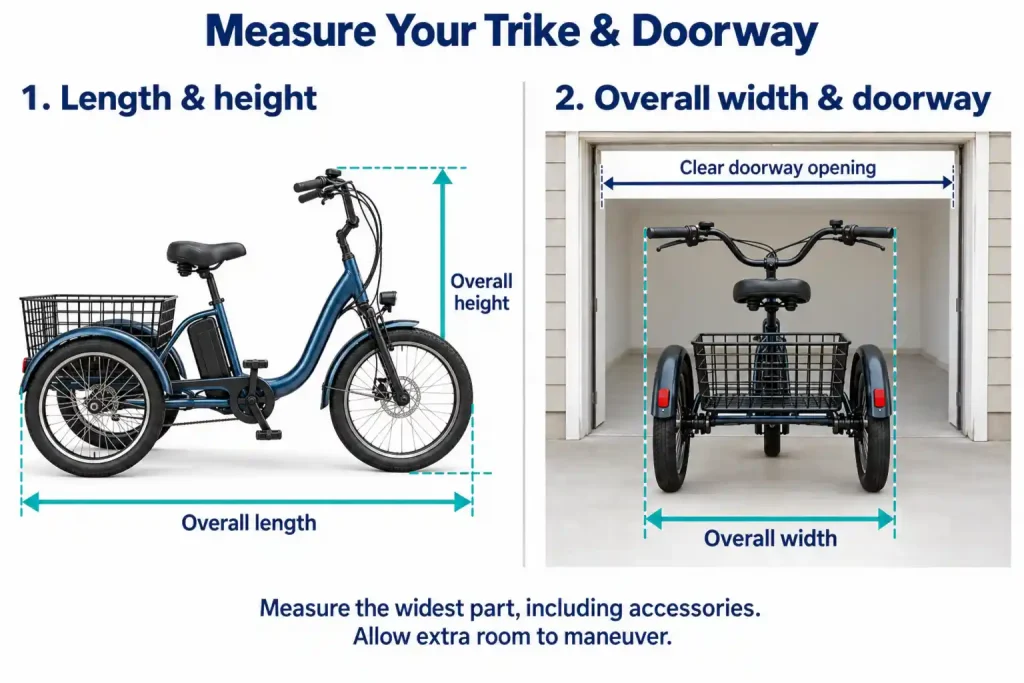
Baskets, mirrors, backrests, and other accessories may extend beyond the manufacturer’s basic dimensions.
Measure your doorway’s clear opening
Don’t rely on the nominal size of the door.
A door advertised as 30 inches wide doesn’t necessarily provide 30 inches of unobstructed space when open.
Measure between the actual obstructions with the door in the position you’ll use.
Account for:
- Door hinges and how far the door opens.
- Handles, locks, and protruding hardware.
- Door frames and thresholds.
- Gates and fences along the route.
- Narrow hallways and tight corners.
- Ramps, steps, or uneven surfaces.
The trike needs a practical margin for maneuvering, not just a mathematically exact fit.
A trike that’s almost precisely as wide as the opening may be difficult to move through without scraping the frame or wheels.
Don’t forget the route to the storage space
Imagine that your trike fits through the garage door, but you then need to make a sharp turn around a parked vehicle.
That turn could become the actual obstacle.
Measure the complete route from your normal parking area to the final storage location.
If possible, mark the trike’s approximate length and width on the floor with removable painter’s tape.
This gives you a better idea of the space it will occupy before committing to a particular arrangement.
2. What if Your Electric Trike Is Too Wide for the Doorway?
This is a frustrating situation, particularly when the difference is only an inch or two.
Before deciding that a storage location won’t work, there are a few things worth checking.
Check the actual clear width again
Make sure you’ve measured the narrowest point with the door fully open.
Sometimes the open door itself, hinges, or another obstruction reduces the usable clearance.
Don’t remove door hardware or modify the opening without making sure any changes are safe and permitted.
Check the manufacturer’s folding instructions
If your trike folds, compare its unfolded and folded widths.
Don’t assume the folded version is narrower.
Some models fold into a shorter but wider arrangement.
Check for removable accessories
A basket, mirror, or other removable accessory might be responsible for the clearance problem.
If the manufacturer designed it for routine removal, taking it off may create additional space.
However, don’t remove structural components or modify the frame simply to get through a doorway.
What about removing a wheel?
Some manufacturers provide a specific storage configuration involving wheel removal.
For example, Lectric lists the XP Trike2 at 38 inches wide when normally folded, but 30 inches wide in its specified folded configuration with the front wheel removed.
That doesn’t mean wheel removal is a good everyday solution for everyone.
It may require additional handling, careful reinstallation, and safety checks.
Follow the manufacturer’s instructions and consider whether the procedure is practical for your abilities and storage routine.
What if it still won’t fit?
If the trike cannot be moved safely through the opening, choose another storage location.
I wouldn’t recommend forcing a heavy trike through a narrow doorway, lifting it awkwardly, or attempting to tilt it into an unstable position.
A storage arrangement needs to work safely every time, not just once.
3. Folding Electric Trikes: Do They Really Save Space?
Folding electric trikes can be practical, but folding doesn’t always reduce every dimension.
In some designs, the trike becomes shorter and lower while its folded width stays similar or even increases.
🎬 See how a folding electric trike measures up. This sixthreezero demonstration shows the EZ Transit’s dimensions to help you visualize its storage footprint. Measurements and folding arrangements vary by model.
Here’s a comparison using published manufacturer dimensions.
Folding electric trike dimensions compared
| Model | Unfolded dimensions (L × W × H) | Folded dimensions (L × W × H) |
|---|---|---|
| Lectric XP Trike2 | 65 × 30 × 43 in | 36.5 × 38 × 26 in |
| Mooncool TK2 | 66 × 29 × approximately 43.7–45.7 in | 39.4 × 28.7 × 26.8 in |
These are manufacturer-published figures. The Mooncool’s unfolded height is its adjustable handlebar-height range. Accessories and individual configurations can affect practical clearance.
Lectric XP Trike2: Folding increases its normal width
According to Lectric, the XP Trike2 measures:
- Unfolded: 65 inches long and 30 inches wide.
- Folded: 36.5 inches long and 38 inches wide.
- Folded with the front wheel removed: 36.5 inches long and 30 inches wide.
The normal folded arrangement is substantially shorter but wider.
The takeaway: If you’re buying an XP Trike2 to fit into a particular storage space, check the dimensions of the exact configuration you intend to use.
Mooncool TK2: A different folding arrangement
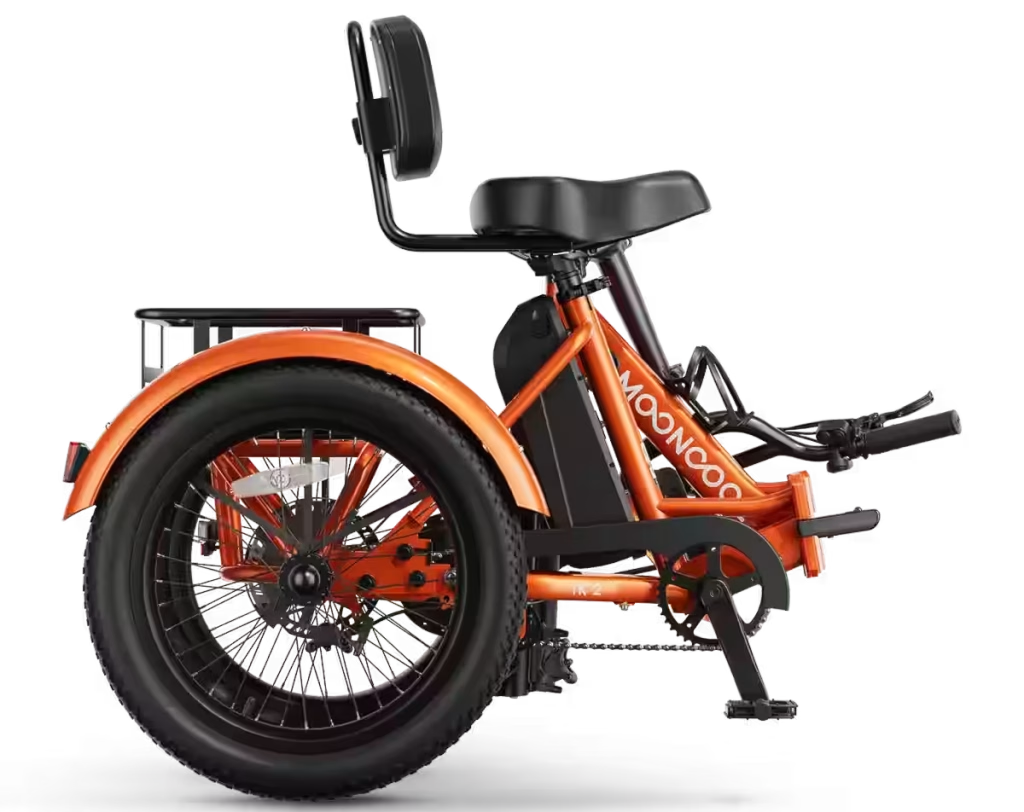
Mooncool lists the TK2 at approximately 66 inches long and 29 inches wide when unfolded.
Its published folded dimensions are:
- Length: 39.4 inches.
- Width: 28.7 inches.
- Height: 26.8 inches.
That smaller folded footprint may make it easier to accommodate in some storage areas.
However, you still need enough space to fold, move, and safely position the trike.
In my Mooncool TK2 hands-on review, I discuss its folding frame and why that feature can be useful.
Should you remove baskets or accessories?
Sometimes a removable basket or other accessory may interfere with storage.
Before removing anything, check whether the component is designed for routine removal.
Don’t loosen structural parts, modify the frame, or disconnect electrical components simply to make a trike fit.
How to fold a trike safely for storage
Follow the instructions for your exact model.
As general precautions:
- Park on level ground and switch off the electrical system.
- Secure the trike against rolling according to the manufacturer’s instructions.
- Remove cargo or accessories when required.
- Follow the prescribed folding sequence.
- Keep fingers, cables, and clothing clear of the folding joints.
- Confirm the folded trike is stable and cannot tip or roll unexpectedly.
Don’t force a folding hinge or latch.
If a folding mechanism doesn’t move as expected, stop and check the instructions.
4. How to Store an Electric Trike in a Garage
For many owners, the garage is the most convenient storage location.
It protects the trike from direct rain and sunlight while keeping it reasonably accessible for everyday use.
However, the best arrangement depends on how much room you have.
Choose a dedicated parking area
I’d look for a spot where the trike can remain on its wheels without having to move several objects every time you want to ride.
Possible locations include:
- Along a garage wall, with appropriate clearance.
- In a dedicated corner.
- Beside a vehicle, if there is sufficient space.
- In a separate bicycle or mobility-equipment area.
Avoid positioning the trike where it could be struck by a moving vehicle, interfere with a garage door, or block access.
Use a suitable floor mat
A non-slip, moisture-resistant floor mat can be a practical accessory.
It may help protect the floor from dirt and water carried in on the tires.
Choose something that lies flat and won’t create a tripping hazard.
Keep the trike away from chemicals
Don’t store your electric trike next to leaking containers, corrosive chemicals, or sources of excessive heat.
Sun Bicycles recommends keeping bicycles, adult trikes, and e-bikes in clean, dry, well-ventilated areas away from corrosive chemicals and fumes.
This matters in garages where fertilizers, pool chemicals, solvents, and other household products may be stored.
Should you lock an electric trike inside the garage?
I’d consider it, particularly if the garage is shared or accessible to others.
A suitable frame lock connected to a properly installed security anchor can provide another layer of protection.
My guide to locking an electric trike and preventing theft explains how to choose appropriate locking points and security equipment.
5. Can You Store an Electric Trike in a Shed?
Yes, provided the shed is large enough and offers suitable protection.
A shed can be useful if your garage is already full or you don’t have one.
However, not every garden shed is suitable.
Check the doorway first
Shed doorways can be surprisingly narrow.
Even when the shed has plenty of internal floor space, its opening may not accommodate the trike.
Measure the clear width and height with the door fully open.
Make sure the floor can support the trike
Electric trikes can be heavy.
Check that the shed floor, foundation, and access ramp are suitable for the trike’s actual weight and any additional loads.
Don’t assume a lightweight portable shed or temporary floor is designed for a heavy electric vehicle.
Control moisture and condensation
A shed should be weather-tight and adequately ventilated.
Watch for:
- Water leaking through the roof or walls.
- Standing water on the floor.
- Persistent condensation.
- Damp flooring or walls.
- Mold and mildew.
- Corrosion developing on tools or other stored equipment.
If the shed regularly becomes damp, it’s not an ideal location for a trike with electrical components.
A breathable dust cover may keep the trike cleaner, but it won’t correct a moisture problem.
What about a storage-shed ramp?
If the shed has a raised floor, a suitable ramp may make access easier.
Verify its weight capacity, surface grip, slope, and compatibility with the trike’s three-wheel arrangement.
All three wheels need a safe path.
Don’t use a narrow bicycle ramp that leaves one or more wheels unsupported.
6. Storage Security, Insurance, and Warranty Considerations
This is worth checking before choosing a garage, shed, or shared storage area.
A location can be convenient without necessarily meeting the conditions of your insurance policy or manufacturer’s warranty.
Does insurance cover an electric trike stored in a shed?
That depends on your particular insurance policy.
Don’t assume homeowners or renters insurance automatically covers an electric trike, especially if its motor, speed, or vehicle classification affects eligibility.
I’d ask the insurer:
- Is my exact electric trike covered?
- Does coverage apply in a detached shed?
- Is a shared garage covered?
- Does the policy require a particular type of lock?
- Must the trike be secured to an immovable anchor?
- Are the battery and accessories covered?
- Are there exclusions for outdoor or overnight storage?
Getting the answers in writing can prevent misunderstandings.
For more information, see my guide to homeowners insurance and stolen e-bikes.
Can improper storage affect your warranty?
Yes, depending on the manufacturer’s warranty terms.
For example, Sun Bicycles states that damage caused by improper storage, moisture intrusion, corrosion, flooding, and prolonged outdoor exposure generally isn’t covered under its warranty.
That doesn’t mean every manufacturer has identical exclusions.
Check your trike’s actual warranty documents rather than assuming environmental damage will be covered.
Don’t rely on a locked shed alone
A sturdy shed door provides one layer of security.
A suitable lock securing the trike’s main frame to a properly installed anchor may provide another.
The right arrangement depends on the structure and the trike.
You can find more detailed guidance in my electric trike security guide.
7. Storing an Electric Trike in an Apartment or Small Indoor Space
Indoor storage can offer good weather protection, but accessibility and available space become especially important.
A trike may fit inside an apartment yet be difficult to get through the building.
Measure the entire access route
Before choosing apartment storage, measure:
- Building entrance doors.
- Hallways.
- Elevator entrances and interior dimensions.
- Your apartment doorway.
- Turns between doors and rooms.
- The intended storage space.
Don’t assume a folding trike will fit into an elevator just because its folded length is relatively short.
Its width, height, and handling arrangement matter too.
Check building rules
Some buildings have restrictions on storing or charging e-bikes and lithium-ion batteries.
Policies may differ depending on local fire rules, the type of building, and the equipment involved.
Check applicable requirements before bringing the trike or battery inside.
Never block hallways, stairwells, exits, or emergency-access routes.
Is a closet practical?
For some folding electric trikes, a large storage closet may be an option.
But it needs enough room for the folded trike without creating a tipping hazard or damaging surrounding items.
A trike that fits only when balanced awkwardly against shelving or a wall isn’t an ideal arrangement.
What about basement storage?
A dry basement can be suitable when it’s accessible.
The challenge is often getting the trike downstairs.
I wouldn’t recommend attempting to carry a heavy electric trike down a flight of stairs without a properly assessed, safe handling method.
If safe access isn’t available, choose another location.
8. Can You Store an Electric Trike Vertically?
I would not recommend vertical storage as a general space-saving solution for electric trikes.
Some conventional two-wheel bicycles and compatible e-bikes can be stored vertically using equipment designed to support them.
Electric trikes are different.
Their wide rear axles, three-wheel configurations, heavier frames, and folding components can make conventional bicycle storage stands unsuitable.
Don’t assume a wall hook, vertical bicycle stand, or ceiling hoist can safely support your trike.
When might vertical storage be acceptable?
Only when the trike manufacturer specifically permits that orientation and the storage equipment is compatible with the exact model and weight.
A generic product description saying a stand supports e-bikes isn’t enough.
If the manufacturer doesn’t approve vertical storage, I’d keep the trike upright on its wheels.
9. How to Move and Position a Heavy Electric Trike Safely
Even if you have sufficient storage space, moving the trike into position can be challenging.
I’d try to make this part of the routine as simple as possible.
Switch off the motor before repositioning
Turn off electrical assistance before maneuvering the trike by hand, unless the manufacturer’s instructions specifically direct otherwise for an approved walking-assist function.
Avoid accidental throttle activation in confined areas.
Secure the trike once positioned
For normal parking, use the parking brake according to the manufacturer’s instructions.
For extended storage, check whether the manufacturer specifies a different procedure.
Whatever the parking-brake setting, ensure the trike is stable and cannot roll unexpectedly.
Avoid unnecessary lifting
A heavy electric trike can be awkward to lift because of its weight distribution and width.
Even a folding model may remain difficult to carry.
If you’re considering a dolly, wheeled platform, or another moving aid, confirm that it’s properly rated and suitable for the trike’s wheel arrangement.
Don’t use an unstable platform that might allow the trike to roll or tip.
For help understanding trike dimensions, loading methods, and safe handling during travel, see my guide to transporting an electric trike safely.
10. How to Store an Electric Trike Battery Safely
Battery storage deserves special attention because lithium-ion batteries have different requirements from the trike’s mechanical components.
A garage or shed may be suitable for the trike itself while being unsuitable for its battery under certain conditions.
Should you remove the battery?
If your trike’s battery is designed to be removed, taking it off for long-term storage may be appropriate.
Follow the manufacturer’s instructions.
Don’t force a stuck battery, damage its connector, or attempt to remove a battery that isn’t designed to be detachable.
What charge level should you use?
There isn’t one universally applicable storage charge level for every battery.
For example, Bosch recommends approximately 30–60% charge for long-term storage of its compatible e-bike batteries.
That figure shouldn’t be automatically applied to every electric trike.
Use the storage-charge guidance for your particular battery and manufacturer.
Avoid assuming that fully charging the battery before several months of storage is always beneficial.
Where should you keep the battery?
Follow the manufacturer’s approved storage-temperature range.
For its e-bike batteries, Bosch recommends a dry environment at approximately 0–20°C (32–68°F), with appropriate ventilation and protection from heat and flammable materials.
This is a Bosch-specific recommendation, not a universal temperature requirement.
The battery should be protected from direct sunlight, excess heat, moisture, and physical damage.
Never store a battery where it obstructs an exit.
Don’t leave the battery charging unattended
The U.S. Consumer Product Safety Commission advises owners to be present while charging micromobility batteries and never charge them while sleeping.
Use only a charger supplied or approved for the particular battery.
Follow the manufacturer’s instructions and disconnect the charger when charging is complete.
If a battery becomes unusually hot, swells, leaks, smells unusual, or shows other signs of damage, stop using or charging it and seek appropriate professional guidance.
For more detail, see my e-bike battery storage tips for winter.
11. Preparing an Electric Trike for Winter or Long-Term Storage
If you won’t be riding for several weeks or months, a little preparation can help reduce problems when it’s time to use the trike again.
Clean the trike before storing it
Remove mud, road salt, and other grime according to the manufacturer’s cleaning instructions.
Pay attention to the frame, wheels, fenders, drivetrain, and areas where dirt tends to collect.
Avoid directing high-pressure water at bearings, electrical connectors, displays, or other vulnerable parts.
Let the trike dry before storage.
Check all three tire pressures
Tires can gradually lose air while a trike sits unused.
Inflate them to the manufacturer-approved pressure and inspect them periodically.
Don’t automatically use the maximum pressure printed on the tire.
My electric trike tire-pressure guide explains how to find the correct PSI and check all three wheels.
Prevent tire deformation during extended storage
A heavy trike parked in the same position for months may place prolonged pressure on the same areas of its tires.
Some manufacturers provide specific instructions to help reduce that risk.
For example, the Trike Bike CHILL manual recommends repositioning the trike monthly when its wheels remain on the ground during long-term storage.
This is a model-specific example rather than a universal requirement.
I’d follow the tire-maintenance and storage schedule for your particular trike.
If repositioning is recommended:
- Choose suitable level ground.
- Make sure there’s enough room to move the trike safely.
- Release any brake only as required for the maneuver.
- Roll the trike a short distance so the tires rest on different sections.
- Secure it again according to the manufacturer’s long-term storage instructions.
Don’t attempt to lift a heavy trike onto improvised supports.
A stand or support system should only be used when it’s properly rated, stable, and approved for the trike.
Inspect the chain and exposed metal components
Where applicable, clean and lubricate the chain according to the manufacturer’s instructions.
Keep lubricant away from brake pads and rotors.
Check for corrosion, particularly in an unheated or humid storage area.
Check the battery periodically
Follow your battery manufacturer’s recommendations for checking the state of charge during storage.
Don’t allow the battery to remain deeply discharged for an extended period.
Don’t leave the charger permanently connected unless the manufacturer expressly instructs you to do so.
Follow long-term parking-brake instructions
Check the owner’s manual for the correct parking-brake position during extended storage.
The Trike Bike CHILL manual, for example, instructs owners to release its mechanical parking brake for long-term storage.
Other braking systems may have different requirements.
If the brake must be released, ensure the trike remains securely immobilized and cannot roll or tip.
Look for pests
Garages and sheds can attract rodents and other small animals.
Check periodically for nesting or damaged cables.
If wiring has been chewed or damaged, don’t operate the trike until it’s been inspected.
Before your first ride after storage
Check:
- Battery condition and connections.
- Tire pressure and tire damage.
- Brake operation.
- Steering and wheel condition.
- Folding hinges and locking mechanisms.
- Lights and electrical controls.
- Any obvious corrosion or loose components.
If anything appears unsafe, have it inspected before riding.
My electric trike beginner riding guide includes useful reminders about handling and pre-ride checks.
12. Can You Store an Electric Trike Outside?
Sometimes outdoor storage is unavoidable, particularly for riders without a garage or suitable indoor space.
But it isn’t my preferred option.
Sun Bicycles advises against prolonged outdoor storage, even under a tarp or cover, because these measures don’t eliminate exposure to humidity, condensation, and temperature changes.
If outdoor storage is your only option
I’d try to minimize exposure:
- Choose a sheltered, permitted location.
- Keep the trike off wet soil or grass.
- Use a properly fitting weather-resistant cover.
- Avoid trapping moisture under unsuitable plastic sheeting.
- Secure the cover against wind.
- Check regularly for condensation and corrosion.
- Follow the manufacturer’s battery-storage instructions.
- Use a suitable security lock and fixed anchor.
A cover can reduce exposure but cannot guarantee that moisture won’t reach the trike.
Should you buy an electric trike cover?
A correctly sized cover may be worth considering if your storage area is dusty or partially exposed.
Before buying, check the trike’s length, width, and height with baskets or accessories attached.
A standard two-wheel bicycle cover may be too narrow for a trike.
Look for suitable fastening, ventilation, and materials designed for the storage conditions.
Don’t use a cover in a way that interferes with safe battery ventilation or charging.
13. Electric Trike Storage Accessories Worth Considering
You don’t necessarily need an expensive storage system.
A few simple accessories may be enough.
| Accessory | When it helps | What to check |
|---|---|---|
| Large non-slip floor mat | Garage or indoor storage | Dimensions, grip, and trip hazards |
| Trike-sized protective cover | Dust protection or limited outdoor exposure | Trike fit, ventilation, and fastening |
| High-security chain or U-lock | Theft deterrence in garages or sheds | Frame fit, security rating, and anchoring |
| Properly installed security anchor | Dedicated indoor or shed storage | Structural suitability and installation |
| Compatible access ramp | Raised shed or storage threshold | Weight rating, grip, width, and three-wheel support |
| Accurate tire-pressure gauge | Long-term tire maintenance | Compatibility with the approved PSI range |
| Suitable wheel chocks or restraints | Preventing unwanted rolling when appropriate | Trike compatibility and manufacturer’s storage instructions |
My preference would be to solve the basic storage problem first.
A dry location with sufficient space is more important than purchasing several accessories that may not fit the trike.
14. My Electric Trike Storage Measurement Worksheet
Before buying an electric trike or deciding where to store it, fill in these measurements.
| Measurement | Your information |
|---|---|
| Electric trike brand and model | __________________ |
| Unfolded length | __________________ |
| Unfolded width | __________________ |
| Unfolded height | __________________ |
| Folded dimensions, if applicable | __________________ |
| Narrowest clear doorway width | __________________ |
| Narrowest hallway or access point | __________________ |
| Available floor-space length | __________________ |
| Available floor-space width | __________________ |
| Access ramp or threshold details | __________________ |
| Approved battery storage location | __________________ |
| Long-term parking-brake instructions | __________________ |
| Security anchor available? | __________________ |
How to use the worksheet
First, compare the trike’s unfolded dimensions with the clear width and height of every opening along the storage route.
If you plan to fold the trike, repeat the comparison using its actual folded dimensions.
Then check whether there’s room to maneuver around corners and position it without blocking access.
Allow practical clearance rather than aiming for an exact edge-to-edge fit.
If any measurement is uncertain, confirm it before purchasing.
This simple check can prevent the frustration of discovering that a trike fits inside the garage but can’t easily get through the doorway.
15. Common Electric Trike Storage Mistakes
Assuming every folding trike becomes narrower: Some folding arrangements increase the width.
Measuring the room but not the doorway: The access route may be the real limitation.
Ignoring baskets and accessories: These can affect the overall footprint.
Trying to lift a heavy trike unnecessarily: Use an appropriate ground-level arrangement whenever possible.
Using an ordinary wall-mounted bike hook: Trike weight and geometry may make it unsuitable.
Leaving the trike in a damp shed: Persistent moisture can damage mechanical and electrical components.
Relying entirely on an outdoor cover: Covers cannot eliminate humidity and condensation.
Ignoring battery temperature requirements: The trike’s storage location may not be suitable for its battery.
Leaving the battery charging unattended: Follow CPSC and manufacturer charging precautions.
Neglecting the tires during long-term storage: Tires can lose air and may require periodic repositioning when the manufacturer recommends it.
Using the same parking-brake procedure for every storage situation: Some models have different instructions for everyday and long-term storage.
Assuming insurance covers every storage location: Verify your particular policy.
Blocking entrances or emergency routes: A storage arrangement must not interfere with safe access.
Electric Trike Storage Checklist
Before leaving your trike in storage:
- ☐ The trike fits through every required doorway.
- ☐ There is enough floor space to park it securely.
- ☐ The trike is stable and prevented from rolling.
- ☐ Motor assistance is switched off.
- ☐ The parking brake is set according to the manufacturer’s instructions for the intended storage duration.
- ☐ Any folding mechanisms are positioned according to the manual.
- ☐ The storage area is clean, dry, and appropriately ventilated.
- ☐ The battery is stored according to its manufacturer’s instructions.
- ☐ The charger is disconnected when charging is complete.
- ☐ All three tires are properly inflated.
- ☐ The trike is protected against unauthorized removal.
- ☐ Any relevant insurance or building requirements have been checked.
- ☐ Doors, walkways, and emergency exits remain clear.
For extended storage, arrange periodic checks of the battery, tires, and general condition according to the manufacturer’s maintenance schedule.
Frequently Asked Questions
Can I store an electric trike in a regular garage?
Usually, provided there’s enough room, a suitable access route, and appropriate environmental conditions. Measure the trike and available space before deciding where it will go.
Will an electric trike fit through a standard doorway?
It depends on the doorway and trike. Measure the clear opening rather than relying on the nominal door width. Some electric trikes are approximately 30 inches wide or wider.
Are folding electric trikes easier to store?
They can be, but folding doesn’t always reduce every dimension. For example, the Lectric XP Trike2 becomes shorter but wider in its normal folded configuration.
What if my electric trike is too wide for the shed door?
Check the clear opening, manufacturer-approved folding configuration, and any accessories designed for removal. Don’t force the trike through the doorway or make unsafe modifications.
Can I store an electric trike in a shed during winter?
A weather-tight, well-ventilated shed may be suitable for the trike itself, but battery-storage requirements may be different. Follow the manufacturer’s temperature and moisture guidance.
Should I remove the battery before storing my trike?
For long-term storage, removing a battery designed for routine removal may be appropriate. Follow the instructions for your particular model.
Should I leave the parking brake on during long-term storage?
Follow your trike manufacturer’s instructions. Some models, including the Trike Bike CHILL, have specific recommendations to release the mechanical parking brake for extended storage. The trike must still be secured against movement.
Can electric trike tires develop flat spots during storage?
Prolonged loading in one position can contribute to tire deformation. Some manufacturers recommend periodic repositioning. Follow your trike’s instructions and avoid unsafe lifting methods.
Is it safe to store an electric trike vertically?
Don’t assume so. Use vertical storage only when the trike manufacturer permits it and the storage equipment is suitable for the exact model.
Can I store my electric trike outside under a cover?
A suitable cover may reduce exposure when outdoor storage is unavoidable, but it doesn’t provide the same protection as a dry indoor location.
Does homeowners insurance cover an electric trike stored in a shed?
Coverage varies. Check whether the policy covers your specific electric trike and whether detached or shared storage locations have additional requirements.
Do I need to keep the tires inflated during winter storage?
Yes, maintain the manufacturer’s approved pressure and check periodically. Follow any model-specific repositioning or storage instructions.
How much space should I leave around a stored electric trike?
Enough to maneuver it safely, access necessary components, and keep walkways clear. There’s no universal clearance measurement suitable for every model.
Should I lock my electric trike inside a garage?
Additional security is worth considering, particularly in shared garages or locations others can access. A suitable frame lock and properly installed anchor can provide additional protection.
Why You Can Trust Electric Bike Explorer
Electric Bike Explorer provides independent, practical information to help people choose, ride, and maintain electric bikes and trikes.
This guide is based on published manufacturer dimensions, storage recommendations, battery-safety instructions, and established micromobility safety guidance.
I’ve distinguished specific manufacturer requirements from general storage advice. I haven’t personally tested every trike and storage arrangement discussed here, so owners should confirm compatibility and follow the instructions for their equipment.
You can also learn more about how Electric Bike Explorer researches and evaluates e-bikes.
My Take
I think storage is one of those things people should figure out before buying an electric trike, not afterward.
It’s easy to concentrate on range, motor power, comfort, and cargo capacity while overlooking whether you’ll have a practical place to keep the trike.
What stands out to me is how misleading the word folding can sometimes be.
A folding trike may become much shorter without becoming narrower. Depending on your doorway and storage layout, that distinction could make a big difference.
I’d concentrate on three things first: making sure the trike fits, finding a dry and accessible storage location, and following the correct battery-storage precautions.
I also think it’s worth checking the manufacturer’s long-term storage instructions rather than assuming everything should remain set up exactly as it is during normal parking.
You don’t necessarily need special equipment or an elaborate garage setup.
A simple, safe arrangement that lets you get the trike out and ride without struggling every time is often the better choice.
And if you’re still shopping, I’d put storage dimensions on your comparison checklist alongside the usual specifications.
Disclosure: As an Amazon Associate, I earn from qualifying purchases. This comes at no extra cost to you and helps support the content on this site.
Explore More Electric Trike Guides
Whether you’re shopping for your first electric trike or already own one, these guides can help you choose, ride, maintain, and protect your trike.
Ownership & Maintenance
- How to Ride an Electric Trike for Beginners – Learn to turn, brake, and ride comfortably on three wheels.
- How to Transport an Electric Trike Safely – Car racks, trailers, ramps, and loading tips.
- How to Lock an Electric Trike and Prevent Theft – Practical security advice for protecting your trike.
- Electric Trike Tire Pressure Guide – Find the correct PSI and check all three tires.
Electric Trike Buying Guides
- Best Electric Tricycles – Compare electric trikes for comfort, stability, and everyday riding.
- Best Electric Trikes for Heavy Riders – Explore high-capacity trikes with attention to weight limits, comfort, and practicality.
Sources and Further Reading
- Lectric eBikes – XP Trike2 Dimensions and Specifications
- Mooncool – TK2 Geometry and Folded Dimensions
- Sun Bicycles – Proper Storage for Bicycles, Trikes, and E-Bikes
- Bosch eBike Systems – Battery Safety and Storage
- U.S. Consumer Product Safety Commission – Micromobility Safety
- Trike Bike CHILL User Manual – Long-Term Storage Instructions (manual reproduced by ManualsLib)

Kristina is not just an enthusiast but a true authority on electric bikes. Nestled in the coastal beauty of Virginia, Kristina has found the perfect backdrop for her passion for electric biking. As a dedicated wife and homeschooling mom, her life revolves around family, faith, and the thrill of adventure.
Originally hailing from Ohio, Kristina's journey with electric bikes began as a curiosity and quickly evolved into a deep expertise. Her blog is a testament to her love for electric biking, combining her fascination for eco-friendly transportation with her coastal lifestyle.
When she's not cruising the beach on her electric bike, you'll find Kristina indulging in her other loves: long walks along the shore, getting lost in a good book, and cherishing moments with her loved ones. With a heart as big as her love for animals, especially cats, Kristina brings a unique perspective to the electric bike world, grounded in her strong faith in God and her dedication to a sustainable lifestyle.
Through her blog, Kristina shares her extensive knowledge of electric bikes, offering valuable insights, tips, and recommendations to fellow enthusiasts. Whether you're a seasoned rider or a newcomer to the electric bike scene, Kristina's blog is your go-to source for all things electric biking, fueled by her passion, expertise, and the scenic beauty of coastal Virginia.